Sanjha Morcha

What’s New

Click the heading to open detailed news

Current Events :

web counter

Print Media Reproduced Defence Related News

Six months of Pulwama terror attack: Two households are united in grief, seek relief

Six months of Pulwama terror attack: Two households are united in grief, seek relief

CRPF head constable Vijay Soreng with second wife and children.

Karmela Devi, 40, sounded sad and anguished on Friday while talking about her late husband, CRPF head constable Vijay Soreng.

The 45-year-old was killed when a suicide bomber rammed his SUV into a CRPF convoy in Jammu and Kashmir’s Pulwama on February 14, 2019.

“We haven’t any received any compensation till now,” Karmela said. Revealing that the family was struck by a double whammy, she said, “Hum badi wali [wife] hain, ek chhoti wali [wife] bhi hai, unhonay bhi compensation manga hai.”

The national tragedy, Pulwama terror attack, had received strong reactions nationwide. Karmela got married in 1990 and has a 24-year-old son. Her husband left her after her son was born. She joined Jharkhand police and is a havaldar in its Mahila Wing, a desperate move to earn a livelihood as her husband stopped supporting her and their son.

Though separated, Soreng never legally divorced her. His second wife Vimla Devi choked when she was asked to give details of her marriage to the soldier. She got married to Soreng in 2011 with their families’ consent, knowing that he had left his first wife. She gave birth to four children – three girls and one boy. She said, “My husband left his first wife long ago. He was living with us.”

She also has pictures to support that they had a happy family until the tragedy struck them.

“He loved to spend time with us, he did not get along well with his estranged wife Karmela. My eldest daughter is 13-year-old, and the youngest one is seven. He would send us Rs 12000 for education and household expenditure every month.”

After the February terror attack, the only source of income in the family stopped. The once prosperous family has been getting financial help in “bits and pieces” as they chip in to help the family. Both the wives now claim to be the rightful claimant of the benefits and compensation after the soldier died in the line of duty.

Head constable Vijay Soreng, a soldier of 82 Battalion, who was deployed in Srinagar, died when he was returning from leave to join his team in Kashmir. Suicide bomber Adil Dar struck the convoy in Pulwama, blowing to smithereens, the soldier’s body.

That is the last time the family heard from him. CRPF sources said that they found out the matter only after they handed over the body to his wives and aged parents.

Both the women have now staked a claim for remuneration and benefits, putting the CRPF in a fix.

Soreng joined the force in 1993 and as per documentation, he ought to reveal correctly the status of his marriage. But understanding the sensitivity of the matter, the CRPF is awaiting a decision by the local court to settle the matter for the “right precedent”.


Demonising Soldiers Over Disability Tax Lowers Morale of Entire Army By Lt Gen Hooda

Those unfairly exploiting the system should be given exemplary punishments, but demonising of soldiers and threatening withdrawal of facilities is not good for the morale of the army.

Lt Gen (Retd) DS Hooda |

Updated:July 4, 2019, 9:01 PM IST

On June 24 ,the Central Board of Direct Taxes (CBDT) issued a circular withdrawing the benefit of income tax exemption on the disability pension to military veterans who had retired after serving their full term.
The veteran community rose up in protest against one more instance of bureaucratic apathy towards the armed forces and the typical insensitivity in dealing with disability cases. Facing criticism, the defence minister promised in Parliament that he would look into the matter.
The dust kicked up by the finance ministry circular would probably have died down in a few days after the usual Twitter war and television debates. The outcome would either have been a retraction of the order, as has happened in a few cases in the past, or a weary acceptance by the disabled veterans to start paying the income tax.
However, the events that followed a few days later reignited the debate. These events are, in my opinion, much more worrying when viewed within the broader context of our civil-military relations. On July 2, the Finance Minister tweeted an undated and unsigned letter calling it the “response of the armed forces on the issue of taxability of disability pension”. It is evident that this response came after the CBDT circular had already been issued because it quoted the case of Major General Ian Cardozo who had appeared on some television channels and criticised the government’s move.
Even considering that the finance minister’s decision was based on prior recommendations of the army, the alacrity with which the decision was taken is remarkable. Contrast this with the anomalies of the 7th Pay Commission remaining unresolved, the Justice Reddy report on One Rank, One Pension seemingly buried, and the recommendations of the military on Non-Functional Upgrade not being accepted. The last case is being fiercely contested by the government in the Supreme Court.
There is also a more significant issue of the political leadership placing the military in front while taking policy decisions. Having taken a consistent stance in the past that no one should question the military, there is now an attempt by the government to put the onus for this poor decision on the army. However, in a democracy, policy-making should remain firmly in the hands of the civilian government and hiding behind the military has many adverse implications on the future of our civil-military relations.
It is also worrying that the army has willingly lent its shoulder to a decision that goes against its own soldiers. The language in the letter tweeted by the finance minister was in extremely poor taste, but the speed and manner in which the official Twitter handle of the Indian Army reacted was even more shocking.
In retweeting the letter, it sought to justify the decision based on the exploitation of disability benefits by “unscrupulous personnel” and a rise in “personnel seeking disability, even for lifestyle diseases”.
There are many logical and legal infirmities with the justifications given in the letter, but my intention is not to go into these. What is of greater concern is a growing trend in the army to make public comments that paint its own officers and men in poor light. We regularly read about the misuse of hotel stay, canteen facilities, ex-servicemen health benefits, and now disability pension. If there are infirmities in our procedures, they must be ruthlessly plugged and those unfairly exploiting the system should be given exemplary punishments. However, this demonising of the officers and soldiers and threatening withdrawal of facilities is not good for the morale of the army.
There is an accepted ‘Military Covenant’ between the nation and its soldiers. Some countries like the United Kingdom have formally introduced this term in public life, while others look upon it as an unspoken pact, but the meaning of the covenant is clear. Soldiers put the nation above themselves and willingly sacrifice their limbs and lives in the line of duty.
In return, the state has the moral obligation to value, respect, and support the soldiers and their families with commensurate conditions of service. This is a mutual obligation that forms the basis of the relationship between a country and the members of the armed forces, and any weakening of this bond due to suspicion and mistrust does not bode well.
Many respected veterans have expressed the confidence that the decision on taxing the disability pension will be reversed with the intervention of the defence minister. Mr. Rajnath Singh is an ardent supporter of the soldier, and his first visit after taking charge was to the Siachen Glacier. Among those waiting anxiously for his decision will be the soldier who lost his foot to a mine blast while returning after successfully carrying out the ‘surgical strike’ of September 2016.
(The author is former Northern Commander, Indian Army, under whose leadership India carried out surgical strikes against Pakistan in 2016. Views are personal.)

Wages, pensions eat into defence spending

Wages, pensions eat into defence spending

Ajay Banerjee
Tribune News Service
New Delhi, July 5

Weighed down by salaries and pensions, the defence budget announced today remains the same as the one announced on February 1. The allocation is 7.93 per cent of the Budget estimates of the last fiscal.

The budget for this fiscal will be Rs 3,18,931.22 cr ($44.74 billion), the same amount set aside in the interim budget in February, and a sum of Rs 1,12,080 crore has been allocated for defence pensions. The combined budget — for operations, salaries, pensions and capital — stands at Rs 4,31,011 crore, which constitutes 15.5 per cent of the government’s spending.

The budget for the last fiscal was Rs 2,95,511 crore and the hike is Rs 23,420 crore this fiscal.

The services are literally weighed down by bulging “establishment” costs -euphuism for salaries and pensions. The salaries of the three services and the civilians work out to Rs 1,19,620 crore and now form 37.51 per cent of the budget. In other words, salaries and pensions take up more money than what is allocated for modernisation.

Finance Minister Nirmala Sitharaman, who served as the Minister for Defence in the previous government, allowed exemption of basic customs duty on import of defence equipment not manufactured in India.

“This will have an impact of augmenting the defence budget by approximately Rs 25,000 crore on account of savings in expenditure on customs duty over the next five years,” the Ministry of Defence said tonight.

The budget has an allocation of Rs 1,08,248 crore as capital expenses meant for new equipment, weapons, aircraft, naval warships, Army vehicles. The MoD will spend around 31.7 per cent of the total Central Government capital expenditure.

The spending is way behind that of China. Data released by Swedish think-tank Stockholm International Peace Research Institute (SIPRI) on April 29 titled “Trends in World Military Expenditure, 2018” says: “China, the world’s second-largest (behind US) military spender, allocated $250 billion to the military in 2018, which accounted for 14 per cent of all global spending.”


OROP: Protesting veterans meet Rajnath by Dinakar Per

Ex-servicemen stage a protest over the delay in the implementation of ‘One Rank One Pension,’ in New Delhi. File

Issue of disability pension also raised

A group of veterans met Defence Minister Rajnath Singh earlier this week to apprise him of their protest demanding the “rightful implementation” of One Rank One Pension (OROP) and the ongoing case in the Supreme Court over the issue.

“He is new to the defence ministry; so we were keen to brief him at the earliest on our main issue, OROP,”  A Major General  heading the team ,told The Hindu. “He listened to us very patiently. He was non-committal as he has to go through the whole correspondence and go through a process. He said he will speak to us again after that,” Maj. Gen. added. The delegation of seven veterans met the Minister on July 1.

Veterans under all ESM Organisations  banners have been protesting at Jantar Mantar since OROP was notified in November 2015 demanding that anomalies be corrected. They have also filed a Special Leave Petition (SLP) in the Supreme Court.

In the last hearing on May 1, the Supreme Court had directed the Defence Ministry to discuss with all stakeholders and remove all the anomalies, Maj. Gen. Singh said. The next hearing is scheduled for August 6.

“Let the government fix the anomalies and we will withdraw the case and stop the agitation,” said Maj Gen , adding that they would also reaccept the 22,000 medals that several veterans had returned in protest. Observing that the veterans had forwarded the Court’s note to then Defence Minister Nirmala Sitharaman, he said the group had written seven letters to Mr. Singh after he assumed office.

OROP implies uniform pension to personnel based on rank and length of service, and irrespective of the date of retirement. The protesting veterans have highlighted three key anomalies which they want corrected. These are the date of implementation, calculation of pension based on the highest slab and not the average as is being done and revision of pension automatically instead of periodically every five years.

Disability pension

The issue of disability pension was also discussed with the minister, said Maj. Gen. Singh. “The Minister said it was done by Finance Ministry and not by Defence Ministry and said he will look into it.” Other issues discussed pertained to veterans’ family issues and a demand for declaring December 16, which marks the end of the Liberation War of Bangladesh, as Victory Day, he added.

Separately, the Disabled War Veterans (India), an organisation of war disabled and battle casualties wrote a letter to the Army on Thursday over the issue of taxing disability pension and the Army’s stand on the issue. “Being at the forefront of issues related to the war disabled, we must put it on record that sensitivity must be displayed towards genuinely disabled with non-operational disabilities also,” the group wrote.

Last month, the Finance Ministry issued a notification which said that tax exemption would be available only to armed forces personnel who have been invalidated from service on account of bodily disability attributable to or aggravated by such service, and not to personnel who have been retired on superannuation or otherwise.


36 MPs purchased junked Army vehicles in last two years

In the last two years, 36 Members of Parliament purchased vehicles disposed off by the Army, the Ministry of Defence informed Parliament on Monday.

n the last two years, 36 Members of Parliament purchased vehicles disposed off by the Army, the Ministry of Defence informed Parliament on Monday.

The vehicles were made available to all the members who had applied. Eleven MPs were allotted vehicles from Vehicle Sub Depot Meerut, 15 from Ordnance Depot Avadi, three from Central Ordnance Depot Chheoki, two from Central Ordnance Depot Mumbai, two from Central Armoured Fighting Vehicle Depot Kirkee, and one MP each was allotted vehicles from 224 ABOD Jodhpur, Northern Command Vehicle Depot Udhampur and Vehicle Depot Panagarh,” the MoD said.

The Army has a policy of discarding old vehicles that are sent to depots almost as junk as they go past their prime. Army vehicles face heavy wear and tear as they are used in hilly regions with tough terrain and poor roads.

All the Members of Parliament got the vehicle from the same depot from where they had asked for.

This information was given by Raksha Rajya Mantri Shri Shripad Naik in a written reply to Shri Ajay Pratap Singh in Rajya Sabha on Monday.


The war that kickstarted a new era for the IAF

Many of the cutting-edge platforms that we now operate are the outcome of lessons learnt 20 years ago

The war that kickstarted a new era for the IAF

Ajay Banerjee in New Delhi

It was in the summer of 1999 that the Indian Air Force (IAF) was called into battle during the Kargil conflict with Pakistan. The outcome changed the thinking of strategic planners in New Delhi and added heft to the IAF war machinery to kickstart a new ‘era’. Many of the new cutting-edge platforms the IAF now operates are the outcome of lessons learnt 20 years ago.

The ‘Kargil War’ (May-July 1999) was fought at altitudes in excess of 15,000 feet in the Himalayas. The IAF was tasked to bomb the Pakistani army-occupied locations between 15,000 feet and 18,000 feet. No country, no air force and no fighter jet had been used to drop armament at such altitudes. “It was unique. It meant pilots were flying at 30,000 feet to hit at targets that were some 12,000 feet away. The rarefied air changes the dynamics and trajectory of the bomb,” said a senior IAF officer who, as a young pilot, was part of the strikes on Tiger Hill, a 16,000-feet high massif.

A restrictive mandate was to not cross the Line of Control (LoC) — the de facto 749-km boundary between India and Pakistan. Enemy troops had occupied winter-vacated posts all along a 168-km Himalayan ridgeline that forms the Drass-Kargil-Batalik-Turtuk axis of the LoC. Conditions are tough, rugged, tree-less, desolate, undulating and punishingly cold.

How Kargil was fought

Between the 1971 Indo-Pak war and Kargil, an interim of 28 years, technology had progressed while geo-strategic alignments were being reworked after the fall of the Soviet Union in 1991-92. India was facing sanctions from the US in the aftermath of the May 1998 Nuclear tests and terrorists like Osama Bin Laden were still not on the hit list of the US. Satellite imagery was just making its debut in India.

Besides the several technological handicaps, India lacked precision weapons. The existing 1,000-pound ‘dumb bombs’ were hurriedly retro-fitted with a ‘kit’ within 12 days. India had purchased the ‘Paveway’ bomb from the US; the first tranche had come in 1997, but the imposition of sanctions following the Nuclear tests had left the integration incomplete. In stepped the Israelis to fit the kit, hence making the first precision bomb drop for the IAF.

IAF Chief Air Chief Marshall BS Dhanoa, speaking at an event at Gwalior on June 24, described the air strikes at Tiger Hill and Muntho Dhalo as “turning points of the Kargil War; it helped ground forces in their advance.”

In the middle of May that year, the Chief of IAF Air Chief Marshall AY Tipnis flew into Srinagar and asked two young pilots if the attacks could be carried out. The answer was: “It can be done.”

By May 25, a MiG 21 fighter squadron (consisting some 16-18 planes), commanded by then Wing Commander Dhanoa, had been re-located from Bathinda to Srinagar. This was augmented with another MiG 27 squadron. Two Mirage 2000 squadrons were forward located from Gwalior to Ambala and Adampur. On May 27, the IAF lost two fighter jets, both hit by shoulder-fired US-made Stinger missiles. One pilot, Squadron leader Ajay Ahuja, lost his life.

On May 28, four IAF personnel lost their lives as a Mi-17 copter was hit. These were our last losses. The IAF went on to carry out 578 strikes, 462 combat air patrols and 149 reconnaissance sorties during the Kargil conflict.

One of the toughest parts was accurate photo imagery. The Mirage used to have a film-based camera that needed to be flown back to the base for the black & white film to be watched over by a group of pilots. Today, the images and videos are beamed live in high definition. At one stage, the iconic MiG 25 — the Soviet-era super high speed plane with the ability to fly at 70,000 feet — was pressed into service over Mushkoh valley, west of Dras to take pictures as it could fly well out of range of Pak fighter jets and ground-fired missiles.

The big changes since

The Ministry of Defence (MoD) and the strategic community ‘woke up’ to new realities. Air Vice Marshal Manmohan Bahadur (retd), who is now the Additional Director General of the Centre for Air Power Studies, says, “The very first need was to have a helicopter that can fire armament at those altitudes.” The Light Combat Helicopter (LCH) made by Hindustan Aeronauctics Limited had the latest Shakti engine (jointly produced by Turbomeca and HAL). One of the key parameters was its ability to fly high (up to 21,500 feet) and launch missiles at that kind of altitude, he says.

Twenty years after Kargil, we have top-class precision weapons. The Mirage 2000 pilots dropped precision-guided armament from 80 km away to strike Jaish-e-Mohd terror training camp at Balakot in Khyber Pakhtunkhwa on February 26. In these years, India has also developed its own beyond visual range (BVR) missile, the Aastra, made by Defence Research and Development Organisation (DRDO). The IAF also uses a European-origin BVR missile and one that is Russian-origin.

A series of mountain radars dot the Himalayas, providing real time update of the incoming threats. India has acquired air-borne early-warning aircrafts that were effectively used during the four-week combat air patrol launched after the Pulwama terror attack on February 14 and the subsequent air strike on Balakot.

In these 20 years, the IAF has become a fully networked force — its planes send live feeds and videos, satellite, UAVs and radars track live targets. The upcoming S-400 missile from Russia will further change the paradigm.

A flight controller sitting at a monitoring node at Barnala, Punjab, was coordinating the air duel over Nowshera on February 27 and the entire air space and was being fed a live feed from air-borne radars and UAVs.

The fighter fleet has a new jet, the twin-engine Sukhoi 30 MKI, a powerful air dominance fighter; 250 of them are serving right now. The fleet of MiG 29 and Mirage 2000 is being upgraded. The first of the Rafale is expected to be in India by September. Strategic lift planes, the C-130 J from Lockheed Martin of the US and the C-17 from the Boeing, have been added to the ageing Russian-origin AN 332 and Il 76 planes. The US planes provide huge advantage in lifting men and machines.

New heavy lift helicopters, Chinook, have been inducted at Chandigarh. These can deliver to mountain tops small body of troops who would otherwise need to climb, hence bringing pace to operations. Another few weeks and brand-new advanced attack copters, the Apache 64 E, will join the IAF.


HAL has concrete orders to build Su30, LCA, Tejas and Chetak helicopters: Rajnath Singh

Singh said that as and when required the HAL borrows from banks to meet its working capital requirements.

The HAL has concrete orders to manufacture Su30 MKI, Light Combat Aircraft Tejas, Dornier, Advanced Light Helicopter, Chetak, Cheetal helicopters among others and defence services have paid the aerospace major Rs 8,140 crore in the last six months, Defence Minister Rajnath Singh said June 24. Arrears of Rs 868.14 crore are outstanding with Hindustan Aeronautics Limited for its contractors, he said.

“The present capacity available in HAL is adequate to fulfil the existing orders, projects in hand. Currently, HAL has firm orders to manufacture platforms like Su-30 MKI, LCA, DO-228 (Dornier), ALH, Chetak and Cheetal helicopters,” Singh in a written response to a question in the Rajya Sabha.

He said that as and when required the HAL borrows from banks to meet its working capital requirements.

Just before the polls, the Congress had launched an offensive against the government alleging that Dassault Aviation, the makers of Rafale fighter jet, overlooked the PSU and gave the offset contract to another private company.

 Earlier this year, the aviation major was forced to borrow Rs 1,000 crore to pay salaries to its employees for the first time in years.

Last month, HAL has posted an all-time high turnover of Rs 19,705 crore, registering a growth of 7.8 per cent in 2018-19.


Awe and fear at Mechuka by Lt Gen Baljit Singh (retd)

Awe and fear at Mechuka

Lt Gen Baljit Singh (retd)

The skin prickles with a sudden rash of goose bumps, the heart pounds in the ears above the roar of engines straining to terminate the flight on the constricted, ad-hoc landing strip and when the aircraft comes to a juddering halt (momentarily in an exaggerated nose-down tail-up profile), one’s body is drenched in a shower of cold sweat; an indelible experience of every landing on the Advanced Landing Ground (ALG) at Mechuka. Anyone on the passenger flight who may hold a contrary view ‘is either a liar or a Gorkha’ — borrowing from Field Marshal Manekshaw’s inimitable exposition on the instinct of fear in battle.

But why in the first place go to Mechuka? Well, even though India and China had emerged as sibling republics, within days of the proclamation of the People’s Republic of China in 1949, the restive PLA first flexed its muscles to ignite war on the Korean Peninsula, and once Gen McArthur prevailed successfully, the PLA switched focus to annex Tibet. So, what for aeons had been the acknowledged as an open Indo-Tibet boundary was to metamorphose by 1954 into a bitterly disputed Sino-India border.

It was against this despondent backdrop that the policy of ‘showing the flag’ along our northern border was put in place, which in the extreme Northeastern segment translated into posts at Mechuka, Longju and Kibithoo, separated from one another by almost inaccessible terrain. As recent as 1987, it took soldiers marching from Sadia 12 to 16 arduous days to reach Mechuka.

Of course, none of these isolated posts sited on express security purposes would have been viable, but for the highly motivated and skilled crew of the IAF who manoeuvred their magnificent flying machines through highly challenging ground and aerial environment with aplomb. Even though the ALG at Mechuka is about 800 metres, its 30-km proximity to the Sino-Indian border and dominant mountaintops, inhibit pilots from making a circuit to descend and ease on the throttle. Nearing the middle of the strip, the aircraft ‘drops’ down with a thud in the hope that the brakes would hold fast!

My friend Air Marshal KC Cariappa (retd) confirms that it was a scary last 20 minutes to approach the Mechuka bowl. The valley was very narrow, steep and thickly wooded. ‘Whenever we flew in it was with a prayer that the engine and a/c would be ok….’

The takeoff is another magnificent experience, and at the same time, somewhat chilling. There is no apprehension of air violation of the international border, but uncomfortably close to the southern tip of the ALG is the looming wooded mountaintop. The takeoff is weirdly dramatic; as the engines of the aircraft in its stationery mode are revved to full throttle to develop maximum thrust, the AN 32 literally starts bucking upon the ALG like an unbroken rodeo horse, and on climaxing it zooms forward like a shooting star, lifting above the mountaintop within kissing distance of its treetops!


Army’s ops professional, dedicated: Lt Gen Ranbir

Army’s ops professional, dedicated: Lt Gen Ranbir

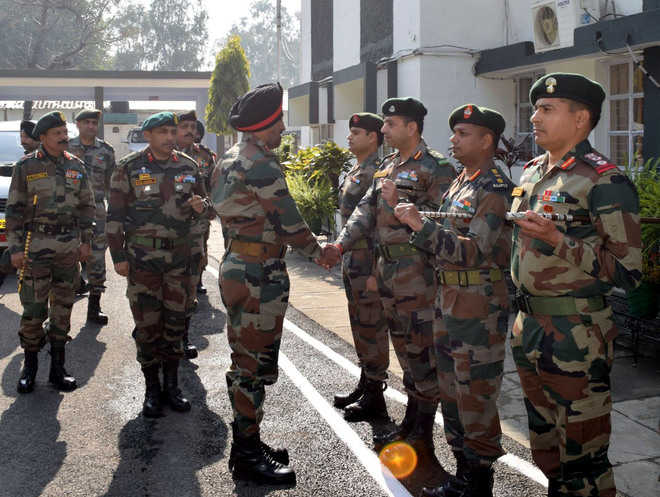
Northern Command chief Lt Gen Ranbir Singh at a function.

Our Correspondent

Anantnag, June 20

Army’s Northern Command Chief Lt Gen Ranbir Singh said on Thursday that operations in the state were being conducted in a professional and dedicated manner.

He was speaking after renaming an Army Goodwill School in Wuzur Kulgam after Ashok Chakra awardee Lance Naik Nazir Ahmad Wani. Singh was answering a question regarding inconveniences caused to general public on the national highway during convoy movement and a recent incident in Srinagar wherein a traffic cop was ruthlessly beaten up by Armymen.

“We have a very strong code of conduct which values human dignity,” Singh told reporters in response to the question. “Our operations are being conducted in a very dedicated and professional manner”. He assured that whenever there are actions to be taken, they are taken at appropriate levels.

Earlier in his speech, Singh praised Wani and said the slain soldier was an example of bravery. He complimented Wani’s wife, also present at the function, for being strong and unflinching in the face of adversity. “It is a matter of great pride for all of us that we have assembled here today to pay homage to our martyr, Nazir Ahmad Wani,” Singh said.

Wani was killed on November 25 last year during an anti-militancy operation in Batagund village of Kulgam district. He became the first Kashmiri to be awarded the prestigious Ashok Chakra award on January 26 earlier this year.

Lieutenant General Ranbir Singh also made a reference of other achievers and heroes of Kashmir, such as Umar Faiyaz and Inspector Arshad Khan, SHO of Anantnag, among others.

Also present on the occasion was the family of Rauf Ahmad Dar, who died recently while rescuing tourists from a rafting mishap in Pahalgam. Singh said Dar was an example of what India stands for and the Indian Army saluted his bravado.

“This is what all of us stand for. He laid down his life without even thinking who the tourists were or where they had come from. He is a role model for all of us,” Singh said. The ceremony was attended by the students of Goodwill School, Wuzur. Singh advised the children to work hard and do something worthwhile for Kashmir and the nation.