










Sanjha Morcha

What’s New

Click the heading to open detailed news

Current Events :

web counter

Print Media Reproduced Defence Related News

Staid practices hampering defence modernisation

Staid practices hampering defence modernisation

Defence acquisition is a mission for committed professionals and not for administrative generalists or indeed for uniformed specialists working on rotating assignments, burdened with other chores and pressures. In the US and elsewhere, it is a profession where people train, specialise and work full-time. The US even has a Defence Acquisition University.

Air Marshal BD Jayal (retd)

Mmilitary Commentator

Arecent panel discussion on ‘Make in India and the nation’s security’ featured General VP Malik, who was the Army Chief during the Kargil war. Few will forget his promise to the nation, when faced with a herculean challenge, of ‘we will fight with what we have’, also discreetly conveying the message to the civil leadership that the defence management, procurement and production systems had failed to deliver, leaving the Army to fend for itself. Not surprisingly, during the panel discussion, he again cautioned the people that unless India becomes self-reliant in defence, its security forces would continue to be vulnerable.

Another panellist, who had been a senior member in the defence acquisition system, suggested a dedicated and overarching organisation to deliver on defence needs and the panel moderator reflected on the irony that the country has launched ballistic missiles but is unable to make the INSAS rifle. If these are the sentiments of those who have been practitioners, then clearly the self-reliance in defence production, that has been an avowed objective of governments since independence, continues to evade us.

It is worth revisiting recent history to fathom why indigenising defence production is proving to be so challenging to successive defence ministers, all of whom mean well, and of late, appear to have taken positive steps towards this end. In 2015, the government appointed the Kelkar Committee to study the public-private partnership concept and make recommendations. This was followed by the Dhirendra Singh Committee which looked at the Make in India concept in the field of defence manufacturing and recommended a strategic partnership model wherein the government would select Indian private enterprises to exclusively make designated military platforms.

Consequently, the ninth version of the Defence Procurement Procedure or DPP-2016 devoted a chapter to strategic partnership, which followed soon after. Whilst the idea evokes optimism amongst most stakeholders because of the dynamism that the private sector will bring, as subsequent events including the drawing of the Rafale controversy into the political arena showed, any attempt to involve the private sector in the defence procurement and production domain will continue to be a challenge.

This is borne out by a recent media report highlighting how in six years, no major Make in India defence project has taken off because of bureaucratic bottlenecks, commercial and technical wrangling and a lack of requisite political push. These shortcomings have a historical reason, some going back decades and unless we attempt to understand and address these, our Make in India vision will continue to stagnate. That the Defence Minister has formed yet another committee to review the DPP-2016, indicates that formulating newer and more complex procedures appears to have become an end in itself rather than merely a means to an end.




The first challenge is to understand that defence manufacturing is in a special category and needs to be treated as such. This is best exemplified by what Jacques S. Gansler, who steered such consolidation in the US, had to say in their context: “In order to understand the economic operations of the US defence industry, it is first absolutely essential to recognise that there is no free market at work in this area and that there cannot be one because of the dominant role played by the federal government. The combination of a single buyer, a few large firms in each segment of the industry, and a small number of extremely expensive weapon programmes, constitutes a unique structure for doing business.” Drawing from this experience and applying our own conditions both in the public and private sector, we first need to arrive at our own ‘unique structure’ of doing business in the field of defence production which must have unanimity across the political system for it to succeed.

The second challenge dates back to the Bofors scandal of 1987 and the attendant political controversy that resulted in a defence procurement eco-system where procrastination has become the mantra. The Services have termed this as the Bofors syndrome, a mindset where few in the decision-making chain would venture to take decisions for fear of falling prey to the shenanigans of others in the complex chain of decision-making.

The unique feature of this syndrome is that it works smoothly where government-to-government procurement contracts are concerned, but goes into deep freeze when faced with an open tender purchase. But with the recent political controversy surrounding the government-to-government agreement for the purchase of Rafale aircraft, this avenue may also become a victim to the Bofors Syndrome.

The next challenge is to recognise that defence acquisition is a complex process involving multiple stakeholders and involves diverse resources and decision-making systems and should aim to provide on-performance, on-time and on-cost capabilities to the armed forces. This is a mission for committed professionals and not for administrative generalists or, indeed, for uniformed specialists working on rotating assignments, burdened with other chores and pressures. In the US and elsewhere, defence acquisition is considered a full-time profession where people train, specialise and work full-time. The US even has a Defence Acquisition University committed to creating acquisition professionals.

In the foreword to the DPP-2016, Manohar Parrikar said, “The DPP is not merely a procurement procedure, it is also an opportunity to improve the efficiency of the procurement process, usher in change in the mindset of the stakeholders and promote growth of the domestic defence industry.’ The biggest challenge to the Make in India aspect in defence production, hence, remains the outdated mindset.

Whatever the official claims, to impartial observers, the underlying spirit of successive DPPs is no longer ‘delivering and sustaining effective and affordable war-fighting capabilities to users within a specified time frame’. Instead, each successive version is being driven by a procedural, legal and defensive mindset where following the book appears to be an end in itself, leaving the armed forces bereft of modernisation and left to ‘fight with what they have.’


Illegal structures around IAF station to be razed in 2 weeks

Illegal structures around IAF station to be razed in 2 weeks

Akash Ghai

Tribune News Service

Mohali, December 23

A total of 81 illegal structures that have come up within the restricted 100 metres around the Air Force station here after the deadline of March 3, 2011, would be razed without any compensation within two weeks.

No compensation for structures will be given to the owners of these buildings rather they might be liable to pay the cost of demolition. If they want compensation for their plots, they can approach the authorities concerned, who will decide on it — Girish Dayalan, Mohali DC

Using powers of collector under the Works of Defence Act, 1903, Mohali Deputy Commissioner Girish Dayalan issued the orders in this regard today.

Confirming the development, Dayalan said earlier a total of 98 structures were identified, which had come up in the restricted area after March 9, 2011.

“Of the total 98 owners of these structures, 16 owners were able to adduce evidence that their structures were existing prior to the set deadline of March 9, 2011, while one owner gave evidence that his property was not situated in the restricted area of 100 metres around the Air Force station. So now, all 81 structures are raised in contravention of the law, therefore, they are liable to be demolished since their action of raising the same was illegal. I have issued orders to demolish these structures within a period of two weeks,” said Dayalan.

Dayalan added that the demolition order had been issued following the directions of Punjab and Haryana High Court after giving adequate time to the owners to plead their case, and carrying out proper legal procedure. “No compensation for structures will be given to the owners of these buildings rather they might be liable to pay the cost of demolition. If they want compensation for their plots, they can approach the authorities concerned, who will decide on it,” said Dayalan.

The Government of India Notification of January 23, 2010, had imposed restrictions on use, enjoyment of land in the vicinity of the Air Force station, Chandigarh, situated at Mohali and ordered that such land may be kept free of buildings and other constructions.

“Directions are also issued to the SSP, Mohali, to provide adequate force for ensuring the demolitions peacefully in coming days,” said Dayalan.


Of leadership Politicisation of the forces is a dangerous malaise

Of leadership

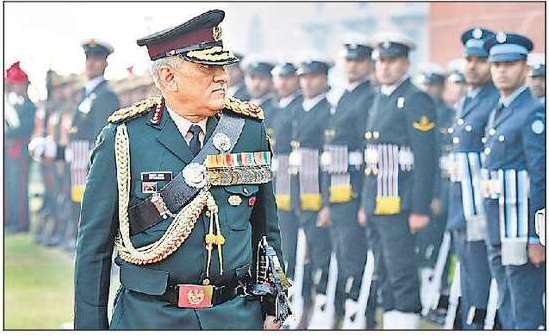
GEN Bipin Rawat knows how to separate the wheat from the chaff. Days before his retirement after a three-year tenure as the Army Chief, he has told us, without naming anybody, who the country’s real leaders are and who aren’t. Speaking at a health summit in the Capital and sounding like a management guru, he stated that leaders led people in the right direction, not in inappropriate directions. It wasn’t hard to guess that he was referring to the ongoing protests against the Citizenship Amendment Act (CAA) and the National Register of Citizens (NCR). By apparently taking a stand in favour of the powers that be, the General not only waded into a minefield called politics but also drew flak, undermining the authority and sanctity of his office. Even though the protests across the country have been unmistakably leaderless, the Army Chief claimed that some people were leading crowds to carry out arson and violence — virtually echoing the government’s point of view that Opposition parties were fanning the flames.

The Army’s clarification on Gen Rawat’s remarks was more of a damage-control exercise: ‘He has not referred to any political event, personality. He was addressing future citizens of India who are students… In the Kashmir valley, youths were misguided first by people whom they trusted as leaders.’ Notably, the Army mentioned the K-word, betraying a desperate attempt to overstate the point that Gen Rawat was not referring to the CAA-NRC agitation. This, too, hints at the malaise of politicisation of the armed forces which is best avoided.

The ruling party rode on the poll plank of national security after the Pulwama terror attack and the Balakot air strike to secure a second successive five-year term. During campaigning, the PM himself hinted that the country was safe only in his hands, while UP CM Adityanath had the cheek to dub the Army as ‘Modiji ki sena’. Amid the political grandstanding, the onus is on the defenders of our borders to uphold their glorious tradition of staying apolitical. After all, they have always fought for the nation, not for any party. And it’s here that the forces need true leaders.


DRDO successfully tests quick-reaction missile

DRDO successfully tests quick-reaction missile

Quick reaction surface to air missile system being tested from Integrated Test Range at Chandipur in Odisha on Monday. PTI

Balasore (Odisha), December 23

India on Monday successfully test-fired its Quick Reaction Surface to Air Missile (QRSAM) system, likely to be inducted into the armed forces by 2021, from a base off Odisha coast.

The missile, developed by the Defence Research and Development Organisation (DRDO), was flight-tested from the Integrated Test Range (ITR) at Chandipur near here at 1145 hrs, a defence statement said.

The QRSAM was flight-tested with full configuration in deployment mode intercepting the target mid-air, meeting the mission objectives, it said.

“The entire event was monitored by ground telemetry systems, range radar systems and electro optical tracking system,” the statement said.

The QRSAM weapon system, which operates on the move, comprises fully automated command and control, active array battery surveillance radar, active array battery multifunction radar and launcher.

Both radars are four-walled having 360-degree coverage with search on move and track on move capability, it said. — PTI


The QRSAM weapon system comprises fully automated command and control, active array battery surveillance radar, active array battery multifunction radar and launcher


China calls for restraint as India, Pakistan exchange fire along LOC

China calls for restraint as India, Pakistan exchange fire along LOC

A JCO and a woman were killed on Wednesday in unprovoked firing during ceasefire violation by Pakistani troops. Tribune file

Beijing, December 27

China on Friday urged India and Pakistan to exercise restraint and refrain from taking action to escalate tensions, amid reports of incidents of exchange of fire by the armies on both sides along the Line of Control (LOC).

A Junior Commissioned Officer (JCO) of the Army and a woman were killed on Wednesday in unprovoked firing during ceasefire violation by Pakistani troops along the LoC in Uri sector of Jammu and Kashmir, defence sources said, adding that Pakistan was targeting civilian population in India with vengeance from gun and mortar positions deployed and inside villages in PoK.

The Pakistan Army on Thursday claimed that two of its soldiers were killed in unprovoked firing by the Indian troops along the LOC.

“We noted the relevant reports and we are following the situation,” Chinese Foreign Ministry spokesman Geng Shuang told a media briefing.

“As neighbour to both India and Pakistan, we call on both sides to exercise restraint and refrain from taking actions that will escalate tensions, peacefully resolve disputes through dialogue and jointly maintain regional peace and stability,” he said. PTI


NSG deployment rising, but special force lacks sniper range for training

NSG deployment rising, but special force lacks sniper range for training

Vijay Mohan

Tribune News Service

Chandigarh, December 23

About 35 years after it was raised as a specialist anti-terrorist force, the National Security Guard (NSG) remains without a dedicated range for training snipers, a critical component of any special force.

The revelation of inadequate training infrastructure comes in the backdrop of increasing deployment of NSG teams for operations, with the average requisition last year being four times a month.

According to the data provided by the Ministry of Home Affairs (MHA), the annual deployment of NSG teams for immediate backup support was 34 in 2016, 33 in 2017 and 47 in 2018. Detachments of the force are also deployed in Kashmir for undertaking anti-terrorist operations alongside the Army and state police.

“Adequate training infrastructure is available with NSG for special training except a dedicated sniper range. Ad hoc arrangements are in place to undertake sniper firing,” the MHA has stated in a report tabled by Parliament’s Standing Committee on Home Affairs this month.

“A sniper range is proposed in and around Manesar to meet its training requirements,” the report adds.

Given NSG’s mandate of counter-terrorist operations in urban areas, hostage rescue and neutralisation of high-value targets, snipers are a very important element of its strike component.

Snipers are considered force-multiplies and are given a great deal of importance and prominence by special forces the world over. Besides precision shooting, a large part of the sniper’s work involves recce and surveillance and providing feedback to commanders from concealed vantage positions. This requires a very high degree of training and requisite training infrastructure.


Immediate backup support 

  • According to the data provided by the MHA, the annual deployment of NSG teams for immediate backup support was 34 in 2016, 33 in 2017 and 47 in 2018
  • Snipers are considered force-multiplies and are given a great deal of importance by special forces the world over
  • A sniper range is proposed in and around Manesar to meet its training requirements, the MHA report adds

.


MiG-27 flies into history

MiG-27 flies into history

Tribune News Service

New Delhi, December 27

Hundreds of serving and retired Indian Air Force pilots today bid emotional farewell to “Cold war” era fighter jet MiG-27, which India procured from the Soviet Union in 1985.

A formation of MiG-27 flew for the last time in India at Jodhpur this morning. The IAF’s 29 Squadron known as the “Scorpios” flew in a five aircraft “Arrowhead” formation flanked by Sukhoi 30-MKI aircraft as a mark of respect.

After the phase-out

  • The IAF will be left with 31 squadrons and there will be no immediate replacement at Jodhpur
  • The Air Force will raise a squadron of Sukhoi 30 at Thanjavur in Tamil Nadu

India operated about 165 MiG-27 planes and these saw frontline combat during the Kargil war in 1999. Before the Kargil conflict, fighter jets had not been used at such altitudes—15,000 feet or more. The IAF was tasked to bomb the Pakistani army-occupied locations at altitudes ranging between 15,000 and 18,000 feet.

No country and no air force had used any fighter jet to drop armament at such altitudes. It was unique. It meant pilots in MiG-27, MiG-21 and Mirage-2000 jets were flying at 30,000 feet to hit targets that were around 12,000 feet away.iG-27 jets had a unique capability to swing their wings from 16° to 72°, depending on the mission. This allowed the plane to fly at variable speeds.


Home Ministry orders withdrawal of 7,000 paramilitary troops from J-K

Home Ministry orders withdrawal of 7,000 paramilitary troops from J-K

Tribune Web Desk
Chandigarh, December 24

The Union Home Ministry has ordered 7,000 paramilitary troopers to withdraw from Jammu and Kashmir immediately.

The notification issued on Tuesday says that 72 companies of paramilitary forces—24 of the Central Reserve Police Forces and 12 each of the Border Security Force, Indo-Tibetan Border Force, Central Industrial Security Force, and Sashastra Seema Bal—should be sent back to their own locations immediately.

One such company has about 100 personnel.

“It is to intimate that the matter has further been reviewed in this Ministry. It has been decided to withdraw 72 Coys of CAPFs (CRPF-24, BSF- 12, ITBP-12, CISF-12 & SSB-12) with immediate effect from J&K and revert back to their respective locations,” the notification says.

The development comes five months after the central government increased security in the then state just before it decided to read down Article 370 of the Indian Constitution—a provision that gave the state special status—and reconstituted the state into two union territories, J&K and Ladakh. About 20 such companies were withdrawn from the valley early this month.


Armed forces extremely secular: Rawat

Armed forces extremely secular: Rawat

New Delhi, December 27

A day after Chief of Army Staff General Bipin Rawat made a controversial statement over Citizenship (Amendment) Act, he said on Friday the armed forces are “extremely secular” and the driving ethos is “insaniyat” (Humanity) and “sharafat” (Decency).

He also stressed the armed forces have utmost respect for laws related to human rights and they not only ensure protection of human rights of people of the country, but also of its adversaries.

‘Humanity driving etho’

The driving ethos of the armed forces are insaniyat and sharafat (humanity and decency). — Gen Bipin Rawat, Chief of Army Staff

He was addressing interns and senior officers of the National Human Rights Commission (NHRC) on “Preserving Human Rights in Times of War and Prisoners of War” at the Manav Adhikar Bhawan here, officials said.

“The Indian armed forces are much disciplined and have the utmost respect for human rights laws and international human rights laws. The Indian armed forces not only ensure protection of human rights of our own people but also of adversaries and deal with Prisoners of War as per the Geneva Conventions,” General Rawat was quoted as saying in a statement.

Rawat asserted, “The driving ethos of the armed forces are ‘insaniyat’ and ‘sharafat’ (humanity and decency) and they are extremely secular.” He said the Army headquarters had created a “human rights cell” in 1993, which is now being upgraded to the level of a directorate. — PTI


Performance standards being set for officers under ‘minimum govt, maximum governance’: Rajnath

Performance standards being set for officers under ‘minimum govt, maximum governance’: Rajnath

New Delhi, December 24

Defence Minister Rajnath Singh on Tuesday said performance standards are being set for officers and mechanisms developed for greater prudence in financial management under the Centre’s vision of ‘minimum government and maximum governance’.

He said this in his address at a workshop for integrated finance (IF) advisers, organised by the finance division of the Defence Ministry at the DRDO Bhawan here.

“Under the ‘minimum government, maximum governance’ (vision), government functions are being made more effective and efficient. Performance standards are being set for government officers.

“And in financial management, mechanisms are being adopted for more prudence and accountability,” Singh said.

The minister said finance is the backbone for any family, society, institution or country.

“Defence Accounts deals with one-fourth of the country’s total budget. And, as I said, integrated finance (IF) is considered the backbone of any department or ministry. Any ministry can achieve its objectives only when it can manage budgetary resources without compromising the operational needs,” the minister said.

Singh said that in this direction, the government had also adopted a lot of innovative methods, like increasing focus on the Public Financial Management System, and introduction of Central Public Procurement Portal.

The minister said that in the last three years, the defence ministry had utilised its allocation “very successfully and through substantial delegation of financial powers the trend of non-utilisation of funds has ceased”. PTI