



Sanjha Morcha

What’s New

Click the heading to open detailed news

Current Events :

web counter

Print Media Reproduced Defence Related News

Pak examining proposal for DGMO-level talks with India: Report

Pak examining proposal for DGMO-level talks with India: Report
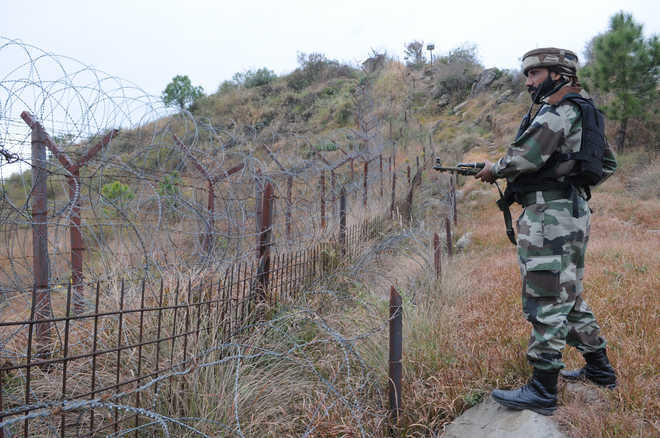
The proposed move is aimed at reducing tensions along the LoC and the Working Boundary. — Photo for representation.

Islamabad, January 16

Pakistan is examining a proposal for a DGMO-level meeting with India after a gap of four years to reduce tensions along the Line of Control and the Working Boundary through fresh confidence-building measures, a media report said on Tuesday.(Follow The Tribune on Facebook; and Twitter @thetribunechd)The report comes a day after Pakistan said four of its soldiers died and five others injured in cross-border firing by Indian troops across the LoC. The Indian Army, however, said seven Pakistani soldiers were killed in its retaliatory firing.A Pakistan defence ministry official in a meeting yesterday told the Senate defence committee that a “fresh proposal of DGMOs’ (Director Generals of Military Operations) meeting is being considered,” the Dawn reported.The official also briefed the senators about the latest trends in Indian ceasefire violations, it said.In November, a telephonic conversation between the two DGMOs took place following a request by the Pakistani side.According to the report, one of the confidence-building measures being considered for the planned meeting of DGMOs is “calibre reduction” of the arms being used at the LoC.Pakistan-India DGMOs have a frequent hotline contact, but they last met face-to-face four years ago at Wagah, a village which serves as a transit terminal between Lahore and Amritsar.The December 24, 2013 Wagah meeting had taken place after a break of 14 years. That meeting too was held to discuss ways to ensure peace along the LoC and the Working Boundary.Meanwhile, a resolution adopted by the Senate committee through consensus condemned Indian Army chief Gen Bipin Rawat’s statement about “calling nuclear bluff of Pakistan” as “stupidity and provocative”.They termed it a “war-like” proclamation, the report said. — PTI
Ex-servicemen celebrate Army Day

Ex-servicemen celebrate Army Day
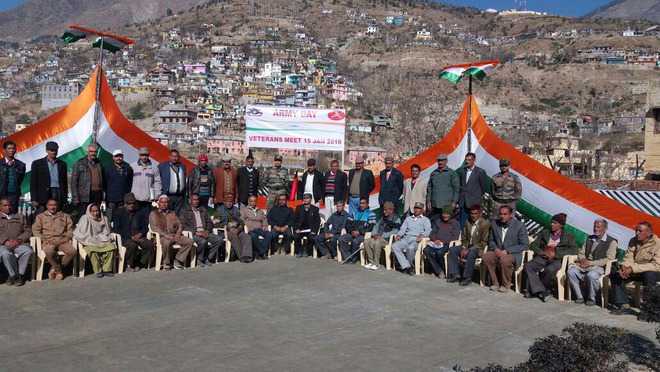
Veterans at the Army Day celebrations in Doda. Tribune photo

Our Correspondent

Doda, January 15

As the nation celebrates the 70th Army Day, the Army in Jammu and Kashmir’s Doda district celebrated the day with its ex-servicemen. The basic objective behind organising the event was to resolve the problems of veterans, which they usually face after retirement.The Commanding Officer, 10 Rashtriya Rifles, was chief guest at the event who welcomed and addressed the guests after paying homage to the martyrs. He highlighted various schemes launched by the Army for ex-servicemen and asked veterans to avail the benefits.“More than 50 veterans from different parts of Doda participated in the event, where guidance was given to them about the new schemes launched for ex-servicemen so that they can avail the benefits. Apart from this, their other issues of pension and documentation were also heard,” a senior Army officer said.


Govt to raise 15 new battalions for Pakistan, China borders

Govt to raise 15 new battalions for Pakistan, China borders
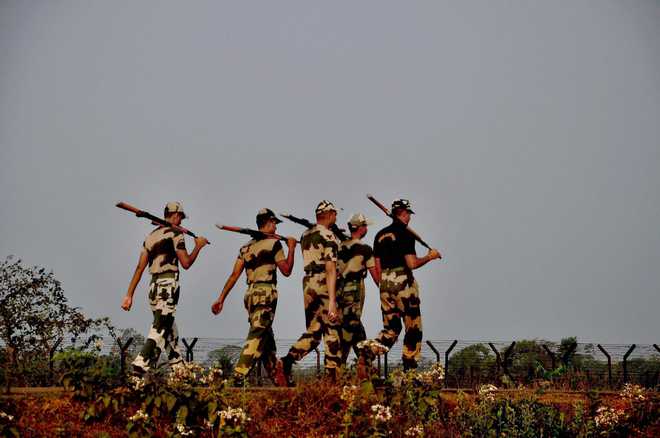
The BSF is the country’s largest border guarding force with a strength of about 2.5 lakh. PTI file

New Delhi, January 14

The government is planning to raise 15 new battalions in the country’s two important border guarding forces — the BSF and the ITBP — to fortify defence along the strategic frontiers with Pakistan, Bangladesh and China.

(Follow The Tribune on Facebook; and Twitter @thetribunechd)

A senior official in the Union Home Ministry said that it is “actively considering” raising six fresh battalions in the Border Security Force (BSF) and nine in the Indo- Tibetan Border Police (ITBP) force.

Each battalion of these forces comprises about 1,000 operational jawans and officers.

Sources in the BSF said the force has projected enhancing manpower by sanctioning of new units so that they can be deployed in the Assam and West Bengal flanks of the Indo- Bangladesh border even as a similar addition in numbers is required to effectively guard the Indo-Pak International Border (IB), especially in Punjab and Jammu regions, in the near future.

“The exact locations for the new battalions could be gauged as and when they are raised but a few areas along Bangladesh and Pakistan will remain a priority owing to their vulnerability profile such as infiltration, drugs smuggling, human trafficking and illegal migration,” a senior BSF officer said.

Similarly, the ITBP has been trying to reduce the inter-BoP (border out post) distance at the 3,488-km-long icy frontier that it is tasked with guarding.

“The original projection was to have 12 fresh battalions for the ITBP but the force requires nine such units in the near future,” a senior ITBP officer said.

The frequent instances of transgressions and confrontations with the Chinese army at the Line of Actual Control (LAC) are being seen as the major reason for the ITBP to enhance its numbers.

The mountain-trained force has recently got sanctions to set up at least 47 new BoPs along the border for effective control of the Himalayan border area.

The home ministry official said the new battalions would also help the two border guarding forces better rotate troops from forward locations to units in the mainland.

While most of the BoPs of the ITBP are in highly arduous terrain and it is difficult and time-taking to reach them, many of the BSF locations at the two borders are also in high-altitude and harsh climate regions.

While the BSF is the country’s largest border guarding force with a strength of about 2.5 lakh, the ITBP is about 90,000-personnel strong.

The home ministry has three such forces under its command, the third being the Sashastra Seema Bal (SSB) that is tasked with guarding Indian borders with Nepal and Bhutan. PTI


Need to shift focus from Pak to China, says army chief

For too long, we have kept our focus on the western front.. Time has come to focus on the northern border… Infrastructure development has to be speeded up.
BIPIN RAWAT, Army chief

NEW DELHI: Army chief General Bipin Rawat said on Friday that India needs to shift its military focus from its western border with Pakistan to its northern border with China, and called for partnerships with neighbouring countries to check China’s growing assertiveness in the region.

Naming Nepal, Bangladesh, Sri Lanka, Myanmar, Bhutan and Afghanistan, Rawat asserted that India must not let these nations “drift away from us”. China is a “powerful country”, he said, but stressed that India isn’t a “weak nation”.

Talking to reporters at his customary briefing before Army Day on January 15, the general said that Chinese troops were still present in reduced numbers in north Doklam — a plateau at the strategic IndiaBhutan-China tri-junction where India and China were locked in a 73-day border standoff last year.

“This de-escalation may have happened due to winter. They may return here or somewhere else after the winter months. If they come again, we will see what to do,” Rawat said, responding to a question on the situation in Doklam.

He said the Indian Army had intensified patrolling along the Line of Actual Control and that had led to an increase in contacts with the Chinese army.

“We are seeking support of other nations to see we are not isolated in a situation in Asia against an assertive China. Thatis the next step that is being taken and therefore you will find that a quadrilateral is formed,” Rawat said, referring to the grouping of the US, India, Japan and Australia in the IndoPacific.

On the western front, Rawat said the Indian Army was ready to call Pakistan’s nuclear bluff. “If we really have to confront the Pakistanis and the country gives us a task, we are not going to say we will not cross the border because they have nuclear weapons,” he said. NEW DELHI: Social media and government schools in Jammu and Kashmir are spreading a ‘disinformation campaign’ resulting in radicalisation of youth, Army chief General Bipin Rawat claimed on Friday, and called for ‘some control’ over mosques and madrasas in the state.

He said a “major revamp” of the education system was needed in the state to deal with the problem.

Rawat said the issue of exercising some amount of control over mosques and madrasas to check the flow of disinformation was being looked into.

ON THE MAPS

Addressing a press conference on the eve of the Army Day, Rawat said each classroom in government schools in Jammu and Kashmir has a separate map of the state besides that of India which sowed the seeds of thought of some kind of “separate identity” among the children.

“The damage done to us is through the social media. A very large amount of disinformation campaign is being spread in Jammu and Kashmir which is radicalising the youths through the social media and through the schools,” he said.

“The other issue is the madrasas and masjids — what is being informed to them (the students) or incorrectly informed to them is through the madrasas and masjids. I think some controls have to be exercised there and that is what we are looking at.” He, however, did not elaborate on what kind of control he was suggesting over such institutions.

ON STONE-PELTERS

Rawat also suggested that some stone-pelters in Kashmir were youth from government schools, and stressed on the need to reform the education system.

“If you go to any Kashmir school, you will find two maps — one is the map of India and one is the map of Jammu and Kashmir. There are always two maps in every classroom. Why should there be a map of Jammu and Kashmir?”

He added, “If you are putting a map of Jammu and Kashmir, then you may as well put map of every state,” said the Army chief.

“What does it mean to children that I am part of the country but I also have a separate identity. So, the basic, grassroots problem lies here is the way the education in Jammu and Kashmir in government school has been corrupted,” said Rawat.

He said students from schools like DPS were not found involved in activities like stone-pelting, and added that is why the ‘goodwill schools’ run by the Army are accorded higher status.

Rawat noted that opening of more public schools and CBSE schools, was the way forward.

China incursions up, but lower than 2014

EW DELHI: The number of incursions by China’s army into Indian territory in 2017 rose to 397 from 260 in 2016, but the number was almost the same in 2015 (391) and 2013 (401), and much lower than in 2014 (507), indicating that last year isn’t what statisticians would call the outlier, but rather a normal year (in terms of Chinese incursions) when seen over a five-year period.

India and China share an uneasy relationship across a 3,488km Line of Actual Control and the two countries were locked in a 73-day-long standoff in Doklam in Bhutan, near the trijunction of the three countries.

The data on incursions, accessed from security agencies, show that they are almost exclusively concentrated in Pangong Tso, Chumar, Samar Lungpa, Kongka La, Spanggur Gap and Mount Sajum in eastern Ladakh sector, Kaurik in HP.


Tibetan PM-in-exile cautions India against China

Tibetan PM-in-exile cautions India against China
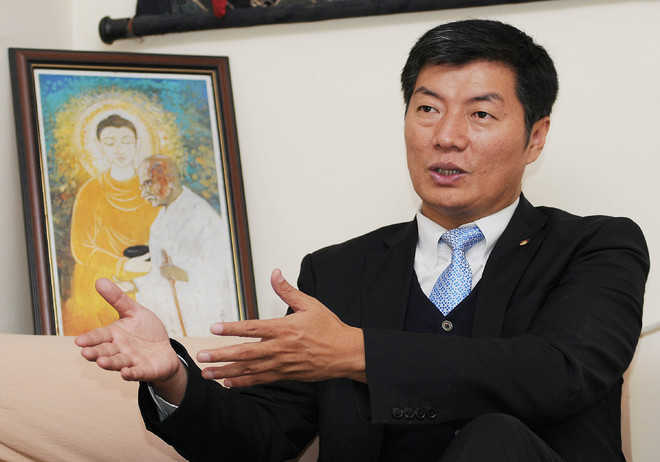
Tibetan “Prime Minister-in-exile” Lobsang Sangay.

Dharamsala, January 11

Tibetan “Prime Minister-in-exile” Lobsang Sangay on Thursday cautioned New Delhi against China’s deceptive policies, warning that what happened to Tibet could happen to India as well.

“The Doklam stand-off and the repeated cross-border incursion of Chinese soldiers into Indian territories is a sign of China’s expansionist mindset,” he told reporters here.

He said India should be wary of China’s belligerent attitude.

Taking about developing airfields and road networks by China along the border with India, he asked India to be cautious.

“To understand the Doklam face-off, you have to look at China’s ‘right hand palm and five fingers’ strategy.

“Chinese leader Mao Zedong described Tibet as the right hand palm while Ladakh, Sikkim, Bhutan, Nepal and Arunachal Pradesh as five fingers.

“Because the Chinese were not stopped when they were occupying Tibet in 1959, they have now got emboldened to move towards five fingers. Had Tibet’s capture been prevented, incidents like Doklam would never took place,” Sangay told IANS.

Sangay, who is also the Central Tibetan Administration (CTA) President, said India was now progressing towards becoming “a number one country” under the leadership Prime Minister Narendra Modi.

Stressing upon the need to develop a Buddhist religious tourist circuit, he said India was the land of Buddha and there were 600-700 million Buddhists in the world.

“Even if only .01 per cent Buddhists come to India to visit Buddhist monasteries and spend am average $1,000, India can earn $6 billion per year,” said Sangay.

The Central Tibetan Administration is based in this Himachal Pradesh town where the spiritual leader the Dalai Lama also resides.

Sangay highlighted the Dalai Lama’s commitment to the revival of ancient Indian values, particularly the Nalanda school of thought.

The Dalai Lama has lived in India since fleeing China in 1959 after a failed uprising against Communist rule over Tibet. The government-in-exile is based in Dharamsala but is not recognized by any country.

IANS


Distorting history another form of terror, says historian Claims space for reason, debate in country shrinking

Kolkata, January 1

An attempt to “fabricate and distort history” is a terror of a different nature, general president of Indian History Congress KM Shrimali said, expressing concern over the shrinking space for reason and debate in the country.The sole agenda behind the RSS-BJP trying to rewrite history was to create a Hindu nation, where minorities were treated as second-class citizens, he said. “It is a matter of concern that the space for reason and debate is shrinking in India. We have never witnessed such a disturbing trend. Those with little knowledge about history are trying to fabricate and thrust their idea. It is a terror of a different nature,” the former history Prof at Delhi University said.The RSS and the BJP were determined to divide the nation on religious grounds, Shrimali said, adding that history was a discipline of reason and could not be written with “fabricated truths, imagination or myth-making.”The historian explained that Hindutva and Hinduism were different concepts with the former being a political ideology. Shrimali said Hindutva was being used as a tool to access power.Reacting to a RSS-BJP criticism that a distorted version of history was being taught in India by the “Left and liberal historians”, Shrimali said historians need not take lessons on nationalism from those “who had surrendered before the British during the Independence movement”.Shrimali’s view found resonance in eminent historian Irfan Habib, who said “history depends on events of facts” and any attempt to invent facts would be treated as fiction. — PTI


Hits out at Sangh ParivarReason and debate have become biggest casualties in Sangh Parivar’s interpretation of history. There are ways of understanding mythology… Not everything that is part of mythology is history… But you don’t enter into arguments, you try to bully people. That’s not the way to write history. KM Shrimali, ex-prof of history


Pakistan PM summons security meeting over Trump tweet

Pakistan PM summons security meeting over Trump tweet
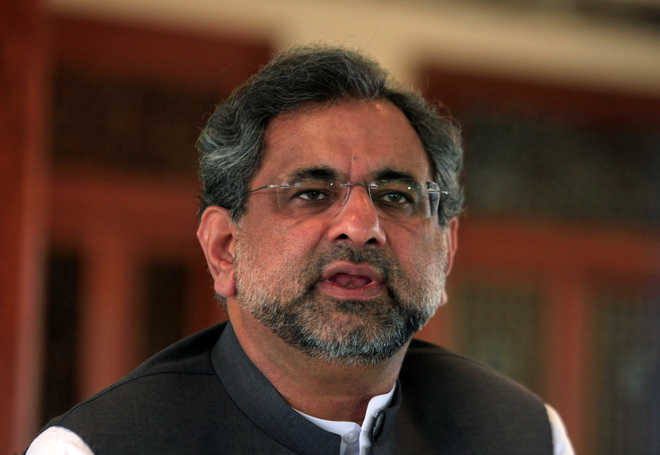
Pakistan Prime Minister Shahid Khaqan Abbasi. Reuters file

Islamabad, January 2

In the wake of US President Donald Trump’s tweet in which he accused Islamabad of “lies and deceit”, Pakistan Prime Minister Shahid Khaqan Abbasi has summoned a meeting of the National Security Committee (NSC) on Wednesday.The Prime Minister will chair the huddle to discuss the future course of action following the US President’s scathing statement against Pakistan, a PM office statement said.The meeting will be attended by Foreign Minister, Interior Minister, Minister for Defence, services chiefs besides senior civil and military officers, the PM office media wing said.

(Follow The Tribune on Facebook; and Twitter @thetribunechd)

Trump tweeted that the US “foolishly” gave aid to Pakistan over the course of 15 years but Islamabad remained deceitful by providing safe havens to “terrorists” from Afghanistan. IANS


Eighth Indo- Maldives joint military exercise concludes

Eighth Indo- Maldives joint military exercise concludes
Photo for representation only.

Bengaluru (Karnataka), December 29A closing ceremony to mark the culmination of 14 days joint training between the Indian Army and the Maldives National Defence Forces was held at Belgaum in Karnataka.The event was held at Maratha Light Infantry Regimental Centre on Thursday where the marching contingent of both the countries participated in the closing ceremony.Fly past done by the army aviation team, carrying flags of both the countries, was also a highlight of the closing ceremony.In addition to the formal march past, there were a number of cultural programs like Kalaripayattu by the Madras Regimental Centre, Malkhamb by the Maratha Light Infantry Regimental Centre, Khukri Combat Display by the Gorkhas and the Assam Regimental Centre showcasing their North East Warrior skills.The audience was also left mesmerised by the aerobic display by the Maratha Light Infantry Regimental Centre and Boduberu display by the Maldivian National Defence Forces.The grand ceremony culminated with a pipe and drum band night display by the sirmoor rifles.Brigadier Alok Khurana, the senior most military observer of the Indian Army said that the exercise has honed individual and collective professional skills of all participants by imbibing best practices of both the Armies and has served to reinforce the close ties of friendship between the two countries.He appreciated the team spirit, camaraderie and high motivation shown by the participants throughout these two weeks.Brigadier General Ali Zuhair, senior observer of the Maldivian National Defence Force addressed all participants and complimented them on the successful completion of the exercise.He also praised them for the high standards of professionalism displayed during conduct of the exercise and thanked the Indian Army in organising the training in a highly professional manner.The exercise has further enhanced the military relation and cooperation between the two forces. Both the contingents exchanged mementoes and resolved to continue this joint exercise in the future. — ANI.


Army pays tributes to jawan killed in Gurez avalanche

Army pays tributes to jawan killed in Gurez avalanche
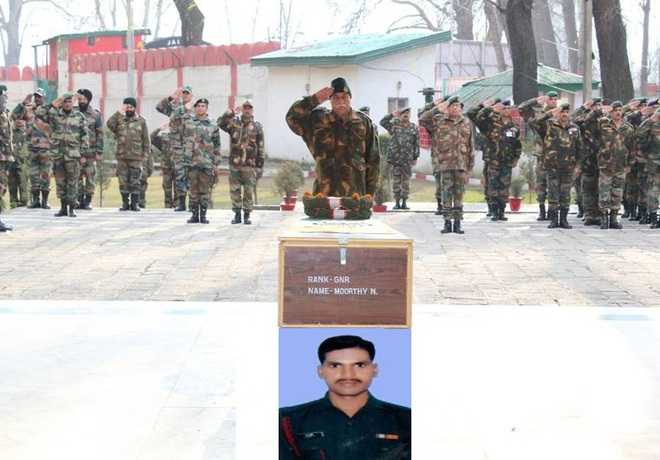
15 Corps GOC Lt Gen JS Sandhu pays tribute to Sepoy Moorthy N at Badamibagh Cantonment in Srinagar on Friday. Tribune photo

Tribune News Service

Srinagar, December 22

The Army on Friday paid tributes to a soldier who had gone missing from a forward post in remote Gurez sector last month and was later found dead.The body of Sepoy Moorthy N, 33, was found on December 19 and transported to Badamibagh Cantonment in Srinagar from where it was airlifted to his home.He had gone missing on December 11 during heavy snowfall along with two other soldiers Lance Naik Marigendra Nath Pramanik and Sepoy Shiv Singh, whose bodies were sent home on Wednesday this week.At the ceremonial farewell held at Badamibagh Cantonment, which houses the headquarters of 15 Corps, senior army officers led by Corps Commander Lt Gen JS Sandhu paid tributes to the soldier.The sepoy, who was part of an Operational Team which was serving in the formidable heights along the Line of Control in the Gurez sector, had got swept away in a snow slide. The Army said concerted efforts of the specially equipped Avalanche Rescue Teams led to the recovery of his body on Tuesday this week.The soldier was had donned the uniform in 2004 and hailed from Nathipatti village in Tamil Nadu’s Karur district. He is survived by his wife and two sons.Two soldiers injured in mine blast in Poonch Rajouri: Two soldiers of Naga unit were injured seriously when one of them reportedy stepped on an abandoned mine in a forward location in Poonch district on Friday. Sources said the soldiers were patrolling a forward location in the Gulpur sector when an abandoned mine blasted off under the foot of one of the soldiers. The injured have been identified as Sepoy W Thung and Sepoy Rakesh. The soldiers, who have splinter injuries in their eyes and on the face, were immediately taken to the Army hospital in Poonch and later airlifted to Command hospital at Udhampur. OC


Vijay Diwas : A fine reminder of national commitment by Lt Gen Syed Ata Hasnain

16 Dec (Vijay Diwas) every year is an important date for India and the Indian people. It symbolizes success, patriotism and commitment. It also acts as a reminder that we have achieved much as a nation and need to remain united and positive for the future while working to take India to its destined position in the world.
For many of us of the generation which was then in existence the Indo-Pak conflict of 1971 generates nostalgia. It was a time when the Indian polity was at its best providing the required leadership in a crisis situation. The political opposition and government worked as one to back the Indian Armed Forces. Prime Minister Indira Gandhi gave the Army Chief General (later Field Marshal) Sam Manekshaw the required freedom of action which any military requires and the armed forces delivered as per the trust reposed in them. The year 1971 is all about heroics of the armed forces. Whether it was Major Hoshiyar Sing PVC, 2/Lt Arun Khetarpal, PVC, L/Nk Albert Ekka PVC, Fight Lt Nirmaljit Sekhon, PVC or Capt MN Mulla, MVC, all of them are etched in memory as national heroes. Battles such as Basantar, Tangail (Dacca), Hilli, Akhaura or Naya Chor   have become part of military heritage. The photograph of Lt Gen AAK Niazi, Pakistan Army’s overall commander in the then East Pakistan, surrendering before Lt Gen Jagjit Aurora at Dacca adorns the walls of many military museums today splendidly conveying the achievement of India and its armed forces. In less than 14 days of focused battle the Indian Army supported ably by the Indian Air Force and the Indian Navy, cut through the heavily defended fortresses of the Pakistan Army and reached the outskirts of Dacca. It was a strategy now recognized as brilliant. The Indian Army simultaneously held and maneuvered around the Pakistani defenses penetrating the heartland and reached the center of gravity, Dacca. The Pakistan Army had enough forces and wherewithal to fight a battle to the end but prudence prevailed as India’s political, diplomatic and military pressure mounted. The combined effect of the latter had the required psychological effect and the Pakistan Army surrendered en masse; 93,000 prisoners fell into Indian hands. They were protected from lynch mobs, safely transported to the Indian mainland and housed in the Army’s barracks which acted as Prisoner of War camps. All principles of the Geneva Convention were followed and India’s image received a boost.
It was unfortunate that the sagacity and strategic maturity displayed in the handling of the 1971 conflict with Pakistan did not travel to the conference table when in 1972 the leadership’s of the two countries met at Shimla for peace talks. While the restoration of status quo ante on the western borders was still an acceptable deal the return of the 93000 prisoners without gaining anything was a strategic blunder.  The Jammu & Kashmir (J&K) issue was still live and a better handling of the bargains at Shimla could have possibly resolved things for the future. The Indian military’s opinion was perhaps not sought on the misplaced notion that the post conflict deliberations were a political-diplomatic responsibility with no role for the military. While India helped create the independent nation of Bangladesh through a resounding military victory the victory appeared incomplete without a matching achievement on the conference table at Shimla. Ironically India only extracted from Pakistan an assurance that J&K would be resolved between the two countries through mutual consultation. We are aware how Pakistan flouted the Shimla Agreement by attempting to secure for itself the Siachen Glacier from 1978 to 1984; India finally beat it to position itself there in a daring operation in 1984.It is also little known that we blundered in our homework by not ensuring the release of all the Indian prisoners in Pakistan’s custody. Even as 93000 Pakistani prisoners of war were released at least 56 of ours continue to languish in Pakistani jails till date leaving their families distraught.
Victory days such as Vijay Diwas are a great symbolism for national self-assurance, self-esteem and expression of confidence in the capability, valor, patriotism and sacrifice of the armed forces. That is how it should be. However, as generational change takes place it is important to not only use this symbolism to unify the nation but equally to impart knowledge about the events of the past that we celebrate. The 1971 war needs better capture in history books, films, museum artifacts, memorials and such like things which can remain constant reminders for the nation. The Indian film industry did a good job with films such as ‘Border’ but these are just too few. Many more need to be sponsored. The military uniform and profession in India is respected by the public but only peripherally without understanding the depth of commitment, valor and sacrifice that men in uniform make for the nation. Little is known about the military profession and national security as a subject is just beginning to attract attention of scholars and researchers. We desperately need a National Defence University (NDU) which has been hanging fire for the last 16 years, so that knowledge management on the crucial aspect of national security receives a fillip and much greater interest.
Unfortunately the threat from Pakistan which should have ended after 1971 progressively re-emerged. In 1989 it decided to launch a low cost proxy war in J&K with the strategy of a ‘war by a thousand cuts’. Aware of its inability to match India in the conventional battlefield it chose to engage it in an asymmetric war. The aim is to exploit India’s perceived fault lines, attempt wresting J&K through cultivation of alienation and keep India embroiled in an asymmetric situation to prevent it attaining its national aspirations. It takes confidence from its ability to calibrate the proxy war and the backing it receives from China.
India has little option but to be militarily strong. Its armed forces need to be manned, equipped and trained optimally to ensure maintenance of our ascendancy. We have the dual threat from China and Pakistan and the threat is no longer limited to the land borders. In the modern world the threats transcend various domains. The maritime, space, cyber, psychological, social and economic domains are equally areas where our adversaries can embroil us in conflicts of different kinds with the aim of preventing us from achieving our true potential.
No nation ever progresses if it forgets the sacrifice of it warriors. Many of these warriors have lost their lives or experienced the most intensely challenging conditions to make India safe. On a day such as Vijay Diwas let us remember these sacrifices and salute the men and women who continue to proudly don the uniform of the Indian Armed Forces. They deserve the best the nation can give and nothing should be held back to empower them to do their duties with utmost honor. The best recognition that the public can give the armed forces is by enhancing the knowledge of the new generations on their role and functioning. The military profession needs to be placed on a pedestal so that the best from India’s young flock to wear the uniforms and contribute to the security of their nation.
(The author is former GOC of  Srinagar based 15 Corps)
feedbackexcelsior@gmail.com