Sanjha Morcha

What’s New

Click the heading to open detailed news

Current Events :

web counter

Print Media Reproduced Defence Related News

Army rectifies cable snag at Khardungla

Army rectifies cable snag at Khardungla

Army jawans rectify a technical snag in an optical fibre cable at the Khardungla in Ladakh. Tribune Photo

Tribune News Service

Jammu, January 28

Braving subzero temperatures and accumulated snow of several metres, Army jawans rectified a technical snag in an optical fibre cable at the extreme height of 18,000 feet at the Khardungla in Ladakh on Monday.

The pictures uploaded by the Army’s Northern Command with soldiers rectifying the snag of fibre cable in the middle of accumulated snow at the Khardungla have gone viral in social media and were widely appreciated by the netizens.

The photographs have been uploaded with the message “No terrain, no weather, no enemy can stop us! We are #IndianArmy!”

“#NorthernComd Signallers braving subzero temperatures, snow covered mountains, extreme heights at #Khardungla Pass(18000 ft) maintain Optical Fibre Cable Link just to keep #Ladakh connected,” the Army said on its official Twitter handle.

The connectivity has remained a major issue in the arid region of Ladakh where there are more than 350 uncovered areas having no telecom connectivity.

Recently, the lone member of Parliament from the region, Jamyang Tsering Namgyal, had urged the Union government to sanction sufficient mobile towers for all 350 uncovered areas to ensure better connectivity in the Union Territory of Ladakh.


Army makes Doda residents stand tall Overcoming all odds, hoists two national flags on R-Day at old bridge

Army makes Doda residents stand tall

Amir Karim Tantray

Tribune News Service

Doda, January 29

Doda took the lead this Republic Day to show residents’ unique style of patriotism towards the country, as two national flags were hoisted by the Indian Army on the old bridge of Pul Doda over the Chenab.

This was a unique gift given to the entire Chenab valley by the Army when, early on the morning of January 26, soldiers of the 10 Rashtriya Rifles (RR) hoisted the two national flags on the bridge and dedicated these to the people of Doda.

The bridge, made of wood and ropes, was closed to vehicular traffic after a concrete bridge was constructed over the river in early 1990s and now stands as a heritage site for posterity. The two national flags, 44-foot-high, are aloft the bridge on both banks of the Chenab, depicting the uniqueness of the 71st Republic Day.

The installation of the flags on the bridge was not an easy task for the Army as it had to manually construct the pillars and hoist the flags without the help of any crane or earthmoving machinery.

“It took one week for the Army to work on the old bridge and erect the poles without any use of modern-day technology. Due to the bad weather prevailing for a fortnight, there was no availability of cranes and latest machines in Doda, Batote, Udhampur and Kishtwar. Undeterred by the challenge, the Army decided to meet the deadline at any cost. Soldiers of the 10 RR, stationed in Doda, improvised methods and worked very hard to finally complete the work for the grand Indian Flags on both sides of the bridge on Pul Doda,” an officer of the Army said.

“The grand flags will make every passenger proud each time they pass through Pul Doda and fill their hearts with patriotism,” he added.


Punjab CM wants equipment to detect drones from Pak

Punjab CM wants equipment to detect drones from Pak

Photo for representation only.

Chandigarh, January 29  

Punjab Chief Minister Amarinder Singh on Wednesday underlined the need for high-end equipment for security forces to detect drones used by Pakistan to smuggle weapons into the border state.

The issue was discussed during a meeting convened by the CM with Congress MPs from both the Houses and to discuss budget proposals for the next fiscal and issues pending with the Centre, a government statement said.

On the Sutlej Yamuna Link Canal issue, Singh asked the MPs to push for amendment in the Inter-State River Water Disputes (Amendment) Bill 2019, pending in Rajya Sabha, to protect Punjab’s water resources, it said.

The Bill seeks to expedite and streamline resolution of inter-state water disputes through a single central tribunal instead of the existing numerous ones.

The linking of the Sutlej and Yamuna rivers through a canal has been a contentious issue between Punjab and Haryana. Punjab wants a reassessment of the volume of water in Ravi and Beas rivers while Haryana seeks completion of the SYL canal to get its share of 3.5 million acre feet of the river waters.

Last week, an all-party meeting in Punjab called for a new tribunal to assess river water availability. Saying that Punjab does not have surplus water, the parties urged the Centre to ensure that the river water from the state is not transferred to non-basin areas.

During the meeting, the CM also expressed concern over the increase in activities by the Pakistani spy agency ISI near the borders and reiterated the need for developing infrastructure that can detect various kinds of drones.

Singh said he had written to the Ministry of Home Affairs back in August 2019, when the first instance of use of suspicious drones came to light.

A GPS-fitted drone was detected to have dropped weapons and money in August last year. Earlier this month, Punjab Police found two drones used for smuggling drugs from Pakistan.

During the meeting, it was also decided that Punjab Congress MPs would urge the Centre to immediately lift food grains from the state in the wake of shortage of storage facilities and tardy procurement of wheat and rice by central agencies.

The statement said 140 lakh metric tonnes of wheat and 95 LMT of rice belonging to the central pool are currently stored in the state.

As much as 70 LMT of wheat is lying in the open (covered area plinth), including 16 LMT wheat purchased under relaxed specifications (URS) during 2019-20 and 10 LMT wheat procured in 2018-19.

The MPs urged the Punjab CM to approach the prime minister over the Commission for Agriculture Costs and Prices’ reported recommendation to review MSP policy, dubbing it a “serious threat” to the state’s farmers.

Any change in minimum support price procurement policy will adversely impact Punjab’s economy, they felt, expressing the fear that the Centre would limit procurement as the first step towards putting an end to MSP purchase.

Punjab Congress chief Sunil Jakhar said all MPs should take up in Parliament the issue of the delayed SGPC elections “to break the stranglehold of the Akalis”. The tenure of the current SGPC ended in 2016. — PTI


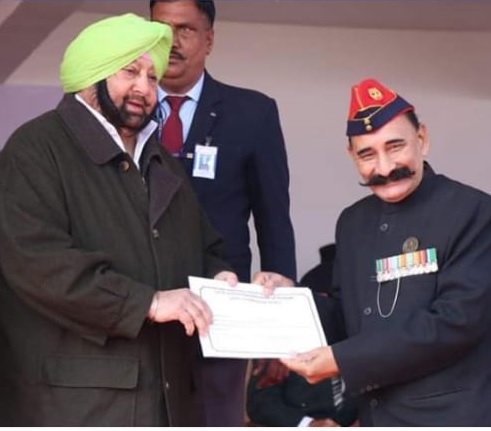
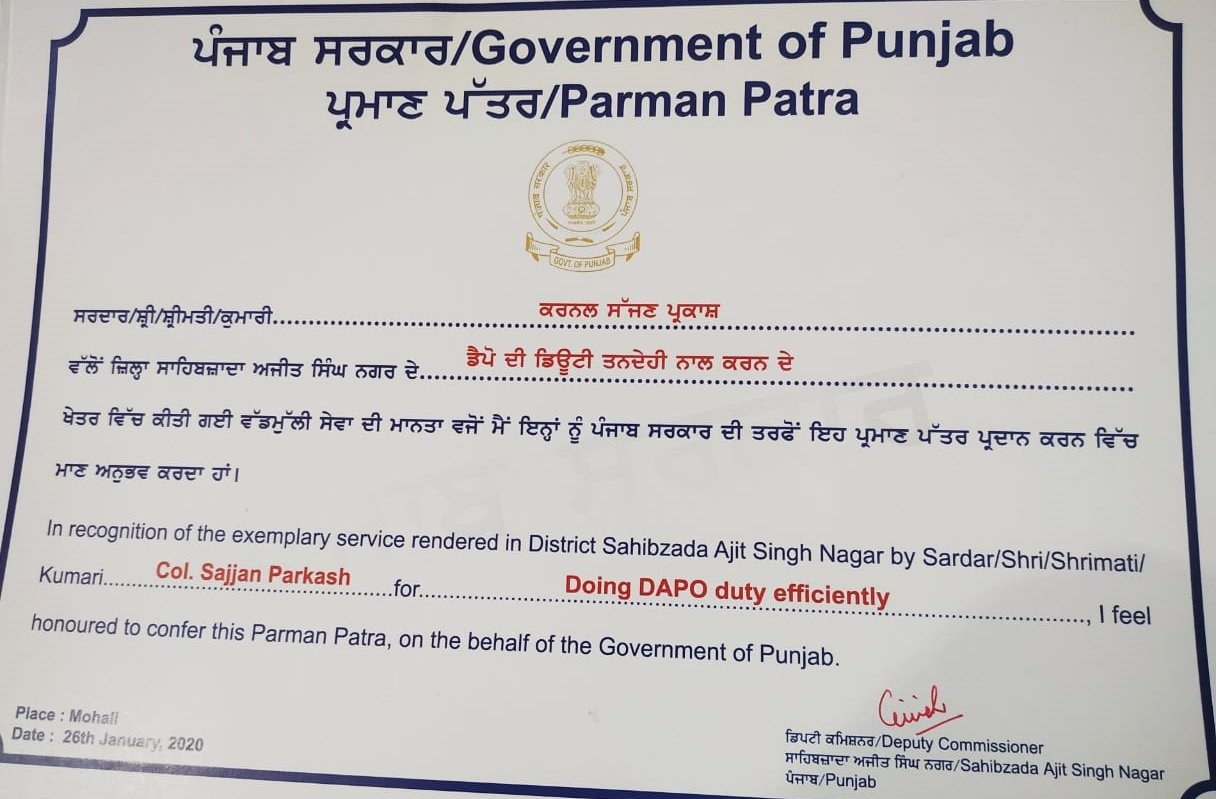
CONGRATULATIONS COL SAJJAN PRAKASH : veterans and SANJHA MORCHA IS PROUD OF YOUR TARGET ORIENTED ACHIEVEMENT

Untitled Untitled1
It is a proud movement for me to share with friends and welwishers that,
My contributions to irredicate Drugs menace  through DRUGS ABUSE PREVENTION  OPERATIONS has been recognised by Govt Of Punjab. I have been  HONOURED by Punjab CM Capt Amrinder Singh on the occasion of 71 st Republic Day at state level function. It is the outcome of hard work of Team GOG Derabassi
Col Sajjan  Prakash

Sikhs protest ‘eviction’ by forest, revenue officials They have been living in Qila Darhal tehsil since 1947

Sikhs protest ‘eviction’ by forest, revenue officials

People of Qila Darhal tehsil have warned to block the Jammu-Poonch highway if the administration fails to resolve the issue.

Shyam Sood

Rajouri, January 24

Various organisations, including the Bajrang Dal, Shiv Sena and the Sikh community, have been holding protests against senior revenue, forest officers/officials for “evicting” the Sikhs from their homes/agriculture land alleging the forest land has been encroached.

Members of the Sikh community residing in Qila Darhal Tehsil in Nowshera sub-district in Rajouri district, alleged that since 1947 they had been living in the area, and had constructed their homes and fields.

“Many among us and our ancestors have fought against Pakistani soldiers and tribesmen in 1947-48 and had forced the invaders to leave the Qila Darhal Fort and other areas” said Balbir Singh.

After the creation of Qila Darhal as a tehsil, the revenue officials in nexus with forest officials have changed their land records and by claiming their lands as encroached, has evicted about eight Sikh families so far, alleged those residing there.

“The Divisional Forest Officer, Tehsildar, Naib Tehsildar, Forest Range Officer and others, instead of taking action against the actual encroachers, have been harassing the Sikh families” said Zorawar Singh.

Shiv Sena activists have held protest at Sunderbani against the revenue and forest officials.

“Stop harassing those who had saved the mother land in 1947 and appeasing encroachers of forest land from a particular community on monetary consideration” they said.

Members of the Sikh community, Bajrng Dal and Shiv Sena have appealed to the Lt- Governor to intervene in this matter and also demanded CBI inquiry against the erring officials.

“In nexus with revenue and forest officials, many families from a majority community have encroached the forest land in Qila Darhal and other areas and have constructed their homes/fields” said Sushil Sudan, a former State Bajrang Dal president.

No action has been taken against such encroachers while the Sikh families living since 1947 have been evicted from their homes and agriculture land. This process should be stopped immediately, added Sushil.

People have warned to block the Jammu-Poonch highway if the administration failed to resolve the issue.


Plan to cut Army from internal security duties in N-E, will be done in next 18-24 months: Chief

“LoC incidents have increased as (Pak) under pressure, they have lost Kashmir,” Naravane said.
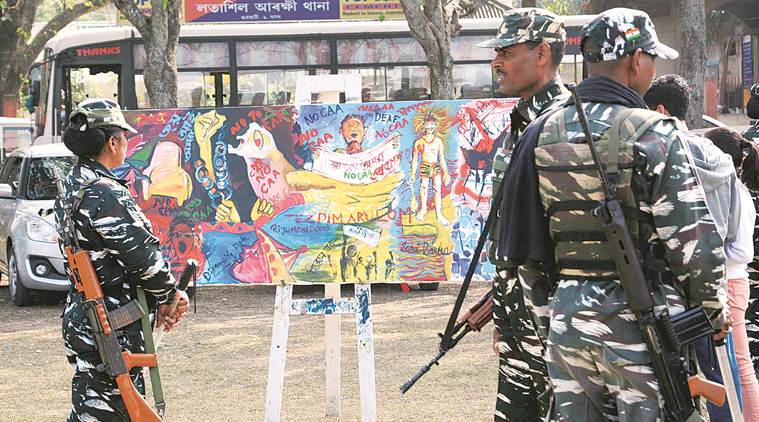
CRPF personnel at the Latasil ground in Guwahati where artists, sculptors and others took part in a protest against the new citizenship law on Wednesday. (Express photo by Dasarath Deka)

The Army plans to draw down all its regular forces deployed in counter-insurgency, counter-terrorism and internal security duties from the North-East in the next 18-24 months, to focus on conventional warfare, said Army Chief General M M Naravane.

He said that two battalions have already been taken off from such duties and the next drawdown will happen after the Bodoland elections in Assam are completed in June-July this year.

“The North-East is going through a very transitional phase, for the good. The security situation is improving as shown by the recent surrender of 600 members of National Democratic Front of Bodoland (NDFB) and other groups. We are working on a plan for the next 18-24 months on how to draw down regular forces from CI/CT/ internal security duties there,” General Naravane told The Indian Express.

“Two battalions have already been taken off. Once Bodoland elections are done in June-July and situation stabilises, we will release more troops,” he said.

“We will be committed fully on our long-term objective to focus on conventional warfare.”

Asked if a similar drawdown was the plan for the Kashmir Valley as well, the Army Chief said: “As I have said even earlier, the primary task is conventional warfare and that is our long-term goal. CI/CT is a short-term and immediate goal. We have not lost sight of long-term goal while focusing on short-term goals.”

He said that the number of ceasefire violations on the Line of Control (LoC) with Pakistan have spiked post August 5 when Article 370 was abrogated by the Centre and the state was split.

“Attempts are being made for terror activities (by Pakistan).Incidents on the LoC have increased as they are under pressure that they have lost Kashmir. It is desperation on their part as situation is better in Kashmir. Stonepelting, ambushes, IEDs. all the incidents have come down.”

General Naravane said that the XVII Corps (Panagarh in West Bengal) and IX Corps (Yol, near Dharamsala) have been selected as the one where Integrated Battle Group (IBG) model of restructuring is being first employed. It will, thereafter, be implemented in other corps, as it “lends itself to wars of the future” and also “lends itself to theatrisation”.

The Army Chief said the Army has sent its budgetary requirements and “the government will look into all aspects in light of the prevailing security situation and we are quite confident that we will get what we need to keep the nation safe and secure.”

“…Whatever the Budget, we will continue to be modernised and be operationally prepared,” General Naravane stressed.

He said that rebalancing of the Army towards the China border should be seen in the larger perspective, “and not merely in terms of numbers.”

“Quality is the focus and there is a lot of capacity building that we are doing. It is not that it wasn’t happening earlier, it was always happening. Different priorities are given in LTIPP (Long Term Integrated Perspective Plan). we are modifying our operational plans, and for plans to be successful, backend is being put in place.”

Citing the example of better infrastructure, including more roads towards the Line of Actual Control (LAC) with China, he said that the closer these roads are to the LAC, the more can be the frequency of patrolling as time for each patrol will reduce. This will “allow us to dominate the area in a more effective manner”.

The Army Chief said that the need for rebalancing towards China border was done “to ensure peace, we have to be prepared for war. we have to be ready to take certain actions when time comes. We have to be prepared.”

He also said that the repeat order for six Apache attack helicopters for the Army is being discussed and these negotiations are likely to be completed by mid-year.



Remove folk dancers’ statues from Heritage Street: Capt

HT Correspondent

letterschd@hindustantimes.com

Chandigarh : Punjab chief minister Capt Amarinder Singh on Tuesday ordered the removal of statues of folk dancers from the Heritage Street that leads to the Golden Temple in Amritsar.

The CM directed the cultural affairs department to shift and relocate the statues to some other appropriate place in the city in view of the sentiments of the Sikh community which had taken exception to these.

He also asked the DGP to review the cases registered against the seven protesters who had vandalised the statues and withdraw the stringent sections of IPC against them, said an official release.

Amarinder, while ordering the removal of statues, said the actions of the youth were not malicious but a reflection of the pain felt by the Sikh community which felt hurt at the statues being located close to the precincts of the gurdwara. The statues depicting folk dances bhangra and giddha, installed during the previous SAD-BJP regime in October 2016, were vandalised by angry protesters on January 15.

The protesters were arrested for damaging public property and allegedly attacking a police team. A number of Sikh organisations, including Shiromani Ragi Sabha, Guru Hargobind Sahib Shiromani Dhadi Sabha and Guru Granth Sahib Satkar Committees, came out in support of the demand for removal of statues, besides seeking their release. Akal Takht acting jathedar Harpreet Singh also backed the demands. “It is better if the statues are replaced with that of Sikh warriors and martyrs,” he had said.


India needs 7-10 days to defeat Pak in war: ModiIndia needs 7-10 days to defeat Pak in war: Modi

Rahul Singh

rahul.singh@hindustantimes.com

New Delhi : Prime Minister Narendra Modi on Tuesday said Pakistan has lost three wars against India, whose armed forces would need not more than “a week to 10 days” to defeat the neighbouring country in case of another war.

Speaking at the National Cadet Corps (NCC) rally here, Modi said Pakistan has waged a proxy war against India in Jammu and Kashmir for decades and killed thousands of people and security personnel but previous governments did not give the armed forces the permission to launch operations across the border.

“Many speeches were given but when our armed forces sought permission to take action, they were refused. But today the country is moving forward with ‘yuva soch’ (youthful thinking). So, it carries out surgical strikes and airstrikes to teach terrorists a lesson in their own backyard,” the PM said during his 45-minute speech.

He was referring to targeted operations against terror camps in Pakistan-occupied Kashmir (POK) in September 2016 and the Indian Air Force’s air strikes against terror bases in Pakistan’s Balakot last February — both swift actions taken after Indian soldiers and paramilitary personnel were killed in suicide attacks in Kashmir.

Modi said the two strikes led to peace not only in J&K but also in other parts of the country where no terror strikes had taken place. “Terrorism has been contained to a great extent,” he said. India will mark the first anniversary of the air strikes on February 26. The strikes on terror bases of the Jaish-e-Mohammed (JeM) were India’s response to last year’s Pulwama suicide attack in which 40 CRPF personnel were killed.

Pakistan’s behaviour has changed after the two strikes as the neighbour realised that the Indian political establishment would not shy away from ordering cross-border operations in response to terror attacks, two senior military officers said asking not to be named. Cross-border operations have been carried out several times in PoK, but the strikes of September 2016 and February 2019 were different because the political leadership took ownership of the action and announced India’s muscular military response to Pakistan-sponsored terrorism to the world. On January 11, army chief General Manoj Mukund Naravane said if the government ordered his force to seize control of PoK, it would act on those directions. “As far as PoK is concerned, there was a parliamentary resolution many years ago that the whole of erstwhile J&K is a part of India,” he said.


An officer’s best judge

An officer’s best judge

COL MAHESH CHADHA (Retd)

JAWANS are said to be the best judge of officers, more so in the combat arms — Infantry, Armoured and Artillery regiments — where they serve together for very long in the same unit. As the officer after joining the unit rises in rank and status, from Lieutenant to Captain to Major and so on, so do the men from the ranks to JCOs, developing a life-long relationship.

Even though officers go out of the unit to attend long-duration courses of instructions or on staff appointments, they invariably return to the same unit after about two to three years. That is till an officer is promoted to the apex rank and appointment as CO, which takes 16 to 20 years, and leaves the unit for good to undertake other appointments.

Thus, over a period, men start judging their officers by their own well established yardstick of leadership qualities — not by precept but by practice, forecasting their future. An officer’s physical toughness reveals itself while undergoing BPET (battle physical efficiency test) that involves a 5-km run, crawling through extremely lowly laid concertina wire obstacles, etc. His skill at arms is tested at the ranges while firing along with men his personal and team weapons. His learning prowess is seen while performing duties of a gunner — carrying and loading a 20-kg shell of a tank or positioning a cumbersome base plate of a howitzer or a mortar much before the laid-down parameters; or taming an unwilling mule to harness it.

His technical keenness is observed while lying under the tank with hands and face smeared with grease and oil. The mental robustness is tested during night watch and inclement weather while manning posts in Jammu and Kashmir and the North-East borders and during long-range patrols across some inhospitable terrain, snow-clad mountains or the sweltering deserts of Rajasthan — indefatigably leading 20-30 men self-contained for two to three weeks, carrying his own stuff, rations, weapon and ammunition.

The professional competence is judged by his performance during courses and competitions, joint exercises with other arms and services, as also when he is given charge to conduct classes to prepare the men for promotion to the next rank. His sportsmanship and team spirit are viewed at his skill in snatching a win for the unit. His jurisprudence comes to the fore during operational tasks when he factually establishes whether the jawan deserves an award or punishment for an act of omission or commission — dispensing justice.

His character is known by professional and personal integrity, punctuality and meaningful conduct during social gatherings, mess and other regimental functions. The humane aspect is judged when he despatches a strongly worded letter to the Deputy Commissioner or the Superintendent of Police to look into the problems faced by a jawan in his village — water from a nearby canal or an electric connection to his house or delivery of due benefits to his old non-earning parents, or taking to task some scoundrel casting an evil eye on his assets.

Displaying all this and more at every step, an officer to be accepted as an undisputed leader proves his nerve during a difficult situation — rescuing his men unscathed.

No astrologer can foretell an officer’s move up the ladder — Colonel to Brigadier to Major General and so on. It matters little though if the jawans, your comrades in arms, hold you in high regard. That is the highest compliment.


India ups testing mechanism as virus fears grip the nation

Coronavirus Health ministry designates 4 more laboratories for testing in suspected cases; 3-member team review preparations

Rhythma Kaul

letters@ghindustantimes.com

New Delhi : India has strengthened arrangements to deal with the deadly coronavirus amid its spread to other countries and reports of more deaths and new cases related to the outbreak from China, according to officials aware of the matter.

The Union health ministry has designated four more advanced laboratories for testing related to the virus along with the Indian Council of Medical Research-National Institute of Virology (ICMR-NIV) laboratory in Pune. The ICMR-NIV is testing four to six samples daily, and the number of suspected cases is on the rise. So far, ICMR-NIV has tested 20 samples of people quarantined across the country. None of the tests have been positive. “There is no coronavirus positive case in the country so far. We have added four more labs for testing and will soon add five more. All our labs are state of the art,” said Union health minister Harsh Vardhan.


The four ICMR labs designated for testing are in Alleppey (Kerala), Bengaluru, Hyderabad, and Mumbai. Hundreds of Indians studying in Wuhan, the epicentre of the coronavirus outbreak, have returned to India this month for the Chinese Lunar New Year holidays.

The officials said a dedicated three-member central team of experts has been sent to various states to review preparedness at the ground level.

“Additional investigations are needed to determine how the patients were infected, the extent of human-to-human transmission, the clinical spectrum of disease, and the geographic range of infection,” said ICMR in a statement.

The government has also extended the screening facilities for travellers coming from China to 13 more airports. This takes the number of airports, where checking happens for symptoms of the coronavirus infection, to 20. The health ministry is procuring extra thermal body scanners.

“The PM [Prime Minister Narendra Modi] is personally monitoring the situation. We have put in place all the measures needed to stop the entry and spread of the infection in India. In 2014, we managed to keep the deadly Ebola infection away from India, and this time also our efforts will be to ensure the virus does not enter the country,” said Vardhan.

The Indian government on Tuesday requested China to clear a flight that could evacuate about 300 citizens from Wuhan, the epicentre of the coronavirus outbreak that has so far killed 106 people and prompted the medical isolation of dozens in India, including the national capital, over suspicions of the infection.

Amid the evacuation of 500-odd Indians citizens stranded in China’s Wuhan, the ministry is also making arrangements for keeping them in isolation. “These people if flown here would need to stay under quarantine to minimise the risk of infecting others. They will have to stay in isolation in a government health facility for at least 14 days even if there are no symptoms,” Vardhan said.

India has so far screened close to 35,000 passengers. “All necessary arrangements are being made to manage the situation. There is nothing to panic so far,” said Harsh Vardhan.