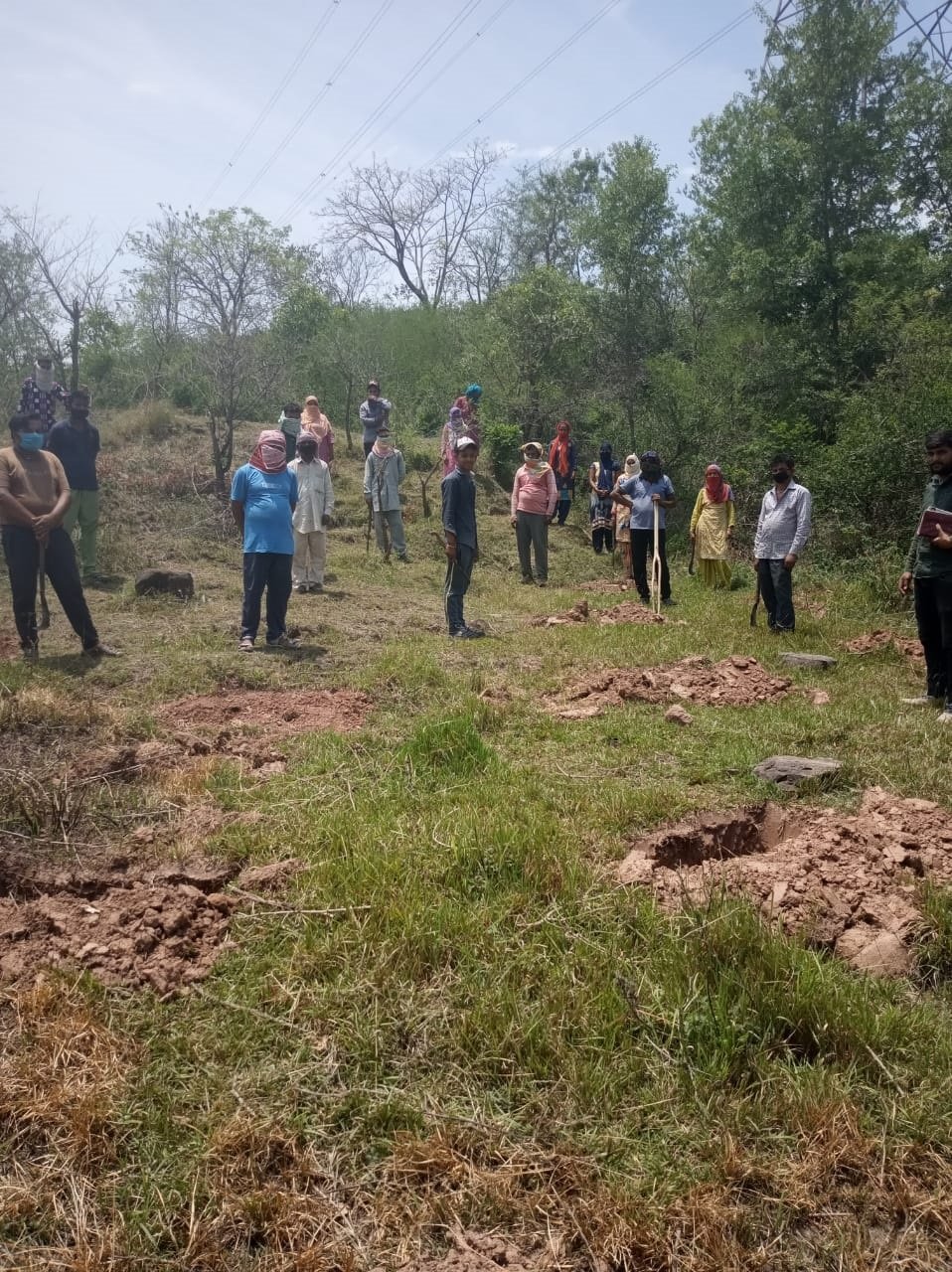
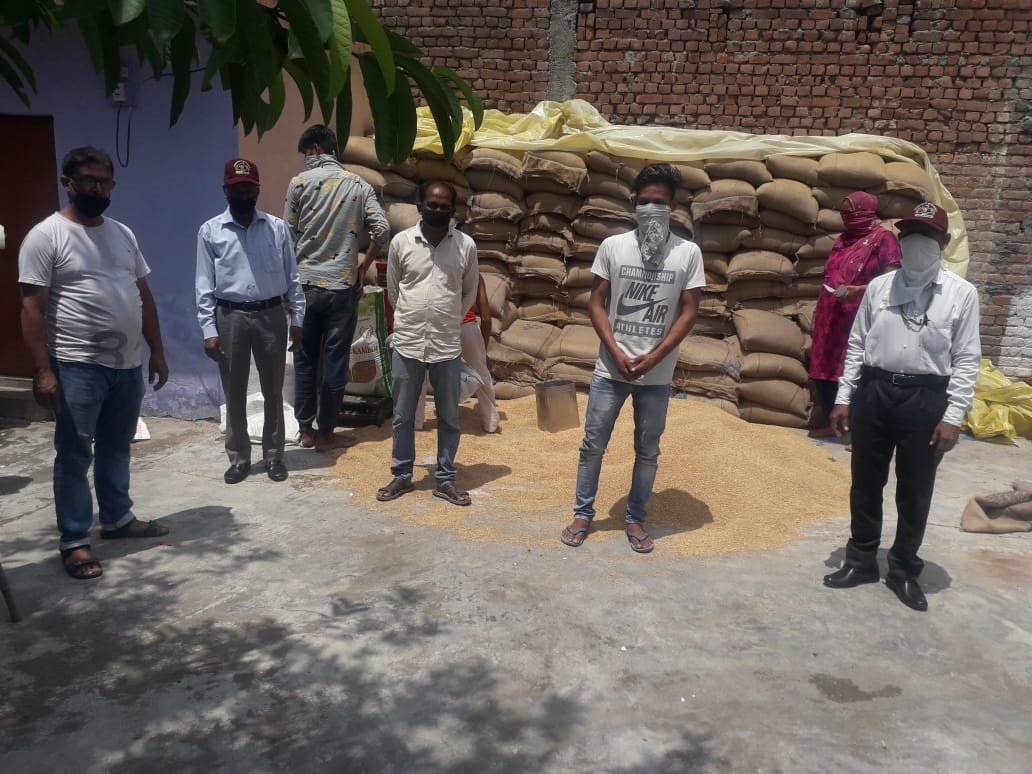
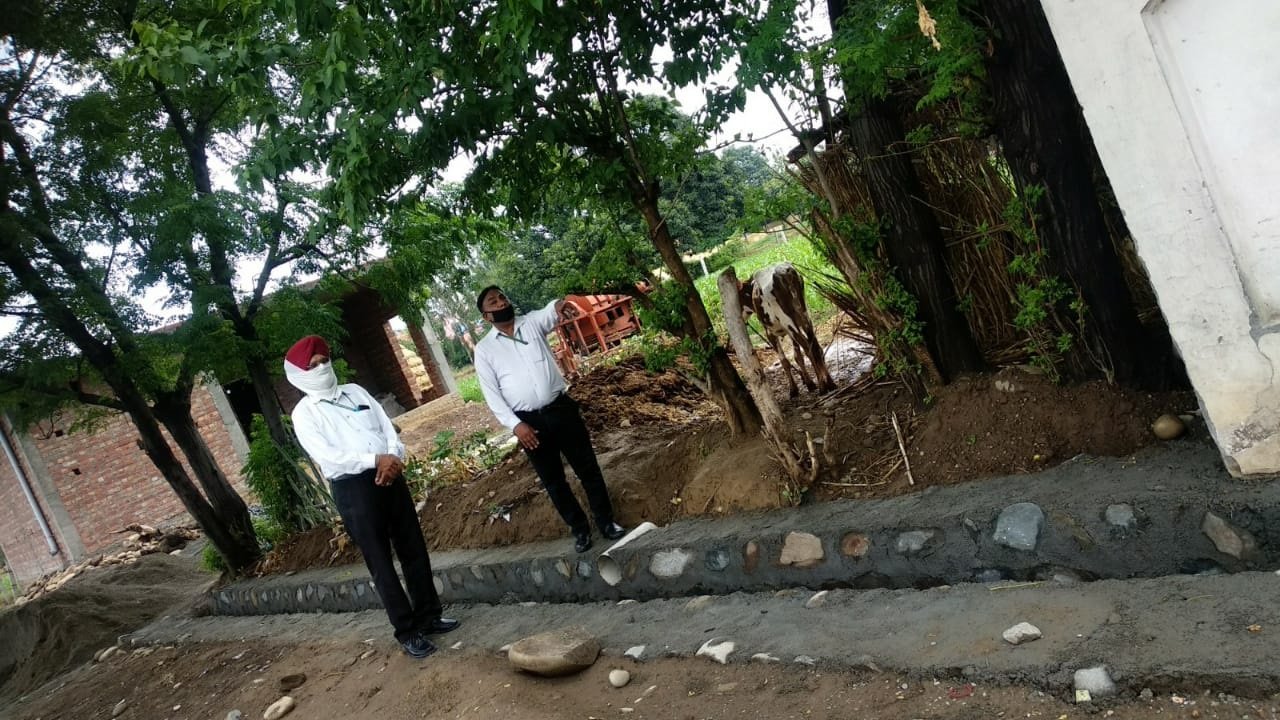
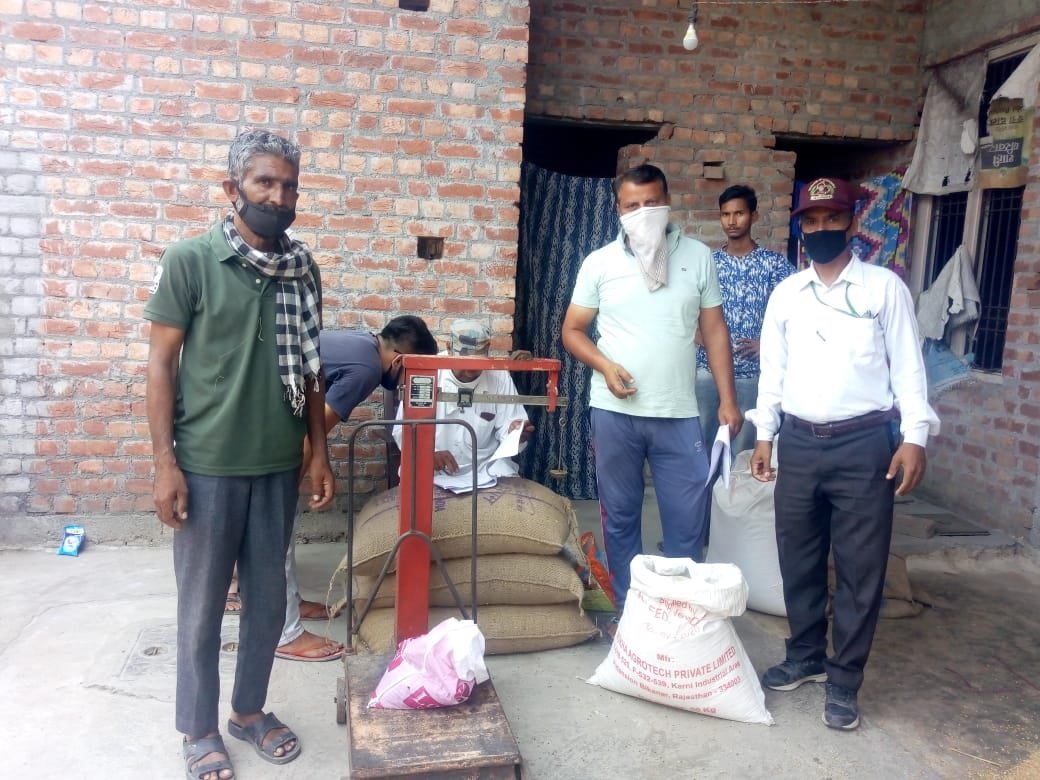
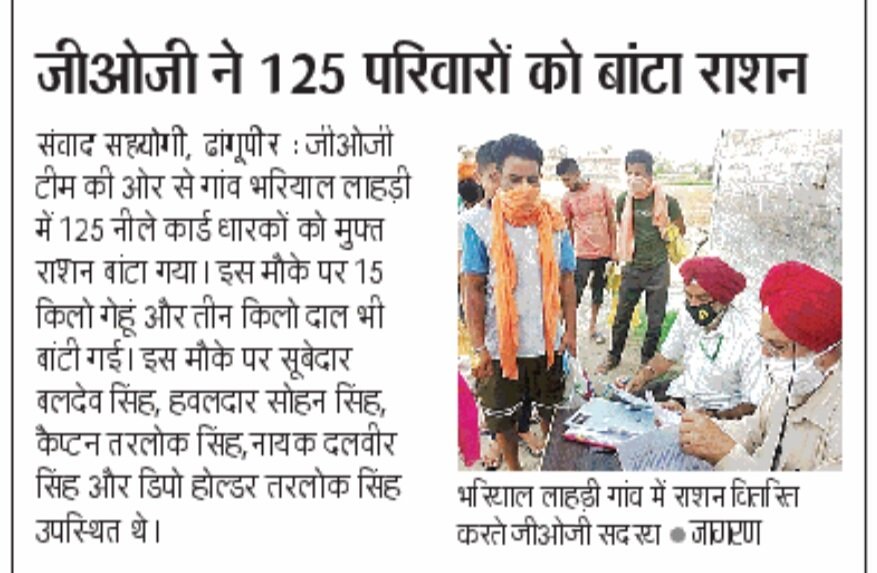
The Ex-Servicemen of Punjab who are employed as GOG (Guardians of Governance ) duties are not any more limited to keep tag over the Welfare Schemes of State along with development works of villages like Ponds/Roads etc .
Seeing their performance,capabilities,experienced, sincerity, and honesty the District Administrations are now depending and allocating additional task to them
During Harvesting seasons approximately 4000 Plus GOG were deputed to supervise procurement of Wheat in Mandis , which went on very smoothly and they in turn earned lot of appreciation from Distt Magistrates and farmers ,Mandi saff
The latest .Generating employment for unskilled and skilled workers in Dist Pathankot. Dist administration approached GoG to register the eligible candidates on Punjab Govt website.
In two days GoGs completed the task.The Target request was for 500 persons but GOG achieved 2662 applicants under Regn for Employment done by GoG as at 1000h on 06 jun 2020
1.Total 2662
2. Labour 1337
3. Skilled 1325
OTHER WORKS IN PROGRESS
दुनेरा पंचायत में जगलात का काम चला है टोटल मजदूर २८है
Be it Hindutva ideologues condemning the wicked foreign invader or Imran Khan hailing Turkish imperial rule, both want to reinforce that going forward means going backward.
A Turkish drama series brimming with tribal intrigues, blood, murder, and conquest — all wrapped in pious religious idiom — has taken Pakistan by storm. Filmed in Anatolia, Dirilis: Ertugrul is a 150-episode fictional account of Ertugrul Ghazi, father of the Ottoman Empire’s founder. As of yesterday (Friday), the YouTube count for the 30th Urdu-dubbed episode had already clocked up 5.5 million views on Pakistan Television.
Even those who made Dirilis are astonished — and hugely pleased — at its tumultuous welcome. Tribal Turkmen fighting for a homeland can’t be expected to capture the imagination of millions in some far-off country. But Pakistan is different. Transfixed, entire families are spending evenings watching it together. They think it is wholesome entertainment and genuine Islamic history.
What history? This is a free-wheeling caricature of 13th-century Anatolia of which we know next to nothing. Facts are not important, says Mehmet Bozdag, the man who wrote and produced the series. To quote: “There is very little information about the period we are presenting — not exceeding 4-5 pages. Even the names are different in every source. The first works written about the establishment of the Ottoman State were about 100-150 years later. There is no certainty in this historical data… we are shaping a story by dreaming.”
That this serial is frankly propagandistic and ideologically motivated is beyond doubt. It has been manufactured for a purpose. But what purpose?
Faked history fuels revivalist dreams, creates false hopes, & suggests the way forward is through the sword.
If it seeks to project Islam as a religion of peace and to counter Islamophobia, then the very opposite is achieved. The first scene of the first episode begins with sword-making and sword-sharpening in the background of nomadic tents. The tribe’s adversaries are Christians and Byzantines whose bloodied bodies lie scattered here and there after every fight. The hero, Ertugrul Ghazi, not only beheads several Knight Templars but also former associates from his tribe, such as Kurdoglu Bey, who he suspects of disloyalty.
Should we be surprised if IS-like organisations find this inspirational? Is glorifying the sword glorifying Islam? Islam can surely be represented in ways more positive than putting a spotlight on power struggles within a tribal society. Far better, for example, would be to build upon Turkish scholars like Ali Qushgi, Taqi-al-Din, or Al-Jazari. Without Islam’s early scholars the colorful tapestry of Muslim culture — and Turkish culture as well — would have been far poorer, its claim to being a great world civilisation weak and unconvincing.
I suspect Dirilis’s real goal is less about Islam and more to vent Turkish nostalgia for a long-lost empire. Production demanded massive funding by the Turkish state. A horse farm was created, together with a special zoo-like area for the sheep, goats, nightingales and partridges that appear on the show. A Hollywood stunt team was hired to train actors for the movie’s staged fights. Erdogan and his family have repeatedly visited the filming site.
Understandably, from within the bastions of Sunni Islam the reaction to this blockbuster has been fiercely negative. Both the UAE and Saudi Arabia have condemned and banned the series, and Egyptian authorities have issued a fatwa decrying this “insidious attempt to re-impose Turkish tutelage” over Arab countries formerly under Ottoman rule. Currently, Saudi Arabia is reportedly funding a $40m counter series called Malik-e-Nar of which trailers have already been produced. Though inadequate it does make the point: Arabs cannot celebrate Turkish imperialism.
Most peoples don’t like invaders, but Pakistan’s psyche is somehow special. Perhaps overwhelmed by Erdogan’s aggressive style, Prime Minister Khan proudly tweeted that Turks had ruled India for 600 years. Historians will raise their eyebrows — this is between quarter-true to half-true only. But it must be rare for a prime minister to hail imperial rule over his land.
Khan is not alone. Pakistan celebrates all post-eighth century invasions beginning with Mohammed bin Qasim’s conquest of Sindh in 712 AD. Urdu novelist Nasim Hijazi’s books, devoured by millions, are an ode to the Arab conquest of India. Like filmmaker Mehmet Bozdag, Hijazi’s strength lay in creating imagery unconstrained by facts.
How should one look at ancient invasions and imperial conquests? To laud or vilify them is equally irrational. India is a stunningly clear example of just how much a society can degenerate if it does that. Hindu revivalism is fixated upon the wicked foreign invader who shattered the seraphic heaven of Mother India. Suddenly all Muslims and Christians became unwelcome. As Narendra Modi’s right-hand man recently declared, foreigners are termites infesting a poor man’s grain store.
But do Hindutva’s mindless ideologues not know that all human civilisation began in Africa and there is no such thing as son of Indian soil? That every single human society on earth today is the result of countless conflicts, wars, and foreign invasions over tens of thousands of years? That even precision DNA tests cannot tell the difference between Hindus and Muslims? These basic lessons are for all, not just Pakistan’s rulers.
A mature attitude towards ancient foreign invasions would be to simply accept them clinically as facts of history. They should be investigated and absorbed without either glorification or condemnation. Doing otherwise is utterly pointless. No one living today can be held responsible for the actions, good or bad, of his or her ancestors. Moreover the mists of time have forever hidden true facts from view.
The creators of Dirilis: Ertugrul want us to wallow in the past glories of others and celebrate imperialism. Hook, line and sinker, we are mindlessly swallowing their proffered bait. This poisonous substance can only reinforce the dangerous delusion that going forward actually means going backward.
Instead, the way forward is to ask that Pakistaniat spring from Pakistan’s native soil. It must be rooted in the diversity of all our peoples and historically formed cultures. The year 1971 showed decisively the limits of pan-Islamism. Aping Saudi culture failed to create a viable Pakistani identity; aping Turkey won’t get us much further. Instead a strong national identity can emerge only if Pakistan embraces pluralism, accepts that Punjab is just another Pakistani province, and helps all citizens achieve a sense of belonging based upon a commitment to equality and justice.
The writer teaches physics in Lahore and Islamabad. Views are personal.
Psy Ops: In Ladakh standoff with India, China’s PLA replays Doklam tactics
China People’s Liberation Army is up to its old tactics to weaken the Indian resolve in the on-going stand-off at Pangong Tso and Galwan River in Eastern Ladakh.
Xi Jinping’s Chinese Communist Party has refined the concept of psychological operations by influencing the influencers of the adversary(AP)
Psychological operations against the adversary is the key ingredient in the Chinese War Zone Concept (WZC) doctrine. Although Psy Ops, as it is called, is an age-old concept since the times of Chanakya and Sun Tzu, the Chinese Communist Party (CCP) has refined it by influencing the influencers among the adversaries, on and off social media, to lower the morale of enemy troops and the political decision makers.
Under this strategy, its version of ground position maps and videos are leaked among the influencers to create political friction within the enemy country and seed doubt in the mind of the adversary on his capability to fight. Exaggerated information about deployed weapons systems against the enemy is circulated through official media even if the theatre weapons are untested or unproven in the field.
The basic idea is to overwhelm the enemy into panic so that his capacity to negotiate is weakened.
Just like the 73-day Doklam stand-off, the Chinese PLA is up to its old tactics to weaken the Indian resolve in the on-going stand-off at Pangong Tso and Galwan River in Eastern Ladakh. With the battle theatre totally transparent to the engagers through technology, the Chinese misinformation campaign has shrilled the pitch to seed the minds of the public with mistrust towards their government through tailored images and conjured up huge deployments to convey the threat of an imminent conflict.
Also Watch | Explained: Trump’s G7 offer to India, how it may help amid China standoff
Like the recent Chinese propaganda over a reconnaissance helicopter drone. Never mind that in a contested airspace, a slow-moving drone can be shot out of the sky in one go.
The propaganda about deploying latest motorised cannons and missiles in eastern Ladakh by Chinese too fails to mention that India too has the same systems in its armoury, if not better.
The PLA may be a step better in indigenous development of drones but India has already blunted that edge through imports from Israel. The air force of the two countries are evenly matched with both using Russian Sukhoi-30 as their front-line fighters. The Indian Air Force calls it Mark India (MKI) and PLA Air Force, Mark China (MKC). Despite China tom-toming about its two aircraft carriers, the Indian carrier-based naval aviation is miles ahead of anyone in the region barring a select few.
The other critical aspect of Psy-Ops is first, to create hope of resolution through dialogue and then lead it to disillusionment among the public, which is always looking for instant noodles. It is quite evident that the resolution of the current stand-off in eastern Ladakh will require a series of engagements with small incremental steps each time, if at all. Given the heavy deployment on both sides, each side would look for concessions from the other before the status quo ante is restored.
It will also be very difficult for either the diplomats or generals on both sides to reconcile due to historical memories constantly refreshed by Chinese attempts to dominate the 3,488 kilometre long Line of Actual Control (LAC).
Although China marched way ahead of upgrading border infrastructure in comparison to India at the turn of the millennium, New Delhi after initial lag, is fast catching up by building strategic roads right up to patrolling posts in eastern, middle and western sector of the Line of Actual Control.
Faced with a daunting Himayalan terrain in comparison to the flat Tibetean plateau, India is surely nullifying the Chinese military advantage. The standoff in eastern Ladakh and the belligerence of the PLA should be understood in this context.
Indian and Chinese armies hold Lt-Gen-level talks amid Eastern Ladakh standoff
The Indian delegation was led by Lt General Harinder Singh, the general officer commanding of Leh-based 14 Corps, while the Chinese side was headed by the Commander of the Tibet Military District, government sources said.
The high-level military dialogue took place a day after the two countries held diplomatic talks during which both sides agreed to handle their “differences” through peaceful discussions while respecting each other’s sensitivities and concerns.(AP file photo. Representative image)
Indian and Chinese armies on Saturday held Lieutenant General-level talks in their first major attempt to resolve the month-long border standoff in eastern Ladakh, official sources said.
The Indian delegation was led by Lt General Harinder Singh, the general officer commanding of Leh-based 14 Corps, while the Chinese side was headed by the Commander of the Tibet Military District, government sources said.
The talks were held at the Border Personnel Meeting Point in Maldo on the Chinese side of the Line of Actual Control (LAC) in Eastern Ladakh.
Without specifically mentioning the talks, an Indian Army spokesperson said: “Indian and Chinese officials continue to remain engaged through the established military and diplomatic channels to address the current situation in the India-China border areas.” Saturday’s meeting took place after 12 rounds of talks between local commanders of the two armies and three rounds of discussions at the level of major general-rank officials could not produce any tangible outcome, the sources said.
The high-level military dialogue took place a day after the two countries held diplomatic talks during which both sides agreed to handle their “differences” through peaceful discussions while respecting each other’s sensitivities and concerns.
Earlier, sources had said the Indian delegation at the military talks will press for restoration of status quo ante in Galwan Valley, Pangong Tso and Gogra in eastern Ladakh, oppose huge build up of Chinese troops in the region and ask China not to resist development of infrastructure by India on its side of the de-facto border.
After the standoff began early last month, Indian military leadership decided that Indian troops will adopt a firm approach in dealing with the aggressive posturing by the Chinese troops in all disputed areas of Pangong Tso, Galwan Valley, Demchok and Daulat Beg Oldie.
The Chinese army is learnt to have deployed around 2,500 troops in Pangong Tso and Galwan Valley besides gradually enhancing temporary infrastructure and weaponry.
The sources said satellite images have captured significant ramping up of defence infrastructure by China on its side of the LAC, the de-facto border, including upgrading a military airbase around 180 km from the Pangong Tso area.
The Chinese Army has been gradually ramping up its strategic reserves in its rear bases near the the LAC by rushing in artillery guns, infantry combat vehicles and heavy military equipment, they said.
China has also enhanced its presence in certain areas along the LAC in Northern Sikkim and Uttarakhand following which India has also been increasing its presence by sending additional troops, they said.
The trigger for the face-off was China’s stiff opposition to India laying a key road in the Finger area around the Pangong Tso Lake besides construction of another road connecting the Darbuk-Shayok-Daulat Beg Oldie road in Galwan Valley.
The road in the Finger area in Pangong Tso is considered crucial for India to carry out patrol. India has already decided not to stall any border infrastructure projects in eastern Ladakh in view of Chinese protests.
The situation in eastern Ladakh deteriorated after around 250 Chinese and Indian soldiers were engaged in a violent face-off on May 5 and 6. The incident in Pangong Tso was followed by a similar incident in north Sikkim on May 9.
Amid the ongoing India-China standoff, a Central Reserve Police Force (CRPF) unit based in north Kashmir has pledged to boycott all Chinese products.
The CRPF has officially distanced itself from the move, terming the pledge by the unit as an emotional response to a situation.
The video of the pledge by the CRPF to boycott all Chinese products has also gone viral on social media.
“This is not an official stand of the CRPF. Some personnel of the CRPF in a unit in Kashmir have taken the pledge out of emotion at the local level. We are looking into the matter,” a CRPF spokesman said on Friday.
In less than a minute video, the CRPF personnel of the 177 battalion based in Sopore sub-district are heard taking a pledge to boycott ‘’Made in China’’ products.
“Main June 2, 2020 ko yeh shapat letha huwn ki cheen main nirmat vastoon athwa samagri ka jaisi khane ki, peene ki, paihane ki athwah electronic upkaran, sanchar upkaran ka upyog nahi karonga, jai Hind (On June 2, 2020, I pledge not to use Chinese products like eatables, clothes, drinks, and electronics gadgets, communication etc etc. Jai Hind),” the CRPF men are heard while taking the pledge.
India and China are engaged in a major standoff along the Line of Actual Control in the Union Territory of Ladakh for the past many weeks.
Last week, the Ramon Magsaysay Award winner and a celebrated innovator and engineer Sonam Wangchuk, had urged the Indians to boycott “Made in China” products in response to the Chinese aggression at the border in Ladakh. Wangchuk, whose life story inspired Bollywood blockbuster ‘3 Idiots’, in his video from Leh had recently said he would get rid of his Chinese mobile phone, and in one year, would throw anything that is made in China out of his life.
Pakistan pounds border posts, villages along IB in J-K’s Kathua district Residents spend night in underground bunkers
Pakistani troops on Saturday violated ceasefire by resorting to unprovoked firing on forward posts and villages along the International Border (IB) in Kathua district of Jammu and Kashmir, officials said.
The firing from across the border in Karol Matrai and Chandwa started around 12.45 am, drawing effective retaliation by the Border Security Force (BSF) guarding the IB, they said.
They said the exchange of firing between the two sides continued till 3 am but there was no report of any casualty on the Indian side.
However, the firing caused panic among the border residents who were forced to spend the night in the underground bunkers for their safety. PTI
BSF jawan shoots himself dead with service weapon in Chhattisgarh The ASI was kept in a quarantine centre set up by the paramilitary forces
A Border Security Force (BSF) jawan allegedly committed suicide by shooting himself with his service weapon in Kanker district of Chhattisgarh on Saturday, police said.
The incident took place in the early hours at a forest in Pankhanjore police station area, police said.
“The deceased jawan, identified as Head Constable Suresh Kumar, was returning along with his colleagues after an anti-Naxal operation,” a senior police official told PTI.
A team of BSF’s 157th battalion had launched the operation on Friday from its camp in Sangam village, he said.
On the way back, Kumar allegedly shot himself with his AK-47 rifle between Ghoda and Dotameta villages, around 200 meters ahead of the camp, and died on the spot, he said.
What prompted him to take the extreme step is being ascertained, he added.
On Friday, an Assistant Sub Inspector (ASI) of the same 157th battalion had tested positive for COVID-19 in Bhilai town of Durg district. The ASI was kept in a quarantine centre set up by the paramilitary forces in Bhilai after he returned from his hometown in Uttar Pradesh following his leave.
The Frontier Headquarters of the BSF, which is extensively deployed in Kanker for anti-Maoist operations, is located in Bhilai.
Security forces who are returning from other states are being quarantined before being allowed to join the duty.
Pakistan Army claims to shoot down ‘Indian spying quadcopter’ along LoC Pakistan retaliated on February 27 by attempting to target Indian military installations
The Pakistan Army on Saturday claimed to have shot down an “Indian spying quadcopter” allegedly intruding across the Line of Control (LoC).
Military spokesman Major General Babar Iftikhar said that the mini copter violated the country’s airspace in Khanjar sector of the LoC.
“The quadcopter had intruded 500 metres on Pakistan’s side of the LoC,” he said in a statement.
The spokesman claimed that it was the eighth Indian quadcopter to be shot down by the Pakistan Army troops this year.
Last month, two such quadcopters were downed, the first on May 27 and the second on May 29 after they allegedly intruded deep inside the Pakistani territory, he said.
India has dismissed previous such claims by the Pakistan Army.
The ties between the two nations strained following the Balakot strike when the Indian Air Force jets bombed a Jaish-e-Mohammed training camp in Pakistan on February 26 last year to avenge the killing of 40 Central Reserve Police Force personnel in the Pulwama terror attack on February 14.
Pakistan retaliated on February 27 by attempting to target Indian military installations.
The ties were further nose-dived after New Delhi abrogated Article 370 that granted special status to Jammu and Kashmir in August last year. Pakistan downgraded diplomatic relations with India and expelled the Indian High Commissioner. PTI
NIA arrests terror funding conspirator in Visakhapatnam espionage case A total of 15 accused have so far been arrested, including 11 Navy personnel
The National Investigation Agency (NIA), on Saturday, arrested a terror-funding conspirator in the infamous Visakhapatnam espionage case, wherein 11 Naval personnel allegedly leaked sensitive information to Pakistan’s spy agency — Inter-Services Intelligence.
Abdul Rehman Abdul Jabbar Sheikh (53), a resident of Mumbai, was involved in the terror funding along with his arrested wife Shaista Qaiser and others, an official spokesman said.
During the search of his house, a number of digital devices and incriminating documents were seized by the NIA, which took over the case in December last year, he said.
The Indian intelligence agencies had busted the espionage racket linked to Pakistan in December last year.
The NIA arrested Mohammed Haroon Haji Abdul Rehman Lakdawala, a resident of Mumbai, last month. A probe found that he was one of the “key conspirators” in the case.
With the arrest of Sheikh, a total of 15 accused have so far been arrested, including the 11 Navy personnel, Pakistan-born Indian national Qaiser and her associates.
Pakistan-based spies recruit agents in India for collecting sensitive and classified information regarding locations and movements of Indian naval ships and submarines, and other defence establishments.
“Investigation revealed that a few Navy personnel came in contact with Pakistani nationals through various social media platforms such as Facebook and WhatsApp, and were involved in sharing classified information in lieu of monetary gains. The money was deposited into the bank accounts of the Navy personnel through Indian associates having business interests in Pakistan,” the NIA said last month. PTI
State Stalwarts
DEFENCE MINISTER
Minister Rajnath Singh
ALL HUMANS ARE ONE CREATED BY GOD
HINDUS,MUSLIMS,SIKHS.ISAI SAB HAI BHAI BHAI
CHIEF PATRON ALL INDIA SANJHA MORCHA
LT GEN JASBIR SINGH DHALIWAL, DOGRA
SENIOR PATRON ALL INDIA SANJHA MORCHA
MAJOR GEN HARVIJAY SINGH, SENA MEDAL ,corps of signals
.
.
PATRON ALL INDIA SANJHA MORCHA
MAJ GEN RAMINDER GURAYA ,MADRAS REGIMENT
sanjhamorcha303@gmail.com
PRESIDENT SOUTH ALL INDIA SANJHA MORCHA
COL SS RAJAN BOMBAY SAPPERS,
PRESIDENT UTTARAKHAND ALL INDIA SANJHA MORCHA
COL B M THAPA ,BENGAL SAPPERSS
PRESIDENT HARAYANA STATE CUM COORDINATOR ESM
BRIG DALJIT THUKRAL ,BENGAL SAPPERS
PRESIDENT TRICITY
COL B S BRAR (BHUPI BRAR)
PRESIDENT CHANDIGARH ZONE
COL SHANJIT SINGH BHULLAR
.
.
PRESIDENT PANCHKULA ZONE AND ZIRAKPUR
COL SWARAN SINGH
INDIAN DEFENCE FORCES
DEFENCE FORCES INTEGRATED LOGO
INDIAN AIR FORCE
Air Officer C-in-C WESTERN AIR COMMAND
AIR MSHL S PRABHAKARAN AVSM VM
AOC-IN-C, EASTERN AIR COMMAND
Air Marshal Inderpal Singh Walia
AOC-in-C SOUTH WESTERN AIR COMMAND
Air Marshal Vikram Singh
AOC-IN-C, SOUTHERN AIR COMMAND
Air Marshal J.Chalapati
AOC-IN-C TRAINING COMMAND
AIR MARSHAL SK GHOTIA VSM
AOC-IN-C MAINTENANCE COMMAND
Air Marshal Jagdish Chandra
Flag Officer Commanding in Chief, Western Naval Command
ice Admiral R Hari Kumar, PVSM, AVSM, VSM
Flag Officer Commanding in Chief, Eastern Naval Command
Vice Admiral Sanjay Bhalla, AVSM, NM
Flag Officer Commanding in Chief, Southern Naval Command