









Sanjha Morcha

What’s New

Click the heading to open detailed news

Current Events :

web counter

Print Media Reproduced Defence Related News

India working on two roads in Ladakh amid border row

India is not allowing the border confrontation with China to hinder strategic road projects in forward areas, including the Ladakh sector, an official familiar with the developments said.

An Indian Army truck crosses Chang la pass near Pangong Lake in Ladakh region in September 2018.

India is working on two key roads near the China border in eastern Ladakh — the site of a tense weeks-long border stand-off with its northern neighbour — to provide connectivity to an important forward area that the military calls Sub-Sector North (SSN), two senior officers familiar with the developments said on Monday.

While the first is the strategic Darbuk-Shyok-Daulat Beg Oldi (DS-DBO) road that provides connectivity to the country’s northern-most outpost, Daulat Beg Oldi, the second road being built from Sasoma to Saser La could eventually provide an alternative route to DBO near the Karakoram pass, said one of the two officers. The Sasoma-Saser La road axis is south-west of DBO.

Both projects are being executed by the Border Roads Organisation (BRO), which is ferrying 11,815 workers to areas near the China border in Ladakh, Himachal Pradesh and Uttarakhand for building strategic roads, as first reported by Hindustan Times on May 31.

India is not allowing the border confrontation with China to hinder strategic road projects in forward areas, including the Ladakh sector, where soldiers of the two nations are eyeball-to-eyeball at four locations along the Line of Actual Control (LAC), said the second officer cited above.

The current Chinese troop build-up in the Galwan valley threatens the critical 255-km DS-DBO road (also known as the SSN road), and top experts and China watchers have argued that India should build an alternative road to DBO.

The road from Sasoma to Saser La, at a height of almost 17,800 feet, is a tough project that falls under “Hardness Index-III”, the BRO’s top-most classification for hard projects, the second official added. Experts believe that the road can be extended to Brang Sa, Murgo and eventually DBO in the long term. BRO officials weren’t available for a comment.

“There’s a 200% need to have an alternative road to DBO in Sub-Sector North. The DS-DBO road can be interdicted at several choke points by Chinese forces during hostilities. While the road from Sasoma to Saser La can connect with DBO, it will be an engineering challenge due to the terrain. It may require construction of a tunnel too,” said Lieutenant General BS Jaswal (retd), a former Northern Army commander.

HT reported on May 27 that if the DS-DBO project is blocked, the Indian Army will be forced to use aerial supply lines and also build an arduous alternative route linking Sasoma to Murgo to DBO through the glaciated Saser La. Two years ago, the BRO said the Sasoma-Saser La road would be the world’s first motorable glaciated road.

Lieutenant General DS Hooda (retd), also a former Northern Army commander, said the construction of Sasoma-Saser La road in the glaciated terrain posed a huge challenge, especially in the final patches near Saser La.

“If we can build this road and further connect it to DBO, it could provide an alternative route during summer months. However, the all-weather DS-DBO road will remain very important for the army,” Hooda said.

The defence ministry told Parliament’s standing committee on defence last year that the Sasoma-Saser La road was a challenging project because of its peculiarities.

“Due to peculiarity of formation and shifting of moraines, the road suffers continuous shifting resulting in various gradients… The Central Road Research Institute has been approached for providing solution and the proposal based on CRRI recommendation is being prepared,” the ministry told the panel.

Amid the border stand-off, top officials said the BRO would complete all 61 strategic roads assigned to it along the China border by December 2022 for swifter mobilisation of troops and stores to forward areas.

A day after the external affairs ministry said that India and China will continue military and diplomatic contacts to resolve the border stand-off, defence minister Rajnath Singh met the chief of defence staff and the three service chiefs and reviewed the situation along the disputed border in the Ladakh sector.

An hours-long meeting on Saturday between a delegation led by Lieutenant General Harinder Singh, commander of Leh-based 14 Corps, and a Chinese delegation headed by Major General Liu Lin, commander of the South Xinjiang military region, at Moldo on the Chinese side of the LAC ended without a breakthrough.

The external affairs ministry said the meeting “took place in a cordial and positive atmosphere” and both sides agreed to work towards peacefully resolving the situation.

In the first official acknowledgement of a troop build-up along the disputed border with China. Singh last week said a significant number of Chinese troops were present along the LAC and the Indian Army had matched the neighbour’s military moves.

China has marshalled close to 5,000 soldiers and deployed tanks and artillery guns on its side of the disputed border in the Ladakh sector, where India has also sent military reinforcements, as reported by HT on May 26.

The situation of the ground remains unchanged in the midst of efforts to break the stalemate, said officials. They added that increased Chinese air activity had been observed on the other side of the LAC during the last few days.


Navy, IAF get ready to evacuate stranded citizens from Gulf nations

NEW DELHI: The government has directed the Indian Navy to get their big sailing engines ready to bring back citizens stuck in the Gulf countries due to the coronavirus induced lockdown.

India has imposed a travel ban both within the country and oversees till May 3 to fight the Covid-19 outbreak.

The directions were issued last week during a meeting of three service chiefs and the Chief of Defence Staff with Prime Minister Narendra Modi and other Cabinet members.

Navy and Air Force were briefed to get their machines ready in order to bring back the Indian citizens from the Gulf countries.

External Affairs Minister S. Jaishankar had stated that the missions in the Gulf countries were liaisoning with local authorities to move Indian citizens to one place. The Indian missions there have opened the registration process for Indians who want to return.

The Indian Embassy in Qatar tweeted: “We are collecting data about the people requesting repatriation to India…. At this stage, the purpose is only to compile information. No decision or details yet on resumption of flights to India.”

It further stated that as and when a decision is taken, the Embassy will make a clear announcement. “Please note that the form has to be filled separately for each individual, even if they are members of a family, ” the Embassy tweeted.

INS Jalashwa, an amphibious assault ship, and two Magar class tank-landing ships are being readied for the evacuation purposes.

These ships have started making arrangements as per the standard protocols laid out to deal with suspected Covid-19 cases like social distancing and sanitisation.

The Indian Navy has started removing non-essential equipment in order to accommodate the evacuees.

These three ships can bring back around 2, 000 people while maintaining social distancing.

The Indian Air Force has been evacuating citizens from countries affected by Covid-19 frequently since January, which includes flights to China, Japan, Iran, Kuwait and Italy. The force has stated that it has kept C-17 Globemaster and C-130s on standby which can be used whenever they are required.

Apart from them, Air India flights are also being kept on standby to pick up stranded Indians from the Gulf countries.

Earlier, the Navy had carried out evacuation efforts in war-torn areas like Lebanon (2006) and Yemen (2015). Before that, evacuation was carried in 1990 during the first Gulf War between Iraq and Kuwait when around 1.5 lakh people were evacuated.


CDS briefs Rajnath Singh on stand-off situation in Ladakh

NEW DELHI:Defence Minister Rajnath Singh met Chief of Defence Staff General Bipin Rawat and three service chiefs on Monday to review the stand-off situation at Line of Actual Control in Eastern Ladakh.


Singh was also briefed about the deliberations that took place during the meeting of military commanders of both the countries on June 6.

“The meeting with Defence Minister was called for an assessment on the talks and future strategy as the army prepares for a long haul, ” a source said.

During the meeting, a plan is being drawn out to deal with issues that continue to be a cause of concern for India. The meeting went on for over an hour where General Bipin Rawat briefed Singh about the further course of action.

On Sunday, India’s External Affairs Ministry stated that India and China have agreed to “peacefully resolve” the stand-off situation in Ladakh in accordance with various bilateral agreements. The ministry also stressed that military and diplomatic dialogue will continue to resolve the prevailing situation in Eastern Ladakh.

“The two sides will continue the military and diplomatic engagements to resolve the situation and to ensure peace and tranquility in the border areas, ” the ministry said in a statement.

The ministry issued a statement based on deliberations that happened during a meeting on Saturday between both countries’ military delegates.

The ministry had said that a meeting was held between the Corps Commander based in Leh and the Chinese Commander on Saturday in the Chushul-Moldo region. Indian military delegate was headed by the commander of Leh based 14 Corp Lieutenant General Harinder Singh and Chinese delegate was headed by Major General Liu Lin, Commander of South Xinjiang Military Region.

It took place in a cordial and positive atmosphere, the ministry said.

“Both sides agreed to peacefully resolve the situation in the border areas in accordance with various bilateral agreements and keeping in view the agreement between the leaders that peace and tranquility in the India-China border regions is essential for the overall development of bilateral relations, ” the ministry had said in a statement.

The ministry had further stressed that both the countries noted that this year marked the 70th anniversary of the establishment of diplomatic relations between the two countries.

“Both the countries have agreed that an early resolution would contribute to the further development of the relationship, ” the ministry had said.

India and China are having dialogue to resolve the stand-off situation in Ladakh region, particularly at the north bank of Pangong Lake where the Chinese People’s Liberation Army has attempted to change the status quo.

China has made attempts to change the status quo by putting up shelters and setting up a camp in areas that were under Indian control so far.

Before this dialogue, talks between major general-rank officers between the two countries took place on June 2 that remained “inconclusive”.

A clash took place at Pangong Lake on May 5 when troops from both the armies were involved in the clashes leaving several from both sides wounded.

Sources further pointed out that the stand-off was not spontaneous reaction to India’s road construction in Ladakh. Unusual activities were first noticed a few weeks before the clash in May.

The current stand-off in Ladakh is not the usual patrolling face-off but part of the new combative strategy that was rolled out by China after Doklam.

In 2017, there was a 73-day stand-off between India and China. The stand-off was at the India-China-Bhutan tri-junction Doklam. China’s road construction in Bhutanese territory was seen as an attempt to change the status quo by India and finally the road work had to be stopped.


Security agencies warn of Chinese espionage attempts amid pandemic

NEW DELHI:China is aggressively pursuing a diverse range of tactics — from cyber-attacks to recruiting insiders for economic espionage, Indian security agencies have warned. The specific alert circulated among key stakeholders suggests that Chinese operatives are not only planning to steal classified cutting-edge defense technology but also eyeing to recruit best academicians and researchers around the globe, especially from the US.
Sources said they have noticed that China has authorized an “aggressive program of stealing US science and technology information by recruiting Americans in the technology sector with access to trade secrets”.

In the technology sector of the US, many Indians scientists are working at the forefront. “This is a serious matter for Indian government and security establishments, ” said a top source further adding that Chinese always pursue economic espionage because it suits their low cost manufacturing sector on the basis of stolen research and costly design developed by top companies across the globe.

“An alert was also issued in early January about Chinese cyber intrusion attempts at several companies where Indian researchers are working. The espionage attempt was to target UAV technology and certain top-end military equipment designs. After stealing the techniques and design, China starts producing these equipment domestically and sells at a cheaper rate, inflicting irreparable damage to the original equipment manufacturers, ” the sources in the security establishment observed.

Recently, the US accused China for targeting academia by sending researchers to American labs and using talent recruitment programme to steal scientific analysis. The US has also found that young recruits of the People’s Liberation Army posing as students are entering into various universities across the globe to get research papers and recruit academia.

Earlier this year, the US charged a former Boston University student of visa fraud for failing to disclose the status as a lieutenant in the China’s People’s Liberation Army.

The US intelligence agencies have found that their “universities have become a soft target in the global espionage war with China”.

In January this year, the US Department of Justice charged a leading academician at the Harvard University for hiding his alleged role in a Chinese government programme.

In July last year, the Federal Bureau of Investigation (FBI) Director Christopher Wray had revealed that the FBI is probing nearly 1, 000 cases of economic espionage and attempted intellectual property theft, nearly all of them leading back to China.

Accordingly, Indian Missions have been informed about the threats being posed by Chinese spies and attempts to recruit Indian scientists and technologists working in the US and other parts of the world.

Sources further stated that security establishments in India have informed the scientist fraternity to be on alert amid threat posed by Chinese spies.

The Chinese had earlier recruited a personnel, Dongfan Chung, working at Boeing for economic espionage. Chung had stolen secret technology to benefit Chinese government and during the raid at his house more than 2.5 Llakh classified pages related to Boeing were recovered.

“There has been intense debate on the international platforms regarding Chinese-sponsored theft of intellectual property. American agencies have gone on record to say that China was targeting trade secrets. In the backdrop of pandemic and global health crisis, Indian establishments in defence and technology sectors have been told to be extra cautious as China is planning to become the most advanced economy while the other countries are crippled by the highly contagious virus, ” the sources further added.


A house for New India’s Parliament

Any plan to discard 7, Lok Kalyan Marg, and spend an extraordinary amount on a new PM House, howsoever magnificent and imposing, across the Central Vista, would be imprudently extravagant. With some minor alterations and refurbishment, the whole of South Block can be used for the PMO. On the commissioning of the new Revenue Bhawan, the North Block can be cleared of all ‘temporary’ additions and alterations and restored to its pristine glory.

A house for New India’s Parliament

Pawan Kumar Bansal

former Union Minister

IN April this year, when the country was battling a novel virus, the entire population was ordered into a lockdown, the engines that drive economy had come to a halt and no viable solution was apparent about how to reboot the economy, officers in the Expert Appraisal Committee of the Environment Ministry were fast-tracking its approval of a grandiose Rs 20,000-crore proposal — a new Parliament building, a Central Secretariat complex to house 70,000 Central government employees, redevelopment of the Central Vista, a stately PM’s house-cum-office and the Vice-President’s residence. That the approval was hurriedly accorded at an online meeting of the officials alone in the absence of expertise from architects and town planners, points to the urgency that the government attaches to the plan.

While some changes might be necessary, it all seems an untimely and a reckless step. Apart from the financial constraints, the country will be sadly deprived of its history and the monuments that speak of our past.

The Palace of Westminster, the seat of British Parliament, was built 150 years ago, incorporating many parts of the old building that survived a major fire in 1834. The Reichstag Building in Berlin was built in 1894 and refurbished in 1990. The US Capitol Building in Washington DC was built in 1800. These age-old structures are a witness to the histories of their nations.

The Indian Parliament House, likewise, is not just another building. It represents the country’s persona. Though built by the imperialist rulers, Sansad Bhawan, as it is now called, represents the best of Indian architecture and tradition. With its design, structure, inscriptions from scriptures and paintings depicting India through the ages, it is an intrinsic part of our history, a national symbol, and a living witness to India’s constitutional and legislative history.

The bracingly stunning Parliament House along with the South and North Blocks on the Raisina Hill are all set to be discarded for making room for museums. The reasons advanced for a new Parliament building is that the Lok Sabha and Rajya Sabha chambers will fall short of space when the number of MPs increases and that it has no offices for MPs and their research staff. The new mega project intends to raze all bhawans built after 1947 to house various ministries. Their demolition by implosion may be effected in a matter of seconds, but building a mammoth complex instead, coupled with the construction of temporary offices for a long interregnum and shifting of all records there, will be no easy task.

Before Independence, the Central Legislative Assembly, Council of State and the Princes met in three different chambers which now function as the Lok Sabha, Rajya Sabha and Members’ Reading Room, respectively. The semicircular and horse-shoe shaped chambers have coterminous inner and outer lobbies. On the first floor are the visitors’ galleries. The Central Hall, where India’s Constituent Assembly met on December 9, 1946, is significant for witnessing the momentous transfer of power and resonating with Jawaharlal Nehru’s ‘Tryst with destiny’ speech. The open circular verandah on the first floor of the building is an imposing colonnade. This, in symphony with other features, lends the circular Parliament House a unique charm of architectural accomplishment and visual delight.

Some modern, elegant buildings like the DRDO Bhawan, Jawaharlal Nehru Bhawan or Vigyan Bhawan have been built in the past and an annexe added to the Parliament House estate. To meet the needs of a modern library, a standalone library building was built in 2006 with a tasteful banquet hall, reading rooms, and the Bureau of Parliamentary Studies and Training. Besides the Parliament area, many ministries have their own standalone buildings or function from joint complexes within the New Delhi Municipal Corporation area. It is impossible, even inadvisable, to club them altogether in one mammoth complex of offices.

To meet any future requirement of bigger chambers for the LS and RS, the Central Hall can be converted into the LS Chamber and the present LS Chamber can house the RS. This will require minimal alterations. A new Central Hall and MPs’ chambers can be built on the piece of land behind Mahatma Gandhi’s statue. A few ministers’ lounges in the main building itself can free over 70 rooms that remain unopened for 280 days in a year. The cost of these changes will be a fraction of the colossal Rs 20,000 crore earmarked for the new plan.

What is puzzling is another underlying agenda of the new plan: a majestic residence-cum-office for the Prime Minister. After the Teen Murti House, occupied by Jawaharlal Nehru as India’s first Prime Minister, there was no permanent PM’s residence. Rajiv Gandhi took up residence at 7, Race Course Road, which has since continued to be the PM House. The RCR, now renamed Lok Kalyan Marg (LKM), actually has five bungalows: two of these are the PM’s residence and office; the third is the PM’s guest house; fourth is with the Special Protection Group; and the fifth is used as a helipad for the PM.

These houses are by no means ostentatious, though like other Lutyens’ bungalows, they have large open spaces and vast, manicured lawns. To this, have been added two conference halls and an underground tunnel leading to Safdarjung Airport to avoid traffic hold-ups during the PM’s movement. Necessary refurbishments carried out from time to time lend LKM grace befitting the PM’s position, though by no means opulent. For the PM’s meetings with and banquets for visiting Heads of State, Hyderabad House provides a perfect venue.

Therefore, any plan to discard 7, LKM and spend an extraordinary amount on a new PM House, howsoever magnificent and imposing, across the Central Vista, would be imprudently extravagant. With some minor alterations and refurbishment, the whole of South Block can be used for the PMO and on the commissioning of the new Revenue Bhawan, the North Block can be cleared of all ‘temporary’ additions and alterations and restored to its pristine glory.

A functionary of the Ministry of Urban Affairs described the project as a representation of the ‘values and aspirations of a New India — good governance, efficiency, transparency, accountability and equity, and is rooted in the Indian culture and social milieu.’ This time, the task of spelling out the spirit of New India to be manifested by our own new grand Capitol has been left to an official and he has succinctly put across the idea, knowing well that for such ideal democratic values, the country does not have to wait for any new physical structures, but a firm resolve by those with whom the government authority vests.


Defence lacks money for self-sufficiency

Defence lacks money for self-sufficiency

CRUNCH: There’s a big gap between funds demanded by the services and outlays allocated to them.

Amit Cowshish & Rahul Bedi

Amit Cowshish Financial Adviser, acquisition, MoD & Rahul Bedi Senior journalist

THE one irrefutable input in augmenting atmanirbharta, or self-sufficiency, to fulfil India’s assorted materiel requirements, as recently promulgated by Finance Minister Nirmala Sitharaman is, simply, money. And lots of it, to galvanise India’s sluggish defence industrial base by attaining military technology, expanding competitive manufacturing and augmenting military exports.

However, in the din over atmanirbharta, the Ministry of Defence (MoD) is, ostrich-like, disregarding the reality that apart from the massive funding needed to buttress this domestic initiative, similar amounts, if not more, will be needed annually to eventually procure the ensuing equipment.

Regrettably, neither Sitharaman nor any other official has provided guidance or direction from where this massive financial injection can be sourced to progress the atmanirbharta objective and to commercially perpetuate it in the calamitous monetary distress triggered by the coronavirus pandemic.

The stock response of MoD officials to these disquieting and seemingly inexplicable queries is that the solution has been outsourced to the 15th Finance Commission, by asking it to address concerns regarding the allocation of a separate and non-lapsable fund to manage India’s various defence and internal security commitments. Incredulously, they would have us believe that such subcontracting is the panacea for this seemingly insoluble financial calamity.

It is now evident that the perennially widening gap between the funds demanded by the services and other MoD departments and the annual outlays allocated to them will widen as a consequence of the pandemic-driven financial crisis. For the services, this fiscal chasm has steadily widened over a decade: from around Rs 23,000 crore in 2010-11 to Rs 1,03,000 crore in 2020-21. In these intervening years, the disparity between capital and revenue outlays for modernisation and salaries and operating expenses respectively, too has sizeably widened.

In the fiscal year 2020-21, for instance, the MoD allocated merely Rs 1,13,000 crore towards capital expenditure for all three services, against Rs 1,75,000 trillion which they had demanded for all-round modernisation and upgrades. Conversely, the annual budget apportioned almost twice that amount of Rs 2,18,000 crore to the military’s revenue expenditure. For the Indian Army, on the other hand, the revenue-to-capital outlay ratio was particularly low — 83:17 per cent — whereas the desired ideal, according to succeeding parliamentary defence committees that have criticised this unremitting decline, is pegged at a 60:40 per cent quotient.

Furthermore, the severity of this resource crunch even before the pandemic struck can be gauged from delayed payments by the MoD for committed liabilities or previously acquired materiel, especially from the local state-owned entities. Last December, the parliamentary defence committee severely castigated the government for defaulting on these payments, which in a wider context is not only embarrassing but also casts doubts on India’s solvency in the global arms bazaar. And though the MoD has been putting up a brave front, its macho stance in insouciantly dealing with the financial predicament is beginning to resemble misdirected bravado.

Another frequently advanced argument, and one propounded by Sitharaman, albeit without elaboration, is furthering defence exports to earn revenue to fund modernisation. As an indicator, MoD officials point to the increase in India’s materiel exports from Rs 4,682 crore in 2017-18 to Rs 10,745 crore the following year. But this deduction, like much of the rest, remains flawed.

Firstly, it is unclear whether this doubling of defence exports includes equipment manufactured by private industry, which was not the case earlier. Secondly, the boost in Indian materiel exports is quite simply the outcome of indigenous manufacturers, including private sector companies, becoming better integrated in recent years with the production lines of overseas original equipment manufacturers (OEMs).

Thirdly, and more importantly, the quality of Indian equipment is highly questionable. This was epitomised by the embarrassing termination in 2015 of the contract for seven Dhruv Advanced Light Helicopters (ALHs) by the Ecuador Air Force (EAF), for $145.2 million, after four of them crashed, which dealt a body blow to the quality of Indian defence equipment.

Manufactured by Hindustan Aeronautics Limited (HAL), the ALH had bested competition from Israel’s Elbit, Eurocopter, and Russia’s Kazan Helicopters in bagging the EAF contract in 2008-09. At the time, the EAF had stated that two of the four ALH crashes were due to ‘mechanical failure’, but HAL, which completed Dhruv deliveries to Ecuador by 2012, absolved itself of all responsibility. It maintained that the 24-month warranty period for HAL to provide after-sales service support for the seven ALHs had long expired and hence it was the EAF’s responsibility to support them

Conveniently, HAL turned a Nelson’s eye to Dhruv’s multiple technical problems at home that included crashes and fleet groundings, all of which detracted from the platform’s overall credibility, not only as a platform or domestic employment but also as a reliable export model. It is also an open secret that India’s military too reposes little or no confidence in indigenously developed equipment, all of which goes to undermine governmental efforts to market it overseas.

And, lastly, around half of India’s defence exports of Rs 5,000 crore in 2018-19, comprising spares and sub-assembles, were to the US, Israel and European Union conglomerates. But now, it’s evident that all these markets will contract significantly due to the pandemic, and without doubt, Indian defence imports will become a low priority for them if, indeed, one at all.

It is also impossible to imagine major materiel importers like Australia, Algeria, Iraq, Saudi Arabia, Turkey and the UAE opting for Indian equipment over more proven systems from long-established sources. Consequently, the decision to hike the limit on foreign direct investment in defence from 49 per cent to 74 per cent too is unlikely to see foreign OEMs lining up to invest in India.

Woefully, this brings the narrative back to where it started: that the achievability of Sitharaman’s aim of atmanirbharta is paradoxically contingent upon money that India neither has, nor is seeking to preserve for spheres other than defence, or both.

In short, where is the money?


Live bullets, empty cases recovered from two bags during X-Ray scanning at Srinagar airport

Live bullets, empty cases recovered from two bags during X-Ray scanning at Srinagar airport

Srinagar, June 8

The security forces have recovered some live bullets and empty cases from two bags during X-Ray scanning at the Srinagar airport on Monday, officials said.

During the X-Ray scanning at the drop gate of the airport, the security personnel deployed there recovered some live bullets and empty rounds from two bags, they said.

The officials said while four AK-47 rifle rounds and one round of INSAS rifle were recovered from a bag, 21 empty cases were recovered from a suitcase.

The bags, sent through a courier, were meant for a soldier presently attached with the Army’s 1 Rashtriya Rifles Unit at the High Ground Anantnag in south Kashmir, they said.

The soldier, a resident of Maharashtra, is currently on leave, they added.

The police have registered a case at Humhama police station and the investigation had been taken up, the officials said. PTI


Cong, Rajnath trade Ghalib couplets on LAC standoff

Cong, Rajnath trade Ghalib couplets on LAC standoff

Tribune News Service

New Delhi, June 8

The ongoing India-China standoff along the LAC on Monday saw the opposition Congress leaders and Defence Minister Rajnath Singh trading Urdu couplets to make their respective points.

After Congress leader Rahul Gandhi borrowed from the legendary poet Mirza Ghalib to take a swipe at the government on the LAC situation, saying “Sabko maloom hai ‘seema’ ki haqeqat lekin, dil ke khush karne ko, ‘shah-yad’ yeh khayal achha hai”, Rajnath Singh retorted Gandhi’s swipe at Home Minister Amit Shah with another distorted Ghalib verse.

Singh’s tweet, a jibe at the Congress and its election symbol (the hand), read, “Haath mein dard ho toh dawa keeje, haath hee jab dard ho toh kya keeje..

The trading of couplets didn’t end here and late Monday it was the turn of Congress media head Randeep Surjewala to rise to the defence of Rahul Gandhi.

Surjewala’s tweet, an answer to Rajnath’s and a poser to Prime Minister Narendra Modi, read, “Sawaal puchho toh sawaal puchhte hain, hukumat waale ab zubaan pucchte hain, Kuchh baazu-e-taaqat toh aazmaaye janaab, Hum Hindustan hain, laal aankh kaa anjaam puchhte hain.”


Eastern Command pays tribute to Lt Gen Aurora

Eastern Command pays tribute to Lt Gen Aurora

Kolkata, June 8

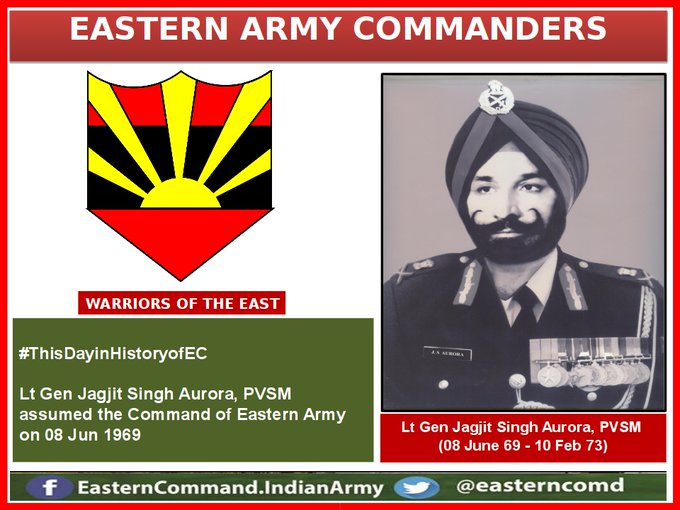
The Eastern Command today paid tributes to its former chief Lieutenant General Jagjit Singh Aurora on the occasion of the 50th anniversary of taking over the responsibility of the Command as its GOC-C.

It stated in a message, “The #WarriorsoftheEast shall always remain indebted for the revered contributions by #Lt Gen Jagjit Singh Aurora…” — TNS

Shubhadeep Choudhury

Tribune News Service

Kolkata, June 8

Indian Army’s Kolkata-headquartered Eastern Command on Monday paid glowing tributes to its former chief Lt Gen Jagjit Singh Aurora on the occasion of the 50th anniversary of Aurora’s taking over the responsibility of the Command as its GOC-in-C.

“The #WarriorsoftheEast shall always remain indebted for the revered contributions by #Lt Gen Jagjit Singh Aurora, PVSM and value his contributions to be ever etched down the memory lane,” the Eastern Command said in a message posted on multiple social media platforms.

Lieutenant General Aurora took over the reins of the Eastern Command on June 8, 1969 and remained in the post till February 10, 1973. During his tenure, he was instrumental in creating Bangladesh and secured surrender by a Pakistani General with over 90,000 troops.

The black and white photograph of Lt Gen AAK Niazi of Pakistan army signing the Instrument of Surrender under the gaze of Aurora on December 16, 1971 at Ramna Race Course in Dhaka encapsulates the most momentous occasion in the history of Indian Army.

EasternCommand_IA

@easterncomd

The shall always remain indebted for the revered contributions by Gen Jagjit Singh Aurora, PVSM and value his contributions to be ever etched down the memory lane.

View image on Twitter
43 people are talking about this

In his book “The Lightning Campaign: The Indo-Pakistan War, 1971” Maj Gen DK Palit (retd) wrote that while drawing up his strategy, the Pakistani commander (Niazi) reckoned “without Eastern Army’s GOC-in-C Lt Gen J S Aurora”.

“No commander before him (Aurora) had ever attempted a war of movement such as this in a land where rivers run to five miles in width, where the going is all infantry – with no scope for fast moving

armoured thrusts, where the enemy was a formidably organised foe…,” wrote General Palit.

During the peak of the 1971 war Aurora commanded nearly half a million men, including the Mukti Bahini and the Army’s northern divisions facing Tibet.

“No Lieutenant General in military history has commanded so large an army and so heavy a strategic responsibility,” Palit added.

In an obituary published in British newspaper The Independent, Aurora was lauded for following “the novel strategy of ‘leaving the highways for the byways’, thereby obviating traditional battle engagements”.

“He formed small, highly mobile units that surrounded the Pakistanis, cutting them off from one another and from their extended supply lines,” wrote the London newspaper.

The ace Sikh soldier was born on February 13, 1916 in Kalle Gujjran in Jhelum district, now in Pakistan. He was commissioned into the 1st battalion of the 2nd Punjab Regiment in 1939, and served in all three Indo-Pak Wars fought till date.

Aurora had criticised the then Prime Minister Indira Gandhi for the Operation Blue Star. He also had a stint in the Rajya Sabha as an Akali Dal representative.

Aurora died on May 3, 2005 at the age of 89.


Take alternative steps to defuse border dispute, India tells Nepal Says dialogue difficult under shadow of Parliament resolution

Take alternative steps to defuse border dispute, India tells Nepal

Sandeep Dikshit

Tribune News Service

New Delhi, June 8

BONE OF CONTENTION

  • The border dispute has been making an appearance for past two decades but was fanned in November last
  • Releasing a map to depict carving of J&K into two UTs, India included Lipulekh, Kalapani and Limpaidhura, areas claimed by Nepal
  • Issue erupted again last month when Rajnath Singh mentioned Lipulekh as ‘China Border’ whereas Nepal claims it is a tri-junction

India has conveyed that it cannot be expected to discuss the border dispute with Nepal under the overhang of a resolution in its Parliament that proposes to amend the political map to include Kalapani, Lipulekh and Limpaidhura.

Nepal’s Parliament is slated to take up a Constitutional amendment resolution on Tuesday after the Nepali Congress came on board to give a two-thirds majority.

It has cited the India-China Army commanders’ meeting and the virtual summit between PM Narendra Modi and Scott Morrison to suggest a similar arrangement between the two Foreign Secretaries.

Sources said while the resolution should not be bandied as a threat, there are other mechanisms to discuss Nepal’s claim over territory that has an Indian military post along with 19 kms of an Indian-built road to China border.

They pointed out Nepal’s haste in taking the Constitutional amendment route, but felt the situation was retrievable. The ties could have taken a turn for the worse had Nepal approached the International Court of Justice or the UN which was the stage of a slanging match between India and Nepalese delegations over an “economic blockade” in 2015.

There were existing modalities such as the report of the Eminent Persons’ Group on resolving the outstanding issues which was convened by the Foreign Secretaries of both countries and has been pending official airing for two years.

Besides, there was also a pending proposal for a field survey to demarcate Kalapani for which a joint boundary committee was to be set up. “There are no dead-ends with Nepal. It is a question of how we handle it from here,’’ said a source.

The border dispute came to the fore last month when Defence Minister Rajnath Singh digitally inaugurated a link road to Mansarovar Yatra.