Sanjha Morcha

What’s New

Click the heading to open detailed news

Current Events :

web counter

Print Media Reproduced Defence Related News

Northern Commander in Ladakh, Army moves more troops amid standoff with China

Additional troops have been brought in from three locations outside Ladakh to the LAC where a standoff with China has been on since early May.

Trucks carry essential commodities in Ladakh | Representational image | ANI

Trucks carry essential commodities in Ladakh | Representational image | ANI

New Delhi: Northern Army Commander Lieutenant General Y.K. Joshi Tuesday reached Ladakh to review the situation amid growing tensions at the Line of Actual Control (LAC), which has forced the Army to move in about two additional division strength-level forces into the region, ThePrint has learnt.

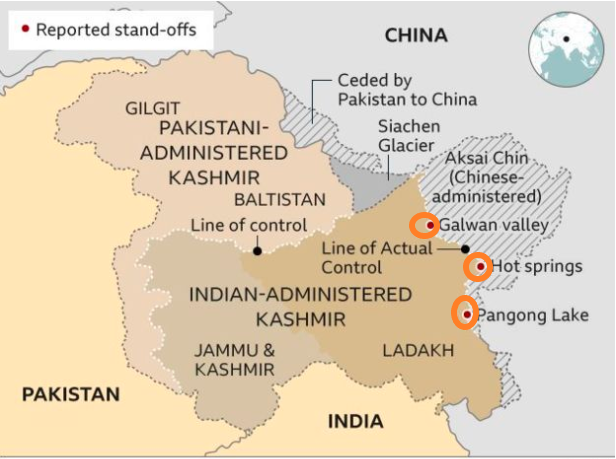
Sources said most of the troops who were moved over the past few weeks have finished their acclimatisation and have been deployed to counter the Chinese build-up along the Galwan Valley, larger Hot Spring Area and the Finger Area of the Pangong Lake.

The brigades that have been moved from at least three different locations into Ladakh also have elements of artillery. Support elements have also been sent.

While the 14 Corps, the Army division that looks after Ladakh, is sufficiently armed in terms of artillery, armour, men and reserves, more soldiers have been brought in to create  large reserves and forward deployment.

The Indian Air Force (IAF) has also increased its flying in Ladakh with a mix of Sukhoi and Mirages even as the Chinese have increased flying on their side.

“What is happening is mirror deployment. The Chinese have a troop build-up and we too are more than adequately placed,” a source said.

Even though the build-up is there, as reported by ThePrint earlier, the focus is on finding an “amicable solution” through talks.

Talks are being carried out through established channels, both at military level as well as the Army level.

Sources said while the situation in Galwan and the larger Host Spring area is “under control”, the main problem lies around Pangong Lake.

The 134 km of Pangong Lake’s northern bank juts out like a palm, and the various protrusions are identified as ‘fingers’.

The Chinese have come between the disputed area between Finger 3 and 4 and have dug up a moat-like construction with troop build-up to prevent Indians from patrolling further.

The dispute lies in the fact that India claims the LAC is at Finger 8 while the Chinese say it is at Finger 2.


Also read: Stand-off with China in Ladakh is India’s worst border tension since Kargil in 1999


Northern Commander visits Ladakh

Lt Gen Joshi flew into Ladakh early Tuesday morning and is scheduled to hold a series of meetings with the commanders there, including 14 Corps Commander Lt Gen Harinder Singh, who was the Director General Military Intelligence before taking over the crucial Ladakh command in October last year.

Lt Gen Singh’s first visit after taking over was to Eastern Ladakh.

Lt Gen Joshi, a Kargil war hero, was the 14 Corps Commander before Lt Gen Singh. He was the Chief of Staff in the Northern Command before becoming the General Officer Commanding-in-Chief, Northern Command, this February.

While it was not immediately known if he will be visiting forward locations, this is his second visit to the region after tensions broke out. He had earlier accompanied Army Chief General M.M. Naravane, who had made a quiet visit on 22 May.


Also read: Stand-off in Ladakh: Army matching wits with China, on every step


Talks on but no change in ground situation

While several rounds of talks have been held between India and China, the ground situation remains the same.

Sources said the Chinese have built up a large number of troops on its side, which includes artillery and armoured units.

As reported by ThePrint earlier, they were diverted from a massive exercise that was being held.

According to protocol, both armies are supposed to inform each other about any exercise that is being held near the LAC. The Indian Army also carries out an exercise in early summer, which was delayed this year due to the Covid pandemic.


Also read: More ‘Ladakh clashes’ emerge as India-China tension turns into social media battle


Chinese build-up and transgressions

With regard to Galwan Valley, sources say the Chinese build-up is in their territory and they have not crossed the Chinese Claim Line (CCL). In Galwan Valley, the CCL and the LAC are the same.

However, the forward movement by the Chinese has put the Shyok-DBO road, inaugurated last year by Defence Minister Rajnath Singh, under stress.

This road is at least 10 km inside the LAC at several points, and runs perpendicular to the Galwan river. To connect this road to the LAC, India was constructing feeder roads. This included a bridge over a rivulet, near the confluence of the Shyok and Galwan rivers.

The Chinese were peeved at these construction activities because it will enable the Indian forces to reach the LAC faster with men and equipment, which changes the equation between both countries.

Army sources admitted that the Chinese have transgressed in the larger Hot Spring Area by about 3 km and the Finger Area, but have not crossed the CCL.


Also read: Chinese aggression in Ladakh also a message for domestic and external audience: Experts


Chinese troops present in sizeable numbers at LAC, India has done what’s needed: Rajnath

Defence Minister says India and China perceive LAC differently, leading to regular jostling; Beijing ‘should seriously deliberate’ and resolve the issue amicably.

Union Defence Minister Rajnath Singh | Photo: ANI

Union Defence Minister Rajnath Singh | Photo: ANI
New Delhi: Defence Minister Rajnath Singh said Tuesday that Chinese soldiers are present in “sizeable numbers” in eastern Ladakh, as the stand-off between the two countries is about to hit the one-month mark.

“The Chinese have come in sizeable numbers. But India has done what needed to be done,” Singh told CNN News18 in an interview Tuesday, without going into further details. The phrase he used in Hindi for the number of Chinese troops was “achhi khaasi sankhya”.

While the Chinese have reportedly built up a large number of troops on their side of the LAC, including artillery and armoured units, India too has moved in additional troops, including two additional divisions strength-level forces.

Singh’s comments come days after he said in another TV interview that the situation in eastern Ladakh was different from earlier face-offs.

These are the first comments from the Government of India on the troop build-up along the Line of Actual Control, and the transgressions committed by the Chinese in at least four locations, including Pangong Lake.

Also read: More ‘Ladakh clashes’ emerge as India-China tension turns into social media battle


Military talks

However, the minister underlined that talks are on between India and China, and another round of “high-level” military talks is scheduled for 6 June.

According to the established protocols between the two countries, divisional commander-level talks are the highest level.

Divisional commanders from both sides met earlier in the day for the third round of talks, and sources said, though there aren’t any tangible results yet, the fact that talks are being held is a positive.

Rajnath Singh also said in the interview that the perception of the LAC between India and China in the region is different, and that hardly a year has gone by when the Indian Army and China’s People’s Liberation Army have not faced off or jostled with each other.

“I think China should seriously deliberate on this, so that the differences can be resolved amicably,” he said.

India’s self-respect

Singh said whenever there has been a difference between India and China in the past, including the Doklam stand-off in 2017, the issues have been resolved at the military and diplomatic levels.

He, however, said that while India doesn’t want to hurt the self-respect of any country and wants to have good terms with everyone, India will not tolerate it if someone tries to hurt India’s self-respect, and that has been India’s clear policy.

Asked why China is resorting to such measures at the LAC when the world is fighting the Covid-19 pandemic, the defence minister said since talks are going on, he would not like to give a statement.

He pointed out that China had also made it amply clear during the recent diplomatic-level talks that it was keen to resolve the issue through dialogue.

Asked about the need for the US intervention in the matter, he said India already has a mechanism with China to solve such issues.

Last Friday, Congress leader Rahul Gandhi had questioned the government’s silence about the situation with China, saying it was fuelling massive speculation and uncertainty in a time of crisis, and that the government should come clean to its people.

However, Rajnath Singh said border disputes should not be politicised, and the country should stand united during such times.


Also read: Chinese troops blacktopping track in disputed ‘finger’ area in Ladakh amid border tensions


Relations with other countries

Speaking about Nepal and its controversial new map that shows the disputed Lipulekh-Kalapani-Limpiyadhura areas as its territory, Singh said: “I consider Nepal as our brother and I cannot accuse Nepal of anything.”

He said at times, there there are misunderstandings between brothers, too, and those can be resolved through talks.

On Pakistan, Singh said the country refuses to give up its old habits by continuing to provoke India, but added that whoever tries to destabilise or weaken India, will get a fitting reply.

He also maintained that Pakistan-occupied Kashmir will continue to be an integral part of India.

He also said Muslims are safe in India, and no community is discriminated against. Those who say otherwise are part of a ploy to defame India, he claimed.

Swadeshi and self-reliant India

On calls to boycott Chinese products, Singh said merely giving out such statements will not work, but if some country wants to progress financially, it can take steps to do so.

Talking about PM Narendra Modi’s call for an Aatmanirbhar Bharat (self-reliant India), he said the target is to be an “exporting country” instead of an “importing country”.

On the issue of only ‘swadeshi’ goods being available at paramilitary canteens, Singh also said there is a consensus among the three services too for military canteens, and “we are working towards that”.


Also read: Chinese aggression in Ladakh also a message for domestic and external audience: Experts


Encounter breaks out in J-K’s Pulwama district Operation on till the reports last came in

Encounter breaks out in J-K’s Pulwama district

Srinagar, June 3

An encounter broke out on Wednesday between militants and security forces in Pulwama district of Jammu and Kashmir, police said.curity forces launched a cordon and search operation in Kangan area of Pulwama on Wednesday morning following information about presence of militants there, a police official said.

He said the search operation turned into an encounter as militants opened fire at security forces.

The operation was going on till the reports last came in, he added. PTI


Ex-serviceman among 2 dead

http://

Tribune News Service

Chandigarh, June 2

An 85-year-old ex-serviceman admitted at Mohan Dai Oswal Cancer Hospital died here today. He had tested positive for Covid-19 on May 31. With this, the death toll in the state has gone up to 46.

The victim was admitted to the hospital as he was a cardiac patient and when his Covid test was done, it came out to be positive.

After he tested positive, a doctor couple from Khanna who work at the hospital also tested positive. Other staff of the hospital were also quarantined.

Dr Rajesh Bagga, Civil Surgeon, said, “He was a cardiac patient and possibly died due to dilated cardiomyopathy. He was also Covid-positive and on a ventilator since May 31.

The second death was reported from Pathankot district. Dr Bhupinder Singh, SMO, Pathankot, confirmed that the latest victim was Harsh Kumar (60), a resident of Indira Colony, who died due to Covid-19 this morning. He had been admitted in the Government Medical College in Amritsar for the last four days. He was put on ventilator support on Monday night and passed away in the wee hours today. He was suffering from diabetes and hypertension.

Meanwhile, 41 fresh cases were reported in the state today, taking the total count to 2,342.

Eleven cases were reported from Jalandhar district, eight from Pathankot, six from Sangrur, four from Ludhiana, two each from Moga, Kapurthala and Gurdaspur districts. One case each was reported from Fatehgarh Sahib, SBS Nagar, Patiala and Faridkot.

Eight cases were reported from Jalandhar city alone. These include seven members of a family from Defence Colony and one of their employees from Bhargo Camp. The family runs a sanitary business in the city and was in contact with Covid-19 patients from Lajpat Nagar. Two more employees of their company have tested positive but since they belong to HP, they have not been included in the Jalandhar tally. The housemaid of the family has tested negative while the couple’s younger daughter has not been tested yet. Besides, three men, who came from Kuwait, were declared positive last evening.

In Kapurthala, two jail inmates have been declared Covid-positive, spreading panic among other inmates.


Govt surveys Private hospitals

  • To meet any future outbreak of Covid-19, the government has carried out a survey of more than 200 private hospitals.
  • The survey was conducted on various parameters, including preparedness for meeting the challenge of large isolation facilities, human resource and building norms.
  • During the survey, 92 hospitals were found up to the mark. The government is planning to use the services of these hospitals in case of disease outbreak at a large scale. TNS


Bipartisan US support for India over LAC stand-off with China

Bipartisan US support for India over LAC stand-off with China

Tribune News Service

New Delhi, June 2

Support for India from the US political class became bipartisan after a prominent Democrat leader Eliott Engel joined US President Donald Trump and Secretary of State Mike Pompeo in speaking out against China for the stand-off on the line of actual control (LAC).

“I am extremely concerned by the ongoing Chinese aggression along the Line of Actual Control on the India-China border. China is demonstrating once again that it is willing to bully its neighbours rather than resolve conflicts according to international law,” said Congressman Eliot Engel who is also the Chairman of the House Committee on Foreign Affairs.

Not too long back, Engel was critical of the CAA and NRC as well as the lockdown in Kashmir.

“Countries must all abide by the same set of rules so that we don’t live in a world where ‘might makes right’. I strongly urge China to respect norms and use diplomacy and existing mechanisms to resolve its border questions with India,” added the statement issued by Engel.

Pompeo spoke on China’s all-round aggression for the second day in succession. “The recent Chinese actions be it on the India border, or Hong Kong or the South China Sea, have been part of the Chinese behaviour in the recent past. We’ve seen over the past number of years continued Chinese building of their military capabilities, and then more aggressive action. I mentioned India. You’ve mentioned the South China Sea,” he said in a podcast interview.

Pompeo’s earlier comments on the same lines were made a day earlier in an interview to Fox TV.


Govt likely to issue draft defence production and export promotion policy soon

On May 16, Finance Minister Nirmala Sitharaman had announced a series of initiatives to promote indigenous defence production

Govt likely to issue draft defence production and export promotion policy soon

New Delhi, June 2

A draft defence production and export promotion policy were likely to be issued within a month, the Centre said on Tuesday, noting that this would give a major push to the ‘Make in India’ programme.

“We are currently in the process of drafting the defence production and export promotion policy and hopefully, within a month or so, we would like to put it in the public domain for seeking your feedback and comments which will be covering all aspects of what Finance Minister Nirmala Sitharaman announced on May 16,” Defence Production Secretary Raj Kumar said during a webinar attended by various defence companies.

On May 16, Finance Minister Nirmala Sitharaman had announced a series of initiatives to promote indigenous defence production which included making separate budgetary outlay to procure Indian-made military hardware, increasing FDI limit from 49 per cent to 74 per cent under the automatic route and generating a year-wise negative list of weapons whose import won’t be allowed.

Kumar said: “In addition to indigenisation, to give a push to ‘Make in India’, to seek substitute of imported items, all those and number of those other similar things will be there as a part of the defence production and export promotion policy.”

“The idea is that in the process of indigenisation, there is a possibility where the investment per se may not be justified. There may be a need for some kind of capital subsidy. We are looking into that aspect. Once the policy is put into the public domain, we will seek your feedback and views,” he further explained.

Currently, the size of the domestic defence industry is of the order of $12 billion. Out of which, 80 per cent is the share of the defence public sector units (DPSUs) and 20 per cent is of the private sector.

“We expect the turnover of the domestic defence industry to go up to USD 25 billion by 2025,” Kumar said during the webinar that was organised by PHD Chamber of Commerce.

“This can only happen if we make conscious efforts to minimise imports beginning with the negative list of imports, realistic GSQRs (General Staff Service Quality Requirements), provide enough budgetary support for domestic procurement,” he said.

There was a focus within the government on indigenisation of imported items, including materials, said the Secretary of the Department of Defence Production.

A committee convened by PHD Chamber of Commerce and headed by Midhani CMD S K Jha on the matter of substitution of defence imports listed out various important issues for our consideration, he said.

“They have pointed out that pre-qualification testing takes a lot of time and involves a substantial expenditure. They have mentioned that attention needs to be given on the issue of long-term supply contracts to indigenous manufacturers,” Kumar said.

“The single biggest point that I saw in that committee’s report was related to the non-availability of the technical specifications (for defence materials and products) that becomes a bigger drawback,” he added.

What we basically now needed was technology, volume, viability and certification capability in house, that was within the country, he said.

“I would like to list out the steps that we need to take. The first and foremost step we need to take is to develop technical specifications in collaboration with research institutions and labs, followed by the development of manufacturing processes. In case of certain identified materials, we plan to adopt a mission mode approach led by the DRDO,” he said.

The Defence Research and Development Organisation (DRDO) works under the Ministry of Defence only.

“Secondly, make one procedure under Defence Procurement Procedure (DPP) to develop these identified materials with the support of the government,” Kumar noted.

“Thirdly, we should develop testing and certification facilities. So, we will like to set up a task force under the Directorate of Standardisation for developing these testing and certification facilities in the country,” he said.

Also, India should try for import of technology under ‘transfer of technology’ route or through inter-governmental agreements to FDI route, especially in those cases where we had got domestic manufacturing capability but the technology was not available at this point of time, he said. PTI


Kin of martyrs get government posts

CM Capt Amarinder Singh has cleared the appointment of eight next of kin of martyrs in recognition of their gallantry actions.Amritbir Singh and Tanveer Kaur have been appointed as tehsildars, Aastha Garg as ETO, Malkeet Kaur as library restorer, Gurpal Singh as JE (Electrical), Akwinder Kaur as naib tehsildar, Amandeep as clerk and Radha Rani as inspector. — TNS


CAPT AMARINDER SINGH ,CM PUNJAB CREATES HISTORY: GOVT JOBS TO NEXT OF KIN OF MARTYRS

th

Punjab CM clears appointments of eight next of kin of martyrs

The CMO said the appointments were recommended by a high-powered committee headed by the Chief Secretary

Tribune News Service

Chandigarh, May 31

Punjab Chief Minister Captain Amarinder Singh has cleared the appointments of eight Next of Kin (NoK) of martyrs in recognition of their gallantry actions.

Disclosing this on Sunday, a spokesperson of the Chief Minister’s Office said the appointments were recommended by a high-powered committee headed by Chief Secretary Karan Avtar Singh.

The state government has appointed

  1.   Amritbir Singh as Tehsildar in the Revenue Department for the supreme sacrifice made by his father, Inspector Raghbir Singh, who belonged to Sathiala village (Amritsar) and had joined the CRPF in 1991. He was an outstanding sportsperson and had won medals in athletics at the national level. He attained martyrdom on April 24, 2017, while fighting the Naxalites in the Sukma district of Chhattisgarh.

2.  Tanveer Kaur has also been appointed as Tehsildar in the Revenue Department. Her husband, Major Ravi Inder Singh Sandhu, joined NDA Khadakwasla in 2003 and was commissioned in the Corps of Signals in 2007. The officer had also done two stints in counter-insurgency in J&K. He laid down his life while serving in the UN Mission in South Sudan and was awarded “Dag Hammarskjold Medal” by the United Nations for courage and sacrifice in the line of duty.

Maj Sandhu to be cremated today

3.  Akwinder Kaur as Naib Tehsildar, Martyr Naik Manwinder Singh hailed from Ghonewal village (Amritsar) and was enrolled in the 3 PUNJAB in 2008. He attained martyrdom on November 18, 2019, when he was on operational duty in a high-altitude area in Siachen Glacier. For his supreme sacrifice, his wife, Akwinder Kaur, has been appointed as Naib Tehsildar in the Revenue Department.

4. Malkeet Kaur as library restorer, W/O Constable (GD) Mukhtiar Singh belonged to Fattuwala village in Ferozepur district and had joined the BSF in 2000. He attained martyrdom on July 15, 2018, while fighting valiantly the Naxalites in Pakhanjure sub-division in Chhattisgarh. For the sacrifice made by him, his wife, Malkeet Kaur, has been appointed as library restorer in the Education Department.

6. Amandeep as a clerk in the Defence Services Welfare Department,Gnr Lekh Raj was born in 1990 in Shajrana village in Ferozepur district. He joined the 332 Medium Regt in 2011. He attained martyrdom on Aug 7, 2018, while he was on patrolling duty on the Line of Actual Control in Arunachal Pradesh. The martyr’s brother, Amandeep, has appointed clerk in the Department of Defence Services Welfare, Punjab.

7. Gurpal Singh as Junior Engineer (Electrical) in PWD, Radha Rani as Inspector in Cooperative Societies and Amritbir Singh as Tehsildar.Gurpal Singh, brother of martyr Rifleman Sukhwinder Singh, has been given the appointment of Junior Engineer (Electrical) in the PWD. Rifleman Sukhwinder Singh was born in Fatehpur village in Hoshiarpur district and joined the 18 JAK Rifles in 2017. He was martyred on December 16, 2019, while fighting at the Line of Control in Sunderbani area of Jammu & Kashmir.

8.  Aastha Garg has been appointed Excise and Taxation Officer. Her husband, Flt Lt Mohit Garg, belonged to Samana (Patiala), and after completing his education from PPS Nabha, he joined NDA Khadakwasla in 2009 and was commissioned as a pilot in the Indian Air Force in 2014. The officer died when the AN 32 aircraft, which he was flying, crashed in a high-altitude area of Arunachal Pradesh.

3 जून को हुआ था लापता

9. Radha Rani, sister of Gdr Sanjay Kumar, has been appointed as Inspector in Registrar, Co-operative Societies. Sanjay Kumar belonged to Rajwal village in Hoshiarpur district and joined the 5 GRENADIERS on October 10, 2012. He died on April 9, 2019, while he was carrying out a field-firing exercise with live ammunition.


No Chinese ‘occupation’. Geolocated images show fast in-and-out intrusions by India and China

Using a video and image of alleged India-China scuffles, we were able to locate the exact place of the fracas and show Army pushed back Chinese intrusion

Pangong area LAC | Abhijit Iyer Mitra and Twitter/@Detresfa_

Pangong area LAC | Abhijit Iyer-Mitra and Twitter/@Detresfa_
We have been surveilling the India-China Line of Actual Control or LAC in Ladakh area almost real-time since several stand-offs were reported a few weeks back, using satellite imagery. For the most part, we found not a single blade of grass amiss save for a brief Chinese encampment on the Indian side of the Galwan Valley. That intrusion was so small — around 40 to 60 Chinese troops — that it simply did not merit the kind of rhetoric and escalation that we have seen over the last fortnight.

However, the inadvertent release of an unauthenticated video (showing Indian troops allegedly attacking Chinese troops and their vehicle) and of an image (showing the Chinese allegedly having bound and apprehended Indian troops) provided us vital clues on what has been happening to justify the heightened tensions. Using these two visual sources we were able to not just triangulate the exact location of the fracas, but also the approximate dates and sequence of events.

It turns out our initial assessment of the situation — that there is no Chinese occupation of Indian territory — is quite correct. The reason the satellites did not see any “occupation” is that there was none. Instead, what has been happening is a series of fast-paced in-and-out intrusions by the forces of India and China into each other’s territory. While the gravity of China’s provocation has been much more serious, but note that India stemmed this, push the Chinese back and retaliated swiftly in order to re-establish deterrence.

Also read: The Chinese are so predictable, Modi & Shah should’ve seen them coming on 5 August 2019


Incident A: Chinese intrusion into India

The video purportedly showing a Chinese patrol intercepted and beaten up by Indian troops is particularly illuminating. The still shot capture (Image 1) allows us to geolocate the incident (Image 2). This is almost 2 kilometres inside Indian territory (as the crow flies), as measured from the LAC close (0.62 kilometres) to the Indo-Tibetan Border Police (ITBP) camp at the base of finger 4 (Image 3).

Image 1 from video of alleged scuffle | Images 2 and 3 via Google | Abhijit Iyer Mitra and Twitter/@Detresfa_
Image 1 from video of alleged scuffle | Images 2 and 3 via Google | Abhijit Iyer-Mitra and Twitter/@Detresfa_

The overall location of the incident and the Indian camp with respect to the LAC and the fingers can be seen in Image 4.

Image: Abhijit Iyer-Mitra and Twitter/@Detresfa_

We were able to place this incident at some time between 19 and 21 May based on two other incidents. The first was a significant beefing up of the ITBP camp starting on 21 May, clearly in response to some trigger, and the second was studying the movement patterns of the Chinese vehicles involved in this incident.

The vehicle (Image 5) is a Dongfeng CSK131, a Chinese armoured four-wheel drive vehicle similar in function and style to the American Humvee. The purpose of this vehicle is high-speed reconnaissance — which is to say it does a rapid drive-through of hostile terrain. An example of such a drive-through by a similar type of vehicle was during the 2003 US invasion of Iraq when the Humvees along with tanks were the first vehicles to enter Baghdad for a rapid reconnaissance.

 Screengrab from video | Abhijit Iyer-Mitra

Our visual surveillance of Chinese camps in the region did show a change in the parking positions of these vehicles as well as trucks (presumably transporting the troops seen in the background in Image 5). Significantly all these vehicles seemed to have returned to their Chinese bases, with none staying on the Indian side over a 14-day period. This proves that whatever happened was momentary and was repulsed rapidly.


Also read: More ‘Ladakh clashes’ emerge as India-China tension turns into social media battle


Incident 2: Indian troops ‘restrained’

This is where the second set of images becomes significant. Image 6 shows Indian troops (at least one quite seriously injured) being allegedly restrained by Chinese troops. This was geolocated to the west bank of Fox point, the peninsula seen in Image 7. There are two interesting features here: 1) note the face-masks on Chinese troops indicating this to be a post-Covid episode, and 2) the boat on the top left of the image, showing this incident to have been just 1-2 meters away from the waterline.

Image 6 via source | Image 7 via Apple maps | Image 8 courtesy Shadow Break Intl and Planet Labs | Abhijit Iyer Mitra
Image 6 via source | Image 7 via Apple maps | Image 8 courtesy Shadow Break Intl and Planet Labs | Abhijit-Iyer Mitra

Our study of Chinese boat activity in the region, showed only one episode of Chinese boats coming so far west during the last fortnight and that was at Fox point – the southernmost peninsula on the northern bank of Pangong Tso (Image 9). Fox point – an extension of finger 4 has a high ridge running on its western periphery. This ridge marks the LAC. The boats, as can be seen in image 8, were clearly on the Chinese western side of Fox point on 22 May.

Abhijit Iyer-Mitra and Twitter/@Detresfa_

This is significant for three reasons. First, it shows considerable Indian activity west of the ITBP base, literally a day or two after the deep Chinese incursion described earlier. Second, it confirms that the Indian troops were ordered to proceed into the Chinese side of the LAC albeit not as deep as the Chinese incursion into India. Third, it confirms that by this time (22 May) there was no Chinese presence west of the LAC, putting paid to any rumours of an “occupation”. Moreover, it confirms our interpretation of Images 1 through 5, that the Chinese were doing rapid sweeps and testing Indian readiness in the area, not occupying it.


Also read: Video shows Indian troops challenging Chinese in Ladakh, but Army says ‘not authenticated’


Testing readiness

In the following articles in this series, we will explain the situation in Galwan and the Hotsprings (Gogra). However, for now, the conclusions as far as the Pangong area is considered are clear. Combined with previous reports, there has been a systemic pattern of testing readiness across the LAC in the Pangong area. This has led to what have so far been non-lethal scuffles, but clearly deep intrusion as described by Defence Minister Rajnath Singh (note his use of past tense). However, India has not been taking this lying down and its response has been robust, albeit not as exuberant as the Chinese

This is the first article in a three-part series, focussing on the Pangong area. Part 2 will focus on Galwan and part 3 on the Hotsprings/Gogra area. 

Abhijit Iyer-Mitra is senior fellow at the Institute of Peace and Conflict Studies. Images courtesy @Detresfa_ an open-source analyst on Twitter who also contributed to this report and spotted the patterns. Views are personal.


Won’t allow India’s ‘pride to be hurt’: Rajnath Singh on Ladakh standoff

As Indian & Chinese troops engage in a tense border standoff, Singh said that bilateral talks were on at military & diplomatic levels to resolve the row.

Defence Minister Rajnath Singh at Parliament | Photo: Praveen Jain | ThePrint

New Delhi: As Indian and Chinese troops remain engaged in a tense border standoff, Defence Minister Rajnath Singh on Saturday asserted that the government will not allow India’s pride to be hurt under any circumstances even as he said bilateral talks were on at military and diplomatic levels to resolve the row.

Asked about US President Donald Trump’s offer of mediation to end the face-off, Singh said he conveyed to US Defence Secretary Mark T Esper during a telephonic conversation on Friday that India and China have existing mechanisms to resolve “problems” through talks at diplomatic and military levels.

In the midst of the flare-ups between Indian and Chinese armies, Trump on Wednesday said he was “ready, willing and able to mediate” between the two countries. He reiterated the offer on Thursday as well.

The Ministry of External Affairs indirectly rejected the offer two days ago, but Singh became the first central minister to speak on India’s position on the issue with clarity.

“I spoke to the US Defence Secretary yesterday. I told him that we have developed a mechanism already under which any problem between India and China are resolved through military and diplomatic dialogue,” Singh told Aaj Tak news channel.

 Asked whether India can be arm-twisted on the issue by China, he said: “you cannot even think of it.”

Also read: Naval helicopters will be Modi govt’s first challenge in its ‘atmanirbhar’ push in defence


The defence minister said efforts are on to resolve the border row in eastern Ladakh.

“I want to assure the country that we will not allow India’s pride to be hurt under any circumstances. India has been following a clear policy of maintaining good relationship with neighbouring countries and it is not a new approach; We have been following it for long. At times, situation arises with China. It has happened before,” he said.

Singh also talked about the Doklam episode of 2017, recalling that the situation then too appeared “very tense”. “But we did not step back. Ultimately, we were able to resolve the situation.”

The defence minister noted that China has also said that it wants to resolve the border issue in eastern Ladakh through diplomatic dialogue and that transgressions take place due to varying perception about the Line of Actual Control by the two sides.

“It has been India’s efforts to ensure that the tension does not escalate. It should be resolved through talks at military and diplomatic levels. Negotiations are ongoing between the two countries at the military and diplomatic levels,” he said.

Troops of India and China were engaged in the standoff for over three weeks in Pangong Tso, Galwan Valley, Demchok and Daulat Beg Oldie in eastern Ladakh.

The trigger for the face-off was China’s stiff opposition to India laying a key road in the Finger area around the Pangong Tso Lake besides construction of another road connecting the Darbuk-Shayok-Daulat Beg Oldie road in Galwan Valley.

Military sources said China was also laying a road in the Finger area which is not acceptable to India.

The sources said military reinforcements including troops, vehicles and artillery guns were sent to eastern Ladakh by the Indian Army to shore up its presence in the areas where Chinese soldiers were resorting to aggressive posturing.

The situation in eastern Ladakh deteriorated after around 250 Chinese and Indian soldiers were engaged in a violent face-off on the evening of May 5 which spilled over to the next day before the two sides agreed to “disengage”.

However, the standoff continued.

The incident in Pangong Tso was followed by a similar incident in north Sikkim on May 9.

The troops of India and China were engaged in a 73-day stand-off in Doklam tri-junction in 2017 which even triggered fears of a war between the two nuclear-armed neighbours.

The India-China border dispute covers the 3,488-km-long LAC. China claims Arunachal Pradesh as part of southern Tibet while India contests it.

Both sides have been asserting that pending the final resolution of the boundary issue, it is necessary to maintain peace and tranquillity in the border areas.


Also read: India’s approach to defence indigenisation has basic flaws. Private players can up the game