India’s push to improve the infrastructure in the border areas was the primary reason for clash between Indian and Chinese soldiers in Ladakh’s Galwan Valley on June 15. Beijing was opposed to a bridge in Ladakh that would consolidate India’s hold of the sensitive sector. The bridge was completed last month.
Defence minister Rajnath Singh reviews border infrastructure projects with BRO officials inNew Delhi on Tuesday.(ANI Photo)
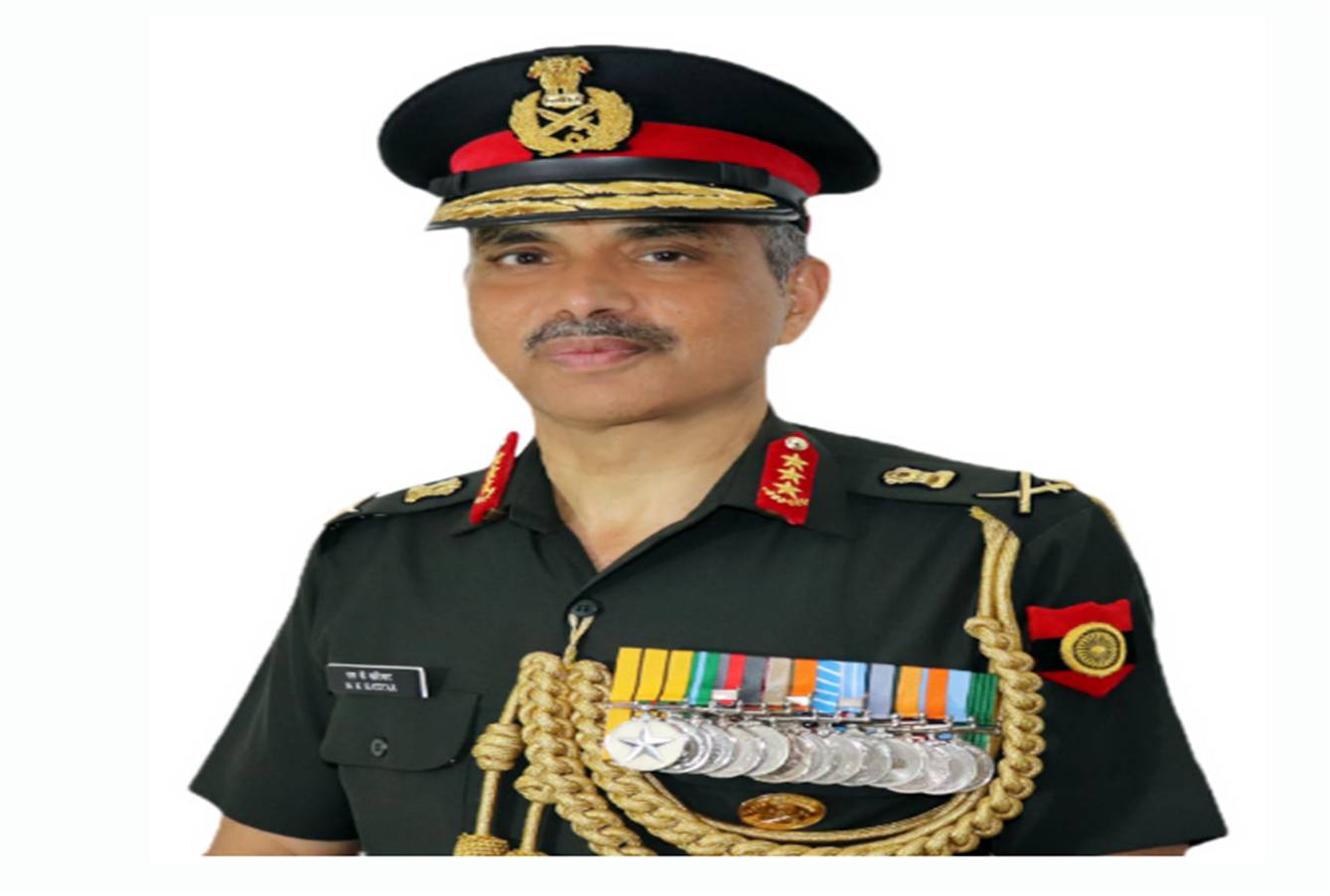
Defence minister Rajnath Singh on Tuesday held a meeting with Border Roads Organisation (BRO) chief Lt Gen Harpal Singh and other officials about the progress in ongoing infrastructure projects on the Line of Actual Control (LAC) with China and Line of Control (LoC) with Pakistan.
The meeting went for about an hour where the BRO chief gave presentation to Singh about the work being done to boost infrastructure in India’s border areas, news agency ANI reported.
India’s push to improve the infrastructure in the border areas was the primary reason for clash between Indian and Chinese soldiers in Ladakh’s Galwan Valley on June 15. Beijing was opposed to a 60-metre bridge over Galwan river in eastern Ladakh that would consolidate India’s hold of the sensitive sector by allowing Indian infantry to move across the cold mountain river and also protect the 255 km strategic road from Darbuk to Daulat Beg Oldie, the last military post just south of the Karakoram Pass.
That bridge was completed last month, days after a face-off between Indian and Chinese soldiers led to the death of 20 Indian soldiers and an undisclosed number of Chinese soldiers.
In the last few years, there have been frequent face-offs in certain sensitive areas in Eastern Ladakh. It has been a direct outcome of India’s ability of increased patrolling in the area due to vastly improved infrastructure readiness.
The genesis of the building up of faster strategic infrastructure can be traced back to 2014, when the Modi government gave it a big push. One of the first decision of the government was to issue a general approval in July 2014 for the creation of road network by Border Roads Organisation (BRO) within 100 km of aerial distance from LAC. This general approval ensured that requirement of prior central government and other bureaucratic process were done away with.
In May, the BRO completed a key road in Uttarakhand which will cut travel time drastically. The road was inaugurated by Defence Minister Rajnath Singh through video conferencing. He also flagged off a caravan of nine vehicles from Pithoragarh to Gunji to indicate that both passengers and load can be sent by the new road stretch through mountainous terrain.
The road has been built from Ghatibagar in Dharchula to Lipulekh near the border with China. It is also known as Kailash-Mansarovar Yatra Route. The road is 75 kilometre long.
The road ends at the 17,000 feet high Lipulekh pass. From there, Mount Kailash is located around 97 km north of the pass in Tibet. The Lipulekh pass, close to the tri-junction of India-China-Nepal, is the lowest point in this section of the high Himalayas.
US military to stand with India in conflict with China, indicates White House official
White House Chief of Staff Mark Meadows said US will stand strongly with India if a conflict with China arises. (REUTERS)
The US military “will continue to stand strong” in relationship to a conflict between India and China or anywhere else, a top White House official has said, after the Navy deployed two aircraft carriers to the strategic South China Sea to boost its presence in the region.
“The message is clear. We’re not going to stand by and let China or anyone else take the reins in terms of being the most powerful, dominant force, whether it’s in that region or over here,” White House Chief of Staff Mark Meadows told Fox News on Monday.
“And the message is clear. Our military might stands strong and will continue to stand strong, whether it’s in relationship to a conflict between India and China or anywhere else,” Meadows said in response to a question.
He was told that India banned Chinese apps because Indian soldiers were killed by Chinese troops last month and asked what’s mission of the two aircraft carriers – the Ronald Reagan and the Nimitz – and what’s America’s mission.
The troops of India and China are locked in an eight-week standoff in several areas in eastern Ladakh including Pangong Tso, Galwan Valley and Gogra Hot Spring. The situation deteriorated last month following the Galwan Valley clashes that left 20 Indian Army personnel dead as the two sides significantly bolstered their deployments in most areas along the LAC.
The Chinese military on Monday began withdrawing troops from the Galwan Valley and Gogra Hot Spring after National Security Advisor Ajit Doval and Chinese Foreign Minister Wang Yi held lengthy talks on Sunday. Doval and Wang are also the special representatives on the India-China boundary talks. The United States has sent two of its aircraft carriers to the South China Sea. “Our mission is to make sure that the world knows that we still have the preeminent fighting force on the face of the globe,” Meadows said.
President Donald Trump has invested more in the US military, more in not only the hardware, but the men and women who serve so sacrificially each and every day, he said. “He (Trump) continues to do so,” he added.
China is engaged in hotly contested territorial disputes in both the South China Sea and the East China Sea. Beijing has built up and militarised many of the islands and reefs it controls in the region. Both areas are stated to be rich in minerals, oil and other natural resources and are vital to global trade.
China claims almost all of the South China Sea. Vietnam, the Philippines, Malaysia, Brunei and Taiwan have counter claims over the area.
Meadows also hinted that President Trump might sign an executive order that relates to China, among other issues.
“I’ll give you a couple of hints, all right. So, a sneak preview here. We’re going to be looking at how we make sure that China is addressed, how we bring manufacturing back from overseas to make sure the American worker is supported,” he said.
“We’re also going to look at a number of issues as it relates to immigration. We’re going to look at a number of issues as it relates to prescription drug prices and we’re going to get them done when Congress couldn’t get them done,” Meadows said.
Appearing on the same Fox News on Monday talk show with host Brian Kilmeade, influential Republican Senator Tom Cotton said that the US aircraft carriers are headed to the South China Sea to thwart off any Chinese misadventure against Taiwan or other countries in the region.
“That’s one of the reasons why we have those aircraft carrier groups in the South China Sea. I mean, look what China did in the southwest. It’s essentially invaded India over the last few weeks and killed Indian soldiers,” Cotton said.
“No country on China’s periphery, right now, is safe from Chinese aggression. All those countries want a close relationship with the United States. We ought to have one,” Cotton said.
India must remain careful | HT Editorial Disengagement is positive. But verify and be prepared
With a two-hour-long conversation between National Security Adviser Ajit Doval and Chinese foreign minister Wang Yi, there appears to be a degree of convergence between the two countries on the need to first disengage, and eventually de-escalate, from the current stand-off(AFP)
After escalatory rhetoric, and more important, aggressive actions, a process to slowly, in a calibrated manner, defuse the tensions at the Line of Actual Control (LAC), has commenced. China’s slight withdrawal of troops from Galwan, and the Hot Springs Area, and what appears to be a minor thinning of its presence at Finger 4 in Pangong-Tso, is a positive development. With a two-hour-long conversation between National Security Adviser Ajit Doval and Chinese foreign minister Wang Yi — the designated special representatives on border talks — there appears to be a degree of convergence between the two countries on the need to first disengage, and eventually de-escalate, from the current stand-off.
There are structural reasons why disengagement makes sense for both countries. China was solely responsible for transgressing across LAC. Even the finest scholars who study China have not been able to offer a fully rounded explanation on why Beijing has behaved the way it did. Is it linked to its pattern of aggression elsewhere? Is it to overcome domestic legitimacy issues Xi Jinping may be confronting? Is it a message to India to not cosy up to the United States? Is it to halt India’s border infrastructure development? Is it to gain tactical advantage to secure Aksai Chin and the China-Pakistan Economic Corridor? Beijing may have been motivated by all these factors, but the fact is, even for a rising power, its actions defied rational calculation, for it has alienated India, and Indian public opinion entirely, throwing the entire relationship — of which China too has been a beneficiary — off-gear. It will also push India in the very direction Beijing does not want it to move. If Beijing is now waking up to what is a miscalculation, that is wise. New Delhi too does not want conflict. It was left with no choice but to respond aggressively to Chinese incursions and defend its territorial integrity. But given the internal economic weaknesses, the Covid-19 challenge, the gaps in military preparation, and the costs of any conflict, peace is, of course, the most desirable option.
But this seeming thaw needs to be accompanied with two caveats. One is immediate. As the Indian establishment has made clear, every step of the disengagement process will be carefully monitored and verified. China has violated past understandings; its statement contained a hint of continued belligerence; and there doesn’t appear to be a deal on it stepping back from the finger area in Pangong-Tso. India must ensure complete restoration of status quo ante. The second is medium-term. Irrespective of a possible de-escalation, it cannot be business-as-usual. India must ramp up its capabilities, deepen external partnerships, reduce dependence on China, and remain wary, for this is possibly the beginning, not the end, of an era of a new strategic competition.
SC extends deadline to give women permanent posting
The Centre agreed to grant a permanent commission to women in 10 non-combat streams and was directed by the apex court to complete the process in three months.
Citing the Covid-19 pandemic and the ensuing lockdown, the Centre moved an application before the Supreme Court to extend the deadline expiring in May by six months.(Sonu Mehta/HT PHOTO)
The Centre on Tuesday received one month to implement the Supreme Court’s path-breaking decision to grant a permanent commission to women Army officers serving under the Short Service Commission (SSC).
An order by the top court passed on February 17 had ended the gender disparity that stood in the way of women SSC officers being denied a permanent commission their male counterparts were entitled to. The Centre agreed to grant a permanent commission to women in 10 non-combat streams and was directed by the apex court to complete the process in three months.
The deadline expired in May. The extension ordered by the court will be valid for a month starting on Tuesday.
Citing the Covid-19 pandemic and the ensuing lockdown, the Centre moved an application before the Supreme Court to extend the deadline expiring in May by six months. Senior advocate R Balasubramanian, appearing for the ministry of defence, told a bench comprising justices DY Chandrachud and Indu Malhotra that the government was is in an advanced stage of implementing the court’s order. The process couldn’t be completed because of the lockdown that caused all government offices to be close abruptly, the lawyer said.
“On account of lack of staff, closure of hospitals, including Army hospital and non-availability of other requirements necessary to comply with the directions of the Supreme Court, it was very difficult to continue with the process of consideration of women officers for grant of permanent commission…..In view of the corona pandemic and the ensuing lockdown coupled with exigencies of service, the applicant has not been able to complete the same and requires more time to complete the entire process,” the Centre said in its petition.
The women SSC officers were represented in the virtual court proceeding by their lawyers Meenakshi Lekhi and Meenakshi Arora. Opposing the application, the counsel argued that an attempt is being made by Centre to dilute the Supreme Court judgment to delay its implementation.
The bench took note of the fact that the Centre had commenced efforts to implement the court order and could not foresee the lockdown due to the Covid-19 outbreak. Recording this submission in its order, the bench said, “We extend the time for compliance by one more month.”
The court kept the matter pending in order to pursue implementation of its direction.
Under the Supreme Court’s February order, women SSC officers who are serving and who had approached the court but retired during the pendency of proceedings were eligible for a permanent commission. It was in 2006 that the Army extended SSC to women recruits allowing them a short stint of 10 years, extendable up to 14 years, to work with the army’s non-combat streams.
In 2010, the Delhi high court, ruling on a batch of petitions filed by women SSC officers, directed Centre to grant them a permanent commission. Challenging this order, the Centre approached the apex court.
4km buffers at three key points as troops pull back from Ladakh clash site
Satellite images from June 28 and July 6 released on Tuesday by Maxar, a US-based satellite imagery company, show the Chinese expansion at the Galwan Valley in eastern Ladakh has been removed as part of the disengagement procedure.(maxar/AP Photo )
The Indian Army has begun a rigourous verification process to monitor the withdrawal of the Chinese People’s Liberation Army (PLA) from friction points along the Line of Actual Control (LAC) in eastern Ladakh even as a complicated disengagement plan moved forward in Hot Springs and Gogra, where the two armies are working to create a 4km buffer zone between troops within a 24-hour time frame, four officials familiar with the developments said on Tuesday evening.
The PLA has withdrawn up to 2km from Patrolling Point 15 (Hot Springs) and a similar retreat is expected to be completed at PP-17 (Gogra) by Wednesday evening, with the Indian Army pulling back proportionately. This is based on an understanding reached last week by top Indian and Chinese military commanders on a phased de-escalation of the ongoing border conflict in the Ladakh theatre, said one of the officials cited above, who spoke on the condition of anonymity.
The two armies have already created a 4km buffer zone in Galwan Valley, the site of a deadly clash which left 20 Indian and an unconfirmed number of Chinese soldiers dead on June 15, said a second official.
The creation of buffer zones will temporarily restrict the patrolling activities of both armies in the region. While some experts saw this as a necessary step, others cautioned that the temporary curtailing of patrolling rights should not become a long-term feature undermining Indian presence and control.industan Times reported on Tuesday that the PLA had withdrawn up to 1.5 km from friction areas in Galwan Valley, Hot Springs and Gogra, and the Indian Army also pulled back proportionately. A minor thinning of PLA soldiers has been noticed at the sensitive Finger Area near Pangong Tso.
Satellite images on Tuesday appeared to confirm the PLA pullback from Galwan Valley. “The images clearly indicate that the PLA has moved back in Galwan Valley. It’s a positive step but constant verification and strict vigil are a must,” said Lieutenant General Vinod Bhatia (retd), a former director general of military operations. Bhatia reviewed the images for HT.
Satellite images from June 28 and July 6 released on Tuesday by Maxar, a US-based satellite imagery company, show the Chinese expansion at the Galwan Valley in eastern Ladakh has been removed as part of the disengagement procedure. ( Maxar/AP Photo )
The disengagement effort involves rival troops pulling back a specified distance from face-off sites, with further retreat taking place in phases as the complex plan progresses on a verifiable basis on the ground every 72 hours by both sides. It also entails the phased withdrawal of weapons and equipment to a mutually agreed distance, and finally the restoration of status quo ante (the situation as it existed in early April).
“The army is keeping a close watch on the ongoing pull back by the PLA. It’s extremely critical to verify and reverify every stage of the disengagement process to avoid surprises,” said the second official, who asked not to be identified.
The verification process launched by the army involves unmanned aerial vehicles, other aerial means of surveillance and satellite imagery of the areas, said a third official.
The Indian Air Force (IAF) is already projecting its capabilities of carrying out day-and-night, all-weather combat missions in Ladakh, with front-line fighter jets, attack helicopters, and multi-mission choppers getting airborne for demanding night-time missions from a forward airbase in the area, people familiar with the matter said on Tuesday.
On the creation of buffer zones, and the curtailment of patrolling, experts had a mixed response.
“The zones of separation will eliminate the possibility of violent face-offs. It’s best to avoid any form of contact between rival troops. A moratorium on patrolling the areas by both sides till things stabilise should help,” said former Northern Army commander Lieutenant General DS Hooda (retd).
Disengagement during a 2014 border standoff at Chumar in Ladakh involved a temporary ban on Indian and Chinese soldiers patrolling disputed areas.
Satisfactory progress of disengagement in Galwan Valley, Hot Springs and Gogra could set the stage for reducing tensions in the Finger Area and also turn the focus on the Depsang plains where the PLA’s forward presence is hindering the Indian Army’s patrolling patterns, said Hooda.
But others sounded a more cautionary note, emphasising that India must be able to — after the agreed period — exercise its patrolling rights again. A senior official said India must never lose track of China’s “salami slicing” tactics to slowly grab territory. “Salami slicing” refers to a string of small, clandestine operations meant to achieve a larger goal that would be difficult to accomplish in one go. He said, “We have to ensure that the buffer zones do not become a new status quo. These can only be a temporary measure to facilitate the disengagement process to restore status quo ante. The army will fully exercise patrolling rights in the area once that happens.”
Before the PLA occupied vantage positions on Finger Four in early May, Indian Army soldiers would patrol right up to Finger Eight, which New Delhi considers to be its territory. The new Chinese positions have restricted the scope of Indian patrols. Fingers Four and Eight are 8km apart.
The army is also keeping a strict vigil along the contested border in the Depsang sector where a 2013 Chinese intrusion blocked the access of Indian soldiers to several patrolling routes, including the ones leading to Patrol Points 10, 11, 11A, 12 and 13, a fourth official said.
The military buildup in Indian and Chinese depth areas, however, hasn’t thinned, with both sides keeping their guard up. The deployment of thousands of soldiers, fighter jets, helicopters, tanks, artillery guns, missile systems and air defence weapons continues in the region.
The disengagement process, a precursor to any kind of de-escalation of the border conflict, has started under the terms mutually agreed to at the June 30 meeting between delegations led by Lieutenant General Harinder Singh, commander of the Leh-based 14 Corps, and Major General Liu Lin, commander of the South Xinjiang military region. This understanding, in turn, was the result of earlier efforts not paying dividends.
60-year-old woman killed, another injured as Pak violates ceasefire in J-K’s Poonch
n Indian Army jawan patrolling at the Line of Control (LOC) in Poonch district of Jammu and Kashmir. (PTI File Photo)
A 60-year-old woman was killed and another injured as Pakistan rained mortars on Indian posts and forward villages along the Line of Control (LoC) in Jammu and Kashmir’s Poonch district on the intervening night of Tuesday and Wednesday.
Poonch district police chief SSP Ramesh Kumar Angral said, “there was ceasefire violation by Pakistan and at around 0235 hrs (2.35 AM) in which an old woman was killed and another injured in Lanjote area of Mendhar. They were hit by Pakistani mortar fire”.
Pakistan violated ceasefire along the LoC in Balakote and Mendhar sectors of the district, he said. The stretch is manned by 12 Madras Battalion.
The deceased was identified as Reshma Bi and the injured as Hakam Bi, 58, both belonging to Lanjote in Mendhar.
No army personnel were injured in the exchange of fire.
Defence spokesman Lt Col Devender Anand said, “around 0200 hours, (2 AM) Pakistan initiated unprovoked ceasefire violation by firing with small arms and then resorted to intense shelling along the LoC in Balakote and Mendhar sectors. Indian Army retaliated befittingly. The firing stopped at about 0245 hours. (2.45 AM).
Last month India lost five soldiers along the LoC in Poonch and Rajouri sectors in Pakistani shelling.
NIA makes 7th arrest in Pulwama terror attack case, he sheltered JeM terrorists, gave them high-end phones
NIA has arrested the man who had sheltered JeM terrorists at his house and also helped them with other logistical support. (AP Photo)
The National Investigation Agency (NIA) has arrested Jammu and Kashmir resident Bilal Ahmed Kuchey for playing a key role in the 2019 Pulwama terror attack that killed 40 CRPF troopers in Kashmir valley, an official agency release said on Tuesday.
Bilal had provided logistical support to the group of terrorists that planned the attack on February 14, when an explosives laden van was rammed into a convoy of Central Reserve Police Force travelling on the national highway in Pulwama area, the release states.
“The main perpetrators in this case stayed in his house and he further introduced them to other OGWs who provided safe houses during their stay and planning of the attack,” the NIA says.
According to the agency, Bilal also provided the Jaish-e-Mohammad terrorists with “high-end mobile phones” to communicate with Pakistan based JeM leadership and among themselves for planning and execution of the attack.
“Further the mobile phone provided by him was also used for recording the video clip of Fidayeen Adil Ahmed Dar, which became viral after the attack,” NIA’s release said.
Adil Ahmed Dar was the one who had driven the van into the CRPF convoy.
Bilal is the seventh person to be arrested in Pulwama case. Last Thursday, NIA had arrested a Budgam resident Mohammad Iqbal Rather (25), a member of JeM’s “transportation module” that ferried infiltrating terrorists from the border to Kashmir in February 2019 before the attack.
Rather is accused of allegedly facilitating the movement of one of the terrorists– Muhammad Umar Farooq– who helped in making the bomb, officials had said, Rather helped Farooq facilitate his movement through the national highway near the international border to South Kashmir he infiltrated into the Indian territory in Jammu region in April, 2018.
The other five arrested earlier this year in the Pulwama attack case include Shakir Bashir Magrey, Mohammad Abbas Rather, Waiz-ul-Islam, a young girl – Insha Jan and her father Tariq Ahmad Shah.
Modi dares China, tells Indian Army ‘our enemies have seen your fire and fury’
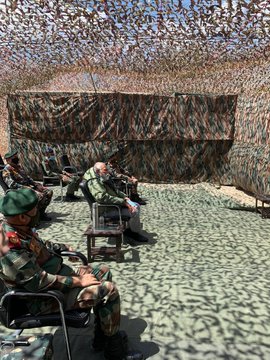
Prime Minister Narendra Modi meets soldiers who were injured in Galwan Valley clash, during his visit to Ladakh, in Leh on 3 July 2020 | ANI
New Delhi: Prime Minister Narendra Modi Friday lashed out at China, saying the “age of expansionism is over” and that New Delhi will continue to develop infrastructure in the border areas.
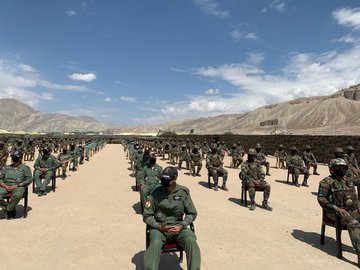
Addressing the Army, ITBP and Air Force personnel in Ladakh, PM Modi lauded their efforts and dedication in protecting their “motherland” and said the “fire and fury” of the armed forces have made him proud.
Without naming China, the prime minister contrasted the policy of expansionism and developmental growth. “The age of expansionism is over. The world has moved on the path of development. Expansionist forces have ruined the world in the last century. They have either been defeated or forgotten in history… History is witness that expansionist forces have either lost or were forced to turn back,” he said.
The PM’s visit to Ladakh has, however, angered China, which saw it as an attempt to “escalate” tensions.
Chinese Foreign Ministry spokesperson Zhao Lijian said, “India and China are in communication and negotiations on lowering the temperatures through military and diplomatic channels.
“No party should engage in any action that may escalate the situation at this point,” he said.
Ji Rong, spokesperson, Embassy of China in India, meanwhile, tweeted: “China has demarcated boundary with 12 of its 14 neighboring countries through peaceful negotiations, turning land borders into bonds of friendly cooperation. It’s groundless to view China as ‘expansionist’, exaggerate & fabricate its disputes with neighbours.”
Experts, however, said Modi’s visit was “a powerful image and a powerful message”, and a sign that the Indian government is not going to let China either escalate the crisis or gloss it over.
While paying tributes to the soldiers who were killed in the violent face-off in Galwan, Modi compared the willpower of the soldiers with that of the mountains they’re surrounded with.
“Every Indian’s head bows before its brave saviours. This land boasts of several stories of bravery and gallantry of Indian jawans,” said Modi, who was accompanied by Army Chief General M.M. Naravane and Chief of Defence Staff Bipin Rawat.
“The bravery of 14 Corps will be talked about everywhere. Our enemies have seen your fire and fury. This land in Ladakh is India’s crown. It has given several brave hearts to the nation… The resolve of a self-reliant India becomes stronger because of your sacrifices,” he said.
The prime minister said Indian soldiers had a long history of bravery and competence in global military campaigns, including in the two World Wars.
“Whenever I think of a decision based on national security, I think of two mothers. The first is our Mother India. The second is our mothers who’ve given birth to brave hearts such as you,” he said, addressing the soldiers.
PM Modi also visited the military hospital in Leh where he met those injured in the face-off in Galwan.
In his interaction with the soldiers at the hospital, Modi said, “Our country has never bowed down and will never bow down to any world power, and I am able to say this because of the braves like you.
“The braves who left us, they didn’t depart without reason, all of you gave a befitting reply.”
Modi added that the bravery displayed by them will inspire coming generations and the country as a whole. “A message has gone to the world about the valour shown by you braves. The way you stood up to the powers, the world wishes to know who are these braves? What is their training? What is their sacrifice? World is analysing your bravery,” he said.
Modi said he pays his respects to not only them, but to their mothers as well.
The prime minister said he had come to just meet them, and is taking back with him fresh energy.
The PM also said: “We are the same people, who pray to the flute-playing Lord Krishna, but we are also the people who idolise and follow the same Lord Krishna who carries the ‘Sudarshana Chakra’.
“Peace can never be brought by the weak. Power is the condition to bring peace. India is widening its powers on land, air and water and this is for the welfare of mankind,” he added.
The PM is now on his way to Delhi where he is expected to hold a meeting with Defence Minister Rajnath Singh, External Affairs Minister S. Jaishankar, Home Minister Amit Shah and National Security Advisor Ajit Doval, according to sources.
Shah, meanwhile, tweeted, saying PM’s visit will “surely boost the morale of our valorous soldiers”.
“Leading from the front. Prime Minister Shri @NarendraModi Ji with our brave and courageous personnel of Army, Air Force & ITBP at a forward location in Ladakh. This visit of honourable PM will surely boost the morale of our valorous soldiers. #ModiInLeh,” he wrote.
Rajnath Singh echoed similar sentiments and said the border areas between India and China in the Ladakh sector have always been kept secure by the Indian Army.
“The borders of the country have always been secure under the Indian Army. Prime Minister Shri @narendramodi going to Ladakh today and meeting the army soldiers and encouraging them has certainly boosted the morale of the army and I thank the Prime Minister for this move,” Singh tweeted.
‘Loud and clear message to China’
Experts believe Modi’s visit coupled with his speech was much-needed amid the stand-off that began in early May.
“This was a powerful image and a powerful message. The Indian PM’s visit is a sign that the Indian government is taking this situation very seriously and is not going to let China either escalate the crisis or gloss it over,” said Rory Medcalf, head of the Australian National University’s National Security College.
“Indeed, the message is quite awkward for China. It shows self-confidence and staying power on the part of India, while also making it hard for Beijing to downplay what has happened,” said Medcalf.
Medcalf, the author of Contest for the Indo-Pacific: Why China Won’t Map the Future, also likened Modi’s pushback on expansionism as that of “India’s triumph over the British empire and the role of Indian forces in stopping imperial Japan”.
“It’s a strong rallying cry for Indian national identity and the sovereignty of partner nations,” he said.
He added that Modi’s message about development was important. “It shows that India is playing a long game. India is gradually strengthening itself, building security partnerships and holding the line. The recipe to manage and limit Chinese power has five ingredients — deterrence, diplomacy, development, solidarity and resilience — and we are seeing them all.”
Jayadeva Ranade, president of Centre for China Analysis and Strategy, said the prime minister’s message was a “rallying cry to the troops” and the situation continues to remain serious.
“It was a clear message to China. It also gave the message loud and clear to China that Galwan Valley belongs to India. He very clearly said that India is a peace-loving country, but it will not shy away if there is a confrontation.”
The PM’s visit was also seen as a strong message to the opposition, especially the Congress, who have been questioning the government’s handling of the border crisis over the past few weeks.
Prime Minister Narendra Modi meets soldiers who were injured in Galwan Valley clash, during his visit to Ladakh, in Leh on 3 July 2020 | ANI
Text Size:
New Delhi: Indian Army on Saturday said that there have been “malicious and unsubstantiated accusations” regarding the state of the facility visited by Prime Minister Narendra Modi during his visit to the General Hospital at Leh on Friday.
“It is unfortunate that aspersions are being cast on how our brave Armed Forces are treated. The Armed Forces give the best possible treatment to their personnel,” the Army said. The Army clarified that the facility is part of the crisis expansion capacity of 100 beds and is very much part of the General Hospital complex.
The statement added, “The COVID-19 protocol had necessitated some wards of the General Hospital to be converted into isolation facilities. Hence, this hall which otherwise was normally used as a Training Audio Video Hall was converted into a ward ever since the hospital was also designated as COVID treatment hospital.”
It further noted that the injured have been kept there since their arrival from Galwan to ensure quarantine from COVID-19 areas. The Chief of Army Staff General MM Naravane and the Army Commander also visited the injured soldiers in the same location.
A file photo of Pangong Lake in Ladakh | Visharad Saxena | Special arrangement
New Delhi: The tensions at the Line of Actual Control (LAC) in Galwan Valley began in April, and China moved 5,000 additional troops to Pangong Lake the next month, China’s main public broadcaster has claimed.
This is the first Chinese acknowledgment about the number of troops mobilised in the Pangong Lake area amid tensions with India.
A report published Friday on the English language CGTN, formerly known as CCTV-9 and CCTV News and part of the state-owned China Media Group, sought to offer a timeline of the recent tensions between the two Asian giants in Ladakh at multiple points, including Pangong Lake and Galwan Valley.
According to the report, it was in April that Indian troops built “facilities along the LAC in the Galwan Valley”, after which China registered “protests”.
As reported earlier by ThePrint, Chinese aggression at the border is aimed at restraining India from carrying out any new construction beyond the confluence of the Shyok-Galwan river, which is about 5 km from the Line of Actual Control (LAC), in the Galwan Valley area. China, it is believed, wants to expand its territory by pushing the LAC further into Indian limits.
While the Chinese have objected to a 60-metre-long bridge over the Shyok river, which was completed by India during the stand-off last month, the real problem was “certain construction” being carried out by India beyond the confluence point.
“Although the two Asian giants are not strangers to border incidents, it was the first time in decades that the border dispute turned deadly,” CGTN said in its report, referring to the 15 June Galwan Valley clashes.
The report is the first extensive account of the border tensions offered by the state broadcaster. So far, the daily Global Times has been leading reportage on the border tensions from the Chinese perspective.
The report said the “first scuffle” between the two sides took place between 5 and 6 May at Pangong Tso in Ladakh, “during which soldiers from both sides were injured”.
It referred to a “second scuffle at Naku La in Sikkim” on 9 May and mentioned that China subsequently moved soldiers into the Pangong Lake area on 25 May. It is learnt from Indian defence sources that China diverted soldiers from an exercise being held near the LAC to carry out transgressions and troop build-up.
While CGTN gave the numbers of troops moved to Pangong, it was silent on the numbers in Galwan Valley, Hot Springs area, and Depsang Plains, which have all been sites of tensions along the western sector of the LAC.
At Pangong Lake, satellite images have established that the Chinese moved 8 km inside Indian territory and are sitting at Finger 4.
India believes the LAC starts at Finger 8, and it has been conducting foot patrols until this point. However, the Chinese have been known to conduct patrols until Finger 4.