Current Events :


In 1839, China declared war on drugs by impounding over 1,000 tons of opium from British dealers in Canton (modern Guangzhou)
One of the myths that China has sedulously perpetrated about its current pugnaciousness with its neighbours is the ‘century of humiliation’ that it ostensibly endured from the commencement of the First Opium War in 1839 till the establishment of the communist state in 1949.
Xi Jinping, while speaking at the 19th National Congress of the Communist Party of China, in 2017 bemoaned the fact that Ancient China, once a great empire, was plumbed into the dimness of domestic turmoil by foreign aggression. Its prosperous people were reduced to penury, torn asunder, and compelled to subsist in destitution and despondency for over 100 years.
A bit of history may just be in order. China’s Ming Dynasty (1368-1644) actively engaged the outside world. It dispatched huge maritime fleets on expeditions across Asia and right down to the coast of Africa.
However, Ming China later retreated into seclusion for two centuries. Consequently, it missed the great intellectual renaissance and industrialisation that swept Europe and later the America’s.
In 1839, China declared war on drugs by impounding over 1,000 tons of opium from British dealers in Canton (modern Guangzhou). The British drug cartels pressured London into demanding that Beijing recompense them the full street value of these narcotics.
The Chinese emperor naturally snubbed this egregious extortion attempt. In 1840, British warships laid many Chinese coastal towns to waste. British troops slaughtered even non-combatants along the coastline. Thus, commenced the First Opium War.
British traders were also flustered as a grave trade imbalance subsisted between the Qing China and Great Britain due to the latter’s astronomical demands for tea, porcelain, and silk. Tea import alone amounted to over 23 million pounds in 1800.
The annual tab was 3.6 million pounds paid in silver. To offset this imbalance, the British started pushing opium into China that they sourced from India. With their defeat in the First Opium War, the Chinese were compelled to cede Hong Kong to the British and open five other treaty ports to international trade.
They soon had to offer the same terms to the other western imperialists.
During the Second Opium War in 1860, the British chastened the Chinese by raising Beijing’s Summer Palace to the ground.
The ruthless pillage of the palace that contained a gargantuan number of priceless artifacts was to psychologically bludgeon the Chinese into submission.
The decades that followed seared the Chinese ego further. China lost one third of of its territory to invasions and tens of millions Chinese perished in internal conflict. The second World War left another thirty-five million Chinese dead.
Many scholars hold that the Chinese Communist Party has cynically perpetuated the ‘shame’ narrative to subserve its own ends.
However, the fact is that this ignominy was painfully felt even by the Nationalist leader Chiang Kai-shek, who inscribed the words ‘avenge humiliation’ on every page of his diary for twenty long years.
Therefore, a failure to discern how central the spectre of humiliation is to the whole idea of modern China would entail making strategic and tactical miscalculations.
However, no country can base its present on historical injustices and humiliations, howsoever traumatic they might have been. If China suffered one hundred years of humiliation at the hands of Western imperialists, India experienced 1300 years of dishonour at the hands of foreign invaders, beginning with Muhammad bin Qasim in 705 AD and ending with the British in 1947.
Can or should this become India’s raison d’être in its dealings with its neighbours? The answer is no. India has not even been vociferous in demanding reparations from the British for 200 years of rapaciousness if you take the Battle of Plassey in 1957 as the inflection point.
China needs to come out of its persecution complex. There is another problem of how China perceives itself vis-à-vis India. From 1911 to 1949, China went through a murderous civil war and a brutal conflict with the Japanese before the ‘Communist Shangri-La’ could be established.
Subsequently, it went through the murderous experiments of the Great Leap Forward and the Cultural revolution.
Conversely, the establishment of a liberal democracy in India was a relatively less bloody experience. It perhaps makes Chinese strategic planners wrongly assume that they are more resilient as a people in terms of their ability to take punishment as compared to us.
It often makes me wonder what would have been the trajectory of our liberation movement if our overlords were the Japanese rather than the British. Imperial Japan was the most tyrannical power in the first 45 years of the 20th century before two atom bombs tamed them. However, we shall leave that for another day.
Returning to the present: Are there any lessons that we need to draw from China’s self-flagellation narrative to fine tune our border strategy? The foremost is that even a weak China did not except the British overtures in 1899 when C M McDonald attempted to delineate India’s northern and China’s western border respectively.
In 1913, they refused to sign off on the McMahon Line at the Simla Conference. From the Chinese point of view, the borders have remained fuzzy for over a century now. They have the patience to play the long game. We must be tenacious enough to go toe to toe and nose to nose.
In 1993, an attempt was made in the Sino-Indian Peace and Tranquility agreement to establish the concept of the Line of Actual Control (LAC). Its non-delineation on the map and non-demarcation on the ground, however, has rendered it virtually useless today.
How then would this impasse substantively end even if the Corps Commander-level talks are temporarily able to arrive at a modus vivendi? It would only recede when the Chinese are made to realize by a concert of Asian powers that there will be no Middle Kingdom in the 21st Century. China cannot rise alone.
The author is a lawyer, Member of Parliament and former Union information and broadcasting minister. The views expressed are personal. Twitter handle @manishtewari
NIMO/LEH:In a quaint little village with tall poplars swinging gently in the summer bloom against the bare lofty mountains, 1962 war veteran Tsering Tashi giggles with exuberance over the thought that Prime Minister Narendra Modi visited his village just a week ago.

“I did not know that he, the Prime Minister of India, was right here in my village, talking to soldiers. Got to know after he left, ” Tashi laughs.
Tashi quickly adds, “His visit to Nimo was really required. It has boosted the morale of our soldiers. He could not have gone to the forward posts but it was very good that he gave a speech here. It uplifted the spirits of the soldiers. I think the Army is happy too.”
The Prime Minister’s visit to Nimo, after India lost 20 soldiers, including a Colonel on June 15 during a violent clash with Chinese troops, has a deep significance for the 80-year-old Tashi.
Even 58 years after India’s defeat in the 1962 war with China, the regret and grief has not faded from the Havildar’s voice as he recalls how India lost the war and territory to the Chinese.
Describing the then Chinese premier Zhou Enlai’s approach to India, prior to the 1962 war, “Muh mein Ram Ram, bhagal mein chhuri” (stabbing someone in the back), Tashi drifts into the memory lane when he had joined the Army in 1959 as a young soldier.
“The war began at night around 1 a.m. (October 20, 1962). Both India and China used to have military posts near DBO (Daulat Beg Oldi), one of the world’s highest airstrip at an altitude of over 16, 600 feet.
“We used to patrol on foot; the Chinese on horses. Our vehicles could not reach our posts but theirs did. They had outnumbered us. We were very few.
“There were only two units of Army at the time — one was at Chushul and the other at DBO. So we airlifted our soldiers of Jat regiment from Pathankot, direct to the DBO airstrip, ” Tashi recalls.
China’s People’s Liberation Army (PLA) had assaulted Indian military posts in Chip Chap valley, Galwan valley and Pangong lake and other numerous small posts. The Chip Chap river flows to the south of Daulat Beg Oldi from east to west.
In October, winter is in full swing in Ladakh, and extremely harsh at high altitude areas like DBO. The temperature dips to freezing point.
“Our troops got no time to acclimatize but they chose to fight. Their hands froze; they lost their limbs. So we had to retreat, ” the war veteran says with a lump in his throat. He repeatedly mentions how the soldiers died in the cold.
As his wrinkles droop at the memory of that night, he remembers that the Army lost another 20 to 30 men at the nearby post. “They (People’s Liberation Army) took some of our soldiers prisoners of war too. One of them, however, escaped; don’t know how he came back, ” he says.
Around 2 a.m., Tashi went from DBO in a Shaktiman truck to bring more soldiers for support.
“I got 30 to 40 soldiers. But our vehicle got stuck in the snow in a frozen stream. Perhaps, our lives got saved because our vehicle got stuck. Once, we were able to move, it was already morning. Since we could see because of the morning light, our commandant was able to move us up the ridge a little bit. I was the guide. But by that time we got there, the PLA troops had occupied our side. So we had to withdraw, ” the ex-serviceman says.
Tashi remembers the martyrdom of Major Shaitan Singh, of the Kumaon Regiment, who had been instrumental in holding on to the Rezang La Ridge, which was important to prevent the airstrip from falling into the Chinese hands.
The 1962 war veteran, who retired from the Ladakh Scouts regiment of the Indian Army in 1975, however, brightens up at the mention of the 1971 war with Pakistan. “That is when we were able to regain Turtuk, Dhothang, Tyakshi and Chalunka of Chorbat valley, ” he says with a certain smugness.
By that time, he adds smilingly, “We had got new arms and weapons, the strength of our units had been hugely increased. We took their top strategic posts; both Pakistani Army and civilians had to flee.”
China, Tashi believes, cannot defeat India now.
“India is very strong. During our time, India was like dust on the ground but now its touching the skies. Now whatever our soldiers ask for, it is immediately fulfilled on the Line of Actual Control (LAC) with China.”

New Delhi: The Indian Air Force has acquired the capability to fly its MiG-29 fighters at night from its Leh base in the future, at a time when India and China are taking steps towards disengagement at the Line of Actual Control in Ladakh.
Sources in the IAF said the process of night-flying, which has already begun, would be a “game-changer” because training by night will strengthen its capability to conduct full-spectrum operations at the Line of Actual Control on short notice, given Leh’s proximity to the LAC.
The new capability is fuelled by upgrades to the MiG-29, including advanced avionics, and faster and more extensive training of IAF pilots among other factors.
Leh is not a permanent fighter base, but detachments of aircraft are sent there on a regular basis.
An IAF officer said the MiG-29s are carrying out extensive, round-the-clock flying from Leh, which will also help the force validate geospatial data to enhance its capabilities in night operations.
Fighters such as the Sukhoi Su-30s conduct night operations in the Leh and Ladakh regions, but they come from other bases that have night capabilities. Apache and Chinook helicopters also carry out night-time operations.
Also read: How IAF has played a critical role in the India-China stand-off at Ladakh
We are deeply grateful to our readers & viewers for their time, trust and subscriptions.
Quality journalism is expensive and needs readers to pay for it. Your support will define our work and ThePrint’s future.
Senior IAF officers explained that in modern warfare, most operations are carried out at night, for two reasons.
“The first reason is that there are chances of the enemy being comparatively less alert during the night. Secondly, there is less chance of visual detection of the aircraft, which helps in surprising the enemy,” an IAF officer said.
An aircraft can be detected visually and by radars. Flying at night cuts down the visual spectrum of detection.
A second officer explained that Chinese airfields in the LAC region near Ladakh are at a higher altitude than Leh, and thus, their load carrying capacity is lower, while fighters operating from Leh airbase can have a higher load-carrying capacity.
“This gives India a strategic advantage too, both in day and night flying,” the second officer said.
A 2013 policy brief written by Air Marshal V.K. Bhatia on ‘Air Power Across the Himalayas: A Military Appreciation of Indian and Chinese Air Forces’ noted that if the People’s Liberation Army Air Force (PLAAF) was to operate from its well-established bases at Khotan, Kashgar, Golmud etc., it would have to operate from much greater distances to reach the IAF airfields, resulting in reduced payloads and possible requirement of in-flight refuelling etc.
Bhatia’s brief stated that the IAF could easily reach its airfield targets in Tibet from its main bases strung around the entire Indo-Tibetan boundary without any payload or other penalties.
However, an NDTV report said China had initiated massive construction activity at the high altitude Ngari Gunsa air base — a dual-use airport located at 14,022 feet altitude and serving the town of Shiquanhe, about 200 km from the Pangong lake.
IAF officers also explained why night flying is difficult in the mountains, as high altitude and rarefied air limit manoeuvrability and capability of an aircraft.
“The undulating and hazardous terrain and rapidly-changing weather conditions at such high altitude are fraught with risks,” an officer explained, adding that the “depth perception” is not there while flying at night. “Also, there is a delayed engine response at high altitudes.”
The officer added: “Take-off, landing and flying in the hills at night would require a combination of both visual flight rules and instrument flight rules, which is a skill set acquired by pilots with extensive training. This has been happening since the IAF has been preparing for a contingency.”
Also read: China ‘deploys’ S-400s, IAF has war gamed the scenario multiple times for air ops
Agenda for the corps commanders meeting will be finalised after India-China Working Mechanism for Consultation & Coordination meet likely to be held Friday.

14 Corps commander Lieutenant General Harinder Singh and Major General Lin Liu, commander of the South Xinjiang Military District, will take stock of the first round of disengagement, which was completed from Patrol Point (PP) 17 in the Galwan Valley and the Hot Spring Area this Thursday.
“There are no Chinese soldiers now in the Indian side of the Galwan Valley, PP 15 and PP 17 and 17 A in the Hot Spring area. The Chinese have moved back by 1.5-2 km in these areas and are now across into their side of the LAC,” a source in the defence establishment said.
There will also be ground verification of the disengagement process by both sides to make sure the terms of the deal have been met.
Also read: Modi, Xi are strong leaders, but for lasting peace at the LAC both need to make compromises
Sources said a meeting of the India-China Working Mechanism for Consultation & Coordination (WMCC) is likely to be held Friday. Following this, the agenda for next week’s corps commander-level talks will be decided.
“There will be a Corps Commander level meeting next week. The points of discussion will be refined based on the WMCC talks on Friday,” a source said
We are deeply grateful to our readers & viewers for their time, trust and subscriptions.
Quality journalism is expensive and needs readers to pay for it. Your support will define our work and ThePrint’s future.
ThePrint had earlier reported that the WMCC meeting will take place virtually between Naveen Srivastava, joint secretary (East Asia), and Wu Jianghao, director general of the Department of Boundary & Oceanic Affairs, Chinese Ministry of Foreign Affairs.
As reported Monday, the disengagement process has been mutual so far, with India also pulling back from the contentious face-off points even though it was the Chinese that had intruded. This has resulted in China being closer to the Line of Actual Control than India.
India moved back a “little less” than China since the Army was anyway in their own territory, sources had said.
Also read: Military talks with the Chinese must not wear India down. Plan B should be ready
The two sides have agreed that for now there will be no patrolling in the areas they pulled back from. Both have also agreed to maintain an equal number of camps and men at various distances from the earlier face-off point, though the Army remained tight-lipped on what the distance was and how many camps/soldiers were being allowed.
“This is not fixed. Let’s assume if the Chinese have to go back by 2 kms and India by 1 km, the tent can be placed only where there is space. It can’t be placed exactly where the 1 kms ends,” a source explained.
The source said that during the earlier Corps Commanders level talks — held on 22 and 30 June — the Chinese had claimed they were in the process of disengagement and the appearance of the Indian patrol team at their location on 15 June caused the delay. The quarrel over this was what had led to the violent face-off by the Shyok river, resulting in 20 soldiers being killed.
To avoid a repeat of such a situation, both sides have agreed to not carry out any patrolling for the time being.
India normally patrols up to PP 14 in Galwan Valley, and PP 15, 17 and 17A in the Hot Spring area.
There have, however, been inputs that the Chinese were challenging the patrolling of PP 11, 12 and 13 in the Depsang area by Indian soldiers.
Meanwhile, as reported Wednesday, China’s presence has “thinned down” at Finger 4 in the Pangong Lake area since the start of this week, though the People’s Liberation Army (PLA) continues to dominate the position.
In Depsang Plains, India and China have both increased deployment, though. The PLA deployed additional tanks and moved them slightly forward from their usual positions, but are still away from the LAC.
Also read: Sumdorong Chu, Ladakh-like India-China face-off which took 9 yrs to end but without violence
Statement also underlines ‘communication gap’ on India-China stand-off from the govt and the military, urges national policy and strategy on neighbours.

The statement, sent to President Ram Nath Kovind, Prime Minister Narendra Modi, Defence Minister Rajnath Singh, Chief of Defence Staff Gen. Bipin Rawat and the three service chiefs on 2 July, said the Galwan incident could only have happened because of failure at one or more levels in the political, civil and military establishments, especially in continuous intelligence acquisition and dissemination.
“While we accept that failures can happen in any system, in the current instance, either our intelligence system was found wanting, or the intelligence which was obtained did not reach the field units in time,” the veterans stated. “We therefore urge that our nation’s intelligence system be urgently revamped.”
Air Marshal K.C. ‘Nanda’ Cariappa (retd), one of the signatories to the statement, told ThePrint that it was the brainchild of former Navy chief Admiral L. Ramdas (retd).
“I went through the letter and we signed it out of our love for the armed forces and the country,” Cariappa said.
The Galwan incident, Cariappa added, has seen a lot of “twisting of facts”, prompting the veterans to come out with the statement.
‘Nanda’ Cariappa is the son of Field Marshal K. M. Cariappa, the first Indian chief of the Indian Army, and was a prisoner of war in Pakistan in the 1965 war.
We are deeply grateful to our readers & viewers for their time, trust and subscriptions.
Quality journalism is expensive and needs readers to pay for it. Your support will define our work and ThePrint’s future.
Also read: India, China corps commanders to meet next week, will focus on next round of disengagement
The veterans’ statement also highlighted the communication gap from the government and the military during the stand-off with China at the Line of Actual Control in Ladakh, and said a formal statement should have been issued by either soon after the Galwan clash, which would have put rumours and guesswork to rest.
“It would have prevented China from taking advantage of contradictions between ambiguous or inaccurate verbal statements needing later clarifications,” the veterans stated, adding that in the event of such future situations, only formal statements be issued to ensure that the Indian public is not confused and the “aggressor nation” does not gain political advantage.
The statement further read that a fact-finding body needs to be immediately instituted regarding the “intrusions, incursions and encroachments by China” in Aksai Chin (Depsang, Galwan, Pangong Tso etc.), and elsewhere along India’s long border with it.
“We request that the report of this fact-finding body be tabled in the Lok Sabha with time-bound framework,” it said.
Also read: India, China look to build on Doval-Wang dialogue, eye ‘long-term settlement plan’ for LAC
The veterans went on to say that India urgently needs a national policy and strategy on neighbourhood management, featuring all of India’s immediate and more distant neighbours, especially China and Pakistan.
“Formulation of such national policy and strategy has been neglected by successive governments,” they said.
This should be immediately initiated to safely guide India’s political, military, bureaucratic and diplomatic establishments towards “stable relations with our neighbours, small and large, friendly or inimical”.
“Having an overarching national policy and strategy will reduce casualties among our troops, which occurred due to the heightened risk of being reactive to conflict situations created by China or Pakistan,” the veterans said.
The statement also sought the release of the Henderson Brooks-Bhagat report on the 1962 India-China war into public domain, so that the “military-bureaucratic-political system and the public can learn from the mistakes of the past”.
“We urge that the government should take very early steps towards concluding boundary agreements with all our neighbours, but especially China and Pakistan, by employing all available diplomatic means and pressures, together with the power of India’s membership position for 2021-22 in the UN Security Council,” it said.
“This does not in any manner imply reduction in deployment of our armed forces or let up in our intelligence systems, but it will enable us to better attend to development for our people within our country,” it added.
The veterans’ statement also said proactive steps should be taken to use non-electoral political tools of consultation, discussion and negotiation to resolve all domestic disputes and situations, instead of coercion and force. This, it said, would strengthen the nation’s integrity and resolve to face any and all aggressive designs by inimical and aggressive neighbours.
“These steps will enable state and central governments to devote more attention and resources towards development of our people within our country,” it said.
Also read: How India lined up US, Russia on its side of LAC and China was forced to return friendless
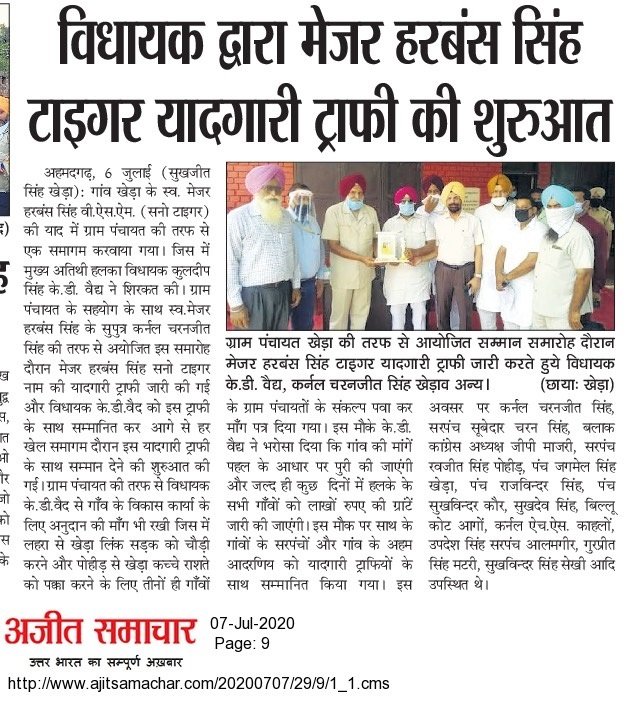
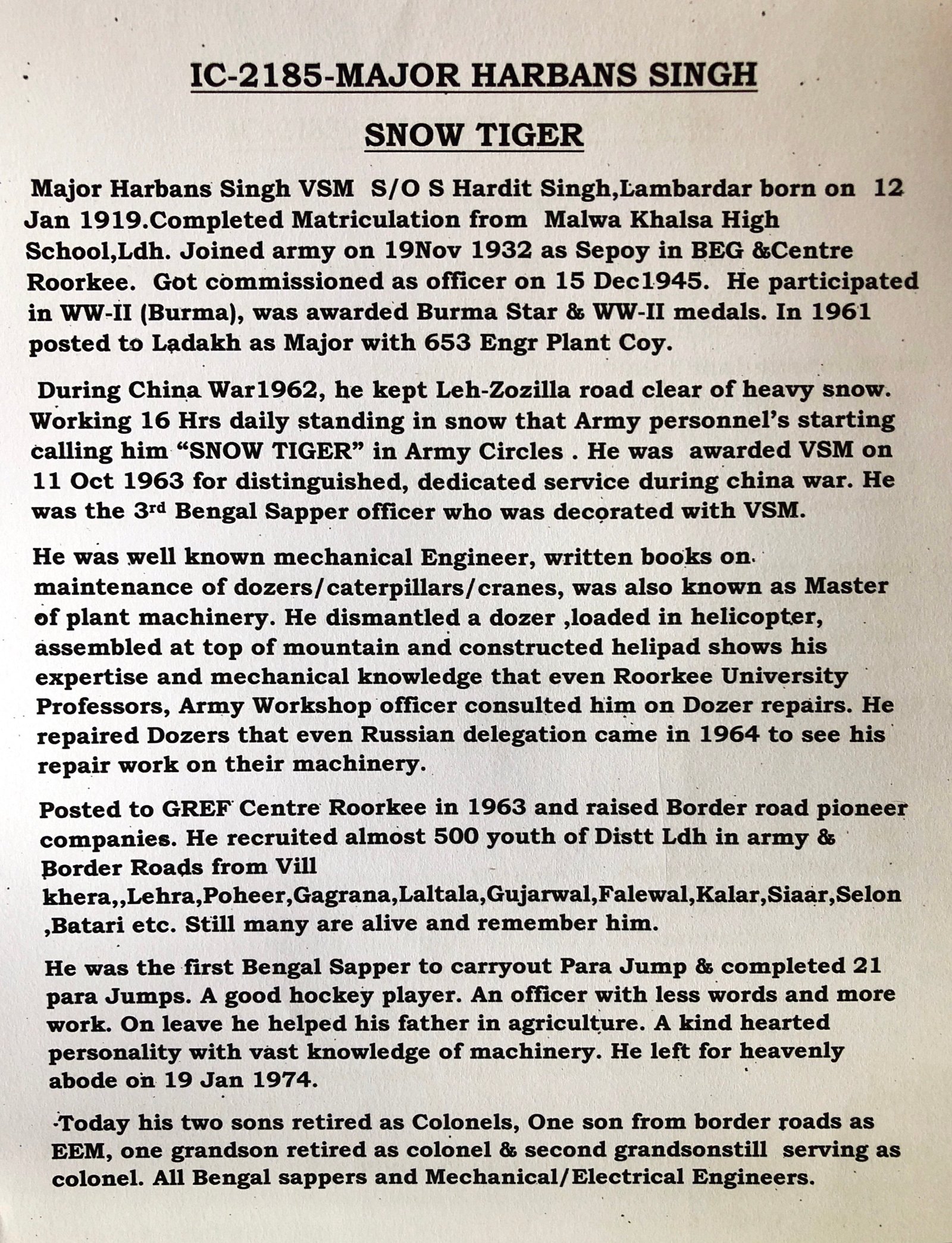
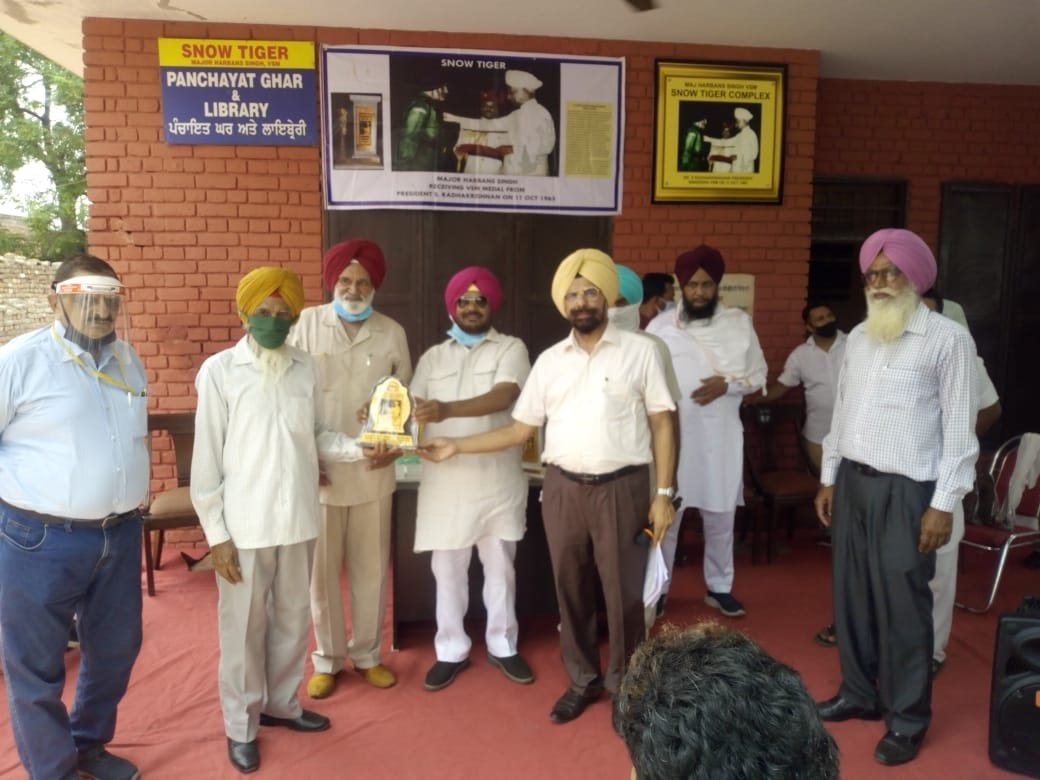
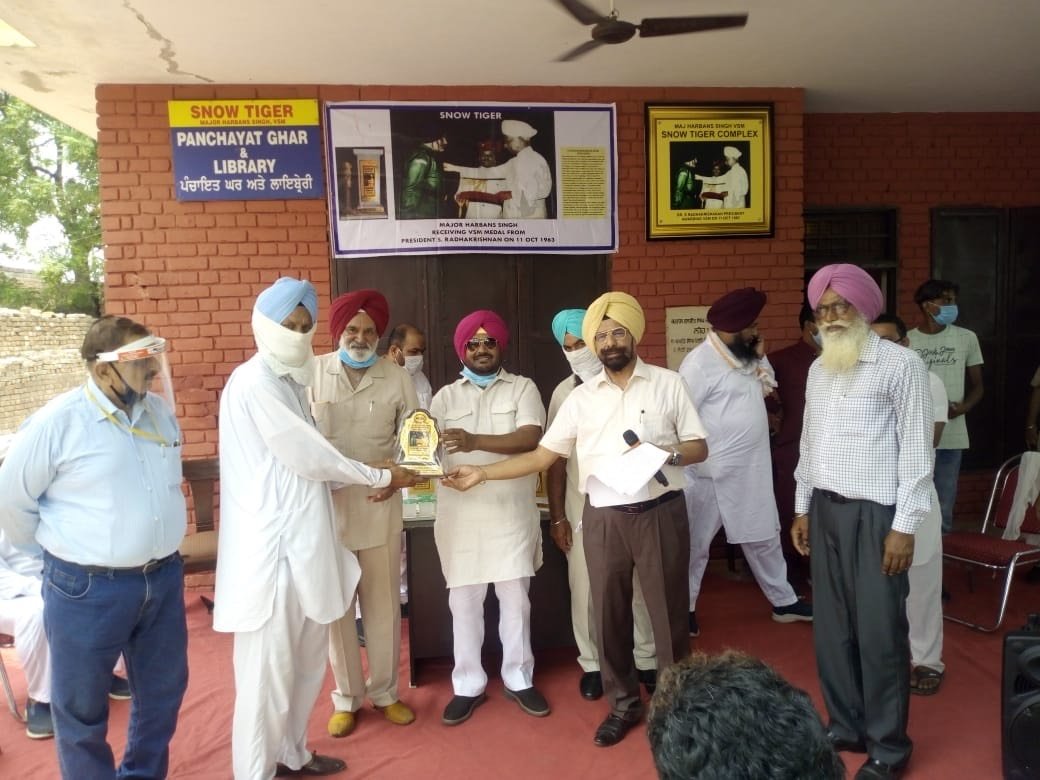
Major Harbans Singh VSM S/O S Hardit Singh,Lambardar born on 12 Jan 1919.Completed Matriculation from Malwa Khalsa High School,Ldh. Joined army on 19Nov 1932 as Sepoy in BEG &Centre Roorkee. Got commissioned as officer on 15 Dec1945. He participated in WW-II (Burma), was awarded Burma Star & WW-II medals. In 1961 posted to Ladakh as Major with 653 Engr Plant Coy.
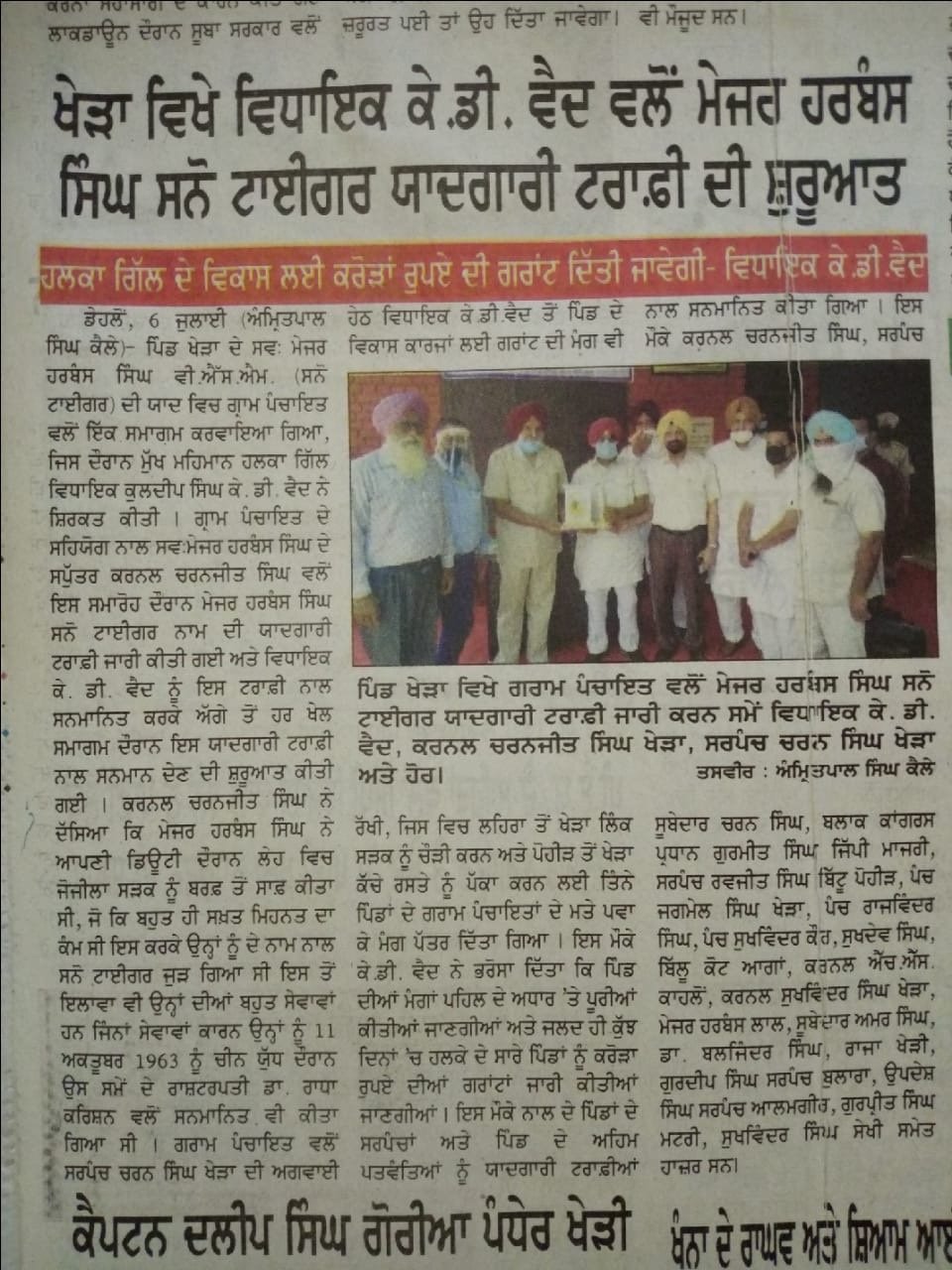
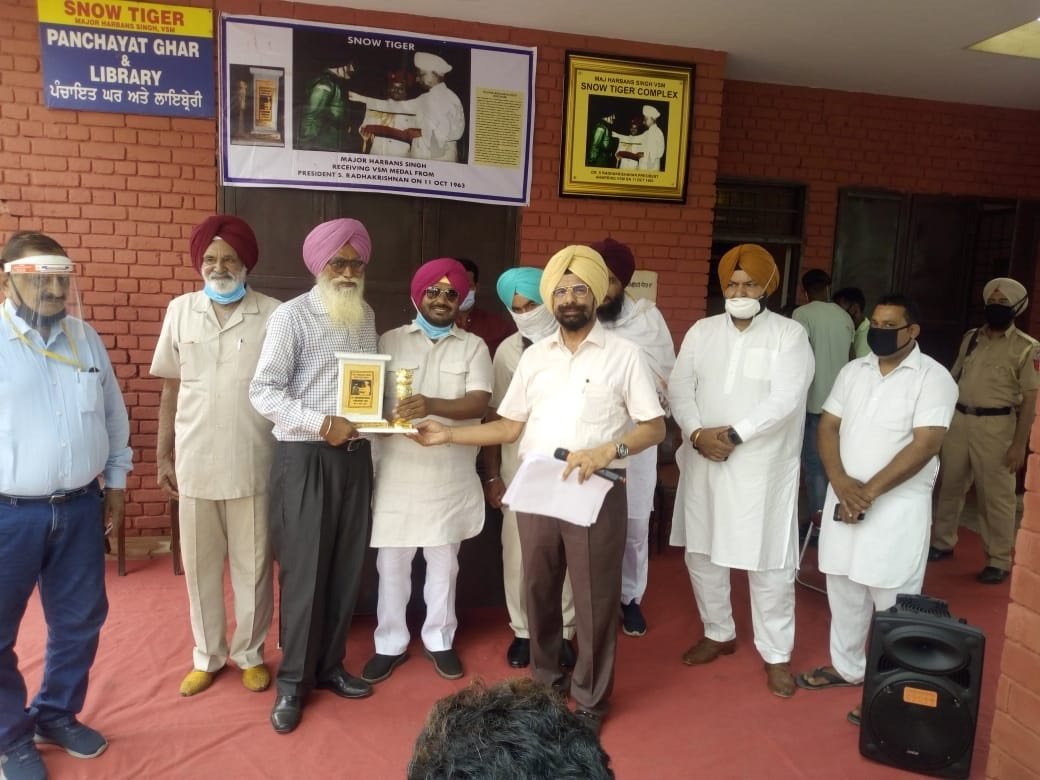
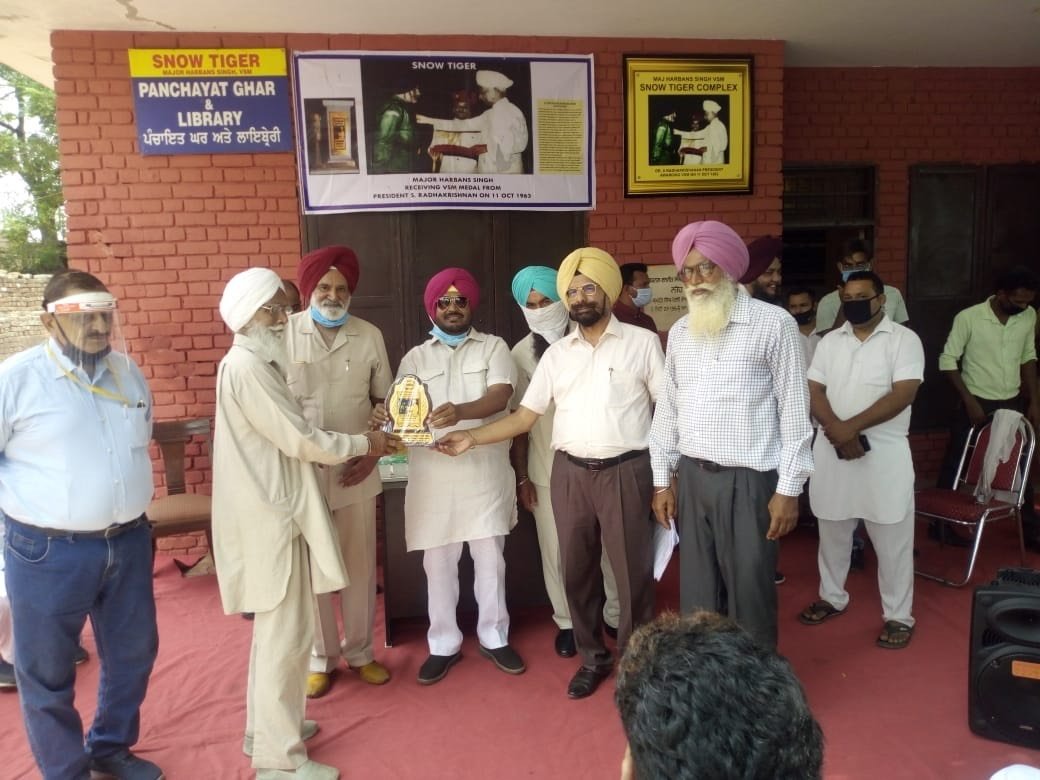
During China War1962, he kept Leh-Zozilla road clear of heavy snow. Working 16 Hrs daily standing in snow that Army personnel’s starting calling him “SNOW TIGER” in Army Circles . He was awarded VSM on 11 Oct 1963 for distinguished, dedicated service during china war. He was the 3rd Bengal Sapper officer who was decorated with VSM.
He was well known mechanical Engineer, written books on maintenance of dozers/caterpillars/cranes, was also known as Master of plant machinery. He dismantled a dozer ,loaded in helicopter, assembled at top of mountain and constructed helipad shows his expertise and mechanical knowledge that even Roorkee University Professors, Army Workshop officer consulted him on Dozer repairs. He repaired Dozers that even Russian delegation came in 1964 to see his repair work on their machinery.
Posted to GREF Centre Roorkee in 1963 and raised Border road pioneer companies. He recruited almost 500 youth of Distt Ldh in army & Border Roads from Vill khera,,Lehra,Poheer,Gagrana,Laltala,Gujarwal,Falewal,Kalar,Siaar,Selon,Batari etc. Still many are alive and remember him.
He was the first Bengal Sapper to carryout Para Jump & completed 21 para Jumps. A good hockey player. An officer with less words and more work. On leave he helped his father in agriculture. A kind hearted personality with vast knowledge of machinery. He left for heavenly abode on 19 Jan 1974.

The decision to include Australia in the drills — the first time all members of the regional grouping known as the Quad will be engaged at a military level — comes as Beijing and New Delhi are caught up in their worst border tensions in four decades. The exercise will bring together the navies of India, Japan, Australia and the U.S. in the Bay of Bengal at the end of the year, according to senior Indian officials who asked not to be identified, citing rules.
New Delhi is expected to clear the way next week for a formal invitation to Australia following final government clearance and consultations with the U.S. and Japan, the officials said.
“The timing of India potentially letting Australia into Malabar would be especially significant at this juncture,” said Derek Grossman, researcher at the Washington-based RAND Corporation who worked in the U.S. intelligence community for more than a decade. “It would send a significant message to China that the Quad — U.S., Australia, Japan, and India — are de facto conducting joint naval exercises, even if not technically conducted under the auspices of a Quad event.”
China has been uncomfortable with the informal coalition of four democracies, which was first formed in 2004 to help nations in the Indo-Pacific after the tsunami and revived in 2017. Post the coronavirus pandemic, the grouping has been coordinating efforts every month with Vietnam, South Korea and New Zealand.
Indian Navy Spokesperson Commander Vivek Madhawal declined to comment.
A spokesperson for Australia’s defense department said in an emailed statement on Friday that while the nation was yet to receive an invitation to Exercise Malabar, “Australia sees value in participating in quadrilateral defense activities in order to increase interoperability and advance our collective interests in a free, open and prosperous Indo-Pacific region.”
We are deeply grateful to our readers & viewers for their time, trust and subscriptions.
Quality journalism is expensive and needs readers to pay for it. Your support will define our work and ThePrint’s future.
Also read: Navy sends more ships from Eastern fleet for deployment in Indian Ocean region
While the Malabar exercises between U.S. and Indian navies were instituted in 1992, they have been more regular since 2004 with other Asian nations joining in the annual event. China had objected to the only other time Australia participated in the drills along with India, Japan, U.S. and Singapore in 2007.
India’s inclusion of Australia this year follows a defense agreement and upgrading ties to a Comprehensive Strategic Partnership. The Mutual Logistics support agreement announced in May by Prime Ministers Narendra Modi and Scott Morrison allows access to each other’s bases and ports. India has a similar agreement with the U.S.
Canberra’s inclusion in the games was “only a matter of time” given improving defense and economic ties, according to Biren Nanda, former Indian High Commissioner to Australia and senior fellow at Delhi Policy Group. Australia’s merchandise trade with India for the year ended June 2019 was A$21.1 billion ($14.5 billion), according to Australia’s Department of Foreign Affairs and Trade.
“There’s no direct relation between inviting Australia and what’s happening at the Sino-Indian border,” said Nanda in a phone interview. “This was a natural progression. Yet the question will be raised: how would the Chinese regard this? And they will react negatively. Just like they had done earlier.”
China objected to Japan’s inclusion in the U.S-India annual Malabar event in 2015 with the then foreign ministry spokesperson Hong Lei warning “relevant countries” to not “provoke confrontation and create tension” in the region. Five years later, with an assertive China pushing neighbors across the Asian seas, Nanda expects a similar response.
Yet, there may be more acceptance to the idea of “like-minded democracies that seek to keep the Indo-Pacific free and open” amid India’s rapidly souring on China ties, purely out of frustration, said Rajeswari Pillai Rajagoplan, distinguished fellow at New Delhi-based Observer Research Foundation and author of ‘Clashing Titans: Military Strategy and Insecurity Among Asian Great Powers.’
Although India and China are now in the process of disengaging along their 3,488 kilometer (2,167 mile) unmarked boundary in the Himalayas after high-level military and diplomatic talks, the deadly clashes that followed the months-long standoff in the Galwan valley was a blow to relations between the nuclear-armed neighbors.
“Especially after Galwan, there’s a growing realization in New Delhi’s elite circles that its increasingly difficult to trust China. They have broken more than four decades of agreements. Good trade ties are no guarantee of peace,” said Rajagoplan. “They have time and again tried to interfere in other nations’ foreign policy. But there’s an agreement in India that China should not have a say in who our friends are.”
With Washington indicating its willingness to back the region through an increased force deployment in Asia, the Malabar exercises may take on more importance.
“The Quad has always been a security platform but didn’t have a military context to it,” said Rajagopalan. “The Malabar exercises may give it just that thanks to China upping its ante and threatening the region’s security.”- Bloomberg
Also read: Army, Navy, IAF personnel can use private airlines to return to units, will be reimbursed

Sometimes history has unsung heroes whose valour and sacrifice go unnoticed because there was none to record it or publicise it. Sometimes, rarely, such valour and sacrifice are well known and documented, but it is embarrassing to sing praise, acknowledge or put the spot light of publicity on them. The story of Maj Bob Ranenglao Khathing MC, OBE, of the Indian army, is one such aberration. He was the man who surreptitiously went and annexed Arunachal Pradesh to India back in 1951 Like the Henderson Report, the real story of 62 war with China, the story of Maj Khathing remains buried in the Def Sec’s cupboard in spite of parliamentary intervention and RTI. It remains hidden from public view even after 50 yrs, though Indian Official Secrets act has a lifespan of only 30 yrs. It is politically expedient for the Govt Of India to erase Maj Khathing from all records that show that such a man ever existed. The right person who can corroborate this story is probably the venerable ‘Dalai Lama’, but even he has too much at stake to say anything that embarrasses GOI.
I did not invent this story and I do not know its veracity personally because I was only 2 yrs old when it happened. I have simply, and rather shamelessly, reinvented and plagiarised it from a story filed by Yambem Laba , a news paper man from the northeast, because I believe it is true. It has some relevance to another story that I am writing for you, about a fictional futuristic Sino Indian war, rather long story compared to my other stories on this blog. My ever increasing brood of fans are demanding stories faster than I can write them. Hence this story is being putout to buy myself time to finish my other fictional war story, about the same kind of ‘Dogs Of War’
To tell the story of Maj Khathing, and highlight his relevance in Indian history in the immediate aftermath of independence, it is necessary for me to first highlight the circumstances that led to the military defeat of Indian army in the Sino Indian war of 1962. Let me start this story from the British colonial India at the turn of the 20th C. Here we go.
In 1903, alarmed by the Chinese and Russian influence in Tibet, Col Francis Younghusband of the British army led a military expedition to subdue Thubten Gyatso, the 13th Dalai Lama (predecessor of the current one Tenzin Gyatso ). Thubten ran off to China and took asylum there. It took quite a while, and a lot of manoeuvring, for the British to tame Thubten. In 1914 Henry McMahon, the then British foreign secretary, finally managed to get Thubten’s envoy into Shimla to sign a free trade agreement between Tibet and British India. As part of the agreement, they also signed a treaty demarcating the southern boundary of Tibet. Since the Himalayas were unchartered, unmapped and rather unhappy territory, McMahon did the only thing that was practical and pragmatic. He took a pencil and drew simple line on a map, connecting all the highest peaks, the water shed, the northern slopes of which were to be in Tibet and the southern ones in British India. Even at that time, this line, the watershed, was neither acceptable to man, Yaks, Yeti, 13thDalai Lama, nor Col Younghusband as a practical, defensible, geopolitical border. However, at that time, this was not considered strategically or militarily important, or an issue, considering the greater cause and benefits to one sided, parochial, British interest in trade and commerce.
The border between British India and Tibet at that time (Shimla agreement in 1914) had three buffer Kingdoms, all of them simple monarchies propped up by treaties with British India. Nepal was ruled by the Ranas, Sikkim by the Chogyals and Bhutan by the Wangchuks. Eastwards from Bhutan lay the large 61,000 sq km stretch of sparsely populated and utterly inhospitable never never land, the barren mountains and jungles beyond any man’s ambition and aspiration. In those days it did not even have a name, at best it was referred to by the British as the ‘Dirang Dzong of Twang’ (it became North East Frontier Agency or NEFA, only in 1954 and Arunachal Pradesh recently in 1986).
I am told that ‘Dzong’ in Tibetan means a fort. I am also told that in those days such forts had a small military or police contingent of sorts to up keep law and order as also collect taxes in kind, and favours from local women. The master of such a Dzong was a ‘Dzongpen’, or a magistrate, with selected Lamas who helped administer the territory under the Dzong, called ‘Dirang Dzong’. The Dzongpen of Tawang owed allegiance to the quasi political and religious leader, the Dalai Lama at Lhasa. Prior to 1951, Aksai Chin, Leh, NEFA (Arunachal) were all Dirang Dzong that were administered by their respective Dzongpen as Tibetan territory with absolutely no allegiance or recognition of Delhi, either British or Indian. So the relevance of the McMahon line was mostly to do with the border along the northern Aksai Chin and Leh area, and the north eastern NEFA, all of which, tactically speaking, was a non contentious no man’s land during the colonial past. It was the land of the Lamas, Yaks and Yetis, all of them of little interest to the men of the early 20th C.
It became contentious half a century later, around 1950-51, when China occupied Tibet and the 14th (Current) Dalai Lama Tenzin Gyatso ran off from Lhasa and took political asylum in a newly independent India. A pro Chinese interim govt was installed in Lhasa. It became necessary for the politically naive, rather new Govt Of India to have a militarily defensible border with the Chinese occupied Tibet, especially keeping in mind India’s then foreign policy of abetment of Tibetan aspirations. The border became a bone of contention around 1958 – 60 period as a result of several clashes between Chinese and Indian army patrols to jockey and occupy mountain passes in the Himlayas that controlled thriving trade route between Tibet and India at several places. To give the Chinese due credit, the then Chinese Premier, Chow En Lai, wrote many letters to Nehru to try and resolve the problems amicably. However, Nehru, though wise and sagacious in so many ways, was besotted by his own rising unpopularity in parliament as well as the political brinkmanship strategies of the inflexible and highly autocratic Def Min, VK Krishna Menon, who was probably perceived by Nehru as his mentor and saviour. India refused to give any importance to the Chow En Lai letters. Chow En Lai then came to India in 1962 with an unusually large 135 member trade and military delegation, armed with trade concessions, historical maps as well as records to prove rightful borders of Tibet (specially Aksai Chin and NEFA). The trade concessions were olive branches sticking out of the barrel of a gun. The GOI did not notice this. The delegation returned to China empty handed. Krishna Menon ordered the Indian army to do forward posturing. The 1962 war was triggered by Indian army incursion at Namka Chu, an east-west stream which separates the Thag La and the Hathung La ridge, and at Se La pass, north of Tawang. But I am jumping the gun, this is a success story, not one of defeat and humiliation. It is the story of Maj Khathing who captured Tawang in 1951, around the time that the Chinese were occupying Tibet.
Ranenglao Khathing was born on 28 Feb 1912 in Manipur’s Ukhrul district. He was a Tangkhul Naga. The Christian missionaries had a profound influence on his psyche and one of them adopted him as their son. He studied at Sir Johnstone High School in Imphal, did his matriculation (10th) from Shillong and joined Cotton College in Guwahati. When he failed to clear his BA examinations in 1936, he was determined not to return home until he had obtained a degree. So he went to Harasingha in Assam’s Darrang district and founded a school where he also taught. A year later, after he had managed to graduate, a family friend SJ Duncan, who was then the British sub divisional magistrate of Ukhrul, convinced him to leave the Harasingha school and return to Ukhrul High School as it’s Head Master. In 1939 when WW-II precipitated worldwide mobilisation, 27 yr old Khathing immediately enrolled in the British army and was sent to the Officer’s Training School in Dehra Dun.
Commissioned into the 9/11 Hyderabad Regiment (now Kumaon Rgt), he had Thimaya (later General) as his company commander and TN Raina (later COAS) as fellow subaltern. In 1942 Khathing was transferred to the Assam Regiment in Shillong and became a captain. He was soon attached to the USAAF contingent at Jorhat for the ‘Hump Lift’ as a logistic liaison officer. ‘I am Capt Ranenglao Khathing’, he would introduce himself. It was too much for the Americans to mouth. ‘Yes Bob’, they would respond. Soon Capt Ranenglao Khathing morphed into ‘Capt Simply Bob’.
After the Japanese blocked the Burma road, the British army formed a guerrilla outfit called Victor Force (an earlier version and subsequent role model for Col Wingate’s Chindits) using the missionary educated tribals of Nagaland. Their task was to use topography and the jungles as their cover, live off the land and operate 100 to 150 miles deep inside the enemy territory to interdict the Japanese supply and communication lines, to inflict heavy causalities on the enemy and to act as a screen for then retreating British army from Burma. Capt ‘Simply Bob’ was sent to command this V-Force group in the Ukhrul area. He shed his army tunic, shaved his head like a typical Tangkhul tribesman with a thick mane running down the middle of his scalp, Mohawk style. On his back he carried a basket with dried salted meat and concealed his gun in his Tangkhul shawl. It is believed that while in command of Victor Force in 1942-44 period, he personally killed some 120 Japanese soldiers and played shindig with the Japanese, hit and run kind of war, living off the land and never surfacing anywhere, totally cut off from friend and foe. After the war was over, for his exemplary sacrifice and valour, he was awarded the Military Cross and made a Member of the British Empire.
After the World War, around 1945-46, Maj Bob was demobilised along with a large number of short-service emergency commissioned officers. Immediately afterwards, on request of then Maharaja ‘Kumar Priyabrata Singh’, he went to Manipur and joined the then interim government as minister in charge of the hill areas. In 1949, when Manipur merged with India, the interim government was dissolved and Bob found himself at loose ends. Soon Sir Akbar Hydari, then Assam governor, asked him to rejoin the Assam Rifles as a stopgap measure. He then served with the 2nd Assam Rifles Battalion for two years in Sadiya. In 1951 he was inducted into the IF AS (Indian Frontier Administrative Service) as an assistant political officer.
One day he was summoned by the new Assam Governor, Jairamdas Daulatram.
‘Bob, do you know where is Tawang ?, Jairamdas asked him.
‘No Sir’, Bob answered truthfully.
The Governor took him to a ‘Globe’ on his desk and pointed out Tawang. ‘This is the kingdom of the Dzongpen of Tawang’, he traced his finger over the incredible 61,000 sq km waste land that lay north of Tezpur stretching eastwards from Bhutan, all the way to Mon tribal area of Nagaland that Bob was familiar with. ‘He who controls Tawang shall control the far east’, Jairamdas predicted. ‘Do you think the Chinese should control it ?’.
‘No Sir’, Bob repeated.
‘What would take you to mount an expedition to Tawang and bring the Dzongpen under Indian political control, and to annex the region to the Union of India ?, the governor came straight to the point.
‘Sir, I am no longer in the army, I am now simply an assistant political officer, an Iff Ass’, he said with visible sadness. ‘I do not have the authority to do this’.
‘I am all the authority that you need, though neither the centre nor I have the ability to get the C-in-C Roy Boucher to agree to a military expedition for this task. At least not quickly enough to do it before the Chinese react’, Jairamdas mulled, running his hands over his bald head. ‘We need someone to do it quietly. Keeping in mind your war record, I cannot think of a better man to do it than you’.
‘I will do it’, Bob answered simply. ‘But I need an expeditionary force, about 200 hundred fully armed troops, mountaineering equipment as well as mules and porters to carry the equipment, a doctor and medical stores.
‘Sure’, answered Jairamdas. ‘Go, think it over. Send me the list of what you need and when you can start, the sooner the better’.
Bob did not think or procrastinate. He simply walked out of the Governer’s office, went to his PA’s office next door and dictated two simple letters to be typed on the letter head of the Govt Of India with the prominent Sarnath Lions in the top left corner. The letters were addressed ‘To Whomsoever It May Concern’. The first letter, with a heading ‘SECRET’, said that the Governor of Assam, on behalf of the newly formed ‘Republic Of India’, has ordered Maj Ranenglao Khathing (Rtd) to rejoin the Indian army, raise an armed expeditionary force, make war if necessary, and annex the Kingdom of the Dzongpen of Tawang with the Union Of India, as soon as possible. In the second letter, with the heading ‘UN CLASSIFIED’, the Governor authorised Maj Ranenglao Khathing, a serving officer of 2nd Assam Rifles, to collect Rs 25,000 from the treasury and requisition any stores or personnel he felt necessary for a mountaineering expedition in eastern India. He concluded the second letter making himself accountable, that he was subject to expenditure accounting at the end of the expedition. He took both the letters to the Governor for his signature and the then ubiquitous red wax seal of authority.
He asked the Governor for two months to conclude the operation. The Governor gave him 45 days to do it. Once again Bob walked into the PA’s office and dictated several telegrams, using Jairamdas’s name.
The first telegram was to his old unit, the 2nd Battalion of the Assam Rifles Regiment, still at Sadiya, near Barrackpore, near Calcutta. The message simply said, ‘Mobilise forthwith two companies with light weapons, ammo and stores to Tezpur. Requisition train resource and complete move with urgency. Capt Hem Bahadur Limbu from 5 AR to be in-charge of the move. Capt Modiero (doctor) and five physically fit medical orderlies to accompany troops with adequate medical and surgical stores. The troops to report to, and be under command of, Maj Khathing, reinstated forthwith to AR as Major’.
The second telegram was to Bata Company in Calcutta, requesting a special order for 1000 pair of fleece lined leather mountaineering shoes, to be shipped to Tezpur by chartered aircraft urgently, payment to be made in advance from treasury against an invoice’.
The third telegram was to the cartographers at the ‘Geographical Society Of India’ also at Calcutta, to urgently forward to the Governor’s office, ten sets of large scale relief maps of area north of Tezpur, whatever was available.
The fourth telegram was to Benny & Sons, Canned Food Suppliers, once again at Calcutta to immediately accept an urgent delivery order for canned Luncheon Meat, Sausages and Mackerel, each ten thousand tins, to be handed over to Captain Hem Bahadur Limbu at Sadiya. Payment to be made in advance from treasury against an invoice’. Bob chuckled when the PA looked up from the type writer with a perplexed look. ‘Look my good man’, he said amicably. ‘If we have to march up the mountains all day, we may as well sleep on a full stomach. Moreover, I have had more than enough of living off the land in Victor Force’.
His last telegram was to the Army Supply Park at Dhimapur. ‘Requisition thousand sets of Parkha or Irwing jackets, socks and other articles of warm clothing. Await instructions from Maj Khathing of 2 AR, scheduled to arrive your location in two days’.
When he finally arrived there at Dhimapur, all he could find was brown US Army issue Angola shirts, which he accepted though they were all of awkward sizes. On a spur of the moment brainwave, he travelled to Chabua and Dinjan where the USAAF had left behind large metal containers of stores when they withdrew their operations of the ‘Hump Lift’ from Chabua and Ledo six years earlier. There were hundreds of containers kept in safe custody of the Army and Air Force. When he broke open these containers, he found camping gear, tents, Irwing Jackets, woollen gloves and socks, inners, just about everything that he wanted for equipping his expeditionary force into the cold wasteland of the Himalayas. He got them repacked into four of the same containers and had them transported to Tinsukhia railway station, from where he sent them to Tezpur via Guwahati since that was the only road and rail crossing across the wide Brahmaputra river. Afterwards he caught a routine ferry from Dibrugarh to Majauli island and crossed over to the north bank of the river on elephant back. Once across the river, he requisitioned an old war surplus jeep from a British tea planter and drove down tea plantation tracks and back roads to Tezpur, arriving several days before the men and material arrived there from all quarters. At Tezpur he made arrangements for around two hundred mules and donkeys, 400 odd porters from the plains, and another two hundred from the hills. He also requisitioned ten odd tailors and cobblers to go with them on the expedition with their tools of the trade. A mountain of food supplies, mostly rice, flour and condiments, kerosene jerry cans, he procured locally. As the men and material arrived, he moved his base camp to a large clearing at Lokra, about twenty km north of Tezpur town.
For three weeks he drilled his men and took them on long endurance runs, carried out rifle shooting practice and formed them into a tough bunch with high morale and camaraderie. He formed small teams of porters, each hundred men, in change of a Naik of the AR, and sent them with the men and animal ported packed stores in relays to establish forward camps. He also sent scouts towards Tawang to not only reconnoitre easy mountain trails to Tawang, but also gather intelligence.
Due to the sudden nature of Bob’s activities and flashing of the unusual authorisation letter, the expedition came to the notice of Major TC Allen, the last British political and intelligence officer of the east, based in Dibrugarh. He followed Bob to Tezpur to enquire into whatever that was happening and met up with him at Lokra. Though Bob received him cordially, he gave Allen a Hobsons’s choice. Either come with him to Tawang or be quarantined at close arrest under guard at Lokra till the expedition was over. Allen, a keen mountaineer, chose the former and applied himself with zest as Bob’s second in command, thereby making it a strange indirect ‘Anglo Indian’ expedition
The expedition started out from Lokra on 17 Jan 1951, with 200 soldiers under full pack with arms and ammunition. There were no regular roads or bridges over the rivers and streams, one had to just walk cross country. Because of physical toughening of troops and staging of camps twenty to twenty five km apart over inhospitable terrain with just goat tracks, Bob was able to move his expeditionary force at great speed. However, he allowed the men from the plains to acclimatise to altitude by stopping a day every three days of march. Within nine days they were able to reach the Dzong at Bomdila, the first frontier post of Tibet then commanded by Katuk Lama, an assistant political agent. Bob camped right at the closed gates of the Dzong. The next day, on 26th Jan he hoisted the Indian flag in front of the Dzong and invited all the inhabitants to a feast. The Governor sent a Dakota from Guwahati to reconnoitre Bob’s progress. The aeroplane flew low over the monastery and while the soldiers waved, it did several rounds of the monastery. The show of force was enough to convince Katuk Lama that an invasion was in progress. He urgently despatched runners to warn all Dzongs towards Tawang.
After three days rest and recuperation, as also time for the hill porters of his retinue to catch up, Bob moved out once again on 1st Feb 51 to Chakpurpu and Senge Dzong at the base of the Sela Pass. The five mile climb to Sela Pass sapped their energy and wits. Undaunted, they moved further up the mountain to Nauranang. On 4 February, they camped at Jang village. Two locals and some troopers were sent out by Bob to collect information and to gauge the feelings of the local people towards their expedition and to invite them for another feast. The next day, the headmen and elders of Rho Changda and the surrounding villages of Jang visited Bob. Through an interpreter Bob explained the purpose of his visit and advised them not to pay obeisance to the Tsona Dzongpens, that they were now free citizens of the Union Of India. To the exceptionally primitive tribals in such isolated and far flung land, the concept of freedom and democracy were as alien as the back side of the moon. However they understood that a new conqueror ‘Bob’ had come to rule them. Bob then detached Capt Limbu, Sub Bir Bahadur and Jam Udaibir Gurung, tasking them to scout around the Sela Tract to find a militarily defensible site and to construct a permanent check post and barracks to establish an Indian frontier post. He left behind some of his troops as well as porters and advised Limbu to take the help of the local tribals to carry out his task.
Bob moved his task force further forward. On 6 February they camped at Gyankar and Tibetan representatives of the Dzongpen of Lhau came down hill to meet them. They brought presents and offered Bob incentives in gold and women if he would go back. Bob simply smiled and welcomed them as fellow citizens of a new country to enjoy a new found freedom. Next day was the Tibetan New Year or Lhosar, the first day of the Year of the Iron Horse. In the evening it snowed heavily and the weather turned extremely cold. However, the entire expeditionary force including the porters were snug and warm in American war surplus clothing due to Bob’s foresight and good sense .
Bob and the expeditionary force reached Tawang on 7 Feb 51. They spent two days scouting the area for a permanent site where both civil and military lines could be laid out with sufficient area for a playground. A place was chosen north-east of Tawang Monastery and he camped his force at this location. He put his soldiers and porters to work building a semi permanent military camp with wooden logs and stones. He then sent emissaries to the Dzongpen for cordial meetings and to arrange an instrument of accession to the Union Of India. For two days there was no reciprocity or goodwill. The small population remained indoors.
After three days, Bob got impatient. That night he ordered his men to fire 20 rounds of two inch mortar at the hill sides and fire off 1000 rounds of 303 ammo in the air. In the closed confines of the mountain, on a dark and silent night, the fireworks sounded like frightening thunder claps, echoing and reverberating, one placating message after another. The voice of God. In the morning he lined up his troops, fixed bayonets and marched his troops up and down Twang for four hours. He also planted the Indian Flag in front of the Monastery. This had the desired effect and the next morning the Dzongpen sent emissaries. Bob put Maj Allen of the British army on the job to negotiate armistice and to draw up a parchment for the formal accession.
There were endless long winded negotiations. The emissaries were told that the Tsona Dzongpens or any representatives of the Tibetan government could no longer exercise any power over the people living south of the Bumla range. Obviously the emissaries had many objections to such a preposterous proposition.
On 11 Feb Bob made a courtesy call on the Abbot of the Tawang monastery. He gifted the Abbot with a hand wound gramophone and two Beethoven 33 rpm records. The Abbot had never seen such an invention and after the initial fear he instantly took a shine to ‘Music of Budha’. Bob then presented other monks with knickknacks from his camp, American warm clothing, several Tiffin carriers, back pack, tinned food, a bugle. He requested them for their assistance to advise and to influence the local people to acknowledge and accept the accession to the Union Of India. No taxes were to be imposed, women were to be treated with respect. He told them of the withdrawal of the British from India. He sold them the concept of freedom and the new found aspirations of the people of India. The rural rustic monks found Bob a more pleasant and sagacious King to have than the autocratic Dzongpens.
After two days, on 13th Feb, because Allen was making no headway, he sent out patrols to round up the Chhgergans (officials) of the 11 Tsos or Tibetan Administrative Units and to bring them into the camp. If they did not come voluntarily, he ordered that they were to be brought by force. For several days afterwards they were wined and dined with great hospitality and respect, Bob issued a general order that they were henceforth not to accept the suzerainty of the Dzongpens or Drekhong, or pay tax or tribute to them.
Finally around the 19th or 20th of Feb, Bob ran out of patience. He was also running out of the time that the Governor had given to him. Along with Allen, the Chhgergans and a hundred troops, he marched directly to the palace of Nyertsang, the Dzongpen of Tawang. He did not meet with any resistance and there was no violence of any kind. All proceedings were done with traditional cordiality and respect.
Nyertsang laboured and stalled for time, to seek advice and guidance from Tibetan government in Lhasa.
‘What Govt ?’, Bob interjected. ‘The Chinese army has invaded Tibet’.
‘You ever heard of Col Younghusband ?’, Allen asked Nyertsang. ‘There is a treaty with the Govt of Tibet, and as per that treaty the area south of the watershed, south of the McMahon line, it is in India, not Tibet. Tawang is part of India. You really have no business here’, he said.
Because of his awkwardness in sitting on the cushions placed on the ground, and because his pistol butt was poking his hip, Allen suddenly took out his Smith & Wesson pistol and placed it on the ground in front of him.
Nyertsang’s visage fell, he deflated like an air pillow.
Allen took out the parchment from his map case and the treaty of accession to the Union Of India was signed by Nyertsang without much ado. Under the powers vested on him by the Governor of Assam, Maj Bob Ranenglao Khathing MC, OBE, signed the treaty on behalf of the Republic Of India. As a token of appreciation, a ‘Nazrana’, of 1000 Rupees was paid to Nyertsang. Allen named the Kingdom of the Dzongpen of Tawang, as the ‘North East Frontier Agency’ (NEFA). Bob appointed Allen as a Lieutenant Governor, accountable to the Governor of Assam, to administer the kingdom till GOI could send their representatives. A quarter-guard was established at the Dzongpen’s treasury using AR troops and Allen set out to document all cash and treasure, besides other administrative tasks of governance. Allen was the first ‘Nawab of Nefa’, albeit white.
After the accession ceremony, Bob had a final task to do, to go back to the Governor and inform him that he had carried out his duty, to every one’s satisfaction, without firing a shot (except for the fire works for entertainment). So he set out downhill to Tezpur with a small retinue leaving the expeditionary force in charge of Allen. The Governor sent a Dakota to pick him up from Tezpur and they flew to Delhi and went to see the Prime Minister, Nehru.
Nehru was livid, ‘Who asked you to do this?’, he vented his anger at the Governor. ‘I wish you had the good sense to consult me before you commissioned this colossal stupidity. Do you have any idea how much trouble I am having with Chow En Lai over Tibet?’, he mourned. ‘I want a complete black out on this incident’, he ordered the PMO. ‘I want the PTI to put the lid over this, and not blabber about it’.
‘And you’, he pointed an accusing finger at Bob. ‘Please get lost, don’t ever talk about it’.
Bob and Jairamdas walked out of the PMO dejected.
It took Nehru another four years of tough negotiations with Chow En Lai to come to terms and sign an eight year agreement over Tibet and form the first ‘Sino Indian Pact’. Only in Apr 1954, after the pact, did GOI publically announced it’s suzerainty over NEFA and appoint an Indian overseer team in NEFA to replace Allen and his merry men from 2 AR. The new Indian team was from the Special Intelligence Bureau, none from the prestigious newly formed IAS ever wanted to go and live in this god forsaken land . NEFA finally became an Indian state, renamed ‘Arunachal’, the land of the rising sun, only in 1986. It was to have a brand new capital, to be built out of the blue at Itanagar, a pasture in the foot hills. Tawang was too much of a bother for both the new found politicals, as well as IAS in NEFA.
Afterwards Bob simply disappeared amongst the vast multitude of India, faceless and without an identity. He was to go back to Tawang only in 1986, for the statehood celebrations. His visit was private and unrecognised. A 74 yr old man’s personal trip down memory lane. None recognised or remembered Bob. Like all old and bold soldiers, he did not die, he simply passed away, having done his duty well.
In 1966, when I joined NDA, my Divisional Officer in Foxtrot Sqn was a nephew of Bob, the same kind of man, with the same genes, simply an incredible, resilient, unstoppable, hard core soldier. The first ten years of my own soldiering was in that area, the god forsaken country in the far-east. One soldier to another, three cheers, ‘Long live Maj Bob Ranenglao Khathing MC, OBE, hip hip ………….


Air Marshal Suresh Chand was the first person from Himachal Pradesh to rise to the post of Air Marshal in the Indian Air Force. He was born to a lawyer’s family in the small village of Nurpur in Kangra district. After schooling, he joined the Delhi College of Engineering. He chanced upon an advertisement inviting applications for commission into the Air Force. He applied and was selected. This was his true vocation — he slipped into the cockpit like a fish takes to water.


Despite the fact that his marital life was not happy, and he had to look after two young sons — one of whom was suffering from haemophilia — he never let these personal problems come in the line of duty or mar his professional career. He took command of the Para Trooper Training School in 1971 and trained a large number of paratroopers. He was awarded the Vayu Sena Medal in 1975, and it was recorded that his training went a long way towards the success of an air-borne assault during the Indo-Pak War of 1971.
He held various strategic posts. During the Indian Peace-Keeping Force (IPKF) operations in Sri Lanka, he played a pivotal role which helped the Army get logistics support from the Air Force. In recognition of his services, he was awarded the Ati Vishisht Seva Medal in 1987 for his inspiring leadership for improving the quality of flying training and in ensuring that the bases under his command achieved their flying task and the aircraft maintenance was of the highest level. He was the first non-fighter pilot to be appointed AOC-in-C — the post he retired from in 1991.
After retiring, he quietly slipped into a life with few perks. He enjoyed the rubbers of bridge and rounds of golf, and kept an active social life. Unfortunately, he was diagnosed with cancer about six months back and accepted it stoically. He decided not to go in for aggressive treatment, saying, ‘I have lived life on my own terms and will end it on my terms.’ He continued going to the club and playing bridge, and meeting his friends.
Then Covid-19 struck. His sons, who were abroad, could not come to meet him. He could not go anywhere. He was lonely. Though physically weak, he never lost his sense of humour. He enjoyed talking about the past, especially his years in the Air Force.
He did not like anybody talking about his illness. Till the end, he fought like a soldier, bore the pain without complaint and lived his life with dignity. Such a braveheart!
In normal times, there would have been hundreds at his funeral, but now, there were only a few members of the family. The Air Force presented a befitting, though much scaled down, farewell to one of its warriors.
A life well lived, and a fighter to the end. That is how I will remember him.