



Sanjha Morcha

What’s New

Click the heading to open detailed news

Current Events :

web counter

Print Media Reproduced Defence Related News

articipants get ready for the Invitational Golf Tournament, a precursor to the 3rd Military Literature Festival, in Chandigarh.— Tribune Photo Vijay Mohan Tribune News Service Chandigarh, November 11 The fourth edition of Military Literature Festival (MLF) will be held virtually this year due to the restrictions placed amid the ongoing global COVID-19 pandemic. The festival is scheduled for December 18, 19 and 20. Most of the events, including the inaugural session and panel discussions, will be conducted online. Few public events, which were held in the previous years, are being done away with this time. However, a War Memorial function is scheduled for December 7. The current stand-off in Ladakh, and the violent clash between the two armies at Galwan Vally, along with the threat from China, is expected to be the major topic of discussion among the geo-strategic issues. A wide array of contemporary, historic, literary, and technical issues related to national security, and the armed forces will feature in the MLF, with experts in the domain, as well as, serving, and retired defence officers propounding their views. With the 50th anniversary of the 1971 Indo-Pak war falling next year, it is also expected to be one of the hot topics of discussion. Higher defence management, military industry unconventional and sub-conventional warfare, foreign relations, military diplomacy and the strategic fallout of events like the impact the ongoing pandemic are other topics of interest. “Live streaming, as well as, recording of events like the panel discussions, weapon display, book launches, war memorial service, films, virtual exhibitions, and other interactive sessions would be done over social media, and other cyber platforms”, said Brig JS Arora (Retd.). A professional agency has been engaged for the conduct of this three-day event. MLF is an annual affair. It is conducted by the Punjab Government, and the Western Command to honour, and commemorate the legendary, brave, and sacrifices of the Indian soldiers. It is also to bring a common platform for experts to deliberate on the contemporary military, security, and geopolitical issues.

Air Vice Marshal wins battle for higher salary, avers juniors draw more pay

Photo for representation. — iStock

Vijay Mohan

Tribune News Service

Chandigarh, November 10

Nearly a year after retirement, an Air Vice Marshal has won a legal battle for higher salary after he had contended that officers junior to him and those posted under his command, were drawing higher pay.

The Armed Forces Tribunal has ordered the government to step up his pay retrospectively with effect from July 2017 to bring it on par with his immediate juniors and thereafter grant him all arrears and consequential benefits along with re-fixing his pension accordingly.

Air Vice Marshal P Subhash Babu, who was commissioned into the Accounts Branch of the IAF in June 1985 and retired after rendering 34 years of service, had averred that his pay as on July 1, 2017 was Rs 2,18,200, including the Military Service Pay (MSP) component, whereas two of his junior officers at the rank of Air Commodore who were commissioned much after him were drawing Rs 2,26,800 and Rs 2,20,600, respectively.

When he was promoted as Air Vice Marshal in July 1016, there was no separate MSP for Air Vice Marshal and equivalents and MSP was subsumed into the basic pay for officers at this rank and above. MSP was granted to defence personnel as a separate element of pay up to the rank of Air Commodore and equivalent.

He also pointed out that the Ministry of Defence, while processing a statutory complaint filed by him in this regard, returned it saying that the matter was being examined by the ministry, but till date, no decision has been taken.

“Merely because the Union of India has taken no decision in the matter to remove the anomaly, we cannot lose sight of the fact that the principle of stepping-up of pay is a well settled principle in service jurisprudence,” the tribunal’s bench comprising Justice Rajendra Menon and Lt Gen PM Hariz said in its order of November 4.

“It has been enforced only for the purpose of removing anomaly in the pay scale and pension between a junior and senior officer and if the anomaly has arisen on account of revision of pay-scales, the same should be removed by stepping-up of pay of the senior officers, as has been done in the case of SN Chaturvedi by the Delhi High Court,” the bench said.

Suresh Babu had relied upon Chaturvedi’s case of 1990, who was also then an Air Vice Marshal and had faced a similar situation following the implementation of the Fourth Pay Commission.

The Tribunal also observed that circulars have been issued by the defence ministry in the matter of stepping-up of pay of Major Generals and equivalents, and it is indicated that the question of extending the benefit by Delhi High Court has been examined by the Government of India and similarly placed Major Generals and equivalent officers would be granted stepping up of pay if officers lower in rank like Brigadiers are drawing more pay.

“In rejecting the statutory complaint without considering all these aspects, the    respondents have committed grave irregularities and illegalities, and accordingly, the impugned order being unsustainable, is quashed,” the bench further ruled.


CBI probe likely into 8 MoD contracts in Kargil 13 military men under scanner

CBI probe likely into 8 MoD contracts in Kargil

CBI probe against 13 persons, including Military Engineering Service (MES) and the Army personnel

Tribune News Service

New Delhi, November 11

The Ministry of Defence (MoD) is all set to recommend a CBI probe against 13 persons, including Military Engineering Service (MES) and the Army personnel, for bungling in eight building contracts related to troop welfare projects in Kargil.

Contractor overpaid

  • Eight contracts for separate works were allotted to a firm in 2012
  • A probe by the vigilance cell of the Defence Ministry was launched in 2016 after a series of questions were raised in the matter
  • It has been found that the contractor was overpaid for the work

Eight contracts for separate works were allotted to a firm in 2012. A probe by the vigilance cell of the MoD — dealing with the MES and the Border Roads Organisation (BRO) — was launched in 2016 after questions were raised in the matter. In October 2018, the progress in a series of cases was reviewed and the probe was intensified. It has now been found that the contractor was overpaid for the work he carried out. The quality of the work and material was of “very poor quality”. There are glaring gaps in accounting of stores and accounts books.

Sources said the civil works related to troop welfare and habitat were of strategic nature. These were in poor condition and the officers at the brigade at Kargil expressed their concern over poor construction.

Over 100 such cases of alleged corruption are being processed.


India, China consider 3-step proposal to ease LAC standoff

India, China consider 3-step proposal to ease LAC standoff

o ease tension in eastern Ladakh, a three-step disengagement plan has been suggested.

Ajay Banerjee

Tribune News Service

New Delhi, November 11

To ease tension in eastern Ladakh, a three-step disengagement plan has been suggested. India is considering a proposal by the People’s Liberation Army (PLA) asking the Indian Army and its troops to pull back from critical spots along the Line of Actual Control (LAC).

If an agreement is reached, India will vacate the 13 spots it occupies along the southern bank of Pangong Tso. In response, the PLA will pull back from the spots on the northern bank of the same lake. However, the contentious 900 sq km Depsang plains in northern Ladakh, where both sides have claims and counter-claims, is not part of the proposal or the suggested pullback.

“It is a proposal, and not an agreement to disengage, let it be fine-tuned and matters to mature,” said a senior Indian Army officer.

The China Study Group (CSG), led by National Security Adviser Ajit Doval, will consider the proposal but is likely to seek iron cast guarantees that the perception of the LAC — an un-demarcated boundary — will be respected.

Also, that the PLA troops will not reoccupy the heights India vacates south of Pangong Tso or those on the north bank or the points of disagreement at Galwan, or patrolling points 15 and 17.

The CSG will be discussing that the issue of entire 826-km LAC in Ladakh should be part of the same disengagement and de-escalation process and must include the Depsang plains.

It is here that the Chinese troops can threaten India’s access to the 255-km Darbuk-Shyok-DBO (DSDBO) road, which leads to Karakoram Pass and has an airfield next to it at an altitude of 16,800 feet.

India will convey its decision at the ninth meeting of the senior military commanders anytime next week.

More than 50,000 troops of each side face each other, accompanied by tanks, artillery guns, fighter jets and missiles, in the worst-ever border crisis since 1967 when both sides had exchanged fire.

Apart from the fatal Galwan clash in June this year, there have been hand-to-hand combat and firing in the first week of September. The night temperature in the area is minus 30 degrees Celsius.

How Delhi, Beijing plan to Disengage

Phase 1: Simultaneous withdrawal of tanks from forward locations along the LAC

Phase 2: Simultaneous withdrawal of troops — Indian troops will return to the Dhan Singh Thapa post located on Finger 3 (see map), north of the Pangong Tso

  • PLA troops will withdraw to Finger 8; the mountain spurs which descend into the Pangong Tso are identified as ‘fingers’

Phase 3 The Indian Army will withdraw from all 13 critical heights and territories, including Rezang La and Renchin La, along the southern bank of Pangong Lake which give India an edge over the Chinese troops

  • These were occupied in August and allow India to dominate Spanggur Gap under the PLA and also its Moldo garrison

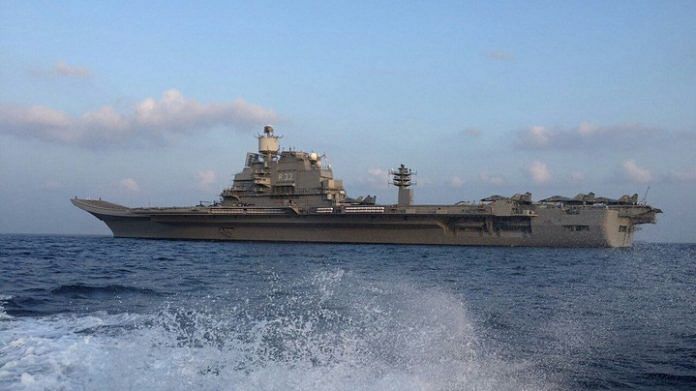
Navy demonstrates combat readiness with video of missile destroying ship in Arabian Sea

INS Vikramaditya | @DefenceDecode | Twitter

New Delhi: In a demonstration of its combat readiness in strategic sea lanes around India, the Indian Navy on Friday released a video of an anti-ship missile destroying a sinking ship with “deadly accuracy” somewhere in the Arabian Sea.

The missile was fired by frontline corvette INS Prabal as part of a mega naval drill involving aircraft carrier INS Vikramaditya and a number of warships, attack helicopters, aircraft and other assets of the Navy.

An Indian Navy Spokesperson tweeted that the missile homed in on its target, an old ship, hitting with deadly accuracy at its maximum range.

“#AShM launched by #IndianNavy Missile Corvette #INSPrabal, homes on with deadly accuracy at max range, sinking target ship,” he said.

Chief of Naval Staff Admiral Karambir Singh on Thursday reviewed the operational preparedness of his force at various shore-based locations a well as at sea.

He also addressed a select group of combatants of the Navy’s Carrier Battle Group over a broadcast from the INS Vikramaditya, India’s only aircraft carrier, and reviewed the force’s overall combat readiness, officials said.

In his remarks, Admiral Singh complimented his force for continuously maintaining “peak combat-readiness” and “high tempo” of operations over the past few months, they said.

The Indian Navy has significantly increased its deployment in the Indian Ocean Region, in an attempt to send across a message to China in the wake of escalation in tension between the two countries.

Giving an overview of the prevailing security situation, the Chief of Naval Staff stated that the Navy would continue to maintain a high-tempo of operations in coming months.

“He also complimented the Carrier Battle Group and its combatants for accurate and effective weapon firings, which left no doubt about the Navy’s readiness to meet any emergent contingencies,” the Navy said in a statement on Thursday.

A carrier battle group is a mega naval fleet comprising an aircraft carrier, accompanied by a large number destroyers, frigates and other ships.

“Indian Navy continues to maintain a high tempo of operations and combat-readiness despite the COVID-19 pandemic by adhering to stringent protocols onboard warships, submarines and aircraft squadrons and bases, and is fully prepared to tackle challenges in the maritime domain,” the Navy said.


Also read: Will continue maintaining high-tempo of operations, says Navy chief amid tensions with China


In Pakistan, a new battle takes shape | Analysis The Opposition has challenged Imran Khan and the army. Khan is weak; the army is not

The army will close ranks to protect its role in the polity. The India factor will be used to remind the people that it is needed to protect them, especially at this time

The army will close ranks to protect its role in the polity. The India factor will be used to remind the people that it is needed to protect them, especially at this time(AP)

The Pakistan army and the country’s principal opposition parties are on a collision course. Despite the army’s warning not to drag it into politics, these parties have publicly complained about its political role. The Pakistani political class has traditionally accepted the army’s political role as a given and politicians have wanted to secure its support to promote their individual interests. Now, these Opposition parties are asking the generals not to interfere in the country’s politics.

The real target of the People’s Democratic Movement (PDM), which is scheduled to hold its first rally on October 16, is not Prime Minister (PM) Imran Khan, though his resignation and fresh elections have been sought, but the men in khaki. This also seems to borne out by former PM and the Pakistan Muslim League(N), PML(N), leader Nawaz Sharif’s blistering attack on the army in his address to a multi-party meeting called by the Pakistan Peoples Party (PPP) on September 20.

Sharif said that Pakistan was controlled by a “state above the state” which did not let any elected Pakistani PM function properly or complete his term. He criticised the manipulation of the 2018 national assembly election to foist a “selected” PM — Khan — on the country. The meeting, which decided to launch the PDM, also expressed great concern at the “establishment” (a euphemism for the army) increasing its “role” in the country’s domestic affairs and, by doing so, threatening the country’s stability and institutions. PPP chairman Bilawal Bhutto Zardari also called for a “non-political establishment”.

The Pakistan army is a professional fighting force and, at the same time, despite its denials, a political institution. It is the final decision-maker of the country’s security and foreign policies but has always, also, reserved the right to intervene in any other area of governance during civilian rule in the country.

Both the army and Khan are taking PDM seriously. This is borne out by Khan alleging that opposition leaders have joined hands to save themselves from corruption charges. He has quickened the pace of investigations against PML(N) and PPP leaders. Nawaz Sharif’s brother, Shahbaz Sharif, the former chief minister of Punjab, has been jailed and former president Asif Ali Zardari has been charged for corruption.

More significantly, Khan, while mounting a stout defence of the army and maintaining that the Inter-Services Intelligence is the finest service in the world, has fired the brahmastra against Nawaz Sharif; he has accused the former PM of playing India’s game in maligning the army. There is no more potent charge that can be levelled in Pakistan than colluding with the permanent enemy, India. Nawaz Sharif is in London since last November. He was then in jail but was allowed to go abroad for his medical condition was said to be critical.

On its part, the army is letting Khan take the lead in battling PDM but is expectedly refuting charges of interference in governance. While addressing the cadets of the Pakistan Military Academy on October 10, army chief Qamar Javed Bajwa said: “I count it a great honour that we stand before the nation as a trusted and accountable institution”. He also emphasised “Our actions are guided by constitution and the national interest of Pakistan”.

This is not the first time in Pakistan’s history that sections of its political class are seeking to take on the army. What is different now is that they are openly calling for it to be an apolitical force, as is traditional in true democracies. This goes against the grain of the army’s entrenched belief that it is the only institution that can uphold the country’s national interest, that all others are ineffective, and the political class is venal and corrupt. This thinking is reinforced by its view that India is a perpetual enemy. The army has ensured that this view of India becomes deeply entrenched among the Pakistani people. Now, even the few Pakistanis who stood for the normalisation of India-Pakistan ties have turned against India because they feel that this country has changed course after the 2019 elections.

Will the PDM succeed in consolidating the substantial disillusionment against the Khan government as well as creating a sentiment for the army to confine itself only to its professional duties?

The government has failed on different fronts since it assumed office. The economy continues to be in a mess and the macroeconomic targets set by IMF remain unmet. Consequently, the Fund is demanding an end to tax loopholes, increase in electricity rates and greater autonomy for regulators. These are politically almost impossible to accomplish. Pakistan’s foreign policy is under strain too. Its Kashmir policy has not yielded results and the strains with the Arab peninsular states, especially Saudi Arabia, are enormous; Turkey cannot replace the Saudi connection. There is thus material to fan discontent against the Khan government.

The same will be difficult to do against the army, despite its support for Khan. Even if there is some discontent because of Bajwa’s extension, the army will close ranks to protect its role in the polity.

The India factor will be used to remind the people that it is needed to protect them, especially at this time. The army’s capacity to break Opposition unity should also never be underestimated.

The October 16 rally may, therefore, give an indication of both the capability of the opposition and the army’s strategy.

Vivek Katju is a former diplomat
The views expressed are personal

India, China agree to continue talks to resolve border tension

Military tankers carrying fuel move towards forward areas in the Ladakh region.

Military tankers carrying fuel move towards forward areas in the Ladakh region.(REUTERS)

India and China have agreed to continue their dialogue to arrive at a mutually acceptable solution for early disengagement in the eastern Ladakh theatre, the two sides said in a joint press statement on Tuesday, a day after the seventh round of talks between senior military commanders at Chushul.The two sides said they had a better understanding of each other’s position in the sensitive sector after the latest round of talks, even as the border row is in its sixth month and efforts to disengage and de-escalate have made no breakthrough. The talks on Monday lasted more than 12 hours.

“The two sides had a sincere, in-depth and constructive exchange of views on disengagement along the Line of Actual Control in the western Sector of India-China border areas. They were of the view that these discussions were positive, constructive and had enhanced understanding of each other’s positions,” said the statement.

India and China have deployed more than 50,000 soldiers each along with advanced weapons and systems in the eastern Ladakh theatre. Even as talks at military and diplomatic levels are on, the Indian Army and the People’s Liberation Army have made preparations for a long haul in the sector.

The statement said both sides “agreed to maintain dialogue and communication through military and diplomatic channels” to resolve the border row.

“Both sides agreed to earnestly implement the important understandings reached by the leaders of the two countries, not to turn differences into disputes, and jointly safeguard peace and tranquility in the border areas,” the statement added.

Monday’s talks took place weeks after China hardened its position and asserted that it recognises the 1959 LAC, which has never been accepted by India. China’s hardened stance has dimmed hopes for an early resolution of the border row.

This was the last round of military talks to be led by Lieutenant General Harinder Singh, who on Tuesday handed over the charge of the Leh-based 14 Corps to Lieutenant General PGK Menon. In his farewell message, Singh conveyed his gratitude and appreciation to all ranks of the ‘Fire & Fury Corps’ for their professionalism and steadfast dedication in the most hostile terrain, weather and altitude challenges faced by any army in the world, an army spokesperson said.

Menon asked the men under his command to discharge their duties with the same commitment and zeal, and always be prepared to deal with any threat to national security, the spokesperson said.

The sixth round of military talks was held on September 21 when Indian negotiators firmly demanded comprehensive disengagement in all friction areas and restoration of status quo ante of early April as the only approach towards de-escalation. On the other hand, China asked India to withdraw its soldiers from strategic heights on the southern bank of Pangong Tso to reduce friction.

Former director general of military operations Lieutenant General Vinod Bhatia (retd) said India was negotiating with the Chinese from a position of strength after occupying heights of operational importance on the southern bank of Pangong Tso and there was no need to hurry things up. “It’s a game of patience now. With the heights under our control, we have greater leverage to resolve the row in a way that is advantageous for us,” Bhatia said.


India, China say latest LAC talks were positive, push for mutually acceptable disengagement

Representational image for India-China relations | File photo: Bloomberg

Representational image | Bloomberg

New Delhi: The seventh round of corps commanders’ talks between India and China Monday at Chushul were “positive, constructive and had enhanced understanding of each other’s positions”, the two countries said in a joint press statement released by the Ministry of Defence Tuesday. China also released a similar statement.

“The two sides had a sincere, in-depth and constructive exchange of views on disengagement along the Line of Actual Control in the Western Sector of India-China border areas,” it stated.

The statement mentioned that both sides agreed to maintain dialogue and communication through military and diplomatic channels, and arrive at a mutually acceptable solution for disengagement as early as possible.

“Both sides agreed to earnestly implement the important understandings reached by the leaders of the two countries, not to turn differences into disputes, and jointly safeguard peace and tranquillity in the border areas,” it added.

The talks at Chushul Monday were led by 14 corps commander Lt Gen. Harinder Singh, who will hand over the charge to Lt Gen. P.G.K. Menon this Wednesday, and take over as the commandant of the Indian Military Academy. They began at around 12 noon Monday, and went on for nearly 12 hours.

The participants from the Indian side included Lt Gen. Menon and Naveen Srivastava, joint secretary (East Asia), Ministry of External Affairs. Representatives of the Chinese foreign ministry and national defence ministry are also learnt to have attended the meeting.


Also read: China has taken LAC clock back to 1959. India not in a position to take back Aksai Chin


Both sides show a ‘degree of flexibility’

The talks will pave the way for further diplomatic talks, sources in the defence and security establishment told ThePrint, and ahead of the 12th BRICS (Brazil-Russia-India-China-South Africa) summit, expected to be held on 17 November. Both Prime Minister Narendra Modi and Chinese President Xi Jinping are expected to participate, sources said.

While there has been “no major breakthrough” in the talks at the LAC, especially with reference to the major friction points, a larger understanding has been reached between the sides that the situation should not get worse before the BRICS Summit.

The sources said that there was “some forward movement” and a “degree of flexibility shown by both sides”, and that a final call on some proposals will be taken by New Delhi after vetting them.

But they added that the slight softening of the stands may not mean any changes in the current friction points, and there is still a long way to go for actual disengagement.

The major friction points along the LAC include the ‘Finger 4’ area on the northern bank of the Pangong Tso, certain key features on the southern bank of the lake, the Y-junction at Depsang Plains, and the Galwan Valley and Hot Springs areas. Indian troops are currently not patrolling these areas.

The talks come at a time when the harsh winter has arrived in Ladakh, but thousands of troops are still deployed on both sides.

India is also “keenly watching” the stance taken at the 19th Chinese Communist Party Central Committee plenary, to be held from 26 to 29 October, sources said.

 The two sides’ stands

India has maintained since the beginning of the stand-off with China that disengagement should happen at all friction points, and not just on the southern bank of Pangong Tso, as China is insisting on.

Sources said the agenda of Monday’s meeting was to immediately address certain “non-contentious” issues where a common ground can easily be reached.

They added that as the scope of the conflict has increased beyond the major friction points, there has been troop deployment and forward posturing along the LAC.

“For instance, the patrolling activities could be reduced in certain areas and the battalion commanders will meet as frequently as possible to avoid any untoward incident, which may lead to sudden escalation,” a source said.

“There is also talk that observation posts deployed ahead of the main company localities would gradually be pulled in at certain places. Such confidence binding measures are aimed at reducing the trust deficit, which has remained at an all-time high since the Galwan Valley clash on 15 June,” the source added.

Eye on winter

Sources also said this round of talks assumed more significance because decisions taken in the days to come will impact troop deployment throughout the harsh winter at the LAC.

“Any large-scale redeployment of troops or de-induction of troops will need to be carried out before the passes close by the last week of October,” a second source said, adding that this will be decided after analysing the outcome of the meeting.

While the situation at the LAC continues to be tense, various local confidence building measures will also continue to be taken.

ThePrint had reported that in the last military-diplomatic talks, the Chinese stance was that they haven’t crossed the LAC, and that it is India that has intruded into their territory. India, however, maintained that it was China that began the stand-off by moving into some areas, particularly the Galwan Valley and Finger 4, and also initiated violence.


Also read: India’s answer to China’s Claim Line also lies in 1959


Atal Tunnel and the Lahaulite snowmen of yore

Atal Tunnel and the Lahaulite snowmen of yore

Atal Tunnel, Rohtang – File photo

KL Noatay

With the opening of the Atal Tunnel, the Lahaul valley is bound to become an extension of Kulu-Manali. The development makes me nostalgic about my two-year tenure in the tribal area from 1964.

In the ’50s, Lahaul-Spiti was part of Kangra district of east Punjab. It was constituted as a separate district of Punjab during the early ’60s. Government employees earned 100% remote locality allowance there. Moreover, emoluments for six winter months were disbursed lump sum in advance every September-October.

Kuluvi officials would do their best to avoid a posting to Lahaul-Spiti. Punjabis, however, opted for it and undertook the tenure for monetary savings. There were no helicopter flights then. Electronic exchange of information not known in that epoch, monthly accumulation of postal dak at Keylong and Manali, even during winter, was around a quintal or so on either side. Evenly packed in dak-bags, each weighing 10 kg, it was exchanged up and down between Keylong and Manali by man-pack — at least once a month. Two or three Lahaulite youths were hired as special winter dak porters. Well-equipped with snow-wear, each porter would generally take three or more bags, which meant nearly 30 kg or so of backpack, depending on an individual’s carrying capacity. They would leave Keylong at 3 am, cruise some 14 km snow-bound trek up to Gondhla by 8 am and rest. On the following morning, they would likewise trek the next 14 km up to Teling (opposite Koksar); again between 3 am and 8 am and rest. On the third morning, starting again in the wee hours, they would cross Rohtang before twilight, to be at Manali by noon. They followed the same itinerary while returning with dak-bags. They took all care to move only under clear sky and not in inclement weather. A round trip took them a week to 10 days. The Deputy Commissioner was empowered to fix rates for any task like this and the portage for a 10 kg dak-bag between Keylong and Manali, one way, was Rs 60. Thus a porter carrying three bags either way used to earn about Rs 360 in a round trip.

Gold cost about Rs 150 a tola (10 gm) then, and the porters made a handsome earning out of their exacting venture. There was no untoward incident during two winters of this mode of movement of dak during the winters of 1964 to 1966. The post-Atal Tunnel generation of Lahaulites might perhaps find it difficult to believe how daring snowmen their elders used to be!

Though Spiti, having its headquarters at Kaza, is clubbed with Lahaul (constituting the catchment of Chandra and Bhaga, or the Chenab river) for district administration, geographically it constitutes the catchment of the Sutlej. All communications therefrom were accordingly wireless-based, sans any exchange of post-bags, unlike that between Keylong and Manali


No indication on China setting up missile sites in PoK: Army

No indication on China setting up missile sites in PoK: Army

Cadets during the passing-out parade at the JAKLI Regimental Centre in Srinagar on Saturday. PTI

Srinagar, October 10

Amid reports that China is helping Pakistan set up sites for surface-to-air missiles in the Pakistan-occupied Kashmir (PoK), a top Army commander here on Saturday said there was no indication of any tactical help being extended by Beijing to Islamabad.

Corps Commander of the Army’s Srinagar-based Chinar Corps Lt-Gen BS Raju, however, said there was military cooperation between Pakistan and China in terms of equipment.

Shopian case

  • The Army on Saturday expressed hope that the “summary of evidence”, a step before a possible court martial, in July’s Amshipura encounter in Shopian district would conclude soon.
  • Commander, Chinar Corps, Lt-Gen BS Raju, said the Army had begun the “summary of evidence” as some wrongs were committed during the encounter. PTI

Amid the continuing standoff between Indian and Chinese troops in Ladakh, media reports quoting intelligence inputs have claimed that China is helping Pakistan set up sites for surface-to-air missiles in the PoK as soldiers of their armies have been carrying out joint patrols in the region.

Gen Raju said there had not been any such indication.

“I have seen the reports in the media. Whether Pakistan is helping China or China is helping Pakistan, we have no such indication,” he told reporters on the sidelines of a passing out-cum-attestation parade at the Jammu and Kashmir Light Infantry Regimental Centre on the outskirts of the city here.

“But because of the CPEC (China-Pakistan Economic Corridor), there is the presence of China in Pakistan. The military cooperation in terms of equipment is there, but we are not seeing any tactical help,” he said.

According to the reports, the construction work for the installation of surface-to-air missile defence system is being carried out by the Pakistan army and China’s People’s Liberation Army at Pauli Pir near Lasadanna Dhok of the PoK. — PTI


IAF skydivers land at Khardung La, create record

http://

ribune News Service

Chandigarh, October 10

The Indian Air Force (IAF) has created a new record for the highest skydive landing at the Khardung La, near Leh, touching down at an altitude of 17,982 feet, while commemorating its 88th anniversary on October 8.

With this feat, the IAF has broken its own earlier record. Wing Commander Gajanad Yadava and Warrant Officer AK Tiwari carried out the successful skydiving jump from a C-130J Super Hercules aircraft, an official statement said.

The landing at such an altitude is extremely challenging due to low oxygen levels combined with low air density and rough and inhospitable mountainous terrain. Both the Air Warriors have shown a high degree of professionalism, grit and determination in overcoming adverse conditions.