Sanjha Morcha

What’s New

Click the heading to open detailed news

Current Events :

web counter

Print Media Reproduced Defence Related News

Pay heed to apex court Put on hold farms laws, end impasse, just talk

Pay heed to apex court

Photo for representational purpose only

THE Supreme Court’s suggestion to put on hold the implementation of the contentious new farm laws to enable negotiations with the farmers needs serious consideration, despite the Centre’s initial submission during the hearing that even this will fail to move the protesters towards any meaningful settlement. A day before, while noting that the talks with farmer groups did not appear to be yielding results, the court had spoken of forming a committee comprising representatives of the government, farmer organisations and other stakeholders to try and resolve the impasse. The farmers’ right to non-violent protests has been acknowledged, but also the fundamental rights of others to move freely. The situation continues to be delicate, and the apex court’s intervention offers a window of opportunity to end the three-week-long stalemate.

The protesting unions seem indifferent to the idea of constituting a panel to break the deadlock, arguing that the time for such an exercise was before enactment of the laws, and sticking to their line of not budging till the laws are repealed. There has been an apparent hardening of stand on the Centre’s part, too, with senior leaders going for the jugular. Reservations and rancour on both sides notwithstanding, obduracy cannot be a goal in itself, nor the determined efforts to bring the other down. A call must go out across the spectrum — be it those holding the reins of power, the protesters and supporters, politicians of all hues and civil society at large — to tone down the rhetoric and invest in talks, no matter the time it takes. The Centre has to show the magnanimity to take the lead.

The sight of farmers spending nights out in the biting cold and the spate of deaths, including the suicide by a preacher, are extremely disturbing. Every day that the protest continues only adds to the distress. Any reform is a sign of executive will, but

it cannot be shoved down the throats of the affected people or be seen in terms of victory or defeat.


Maritime command Amid Chinese threat, seamless integration will be a challenge

Maritime command

Representational photo

CHINA’s aggressive posturing along the Line of Actual Control and its growing footprint in the Indian Ocean region have prompted India’s armed forces to considerably raise their level of preparedness on land, sea and in the air. Last month, the navies of the four Quad nations — the US, India, Japan and Australia — jointly conducted the Malabar military exercise in the Bay of Bengal and the Arabian Sea. The multilateral show of strength was intended to unnerve China, whose submarine fleet is three times bigger than that of India, and it did somewhat achieve its aim. Now, India is on course to set up an integrated maritime command that will have warships, fighter jets, helicopters, submarines, aircraft carriers and special amphibious brigades of the Army. The maritime theatre commander will be tasked with securing the sea lanes along the 7,500-km coastline.

The long-awaited move comes 19 years after India established its first unified command — the Andaman and Nicobar Command (ANC). Over the years, the ANC has been plagued by inadequate development of infrastructure, with a slew of environmental and coastal regulatory clearances being a major challenge. The unsavoury tug of war between the services is another stumbling block. The prolonged standoff in Ladakh apparently made the defence top brass look for ways to fast-track plans to strengthen the ANC. These projects should be executed without delay, even as the focus would eventually shift to the proposed maritime command, which is likely to be based in Karnataka. In view of the Andaman & Nicobar experience, infrastructural issues and mandatory clearances should be dealt with on priority so that the command becomes operational in a year or so, as envisaged.

The Chief of Defence Staff, Gen Bipin Rawat, has big plans to integrate the Army, Navy and Air Force while ‘retaining the niche capabilities of each service’. Considering the current geostrategic scenario, it’s clear that no single service can handle a conflict situation on its own. The key is to make the integration seamless so as to multiply the country’s combat potential. The maritime command will serve its purpose only if various forces work as a cohesive unit.


Rahul writes to LS Speaker, claims he was not allowed to speak in Parliamentary panel meet

Rahul writes to LS Speaker, claims he was not allowed to speak in Parliamentary panel meet

ngress leader Rahul Gandhi. File Photo

New Delhi, December 17

Congress leader Rahul Gandhi on Thursday wrote to Lok Sabha Speaker Om Birla claiming he was not allowed to speak freely in the meeting of the Parliamentary Committee on Defence and sought his intervention, the sources said.

In his letter, Gandhi urged the Speaker to ensure that the right of elected MPs to speak freely in Parliamentary panel meetings was protected.

He also said the Speaker, being the custodian of Parliament, should ensure that the discussions and presentations in the panel on defence were in consonance with its role and objectives.

Gandhi and other members of his party on Wednesday walked out of the meeting of the Parliamentary Committee on Defence, alleging that the panel’s time was being wasted in discussing armed forces’ uniform instead of the crucial issue of national security.

He was disallowed to speak at the meeting by the panel chairman Jual Oram (BJP) when he sought to raise the issues of Chinese aggression and better equipping the soldiers at the border in Ladakh, said the sources.

“It is the right of a member to point out digressions from the agenda and the purpose of the Standing Committee. The Committee is free to disagree with what I say, but the fact that the Chairman does not even permit a member to speak is a sad comment on how the government handles military affairs.

“Sir, as Speaker of the Lok Sabha and custodian of the House, I urge you to intervene and ensure that the discussion and presentations held in the defence committee are in consonance with the role and objective of the institution and that the right of elected MP’s to speak freely is protected,” wrote the Congress leader.

He expressed his dismay over the contents of the meeting and the manner in which it was conducted and said it was meant to provide legislative oversight on the policies and decisions of the Defence Ministry, it being the premier interface between the defence forces and elected representatives.

Gandhi said the agenda for the discussion at the meet was military uniforms, but taking into account the current military situation he felt this surprising. PTI


Defence Ministry approves acquisition of military hardware worth Rs 28,000 crore

Defence Ministry approves acquisition of military hardware worth Rs 28,000 crore

Defence Minister Rajnath Singh. PTI file photo

New Delhi, December 17

The defence ministry on Thursday approved procurement of weapons and military equipment worth Rs 28,000 crore for the three services, officials said.

The procurement proposals were cleared at a time India and China are locked in a bitter border standoff in eastern Ladakh.

The officials said almost all the weapons and military hardware approved for procurement will be acquired from domestic industry.

“The Defence Acquisition Council (DAC) headed by Defence Minister Rajnath Singh approved proposals to procure equipment worth Rs 27,000 crore from domestic industry,” the defence ministry said in a statement.

Officials said a total of seven acquisition proposals were approved by the DAC, the defence ministry’s highest decision-making body on procurement.

“Six of the seven proposals, that is, Rs 27,000 crore out of Rs 28,000 crore for which AoNs (Acceptance of Necessity) were granted will be sourced from the Indian industry to give a boost to the ‘Make in India’ and ‘Atmanirbhar Bharat’ initiatives,” the ministry said.

Acquisition proposals approved include procurement of the DRDO-designed and developed airborne early warning and control systems for the Indian Air Force, next generation offshore patrol vessels for the Indian Navy and modular bridges for the Indian Army. — PTI


No relief for Indians on ‘floating prisons’ for six months Like a food delivery guy getting hammered in fight between neighbours: Shippers’ union

No relief for Indians on ‘floating prisons’ for six months

Photo for representation. — iStock

Tribune News Service

New Delhi, December 17

There is no relief in sight for 41 Indians stuck on two “floating prisons” off the Chinese coast due to an escalating trade conflict between China and Australia.

“The Indian Embassy in Beijing is in touch with the Chinese authorities. They have said crew change is not permitted from these ports due to local Covid restrictions,” said MEA spokesperson Anurag Srivastava at the weekly media briefing here on Thursday.

Srivastava was asked about the fate of Indians aboard two ships. The first is the MV Jag Anand ship with 23 Indians carrying coal from Australia and not allowed to dock at Jiangtang Port since June 13. The other is MV Anastasia, with 18 Indians, also carrying coal from Australia and at Caofeidian anchorage since August 3.

“It is like a food delivery guy being hammered in a fight between neighbours,” said Abdulgani Serang, Secretary of the National Union of Seafarers of India.

“The Government continues to be in touch with the Chinese authorities to seek resolution and ensure their humanitarian needs are taken care of,” added Srivastava.

The ship owners have repeatedly attempted to relieve the crew but the Chinese have refused changeovers citing Covid restrictions.

The Australians are also at sea over the escalating dispute. Australian PM Scott Morrison is reportedly demanding answers over reports that China has blocked Australian coal exports in the latest trade dispute between Canberra and Beijing.

Chinese media outlet The Global Times has said China will not import coal from Australia for its power plants. Bilateral ties sharply deteriorated during the pandemic after Australia backed US demand for an independent inquiry into the origins of the Covid pandemic.


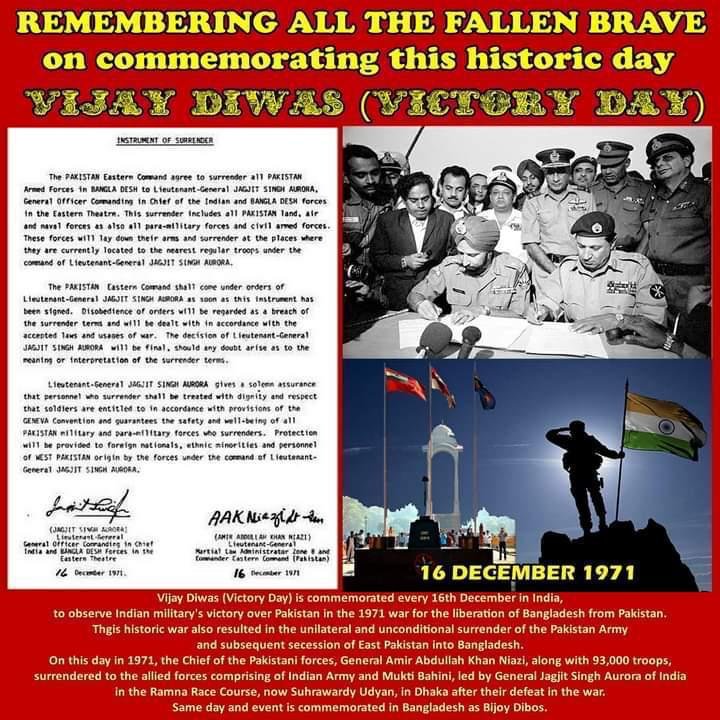
VIJAY DIWAS: THE 1971 WAR A victory to remember

We, as a nation, should forever remember with great pride and gratitude the ultimate sacrifice made by 4,000 soldiers who laid down their lives on the battlefield and 10,000 more who went home wounded or disabled. Let us also never forget our 54 officers and men taken prisoners of war, who are dead or dying in Pakistani prisons. It would be a fitting tribute to all of them if 2021, the golden jubilee year of the war, is declared as the Year of the Soldier.

A victory to remember

ICONIC: The sign on the Indo-Pak border for Indian soldiers spearheading the offensive into the Shakargarh Bulge in December 1971.

Lt Gen SR Ghosh (retd)

Former GOC-in-C, Western Command

An iconic signpost on the Indo-Pak border read: “You are now entering Pakistan. No passports required. Bash on regardless.” This was for India’s 54 Infantry Division under the command of the charismatic Maj Gen WAG Pinto, spearheading the Indian offensive into the Shakargarh Bulge in December 1971.

For the nation, 1971 was a historic year and we, as newly commissioned second lieutenants, were part of this history, part of this great military success. And this victory is since celebrated every year on December 16 as Vijay Diwas.

Unfortunately, over the years, it appears that the 1971 war is gradually fading from public memory and being overtaken by Kargil, Balakot, Doklam and Galwan. Vijay Diwas has been replaced by Kargil Vijay Diwas. Has the nation forgotten the greatest ever victory achieved by its armed forces? Have all the sacrifices of our young officers and men gone in vain?

Today, many of us who were part of this great campaign are no more. The youngest alive are in their 70s. All that is left for these veterans is a brief wreath-laying ceremony on December 16 at a war memorial, for which most of them are not even invited. The rest of the nation, in any case, hardly remembers this war.

In the run-up to the 50th anniversary of the war next year, the nation needs to commemorate December 16, 1971, when under the leadership of the iconic General Sam Manekshaw, the Indian Army, supported by the IAF and the Indian Navy, blitzkrieged its way to achieve one of the greatest victories by any modern-day military, dismembering Pakistan, and bringing about one of the biggest humiliations any country could ever have to undergo.

The ‘famed’ Pakistani Army was disgraced in the eyes of the world when Gen AAK Niazi and his 93,000 soldiers prostrated themselves in front of the Indian Army in the biggest military surrender after World War II. Till today, the Pakistani military smarts from the ignominy of this defeat by an Army which it used to sneer at.

December 16 is a day of rejoicing because on this day we, along with the Mukti Bahini, liberated and created a free new nation, Bangladesh, and ended a barbaric pogrom by the Pakistani Army of mass killing and rape of its innocent and hapless people.

In a memorable conclusion to the war, young Major Ashok Tara, VrC, in a brilliant operation, rescued the entire family of Sheikh Mujibur Rehman, held prisoner by the Pakistani Army, including his wife Begum Fazilatunnesa and daughter Sheikh Hasina, the current Prime Minister of Bangladesh and a great friend of India.

The war produced heroes like our young Param Vir Chakra (PVC) recipients 2/Lt Arun Khetrapal, Flying Officer Nirmaljit Sekhon and Lance Naik Albert Ekka, who along with several thousands of unrecognised, gallant soldiers laid down their lives with the words ‘Naam, Namak, Izzat’ on their dying breaths. We had inspiring officers like Major Hoshiyar Singh, awarded the PVC for his extraordinary bravery at Shakargarh, Major Ian Cardozo, who, given up for dead due to gangrene, chopped off his leg with his khukri and went on to become a Major General, or Maj KS Chandpuri, MVC, who with his small force, gallantly defended the post of Longewala against the greatly superior Pakistani forces, thus enabling the IAF to decimate the attacking enemy tank regiments.

A special place of honour should be reserved for the silent service, the Indian Navy. In a daring operation, its missile boats attacked the Karachi port, sinking and damaging several Pakistan ships and destroying critical logistics facilities. The Navy dominated both the western and eastern seaboards, thus greatly restricting freedom of action of the Pakistani Navy.

The new generations also need to learn about and honour extraordinary commanders like Capt MN Mulla, MVC, who, in the highest traditions of the Navy, chose to go down with his ship INS Khukri, along with near 200 officers and sailors.

On this occasion, we, as a nation, should forever remember with great pride and gratitude the ultimate sacrifice made by 4,000 Indian soldiers who laid down their lives on the battlefield and 10,000 more who went home wounded or disabled.

Let us also never forget our 54 officers and men taken prisoners of war, who are dead or dying in Pakistani prisons. How unfortunate and tragic that we as victors, allowed 93,000 Pakistani prisoners to return home to their families but could not bring back our own soldiers, while also returning 13,000 square km of captured territory won with the blood, toil and sweat of our men.

Next year is the golden jubilee year of the war. On this landmark occasion, not just the Indian military, but India as a nation also needs to celebrate Vijay Diwas 1971 and remind the world of this great victory of the ‘righteous over evil’. Apart from declaring 2021 as the Year of the Soldier, December 16 should henceforth be celebrated as the Armed Forces Day and do away with the irrelevant and antiquated Armed Forces Flag Day on December 7.

Let a chapter be added to our history books so that future generations read about this momentous victory and continue to remember and honour the sacrifices made by the gallant soldiers of India.



How Indian Army’s secrecy & unorthodox deployment fooled the Chinese at Pangong Tso

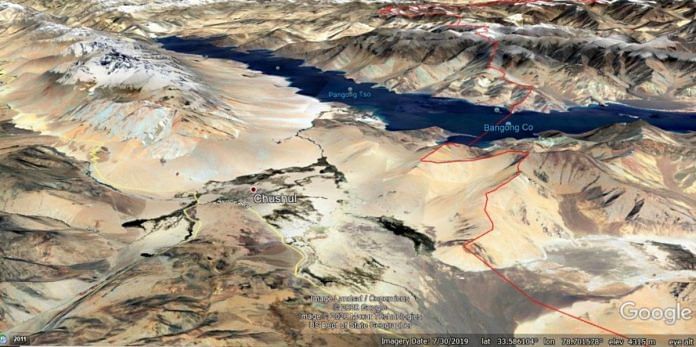
A Google Earth image showing the elevation on the southern bank of Pangong Tso

A Google Earth image showing the elevation on the southern bank of Pangong Tso | Google Earth

New Delhi: Nearly a month’s planning in utter secrecy, unorthodox deployment of multiple units and false flag manoeuvering, is what led to Indian forces outflanking the Chinese in Eastern Ladakh in August, ThePrint has learnt.

The operation has enabled India to dominate the southern banks of the Pangong Tso and offer a determined counter deployment in the northern banks.

The development also took place even as the Navy deployed almost its entire Eastern and Western Fleets out at sea to counter any possible Chinese aggression at sea and to showcase capability to completely dominate the area of influence.

Top government sources had earlier ruled out any premature withdrawal from the southern banks, which have given India a bargaining chip in negotiations that until then in August, were one-sided.

They have now told ThePrint that when New Delhi realised that the Chinese had no intention of going back, the Army was asked to come up with options so that India could have some sort of a bargaining power.

According to the plan finalised, 6-7 places were identified along the Line of Actual Control (LAC) where Indian forces could gain an upper hand over China’s People’s Liberation Army (PLA).

Once the locations were identified, the only offensive formation against the Chinese — Panagarh (West Bengal)-based Mountain Strike Corps (MSC) – was put into action.The offensive operation also saw the participation of the Army’s elite Para SF and the Chakrata (Uttarakhand)-based Special Frontier Force (SFF), largely made up of Tibetan Refugees.


24 hours notice and just one aircraft 

In early August, on just 24 hours notice, a team from the MSC, sans any big equipment besides their own personal gear and led by its General Officer Commanding (GOC) Lt Gen Gen Savneet Singh, flew out to Ladakh.

 “It was important to ensure that the Chinese were not able to pick up any large movement of troops and equipment since their satellites and potential spotters on the ground would be active. Accordingly, the Army went in for unorthodox deployment,” a source in the defence and security establishment said.

Sources said that unlike earlier, when the full division would have moved, only a much smaller team left without any additional equipment while the life at MSC, also known as the 17 Corps, went on as usual to avoid raising any eyebrows.

 Lt Gen Savneet Singh was the man in charge of the offensive operation and its planning.

Asked how two corps commanders, the other being the then GOC of 14 Corps Lt Gen Harinder Singh, were functioning in Ladakh, sources said that while the Leh-based 14 Corps was the holding or defensive corps, the 17 Corps was the offensive one.

“It is always understood that whenever an offensive action is needed, a strike corps will come in from outside. That is what the strike corps are all about,” a second source said.


Also read: When India sent scores of prisoners to Iraq as sweepers during World War I


Multiple teas and false flag maneuvering

The men who undertook the offensive operation belonged to the MSC, Para SF, the SFF and elements from the mechanised and armoured units.

As part of the overall counter deployment against the Chinese aggression is Eastern Ladakh, India had deployed nearly 40,000 additional troops along with artillery and tanks.

Sources said that when the 29-30 August operation was put into action, various elements came together while equipment came from a different pool.

They added that India also did false flag maneuvering to make the Chinese believe that the Army was focusing on something else while the real action was at a different height.

Accordingly, specialised Indian elements managed to surprise the Chinese and dominate the southern banks of the Pangong Tso and capture heights on what is known as Kailash Range, which had been under dispute by both sides.

However, neither India or China occupied these heights, until August end. The heights include Rechin La and Rezang La. These along with some other peaks has allowed India to dominate Spanggur Gap under Chinese control and also the Moldo garrison on the Chinese side.


“This has proved to be highly beneficial because it gave India a lot of bargaining power,” the first source cited above said. “The fact that the Chinese are insisting on India moving back from the southern ranges is an indication of the strategic significance of the Indian ops.”

Adding to the bewilderment of the Chinese was that India had managed to bring their tanks to these heights along with armoured personnel carriers.

“A lot of planning and unorthodox movement took place to bring multiple units and equipment to these heights,” a third source said.

Operation on the northern banks 

Even as the focus remained on the southern banks, a small team of one of the Para SF in operation, had managed to climb up to the dominating heights of the finger areas and click pictures of the Chinese posts on top of Finger 4.

With a new route found, specialised elements managed to climb up by the end of August and set up camps facing the ridgelines of Finger 4 in the Northern Banks of Pangong Tso as reported by ThePrint first on September 2.

Sources said while this did now give as much tactical advantage as in the southern banks, it showed India’s determination to stand up.


Also read: China supplying arms, providing hideouts to northeast militants via Myanmar, India alleges


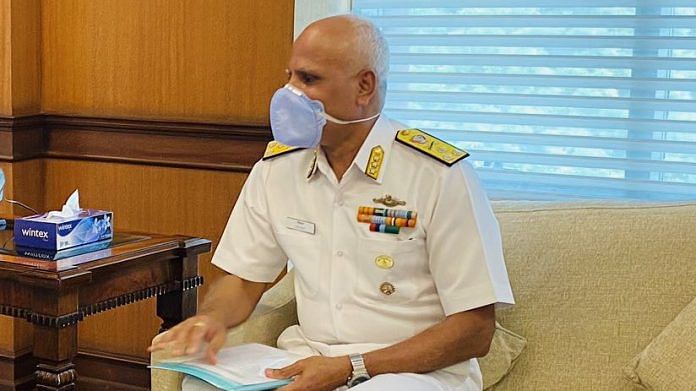
Vice Admiral Srikant, Navy’s senior-most submariner, dies of Covid-19

Vice Admiral Srikant | @CaptDKS | Twitter

New Delhi: Vice Admiral Srikant died on Tuesday morning at the base hospital here due to COVID-19-related complications, officials said.

The vice admiral, the Navy’s senior-most submariner, was due to retire on December 31.

 Expressing his condolences, Defence Minister Rajnath Singh tweeted, “Deeply pained at the untimely and sudden demise of Director General Seabird, Vice Admiral Srikant.”

The Ministry of Defence and the Indian Navy will always remember his stellar contributions and remarkable service to the nation, Singh said.

“My deepest condolences to his bereaved family and friends. Om Shanti!” the minister stated.

 Srikant was admitted at the base hospital in Delhi after he contracted COVID-19, said a junior Navy officer who had worked under him.

Subsequently, the vice admiral tested had negative for COVID-19 on Sunday morning, but developed breathing difficulties by evening, the officer said.

“He was shifted to ICU and was subsequently put on a ventilator,” the officer mentioned.

Officials said the vice admiral, who was the Navy’s senior-most submariner, died on Tuesday morning.

Previously, he had held charge as Inspector General of Nuclear Safety and Commandant of the National Defence College, officials said.


Western Command chief visits Jammu

Western Command chief visits Jammu

General Officer Commanding-in-Chief, Western Command, Lt Gen RP Singh. File photo

Jammu, December 13

The General Officer Commanding-in-Chief, Western Command, Lt Gen RP Singh paid a two- day visit to the Tiger Division to review the security situation in the Jammu sector. He was accompanied by Lt Gen Upendra Dwivedi, General Officer Commanding of the Yol-based Rising Star Corps.

He was briefed on the operational scenario and other aspects. The Army commander also visited the troops in forward areas and complimented them for maintaining a high degree of operational preparedness.— TNS