



Sanjha Morcha

What’s New

Click the heading to open detailed news

Current Events :

web counter

Print Media Reproduced Defence Related News

Dilemma of the Indian farmer

Dilemma of the Indian farmer

Fear of unknown: Reforms should promise success to gain acceptance. Tribune photo

Rajesh Ramachandran

Just a couple of decades ago, Odisha was known more for starvation deaths in Kalahandi, Balangir and Koraput than its breathtaking beaches or the architectural marvel at Konark. It’s so no more. Now, Odisha is a rice-surplus state — no mean achievement by any yardstick. How did this turnaround happen? Well, it was rather simple. The government began buying paddy. Rice is Odisha’s staple diet, while it is largely a cash crop in Punjab — but the economics of growing paddy remains the same in these two totally dissimilar contexts. There could be production and supply only if there is demand — routine, assured and unfailing procurement. A cabinet memorandum of the Odisha government last month projected a bumper crop of 71 lakh tonnes of paddy this season. But most interestingly, the note assured that the government would buy everything that the registered farmers bring to the mandis. This promise triggers the Keynesian animal spirits in the rural economy.

The long march of Indian farmers — as producers and consumers — from starvation to surplus, thus, has been through the mandis or primary agricultural credit societies, using the prop of the Minimum Support Price (MSP) offered by the government procurement agencies. It is this mechanism that has produced a mountain of food that is nearly three times the prescribed buffer stock. However, in the din of allegations against protesters hurled by the establishment, there seems to be a screeching strain of annoyance over the problem of plenty. Well, the dismantling of the foodgrain procurement regime is all that it would take to make the overflowing government granaries empty. For, the production of foodgrains, be it in MP, Chhattisgarh, West Bengal, Telangana or Punjab, is dependent on demand. Once the demand disappears, production will automatically come down and a sliding graph often stops only after crashing down.

Somehow, the new farm laws and the agitation against them have been portrayed as a Punjabi-Haryanvi problem, which it is not. The threat of privatisation of the procurement process is a pan-Indian fear. It is private procurement that has failed in Bihar and it is the government one that has lifted a fellow Bimaru state, Odisha, out of starvation. Sure, farmers of Odisha, Madhya Pradesh, Chhattisgarh, Telangana, Andhra Pradesh, Tamil Nadu and elsewhere are not visibly protesting like the Punjabi farmers. But the reason is not lack of fear of the new farm laws, it is something else: Punjabi-Haryanvi farmers have got empowered and informed because of decades of government procurement since the 1960s, and they are obviously more organised than their counterparts in Odisha or Chhattisgarh. Most importantly, they live at the gates of Delhi. The network of Bharatiya Kisan Union’s units across Punjab, Haryana and Western UP is undoubtedly the powerhouse that has electrified the farming masses in these regions, and not without reason.

Change ought to have been brought in through example. A recent news report has gone viral, about a $7-billion food corridor between India and the United Arab Emirates to be run by Dubai Ports World and Dubai Multi Commodities Centre. The government should have linked paddy farmers of Bihar and Uttar Pradesh or vegetable farmers of Punjab and Haryana with the corridor to show how effective an alternative procurement mechanism would be. Instead, a corporate house accused of being the government’s crony is setting up storage silos in Punjab and Haryana to get into the foodgrain business. It is this involvement of a certain kind of corporate that makes the farmers wonder whether the procurement is going to get privatised and, thus, compromised.

Of course, this is no argument for the efficiency of the government sector, but it is more about the fear of the unknown future involving players who can leverage power over the Central Government far outweighing the collective bargaining capacity of the farmer unions or local politicians. For, the farmers know well that the crying need of investment in this region’s agriculture is not in the foodgrain business. The mandi-MSP-government procurement system has made foodgrain production a viable enterprise. But vegetable farmers are at the mercy of the vagaries of the market, with insufficient storage facility, holding capacity, cold chain or value addition. So, any informed farmer would have expected reforms in the vegetable farming sector to make it a success. Contract farming has been experimented with varying results, and hence, that also does not hold any special charm because a produce linked to the open market makes contracts less attractive. If the market offers a better price than contracted, obviously the farmer would feel cheated and if the market price falls below the figure put in the contract, contractors could renege, as has happened in the past.

The most glaring example of lack of private investment by mega-corporates, governmental apathy and baby steps being taken by genuine entrepreneurs is the fishing industry. For meagre profits, small businessmen are setting up a cold chain from the coasts to the markets of north India for sea fish, which has long been adulterated with formaldehyde for a longer shelf life. No Gujarati conglomerate has yet invested in taking trout from Manali to Thiruvananthapuram or apples from Kinnaur to Kolkata.

The business model of switching from oil to data in search of mega-profits does not work for farmers totally dependent on government payouts. Oilfields, telecom spectrum, sea ports and airports are public resources that a friendly government can sell cheap, but paddy and wheat are a farmer’s lifeline, which he is scared of losing. In this standoff between the government and the farmers, a genuine dialogue, real assurances and illustrative examples could be the way out. The reassuring response from the Supreme Court has set the tone for a resolution. Now, the government needs to appreciate that the protesters are unions of Bharatiya Kisan and it hurts their children guarding the icy battlefields atop the Himalayas when their parents are called dirty names.


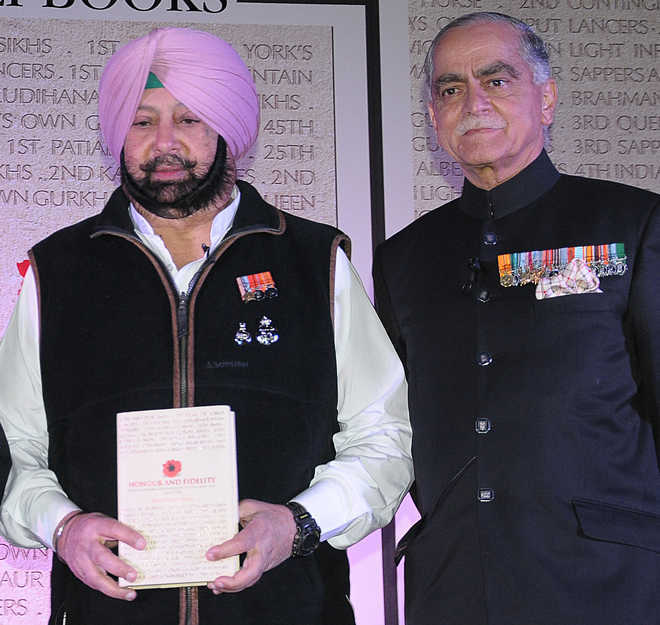
MILITARY LITERATURE FESTIVAL No alternative to strong alliances to push back against Chinese aggression, says Ex foreign secretary

No alternative to strong alliances to push back against Chinese aggression, says Ex foreign secretary

Vijay Mohan
Tribune News Service
Chandigarh, December 19

Pointing out that China believing that its power based on its impressive economic growth gives it a position of pre-eminence in the Asian region and hence it need not adhere to any kind of a multi lateral arrangement, Shyam Saran, former foreign secretary, said that If this is China’s approach, then there is no alternative but to have a strong coalition to push back against such aggressive behavior.

Stating that India should have less hesitation in taking this forward while speaking at a session on ‘The QUAD: Emerging Indo-Pacific Naval Alliance’ at the Military Literature Festival here today, he said: “The QUAD is an alliance formed by India, United States Australia and Japan”.

“The QUAD is emerging because there is a feeling that a very aggressive and assertive China, which has built up considerable naval power, particularly in the South China Sea, poses an increased challenge,” he said. “Further, with the security relations among the four countries having become much deeper, the building blocks were already in place, while the major European powers like Germany, France and the UK also have an interest in working with other partners for security of the Indo-Pacific region, he added.

Saran said that India’s approach towards maritime security is that the security architecture should be open, transparent and inclusive so that it keeps open the door for China too to join provided that it adheres to various norms and rules that are necessary for sustaining such a maritime security architecture. If we are able to convince China that its interests are better served by being part of this inclusive architecture rather than pursuing unilateral dominance then we would be making some progress,” he added.

Former Chief of the Naval Staff Admiral Sunil Lanba said that that there has been a great deal of aggressive behaviour by China.

“They are signatories to the majority of international agreements but they have been changing the rules and regulations to suit their own interests,” he added.

Vice-Admiral Pradeep Chauhan, former Chief of Staff, Western Naval Command, said that China considers India as one of its target of military assertion, a challenge which our establishment has so far not been familiar and comfortable dealing with it.

“We need to have a nimble asymmetric strategy and must maneouver our strengths to best of our capabilities in thwarting China,” he added.

Pointing out that China has been weaponising its economic prominence to saddle other countries, he added that India need bold steps across the board to counter rising China and it cannot be choosy while entering alliances. He said that India’s decision to stay out of the Regional Comprehensive Economic Partnership was incorrect and not in line with keeping the high ambitions to match geo-strategic goals.


Stating that India faces growing threats and it needs more partnerships globally than ever before, Prof. C Raja Mohan, Director Institute of South Asian Studies, National University of Singapore added that in the changed global scenario India cannot remain neutral anymore and it will have to move fast on multiple fronts while strengthening QUAD and enhancing other regional mechanisms.

“The way China threatens India today requires it to dynamically improve national economic capacity along with military capability, in partnerships with intensive international coalitions for which QUAD could be the central fulcrum for the time being,” he added.


Protesting farmers launch bilingual paper ‘Trolley Times’

Protesting farmers launch bilingual paper ‘Trolley Times’

A farmer reads the ‘Trolley Times’ at the Singhu border.

Vishav Bharti
Tribune News Service
Chandigarh, December 18

Recently, sitting in a trailer, a group of four youngsters discussed a Facebook post at the Singhu border. An old farmer, sitting next to them, quipped: “Oye mundiyo tusi parhe likhe lagde ho, saanu vi dass do ki ho reha”. Thus the idea of Trolley Times was born. Farmers’ own newspaper.

Reporters were aplenty; an army of amateur photographers was ready with the feed, a trailer became their editing desk, and soon came out the first edition of 2,000 copies of four-page bilingual paper. It was an instant hit on Friday.

“Looking at the response, we are going to print 10,000 copies of the next issue,” says Ajaypal Natt from Mansa, a physiotherapy teacher. He along with Surmeet Mavi, Gurdeep Singh and Narinder Bhinder conceived the idea. The name, Natt says, was floated by one of us just out of fun. “But we instantly picked that,” he says.

The style of the paper, he says, will be conversational. “We want it to read like the discussions taking place in village sath (common place),” he says, adding “we have a platform now to counter all kind of trash being dished out by some sections of media.”

The first issue of the paper carried Bhagat Singh’s quote on struggle; photographs from the centre of the struggle; story of a woman farmer, Gurmail Kaur, who died during the protest; some works of art and the lead article gave the message of unity, struggle and victory. The paper

was simultaneously launched digitally on all social media platforms like Facebook, Twitter, etc.


his demonstrated to the world India’s military strength and the country’s firm intentions against terrorism, he added. PTI

http://

Watch a Military Literature Festival-2020 discussion on self-reliance in defence preparedness.

The panellists are Rahul Bedi, Harpal Singh, Rajeev Chandrasekhar, Brig Suresh, M V Kotwal, Vishnu Som


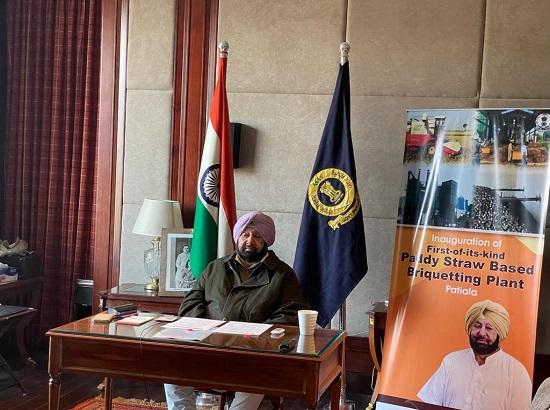
Capt Amarinder inaugurates India’s first of its kind paddy straw-based Briquetting Plant in Patiala

Capt Amarinder inaugurates India's first of its kind paddy straw-based Briquetting Plant in Patiala 

Capt Amarinder inaugurates India’s first of its kind paddy straw-based Briquetting Plant in Patiala 

Chandigarh, December 18, 2020: In a major initiative to cut down stubble burning and reduce environmental pollution, Punjab Chief Minister Captain Amarinder Singh on Friday virtually inaugurated the country’s first-of-its-kind Paddy Straw based Briquetting Plant of 100 tons per day capacity in Patiala.

Calling it an overdue initiative, the Chief Minister said the new technology will not only help check environmental pollution through gainful utilization of paddy straw in the state but will also enable farmers, especially small farmers, earn extra income from sale of paddy stubble.

Confident that more such plants would come up in the future to ease Punjab’s stubble burning problem, he said the low calorific value of 3500 for briquettes (as compared with 7000 for coal) is amply balanced out economically since coal costs Rs 10000 per ton as against Rs 4500 per ton for briquette. Further, with oil becoming expensive, this is also a more viable source of energy, he added.

The plant has been set up at village Kulburchan in Patiala district, at a capital cost of Rs 5.50 crore, by Punjab State Council for Science & Technology (PSCST) in collaboration with Private Partner M/s. Punjab Renewable Energy Systems Pvt. Ltd, with the support of Ministry of Environment, Forest & Climate Change, Govt. of India under the Climate Change Action Programme.

Lauding the efforts of scientists, farmers and farm equipment manufacturers to make India self-reliant in food production, the Chief Minister said that with this new technological intervention, paddy straw from around 40 villages in the plants’ vicinity will be converted to green fuel.

Not only will this help in checking environmental pollution, which has become more dangerous amid the Covid pandemic, it will also the resultant health hazards, he added. The plant will utilize 45000 ton paddy straw and would help replace fossil fuel in industries, thus resulting in carbon footprint reduction to the tune of 78,000 ton CO2.

Speaking on the occasion, Chief Secretary Vini Mahajan welcomed the establishment of the plant as an important initiative as part of the various measures being taken by the state government to check the menace of paddy burning in the field. She expressed the confidence that successful commercialization of such technological interventions will pave the way for their replication not only across the State but the entire country.

A predominantly agricultural state, Punjab generates huge quantities of agri-residue, and while wheat straw gets consumed as fodder etc., the management of paddy straw is major challenge for the state, said the Chief Secretary.

Besides initiating the State Action Plan for paddy straw management, Punjab had been able to divert about 3 lac hectare of area from paddy to other alternative crops such as cotton, maize etc, said Mahajan, adding that the state is also promoting in-situ management of paddy straw through distribution of crop residue management machines to the farmers. More than 75,000 machines have been distributed so far, she disclosed, adding that 18,878 Custom Hiring Centres have also been established for distributing the crop residue management machinery, said the Chief Secretary.

Mahajan disclosed that 11 biomass based Power Plants have already been set up in the State, and a number of units for ex-situ manage of paddy straw are under installation. The first bio-CNG plant of about 33 ton per day capacity would be operational in March, 2021, she added.

Meanwhile, Executive Director, PSCST, Dr. Jatinder Kaur Arora, in her brief presentation, spoke about the salient features of the project. She shared that extensive R&D was carried out to stabilize machinery, the process of briquette manufacturing from paddy straw, as well as combustion behaviour of briquettes for use as fuel in industry. She said that the Punjab Pollution Control Board and NABARD had supported these activities in the initial stages of the project.

Thereafter, the first briquetting plant with 24 TPD production capacity was successfully set up at village Jalalabad in Moga district at a capital cost of 85 lac. Subsequently, within one year, the second paddy straw briquetting plant with four times higher production capacity had been set up in village Kulburchan in Patiala district.

She further said that with support of Department of Science & Technology, Govt. of India, the Council was also setting up a pilot unit within the Briquetting Plant site at Patiala, which can be used by R&D institutions to carry out research for further increasing the life cycle of wearable components of paddy straw processing machinery.

Speaking on the occasion, MD, Punjab Renewable Energy Systems Private Ltd (PRESPL) Lt. Col Manish Ahuja (Retd), who is the private partner for the project, said that key management personnel of PRESPL were all ex- Defence forces. PRESPL plans to invest Rs. 5000 million in cleaner technologies in coming 4-5 years across the state.


Military Literature Festival: Air Force experts discuss air power of China

Military Literature Festival: Air Force experts discuss air power of China

Military Literature Festival: Air Force experts discuss airpower of China

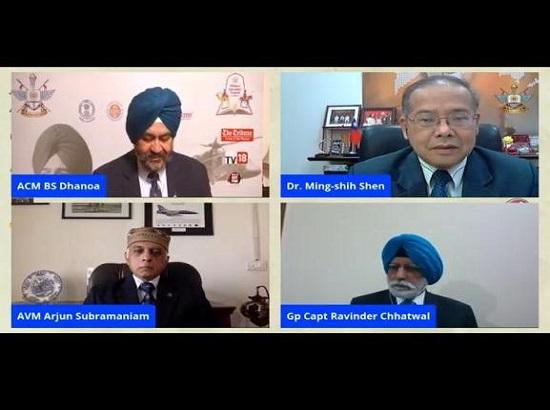
Chandigarh, December 18, 2020: An extensive debate on the airpower capability of China was held on the first day of the 4th edition of the Military Literature Festival, organized on virtual mode this time.

The debate was moderated by former Air Force chief BS Dhanoa. Other participants included AVM Arjun Subramaniam, GP Captain Ravinder Chhatwal, and Dr. Ming-Shih Shen.

The former Air Force chief started the talk by discussing the role of artillery support to the Air Force. He gave an insight into the contours of India bordering China. The former air chief talked about the fighter planes’ distance from the airbase and said that the return of planes to their base to get the fuel refilled is important in a battle.

He compared the distance covered by fighter planes and the distance between airbases. The strategy of recouping, the ability to operate from dispersing location, squadron strength, combat experience, base strength, and the importance of the Himalayas was also discussed during the talk.

Dr. Ming-Shih Shen from Taiwan throws light upon the bombers attacking the ground and the importance of artillery on launching the air attack.

He also revealed the air capabilities of China, new airports coming up in border areas, and delay in the manufacturing of large planes due to COVID-19. The offensive and defensive strategies of China’s Air Force and the role of drones, cyber, and electronic intelligence were also a part of his talk.

Author of two books based on his personal experiences, Arjun Subramaniam talked about the probability of conflict between India and China. He talked about the effectiveness of combating war with the importance of airpower, disruptive strategies, and the role of ground power.

GP Captain Ravinder Chhatwal spoke about China’s limitation in warfare against India, support of airfields, and innovation in the field of making drones, predator drones, and UAVs.


Kargil veteran speaks about his book on war experience ‘Focus of the book is on identifying the mistakes committed during the conflict’

Kargil veteran speaks about his book on war experience

Image only for representational purposes. File photo.

Tribune News Service
Chandigarh, December 18

The stories of the men who have fought wars must be recorded for posterity so that the new generation of officers learn from their experiences, do not repeat the mistakes and write history with more blood, said Kargil war veteran Brig US Bawa (retd) on Friday.

Stating this while speaking about his recently published book, ‘Mashkoh – Kargil As I Saw It’, Brig Bawa (retd) said that the focus of the book is on identifying the mistakes committed during the conflict.

“Each and every citizen should know about how the war was fought and the sacrifices made by the soldiers,” he said.

“Generally battalion histories are relegated to the museums and archives, but everyone should know about it. The book also details the problems faced by soldiers and their families after the war,” he added.

Brig Bawa had commanded 17 Jat during the Kargil conflict. He was decorated with the Vir Chakra for gallantry. His unit had been tasked to capture Pimple Complex, part of Point 4875 in Mashkoh Valley adjoining Dras.

On why he chose to write the book, he said, “There is a very eventful point in everyone’s life and in my life, it was the Kargil war. Though it gave me and by uint a lot of awards and fame, it also made me sad on losing my men.”

The book tells the stories of bravery, humour, emotions, tragic losses and hard-won victories in extremely challenging high-altitude terrain of the Kargil sector along the Line of Control in northern Jammu and Kashmir, he said.

Maj Gen Amarjit Singh (retd) said that very few books on military operations have been written by men who have fought a battle and faced bullets.

Brig Bawa said the book is based on first hand, experience, emotions and ground incidents.


Watch: Military Literature Festival 2020 inaugural session Speakers: Punjab Governor VP Badnore, J&K ex-Governor NN Vohra, Western Command GOC-in-C Lt Gen RP Singh

http://

Tribune News Service

Chandigarh, December 18

The fourth edition of Military Literature Festival (MLF) began with Defence Minister Rajnath Singh delivering the inaugural address virtually today. Other prominent speakers during the inaugural address included Governor of Punjab VP Singh Badnore, former Governor of Jammu and Kashmir NN Vohra, and Western Command General Officer Commanding-in-Chief Lt Gen RP Singh.

http://

Allow access to war histories and records, says former J&K Governor Vohra

Tribune News Service

New Delhi, Dec 18

Former Governor of Jammu and Kashmir NN Vohra on Friday made a strong pitch to make public the histories of war fought by the Indian armed forces, saying reading these would help the younger generation of soldiers.

Vohra, a former Punjab cadre IAS officer who was Defence Secretary (March 1990 to April 1993) of the country, was speaking at the inaugural session of the fourth Military Literature Festival. The annual event was conducted virtually from Chandigarh this year.

Vohra said we had unfortunately not allowed access to documents, and had been secretive and confidential. He gave the example of his three-year tenure as Defence Secretary, saying, “We finalised the military histories of wars in 1948, 1962, and 1971; when we tried to get them published, there was enormous opposition and could not be published.”

Experience of war and combat if not recorded well in time, and was not made available to cadets in military academies, or in institutes such as the National Defence College, the younger generation would not be able to learn from it.

Former J&K Governor NN Vohra

The nation, he said, had been guilty of not allowing certain reports such as the one by Henderson Brookes on the 1962 India-China war to be made available. These could at least be used for military for learning. He suggested that after 30 years a document could be made available in an archival repository and scholars be allowed to go and examine those with prior permission. This could be done in case putting the document in public domain was not okay.

Vohra went on to commend the plethora of writings in newspapers and journals, saying it showed commendable insight of officers of the services. There was an intertwining in matters civil and military; it would lead towards national strength and strong foundations.

Defence Minister Rajnath Singh, who was also present at the virtual session, commended the forces for the 1971 war victory, saying we were celebrating the golden jubilee of the victory.

He lavished praise on the experience of the veterans, asking young people to learn from retired soldiers, instead of playing ‘war linked’ games on mobiles. The veterans were like living institutions.

(Also read: Salute to reservoir of military might)

He asked the organisers to devote the next year’s theme to cyber war and tackling misinformation campaigns. The enemy, he said, could reach our people through mobile phones.

The Governor of Punjab and Administrator of Chandigarh, VP Singh Badnore, said the festival was unique in its fabric. Chandigarh, he said, was the most appropriate venue to conduct the festival.

http://


Can’t rule out probability of Ladakh skirmish, but China faces logistical issues — Dhanoa

former IAF chief Air Chief Marshal B.S. Dhanoa

Former IAF chief Air Chief Marshal B.S. Dhanoa | ANI

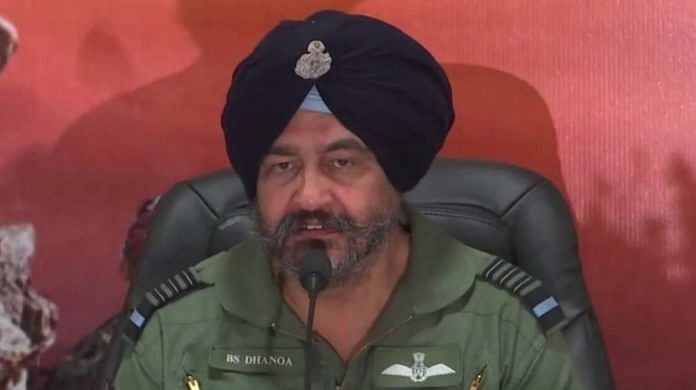
New Delhi: Noting that the probability of a conflict between India and China can never be ruled out, former IAF chief Air Chief Marshal (ACM) B.S. Dhanoa Friday said that while on paper the Chinese Air Force has huge capability, a lot of natural and logistics factors are flying against it.

Chairing a session of the Military Literature Festival, which is being held online this year due to the Covid pandemic, he argued the Indian Air Force can actually provide a credible punitive action in the Himalayas as against the People’s Liberation Army’s Air Force (PLAAF).

Speaking about the ongoing stand-off in Ladakh, Dhanoa said, “Probability of India-China skirmish can never be ruled out.”

He added that the Chinese believe in the old Soviet era doctrine of their main offensive being missile and rocket-based.

Dhanoa further said that today’s China is not the same China that fought in Korea. “Taking large casualties is something that a developed China with one-child policy cannot take,” he explained.

About the PLAAF, the former IAF chief said, “On paper, the PLAAF has a huge capability and is supported by a much larger economy funding a defence budget, which is almost three times ours. This is a public defence budget in which a lot many things are hidden.”

He noted that the PLAAF has 1,500 fighters, of which 800 are fourth generation.

Dhanoa further said China has also deployed a limited number of fifth generation fighters — J-20 and J-31 — and has also completed the induction of 24 Su-35 that it procured from Russia and the S-400 air defence system.

Also read: China wanted ‘no escalation’ on hotline call in the day, tried to capture territory at night


‘Effect of terrain has to be taken into consideration’

Talking about the PLAAF strength, Dhanoa said China has strategic bombers and has also deployed advanced AWACS (Airborne Warning And Control System), besides having a large fleet of UAVs, including stealth UAV.

He added that the Chinese have rocket forces deployed, which have the ability to target all military installations opposite them and also in the hinterland.

“It has developed Electronic Warfare to counter the US. So it has more than a match for our technology. But the bottom line is how credible are these technologies when we look beyond the Himalayas into Tibet,” Dhanoa said.

He questioned how much of this force can be brought against India given the state of infrastructure in Tibet and Xinjiang.

“Effect of terrain has to be taken into consideration. It has an impact on aircraft operations due to altitude and extreme cold. It has an effect on targeting and weapons ballistic, specially because their adversary, which is us, is likely to be dispersed. It has got serious issues on radar’s line of sight resulting in very poor trans-frontier visibility,” Dhanoa added.

He said all of these result in very low reaction time and by the time the IAF fighters cross the Himalayas, the Chinese will have less time to react.


Also read: India in Ladakh is breaking ‘China is invincible’ myth. Pentagon needs to catch up