Army Chief Gen MM Naravane on Monday left for South Korea on a three-day visit during which he will hold talks with the top defence brass of the country on ways to expand bilateral military cooperation, officials said.
South Korea has been a major supplier of military platforms and weapons to India.
The Chief of Army Staff’s visit to South Korea comes two weeks after concluding a six-day crucial tour of the United Arab Emirates and Saudi Arabia that reflected India’s growing strategic ties with the two influential Gulf nations.
In the South Korean capital, Seoul, Gen Naravane is scheduled to meet the country’s minister for national defence, army chief and chairman of joint chiefs of staff, the officials said.
The Chief of Army Staff will also meet South Korea’s minister of defence acquisition planning administration (DAPA).
Gen Naravane will discuss avenues for enhancing defence relations between India and the Republic of Korea, the Army said in a statement.
The Army Chief will also visit the Korea Combat Training Centre in Gangwon province and Advance Defence Development (ADD) facility at Daejeon.
Last month, Gen Naravane travelled to Nepal on a three-day visit that had significant diplomatic overtones.
In October, the Chief of Army Staff, accompanied by Foreign Secretary Harsh Vardhan Shringla, travelled to Myanmar during which India decided to supply an attack submarine to the Myanmar Navy besides agreeing to further deepen military and defence ties. PTI
Gurbax Rawat,Chandigarh Councillor shows solidarity with farmers agitation
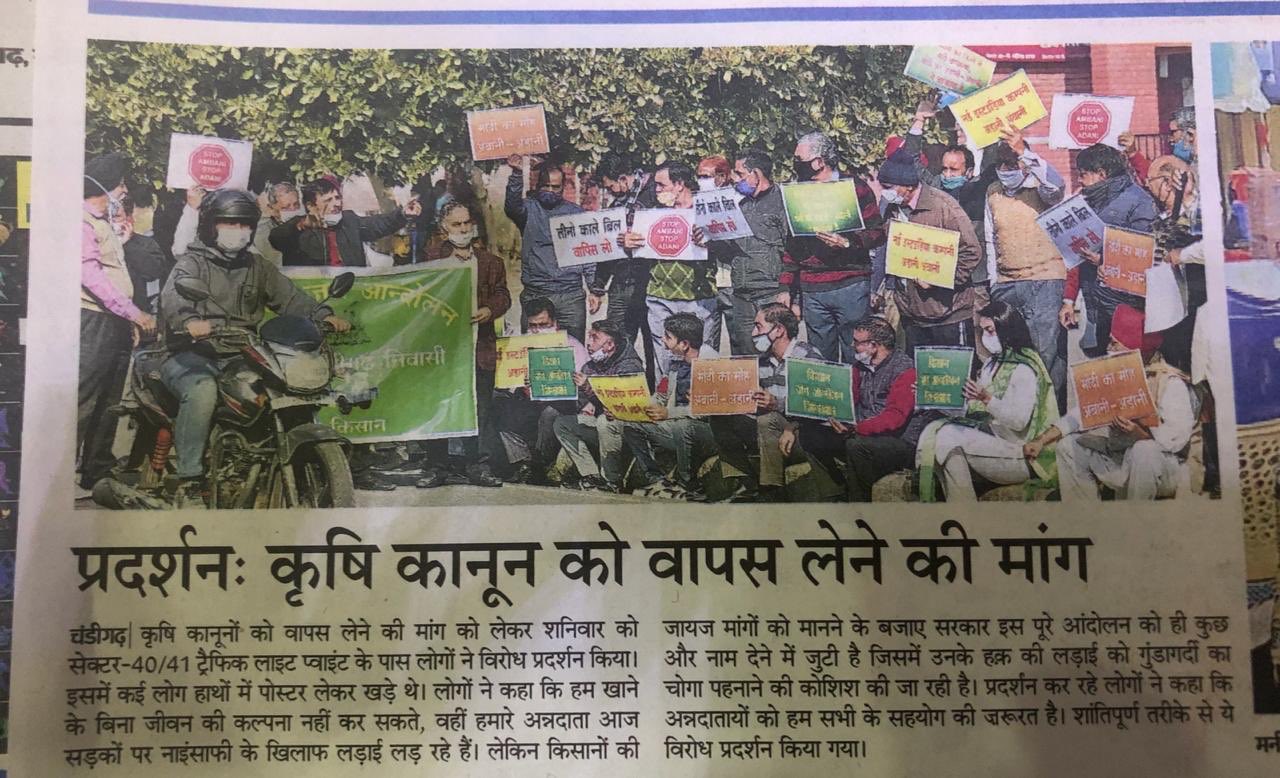
Gurbax Rawat,Councillar cum Ex-Dy Mayor of Chandigarh whose grandparents were freedom fighters in Indian National Army and participated in Quit India Moment. Her father, an army veteran, who fought wars of 1962, 1965 & 1971 and participated in Congo army contingent for a peace mission Gurbax Rawat protested against the Farmers ordinances and appealed to central to repeal the laws being not in favor of Farmers Community. She along with supporters of farmers showed solidarity with farmers agitation .
In protest against the three farm laws enacted by the Centre, the farmers are planning an alternative Republic Day parade on tractors in Delhi. As per a proposal taken up by a group of 32 farmer organisations at their last meeting, farmers will hold a ‘kisan parade’ to mark Republic Day.
The proposals
During the parade, the farmers plan to take out a tractor rally in Delhi
Another proposal under consideration is to hold the Tricolour and march on the Capital roads
During the parade, the farmers plan to march on the roads of Delhi atop tractors. Another proposal being considered is to hold the Tricolour and march on the roads of Delhi. The proposal may also be taken up by the All India Kisan Sangharsh Coordination Committee.
A senior leader of one of the farmer organisations said: “We want to tell people this government does not have the moral right to hold R-Day functions.” — TNS
Protesting farmers clang ‘thalis’, ask PM Modi to listen to their ‘Mann ki Baat’ too Agitation enters 32nd day on Delhi borders
Farmers on Sunday beat “thalis” at a few places in Punjab and Haryana during Prime Minister Narendra Modi’s ‘Mann Ki Baat’ radio programme as part of their protest against the Centre’s new agri laws.
While addressing a press conference on December 20 at Delhi’s Singhu border, farmer leaders had asked people protesting against the laws to beat utensils during the programme, the same way the prime minister had asked them in March to beat ‘thalis’ (steel plates).
Modi had asked people to express gratitude towards those at the forefront of combating the coronavirus and extending essential services by giving a five-minute standing ovation by clapping, beating plates or ringing bells.
Farmers beat “thalis” during protests at Amritsar, Ferozepur, Sangrur, Talwandi Sabo, Bathinda, Tarn Taran and Gurdaspur districts in Punjab and Rohtak and Jind districts in Haryana, among other places in the two states.
“The common people too are with farmers in their agitation against the farm laws,” said a protester in Amritsar as he beat a “thali” with a spoon and raised “Jai Kisan” slogan.
At many places, farmers, who were joined by people from other sections of society, raised slogans against the BJP-led government at the Centre.
Haryana Bharatiya Kisan Union (BKU) chief Gurnam Singh Chaduni went to the Makrauli toll plaza in Rohtak district along with a group of farmers to protest against the legislations.
They beat ‘thalis’ with shoes during the prime minister’s monthly radio broadcast.
“We are here to oppose Modi’s ‘Mann Ki Baat’. We are registering this protest because the prime minister only says what he has to without listening to the voice of the people,” Chaduni said during the protest.
He said feedback has been received from protesting farmers that toll collection on highways in Haryana should be halted till the Centre accepts the demands of the agitating farmers.
Thousands of farmers, mainly from Punjab and Haryana, are protesting against the laws since the last week of November at various border points of Delhi and demanding that the legislations be repealed.
“We went to many toll barriers and farmers who are protesting there said no toll should be charged from people till the government accepts our demands,” the BKU leader said.
Intensifying their agitation against the Centre’s new agri laws, farmers on December 20 had also announced that they will halt toll collection on highways in Haryana from December 25 to 27.
“From December 25 to 27 all toll booths in Haryana will not be allowed by us to collect toll, we will halt them from doing so. On December 27, our prime minister will say his ‘Mann ki baat’ and we want to appeal to the people to beat ‘thalis’ during his address, the same way the PM had asked the country to bang utensils for coronavirus,” BKU leader Jagjeet Singh Dalewala had said at the press conference.
When the prime minister will speak, “we appeal to the people of the entire country to bang utensils in your houses throughout the duration of his programme to drown out his Mann Ki Baat”, he had said.
Farmers are protesting against the Farmers (Empowerment and Protection) Agreement of Price Assurance and Farm Services Act, 2020, the Farmers Produce Trade and Commerce (Promotion and Facilitation) Act, 2020, and the Essential Commodities (Amendment) Act, 2020.
The three farm laws, enacted in September, have been projected by the government as major reforms in the agriculture sector that will remove middlemen and allow farmers to sell anywhere in the country.
However, the protesting farmers have expressed apprehension that the new laws would pave the way for eliminating the safety cushion of Minimum Support Price and do away with the mandis, leaving them at the mercy of big corporates. The Centre has repeatedly asserted that these mechanisms will remain. — PTI
Meet the women feeding protesting farmers at Singhu border
For the past over 11 days, several women are following a 7.30 am to 11 pm schedule. They cook, laugh and share stories at the Singhu border.
Cooking langar for hundreds of people, a group of women from Chabbewal village busy themselves with a gruelling 16-17 hours’ schedule to feed the sangat at the Singhu border. The women said they came here to express solidarity with the farmers. Themselves from farming background, they said this was their way of pooling in for the struggle.
Simranjit Kaur from Chabbewal says: “We came here about a fortnight ago. While a jatha from Hoshiarpur had originally come in, we have been joined by many more people now. More women keep chipping in, offering their services. Now, it’s not just us. Everyone is keen on helping and doing their bit for farmers. We ourselves are from farming families. This is our way of expressing solidarity with farmers.”
With many people to cook for, these women are busy working throughout the day.
Manjinder Kaur says: “We get up at 7 am and keep working throughout the day. We take breaks to rest or sleep, but since long hours of prep are needed for the langar, we are mostly cooking throughout the day. Hours go by in cooking, talking and we don’t even come to know how time flies.”
Manjit Kaur from Chandigarh joined these women for the langar sewa soon after their arrival. While Manjit’s husband is an ASI, her entire family has come to Singhu border to express solidarity with farmers.
Manjit sits with her daughter Sneh Lata Kaur and both mother and daughter prepare chapatis for the sangat.
Manjit says: “My son is in Brampton, he couldn’t come. But the rest of us are here. My husband took special leave to come here. He also cooks in between and sometimes sweeps the langar spot. My daughter is also keen on helping. Every day, we cook the langar together. She pursues graduation. Our kids joined us as they were keen on helping farmers. They are all fighting for us. This is the least we can do to help them out in the movement.”
ITBP introduces first ever Centralised Liquor Management System for the Central Armed Police Forces
Vijay Mohan Tribune News Service Chandigarh, December 27
Going digital for the first time in the liquor issue management within the force, the Indo-Tibetan Border Police (ITBP) has introduced a Centralised Liquor Management System (CLMS) for its personnel. This is the first of its kind system amongst all the Central Armed Police Forces under the Ministry of Home Affairs.
There was a long standing demand from ITBP personnel that good quality liquor should be made available to them in the vicinity of their native places. Untill recently, the jawans could purchase their authorised liquor quota only from the canteens of the formation or unit where he was posted and there was no system which could enable them to buy liquor from canteens of other unit of the force even if it is located nearby his home town.
Due to this difficulty, jawans deployed in the remote and far flung areas had to face many difficulties in carrying the liquor due to different excise rules and duties of different states. Also, the liquor was sold in a manual manner and limited brands were available.
The Centralised Liquor Management System has been prepared for the retired and serving personnel of the ITBP by the Force Headquarters and it was first introduced on July 31, 2020, an ITBP spokesperson said today.
Under the system, the serving jawans can visit the main page of the ITBP website by using the CLMS tab on the portal and can generate their account through an online PIN and thereafter choosing the option of a liquor canteen of any formation or unit of the Force which is located nearby his home town.
Further, the jawans can get easy access to his selected liquor canteen to get his authorised liquor quota on payment after login. Under this system, the issue of liquor is supported by automated SMS facility on the personal registered mobile numbers of the jawans.
After the introduction of the CLMS system software, jawans are now able to select multiple liquor brands as per their choices and prescribed quota. The online availability of liquor’s brand, price, information, authorised quota and online purchase history can also be easily viewed or accessed through the system.
CLMS is a fully transparent and centralised digital system. This system also enables jawans to easily view the online approved selling price of any variety of liquor or brands and their personalised prior purchase history.
With this software, availability of quality liquor has now been ensured to ITBP jawans. The liquor is being made available to the Force personnel under CLMS on the basis of authorised monthly quota and approx 85 brands of different kinds of liquor are presently available on the CLMS. Based on requirement, number of available brands may increase in future.
The Central Armed Police Forces have their own canteen set up on similar lines to the Defence Ministry’s Canteen Stores Department, that make various grocery, daily needs and household items available to their personnel.
Despite what the govt and the army have been saying, the Baloch insurgency is a major security challenge for Pakistan and Chinese investments. The challenge is being met by fencing Gwadar, the outlet for CPEC, and taking steps to divide Balochistan and assuming control of southern portions. The justification that these are backward does not hold.
oncerned: Political solution is needed to check alienation among Balochis. AP
Tilak Devasher
Member, National Security Advisory Board
Several recent developments point towards an ominous plan that the hybrid army-sustained Imran Khan government has devised to further subjugate Balochistan in order to secure Chinese interests.
In 2015, English daily Dawn had talked about a fencing plan to protect Gwadar from attacks of Baloch nationalists whereby local residents would get residence cards while all outsiders coming into the city would be registered at entry points. An April 2016 article in the Wall Street Journal mentioned that the Chinese were pushing for a 65-mile fence around the whole town for purposes of security, with a special permit required by anyone— including locals— to enter.
The fencing that was earlier talked about has now been initiated. While details are scanty, it is believed that security fences with surveillance cameras would be laid around a major part of the city. Two or three entry and exit points will regulate the flow of people with residents being given a residence card, without which entry would not be possible. Such a procedure would be akin to the apartheid era system of passes that kept the native population of South Africa under control by regulating their movement.
Curiously, details of the Gwadar port are not in the public domain. A Senate panel was informed in November 2020 that the contract governing affairs of the Gwadar port was “confidential” and its details could not be disclosed publicly. The local Baloch perceive lack of transparency and the fencing as a conspiracy to displace them from the city, change its demography and ultimately separate Gwadar from Balochistan.
Then there is the use of the new term ‘south Balochistan’ to describe the Makran coast that has crept into the vocabulary of the federal government. On a visit to Balochistan on September 11, 2020, Imran Khan expressed his desire for development of the southern districts. In November 2020, the federal cabinet announced a Rs 600-billion package for development exclusively of the nine districts of south Balochistan over the next three years.
Prior to this, there was no geographical categorisation and for purposes of administration, ‘divisions’ and ‘districts’ were used. The army has a southern command based in Quetta that was earlier commanded by Lt Gen Asim (Papa John) Bajwa who now heads the CPEC Authority. The paramilitary Frontier Corps (FC) Balochistan was divided into North and South regions in 2017. The areas referred to as south Balochistan by the government are the same as those in the FC South.
Similar past development packages of 2009 and 2017 have had a dismal history of implementation. More than the fate of the package, however, the Baloch are concerned and suspicious because it could well be the beginning of a conspiracy to separate the coast from the rest of Balochistan in the name of development and security. As a former chief minister put it: ‘There is only one Balochistan and there can be no Southern, Northern, Eastern or Western Balochistan.’ Likewise, it is believed that the federal government would be in complete control of south Balochistan and the province as a whole would lose its precious coast and Gwadar port.
Making matters worse was the recent promulgation of an ordinance to set up a Pakistan Islands Development Authority (PIDA) for “development and management of islands in internal and territorial waters of Pakistan.” The people of Sindh and Balochistan have seen this as Islamabad muscling its way into their coast and taking control of their islands. Sindh is up in arms over the attempted takeover of two islands off Karachi and now the Baloch are concerned over the possible federal takeover of south Balochistan.
An important question is about funding. The federal government is not only broke but under massive debt and is seeking loans from all and sundry. It has just secured a $1- billion loan from ‘iron brother’ China to repay the ‘brotherly country’ of Saudi Arabia. So, the moot question is why announce a package when there are no funds unless the intention was not development but creation of south Balochistan?
These developments confirm one thing above all: despite what the government and the army have been saying, the Baloch insurgency is a major security challenge for Pakistan and for the Chinese investments. The challenge is being met by fencing Gwadar, the outlet for CPEC, and taking initial steps to divide Balochistan and assuming control of the southern portion. The justification that these districts are backward does not hold since all districts of Balochistan are backward too. Thus, the underlying reasons for this package are strategic — an attempt to pacify the Makran region that is believed to be the hotbed of insurgency and so allow the CPEC projects in Gwadar to fructify without hindrance.
Additionally, there are massive human rights violations being committed by the army that include thousands of Baloch who have been subjected to ‘enforced disappearance’ as well as the suspicious death in 2020 of at least two Baloch activists in exile — Sajid Hussain in Sweden and Karima Baloch in Canada. It is clear that the state has decided to go on an overdrive to impress the Chinese that their investments and citizens are safe. In the process, the Baloch are being pushed further to the wall.
Under these circumstances, a mere development package is unlikely to tackle the deep-rooted and festering political, economic and human rights problems of Balochistan. If anything, attempts to fence Gwadar and bifurcate Balochistan would only aggravate the feeling of alienation of the Baloch. The remedy can only be political, something that the army is unwilling to understand just as they were unable to perceive the political problem of the then East Pakistan in 1971 with disastrous consequences for the country.
Views are personal
After two decades, Kargil martyr’s 80-year-old mother gets pension Relief comes after video showing her plight went viral
Over two decades after a soldier from Mansa was killed during the Kargil war in June 1999, the Army has awarded a part of his liberalised family pension to his 80-year-old mother.
Jagir Kaur was in a bad condition, living in a dilapidated house. Her case was taken up by the Mohali-based Ex-servicemen Grievance Cell (ESGC) after a video highlighting her condition surfaced on social media.
After NK Nirmal Singh of the Sikh Light Infantry died, the family was given all due benefits by the Central and state governments, but his widow Paramjit Kaur took away everything and remarried.
According to the ESGC, Nirmal had been married for four years, but Paramjit never lived at her in-laws’ place. Even no ‘Part-II order’ recording the marriage, as is required for administrative purposes, was published by the Army. However, after Nirmal’s death, Paramjit had managed to get the Part-II order published.
Jagir Kaur, being illiterate and from a remote place, never knew her entitlements. She had six sons, out of whom two died, and four daughters, who are married. Her sons work as labourers or do odd jobs.
After the ESGC took up the case with the Army in August this year and presented various documents and court records, the Army issued a new pension order granting Jagir Kaur one-third of the liberalised family pension that was being paid to Paramjit. — TNS
The Chinese challenge Need for fresh policy which reduces import dependence on Beijing
Uneasy calm: A peaceful LAC appears outmoded after the Chinese actions. PTI
Vivek Katju
Ex-secretary, Ministry of External Affairs
India-China relations came to the forefront in this country’s external engagement this year. This is no doubt because of Chinese moves to change the status quo in some areas along the LAC in Ladakh. Otherwise, the real focus of public attention has always been India-Pakistan ties and not the country’s principal foreign policy and security challenge — China. All governments, past and present, and the Indian strategic community are aware that China is of greater significance than Pakistan to the country’s long-term interests but relations with the latter are embedded in a long and bitter history and easily excite emotions, and are therefore in constant popular focus unlike those with China.
It needs to be emphasised that Pakistan’s implacable animosity towards India and its pursuit of terrorism against this country cannot be underplayed, let alone overlooked. India has paid a heavy price in lives lost and in economic costs but Pakistan does not, and can never have, the resources to effectively thwart India’s progress. On the other hand, China’s astonishing rise over the past four decades has led to its acquisition of an enormous advantage in capacities and resources over India. It is willing to use these to undermine India’s regional and global standing and hobble its rise. Its aggressive posture and actions on the LAC this year were partly undertaken with this objective.
Defence Minister Rajnath Singh’s speech in the Lok Sabha on September 15 placed on record the bare bones of Chinese actions. It did not, however, clarify if Chinese troops were now actually physically present where they were not so, prior to their moves this year, because Singh’s different formulations about different Chinese actions and Indian military responses were ambiguous.
He noted that in April, a build-up of troops and ‘armaments’ was noticed on the Chinese side by India. In May, the Chinese hindered the ‘normal, traditional patrolling pattern of our troops in the Galwan Valley area’. Further, ‘in mid-May’, the Chinese made several attempts to transgress the LAC, including in ‘Kongka La, Gogra and north bank of Pangong Lake’. He asserted that our troops responded ‘appropriately’ but did not clarify what ‘appropriate’ meant precisely. He went on to state that the Chinese violated the understanding reached between the military commanders on June 6 and this ‘created a violent face-off on June 15 at Galwan. Our brave soldiers laid down their lives and also inflicted costs, including casualties, on the Chinese side’. Despite ongoing discussions, Singh stated, the Chinese ‘again engaged in provocative military manoeuvres on the night of August 29 and 30, in an attempt to change the status quo in the South Bank area of Pangong Lake’. He went on to say, ‘But yet again, timely and firm action by our armed forces along the LAC prevented such attempts from succeeding’.
Summing up the situation, he informed the Lok Sabha, ‘as of now, the Chinese side has mobilised a large number of troops and armaments along the LAC as well as in the depth areas. There are several friction areas in eastern Ladakh, including Gogra, Kongka La and north and south banks of the Pangong Lake’. In response to Chinese actions, he said, ‘Our armed forces have also made counter deployments in these areas’ to protect our interests. He sought the Lok Sabha’s understanding of not being able to go into further details because of ‘sensitive operational issues’.
Talks have continued since the time he spoke to Parliament but there has been no recent authoritative statement on the ground situation or on what the Chinese are offering, but media reports lead to the conclusion that they are reluctant to adhere to the letter and spirit of the 1990s agreements which were designed to ensure peace along the LAC. The government seems willing to settle for protracted negotiations. It has pointed to previous LAC situations which took years to resolve, though this is hardly comforting.
An important aspect of the LAC situation is the unfortunate intrusion of domestic politics in what should be a purely national security and foreign policy issue. The Modi government is determined to show that unlike past Congress governments, it has fully safeguarded India’s territories. On the other hand, the Congress sees an opportunity to show the government as weak on national security. This political point scoring by both parties is futile and harmful to national interest. There is an undoubted need for the entire political class to demonstrably come together to meet a very grave challenge to the country’s interests. That will send the right signals to the region and beyond.
China’s actions have made the earlier policy which relied on a peaceful LAC outmoded. There is need for a fresh China policy which reduces inter-alia import dependence on China. PM Modi’s emphasis on Atmanirbhar Bharat is timely and a strategic necessity too. A new policy will also have to look at some of India’s foreign relationships—in the Indo-Pacific, the immediate neighbourhood and with the major powers— at least partially through the prism of the Chinese challenge. Some useful steps were taken in this direction this year, including through the upgrade of India’s engagement with the Quad but innovative mechanisms will have to be crafted to ensure that Chinese ingress in the neighbourhood does not adversely impact Indian interests.
That Indian and US interests coincide regarding the need to contain Chinese aggression is obvious, but there are uncertainties about the precise direction that the incoming Biden administration will adopt vis-à-vis China. There is a compelling need for the Modi government to have an honest interaction with the Biden administration on China, though ultimately, India has to rely on its own capabilities to meet the Chinese threat.
SHARE ARTICLE
A
Capt Amarinder slams BJP for calling farmers ‘Urban Naxals’
Capt Amarinder slams BJP for calling farmers ‘Urban Naxals’
Says party that can’t distinguish between citizens fighting for their rights & terrorists has no right to rule
Chandigarh, December 27, 2020: Lambasting the Bharatiya Janata Party (BJP) over the malicious and derogatory terms used by its senior leaders against protesting farmers, Punjab Chief Minister Captain Amarinder Singh on Sunday asked the party to stop maligning the farmers and their genuine fight for justice by calling them offensive names like `Urban Naxals’, `Khalistanis’, `Hooligans’ etc.
“If the BJP cannot distinguished between anguished citizens fighting for their survival and terrorists/militants/hooligans, it should give up all pretense of being a people’s party,” said the Chief Minister. A party which treats citizens exercising their democratic right of protest as Naxals and terrorists has lost all right to rule over those citizens, he added.
Hitting out at BJP general secretary Tarun Chugh over his petty description of farmers in Punjab as `Urban Naxals’, Captain Amarinder said with these remarks, the BJP leadership had hit a new low in its desperation to promote its political agenda. He pointed out that such protests by angry farmers were taking place not just in Punjab but also in BJP-ruled states such as Haryana and Uttar Pradesh. “Do the farmers protesting in all these places look like Naxals to you? And does that mean law and order has collapsed everywhere?,” he asked Chugh.
“What is being seen in all these states, as well as the Delhi borders, is the sorry fall-out of the BJP-led central government’s failed policy on Agriculture, and its mishandling of the situation triggered by the farmers protest,” said the Chief Minister. Instead of heeding the plea of the `Annadatas’ and responding to their concerns, the BJP was busy trying to demean them and stifle their voice, he lamented.
Pointing out that various farmer leaders had themselves appealed to agitating farmers not to disconnect power to mobile towers, the Chief Minister said this clearly showed that what was being witnessed on the ground in some places was a spontaneous manifestation of the wrath of farmers who see a dark future ahead as a result of the new farm laws. He pointed out that Kisan Unions had clearly stated that they did not want farmers to indulge in such acts. In fact, the Unions had advised all protestors, and those standing with the farmers, to port their numbers out of the network of the telecom provider whom they had decided to boycott, he added.
The Chief Minister noted that the farmer leaders themselves believed, and were stressing, that it was imperative for the success of their movement to ensure that it remains peaceful. “Is that the language of Naxals, as Chugh is alleging?” he asked, dubbing the BJP leader’s remarks as a shameless reflection of his own cheap and vicious mentality.
In sharp contrast to the BJP, the Congress believed in upholding the people’s Constitutional right of peaceful protest, which even the Supreme Court had validated in the context of the farmers’ agitation, the Chief Minister said. “But the BJP and its leaders like Chugh seem to be bent on stifling all such protests with their brazen lies and false propaganda,” he added.
The Chief Minister also took a dig at Chugh’s plea to the Union home ministry ‘to keep an eye on such developments in Punjab’, saying that it would been better for the state if the BJP leader had sought the Centre’s support in keeping any eye on the fresh spurt of terrorist movement, as well as smuggling of weapons, in Punjab.
Reiterating his appeal to the farmers to keep their protests peaceful, as they had done all these months, Captain Amarinder said this was in the interest of Punjab, including its farming community. Disruption of telecom services was hampering the education of children and the work of professionals, and was also disrupting essential services, he pointed out. He urged the farmers not to give in to the provocations of BJP and other opposition parties in Punjab, as their sole agenda was to prevent the farming community from getting their rightful due from the Centre.
State Stalwarts
DEFENCES FORCES RANKS
ARMY, NAVY, AIRFORCE RANKS
FORMATION SIGNS
FORMATION SIGNS
ALL HUMANS ARE ONE CREATED BY GOD
HINDUS,MUSLIMS,SIKHS.ISAI SAB HAI BHAI BHAI
CHIEF PATRON ALL INDIA SANJHA MORCHA
LT GEN JASBIR SINGH DHALIWAL, DOGRA
SENIOR PATRON ALL INDIA SANJHA MORCHA
MAJOR GEN HARVIJAY SINGH, SENA MEDAL ,corps of signals
.
.
PATRON ALL INDIA SANJHA MORCHA
MAJ GEN RAMINDER GORAYA , CORPS OF
sanjhamorcha303@gmail.com
PRESIDENT HARAYANA STATE CUM COORDINATOR ESM
BRIG DALJIT THUKRAL ,BENGAL SAPPERS
PRESIDENT TRICITY
COL B S BRAR (BHUPI BRAR)
PRESIDENT CHANDIGARH ZONE
COL SHANJIT SINGH BHULLAR
.
.
PRESIDENT PANCHKULA ZONE AND ZIRAKPUR
COL SWARAN SINGH
PRESIDENT SAS NAGAR (MOHALI)
COL BALBIR SINGH , ARTY
INDIAN DEFENCE FORCES
DEFENCE FORCES INTEGRATED LOGO
FORCES FLAGS
15 Th PRESIDENT OF INDIA SUPREME COMMANDER ARMED FORCES
Droupadi Murmu
DEFENCE MINISTER
Minister Rajnath Singh
CHIEF OF DEFENCE STAFF (2nd)
General Anil Chauhan PVSM UYSM AVSM SM VSM
INDIAN FORCES CHIEFS
CHIEF OF ARMY STAFF(29th)
General Upendra Dwivedi, PVSM, AVSM (30 Jun 2024 to Till Date)