Swaraj India leader Yogendra Yadav along with farmers’ leaders addresses a press conference, at Singhu border in New Delhi,on Tuesday, January 5, 2021. PTI
Tribune News service
New Delhi, January 5
A day after the latest round of negotiations between Government of India and the conglomerate of farm bodies failed to bear the fruit, the Sanyukt Kisan Morcha announced intensifying protests against the farm laws.
Social activist Yogendra Yadav who chaired the meeting on Tuesday aimed a dig at the establishment saying it is very clear to them that Government was not serious.
“One can gauge the seriousness when a minister asked us at the last meeting whether we were serious to get all the laws repealed,” Yadav said.
“So we have decided to intensify our protests starting with the tractor march on January 7 where farmers will get on the eastern and western expressway. It will be a dress rehearsal for our tractor march on January 26,” he added.
The farm bodies had already announced a calendar of protests before the January 4 meeting.
Further, the farm bodies have also decided to gherao members of Parliament from the ruling alliance and burn the copies of farm laws on Makar Sankranti and Lohri.
the App is available only for Android mobiles. The same will be available for IOS shortly
All are requested to note down details of your *Pension Account Bank Nodal Officer* being enclosed. In case of any difficulty/ issue on pension, you may contact him. This information is very important.
All are requested to note down details of your *Pension Account Bank Nodal Officer* being enclosed. In case of any difficulty/ issue on pension, you may contact him. This information is very important.
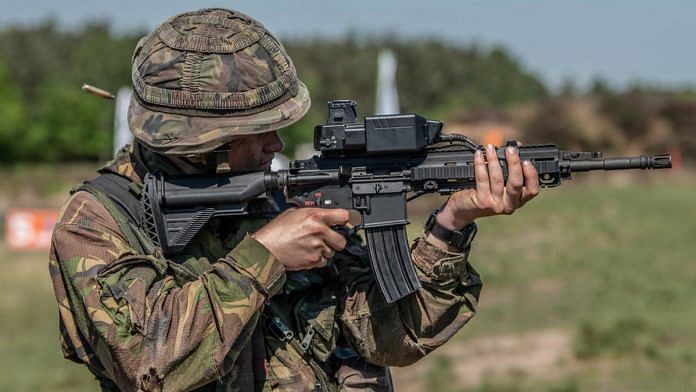
epresentational image of Israeli firm Smart Shooter’s SMASH 2000 Plus system deployed on a rifle | Photo courtesy: Captain Fred Warmer
New Delhi: Israeli defence firm Smart Shooter, whose new-age fire-control system turns assault rifles into smart weapons, is looking to set up a manufacturing plant in India, eyeing more contracts besides the one it has already bagged from the Indian Navy.
The Navy had last month gone in for an unspecified number of ‘SMASH 2000 Plus’ systems, which are already in use by Israeli and American special forces, apart from some other countries. The Army and the Border Security Force are evaluating it for anti-drone operations. The system features a built-in targeting algorithm that can track and hit multiple targets at first shot, including drones.
“We have got the permission from our defence ministry, and we are willing to cooperate with India,” Smart Shooter’s vice-president (business development) Abraham Mazor told ThePrint.
Sharone Aloni, vice-president (research and development), added that while Smart Shooter currently does all research, marketing and production from its facility in Israel, the firm is looking at the possibility of making the system in other locations, and India is one of the options.
The company, in a statement to ThePrint, said it is committed to complying with all Indian requirements and regulations as part of the ‘Make in India’ programme.
Mazor stressed that Smart Shooter owns the entire intellectual property and technological knowhow of the system, and so, there will be no issue in transferring it to India.
“It all depends on quantity, and quantity should justify the investment we are going to make,” he said.
For future contracts, the firm has tied up with an Indian company, Defsys.
“We have cooperated with a local company. We are together planning how to make it in India,” Mazor said.
Mazor noted that the modern battlefield is becoming more complex, but, with the SMASH system, a soldier has to simply decide whom or what he wants to shoot at.
Aloni said the system can be fixed on to any assault rifle without any need of modifications in most cases, adding that the system focuses on “one shot, one hit”, or the first-round hit.
“The system tells the user when to shoot,” Aloni said, adding that the company first went in for ground targets and moved on to aerial targets like drones.
Mazor said, worldwide, a lot of research and development has gone into making weapons accurate, but there has not been much movement on assault rifles, which continue to be fired in bursts to get a good hit.
“The SMASH 2000 changes the way a soldier functions in the battlefield,” he said.
The Bhartiya Kisan Union (BKU) is imparting driving training to women hailing from villages, who will then lead the procession of tractor-trolleys carrying farmers to participate in the ‘tractor parade’ in Delhi on the Republic Day.
The BKU’s local unit has roped in tractor drivers to train women in driving skills so that they can drive on the highways to reach Delhi on January 26.
The union has planned to train 500 women as tractor drivers.
“While many of these women already have tried their hands on the wheels, they need to sharpen their skills to drive the tractors on the highway and roads in Delhi during their procession,” said one of the trainers.
Sankyukta Kisan Morcha, an umbrella body of around 40 protesting unions, had announced on Sunday to march towards Delhi with a “tractor parade” on the Republic Day if the Centre fails to accept their demands.
Ramraji Dhull, BKU leader from Jind district, said they had planned to take nearly 20,000 people from Jind district to Delhi to participate in the procession.
“The women-driven tractors will be in the front row of the parade that will carry women activists,” he said.
“Some women can drive a tractor in fields to perform farming activities such as ploughing. But they don’t have the exposure of driving on the roads. We have roped in drivers to impart training for these women so that they can drive to Delhi. They are doing a good job and are quick learners,” he stated.
SC treats Panjab University students’ letter on ‘excesses against farmers’ as PIL
Students seek inquiry into the Haryana Police’s use of water cannons, tear gas shells, lathis on protesting farmers.
New Delhi, January 4
The Supreme Court has agreed to hear a plea by 35 students of Panjab University, who had written a letter to the Chief Justice urging him to take cognizance of “excesses” against protesting farmers. The top court has registered the letter as a PIL.
The students have sought direction from the top court to order an inquiry into the Haryana Police action of illegitimate use of water cannons, tear gas shells and lathis on peaceful protesting farmers. The letter contended that farmers are protesting peacefully, but the government is not sensitive to these issues.
The students have urged the Chief Justice to direct the Haryana police and Delhi police to withdraw all the cases against innocent farmers which were registered as political vendetta and order a probe into the cases of illegal detention of farmers. “Firstly, in a democratic country, the will and sentiments of people are sine-qua-non. But, here the Government of India is turning deaf and indifferent in toto to the farmers’ plight. We believe the course of action taken by the Government of India is insensitive to understand farmers sentiments”, said the letter.
The students from the Centre for Human Rights and Duties, Panjab University, Chandigarh, sought a direction to both the Centre and state governments to ensure the safety of all protesters, and provide basic amenities to all, especially women, children and the elderly. Mobile toilet vans should be provided at the protest sites.
The farmers have been protesting at various Delhi borders for over a month, asking the government to repeal the three recently enacted farm laws.
The students also sought a direction to curb fake news and action against media channels indulging in misrepresentation and polarisation of the whole issue.
On December 17, the Supreme Court had unequivocally pronounced that it will not interfere with the farmers’ protest and the right to protest is a fundamental right. However, it emphasized on forming a committee comprising of independent and impartial persons — experts in the field of Agriculture — to resolve the impasse between the Centre and the farmers’ unions.
A bench headed by Chief Justice S A Bobde and comprising Justices A S Bopanna and V Ramasubramanian had said: “We clarify that this Court will not interfere with the protest in question. Indeed, the right to protest is part of a fundamental right and can, as a matter of fact, be exercised subject to public order.” The observation from the top court came after learning from the Centre that roads are blocked by the police in order to prevent the entry of the protesters/farmers into Delhi.
Punjab farmer turns truck into makeshift home at Singhu border Others have made makeshift gyms, libraries and community centres.
Farmers’ unrest that has entered Day 40. Reuters photo.
New Delhi, January 4
As the face-off between the farmers and government over new farm laws await a breakthrough, the onslaught of biting cold wave accompanied by thunderstorms and rain over the past days, have forced a vast populace awaiting at the Delhi border to innovate ways and means to survive the crisis.
At the Singhu border, adjoining Haryana, a Punjab-based farmer has turned his container truck into a makeshift home. Others have made makeshift gyms, libraries and community centres.
Harpreet Singh Mattu, the farmer from Jalandhar, who is part of the farmers’ unrest that has entered Day 40, has equipped his container truck with all kinds of basic amenities.
Mattu told IANS that it took him two days to build the temporary accommodation. He has also been serving ‘langar seva’ at the border since December 2, 2020.
The makeshift home is equipped with every facility you want in a normal functioning home. It has a TV and even a functional toilet along with mobile charging points, a bed and a few sofas.
Mattu told IANS: “I came here at the Singhu border on December 2 last year and since then started a ‘langar seva’ for the farmers who have been continuing with the protest till date.” “On December 8, I turned my truck into a temporary accommodation, for which I have sought assistance from my colleagues,” said the Jalandhar-based farmer.
“There are 12 other trucks owned by me which are busy serving other protesting farmers by providing them blankets to protect them from the biting cold.” –IANS
Humility in Hall Bazaar by Lt Gen RS Sujlana (retd)
During a trip to the holy city of Amritsar, a naval mate of mine, Arvind, took me on a memorable walk through the back lanes of the Old City. A raconteur by habit, I was regaled by many a tale. When we entered the famous Hall Bazaar, he halted in front of Sur Chemists. This, he said, was once ‘Surbabu and Company,’ owned by Field Marshal Sam Manekshaw’s father, a doctor, and served as his clinic.
The Field Marshal, born and brought up here, had studied at Amritsar’s famed Hindu College. Years later, he visited his alma mater, and humbly attributed his achievements to his former gurus and mates there. His sister, Mrs Chawahji, was a respected and caring mathematics teacher at the local St Francis School.
Arvind’s father, a college mate of the Field Marshal, also had a family shop here and a visit there was equally interesting. My attention was drawn to a photograph of an elderly gentleman. ‘Who is this?’ I enquired. ‘My grandfather,’ said Arvind, and kept quiet. Thankfully, another person furthered the introduction. The portrait was of Prof Ram Chander Kohli, remembered and respected for his convictions, humane and humble qualities, an outstanding educationalist who was an MA in pure maths from University of Calcutta in 1922 and BA in French from University of Punjab.
The professor, a person of simple habits, always wore plain clothes, but he had his own way to convey a message. Once, like a commoner, he had queued up to register himself in a government office. When his turn came, the clerk, thinking him to be illiterate, held the professor’s thumb and impressed it in lieu of the signature. Unperturbed, the professor took out his pen, signed and endorsed his name, annotated with MA, BA. The clerk, taken aback, asked the next person in line, ‘Sign karoge ki angutha lagaoge?’ The lesson was delivered.
The professor worked in the English department prior to Independence. Once, an Englishman walked into his office. Uninvited, he took a chair and directed him to do something which was in contravention to rules. The professor refused to abide. The Englishman was given the option to leave his office or be thrown out! Dazed, he left in a huff.
To avoid any embarrassment, the professor handed over his resignation letter. The day he left office was a hot summer day. Near his house, he observed a beggar in a rather pitiable state, trudging barefoot. The professor asked Arvind to give the beggar a pair of his shoes. A few days later, the same beggar was found barefoot again.
The professor asked his grandson to give him another pair of shoes. The grandson protested. The professor replied that the beggar must have bartered the first pair for something he needed more. The grandson had to relent.
I again looked at the portrait. Kindness seemed to flow from his eyes. I left with a prayer that may many such plebeians be born to right the growing decadence in our society.
I RECENTLY read an article regarding INS Viraat going to Alang, a graveyard for decommissioned ships. I reminisced of the time when I was an engineer with India’s pioneer shipping company, Scindia Steam Navigation, in Bombay. The company came into being in 1919 and ruled the seas in cargo trade. It had a fleet of over 60 ships. As a ship aged and became economically unviable, it was either sold to a new company that repaired and ran the ship or it was declared unseaworthy, when it became a liability, instead of an asset.
If a ship was declared unseaworthy, Alang was its final resting place. For any officer and crew who worked on board that ship, it was a heart-wrenching moment as all that was left was the memory of a ship whose name was etched in their mind, of the wonderful, varied experiences they had on board which enhanced careers, the moments she rose and crashed with each wave, how many ports the ship had called on, and of so many untold tales. It may have been the death of the ship, but the ship lived on in the memories of all who served on her. A ship-breaker will never understand the soul and story behind each ship.
For the ship-breaker, she was just a piece of metal — to be torn apart and her parts resold to the highest bidder. Though merchant navy ships can’t be compared with INS Viraat, and whose sailors, too, must be remembering their service on her, but for the crew serving on cargo and passenger ships, attachment with their livelihood providers can’t be underestimated.
After serving for long in the merchant navy, I explored the options of a shore job. Coincidentally, while travelling on a train, a co-passenger got interested in my experience as chief engineer on board a merchant ship. He was the owner of a ship-breaking company and came straight to the point and made a lucrative job offer at Alang. For a while, I was tempted, but there was a gnawing at the back of my mind which stirred my conscience into declining his proposal. After all, it was the ships that provided me with a job, livelihood, sights of the world, and places visited, sometime with my family on board. My conscience would not permit me to tear it apart.
How could I think of a service in which I have to supervise the very breaking up of a ship that had provided me with resources for a good living? I was trained to repair and run her, even with all her age-related problems.
Just like the sea waves, life too has its crests and troughs, and so all things must come to an end, as is the law of nature. But for those whose lives have revolved around it, it leaves an indelible imprint, to be cherished forever.
State Stalwarts
DEFENCES FORCES RANKS
ARMY, NAVY, AIRFORCE RANKS
FORMATION SIGNS
FORMATION SIGNS
ALL HUMANS ARE ONE CREATED BY GOD
HINDUS,MUSLIMS,SIKHS.ISAI SAB HAI BHAI BHAI
CHIEF PATRON ALL INDIA SANJHA MORCHA
LT GEN JASBIR SINGH DHALIWAL, DOGRA
SENIOR PATRON ALL INDIA SANJHA MORCHA
MAJOR GEN HARVIJAY SINGH, SENA MEDAL ,corps of signals
.
.
PATRON ALL INDIA SANJHA MORCHA
MAJ GEN RAMINDER GORAYA , CORPS OF
sanjhamorcha303@gmail.com
PRESIDENT HARAYANA STATE CUM COORDINATOR ESM
BRIG DALJIT THUKRAL ,BENGAL SAPPERS
PRESIDENT TRICITY
COL B S BRAR (BHUPI BRAR)
PRESIDENT CHANDIGARH ZONE
COL SHANJIT SINGH BHULLAR
.
.
PRESIDENT PANCHKULA ZONE AND ZIRAKPUR
COL SWARAN SINGH
PRESIDENT SAS NAGAR (MOHALI)
COL BALBIR SINGH , ARTY
INDIAN DEFENCE FORCES
DEFENCE FORCES INTEGRATED LOGO
FORCES FLAGS
15 Th PRESIDENT OF INDIA SUPREME COMMANDER ARMED FORCES
Droupadi Murmu
DEFENCE MINISTER
Minister Rajnath Singh
CHIEF OF DEFENCE STAFF (2nd)
General Anil Chauhan PVSM UYSM AVSM SM VSM
INDIAN FORCES CHIEFS
CHIEF OF ARMY STAFF(29th)
General Upendra Dwivedi, PVSM, AVSM (30 Jun 2024 to Till Date)