Sanjha Morcha

What’s New

Click the heading to open detailed news

Current Events :

web counter

Print Media Reproduced Defence Related News

Time for govt to resolve row over farm laws

The Modi govt is handling the farmers’ protest as it would handle any trade union protest. Attempts to divide the movement have met with the ridicule they deserved. Now, the govt is out to drown the movement with propaganda. It may work partly with the urban middle class, but it’s not possible to demonise farmers like any other section.Time for govt to resolve row over farm laws

Upsurge: The present agitation by the farmers is the 21st-century version of the peasant rebellions of colonial times. PTI

Yogendra Yadav

President, Swaraj India

Ever heard of “moral economy of the peasant”? You must understand this awkward phrase if you wish to make sense of the farmers’ rebellion that has arrived at the doorsteps of the national capital. Policymakers must understand this to see why their argument has no purchase with the farmers. PM Modi must understand this to realise why his approach to handling this will not work, or why the government must give in, sooner than later.

The concept of ‘moral economy’ is simple. First used by British historian EP Thompson to understand the 18th-century food riots in England, the basic idea is that the poor operate with a moral vision, a sense of right and wrong, just and unjust, which refuses to obey the rationality of the market. The concept was extended by James Scott to explain peasant rebellions in South East Asia. He showed that the changes introduced by colonial authorities challenged the ‘subsistence ethics’ of the peasants, leading them to rebel. Ranajit Guha’s classic book Elementary Aspects of Peasant Insurgency in Colonial India deployed this to understand a series of peasant rebellions in the 19th century, including 1857. He showed that what appeared to the colonial masters as strange, irrational and spontaneous eruptions of violence by the natives were organised acts of resistance. The new system of agriculture introduced by the colonial State violated the basic ethics of the peasant, their sense of dignity and their intuitive sense of what was their due. Hence, the rage, outrage and eruption of violence against every symbol of colonial authority.

Cut to Singhu border of Delhi in the last month of 2020. Sure, these farmers do not look like the peasant rebels of the 19th century. Their langars are sumptuous. You can get even jalebi, if you are lucky. Their trolleys and tents are warm, equipped with solar panels to charge their phones. Some of the tractors are fitted with hi-fi sound systems. You can spot SUVs as well. Their cousins at Shahjahanpur border live in more frugal conditions (I write this column from one of these basic tents at this morcha, a constant draft to remind me of 7°C outside). But these farmers are not the hungry rebels who joined food riots. There is no eruption of violence in the present case, it follows the grammar of modern democratic protest.

Yet there is something common between the current upsurge of the farmers and the 19th century peasant rebellions. As in the case of their predecessors, the farmers today are outraged by an attempt to disrupt the existing agrarian arrangement. It is not that they are happy with the existing system. But they fear, with good reason, that the new system could be worse. Farming is increasingly uncertain, unremunerative and undignified. If monsoon is bad, they lose their crop. If the monsoon is good, they lose on prices. Farmers’ children do not wish to take to farming. An average farmer carries a grudge against the system that he or she finds unfair and unjust. In this context, the three farm laws passed by the Modi government have become a symbol of all that is wrong with the way the system treats the farmers. The manner in which these laws were pushed without any consultation with the principal stakeholders reminds the farmers of the contempt with which they are treated.

Farmers do not read the fine print of these laws, but they can smell them. And they don’t like it. Farmers of Punjab, Haryana and some other regions can sense the gradual dismantling of the mandi system that has been their lifeline for the last few decades. Farmers from other regions, who do not yet benefit from the mandi-based state procurement, can also foresee diminishing chances of their benefitting from such a system. They are not happy with the government, but the prospects of the government leaving them at the mercy of market forces exacerbate their worst fears. This fear is passed on by word of mouth, which is trusted more than any media. The message takes many forms, including rumours, just as it did during the 19th century peasant protests.

The moral outrage lies at the heart of the present upsurge. This is no longer about the calculus of gains and losses, about prospects of prices to be obtained outside the Agricultural Produce Market Committee (APMC), about the potential gains of contract farming. In a way, this is no longer about the three laws or this government. Now, this is about the way farmers have been treated by successive regimes, about the systematic discrimination that they suffer in the system. It is now about the dignity of farmers, their very being or ‘hond’ as they say in Punjabi. The ruling Bharatiya Janata Party and its formal and informal spokespersons have fuelled this fire by throwing indiscriminate allegations about the farmers being ‘Khalistanis’ or foreign agents. At least for Punjab and parts of Haryana, this is now an emotional issue.

Hence, the community dimension of the current upsurge. Once a movement touches the moral nerve of society, community networks come into play. Gurdwaras and their resources are at the disposal of the farmers. Khap panchayats have jumped into the fray to support the cause, as have the NRIs. Boundaries between professionals and the community have been blurred. All kinds of local clubs and organisations have chipped in, from lawyers’ organisations to sports clubs. Those in uniform are privately with the farmers. This is not just a farmers’ protest or farmers’ movement anymore. This is the 21st-century version of farmers’ rebellion.

This is why the government’s handling of this upsurge is counter-productive. The Modi government is handling it as it would handle any trade union protest. The usual tricks of dodge, derail and divert have not worked. Attempts at dividing the movement by reportedly getting ‘non-existent’ farmer leaders and farmers’ organisations to meet the government have met with the ridicule these deserved. Now it is out to drown the movement with propaganda. It may work partly with the urban middle class, but it is not possible to demonise the farmers the way any other section can be. So, it is now down to a waiting game, as the government hopes to tire the farmers out or play some insidious game.

Meeting the protesting farmers over the last month, I can say for sure that this won’t work. Farmers know that this is their last battle, aar-paar ki ladai, as they say. With the passage of time, this upsurge is growing. All the morchas around Delhi are growing in numbers and moral strength. Farmers across the country now share a sense that the government is doing something big and bad. The longer the government takes to realise this, the higher the cost for it and the country.


Centre wants to impose Prez rule in state: Sidhu

Centre wants to impose Prez rule in state: Sidhu

avjot Singh Sidhu. File photo

Amritsar, January 3

Amid protest against the newly enacted farm laws, former state Cabinet Minister Navjot Singh Sidhu said the BJP-led Centre was creating grounds for imposing President’s rule in Punjab.

He expressed his apprehension through his tweet saying, “There’s no law and order problem in Punjab. Farmers dying on Delhi’s borders should be the government’s real concern but it is maligning Punjabis and scuttling our democratic voice by projecting us as anti-national to safeguard corporate interests and create grounds for President’s rule.”

In the backdrop, reports surfaced about damage to mobile towers of a telecom firm owned by a corporate house in the state. Following this, the BJP state leadership has accused the Congress of not maintaining law and order in the state. Meanwhile, dejected by “offensive comments” being used by the BJP leadership against the farmers’ peaceful protest, senior leader of Aam Aadmi Party (AAP) Kuldeep Singh Dhaliwal has served a legal notice to Union Minister Giriraj Singh. — TNS

Rs8 lakh relief for family of advocate who ended life

Rs8 lakh relief for family of advocate who ended life

Amarjit Singh Rai. File photo

Our Correspondent

Fazilka, January 3

A large number of residents took part in the last rites of advocate Amarjit Singh Rai who ended his life in support of farmers’ agitation at the Tikri border a week ago.

Jalalabad MLA Raminder Singh Awla, Fazilka MLA Davinder Singh Ghubaya, former minister Hans Raj Josan, Jalalabad Bar Association president Rohit Dahuja and farmer leaders paid tributes to Rai at a ceremony at Jalalabad on Saturday.

Awla handed over a cheque for Rs 5 lakh to the family members of the deceased on behalf of the Punjab Government. Besides, Rs 1 lakh each were given to the family by the Jalalabad Bar Association, Bar Council of Punjab and Haryana High Court and the Shiromani Gurdwara Parbandhak Committee.


Withdraw dung dump FIR or will block roads: BKU (Rajewal)

Withdraw dung dump FIR or will block roads: BKU (Rajewal)

A BKU (Rajewal) activist addresses the media in Jalandhar on Sunday.

Tribune News Service

Jalandhar, january 3

Members of the Bhartiya Kisan Union (Rajewal) today threatened to block major roads in Jalandhar and hold protests at BJP leaders’ residences if an FIR against those accused of dumping cow dung at the entrance to party leader Tikshan Sud’s house wasn’t withdrawn by January 6.

Union members said the farmers’ act was in response to BJP leaders’ alleged inflammatory statements amid a growing number of deaths at the Delhi border. An FIR under Sections 452 (trespass after preparation for hurt), 506 (criminal intimidation), 323 (voluntarily causing hurt), 307 (attempt to murder), 148 (rioting) and 149 (unlawful assembly) of the IPC had been lodged against a Dal Khalsa member and several unidentified protesters. The protesters had taken exception to Sud’s reported statement that “most farmers were unaware of farm laws and were going there on a picnic”. Kulwinder Singh, union’s district general secretary, said: “BJP leaders have been making repeated statements about farmers amidst loss of lives at the Delhi border.”

“We give an ultimatum to the state government to withdraw the FIR lodged under Section 307 and other grave offences against farmers at Hoshiarpur by January 6 or we will block roads in Jalandhar. In the coming days, we will bring such tractor-trailers to BJP leaders’ residences regularly.”

“In the middle of deaths at Singhu, if a leader says farmers go there on a picnic then it is bound to cause anger. We do not approve of the farmers’ act either. But in a democracy, an attempt-to-murder FIR can’t be lodged for dumping dung. We are not scared of FIRs. We just want peace in the state. But the government, rather than acting against the minister for provoking farmers, has lodged an FIR under serious offences,” he said.

Hoshiarpur SSP Navjot Singh Mahal said: “The FIR was lodged on a complaint received by the police. An SIT has been formed and is looking into the matter. Action will only be taken as per sections that merit the act by protesters. If any sections are found unwanted, these will be removed.”

On his part, Sud said his statement had been taken out of context. “I’m from farming background and haven’t said anything against farmers. Everyone has the right to protest. But we are against those who in the garb of protest trespass on to people’s homes. The farm leaders had never asked people to dump things on residential premises.”


Farmers, cops clash near BJP event Barricades torn down in Sangrur | Two protesters, three police officials injured

Farmers, cops clash near BJP event

Police officials try to stop a tractor-trailer during a clash with protesting farmers in Sangrur on Sunday. Tribune photo

Tribune News Service

Sangrur, January 3

Farmers clashed with the police near the Sangrur-Patiala bypass when the latter tried to stop them from marching towards the venue of a meeting of BJP leaders being presided over by party’s Punjab chief Ashwani Sharma. Farmers broke the first barricade but when they tried to break the second one, a scuffle ensued causing injuries to two farmers and three cops.

“The police must register an FIR against the state BJP chief for causing tension in Sangrur deliberately by calling a meeting despite being aware that we will not allow it. Two farmers have suffered injuries and are under treatment. We will keep opposing the visits of BJP leaders,” said Gobindar Singh Mangwal, BKU (Ugrahan) Sangrur block president.

To prevent any trouble, senior police officers from Patiala were also deployed but the problem started when protesting members of various organisations tried to move towards the residence of Sangrur BJP chief Randeep Deol after breaking the first barricade.

“The Congress government has been supporting BJP leaders rather than banning their meetings. It shows that Congress and BJP are two sides of the same coin,” said Jasdeep Singh, a leader of the Kirti Kisan Union.

Farmer Gurpreet Singh and another protester along with Inspector Harwinder Singh (Training School) and Constables Harpreet Singh and Beant Singh have suffered injuries.

During the meeting, Ashwani Sharma said peaceful protest was a democratic right, but some miscreants were creating problems for them.

“In a democracy, we have the right to conduct meetings and farmers have the right to protest, but our political opponents are creating problems for us,” he said.

After a meeting at the residence of Deol, Sharma also went to the house of another BJP leader Satwant Singh Punia at Gurdaspura, where two farmers raised slogans against the BJP.

Sangrur SSP Vivek Sheel Soni said farmers had a scuffle with cops. “Our officers had a narrow escape as some farmers tried to run over the cops after breaking the first barricade. Further investigations are on,” Soni said.


State BJP chief faces protest in Moga

State BJP president Ashwani Sharma faced stiff opposition in Moga from farmers during his visit to district president Vinay Sharma’s house. The farmers raised slogans against the BJP leadership and showed black flags. Reacting to the incidents, the BJP state chief termed the protests a conspiracy by the Congress


First time such arrogant govt in power, must withdraw farm laws unconditionally: Sonia ‘Governments that ignore public sentiments in a democracy cannot govern for long’

First time such arrogant govt in power, must withdraw farm laws unconditionally: Sonia

Sonia Gandhi. PTI file photo
New Delhi, January 3 

In a scathing attack on the Centre over the farmers’ protests, Congress president Sonia Gandhi on Sunday said that for the first time since independence such an “arrogant” government has come to power that cannot see the sufferings of ‘annadatas’, and demanded that the new farm laws be immediately withdrawn unconditionally.

In a statement in Hindi, she said governments and their leaders who ignore public sentiments in a democracy cannot govern for long and it is now quite clear that the protesting farmers will not bow in the face of the Centre’s policy of “tire and pushover”.

“There is still time, the Modi government should leave the arrogance of power and immediately withdraw the three black laws unconditionally to end the agitation of the farmers who are dying in the cold and rain. This is Rajdharma and a true tribute to the farmers who have lost their lives,” Gandhi said.

The Modi government should remember that democracy means protecting the interests of the people and the farmers-workers, she said.

“Along with the people of the country, I am also disturbed seeing the condition of the ‘annadatas’ who have been agitating for 39 days at the borders of Delhi in the bitter cold and rain in support of their demands,” Gandhi said.

In the wake of the government’s apathy, so far, more than 50 farmers have lost their lives with some even taking the step of committing suicide due to the government’s neglect, she said.

“But neither the heartless Modi government relented nor the Prime Minister or any other minister uttered a word of consolation till today. I pay my respects to all the deceased farmer brothers and pray to the Lord to give their families the strength to bear this sorrow,” the Congress president said.

“Since independence, this is the first such arrogant government that has come to power in the history of the country that, leave alone people, cannot even see the sufferings and struggles of ‘annadatas’,” she said.

It seems that ensuring profits for a handful of industrialists has become the main agenda of this government, Gandhi alleged.

The Congress has been seeking the repeal of the three new farm laws, alleging that they will ruin farming and the farmers. The Congress is also supporting the farmers’ agitation against the legislations.

After the sixth round of formal negotiations on Wednesday, the government and farm unions reached some common ground to resolve protesting farmers’ concerns over rise in power tariff and penalties for stubble burning, but the two sides remained deadlocked over the main contentious issues of the repeal of three farm laws and a legal guarantee for minimum support price (MSP).

Braving the cold, thousands of farmers, mainly from Punjab and Haryana, are protesting at various borders of the national capital for more than a month against these laws.

The government has presented these laws as major agriculture sector reforms aimed at helping farmers and increasing their income, but the protesting unions fear that the new legislations will leave them at the mercy of big corporates by weakening the MSP and mandi systems. — PTI


Police, farmers clash on Delhi-Jaipur highway Teargas shells lobbed, tractor-trailer catches fire

Police, farmers clash on Delhi-Jaipur highway

Protesting farmers being stopped at Masani barrage near Dharuhera town on Sunday. Tribune photo

Ravinder Saini

Tribune News Service

Rewari, January 3

A clash between protesting farmers camping on the Delhi-Jaipur highway near Bhudla-Sangwari village for the past three days and police was witnessed on Sunday when the former reached Masani barrage near Dharuhera town after covering 4 km from their previous halt.

The police lobbed teargas shells to stop farmers. A tractor caught fire during the clash but the blaze was doused by farmers. The protesters were adamant on going ahead while the police had blocked the service lane. The farmers were trying to remove the blockade till the filing of this report.

Read more: Will burn copies of new farm laws on Lohri: Farmer leaders

Sources said many farmers from the Tikri border today joined the camp of another group of farmers at Bhudla-Sangwari village and decided to go ahead. In the evening, they removed police barricades near their camp and moved ahead. The police resisted them initially, but let them go later. The protesters were, thereafter, stopped at Masani barrage as police used teargas shells, sources added.

A member of the Rapid Action Force fires a teargas shell towards farmers as they try to cross barricades during a protest against newly passed farm laws on a highway at Dharuhera in Haryana on January 3, 2021. Reuters

Happy Singh, a farmer from Rajasthan, told The Tribune that a tractor-trailer caught fire due to teargas shells. Some blankets and quilts also got burnt while some farmers who were sitting inside saved their life by jumping off the trailer. They also managed to take out an LPG cylinder, he claimed.

“We wanted to go to Delhi peacefully, but the police lobbed teargas shells and used force on us to stop us from moving ahead,” said a protesting farmer, adding that they are vowed to go to Delhi and would do it come what may.


Read also: 4 more protesting farmers die at Tikri border; count rises to over 50

Heavy rain adds to woes of farmers protesting at Delhi borders

On eve of talks with farmers, Tomar meets Rajnath to discuss govt strategy to end deadlock


The sudden clash resulted in the blockade at the highway. Long queues of vehicles were witnessed, causing inconvenience to commuters who had to use alternative routes to reach their respective destinations.

Meanwhile, ‘Chetna Yatra’ being taken out by the farmers belonging to Bhartiya Kisan Union (Ugrahan) reached the Shahjahanpur-Khera border in Rajasthan in the evening. They spent Saturday night at Gangaicha Jat toll plaza near Rewari city in the open amid bone-chilling cold. Locals provided them food and tea. The yatra would return to Tikri on Monday.

Kavita Arya, a farmer leader, said they welcomed the Chetna Yatra at the Shahjahanpur border and made special arrangements for food and stay for farmers.


Farmers step up pressure, to burn copies of 3 laws on Lohri 7th round of talks today | Unions ask Centre to discard obduracy

Farmers step up pressure, to burn copies of 3 laws on Lohri

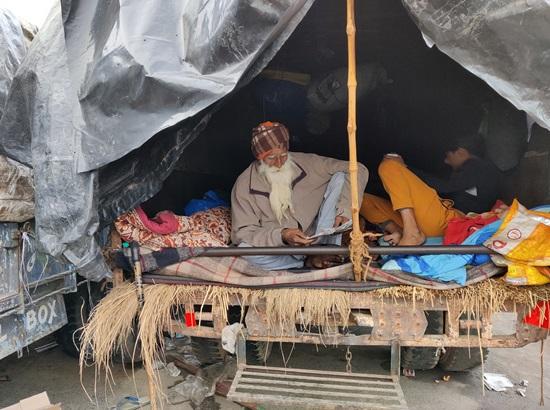
Amid rain, a farmer takes shelter inside a makeshift tent at the Singhu-Delhi border. PTI

Impasse: union agri minister Tomar meets Rajnath to firm up strategy

Tribune News Service

Sonepat, January 3

Ahead of the seventh round of talks with the Centre on Monday, Punjab’s farm unions announced that they would burn copies of the three contentious farm laws on Lohri (January 13) and celebrate January 23 — Netaji Subhas Chandra Bose’s birth anniversary — as ‘Azad Kisan Diwas’.

  • Edit: Cold and cruel

Representatives of the unions at a press conference here condemned the lathi-charge on farmers protesting against BJP leaders in Sangrur. Harmeet Singh Kadian said: “We will only focus on the repeal of farm laws and MSP during our meeting with the Centre on Monday.” In a statement, the All-India Kisan Sangharsh Coordination Committee said the success of Monday’s talks would depend entirely on the repeal of three farm laws.

Sonia Gandhi, Congress

Shun arrogance: Sonia Gandhi

Over 50 farmers have lost their lives. This is an arrogant govt. Leave alone people, it cannot even heal the suffering of the ‘annadatas’.

Union leader Onkar Singh urged the Centre to discard obduracy and repeal the “black” laws. Jangveer Singh Chauhan observed that the protest had been peaceful for the past 37-38 days but some political leaders were trying to provoke the farmers. He also said they had sent a letter on sugarcane rates to the Punjab Government but had yet to receive a response. “We will decide whether or not to hold a tractor march on Republic Day after tomorrow’s meeting,” Kadian said. Farmers camping at Singhu and Tikri had a tough time owing to overnight rains. Waterproof tents were of little help. Meanwhile, farmers from Maharashtra on Sunday left Nagpur for Delhi to join the protesters.

Haryana cops use force to halt march

The Haryana Police on Sunday fired tear gas shells to thwart a march by a group of farmers proceeding towards Delhi at the Masani barrage in Rewari. The farmers, who broke barricades, had been camping at the service lane of Delhi-Jaipur highway for several days.


Braving all odds, women at forefront of farmers’ protest Women of all ages are out are staging a protest demanding the repeal of the farm laws.

Braving all odds, women at forefront of farmers' protest

Large number of women have been staging protest against farm laws at Tikri border. Tribune Photo

Sukhmeet Bhasin
Tribune News Service
Bathinda, January 3

Women in large numbers have emerged at the forefront of the farmer’s protests against the farm laws in Delhi.

This has led to the new awakening of gender equality amongst the male-the dominated mindset in the state amid the farmers protest.

Women of all ages are out are staging a protest demanding the repeal of the farm laws.

In the past few weeks, they have braved all odds and stayed put despite Delhi’s bone-chilling winter amid lack of toilets, privacy or hygiene. Many are staying in the tractors in the cold.

These women have given a new fillip to the protests as some can be seen singing revolutionary songs, while others are giving fiery speeches. They have been occupying front rows and are shouting slogans against the anti-government.

Shingara Singh Mann, state secretary BKU Ekta Ugrahan said “We have always believed that women should be given equal respect and chances as they are no less than men in any aspect, due to which our union has mobilized women in large numbers to participate in this protest.”

Harjinder Kaur Bindu, BKU Ekta Ugrahan women wing president said: “More than 2,000 women are staging a protest at Tikri border only and we have known that this fight against three farm laws would be big, so we planned that farmers along with their families would participate in this protest and mobilize the farmers accordingly.”

She stated that young girls, college-going women, newly married women and the elderly were all are participating in the protest.

80-year-old Mohinder Kaur of Bahadurgarh Jandian in Bathinda, who hit the national headlines after Kangana Ranaut tweeted her photo, said: “I went to Delhi to participate in protest because the union government want to give their lands to the big corporate houses, to save my land, I went to Delhi.”

Paramjit Kaur of Bathinda district, who along with his 10-year-old daughter is in protest at Tikri border said: “They have sacrificed everything and has come here along with her family in protest to save our land, because if we will not have land, then how we will survive. It is a fight for our survival, so she will be staying along with her family till these laws are not repealed”.


Heavy rain adds to woes of farmers protesting at Delhi borders Farmer leader Abhimanyu Kohar said farmers have waterproof tents but they cannot protect them from biting cold and waterlogging

http://

New Delhi, January 3

Waterlogged tents, soaked firewood and blankets, and cold conditions — farmers camping at Delhi borders in protest against new farm laws had a difficult morning on Sunday due to overnight rains.

The continuous downpour led to waterlogging at agitation venues and waterproof tents did not help much, according to the protesters.

Farmers at the Ghazipur border battle rain and cold weather conditions, in New Delhi on Sunday. Tribune Photo: Manas Ranjan Bhui

Farmer leader Abhimanyu Kohar, who is a member of Sankyukt Kisan Morcha, said farmers had waterproof tents but they could not protect them from biting cold and waterlogging.

“The situation is very bad at protest sites due to rain which has caused waterlogging. There is so much cold after the rains but the government is not able to see our misery,” he said.

Gurwinder Singh, who is camping at Singhu Border, said there was waterlogging at some places as civic facilities are not up to the mark but asserted that the weather would not dampen the spirit of farmers who have been protesting for over a month.

 “Despite facing several problems, we will not move from here until our demands are met,” he said.
Farmers at the Ghazipur border battle rain and cold weather conditions, in New Delhi on Sunday. Tribune Photo: Manas Ranjan Bhui

According to a MeT Department official, heavy rainfall was reported in areas across Delhi and minimum temperatures have increased due to clouding and easterly winds.

 “Safdarjung observatory recorded a minimum temperature of 9.9 degrees Celsius, an increase of 6.7 degrees with 25 mm rain. Palam observatory recorded a minimum temperature of 11.4 degrees Celsius with 18 mm rain. Rain with hail storm is expected until January 6,” the official said.
Farmers at the Ghazipur border battle rain and cold weather conditions, in New Delhi on Sunday. Tribune Photo: Manas Ranjan Bhui

Thousands of farmers, mostly from Punjab and Haryana, have been camping at three Delhi border points — Singhu, Tikri and Ghazipur — for more than a month, demanding repeal of three farm laws and a legal guarantee for Minimum Support Price (MSP) and other two issues.

 Bharatiya Kisan Union (Ugrahan) leader Sukhdev Singh, whose Union is leading the protest at Tikri border, said arrangements made by farmers to brave the cold weather were not helping much because of rains and subsequent waterlogging.
Farmers at the Ghazipur border battle rain and cold weather conditions, in New Delhi on Sunday. Tribune Photo: Manas Ranjan Bhui

Veerpal Singh, a protesting farmer, said their blankets, clothes and wood were soaked.

 “Our clothes are soaked due to waterlogging caused by rains. Besides, we are facing difficulties to cook food as rainwater has also soaked firewood. We do have an LPG cylinder but not everyone here has it,” he said.

Dharmveer Yadav, who is camping at Ghazipur border protest site, said farmers would not move an inch from their agitation venues.

Farmers at the Ghazipur border battle rain and cold weather conditions, in New Delhi on Sunday. Tribune Photo: Manas Ranjan Bhui

“We are ready to face any problem, be it heavy or storm, but we will not leave this place in any condition until our demands are met,” Yadav said.

Rainwater also entered camps at Burari ground and the protesters were seen draining the water out and rearranging their belongings to prevent from soaking in water. PTI


4 more protesting farmers die at Tikri border; count rises to over 50 The farmers were from Bathinda and Sangrur in Punjab, and Jind and Sonepat in Haryana; cause of death is reported to be a cardiac arrest

4 more protesting farmers die at Tikri border; count rises to over 50

Farmers during the ongoing protest against the new farm laws, at Singhu Border in New Delhi, on Saturday. PTI Photo

Tribune News Service

Jhajjar/Sonepat, January 3

Two farmers protesting against the Centre’s three agri laws reportedly died at Tikri border on Saturday night.

The two farmers were from Bathinda (Punjab) and Jind (Haryana).

Meanwhile, two more farmers died at Kundli (Singhu) border today.

The deceased have been identified as 45-year-old Kulbeer of Gangana village (Sonepat) and 45-year-old Shamsher Singh of Lidhra village of Sangrur district (Punjab).

The cause of death for all four is reported to be a cardiac arrest.

 The dead bodies of the farmers have been sent to a mortuary at Sonepat.

As many as 13 protesters have, so far, have lost their lives during the ongoing farmers’ protest at Tikri. Of those 13, a total of 11 have died due to cardiac arrest.

So far, a total of 50 farmers have died while protesting against the farm laws on the Delhi borders.

In the first 15 days the protest at Delhi, as many as 15 farmers died either owing to the cold weather conditions or accidents.

 Since then, the number of casualties has been continuously increasing.

As per a list released by the Sanjyutka Kisan Morcha on December 16, a total of 30 farmers have died during the protest against the three farm laws. Since then, as many as 20 more succumbed to either accidents or health issues.

The 32 farmer organisations had given the ‘Delhi Chalo’ call for November 26 and 27. Following a massive response from Punjab, a large number of farmers from other parts of the country also reached the capital borders.