Sanjha Morcha

What’s New

Click the heading to open detailed news

Current Events :

web counter

Print Media Reproduced Defence Related News

Sanjha Morcha Wishes ALL Happy Lohri and MAGI

lohri2 punjabi

Lohri Is The Popular Festival Of Punjabi People, Celebrated By Sikhs and Hindus From The Punjab Region Of Indian. Lohri Event Is Celebrated On 13th Of January Of Every Year. This Event Is Very Important To Newly Borned Babies As Its Marks Of Richness and Fertility. People Offered Prayers To The Bonfire Seeking Wealth and Success. Lohri Event Brings Happiness Among All People Enjoy This Event By Dancing and Singing Traditional Songs

Happy Lohri 2020 Wishes Status for Whatsapp and Facebook, Happy Lohri Wishes Shayari Quotes in Hindi, Happy Lohri Wishes in Hindi 2020, Happy Lohri Whatsapp Status, हैप्पी लोहड़ी व्हाट्सप्प स्टेटस, Punjabi Lohri Quotes, लोहड़ी मैसेज, Lohri Festival Quotes

happy lohri, happy lohri images, lohri images, happy lohri 2020, lohri wishes in punjabi, happy Lohri, happy lohri 2020 status in hindi, happy lohri wishes, happy lohri wishes in hindi, lohri quotes in punjabi, lohri wishes, Happy lohri

happy lohri 2020 images in hindi, happy lohri 2020 wishes in punjabi, happy lohri image, happy lohri images 2020, happy lohri images hindi, happy lohri in punjabi, happy lohri photos 2020, happy lohri pics, Happy lohri pics 2020, Happy lohri quotes in hindi, happy lohri shayari in hindi, happy Lohri wallpaper

lohri 2020, lohri image in hindi, Lohri message, lohri photos, Lohri Photos, lohri quotes in hindi, lohri shayari, lohri wish image wallpaper, lohri wishes hindi, lohri wishes in Hindi, lohri wishes love pics, wishing for lohri, Happy Lohri 2020 Wishes Images

happy lohri, happy lohri images, lohri images, happy lohri 2020, lohri wishes in punjabi, happy Lohri, happy lohri 2020 status in hindi, happy lohri wishes, happy lohri wishes in hindi, lohri quotes in punjabi, lohri wishes, Happy lohri, happy lohri 2020 images in hindi, happy lohri 2020 wishes in punjabi, happy lohri image, happy lohri images 2020

happy lohri wishes, lohri messages, Lohri Wishes In Hindi, Lohri Wishes In Punjabi, Happy Lohri 2019

http://

http://


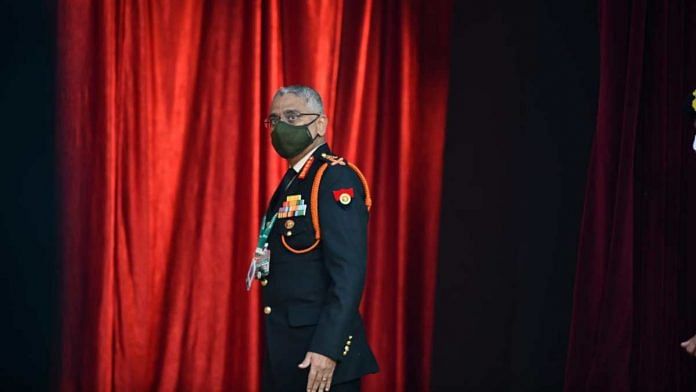
Army to have women pilots in frontline operational units by next year, says chief Naravane

Army chief General M.M. Naravane addresses press on 12 January in New Delhi | ThePrint photo

Army chief General M.M. Naravane addresses press on 12 January in New Delhi | ThePrint photo

New Delhi: The Army plans to induct women officers soon for combat roles in the flying branch of the Army Aviation Corps as early as next year, Army chief General M.M. Naravane said Tuesday.

Addressing the media ahead of Army Day on 15 January, the Army chief said that just a month ago, he had proposed that Army aviation should have women pilots.

So far, the Army does not have women officers in the flying branch, unlike the Indian Air Force and the Navy. The Army has women officers deployed at the ATC (Air Traffic Control) for ground duties.

The Army chief said that women officers will undergo pilot training in the next course beginning July, and after a year of training they would be serving in frontline operational units for flying duties.

“The Adjutant General’s branch, the Military Secretary branch, the Aviation Directorate have also reached a consensus that women officers should be there for flying duties,” General Naravane said.

Armoured Corps, Mechanised Infantry and Infantry comprise the combat arms of the Indian Army, while combat support arms include Artillery, Corps of Engineers, Corps of Army Air Defence, Army Aviation Corps, Corps of Signals.


Also read: What India, Saudi, UAE look to gain from Gen. Naravane trip, a first by an Indian Army chief

‘Going to be a path-changing move’

Naravane’s statement comes after the Army in November last year found 422 women officers eligible for permanent commission out of 615 officers, who were screened by a Special Number 5 Selection Board. Many of them had fought a legal battle lasting over 14 years.

The eligible women officers are of the rank of majors and lieutenant colonels. Many of them have already served in the Army for over 20 years, but had not been given promotions since the matter was sub-judice.

“It’s going to be a path-changing move. Till now, women were not considered for flying duties. With this, they will also be shouldering the challenging responsibilities at the frontline along with their male counterparts,” a senior woman Army officer told ThePrint.

As of now, women Army officers are eligible for permanent commission in Army Aviation, Army Air Defence, Signals, Engineers, Electronics and Mechanical Engineers, Army Service Corps, Army Ordnance Corps, and Intelligence Corps, in addition to Judge and Advocate General and the Army Educational Corps, where women officers were given permanent commission in 2008.

The Army Aviation Corps is one of the youngest corps of the Indian Army and operates a fleet of Chetak, Cheetah, Advanced Light Helicopter (ALH) Dhruv, and Rudra helicopters. The main roles of the choppers include observation, reconnaissance, casualty evacuations, load drops as well as search and rescue operations.

Assets of the corps were also deployed during the Galwan clashes in eastern Ladakh on 15 June for search and rescue, and other operations.


Also read: Ready to hold ground in eastern Ladakh ‘for as long as needed’ — Army chief Gen Naravane


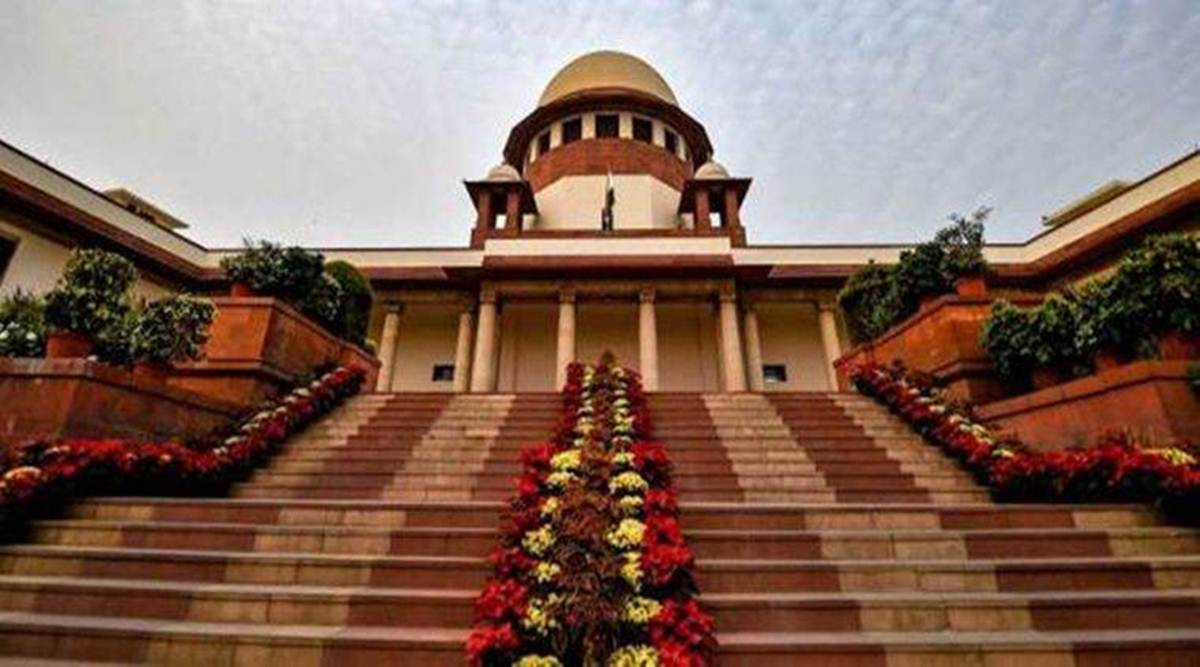
SUPREME COURT COMMITEE TO RESOLVE FARM LAWS:ALLEGED TO BE PRO GOVT

PHOTO-2021-01-12-19-05-24

With amputated arms & half blindness 78-year-old man is Kisan Morcha fighter since day one

With amputated arms & half blindness 78-year-old man is Kisan Morcha fighter since day one  

8-year-old man with amputed arms and half blindness, sits at Kisan morcha since 1st day
Said, will never return to his village if the farms laws not repealed

By Harshabab Sidhu

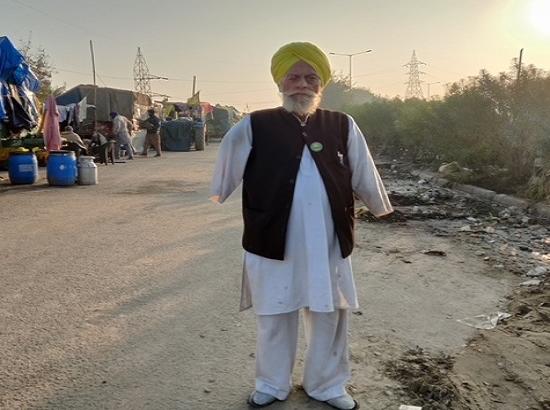
Tikri Border (Delhi), January 12, 2021: The enthusiasm of the farmers is limitless and many surprising as well as emotional pictures can be witnessed on the Delhi borders here amid the Kisan morcha. One such brave farmer was seen at the Tikri Border, who has no arms and he is also blind from one of his eyes.
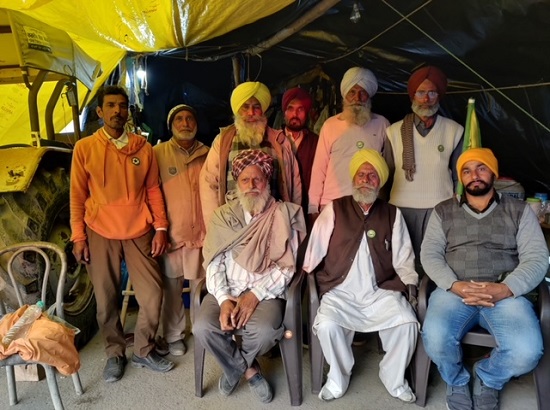
Nirmal Singh (78), a resident of Hathan village in Sangrur district is protesting with his family and villagers, and staying in the trolley home since the farmers approached towards Delhi on November 26 last year. Nirmal Singh, who is here for the last around 50 days, said he will not return to his village untill the farms laws are not repealed.

“I am sitting here from the very first day of Delhi chalo movement. We are having a ration of approximately six months and I can live here for several months or an year if the protest continues. Now, Haryana farmers are also helping a lot in providing food and milk. When I left my home, I had swear to my villagers that I will return only after the three black laws are repealed, ” he said.


Nirmal Singh shared about the worst incidents of his life and said that he had lost his right eye when he was just 10-year-old as a stick accidentally hit his eye following which his right eyesight lost. He said he was working as an employee in the electricity department but just after 10 months, he lost both of his arms in an incident of 1982 when he was using a chaff cutting machine. “I have spent my whole life like this but had never lost confidence. My villagers kept encouraged me from the beginning. Now, I am working as a cashier of my village and collects the donation from all, said Nirmal Singh with his teary eye.

Speaking about the new farm laws, Nirmal Singh said, “I had three acres of land but following poverty I left with only two acres now. We are nine family members and our life is already in pathetic condition. We takes the land of other farmers on contract. We also have three buffaloes and we earns some money by selling their milk to the villagers” while adding that “the three laws will throw the small farmers like me in the whole darkness. These laws are nothing less than the death warrants. I will survive my life anyhow now but I can’t able to see the future of my children if the laws are not repealed.”


Supreme Court’s order putting on hold the farm bills is terrible constitutional precedent, bereft of judgment


Supreme Court’s order putting on hold the farm bills is terrible constitutional precedent, bereft of judgment

he Supreme Court is increasingly looking like one of those fantasy creatures with disjointed shapes, where nothing is what it appears to be.

The Supreme Court is increasingly looking like one of those fantasy creatures with disjointed shapes, where nothing is what it appears to be. The forms keep mysteriously changing, with benign faces masking more ominous fangs, and shapes shifting as the need arises. So this is a constitutional court that does not pronounce on the constitutionality of laws. Instead, it wades into political and administrative management without the imprimatur of any law. It positions itself as a saviour of democracy only to make a mockery of the parliamentary process. It wades into conflict management, only to hide behind the façade of some expert committee. It pretends that distributive conflicts are technical ones. It finds ruses to defuse genuine democratic protest. Yet it will not facilitate the orderly and law-bound expression of protest.

It will accuse governments of not responding, while it itself perpetually refuses to pronounce on constitutionality and law in a time-bound manner. It speaks the language of neutrality, of being above the fray, but is clearly willing to disrupt the normal political give and take in a democracy. The court’s order putting on hold the farm bills is terrible constitutional precedent, bereft of judgment. It has an odour of cynicism behind it.

The issues in the farm bills are complex. But no matter which side you are on, you should now worry about how the Supreme Court is interpreting its function. It has suspended the implementation of the farm laws, and created a committee to ascertain the various grievances. But it is not clear what the legal basis of this suspension is. The court’s action, at first sight, is a violation of separation of powers. It also gives the misleading impression that a distributive conflict can be resolved by technical or judicial means. It is also not a court’s job to mediate a political dispute. Its job is to determine unconstitutionality or illegality. Even in suspending laws there needs to be some prima facie case that these lapses might have taken place. But instead of doing a hearing on the substance — the possible federalism challenge, the possible challenge based on the ouster of grievance redressal — and then pronouncing a stay, it has simply decided to create a committee to hear farmers’ grievances and wade into political territory.

The framework governing agriculture needs serious reform. The objective of reform must be to improve farmers’ incomes and well-being, to increase crop diversification, make agriculture more environmentally sustainable, make subsidies less counterproductive, keep food inflation down, and ensure that nutrition reaches all. Achieving all these objectives in no easy task, especially in states like Punjab. It will require immense trust to move to a new regime in agriculture. The government was right to think reforms were necessary. But it was prioritising the wrong reforms by beginning with the hollow promise of “choice of traders,” which did not tackle the underlying issues, but created more uncertainty all around.

In not responding to legitimate concerns of the farmers, the government was forfeiting their trust. The farmers were well within their rights to protest, and did so with grace, despite repeated government attempts to delegitimise them as anti-national. There was a stalemate. In principle, any mediation to break the stalemate is welcome. But the mediation has to be a political process between the government and the people. If there is no unconstitutionality involved, Parliament has to fix what it broke.

Here is why what the Supreme Court has done is dangerous. It has set a new precedent for putting on hold laws passed by Parliament without substantive hearings on the content of the laws. It has muddied all the possible lines of judicial procedure, where it is not clear what the locus standi of different counsel are, what are the specific prayers that need to be addressed and how the court’s remedies address them. It has not really heard the farmers, whose counsel were not fully heard before the passing of orders. This is a monumental irony since a court whose own procedures seem to be opaque sets itself up as the arbiter of responsive government. This is not public interest litigation, it is whimsy on steroids.

The court is, perhaps unintentionally but damagingly, seeking to break the momentum of a social movement. You can have a view on whether the government is right or the farmers. But it will be up to the people and the political process to decide who is correct, as long as there is no unconstitutionality involved. But political movements require collective action and timing, they are not easy to assemble. There is no question that the timing of the order has the objective to save the government the embarrassment of intensifying protests. By appointing a committee, the court has shifted the onus on the farmers to stop their protests, or else appear unreasonable. In a related matter, on the form in which protests in Delhi should be allowed, the court has also positioned itself as an arbiter of national security by taking seriously the Attorney General’s contention that farmers’ protests may be the vehicle for the Khalistan movement. This is delegitimisation of protest by misdirection. It is preparing the ground for the protests on a significant scale being rendered illegal.

In another ruse, the court seems to have redefined the function of mediation. If the function of a committee is mediation, then the court has violated the first rule of mediation: The mediators must be acceptable to all parties and appointed in consultation with them. If the purpose of the committee is to ascertain facts, why not just do it through open hearings of all parties in the court?

The farmers did not need the paternalism of the court, the way in which it is infantilising them, protecting them from themselves. What they need is clarity of law where relevant, and the right to make their demands heard through the political process and civil society. By being too clever by half, the court has potentially created an explosive situation. It has set a bad precedent where implementation of laws can be suspended without legal basis. It has created mistrust in farmers about its intention. The court seems to have given the government a setback, but it is more a “get out of jail” card: Saving it from being on the political backfoot in the face of a movement. By this order, the court has forfeited the very thing it needs most: Being a repository of trust.

The writer is contributing editor, The Indian Express


APPLE GROWERS IN HIMACHAL AT RECEIVING END

किसान आंदोलन क्यों कर रहे हैं, यह समझने के लिए शिमला जाइए।

शिमला में सेब के बाग है और किसानो से छोटे छोटे व्यापारी सेब ख़रीदकर देश भर में भेजते थे। व्यापारियों के छोटे छोटे गोदाम थे। अड़ानी की नज़र इस कारोबार पर पड़ी । हिमाचल प्रदेश में भाजपा की सरकार है तो अड़ानी को वहाँ ज़मीन लेने और बाक़ी काग़ज़ी कार्यवाही में कोई दिक़्क़त नहीं आयी। अड़ानी ने वहाँ पर बड़े बड़े गोदाम बनाए जो व्यापारियों के गोदाम से हज़ारों गुना बड़े थे ।

अब अड़ानी ने सेब ख़रीदना शुरू किया, छोटे व्यापारी जो सेब किसानो से 20 रुपए किलो के भाव से ख़रीदते थे, अड़ानी ने वो सेब 22 रुपय किलो ख़रीदा। अगले साल अड़ानी ने रेट बढ़ाकर 23 रुपय किलो कर दिया। अब छोटे व्यापारी वहाँ ख़त्म हो गए, अड़ानी से कम्पीट करना किसी के बस का नहीं था। जब वहाँ अड़ानी का एकाधिकार हो गया तो तो तीसरे साल अड़ानी ने सेब का भाव 6 रुपय किलो कर दिया।

अब छोटा व्यापारी वहाँ बचा नहीं था, किसान की मजबूरी थी कि वो अड़ानी को 6 रुपय किलो में सेब बेचे। अब अड़ानी किसान से 6 रुपए किलो सेब ख़रीदता है और उस पर एक-दो पैसे का अड़ानी लिखा स्टिकर चिपका कर 100 रुपए किलो बेच रहा है। बताइए क्या अड़ानी ने वो सेब उगाए?

टेलिकॉम इंडस्ट्री की मिसाल भी आपके सामने हैं। कांग्रेस की सरकार में 25 से ज़्यादा मोबाइल सर्विस प्रवाइडर थे। JIO ने शुरू के दो-तीन साल फ़्री कॉलिंग, फ़्री डेटा देकर सबको समाप्त कर दिया। आज केवल तीन सर्विस प्रवाइडर ही बचे हैं और बाक़ी दो भी अंतिम साँसे गिन रहे हैं। अब JIO ने रेट बढ़ा दिए। रिचार्ज पर महीना 24 दिन का कर दिया। पहले आपको फ़्री और सस्ते की लत लगवाई अब JIO अच्छे से आपकी जेब काट रहा है।

कृषि बिल अगर लागू हो गया तो गेहूँ , चावल और दूसरे कृषि उत्पाद का भी यही होगा। पहले दाम घटाकर वो छोटे व्यापारियों को ख़त्म करेंगे और फिर मनमर्ज़ी रेट पर किसान की उपज ख़रीदेंगे। जब उपज केवल अड़ानी जैसे लोगों के पास ही होगी तो मार्केट में इनका एकाधिकार और वर्चस्व होगा और बेचेंगे भी यह अपने रेट पर। अब सेब की महंगाई तो आप बर्दाश्त कर सकते हो क्यूँकि उसको खाए बिना आपका काम चल सकता है लेकिन रोटी और चावल तो हर आदमी को चाहिए ।

अभी भी वक्त है, जाग जाइए, किसान केवल अपनी नहीं आपकी और देश के 100 करोड़ से अधिक मध्यमवर्गीय परिवारों की भी लड़ाई लड़ रहा है।

जो भी अंधभक्ति में डूबा हुआ व्यक्ति है और किसानों के साथ नहीं उसका सामाजिक बहिष्कार करो।


3 Rajya Sabha MPs walk out of agri panel meeting Partap Singh Bajwa, Sukhdev Singh Dhindsa and Chhaya Verma had sought discussion on farm laws, protests

3 Rajya Sabha MPs walk out of agri panel meeting

Tribune News Service

New Delhi/Chandigarh, Jan 11

Three Rajya Sabha MPs, including Partap Singh Bajwa and Sukhdev Singh Dhindsa from Punjab, today walked out of a meeting of the Parliamentary Standing Committee on Agriculture in New Delhi after the committee chairman refused to discuss the three central Acts passed recently and the subsequent protests by farmers.

The three, including afrom Chhattisgarh, demanded that the issue of farm laws and ongoing protest by farmers be discussed at the meeting. However, their demand was turned down by committee chairman PC Gaddigoudar, a BJP MP from Karnataka.

PM must show magnanimity

If the PM does not show magnanimity by agreeing to demands of the farmers, people will lose faith in the executive and legislative branches of the government. — Partap Singh Bajwa, MP

He cited the laid down agenda had to be followed and other matters could not be discussed. Officially, the agenda of the meeting was “Evidence of the representatives of the Ministry of Fisheries, Animal Husbandry and Dairying (Department of Animal Husbandry and Dairying)” in connection with the examination of subject “Status of Veterinary Services and Availability of Animal Vaccine in the Country”.Sukhdev S Dhindsa

The three MPs raised the issue citing protests by farmer unions at the Delhi borders for the past 40 days. However, the chairman refused to digress from the agenda and allow a discussion on the three central farm Acts, prompting the three to walk out of the meeting in protest.

Bajwa said the government should not have let the situation to continue for so long. “This is the last chance for the Prime Minister to intervene in this matter,” he said.

“If the PM does not step in now and show magnanimity by agreeing to the demands of the farmers, people of India will further lose faith in the executive and legislative branches of the government,” the MP added.

Talking to mediapersons after the meeting, Shiromani Akali Dal (Democratic) president Dhindsa, who is a nominated member of the committee, objected to the refusal of the committee to discuss the farm laws.


Farm issue: All SC panel members favour farm laws with amendments Committee not representative of farmers, has ‘only government people’, says farmer leader

Aditi Tandon
Tribune News Service
New Delhi, January 12

Farm issue: All SC panel members favour farm laws with amendments

Moments after the Supreme Court formed a committee to resolve a debate over contentious farm laws, farm unions said they won’t be part of the panel that had “only government people”.

BKU’s Rakesh Tikait said the committee did not have people who could represent the point of view or agitating unions which would continue their protests until the farm laws are repealed.The 41 agitating unions are currently discussing the SC order and will come out with a proper response, Tikait said.

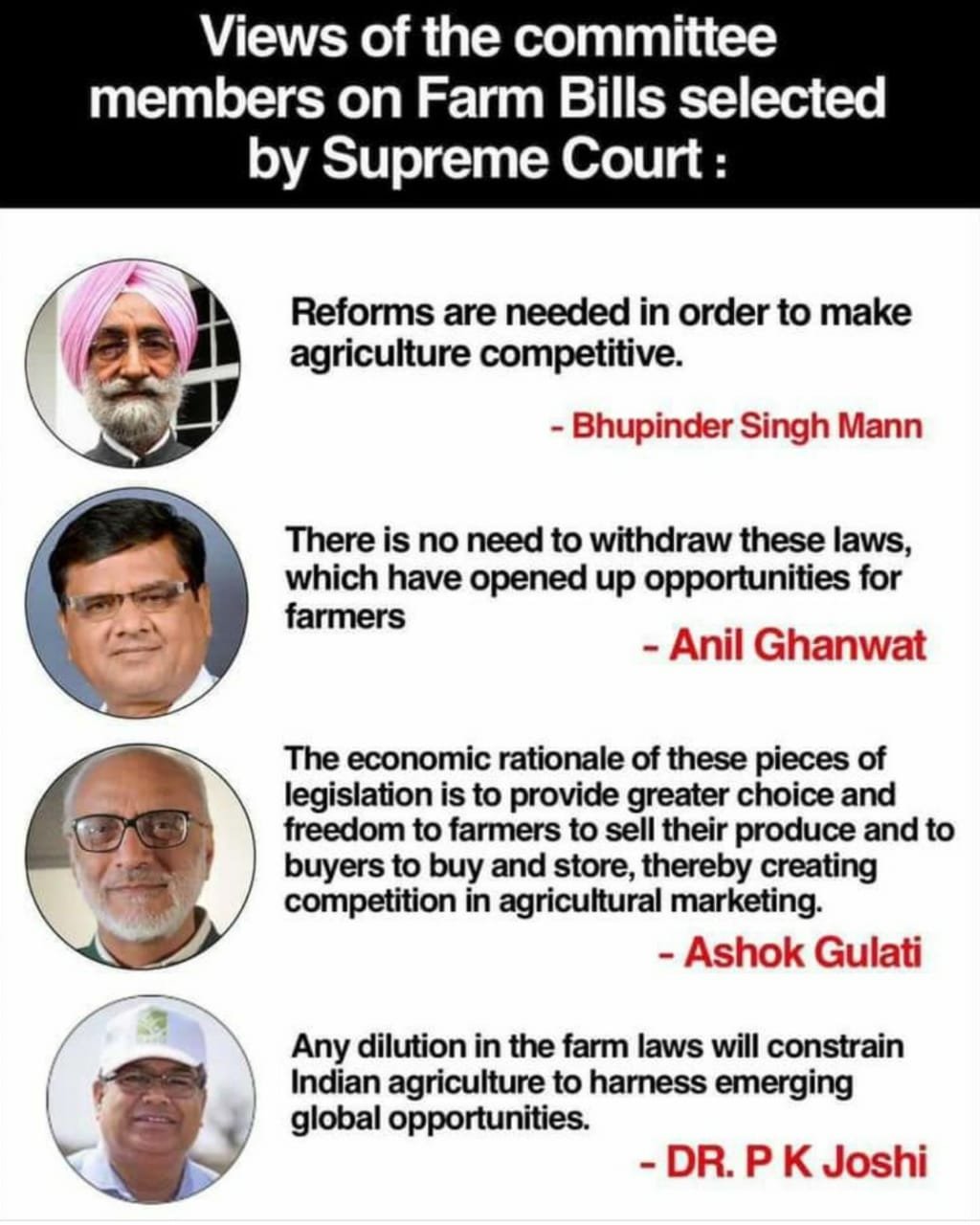
A look at the credentials of the four committee members meanwhile reveals they are all in favour of the farm law implementation with some amendments.

Agricultural economist Ashok Gulati has been the most vocal supporter of deregulation of agriculture markets and has argued that the matter has been debated for years.

PK Joshi has written articles in past days regretting prolonged agitation by farmers and noting that the Centre had made all our efforts to accommodate genuine concerns of the protesters.

Joshi has also said that the agitators have been changing goalposts and had begun by seeking government assurance that the MSP won’t be discontinued. He has said the farmers later began seeking legal status for MSP and finally the repeal of laws altogether.

The two farm leaders on the panel—Bhupinder Singh Mann of the BKU and Anil Ghanwant of  Maharashtra based Shetkari Sangathan had in mid-December met Agriculture Minister NS Tomar and called for the implementation of the laws after bringing certain amendments to satisfy the protesters.

Agitation unions said their principal demand of farm law repeal cannot be addressed by a committee whose members favour the laws and are against the repeal.

PHOTO-2021-01-12-19-05-24

Supreme Court proceeding exactly as directed!
1. Yell at Govt to create false credibility.
2. Stay operation of laws to break up agitation.
3. Two days before Bobde’s retirement declare laws valid.
4. Farmers cannot reorganise themselves on this scale ever again.
5. Adani gets control of India’s food grains and Bobde gets Governorship or Rajya Sabha nomination.
6. Everybody lives happily ever after.

Supreme Court stays implementation of farm laws Top court forms four-member committee to hear farmers’ grievances against the laws

http://

Satya Prakash
Tribune News Service
New Delhi, January 12

A day after pulling up the Centre for its poor handling of farmers’ agitation, the Supreme Court on Tuesday stayed the implementation of the three farm laws being opposed by farmers who have blocked key entry points to Delhi since November 2020.

While staying the implementation of the Farmers (Empowerment & Protection) Agreement of Price Assurance & Farm Services Act 2020, Farmers Produce Trade & Commerce (Promotion & Facilitation) Act & Amendment to Essential Commodities Act, a Bench headed by CJI SA Bobde set up a four-member committee to hear the stakeholders and report back to it.

Those named as members of the committee are — National president of Bharatiya Kisan Union Bhupinder Singh Mann, Pramod Kumar Joshi (Director, South Asia international Food Policy), Agricultural Economist Ashok Gulati and Shetkari Sanghatana leader Anil Ghanwat.


Also read: 3 more protesting farmers die at Tikri border

Farmer leaders welcome SC verdict, but say protest to continue

Farmers’ agitation has been fearless: Filmmaker Gurvinder Singh

Opposition parties get behind farmers, want farm bills repealed


“We are going to suspend the implementation of the three farm laws until further orders,” the top court said while setting up the committee.

A detailed order will be released later on the court’s website.

“We believe in the committee and we are going to constitute it. This committee will be the part of judicial proceedings,” it said, adding it did not want to hear that farmers were unwilling to go to the committee.

“We are looking to solve the problem. If you want to agitate indefinitely, you can. Every person who is genuinely interested in solving the problem is expected to go before the Committee. The Committee will not punish you or pass any orders. It will submit a report to us. We are going to take the opinion of the organisations. We are forming the Committee so that we have a clearer picture,” the CJI said.

The Bench said it shall protect farmers’ land, but the farmers should agree to participate in the proceedings before the committee.

“We are concerned only about the validity of the laws and also about protecting the life and property of citizens affected by protests. We are trying to solve the problem in accordance with the powers we have,” it said.

The Bench turned down farmers’ demand that the prime minister himself should approach them to hold negotiations.

“We cannot ask the Prime Minister… He is not a party here,” the CJI said even as Government side told the court that the Agriculture Minister had been a part of the negotiations.

Pulling up the government for poor handling of farmers’ agitation against farm laws, the Supreme Court had on Monday had made it clear that it intended to stay the implementation of the contentious laws and set up a committee to find an amicable solution to the problem.

“We are extremely disappointed with the way the government is handling the issue. Last four times you said negotiations are on. What negotiations are you talking about? If you have some sense of responsibility, and if you say you will withhold the implementation of laws, we will form a committee to decide,” a three-judge Bench headed CJI Bobde had told Attorney General KK Venugopal.


Will not appear before SC-appointed panel; protest is for indefinite time: Farmer unions Say will go in meeting with govt on January 15

Will not appear before SC-appointed panel; protest is for indefinite time: Farmer unions

Photo for representation purposes. PTI file

Tribune News Service

New Delhi, January 12

Stating that they will not appear before the Supreme Court-appointed committee, farmers’ unions have claimed that members of the said panel are pro-government.

“Members of SC panel are not dependable as they have been writing on how agriculture laws are pro-farmer,” Farmer unions added.

Supreme Court can repeal the farm laws suo motu, they told a press conference.

“We never demanded from SC to form a committee, the government is behind all this,” said farmer leader Balbeer Singh Rajewal on the panel formed by court.

“Our protest will continue and it is for indefinite time.” The tractor march in Delhi on January 26 will be peaceful, they added.

“We will go in meeting with the Centre on January 15,” the unions said.

Earlier, farmer leaders welcomed the Supreme Court’s order to stay the implementation of three farm laws on Tuesday, but said they would not call off their protest until the legislations are repealed.

The Sanyukt Kisan Morcha, an umbrella body of around 40 protesting farmer unions, has called a meeting later in the day to decide the next course of action.

The farmer leaders said they are not willing to participate in any proceedings before a committee appointed by the Supreme Court, but a formal decision on this will be taken by the Morcha.

“We welcome the court’s order to stay the implementation of the farm laws, but we want a complete repeal of these laws,” Abhimanyu Kohar, a senior leader of the Morcha, told PTI.


Also read:

Supreme Court stays implementation of farm laws

3 more protesting farmers die at Tikri border

Farmers’ agitation has been fearless: Filmmaker Gurvinder Singh

Opposition parties get behind farmers, want farm bills repealed


Another farmer leader, Harinder Lokhwal, said the protest would continue until the contentious farm laws are repealed.

The Supreme Court stayed the implementation of the controversial farm laws till further orders on Tuesday and decided to set up a committee to resolve the impasse between the Centre and the farmers’ unions protesting at Delhi’s borders over the legislations.

A bench headed by Chief Justice SA Bobde said it would pass an order to this effect.

The committee will look into the farmers’ grievances against the three laws.

Thousands of farmers, mostly from Haryana and Punjab, have been protesting at several border points of Delhi since November 28 last year, demanding a repeal of the three laws and a legal guarantee on the minimum support price for their crops.

In a statement, the All India Kisan Sangharsh Coordination Committee noted that the court was not inclined to pass any orders on the ongoing protests with regard to vacating farmers from the Delhi borders and welcomed the same.

Suspending the implementation of the laws as an interim measure is welcome but is not a solution and the farmer unions have not been asking for this solution, given the fact that the implementation can be reinstated at any time. The government must withdraw. It must understand that farmers and people of India are opposed to the laws, it said in a statement.

Farmer unions reiterate the fact that they will not participate in any court-ordered committee process further, one of their apprehensions about such a process got validated in the very constitution of the committee. It is clear that the court is being misguided by various forces even in its constitution of a committee. These are people who are known for their support to the three Acts and have actively advocated for the same. — With PTI inputs




Farm laws on hold Panel composition thwarts forward movement

Farm laws on hold

Photo for representation only. – File photo

By putting on hold the implementation of the three controversial farm laws until further orders, the Supreme Court has said it is trying to solve the problem in the best way. There is little room to disagree, considering the deadlock and unlikelihood of any forward movement in the talks between the Centre and the protesting farmers. The unions’ immediate reaction not to back down from their demand of the repeal of laws is not surprising. A month-and-a-half of a peaceful, organised protest in extreme conditions, riding on popular sentiment and support, lends strength to the conviction of purpose. But opting for a point of no return and a prolonged holdout — by the government and the protesters — cannot be seen as a prudent stand. As Chief Justice Bobde observed, ‘These are matters of life and death. We are concerned with laws. We are concerned with lives and property of people affected by the agitation.’

The court’s intervention lends an opportunity to come out with possible solutions which both sides can agree not to disagree on, but questions are bound to be raised over the composition of the committee if the perception is that all the four members support the new laws. Only a suitable mix would make the discussions meaningful and lend weight to it being a forum for a frank and open discussion. If the opposition is to the manner and intent of the reform proposed and not the idea of reform itself, there is merit in bringing forth articulate, informed depositions on the pros and cons, the apprehensions, the distrust. Much of the onus lies on the government. It has to show its willingness to new proposals and assurances that the farmers cannot do without.


Keeping in view the proposed protest march in the Capital on Republic Day, a notice has been issued to the unions on a Delhi Police plea to stop their tractor rally during the January 26 parade. The fervent hope is that the need for such a protest does not arise.