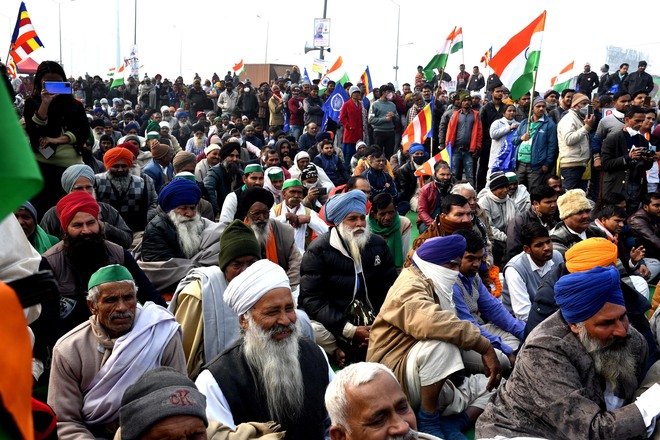
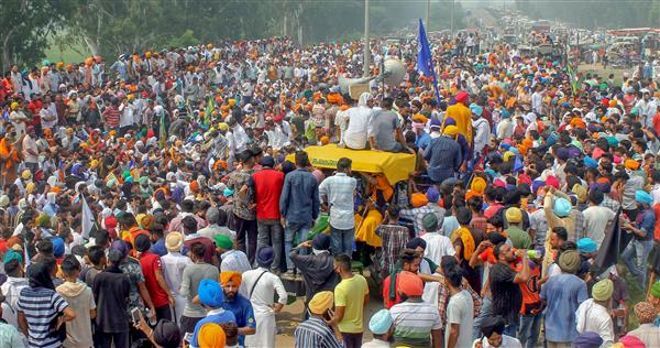
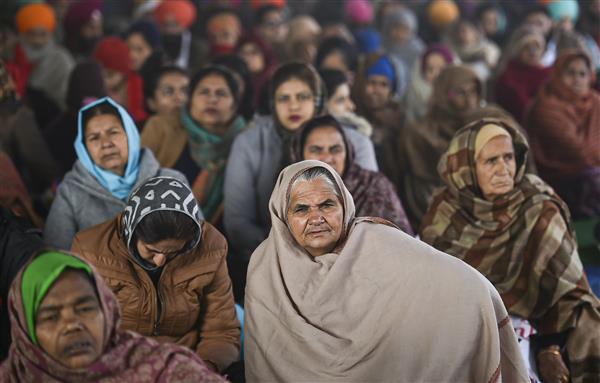
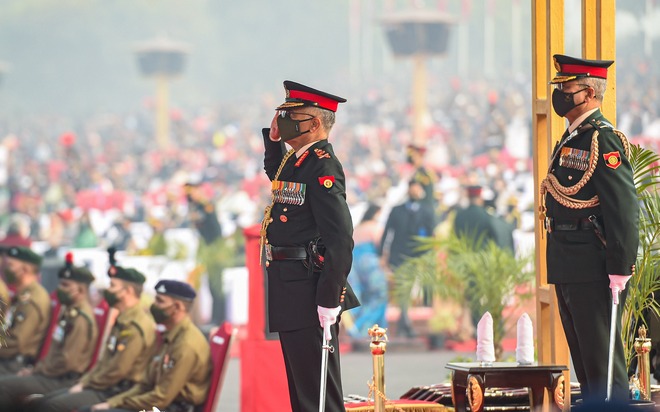
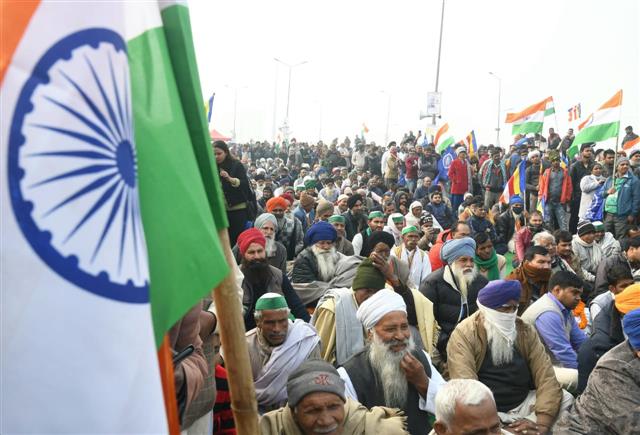
Farmers and their supporters during their ongoing protest against the new farm laws, at Singhu border in New Delhi. PTI Photo
Tribune News Service
New Delhi, January 12
The Opposition parties have once again reiterated that the three farm acts should be repealed and a special Parliament session called to discuss the whole gamut of agrarian issues.


Leaders from the Congress, the TMC, the RJD, the CPI (M), the CPI and the Forward Bloc put forward these views while taking part in the ‘Special Kisan Session’ of the Janta Parliament, which was moderated by leading activist P Sainath.
“It is very clear that these farm laws are not for the welfare of our kisans. These are meant for profiteering of the corporates,” CPI (M) general secretary Sitaram Yechury said.
“We have said on a number of occasions that these laws have to be repealed and a legislation be brought to ensure the MSP. However, without a guarantee of procurement, the MSP will not be helpful. Only 6 per cent of farmers get the benefit of MSP in the country, MSP has to cover every farmer and every crop until that happens legislation will not be effective,” Yechury added.
Prominent politicians who took part in the discussion were K Raju and Rajeev Gowda (Congress), D Raja (CPI), Sukhendu Sekhar Roy (TMC), Dipankar Bhattacharya (CPI-ML) Ghanshyam Tiwari (SP) and G Devarajan (Forward Bloc).
Throwing the party’s weight behind farmer agitation, RJD MP and spokesperson Manoj Jha said that the opposition parties have not done enough to support the cause.
“I have no qualms in accepting that opposition parties have not come out of their comfort zone. We have not done our bit,” Jha said.
“We believe that a special session in Parliament will not help if it is bereft of debate. There has to be a difference between monologue, which this government is so fond of and a dialogue amongst colleagues. So we want a special session to discuss the farm issues and later on it should be sent to a select committee,” he added.
US planned to assist India against China after Doklam’ Declassified document says US to offer India military, intelligence support against China
In a classified document made public after just two years, the US said its Indo-Pacific strategy had a “particular focus” on India. The objective was to accelerate India’s rise by building stronger defence ties and also by offering diplomatic, military and intelligence support to help address continental challenges such as the border dispute with China.


In other words, the US had taken a strategic decision to build an alliance with India against China in 2018, when the document was prepared. This happened a year after the India-China confrontation in Doklam and two years before both armies clashed violently in eastern Ladakh in mid-2020.
The 10-page document, which explains the need to align US’ Indo-Pacific strategy with those of Australia, India and Japan, was released surprisingly early rather than after 30 years. Partly redacted, it sets out the Trump administration’s strategy for Indo-Pacific that was developed by the US National Security Council.
The four members of the Quad – India, Australia, Japan and the US – had elevated their discussions to the level of Foreign Ministers in 2019, a year after the US had prepared the document followed by a second ministerial in Tokyo last year.
The military part of the strategy sets out three aims – (i) deny China sustained air and sea dominance inside the first island chain in a conflict; (ii) defend the first-island-chain nations, including Taiwan; and (iii) dominate all domains outside the first-island-chain.
The change of classification of the document in the last week of the Trump administration is a “gesture of reassurance to the United States alliance partners, including Australia, that we are not fading away but doubling down in the Indo-Pacific” and the language is likely to be seen to confirm to Beijing its claim that the US is seeking to contain China,” said reports quoting US sources.
“It is highly classified, secret, not for release to foreign nationals, and I think it is a signal about the kind of continuity that the permanent government of America, if you like, the officials, want to see in America’s relations with the Indo-Pacific, including in managing Chinese power,” said Australian National University’s Rory Medcalf, a consistently strong proponent of the Quad since his days with the Lowey Institute.
“This is very clear code for America holding its ground with Taiwan, with partners and allies in the South China Sea, with Japan, with Korea – really maintaining the integrity of those relationships and protecting them from Chinese assertiveness, from Chinese aggression,” he added.
Air Chief Marshal R.K.S. Bhadauria with IAF personnel in Ladakh on 11 January 2021 | Twitter/@IAF_MCC
New Delhi: Air Chief Marshal RKS Bhadauria on Monday visited the strategically located Daulat Beg Oldie, Thoise and Nyoma advanced landing strips in Ladakh and undertook a comprehensive review of the IAF’s preparedness in the region in view of the eight-month-long border standoff between India and China, officials said.
The Chief of Air Staff interacted with field commanders and was briefed on the operational readiness as well as the status of deployment of forces at the high-altitude airbases, they said.
The Daulat Beg Oldi Advanced Landing Ground (ALG) is located close to the Line of Actual Control (LAC) at an altitude of 16,700 ft and is known as the highest airfield in the world. The Nyoma airfield is located at a height of around 13,000 feet.
Air Chief Marshal Bhadauria also interacted with Indian Army personnel deployed at these locations, they added.
“During his visit to Thoise, he reviewed the ongoing logistic operations for support and sustenance of troops in the winter season,” the IAF said in a statement
It said he also visited Daulat Beg Oldie and Nyoma ALGs where he was given a security overview.
At Daulat Beg Oldie, Air Chief Marshal Bhadauria laid a wreath in honour of the fallen heroes.
Prior to his departure, the Chief of Air Staff joined Chief of Defence Staff Gen Bipin Rawat for a comprehensive discussion on operational matters with senior IAF and Indian Army Commanders at Leh air force station, the IAF said.
“The Chief of Air Staff conveyed his deep appreciation for the exceptionally high levels of morale and dedication with which all personnel continue to maintain operational preparedness despite the harsh weather and an inhospitable terrain,” it said.
The Army and the Indian Air Force (IAF) have been maintaining a high state of operational readiness along the nearly 3,500-km LAC with China in view of the eastern Ladakh row.
Nearly 50,000 troops of the Indian Army are deployed in various locations in eastern Ladakh as multiple rounds of talks between the two sides have not yielded concrete outcome to resolve the faceoff that began in early May.
China has also deployed an equal number of troops, according to officials.
The eighth and last round of military talks had taken place on November 6, during which both sides broadly discussed the disengagement of troops from specific friction points.
Last month, Chief of Army Staff Gen MM Naravane too had visited eastern Ladakh to review the ground situation in the region that has been experiencing harsh winter.
The faceoff began on May 5 last year following violent clashes between the two armies in the Pangong lake area. The incident in Pangong Tso was followed by a similar incident in north Sikkim on May 9.
Representational image. A file photo of the cantonment in Agra. | Photo: ANI
New Delhi: The Army has put on hold the monetisation of defence land, given that real estate prices have dropped due to the coronavirus pandemic, and will move ahead as soon as the situation improves, Army chief General M.M. Naravane said Tuesday.
Describing the land monetisation plan as a good way to beat the budgetary constraints, the general said the step will help all three armed forces and not just the Army.
Speaking at the annual press conference ahead of Army Day, Gen. Naravane also hoped that the armed forces will get additional money to go ahead with modernisation plans in light of the continuing stand-off with China in Eastern Ladakh.
“As far as land monetisation is concerned, there has been a lot of progress. We have got permission for equal value infrastructure. We will go ahead with the monetisation of land. But because there is a Covid situation, land prices have also fallen. Hence, we are waiting. As the situation improves, we will move it forward,” he said.
In October 2020, the Narendra Modi government paved the way for a number of stalled public projects to take off by approving new rules that allow equal value infrastructure (EVI) development for armed forces in lieu of the land procured from them.
Under the new rules, eight EVI projects have been identified, which the acquiring party can provide infrastructure for in coordination with the service concerned.
The Ministry of Defence is the biggest land-owner in the country and, according to the Directorate General, Defence Estates, the ministry has about 17.95 lakh acres of which about 16.35 lakh acres are outside the 62 cantonments in the country.
Gen. Naravane said the new scheme is an important step and will be good for the three services since unused land like old camping ground and land belonging to now-dismantled military farms can be traded for creation of EVI.
“A lot of budgetary constraints will also go away,” he said.
The Army chief said that the force works according to the long-term integrated plans.
“Depending on the situation and budgetary allocations, these priorities keep changing. And we make whatever changes that need to be made on the modernisation plans,” he said.
He noted that while all ministries were told that instead of 25 per cent expenditure every quarter, only 20 per cent had to be spent, no restrictions were placed on the defence ministry.
“We are hopeful that at the Revised Estimates stage, and have full belief, that we will get, especially in revenue expenditure, more funds so that the more work that needs to be done is completed,” he said.
Gen M.M. Naravane questions the sample size of the study by tri-services think tank USI that said over half of the over 13-lakh-Army personnel ‘seems to be under severe stress’.
File photo of Army Chief General M.M. Naravane at Leh to review security situation and operational preparedness along the Line of Actual Control in Eastern Ladakh | Photo: Twitter | @adgpi
New Delhi: Army chief General M.M. Naravane Tuesday junked a study published by the tri-services think tank United Service Institution of India (USI), which said more than half of the over 13-lakh-strong Indian Army personnel seem to be “under severe stress”.
Asked about the USI study that created a storm in the defence circles, but was taken down later, Naravane said in a lighter vein: “Even I am under stress.”
The Army chief questioned the report over sample size and representation.
“I have read this report. I will say that the sample size was only 400. And I understand this is not an adequate sample size. If you want a 99 per cent accuracy with 1 per cent margin of error, then for such a study, 19,000 samples should have been taken. And for 95 per cent accuracy, it will come down to 7,000-8,000 sample size,” he said.
Highlighting that a sample size of 400 can’t accurately assess the stress factor, he said, “Maybe there is stress. Even I am stressed. But stress is not always a bad thing. Stress can also result in good work”.
He added that the Army has taken a number of steps to address concerns over stress, and also issued multiple advisories.
“We have taken into consideration what all factors can be there. For example, somebody might not be able to produce children, someone might not be getting married, someone’s child is in 12th, it also leads to stress about whether he/she will pass or not and whether the child will get admission or not. Some are stressed about their child’s marriage,” said Naravane.
“We have analysed all these factors and keeping this in mind, the company commander and the commanding officer keep talking to people in that category and try for solutions,” he said.
The Army chief added that suicide cases in the force, according to his information, are falling on an annual basis. “My facts and figures are that suicide figures have actually (come) down year on year,” he said.
There have been over 1,100 cases of suicide among various ranks since 2010.
According to the USI study, the Army lost more personnel every year due to suicides, fratricides and untoward incidents than in response to enemy or terrorist activities.
The study — by a serving Colonel — and its summary was published on the think-tank’s website last month. However, it was removed on 8 January when it gained traction.
Some of the major organisational causes of stress among Army officers were identified as inadequacies in the quality of leadership, overburdened commitments, inadequate resources, frequent dislocations, lack of fairness and transparency in postings and promotions, insufficient accommodation and non-grant of leaves.
The main organisational stress factors, as perceived by Junior Commissioned Officers/Other Ranks, were delay and denial of leaves, excessive engagement, humiliation by seniors, lack of dignity, zero error syndrome, unreasonable restrictions on the use of mobile phones, poor quality of ration and cooked food, besides lack of recreational facilities and conflict with seniors as well as subordinates.
Army chief Gen.M.M. Naravane says situation in Northeast, especially Nagaland, has significantly improved, which could see more troops being pulled out from the region.
hief of Army Staff General M.M. Naravane during the inauguration of a new residential facility at Kohima Orphanage, in Kohima, Nagaland, in November 2020 | ANI File Photo
New Delhi: The Army is planning to gradually reduce the number of troops deployed for internal security duties in the Northeast, but is not contemplating moving soldiers out of Jammu and Kashmir because of the prevailing terror situation in the Union Territory, Army chief General M.M. Naravane said Tuesday.
Addressing the media ahead of Army Day on 15 January, General Naravane said that while terror continues unabated in J&K, the security situation in the Northeast has improved manifold. As a result, the Army has already pulled out one of its brigades from the region and now plans to move out another one or two in the near future.
With this, the Army will be able to concentrate on its primary duty of conventional war fighting, he said.
“As far as internal security duties are concerned, terror continues unabated in J&K, although the situation in the hinterland has improved somewhat. We have not yet reached a level where we can contemplate moving troops out of the UT of J&K,” he said.
He added that the security situation in the Northeast has improved.
Now, concerns remain only in three districts of Arunachal Pradesh. In Nagaland, the Army chief said he hopes the National Socialist Council of Nagaland-S.S. Khaplang (NSCN-K), which is not part of the ceasefire agreement, will rejoin the ceasefire process with the surrender of its top leadership, making the state violence-free again.
He added that there is no violence in Mizoram, only one or two groups are involved in Manipur, and most of Assam is quiet.
This is not the first time that the Army chief has spoken about withdrawing troops from the Northeast.
In January last year, while interacting with a small group of journalists, he said the region was going through a transitional phase and the Army had drawn up a plan to increasingly withdraw troops deployed there for counter-insurgency and counter-terrorism operations.
He had then said two battalions of troops, or around 2,000 soldiers, have already been withdrawn from the Northeast and the same could be replicated in Kashmir in the future given that the long-term focus of the Army remains conventional war-fighting, as against the short-term and immediate goals of being involved in counter-insurgency and counter-terrorism operations.
General Naravane said the overall situation in the Northeast has improved by leaps and bounds for the last one or two years, both due to the efforts of the security forces (the Army, the Assam Rifles and the state police forces) as well as various initiatives taken by the government.
“As a result of this, we have carried out reassessment of our commitment in internal security and one brigade has already been pulled out,” he said.
He added that the Army was awaiting the successful conclusion of the Bodoland Territorial Council election, which was held in December 2020.
“Once that stabilises, we will be able to pull out further — at least one or two more brigades, and with that, hand over the law and order situation to the state police apparatus and other CAPFs,” he said, adding that the Army will then be able to concentrate fully on its primary task, which is to deal with external threats.
He, however, mentioned that certain emergent requirements keep coming up, especially in aid to civil authorities and Humanitarian Assistance and Disaster Relief (HADR) operations, for which the Army has to step up and be available. He cited the recent example of a forest fire in Dzukou range in Nagaland.
Coming out in support of protesting farmers, US-based NRI and social worker Darshan Singh Dhaliwal has sent many trailers of dry ration to Delhi borders. File photo
Patiala, January 11
Coming out in support of protesting farmers, US-based NRI and social worker Darshan Singh Dhaliwal has sent many trailers of dry ration to Delhi borders.
Hailing from Patiala, Singh said farmers needed the support to continue the ongoing protest against the farm laws. “Every time, people of Punjab face a problem, we have always come out in support. This time also, we have sent dry ration for farmers protesting at Delhi borders,” Dhaliwal said. He said he himself would be protesting at Delhi borders along with the farmers. Meanwhile, Akali Dal leaders said they had erected waterproof tents for the farmers so that they did not face any problems during the protest. — TNS
Cyclothon marks golden jubilee year of Indo-Pak war
With the 1971 Indo-Pak war entering its golden jubilee in 2021, the Army, along with the BSF, organised a programme, as a part of the ongoing ‘Swarn Vijay Varsh’ to celebrate India’s victory over Pakistan.
Besides, honouring the war veterans and kin of martyrs at the Punjab State War Memorial and Museum, a cyclothon was also flagged off by BSF DIG Bhuphinder Singh. Officers, as well as children of the Army and the BSF officers participated in the cyclothon, from the Attari border to the war memorial.
Seven 1971 war heroes and the next of kin of the martyrs joined the wreath laying ceremony.
Major General Raju Baijal, recipient of the Sena Medal, said the event also marked the formation of East Pakistan as the new nation of Bangladesh. “The occasion marked the brave deeds of our soldiers who sacrifised their lives in the service of the nation,” he said.
Col HP Singh (retired), general manager of the memorial, said, “The memorial is the apt place to pay tributes to the soldiers of the war. An original Patton tank that was captured from Pakistan forces is also stationed here, and there is a full-fledged gallery erected at the memorial,” he said.
Brigadier Joginder Singh Jaswal (retired), recipient of the Vir Chakra and the Sena Medal, who was a part of the 1971 squad, also showed solidarity with the farmers, who were protesting against the farm laws.
“Constitutional dictatorship is prevailing at the Centre, worse than that at the time of the Emergency during the regime of Indira Gandhi. The farmers have been braving the adverse weather conditions. The former servicemen too face discrimination. They have been fighting to get one rank-one pension (OROP) for the past five years, but in vain. Similarly, many facilities given to the veterans have also been withdrawn. Taxes have been imposed on canteen facility,” he said.
Time for breakthrough Leave it to states to accept, modify or even reject farm laws
Nothing is gained any longer from weighing the rights and wrongs of the farm laws; it is time for a breakthrough. The losses to Punjab, Haryana, western Uttar Pradesh and private and government enterprises like the railways are mounting day by painful day. Punjab Government officials claim that the state could have incurred a loss of Rs 4,500 crore during the ongoing agitation. The loss of lives (60, according to certain accounts) among the agitators in the coldest months of this particularly harsh winter; the three who have committed suicide; and those elderly who brave the elements are all pointers to the human suffering involved in the agitation. Equally miserable are those whose lives and livelihoods have been disrupted due to the blockade. Thursday’s tractor march on the Kundli- Manesar-Palwal Expressway forewarnsof Delhi being cut off from Punjab, Haryana, Chandigarh, parts of Himachal Pradesh and western Uttar Pradesh. This is a crisis and the government is badly mistaken if it plans to wear the farmers out. That is no plan.
The meeting of Baba Lakha Singh of Nanaksar Gurdwara with Agriculture Minister Narendra Tomar is a welcome move. The Baba says he has been serving the protesters langar at the Delhi border and knew the fellow priest from Karnal of the Nanaksar sect, who took his life to express solidarity with the farmers. The BJP’s Kisan Morcha seeking out the Akal Takht Jathedar, its religious symbolism notwithstanding, is a promising signal because the Centre ought to pause and let the state governments decide whether they want to notify the farm laws and implement them. Agriculture is a state subject and it should remain so. The Centre has a responsibility to give direction and to push the nation towards prosperity by framing model laws on state subjects; but then it should leave it to the people, particularly the state governments, to accept, modify or even reject the proposals.
A well-intentioned proposal will surely get the people’s acceptance in due course of time. Meanwhile, good governance is all about finding solutions, however intractable the situation is. Let there be governance.
Amshipora encounter case: Army says it has no system of cash rewards for its personnel
The Army on Monday denied that its captain, who is facing the allegation of a fake encounter in Amshipora, was “driven” by a Rs 20-lakh reward for killing terrorists, saying there was no system of cash rewards for its personnel for any acts in combat situations or otherwise in the line of duty.
The brief statement was released by Srinagar-based defence spokesperson Col Rajesh Kalia.
“There are media reports quoting that Amshipora encounter actions were driven by a Rs 20 lakh award for the killing of terrorists. It is clarified that the Indian Army has no system of cash awards for its personnel for any acts in combat situations or otherwise in the line of duty,” the statement said.
It said the reports are “not based on facts of the processes internal to Indian Army”.
Three youths, who were dubbed as terrorists, were killed in the alleged fake encounter in July last year.
However, the Special Investigation Team constituted by the Jammu and Kashmir police to probe the incident stated in its charge sheet that “by staging the encounter” the accused Capt. Bhoopinder Singh and two other civilians—Tabash Nazir and Bilal Ahmed Lone—also “purposefully destroyed evidence of the real crime that they have committed and also have been purposefully projecting false information as part of a criminal conspiracy hatched between them with the motive to grab prize money of Rs 20 lakh”.
The army had ordered a Court of Inquiry into the incident.
The charge sheet was filed by the police before Chief Judicial Magistrate Shopian on December 26, 2020. PTI
State Stalwarts
DEFENCES FORCES RANKS
ARMY, NAVY, AIRFORCE RANKS
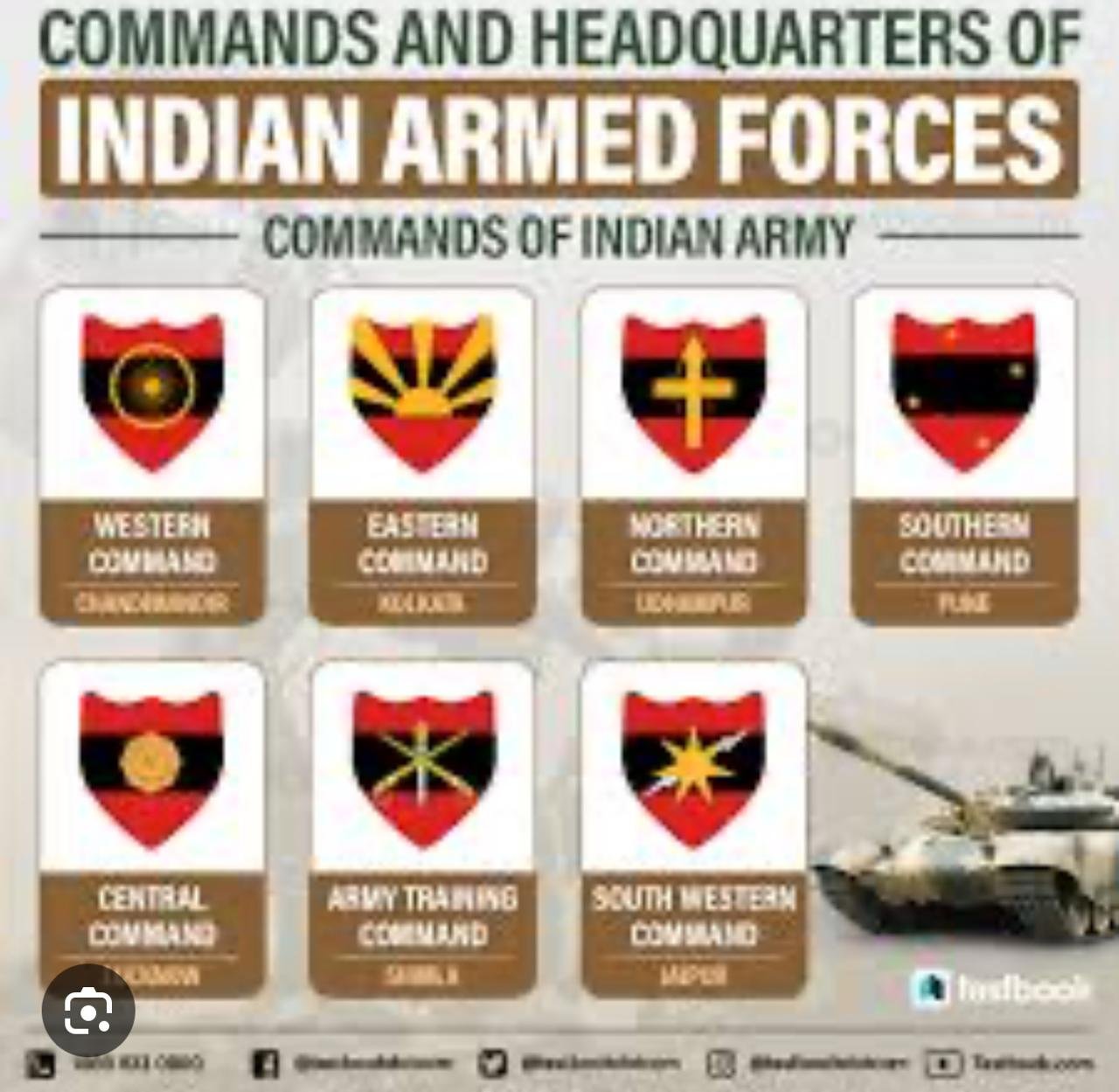
FORMATION SIGNS
FORMATION SIGNS
ALL HUMANS ARE ONE CREATED BY GOD
HINDUS,MUSLIMS,SIKHS.ISAI SAB HAI BHAI BHAI
CHIEF PATRON ALL INDIA SANJHA MORCHA
LT GEN JASBIR SINGH DHALIWAL, DOGRA
SENIOR PATRON ALL INDIA SANJHA MORCHA
MAJOR GEN HARVIJAY SINGH, SENA MEDAL ,corps of signals
.
.
PATRON ALL INDIA SANJHA MORCHA
MAJ GEN RAMINDER GORAYA , CORPS OF
sanjhamorcha303@gmail.com
PRESIDENT HARAYANA STATE CUM COORDINATOR ESM
BRIG DALJIT THUKRAL ,BENGAL SAPPERS
PRESIDENT TRICITY
COL B S BRAR (BHUPI BRAR)
PRESIDENT CHANDIGARH ZONE
COL SHANJIT SINGH BHULLAR
.
.
PRESIDENT PANCHKULA ZONE AND ZIRAKPUR
COL SWARAN SINGH
PRESIDENT SAS NAGAR (MOHALI)
COL BALBIR SINGH , ARTY
INDIAN DEFENCE FORCES
DEFENCE FORCES INTEGRATED LOGO
FORCES FLAGS
15 Th PRESIDENT OF INDIA SUPREME COMMANDER ARMED FORCES
Droupadi Murmu
DEFENCE MINISTER
Minister Rajnath Singh
CHIEF OF DEFENCE STAFF (2nd)
General Anil Chauhan PVSM UYSM AVSM SM VSM
INDIAN FORCES CHIEFS
CHIEF OF ARMY STAFF(29th)
General Upendra Dwivedi, PVSM, AVSM (30 Jun 2024 to Till Date)