The company also shared a promo video of its K21-105 tank, which is classified as a medium tank South Korea’s Hanwha Defence is pushing a new combat vehicle with a 105mm turret mounted on its K21 chassis for the Indian Army Just last week, the Indian Army released Request for Information (RFI) to seek prospective vendors to procure around 350 light tanks in a phased manner under the Make in India initiative. Indian Army plans to procure versatile combat platforms, weighing less than 25 tons, to sharpen its edge in mountain warfare as they will be able to exploit the limited space available in mountainous terrains by way of enhanced mobility, thus providing additional firepower. The RFI dated April 22 and published on Friday stated that the Defence Ministry intends to procure a “new generation combat vehicle platform, approximately 350 Light Tanks in a phased manner, along with performance-based logistics, niche technologies, engineering support package, and other maintenance and training requirements.” “The last date of acceptance of receipt of response is June 18, 2021,” the RFI stated. One potential option could be a proposal from a South Korean company based on its K21-105 tank. Hanwha Defence says the vehicle has a 105mm turret mounted on a K21 infantry fighting vehicle chassis. It has strong firepower and manoeuvrability that enables the vehicle to perform a wider variety of tactical operations than main battle tanks. The company also shared a promo video of its K21-105 tank, which they are classified as a medium tank.
Bombs away from 44 Squadron: An IAF officer’s wartime lessons in innovation, courage and leadership
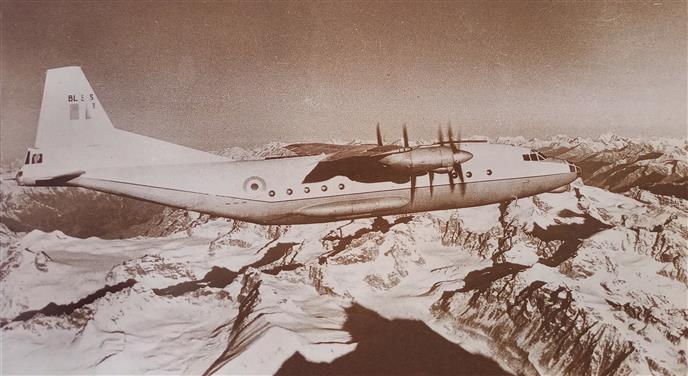
A file photo of An-12 aircraft flying over the Himalayas. Photo courtesy: Official IAF publication
Air Vice Marshal Arjun Subramaniam (Retd)
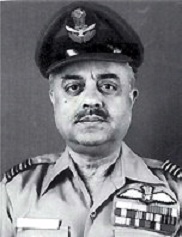
Wing Commander Vidya Bhushan Vashisht (later Air Vice Marshal), among the most experienced An-12 pilots in the IAF at the time, assumed command of 44 Squadron in August 1971 under trying circumstances. The squadron had just lost its commanding officer and an entire crew in an accident while practising a live bombing mission and restoring morale and getting the squadron battle-ready was uppermost in the mind of Vashisht. Thus, emerged the story of how an An-12 squadron under a dynamic commanding officer covered itself with glory in the Western Sector during the 1971 war. No stranger to 44 Squadron, having been the flight commander of the unit, Vashisht knew all the crew and personnel of the unit intimately. With an able and proactive flight commander, it did not take long before the squadron was ready for battle.
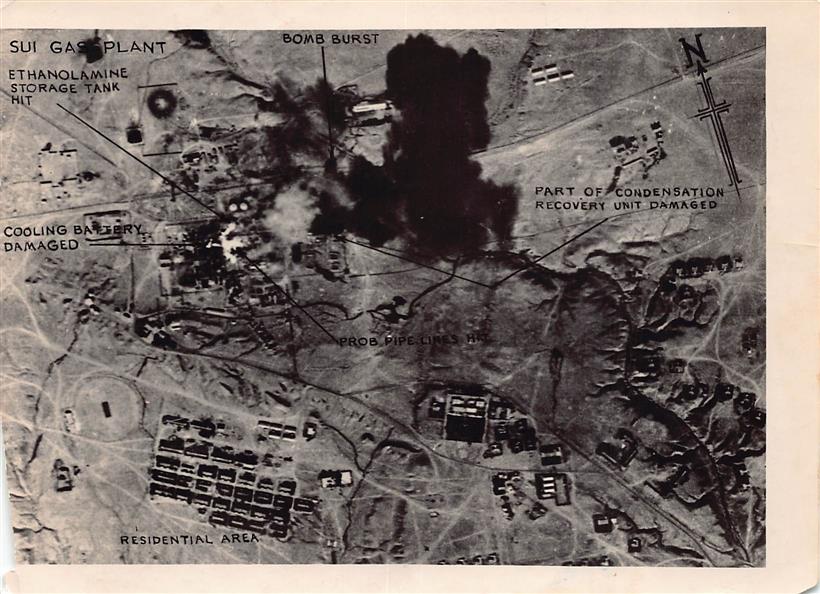
The Sui Gas Plant after the 44 Sqn raid on December 15, 1971. The gas plant was seen burning for several days after the raid.— Photo courtesy: Gp Capt Gursaran Ahluwalia
Honing its bombing skills and modifying the delivery platform with a bomb cradle for each 500 lb bomb, which was designed by an army officer, the squadron moved to Bareilly in Central Air Command a few days before the war commenced. With a maximum bomb load of 40 such bombs, a six-aircraft mission packed quite a punch of TNT. The IAF’s bomber force was concentrated between Bareilly, Agra and Gorakhpur to relieve the pressure on Western Air Command, a wise move as it allowed planners to centrally coordinate all bombing missions from one headquarters.
Wing Commander Vidya Bhushan Vashisht
Group Captain Gursaran Ahluwalia (then a squadron leader and flight commander of the squadron) had a ringside view of the transformation of the squadron into a feared bomber unit during the 1971 war, particularly on the Western Front. He recalls Vashisht as “a quiet and inspirational leader, an exceptional flyer, organiser and a coolheaded and kind person. I never saw him losing his nerve and he always had a pleasant smile on his face. He was exceptional in understanding the abilities of men under his command and had implicit faith in me as his No2 and left all the planning, briefings and debriefing to me.”
Vashisht led the opening night bombing missions over the Changa Manga Forest on the nights of December 3 and 4, 1971. Intelligence reports had indicated that the area had a large ammunition dump and large troop concentrations. Dropping his bomb load from low levels itself, Ahluwalia recollects that sky was lit up with the explosions and that both Pakistan Radio and Pakistani newspapers reported the raid and its effects the next day. Over the next two weeks, the squadron flew around 45 missions against a variety of targets that included a Pakistani artillery brigade at Haji Pir Pass that was harassing Indian operations, a divisional headquarters at Fort Abbas, the Sulaimanke Bridge, a railway yard at Hyderabad, the Sui Gas Plant and a cheeky day raid on Skarduair field with Canberra bombers on the last day of the conflict. By all reports, the night raid over Haji Pir and the day raid over Sui Gas Plant, also flown by Vashisht and Ahluwalia, proved to be the most effective of all. While the gas plant was seen to be burning for several days after the raid, the air and army chiefs personally rang up to congratulate the squadron for the successful Haji Pir raid.
While most of the raids comprised six aircraft, the Skardu airfield raid on December 12 involved only one An-12 acting as a pathfinder-cum-lead bomber for the Canberras. Without taking away any credit from the Canberras, the comfort levels of the An-12 squadron in flying over mountainous terrains prompted Central Air Command to assign Vashisht to lead the formation. Seeing their success in the west, the squadron was also assigned to target a large ammunition dump near Dacca on December 13, a mission that was led by Ahluwalia. Vashisht’s inspirational leadership and good teamwork ensured that no aircraft or crew were lost during the entire conflict, though Ahluwalia recollects three missions in which his aircraft was damaged by ground fire. He was even chased by a PAF Mirage-3 which had locked on to him and was probably seconds away from firing a missile. It was an alert IAF fighter controller, Sqn Ldr ML Bauntra, who saw this on the radar screen and yelled at Ahluwalia on the open channel to duck down to tree-top level, a warning that saved the aircraft and crew — such are bomber tales from 1971.
Describing the mission profiles with remarkable clarity, Ahluwalia recalls, “For the day raid on Sui Gas Plant, we flew from Bareilly to Jodhpur, refuelled there and then flew at 300 feet and got down to 100 feet approximately 150 miles from the border. A minute before the target and at speeds of slightly over 500 km/hr, we pulled up to 300 feet, dropped our bombs and got back to 100 feet till we entered Indian territory. For the Haji Pir night mission, we flew directly from Bareilly to Srinagar at 20,000 feet and descended to 6,000 feet over Srinagar airfield; we then navigated to Poonch airfield and further on to Haji Pir, returning via same route after bombing the Pakistani brigade.
The pilots were responsible for the accurate navigation to the target area, situational awareness and the evasive action to be taken to avoid ground fire or any ongoing aerial threat. The navigator assisted the pilots in the navigation as also used the improvised gun sight to decide the right moment to release the bombs before which the rear door was opened — the tail gunner and flight signaler would then come into action as they would first activate the fuses and then allow the cradles to slide out of the rear doors even as the pilots pitched up the nose and accelerated the aircraft for the bombs to fall under the force of gravity. While 44 Squadron has the distinction of being the first transport squadron to have been awarded with Battle Honours by the President of India, Squadron Leader Gursaran Ahluwalia and his navigator from the squadron, Flight Lieutenant PB Kalra were awarded Vir Chakras. Wing Commander Vidya Bhushan Vashisht was awarded the Maha Vir Chakra for his intrepid and daring leadership of 44 Squadron through the conflict. Excerpts from his citation reveal much:
“On the night of December 5, 1971, he led a formation of his bombers, this time to attack enemy positions in the Haji Pir Pass in Pakistan-occupied Kashmir. The difficulties and dangers of this operation were due as much to the great volume of ground fire in the target area, as to the hazards of flying his large aircraft and leading his formation at low level through mountainous terrain. Wing Commander Vashisht pressed home the attack and achieved marked success in hitting the enemy’s positions. In addition to these, he led many other missions deep into enemy territory where opposition could be expected from fighter aircraft and anti-aircraft fire. In all these raids Wing Commander Vashisht completed the tasks to him without any loss to our aircraft. He has displayed inspired leadership, exceptional devotion to duly, and conspicuous bravery in repeatedly leading attacks against heavily defended enemy targets, night after night.”
— The writer, a former fighter pilot and military historian, occupies the President’s Chair of Excellence at the National Defence College
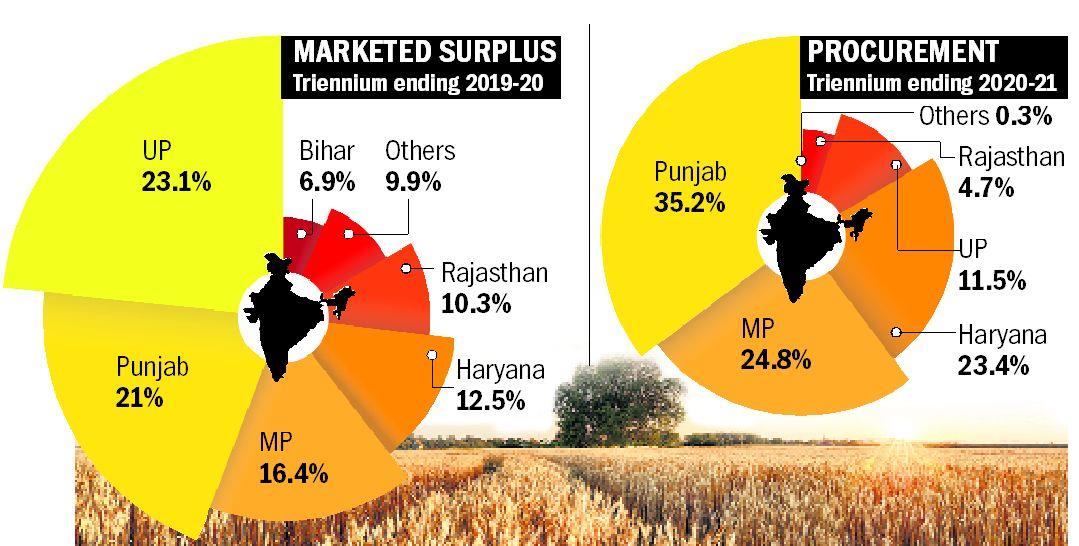
Share of Major States in Marketed Surplus and Procurement of Wheat
Sources: Directorate of Economics & Statistics, Ministry of Agriculture and Farmers’ Welfare; Food Corporation of India
RS Sidhu and BS Dhillon
PROMOTING a free market economy in agriculture in India has been a topic of debate since 1991 when reforms in the industrial and financial sectors were introduced. Then came the WTO agreement in 1995 to which India was one of the first signatories. Under this agreement, quantitative restrictions on agriculture trade were dismantled, bound tariff rates were negotiated for various crops and maximum level of agriculture subsidies were defined for developed and developing countries. It was argued that wide-scale reforms were required to unshackle growth in agriculture. Last year, the Union Government enacted three laws with the avowed aim of making agriculture markets more competitive for better harvest prices to farmers as they would be able to sell their produce outside the designated APMC markets to any buyer (processor, aggregator, bulk buyer, trader, FPO, etc.).
In the past 10 years, perception is being created that benefits of MSP and public procurement accrue largely to only 7-8 states, whereas in other states farmers face market forces and receive prices of their produce accordingly. Further, the narrative is being built that MSP has outlived its utility in the wake of an increase in foodgrain production in states other than Punjab and Haryana, and buffer stocks reaching as high as 80 million tonnes. The food subsidy bill is becoming burdensome, warranting public procurement to be curtailed, rationed and undertaken in the consuming areas itself in the name of rationalisation and cost-effectiveness. The MSP and public procurement system needs to be analysed for its role and benefits against the so-called free market economy in Indian agriculture being promoted through the Acts of 2020.
The Agriculture Prices Commission, now called Commission for Agricultural Costs and Prices (CACP), and the Food Corporation of India were established in 1965 to recommend the MSP of various crops and procure foodgrains for the public distribution system (PDS). During that period, India was facing severe food shortage and depended on food imports. The objectives of the MSP were to incentivise production through better and assured harvest prices, backed by assured marketing by the government, and making food available and accessible to poor consumers at low prices for overall national food security through PDS. Assured prices encouraged farmers to adopt new technologies in the form of improved seeds, chemical fertilisers and making private farm investments in irrigation (tubewells), tractors and other farm machinery. The government created market infrastructure under the APMC Act to handle the produce, facilitated tubewell connections and provided institutional loans at subsidised interest rates. Punjab, Haryana and a few other states adopted new technology and diverted land and other resources towards the production of foodgrains. Consequently, India not only became self-sufficient in food but also an exporter of rice and wheat. The policy also deliberately kept food prices low through MSP to protect the interests of consumers when improved technology had been leading to a substantial increase in agriculture productivity and production during the Green Revolution and thereafter.
Punjab was at the forefront to harness the potential of improved technology. Its foodgrain production increased from 33.9 lakh tonnes in 1965-66 to 306.9 lakh tonnes in 2019-20. Other irrigated regions also followed and benefited to the extent their agro-climatic conditions, natural resource endowments and infrastructure allowed. However, during this process, Punjab and other states overexploited their natural resources of land and water.
The MSP and public procurement system is effectively implemented for wheat and paddy in production-surplus states like Punjab. In states like UP, public procurement at MSP is limited, while Bihar represents the case of a free unregulated agriculture market where the APMC Act was abolished in 2006. Farm harvest prices were examined against MSP for paddy and wheat in these states. MSP was effectively realised by the farmers in Punjab, whereas wheat and paddy prices in the immediate harvest season were lower than the MSP in UP and Bihar. For instance, FHP (farm harvest price) was equal to MSP in Punjab, whereas it was lower by 7-14% (paddy) and 4-5% (wheat) in UP, and 20-25% (paddy) and 10-20% (wheat) in Bihar during 2013-18. It indicates the economic benefits of the presence of the public sector in buying operations. Further, freeing the agriculture markets from the APMC Act in Bihar did not result in better price discovery of the produce for farmers. Conversely, in Punjab, regulated markets ensured MSP to the farmers through public procurement and aggregation of produce at APMC markets as well as better market infrastructure.
The MSP is announced for 23 crops, but is received by the farmers for wheat and paddy in a few states due to economies of scale of procurement operations. In other states, market prices are lower than MSP. This raises many questions about the relevance of MSP. First, it defies the objective of MSP of providing economic incentive for production to farmers, covering the cost of production. It was implicitly presumed that higher demand than supply in deficit regions would result in higher market prices than MSP, which in reality is not happening, causing economic losses to farmers. Second, what is the logic of announcing MSP when it is not assured to the farmers?
Chalk and cheese
It is claimed that the new farm laws will create an alternative market set-up outside the APMC designated market place and improve marketing competitiveness for better price realisation. Producer-sellers are very large in number, poor, less educated or uneducated, unorganised and ignorant about the harsh outcomes of free market forces. On the other hand, buyers (traders and corporates) are relatively less in number, resourceful, better informed, well organised, equipped with demand and supply forces’ information and well connected for leveraging financial resources. MSP is still relevant for agricultural growth because output prices have an assumed primary role. The agriculture sector recorded 4% growth largely steered by prices during the 11th Five Year Plan. Higher prices raise income of farmers directly and subsequently help in the adoption of modern agricultural production technologies and practices for higher productivity. In large parts of the country, there are still large gaps in technology adoption due to deficiency of capital, which can be covered by raising profitability of the farming system. Agriculture engages about 50% of the workforce and ensures food security for the nation, thus the need to ensure livelihood security and better living conditions for farmers. Let the MSP be made mandatory for all transactions and the effect of higher agricultural prices be transmitted to consumers. Farmers have supported consumers through low food prices in the past and now it is the turn of consumers to support farmers. Poor consumers can be covered by expanding the food safety net, if needed, which will also help in bringing in demand-supply balance.
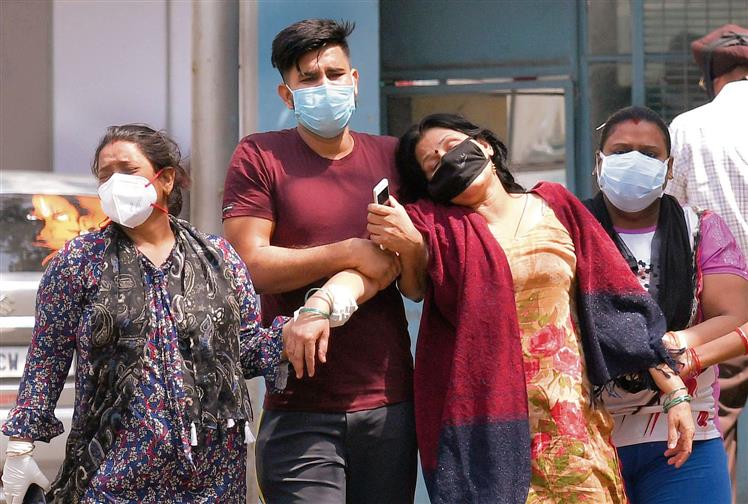
There could not be a better description of the Indian situation than the lament by the Delhi High Court on Friday: the State has failed to protect the most basic fundamental right, the right to life. The State, according to Article 12 of the Indian Constitution, includes the Central government, Parliament, the state governments, state legislatures and all local bodies; and what we witness now in Delhi and elsewhere is a total collapse of what has long been perceived as the State. The anguish of Justices Vipin Sanghi and Rekha Palli was prompted by the death of a petitioner who had sought an ICU bed in Delhi. He died gasping for oxygen.
The same day, in the suo motu hearing of the Covid crisis, the Supreme Court Bench of Justices DY Chandrachud, L Nageswara Rao and S Ravindra Bhat made several important observations and orders, which the Central government should immediately implement. The Bench has warned the state governments and their police forces not to trample on the right of desperate caregivers to air their anxieties or to call for help on social media. Certain state governments have been brazen enough to impose the National Security Act and incarcerate those who take on the government for its policies. This order invoking the contempt law should stop them in their tracks.
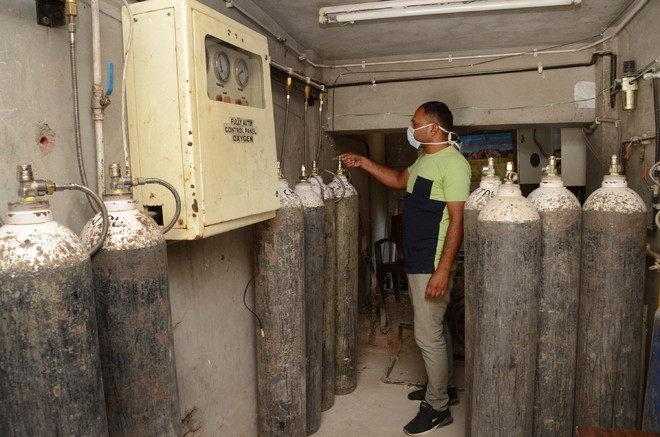
The Supreme Court has very pertinently asked the Central government why it is not following its own national immunisation policy and buying 100 per cent of the Covid vaccine doses. The court has rightly pointed out that pricing cannot be left to vaccine manufacturers, who cannot determine equity. Moreover, these manufacturers have received government funding, which needs to be accounted for. Most importantly, the Bench has asked the Centre to look at the possibility of importing Remdesivir from Bangladesh, which as a least developed country is allowed by the WTO agreement to produce patented drugs. Meanwhile, the government has to draw up a uniform policy on hospital admissions while ensuring hospital beds, oxygen cylinders and life-saving drugs. This is the last and final call to save the nation.
A soldier, posted in Baramulla district, shot himself on Sunday. Sources in the police said the soldier, identified as Parveen Kumar, used his service rifle to shot himself.
A police official said a case had been registered in connection with the incident. “Further investigation has been started to ascertain the reason behind his extreme step,” he added. — IANS
Vehicle ownership transfer: Road ministry notifies changes in motor vehicle rules
Now, owner can put the name of nominee at the time of registration of vehicle
Photo for representational purpose only. iStock
New Delhi, May 2
The Ministry of Road Transport and Highways has notified certain changes in the Central Motor Vehicles Rules, 1989, to facilitate the owner of a vehicle for nominating a person in the registration certificate, which would help the motor vehicle to be registered or transferred in the name of the nominee, in case of death of the owner.
Now, the owner can put the name of the nominee at the time of registration of the vehicles and can also add it later through an online application.
The process is otherwise cumbersome and non-uniform across the country.
According to the notified rules, the owner of a vehicle has to submit proof of the identity of the nominee, in case the nominee is mentioned.
“Where the owner of a motor vehicle dies, the person nominated by the vehicle owner in the certificate of registration or the person succeeding to the possession of the vehicle, as the case may be, may for a period of three months from the death of the owner of the motor vehicle, use the vehicle as if it has been transferred to him, Provided that such person has, within thirty days of the death of the owner, informed the registering authority of the occurrence of the death of the owner and of his own intention to use the vehicle,” the notification said.
It further said the nominee or person succeeding to the possession of the vehicle shall apply in Form 31 within the period of three months from the death of the owner of the motor vehicle, to the registering authority for the transfer of ownership of the vehicle in his name.
For change in nominee in case of contingencies like divorce or division of property, the owner may change the nomination with an agreed Standard Operating Procedure (SOP), it added.
Currently, in case of death of a registered owner of a vehicle, the procedure of transferring the vehicle to a nominee requires complying with a raft of procedures and frequent visits to different offices.
The Ministry of Road Transport and Highways on November 27, 2020, had proposed to amend the Central Motor Vehicles Rules, 1989, to facilitate the owner of a vehicle for nominating a person in the registration certificate.
The government “has invited suggestions and comments from public and all stakeholders on the proposed amendment…,” it had said.
Under the proposed amendment, “an additional clause is proposed to be inserted wherein ‘proof of identity of nominee, if any’ to enable the owner to nominate anyone to be the legal heir of the vehicle in case of death,” it had said.
For transferring the vehicle to the legal heir in case no nominee has been specified by the owner, it is proposed that an additional clause may be inserted to enable the owner to nominate a nominee.
In case where the nominee is already specified, the vehicle will be transferred in his/her name. PTI
Despite attempts by official agencies and pressure groups to evict them from a prime commercial area in Shillong, Sikhs are extending a helping hand to locals at the time of crisis. They have started an “oxygen langar” for locals at the city’s largest gurdwara.
“Though hospitals have been able to take care of oxygen requirements of Covid patients, we too have made arrangements to help during the crisis,” said Kamaljeet Singh Sehdave, Shillong-based dental surgeon who is secretary of Sri Guru Singh Sabha that oversees the running of the gurdwara.
Sehdave said they had made arrangements with dealers in Guwahati to supply oxygen cylinders and concentrators. While some cylinders and concentrators had arrived, more would soon come, he said.
Appreciating the Sikh community’s efforts, Patricia Mukhim, editor of the region’s English daily, wrote in a post on the Facebook, “the Sikh community of Shillong is the first to respond and come forward with this critical facility (oxygen langar) at these daunting times. And this is the only building they have. Will those other religious institutions with huge infrastructure please come forward and open similar facilities to help overcome the medical crisis should we ever come to such a point? What’s the use of all the big buildings if they are not used to serve humanity? Preparedness is wisdom. Thank you Guru Singh Sabha, Shillong”.
Notably, Sikhs living in Shillong’s Harijan Colony have been facing pressure from some Khasi outfits as well as from the Municipal Corporation to vacate their houses where they have been living for several generations.
Retiring SSC officers in Armed Forces Medical Services to get extension till Dec: Lt Gen Kanitkar
Around 200 such medical officers, who were to retire, will continue with their services
hoto for representation. — iStock
New Delhi, May 2
Around 200 Short Service Commission (SSC) officers with the Armed Forces Medical Services (AFMS), due for retirement over the next seven months, will get an extension till December 31 in view of the Covid-19 situation in the country, a senior Army officer said on Sunday.
Lt Gen (Dr) Madhuri Kanitkar, who is part of the medical team under the Chief of Defence Staff, said they will be deployed for Covid-19 management programme initiated by the armed forces.
“Short Service Commission officers of the AFMS who are retiring in the next seven months will be given a unilateral extension. So, we have around 200 such medical officers, who were to retire, we will continue to have their services.
“So, we are holding back these medical officers who would have otherwise left us,” Lt Gen Kanitkar, the Deputy Chief of Integrated Defence Staff (Medical) under the Chief of Defence Staff, told PTI here.
The orders for implementation of this plan are expected soon as the proposal is in advance stages of approval, said Lt Gen Kanitkar, the third women officer to have reached to the level of three-star general in the armed forces.
The other two were Punita Arora, who worked with the army and later shifted to the Navy, and Air Marshall Padma Bandopadhyay.
The SSC medical officers are granted commission in the armed forces for a tenure of five years which is extendable by another 5 years for those who are willing to continue subject to laid down eligibility criteria.
Lt Gen Kanitkar feels that the present Covid-19 crisis has taken every country back to the drawing board and rework their plans according to the age-old saying ‘health is wealth’.
“I think we need to ramp up basic primary health infrastructure. In this kind of pandemic even countries with the best of the infrastructures collapsed. If we look that way, we have performed much better during the first wave of the pandemic,” she said.
Among the host of services launched by the armed forces include starting a website ‘SeHAT’ (Services eHealth Assistance and Teleconsultation) to provide assistance to the families of armed forces as well as ex-service personnel.
Having served during the Kargil war in 1999, when she was posted to the Northern Command, Lt Gen Kanitkar feels that today the doctors are frontline workers while soldiers are helping the medical fraternity in fighting the pandemic.
In addition, those retired from AFMS have been advised to help in their respective localities and the local army commanders can be their facilitator.
“Already senior doctors including a retired Director General of Armed Forces Medical Services have started providing teleconsultation to needy as well as to the ex-servicemen,” she said.
State government hospitals would be provided with Nursing Assistants, who have retired from the service, she said.
“Some of the SSC medical officers, who have recently retired from the armed forces, may also be roped in on a voluntary basis and used for Covid-19 management,” she said. PTI
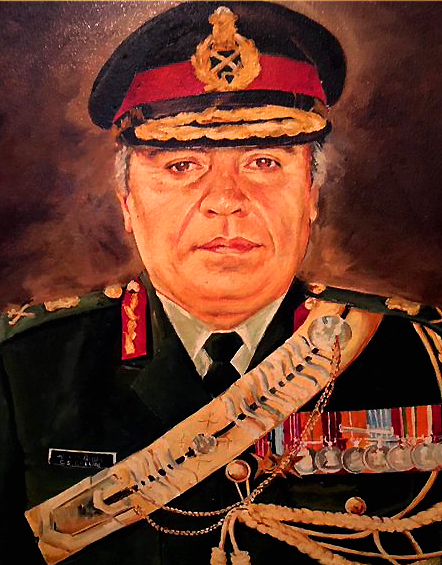
Former Western Command chief dies of COVID in Delhi
ortrait of Lt Gen GS Grewal displayed at Headquarters Western Command. Tribune photo
Tribune News Service Chandigarh, May 1
Former General Officer Commanding-in-Chief, Western Command, Lt Gen GS Grewal passed away at the Army’s Base Hospital in New Delhi on Saturday. He was 86 and had reportedly contracted COVID-19.
An Armoured Corps officer, he was commissioned into One Horse (Skinner’s Horse), one of the Army’s oldest cavalry regiment, which he had commanded. He served as the Western Army Commander from July 1, 1990 to July 31, 1992, during which he oversaw Operation Rakshak. the Army’s deployment for counter terrorism in Punjab.
Popularly known as “Goody Grewal” by his contemporaries, he was considered an outstanding commander in Army circles. He is survived by his 35-year old son, Simranjeet Singh. His wife had also passed away on April 13 this year.
SHERPA PURSUES ALLEGED CORRUPTION INQUIRY INTO INDIAN RAFALE ACQUISITION
by Pierre Tran Paris – Sherpa, a French non-governmental organization, said it filed April 28 a request for a judicial inquiry into alleged corruption on India’s acquisition of 36 Rafale fighter jets in a deal worth €7.8 billion ($9.4 billion). “Sherpa, represented by its lawyers William Bourdon and Vincent Brenghart, is filing a complaint and requesting the opening of a judicial investigation for corruption, favouritism and various financial offences likely to have occurred in the context of the sale of 36 combat aircraft produced by Dassault Aviation and sold to India in 2016,” the NGO said in a statement. The filing was in response to a lack of official action following Sherpa’s Oct. 26 2018 call for a French investigation into the pick of Reliance as the Indian industrial partner for Dassault, the anti-corruption office said. Reliance had little experience in the aeronautics industry, The French National Financial Prosecutor, in the wake of the 2018 filing, failed to conduct a full enquiry into the selection of Reliance, which was then in financial difficulty and was led by an executive close to the Indian prime minister, Sherpa said. Before the appointment of Reliance, Dassault had been in talks with state-owned Hindustan Aeronautics Ltd. (HAL) as local partner on a prospective deal for 126 Rafales. New Delhi in 2015 ditched the talks with Dassault and switched to a government-to-government order for 36 units. It was part of that €7.8 billion deal for 36 Rafales that India selected Reliance as local partner to Dassault. Apart from an informal interview with a Dassault lawyer, the French prosecutor’s office failed to conduct a detailed inquiry, and in June 2019 ruled “absence of an offence,” reported the website Mediapart, Sherpa said. Sherpa has worked on the case separately from Mediapart, a lawyer for the NGO said. Sherpa has conducted its own inquiry over the last two years, the NGO said, and the reporting of Mediapart pointed up a “passivity” of the French Anti-Corruption Agency, while there were suspicious payments, “hidden commissions” and the absence of anti-corruption clauses in weapons contracts. Mediapart reported that Dassault paid €1 million to Sushen Gupta, an Indian “middle man” who helped secure the Rafale contract. The French aircraft builder told the Anti-Corruption Agency the payment covered 50 reduced size models of the fighter, to be presented as gifts to customers in India. There was concern that the €1 million payment may have covered illegal commissions, and the excising of anti-corruption clauses from the Indian contracts may be related to that payment, Mediapart reported. The Indian authorities have conducted investigations on Gupta following corruption allegations on the 2010 sale of AgustaWestland helicopters. The Anti-Corruption Agency reported to two ministries — budget and justice — seen as placing the office under political pressure. There were flaws in a French anti-corruption system which gave “too much leeway for the implementation of internal procedures in companies to fight corruption,” Sherpa said. “The present case is an example of the failure of this approach, which relies on a convergence of the private interests of the company and those of the general interest that criminal law is supposed to protect,” Sandra Cossart, executive director of Sherpa, said in the statement. “Those latest revelations show to what extent the admissibility of associations to bring judicial actions before the courts is a central component of our democracy.” A Dassault spokesman declined to comment and referred to an April 8 company statement in response to the Mediapart reporting. Official organizations, including the French Anti-Corruption Agency, had conducted “numerous controls,” the Dassault statement said, and no violations were reported in the Indian contract for 36 Rafales. The company acted in strict compliance with the OECD anti-bribery convention and in line with national laws, particularly the French law known as Sapin-2, adopted Dec. 9, 2016, the company said. “Since the early 2000s, Dassault Aviation has implemented strict internal procedures to prevent corruption, guaranteeing the integrity, ethics and reputation of the company in its industrial and commercial relations,” the company said. “In the context of the Sapin-2 law, the company has completed and strengthened its system for the prevention and detection of corruption and influence peddling, both at the level of the parent company and its subsidiaries.”
State Stalwarts
DEFENCE MINISTER
Minister Rajnath Singh
ALL HUMANS ARE ONE CREATED BY GOD
HINDUS,MUSLIMS,SIKHS.ISAI SAB HAI BHAI BHAI
CHIEF PATRON ALL INDIA SANJHA MORCHA
LT GEN JASBIR SINGH DHALIWAL, DOGRA
SENIOR PATRON ALL INDIA SANJHA MORCHA
MAJOR GEN HARVIJAY SINGH, SENA MEDAL ,corps of signals
.
.
PATRON ALL INDIA SANJHA MORCHA
MAJ GEN RAMINDER GURAYA ,MADRAS REGIMENT
sanjhamorcha303@gmail.com
PRESIDENT SOUTH ALL INDIA SANJHA MORCHA
COL SS RAJAN BOMBAY SAPPERS,
PRESIDENT UTTARAKHAND ALL INDIA SANJHA MORCHA
COL B M THAPA ,BENGAL SAPPERSS
PRESIDENT HARAYANA STATE CUM COORDINATOR ESM
BRIG DALJIT THUKRAL ,BENGAL SAPPERS
PRESIDENT TRICITY
COL B S BRAR (BHUPI BRAR)
PRESIDENT CHANDIGARH ZONE
COL SHANJIT SINGH BHULLAR
.
.
PRESIDENT PANCHKULA ZONE AND ZIRAKPUR
COL SWARAN SINGH
INDIAN DEFENCE FORCES
DEFENCE FORCES INTEGRATED LOGO
INDIAN AIR FORCE
Air Officer C-in-C WESTERN AIR COMMAND
AIR MSHL S PRABHAKARAN AVSM VM
AOC-IN-C, EASTERN AIR COMMAND
Air Marshal Inderpal Singh Walia
AOC-in-C SOUTH WESTERN AIR COMMAND
Air Marshal Vikram Singh
AOC-IN-C, SOUTHERN AIR COMMAND
Air Marshal J.Chalapati
AOC-IN-C TRAINING COMMAND
AIR MARSHAL SK GHOTIA VSM
AOC-IN-C MAINTENANCE COMMAND
Air Marshal Jagdish Chandra
Flag Officer Commanding in Chief, Western Naval Command
ice Admiral R Hari Kumar, PVSM, AVSM, VSM
Flag Officer Commanding in Chief, Eastern Naval Command
Vice Admiral Sanjay Bhalla, AVSM, NM
Flag Officer Commanding in Chief, Southern Naval Command