Meanwhile, an official said in Jammu: Indian and Pakistan army exchanged sweets on the occasion of Eid today at Chakan Da Bagh crossing point Mendhar-hotspring crossing along the LoC in Poonch SRINAGAR/JAMMU: The armies of India and Pakistan on Thursday exchanged sweets at the Line of Control (LoC) in Jammu and Kashmir on the occasion of Eid-ul-Fitr, defence officials said. “On the occasion of Eid-ul-Fitr, the tradition of exchanging sweets between India and Pakistan on major festivals like Eid, Holi, Diwali and respective National days was revived and meetings were held at the Tithwal crossing on Kishanganga River in Tangdhar, Kupwara and Kaman Aman Setu in Uri to exchange sweets and pleasantries,” a spokesperson said in Srinagar. Meanwhile, an official said in Jammu: Indian and Pakistan army exchanged sweets on the occasion of Eid today at Chakan Da Bagh crossing point Mendhar-hotspring crossing along the LoC in Poonch. They said the sweets and compliments were exchanged by both the armies in an atmosphere of bonhomie and festivities in wake of the newly achieved calm along the LoC as a result of renewed ceasefire which has brought warmth between the two neighbours. The gesture was appreciated by both the armies and expected to promote goodwill and mutual trust, they said. “Exchange of inadvertently crossed over youths on three occasions in the last two months at the zero line in Tithwal bode well for the future,” the spokesperson said. The exchange of sweets and pleasantries was conducted with full adherence to all COVID protocols by both sides, they said.
PAKISTAN WILL NOT HOLD TALKS WITH INDIA UNTIL NEW DELHI REVERSES ITS DECISION ON KASHMIR: PM IMRAN KHAN
Indo-Pak relations deteriorated after India announced withdrawing special powers of Jammu and Kashmir and bifurcation of the state into two union territories in August 2019 ISLAMABAD: Prime Minister Imran Khan said on Tuesday that Pakistan would not hold talks with India until New Delhi reverses its decision of scrapping the special status of Jammu and Kashmir. India abrogated the special status of Jammu and Kashmir under Article 370 on August 5, 2019 and bifurcated it into two Union territories. “Unless India retreats from the steps taken on August 5″, the Pakistani government will not talk to India at all,” Khan said while responding to questions from the public during a live broadcast session. Earlier in the day, Foreign Minister Shah Mahmood Qureshi said that no talks presently were taking place with India but parleys could be held if New Delhi revisited its policy regarding Kashmir and provided relief to the people of Kashmir. “Jammu and Kashmir cannot be an internal issue of India as it is on the agenda of the UN and there are several Security Council resolutions on it,” he said while addressing a news conference in Islamabad. India has repeatedly said Jammu and Kashmir is an integral part of India and the country is capable of solving its own problems. New Delhi has told Islamabad that it desires normal neighbourly relations with it in an environment free of terror, hostility and violence. Indo-Pak relations deteriorated after India announced withdrawing special powers of Jammu and Kashmir and bifurcation of the state into two union territories in August 2019. India has maintained that issue related to Article 370 of the Indian Constitution was entirely an internal matter of the country. However, lately there has been some improvement when the two countries agreed in February to restore peace on the Line of Control. It is said that the rival officials have been interacting through the back channel diplomacy to ease tension. Khan also responded to several questions about domestic issues and defended the performance of his government which came to power in August 2018.
PAKISTAN WILL NOT HOLD TALKS WITH INDIA UNTIL NEW DELHI REVERSES ITS DECISION ON KASHMIR: PM IMRAN KHAN
Indo-Pak relations deteriorated after India announced withdrawing special powers of Jammu and Kashmir and bifurcation of the state into two union territories in August 2019 ISLAMABAD: Prime Minister Imran Khan said on Tuesday that Pakistan would not hold talks with India until New Delhi reverses its decision of scrapping the special status of Jammu and Kashmir. India abrogated the special status of Jammu and Kashmir under Article 370 on August 5, 2019 and bifurcated it into two Union territories. “Unless India retreats from the steps taken on August 5″, the Pakistani government will not talk to India at all,” Khan said while responding to questions from the public during a live broadcast session. Earlier in the day, Foreign Minister Shah Mahmood Qureshi said that no talks presently were taking place with India but parleys could be held if New Delhi revisited its policy regarding Kashmir and provided relief to the people of Kashmir. “Jammu and Kashmir cannot be an internal issue of India as it is on the agenda of the UN and there are several Security Council resolutions on it,” he said while addressing a news conference in Islamabad. India has repeatedly said Jammu and Kashmir is an integral part of India and the country is capable of solving its own problems. New Delhi has told Islamabad that it desires normal neighbourly relations with it in an environment free of terror, hostility and violence. Indo-Pak relations deteriorated after India announced withdrawing special powers of Jammu and Kashmir and bifurcation of the state into two union territories in August 2019. India has maintained that issue related to Article 370 of the Indian Constitution was entirely an internal matter of the country. However, lately there has been some improvement when the two countries agreed in February to restore peace on the Line of Control. It is said that the rival officials have been interacting through the back channel diplomacy to ease tension. Khan also responded to several questions about domestic issues and defended the performance of his government which came to power in August 2018.
DRAGON ON THE PROWL: CHINA’S GEO-POLITICAL GAMES ARE STILL ON
There are wide spread protests but the regime is likely to run roughshod over them Chinese behaviour is acquiring sinister variations. Whilst, the regime of Xi Jinping has come forward to offer medical aid in the current health calamity engulfing India, media outlets, mouth pieces of the Communist Party of China (CPC) are spewing ridicule at Indian efforts at combating the calamity. Chinese nationals currently in India are being persuaded to record videos of ailing patients in anguish and send them to these media houses. Well known China watchers from India have identified several such dying scenes on the streets being shown in still pictures. The linked commentaries are not sympathetic at all but instead are bordering on showering apathy and ridicule on leaders. Is this what the world should expect from China, a claimant to being an ancient civilization. Or, once again mind games are being played again as a precursor of things to come. What is absolutely astonishing is the total silence on part of the WHO in leaving the investigation of the role of Chinese regime in managing and most importantly reporting the pandemic in a limbo. The actions of the Chinese Media houses stem from the failure of the WHO in arriving at conclusions. Concurrently, one notices strategic manoeuvring by the Chinese Strategic apparatus for deriving tactical benefits from governments in South Asia as they are being ravaged by COVID-19. A delegation led by the Chinese Defense minister visited both Bangladesh and Sri Lanka a few days ago. Long-time Chinese investments in Bangladesh are loans which essentially focus on the strategic power and road sectors. At the heart of the matter would be the continuum to the Chinese Road and Belt projects linking ports in Myanmar with the ports in Bangladesh. We would recall that it was only two years ago Xi Jinping inked 33 memoranda with the Aung Su Chi government in Rangoon and the piece-de-resistance of this strategic visit by Xi Jinping was to sign 90 years management contract for deepening the port facilities at Kyaukphew at the northern most coast of Myanmar. These loans were most willingly offered by China despite the explicitly counter Rohingiya attitudes of the Aung Su Chi regime. And now that this regime has been toppled by the military junta who remain on the same page with the Chinese. It is apparent that a communication network has been conceived linking Mandalay and Akyab port with Kyaukphew and eventually joining up with harbours at Chittagong and Cox’s Bazaar, the inlets into the Bay of Bengal. The factors of well-established inland waterway navigation systems over rivers , specially the Meghna River which leads in to Chittagong Harbour would have been recognized by Chinese Strategic planners. Let us now examine the Island County of Sri Lanka smack into the Bay of Bengal whose ports of Colombo and Humbantota have been on the Chinese radar for a very long period now. Humbantota sitting on the Southern tip of Sri Lanka has already been possessed by the Chinese whose loans were seemingly used for the development of the Airport and the Sea Port. The former, a dream of the current Rajpaksha regime and built during its previous tenure has emerged as a white elephant. For the port at Humbantota, the previous regime unable to payoff the loans had to lease it to a Chinese Company for ninety years. Although the Indian Government , sensing a strategic threat had prevailed over the Sri Lankan government to sign a treaty which forbid the use of this port for foreign militaries. But a respectful honour of this agreement would always remain in serious doubt as it is widely reported that the Rajpaksha family has received kickbacks for award of the Airport and Sea Port contracts to Chinese proxies. And what is even alarming are the plans of Rajapaksha government for handing over Colombo Sea Port to the Chinese lock stock and barrel and for which a bill is being brought into the Sri Lankan Parliament any time now. There are wide spread protests but the regime is likely to run roughshod over them. The belief that the Chinese may be hastening steps to gear up for the likely energizing of the QUAD group consisting of the USA, Japan, Australia and India would just be partly likely. On that angle there may be anxieties with the PLA Navy that securing a foothold over ports in Bangladesh and Sri Lanka would be useful at an early stage. But both Myanmar and Bangladesh will not acquiesce very easily and engage in discussions, and not like to be pushed as their countries battle Covid 19. The Bangladesh External Affairs Minister has already rebuked the Chinese Minister for his warning tone on this subject. The bigger tasks for the PLA Navy would be to protect their own Sea Lanes of communication in the in the seas of the yonder in the South China Sea where large swathes of sea have been claimed by them. That nevertheless does not deter them as far as they achieved a modicum of acquisitions in Sri Lanka. The time is now ripe for the Indian State to invigorate its own campaign of looking east. With Bangladesh, the diplomatic relations are ripened in the 50th Anniversary Year of the Founding of Bangladesh and seal on which was placed by the visit of Indian Prime Minister. It has been followed up with large consignment of Indian made vaccines and for a similar acquisition from China, Bangladesh had to dole out huge sums. To Myanmar also vaccines have been made available at no cost to them. Above all, India’s studied silence on the unseating of Aung Su Chi government will have its own benefits.
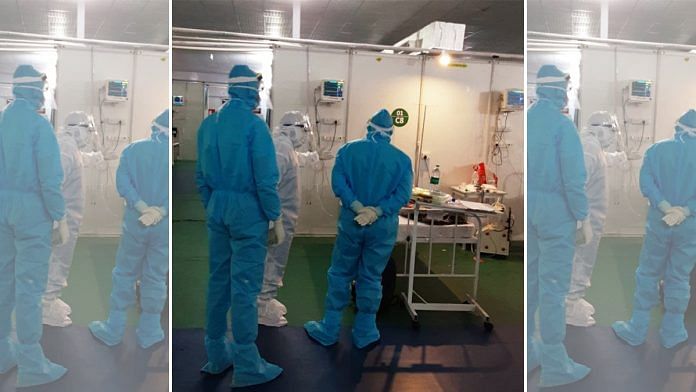
Delhi’s Base Hospital chief transferred, move surprises many, Army calls it routine
A file photo of the Army Base Hospital in New Delhi. | Photo:
New Delhi: In a move that has surprised many, the commandant of the Army Base Hospital in the national capital has been transferred out even as the establishment is in the thick of the fight against the Covid-19 pandemic.
Major General Vasu Vardhan was moved out to the Army Research and Referral Hospital in Delhi as additional officer on 10 May.
Major General S.K. Singh, who was the deputy commandant at the Army Medical Corps Centre and College in Lucknow, has replaced Vardhan at the Army Base Hospital.
The transfer order, issued by the Directorate General of Medical Services (Army), came as a surprise since Maj Gen Vardhan had service until August this year. He is a pulmonologist, who is considered within the military’s medical fraternity as a very able officer.
Senior Army sources termed the transfer as a routine posting carried out as part of a larger plan of HR management within the Armed Forces Medical Services. They also pointed out the officer has completed tenure of 18 months. However, speculation persisted on the nature of the move.
Serving and retired officers ThePrint spoke to said the decision was unexpected in the middle of the Covid crisis when the Base Hospital has been performing well.
A former Army commander also expressed shock, saying that the transfer just months before his retirement as “additional officer” showed that the move was not routine. “You don’t change the Captain of the ship in the middle of a war or a Corps Commander when he is in confrontation with the enemy,” the ex-officer said on condition of anonymity.
The Base Hospital is one of the most sought after Covid care centres and all admissions are given on the basis of criticality of the patient.
Both Iran and China are today on the same page on Chabahar, where India was once perceived to be a weighty player. Of course, India still retains its position and visibility in the Persian Gulf; nevertheless, Beijing has marched a step ahead owing to New Delhi’s seasonal foreign power play. Chabahar is part of an important Iranian pivot, with the region adjacent to it accounting for 70% of the world’s proven oil reserves and 40% of its natural gas reserves.
LARGER SCOPE: China’s role in Chabahar should be seen beyond the Delhi-Beijing tug of war. Reuters
ABHIJIT BHATTACHARYYA
Commentator and Author
IN hindsight, the recent statement of Iranian Foreign Minister Javad Zarif wasn’t unexpected: “China wants to play a role in the Chabahar (port) project”. It’s Iran’s nudge to India about the arrival of Beijing in a territory where New Delhi enjoyed prime privilege for some time. Does it constitute a major breakthrough by the Communist Party of China (CPC) by creating a coveted space for itself to counter and confront India in a strategic seaport in a third country? Can India avoid future pressure and tensions in a long, connected terrain spanning Pakistan, Iran and Turkey?
Indeed, true to its fresh understanding of geography, the CPC has posed an extremely challenging task to India, dealing with which could be an arduous long haul, with unprecedented situations likely to emerge. What thus far appeared to have been trumpeted by India — that the India-Iran Chabahar project was New Delhi’s answer to the China-Pakistan Economic Corridor’s (CPEC) fulcrum, the Gwadar port — now constitutes an acid test of India’s ability to continue with its avowed power play beyond South Asia.
Although ‘unfriendly’ China started late, it learnt the geography of the sea fast. That subject has rarely been the forte of Indian rulers since time immemorial. Else, how does one explain the constantly changing political maps of India with virtually no naval tradition and an uninterrupted loss of territory from 1947 to 2021?
Hence, compulsively, it’s time to learn from China the supreme importance of geography for a sovereign nation’s self-interest. Else, India will continue to be projected as a ‘future potential power’, which shows no sign of shedding its tag of laggard.
Coming back to Chabahar, Iran has been forthright. It has given India the signal that the Chinese are more than welcome in Chabahar. “Chabahar is open to cooperation for everybody. It’s not against China or the Gwadar port. It’s a place where we can all come together to help Afghanistan… the Chinese are interested in playing a role elsewhere in Iran and also in Chabahar,” the Iranian Foreign Minister said. The choice of words is aimed at assuring China and Pakistan. But no mention of India means no assurance to India as such.
The message is loud and clear: China looms larger than all South Asian nations taken together because Beijing is “interested in playing a role elsewhere in Iran” and “also Chabahar”. Chabahar may be a late addition to Chinese ‘interest’ in Iran, but its overall importance in Tehran’s eyes is long-term. And, why not? When India, owing to US pressure, stopped Iranian oil import in 2019, Tehran’s anxiety of dealing with traditionally friendly India was understandable. India couldn’t go on its own in the Delhi-Tehran bilateral. Rather, it’s been following instructions of the US. Little wonder, China wholeheartedly grabbed the opportunity for long-term fuel supply at financially favourable terms. Holding cold and calculated ‘national interest’ above everything else. Consequently, both Iran and China are today on the same page on Chabahar, where India was once perceived to be a weighty player.
Of course, India still retains its position and visibility in the Persian Gulf; nevertheless, Beijing has marched a step ahead owing to New Delhi’s seasonal foreign power play.
Chabahar is part of an important Iranian pivot, with the region adjacent to it accounting for 70 per cent of the world’s proven oil reserves and 40 per cent of its natural gas reserves. That one country-bridge connects the great Eurasian space, South Asia, western highlands of China, the great arc of the Sunni world with unrestricted access to the Indian Ocean after crossing through a narrow channel of a virtually landlocked water body called the Persian Gulf.
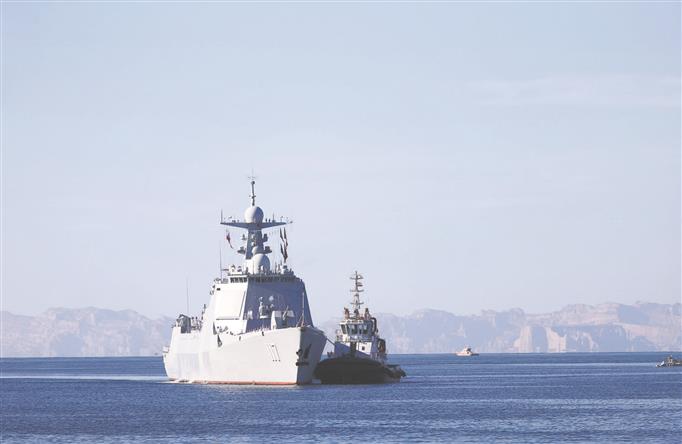
Hence, what’s unique is the Chinese ‘sea sense’ of ‘forward deployment’. With mounting tensions in the eastern and south seas surrounding mainland China, it’s time to switch flanks for a fresh, flexible frontier. Chabahar opens up options for mobilisation during a crisis. In a straight east-west coastline of 365 nautical miles, the Chinese navy, mercantile marine and fishing vessels have attained advantage over others. From Pakistan’s Karachi-Gwadar stretch (289 nautical miles), it has now 76 nautical miles of the Iran-Pakistan Chabahar-Gwadar connect.
The history of ‘forward deployment’ by the British at the height of European imperialism and the US command and control of oceans in the 20th century comes alive with 21st-century Chinese understanding of geography. No doubt Chabahar is prima facie projected for economics, commerce and trade. Nevertheless, no port in a strategic location can only be for economics. That’s highly unlikely, especially once China comes to the fore.
China’s role in Chabahar should be seen beyond the Delhi-Beijing tug of war, as its span and scope are much larger and deeper than that. It’s a first step towards a Chinese navy foothold deep inside US Central Command territorial jurisdiction which has its headquarters at MacDill Air Force Base, Florida. The Chinese urgently need more than Djibouti for its expanding armada as its naval competition with the US becomes fiercer.
It has to be admitted that the US Navy is no longer the force that it was at the turn of the 20th century. Today, the gap between strategy and resources is a stark challenge to the US in the West Pacific, arguably the most sensitive and strategic region. China, therefore, definitely proposes to create a fresh seafront in the Persian Gulf-Indian Ocean to expand and consolidate. China has already scaled up its naval inventory to more than 350 combat ships, thereby leaving the US stuck at around 300 vessels. The strategic US goal for 355 combatants remains unrealised. Hence, with three ports (Karachi, Gwadar, Chabahar) in a straight line of 365 km, China has laid the foundation for multiple options and opportunities for a multi-front crisis in the sea along with fresh availability of the Persian Gulf to the Beijing-Shanghai landline, thereby avoiding the potentially turbulent and choppy Indian Ocean-Singapore Strait-Pacific Ocean sealane. It’s real-time geography and economics of sea and port craft.
Civil, Army officers recce site for 100-bed facility in Mohali
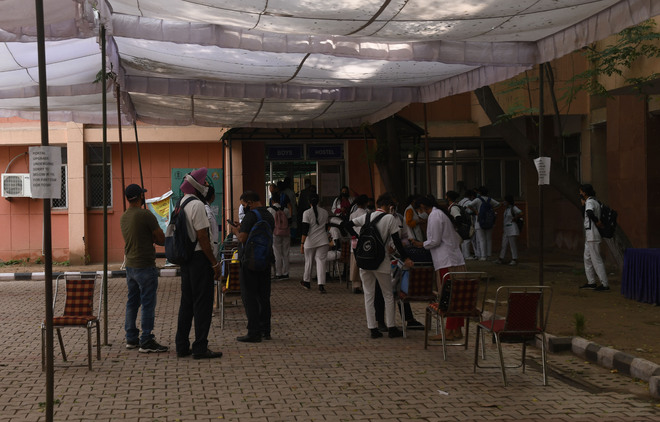
No vaccination was held at the Dr BR Ambedkar State Institute of Medical Sciences in Phase 6, Mohali, on Thursday. Vicky
Tribune News Service Mohali, May 13
To augment the health infrastructure, officers of the district administration and the Western Command today jointly conducted a recce of a site for setting up a 100-bed facility for Covid-19 patients in Mohali.
Divulging details, Deputy Commissioner Girish Dayalan said: “The initial plan is of setting up a makeshift facility. Till the pre-fabricated structure arrives, we intend to commence the facility on the second/third floor of the Civil Hospital in Phase 6, Mohali, in order to provide early respite in the raging pandemic”.
Dayalan said the exercise for joint needs assessment had begun and pooling of resources with the Western Command was being worked out so that a well-equipped L2 facility for holistic treatment to Covid-19 patients as per the ICMR guidelines could be set up.
Various aspects of the set-up, including site, deployment of doctors, nurses, paramedics, ambulance service, trained personnel for administration and management of the facility and uninterrupted oxygen supply, were being looked into, he said.
Dayalan said with the availability of L2/L3 beds hovering around saturation, they seek to make available as many oxygen beds as possible to Covid-19 patients.
Rubbishing aside the reports that due to non-commissioning of makeshift hospital in Mohali, the Western Command is now extending support to the Covid facility at Rajindra Hospital, Patiala, which will be a loss to natives of Mohali, Dayalan said: “Rajindra Hospital is the government L3 facility attached officially with Mohali and any critical Covid-19 patient from Mohali can be referred to Rajindra Hospital. So, by no means Army supporting Rajindra Hospital is a loss to the people of Mohali. In the meanwhile, we are working towards operationalising a civil-Army joint venture.”
Col Jasdeep Sandhu, Director, Civil and Military Affairs, Western Command, also ruled out the idea of sending staff earmarked for one district to another and said the Army would work to provide support to the civil authorities in combating the Covid surge, wherever the need be.
The decision to agree to the 2003 ceasefire agreement was announced on February 26
ndian Army and Pakistan Army personnel exchange sweets. Tribune photo
Tribune News Service New Delhi, May 13
Less than three months after Indian Army and Pakistan Army agreed to hold the ceasefire along the Line of Control (LOC), the two armies on Thursday exchanged sweets to mark Eid-ul-Fitr.
The decision to agree to the 2003 ceasefire agreement was announced on February 26.
Indian Army and Pakistan Army celebrated Eid-ul-Fitr on the LoC at Poonch-Rawalakot crossing point and Mendhar-Hotspring crossing point in Poonch district of Jammu & Kashmir, a spokesperson of the Northern Command of the Indian Army said.
Sweets and compliments were exchanged by the representatives of both the armies in an atmosphere of bonhomie and festivities.
The ceremony is seen as a confidence building measure in the backdrop of recently agreed ceasefire between both the countries.
The gesture was appreciated by both the armies and expected to promote goodwill and mutual trust, said the spokesperson.
The UK and WHO recommended an interval of over 12 weeks between the two doses of Covishield.
Tribune News Service
New Delhi, May 13
India today increased the interval between the two doses of the Covishield vaccine from 6-8 weeks to 12-16 weeks after an expert panel recommended changes based on the experience in the UK.
“The Health Ministry has accepted this recommendation of the Covid Working Group for extension of the gap between the first and second doses of Covishield vaccine to 12-16 weeks,” an official statement said.
The group chaired by leading vaccinologist NK Arora relied on studies from the UK that established the efficacy of AstraZeneca vaccine reached 82.4 per cent after the second dose in people with a dosing interval of 12 weeks or more. If the two doses were given less than six weeks apart, the efficacy was only 54.9 pc. “It’s a science-based decision. We started with a dosing interval of 4-6 weeks for Covishield which was raised to 6-8 weeks. The UK and WHO recommended an interval of over 12 weeks between the two doses of Covishield. In the UK, millions have been inoculated with the second dose at 12-16 weeks apart from the first,” said VK Paul, chairman, National Expert Group on Vaccine Administration.
No changes were recommended for Covaxin dosing with two shots still to be taken 28 days apart.
The working group is also learnt to have recommended that Covid-positive patients defer their vaccinations for six months after recovery instead of the present protocol of 4-8 weeks post recovery.
It suggested that pregnant women be given an option to inoculate and lactating women be allowed to get vaccines any time after the delivery. These two suggestions are still under deliberations.
These soldiers are serving 24×7 to cremate veterans, dependents succumbing to Covid
Last rites being performed at the Brar Square Crematorium in the Delhi Cantonment | By special arrangementText Size: A- A+
New Delhi: The last time Lt Col Vishal Sharma and his team of three military personnel caught six hours of sleep was on 18 April.
The officer from the Army Air Defence Corps and his team, which is in-charge of the Brar Square cremation ground in the Delhi cantonment, have since been working round the clock to ensure last rites to veterans and dependents succumbing to the deadly second wave of Covid-19.
The Brar Square crematorium caters to the personnel of the Army, Air Force and the Navy.
Such has been the rush here that from its capacity of four pyres until 19 April, the ground now has 15 cremation spots. This is being further raised to 20.
But even this is not enough. Lt Col Sharma has had to coordinate even with civil crematoriums to cater to the extra rush.
“We soldiers stay strong and are trained to not break emotionally. But this time it is troubling to see so many succumbing to the virus. We are trying to ensure that at least the final rites of the members of our military family pass off peacefully,” Lt Col Sharma told ThePrint.
The last two weeks were physically demanding and emotionally draining, he said.
Appointed as the Staff Officer (Administration), Headquarter, Delhi Area in October 2019, the officer handles the Brar Square crematorium.
Last year, he was involved in setting up of the quarantine facility of the Army in Manesar to cater to incoming passengers from Wuhan and the United Kingdom.https://bbb7a0ddb036397d634ea21eebf33b9d.safeframe.googlesyndication.com/safeframe/1-0-38/html/container.html
“Last time, there were not many casualties. However, this time it is very different. Casualties are mainly veterans with co-morbidities and dependents besides few serving soldiers,” he said.
For Lt Col Sharma and his team, the task does not mean just carrying out cremation but also coordinating with hospitals for release of body, transport and even liasoning with police in case the body is coming in from the National Capital Region and beyond.
To cater to the rising demands, the General Officer Commanding (GOC), Delhi Area, Lieutenant Gen Vijay Kumar Mishra, has ordered hiring of civilian staff and more hearse vehicles.
ThePrint reported last month that the Army has set up a special cell in the Delhi cantonment to provide “decent last rites” to members of its own family.
Lt Col Sharma said his day begins at about 5:30 in the morning as families come to take away the remains because the bodies burn for about 15-16 hours.
“I am usually on calls till about 2:30 in the night as various people call to help with not just cremation but also movement of remains. I had this case of a veteran dying and his entire family being down with Covid. We had to arrange vehicles and men to bring his body and cremate while his son watched the proceedings from the US on video,” he said.
Another moving case was when the wife of a serving soldier brought his body from Palwal to the Brar Square without any intimation. The soldier had died due to Covid.
“The team ensured that all help was extended and there was a ceremonial wreath-laying also. There was certain other help that was needed and I called up my GOC to seek permission and he said I had the full freedom to take a decision as deemed fit and he will sign it off,” Lt Col Sharma said.
Besides the civilian staff hired, there is a military team for ceremonial wreath-laying when the body is that of a serving soldier or veteran.
‘First come first serve’ only
Asked if he gets calls from senior serving and retired officers to rush particular cases, he said everyone is aware that it is a ‘first come first serve’ basis.
“It does not matter if the veteran is a three star officer or an NCO. The military has its own culture and everyone is aware,” he said.
Asked about non-Hindu cases, he said his team liaisons with the families for all formalities and movement of body to their choice of burial ground.