



PLA armoured vehicles retreating from the Pangong-Sa area in Ladakh The 11th round of the Corps Commander talks at Chushul took place after almost a two-month gap There was no visible forward movement at the latest round of military talks between India and China for disengagement of troops at the remaining friction points of Hot Springs, Gogra and Depsang in eastern Ladakh as the Chinese side did not show flexibility in their approach on this issue, people familiar with the negotiations said on Saturday. A day after the 11th round of talks that lasted for 13 hours, the Indian Army said in a statement that both sides held a detailed deliberation on disengagement in remaining areas and agreed to jointly maintain stability on the ground, avoid any new incidents and resolve the outstanding issues in an “expeditious manner”. The people cited above said the Chinese delegation came to the talks with a “premeditated mindset” and did not show any flexibility in moving forward on the disengagement process at the remaining friction points. The Indian Army statement said it was highlighted at the talks that completion of disengagement in other areas would pave the way for considering “de-escalation of forces” and ensure full restoration of peace and tranquillity in the region. The Corps Commander-level talks took place at the Chushul border point on the Indian side of the Line of Actual Control (LAC) in eastern Ladakh. The parleys began at around 10:30 AM and ended at 11:30 PM. The people cited above said the Indian delegation, led by Commander of the Leh-based 14 Corps Lt Gen PGK Menon, particularly insisted on resolving outstanding issues in Hot Springs, Gogra and Depsang. “The two sides had a detailed exchange of views for the resolution of the remaining issues related to disengagement along the LAC in eastern Ladakh,” the Army said. It was the second high-level military talks between the two sides after disengagement of troops in the Pangong lake areas in eastern Ladakh in February. “The two sides agreed on the need to resolve the outstanding issues in an expeditious manner in accordance with the existing agreements and protocols,” the statement said. In this context, the Army said it was also highlighted that completion of disengagement in other areas would pave the way for the two sides to consider de-escalation of forces and ensure full restoration of peace and tranquillity and enable progress in bilateral relations. “The two sides agreed that it was important to take guidance from the consensus of their leaders, continue their communication and dialogue and work towards a mutually acceptable resolution of the remaining issues at the earliest,” it added. “They also agreed to jointly maintain stability on the ground, avoid any new incidents and jointly maintain peace in the border areas,” the statement said. The border standoff between the armies of India and China erupted on May 5 last following a violent clash in the Pangong lake areas and both sides gradually enhanced their deployment by rushing in tens of thousands of soldiers as well as heavy weaponry. As a result of a series of military and diplomatic talks, the two sides completed withdrawal of troops and weapons from the North and South banks of Pangong lake in February in line with an agreement on disengagement. India has been insisting that a resolution of outstanding issues including in Depsang, Hot Springs and Gogra is essential for overall ties between the two countries. Late last month, Army chief General MM Naravane said the threat to India has only “abated” following the disengagement in the Pangong lake areas, but it has not gone away altogether.
Corps Commander talks ends after 13 hours, India and China discuss further disengagement
Chinese PLA troops march back from the Pangong Tso area in eastern Ladakh | File image| Photo released by Indian ArmyText Size: A- A+
New Delhi: After having successfully disengaged with China in the Pangong lake area, India and China held the 11th round of Corps Commander-level talks in Ladakh on Friday where disengagement from remaining friction points including Gogra heights, Hot Springs and Depsang Plains was discussed, Army sources said.
According to sources, the meeting lasted for around 13 hours on Friday and concluded at 11:30 pm. The two countries have been engaged in a military standoff for almost a year but disengaged from the most contentious Pangong lake area last month after extensive talks at both military and political levels.
The credit for the disengagement was given to all stakeholders by Army Chief General Manoj Mukund Naravane who also talked about the country benefitting from the inputs given by the National Security Advisor Ajit Doval during the crisis.
Earlier, India and China held 10 round of talks at the Corps Commander level to reach the arrangement to disengage from the Pangong lake area.
Inspirational Commander Mohan NR Samant, Lt Commander Joseph PA Noronha and Leading Seaman Chiman Singh Yadav
Lt Col Dilbag Singh Dabas (Retd)
As a student, Chiman Singh Yadav was passionate about swimming and diving in the village pond. In 1961, he accompanied a group of students to watch the Republic Day Parade in Delhi. There he saw for the first time a tableau of a ship, with young men atop attired in immaculate whites performing mock drills on diving from the deck. Fascinated, he needed no counselling on what career to choose.
Son of Rao Nand Kishore Yadav, Chiman was born at Gokalgarh village in Gurgaon district of then undivided Punjab on June 1, 1945. Gokalgarh, incidentally, was one of the villages in the water-starved south-west Haryana called Ahirwal. Some of the villages though had small ponds to fetch water from when the wells went dry.
After matriculation from BS Ahir High School, Rewari, and at just about 16, Chiman joined the Navy as a sailor through the Boys Entry on June 8, 1961. Within seven years, Chiman, as Leading Seaman, was a Clearance Diver Class 2 and underwater bomb disposal specialist at the Naval Diving School, Cochin. He also specialised in the use of limpet mines against enemy warships and submarines.
In 1965, consequent to Pakistan Navy’s unsuccessful raid on Dwarka’s front waters, the Indian Navy wanted to retaliate, and in a big way, but was kept on leash, possibly based on strategic thought to restrict the scope of the war. But six years later, the maritime sword arm of the Indian military could no longer be kept on leash. It was widely believed that domination over Arabian Sea could prove to be the game-changer.
During the war with Pakistan in 1971, Operation Trident, the Indian maritime offensive by its Western Naval Command, did change the game by not only blasting the Karachi harbour but also effectively denying West Pakistan war efforts from reaching its eastern half, thereby contributing a lot to the Indian victory during the 14-day war.
Before the outbreak of the war in December, Chiman Singh, now a Leading Seaman (LS-2), not only trained the Mukti Bahini guerrillas in covert sea-borne operations, but himself led many successful operations deep inside East Pakistan waters.
During the 1971 war in the eastern theatre codenamed Operation Cactus Lily, Leading Seaman Chiman Singh, for his conspicuous bravery, unparalleled camaraderie and strong determination in the face of the enemy far superior in number and strength, was awarded the Maha Vir Chakra. The write-up on his gallantry decoration reads:
During Operation Cactus Lily, Leading Seaman Chiman Singh was part of the crew of a small naval vessel entrusted with the task of attacking enemy targets in Khulna, Mongla and Chalna bays in East Pakistan. On December, 11, 1971, while on the mission, the vessel was subjected to enemy air attack while operating off Khulna and was sunk. Leading Seaman Chiman Singh was thrown overboard and seriously injured by shrapnel. Simultaneously, the enemy shore defences opened fire at the survivors in water.
Chiman Singh noticed that the survivors, including an injured officer, were finding it difficult to keep afloat. Despite himself being seriously injured, unmindful of his own safety against enemy automatic fire, he rescued and brought all the survivors to the shore. On reaching the shore, not bothering about his own injured condition, Chiman, to make it possible for his two colleagues from being captured, charged at the enemy, exposing himself to the hostile fire.
Leading Seaman Chiman Singh was eventually overpowered and taken prisoner by the enemy. He, however, was released upon the liberation of Bangladesh. His valiant action behind the enemy lines and in the face of perceivably insurmountable opposition was an embodiment of the Indian Navy’s core values of duty, honour and courage and the diving cadre’s ethos of strong will to succeed and surmount all odds.
For his conspicuous act of bravery and display of utmost courage and determination in the face of the enemy, Leading Seaman Chiman Singh Yadav was awarded the Maha Vir Chakra.
Chiman Singh Yadav was also awarded the ‘Friends of Liberation War’ Honour by the Bangladesh President in 2013. Incidentally, his name figures prominently on the list of invitees by Bangladesh in its yearly celebrations on December 16 every year.
Even after retirement, Chiman Singh continues to live up to his one-liner — once a diver, always a diver, and is a visiting faculty at INS Venduruthy (Naval Diving School, Cochin), a premier training establishment that trains commandos not only from the Indian Tri-Services but also from friendly countries. He is also often invited to attend seminars on updating of the Standard Operating Procedures regarding use of limpet mines.
Petty Officer Chiman Singh Yadav, the living legend, incidentally, is the only sea warrior below Officers rank in the Indian Navy to have been conferred the Maha Vir Chakra, the second highest gallantry decoration.
For the naval operations between December 8 and 11, 1971, against targets on shore at Khulna, Mongla and Chalna bays in south-west East Pakistan, emerged not just one Maha Vir, but three; the other two being Commander Mohan Narayan Rao Samant and Lieutenant Commander Joseph Pius Alfred Noronha.
Samant, the eldest of five children of Subedar Major Narayan Ramchandra Samant, hailed from Parule village in Sindhudurg district along the Konkan coast in Bombay state. He studied in schools wherever his father was posted, mainly at Peshawar, Chaklala and Meerut.
After Intermediate (Science) from Wilson College, Bombay, Samant joined the Royal Indian Navy and was shipped to the United Kingdom for four years’ training at the Royal Navy College, Dartmouth. After his fifth year as a midshipman, Samant returned in 1953 as Sub-Lieutenant (Navigator) along with the last batch of Indian executive officers commissioned in the UK.
During the sea-borne operation deep inside the enemy’s backwaters in the eastern theatre, Samant, now a Commander, headed the task force of three boats armed to the teeth — INS Palash, INS Padma and INS Panvel, which not only neutralised the shore defences but also blasted and set ablaze the oil installation in Khulna, the second biggest in East Pakistan.
For not just commanding but also leading the task force from the front, Commander Samant, for his conspicuous bravery, was awarded the Maha Vir Chakra.
Lieutenant Commander Noronha, Alfred to his friends, son of Joseph C Noronha, a postmaster from Mysore, never wanted to follow in his father’s footsteps, and was a man in search of an elusive destiny. Good at academics, he topped the UPSC entrance and joined Joint Services Wing (present-day National Defence Academy) in 1955 and was commissioned in the Indian Navy in October 1959.
Lieutenant Commander Noronha, commanding INS Panvel, was part of the task force under Commander Samant which attacked Mongla, Chalna and Khulna bays. His ship was subjected to incessant air attacks and enemy fire from shore defences. Lieutenant Commander Noronha, with total disregard to personal safety, handled his ship in the most competent and fearless manner in very restricted waters and effectively engaged enemy shore defences.
For his conspicuous gallantry in silencing the enemy’s shore defences and causing extensive damage to vital enemy installations, Lieutenant Commander Noronha was awarded the Maha Vir Chakra.
Army pays tributes to soldier shot dead by militants in Anantnag
The Army on Saturday paid floral tributes to Havildar Mohammad Saleem Akhoon who was shot dead by militants in Anantnag district of Jammu and Kashmir.
In a solemn ceremony at Badamibagh Cantonment, Chinar Corps Commander, Lt Gen D P Pandey and all ranks paid homage to the gallant soldier on behalf of the proud nation, an Army spokesman said.
He said Akhoon was on leave in his native village and unarmed when he was attacked by militants on Friday.
The injured soldier was immediately evacuated to District Hospital Janglat Mandi, Anantnag, but the doctors there declared him bought dead.
Akhoon (43) had joined the Territorial Army in 2004 and belonged to Bijbehara village of Bijbehara tehsil in Anantnag district of south Kashmir.
Akhoon is survived by his wife, a daughter and a son.
“The mortal remains of Akhoon were taken for last rites to his native place, where he would be laid to rest with full military honours. In this hour of grief, the Army stands in solidarity with the bereaved family and remains committed to their dignity and wellbeing,” the spokesman said. — PTI
In pictures, cops forcibly remove protesters at Tewasan toll plaza to clear KMP expressway in Haryana
The Haryana Police detained several farm union leaders and supporters on Saturday as the protesters blocked the Kundli-Mewat-Palwal (KMP) Expressway as part of their ongoing protest against the central agri laws.https://www.youtube.com/embed/dM7vTqDTscQ
Tribune photo: S.Chandan
The police were seen forcibly removing the activists at Rewasan toll plaza to clear the way for motorists.
Tribune photo: S.Chandan
Farmers blocked the Kundli–Manesar–Palwal expressway at some places in Haryana early on Saturday.
The blockade started at 8 am and would last 24 hours.
Tribune photo: S.Chandan
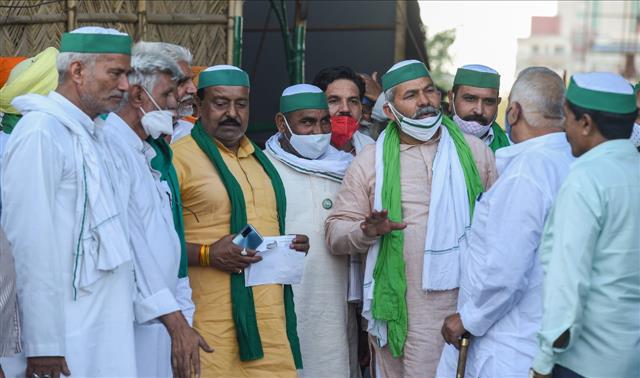
The Samyukta Kisan Morcha, an umbrella body of protesting farmer unions spearheading the agitation against the agriculture-related legislations, on Friday gave a call for a 24-hour blockade of the KMP expressway.
Tribune photo: S.Chandan
A long traffic jam was witnessed on both sides the KMP.
Farmers block the KMP expressway near Mandothi village in Jhajjar district on Saturday and protesters camp at the Rewasan toll plaza in Nuh. Sumit Tharan & S Chandan
Tribune News Service
Sonepat, April 10
Intensifying their stir against the Centre’s three contentious agricultural laws, farmers today blocked the 136-km Kundli-Manesar-Palwal (KMP) and Kundli-Ghaziabad-Palwal (KGP) expressways.
The call for a 24-hour blockade was given by the Samyukt Kisan Morcha (SKM), an umbrella body of farmer unions spearheading the agitation. The blockade started at 8 am and will last 24 hours till Sunday morning.
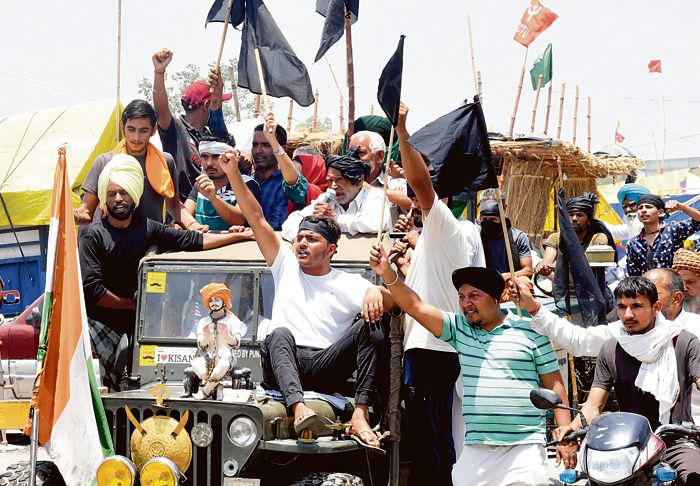
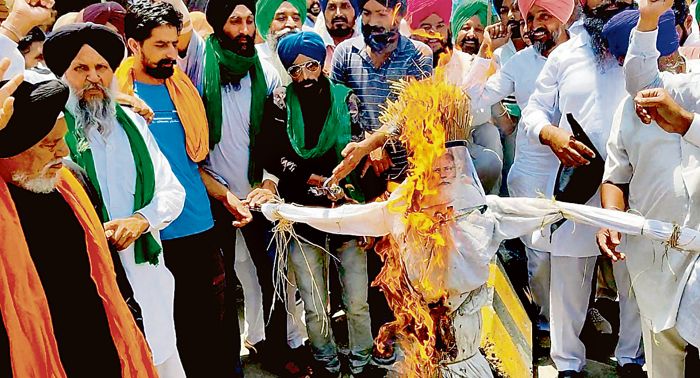
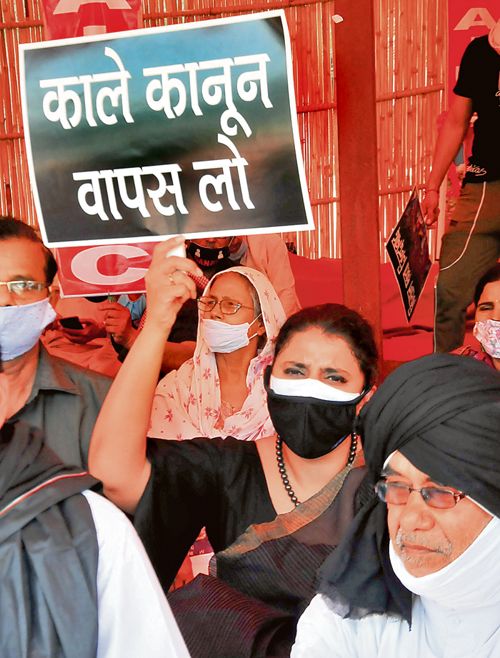
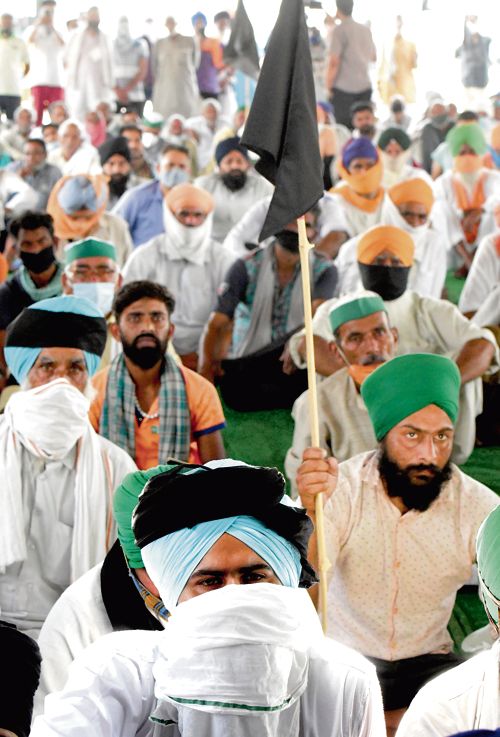
Farmers, including women, carried flags of their organisations and raised slogans against the government. They squatted on the expressways while slamming the Centre for not repealing the farm laws.
As per the scheduled programme, hundreds of farmers gathered at the KMP and KGP zero point and then proceeded towards a toll plaza on the KMP e-way near Nahra-Nahri village where they staged a protest.
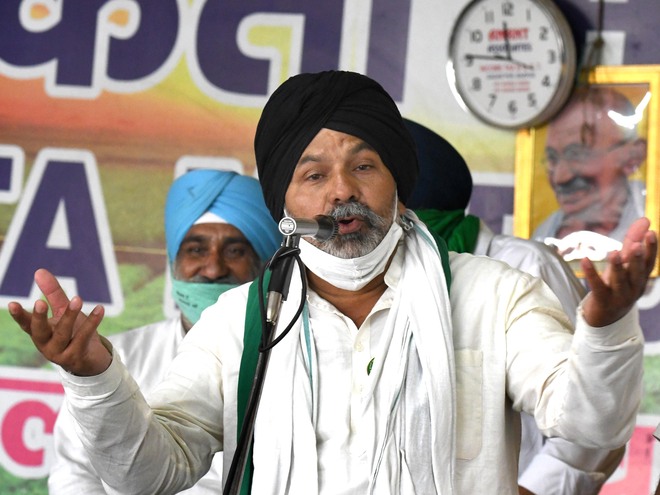
Farmer leaders Dr Darshan Pal, Jagjeet Singh Dallewal, Balbir Singh Rajewal, Surjeet Singh Phul, Harinder Singh Lakhowal and Baldev Singh Sirsa were also present at the toll plaza. They addressed farmers, appealing to them to maintain peace during the protest.
They also said the today’s blockade was a warning to the Centre.
Because of the road blockade, long queues of vehicles, especially commercial four-wheelers, were seen in Sonepat.
However, the SKM’s call for blockade did not evoke much response at Nuh, Manesar and Farukhnagar.
The blockade was scheduled to continue till 8 a.m. on Sunday. However, the Gurugram police had diverted traffic near Panchgaon and Farukhnagar and advised commuters to avoid travelling on the super expressway.
Suchha Singh of Phillaur said, “We have been camping at the Delhi Borders for the past four months, but the Centre did not pay heed to our demands.”
In Jhajjar, farmers blocked the KMP expressway at three points near Aasoda, Mandothi and Badli villages
Bharatiya Kisan Union (Ekta) president Joginder Singh Ugrahan said, “It is a long battle, not against the Modi government but against the corporate sector. Farmers are ready for a long haul. They will continue their dharna until the three farm laws are repealed.”
Probe fair, will challenge High Court decision in apex court: Capt Amarinder Singh
Punjab Chief Minister Captain Amarinder Singh. File photo
Tribune News Service
Chandigarh, April 10
Terming the probe into the Kotkapura firing case as totally fair, impartial and unbiased, Chief Minister Capt Amarinder Singh on Saturday said his government will challenge the orders of the High Court for quashing the investigation of the Punjab Police SIT or removing its chief in the Supreme Court.
Reacting to media reports in this regard, the Chief Minister said he has directed the state government’s legal team in the case to examine the orders of the Punjab and Haryana High Court as soon as the copy is received, and prepare to challenge the same in the apex court if either the SIT probe is directed to be scrapped or its leader is asked to be removed.
He said he had full faith in the state’s legal team, headed by Siddharth Luthra, Senior Advocate from Delhi, who appeared for the state in the case before the High Court.
Won’t spare guilty, will ensure justice
The Kotkapura firing case will be taken to its logical conclusion and nobody who is guilty will be spared, irrespective of his political affiliation or position, Chief Minister Capt Amarinder Singh said, declaring his commitment to fulfilling every single poll promise of his government, including ensuring the much-awaited justice for the families of the victims of the firing case.
The case will be taken to its logical conclusion and nobody who is guilty will be spared, irrespective of their political affiliation or position, said the Chief Minister, declaring his commitment to fulfilling every single poll promise of his government, including ensuring the much-awaited justice for the families of the victims of the firing case.
Expressing full confidence in SIT chief Kunwar Vijay Partap Singh, and the probe conducted so far under his supervision, the Chief Minister said he was an extremely competent and experienced officer who had been working relentlessly on the case since the SIT was constituted. The inquiry is being conducted in a completely fair and unprejudiced manner by the SIT under the leadership of Kunwar Vijay Pratap Singh, he said, adding that neither changing the officer nor setting up a fresh SIT at this stage was acceptable to his government. He pointed out that the investigations were in an advanced stage, with four challans already filed against persons in the 2015 case that followed the Bargari sacrilege incident, with final reports submitted to the sessions court for trial.
The Chief Minister also slammed SAD president Sukhbir Badal for continuing to play “dirty politics” over such a grave and sensitive issue.
Photo for representation only. – iStock file photo
NEW DELHI, APRIL 10
India has lodged diplomatic protests here and in Washington DC over the passage of its warship, USS John Paul Jones, through its exclusive economic zone (EEZ) without consent. India and the US differently interpret a key clause in the United Nations Convention on the Law of the Sea (UNCLOS).
India is among the group of countries insisting that its consent is essential for an external military power to hold exercises, in particular those involving the use of weapons or explosives. The US, however, maintains that this interpretation restricts the concept of a free and open ocean, and needs to be challenged, which it does practically every year. The only additional element this year is that the US Navy also issued a statement immediately after the passage.
The Pentagon insisted that Indian misgivings were misplaced, stating it was an “innocent passage” to assert navigational rights and freedoms. Interestingly, the Pentagon claimed that the passage tool place through Maldives’ EEZ without requesting prior permission. — TNS

Controversy erupts over Prashant Kishor’s leaked audio chat on West Bengal polls
TMC election strategist dares BJP to release full conversation
As the fourth phase of polling in West Bengal concluded today, the BJP was quick to lap up the purported claims of ruling TMC’s election strategist Prashant Kishor to buttress its argument that the saffron outfit has gained popular support in the state.
Tribune News Service
New Delhi, April 10
As the fourth phase of polling in West Bengal concluded today, the BJP was quick to lap up the purported claims of ruling TMC’s election strategist Prashant Kishor to buttress its argument that the saffron outfit has gained popular support in the state.
Prashant Kishor
BJP won’t cross 100-seat mark
I am glad BJP is taking my chat more seriously than words of their own leaders. They should show courage & share the full chat instead of getting excited with selective use of parts of it. I have said this before & repeating again – BJP will not to cross 100 in WB.
The BJP IT cell head and co in charge for West Bengal Amit Malviya argued that Kishor’s comments made to a few Delhi-based journalists during a social media audio discussion amounted to the TMC conceding defeat in the state Assembly elections.
Further, the saffron party’s IT cell went all out to amplify the clips of the purported audio conversation in which Kishor is heard saying that Prime Minister Narendra Modi continues to enjoy as much popularity in West Bengal as Chief Minister and TMC leader Mamata Banerjee. Kishor is also heard saying that 27 per cent Dalit voters in the state are voting for the BJP. In the audio, which Malviya shared on Twitter, Kishor can be heard making claims that there’s anti-incumbency factor against the TMC and it is also at the receiving end because of appeasement politics.
“On a day Bengal is voting for 4th phase on as many as 44 seats, TMC cadre and leaders woke up to find out that Mamata Banerjee’s election strategist (Prashant Kishore) has conceded the election. Every voter in Bengal has these videos on their mobile and is watching them as s(he) queues up to vote,” tweeted Malviya, who also claimed that the TMC election had just been thrown away.
Kishor purportedly stated during the conversation that PM Modi enjoyed cult status to an extent that a substantial chunk of population in the state gives him a demigod status. “There is anti-incumbency against the TMC and polarisation is a reality, says Mamata Banerjee’s strategist in an open chat,” Malviya said.
Taking purported claims of Kishor to strengthen BJP’s narrative against Mamata for minority appeasement, Malviya quoted TMC’s election strategist having said that “all that the Left, Congress and TMC ecosystem have done in the last 20 years is Muslim appeasement. It has resulted in resentment.”
Meanwhile, Kishor, on his part, also took to Twitter to counter the saffron party.
‘PM enjoys cult status’
Prashant Kishor purportedly stated during the conversation that PM Modi enjoyed cult status to an extent that a substantial chunk of population in the state considers him a demigod. “There is anti-incumbency against the TMC and polarisation is a reality, says Mamata Banerjee’s strategist in an open chat,” BJP IT cell head and co in charge for West Bengal Amit Malviya said.
India, China agree to maintain stability and peace on ground
So far, the People’s Liberation Army (PLA) of China has been inflexible to this suggestion. As of now, the ‘disengagement’ has happened only at one sector — Pangong Tso. – File photo
Ajay Banerjee
Tribune News Service
New Delhi, April 10
India and China military-level talks have hit a deadlock. India has made it clear that pulling back troops from friction points along the Line of Actual Control (LAC) in eastern Ladakh could be done only after the Chinese army ‘disengages’ from areas like Gogra, Hot Springs and the Depsang plains.
So far, the People’s Liberation Army (PLA) of China has been inflexible to this suggestion. As of now, the ‘disengagement’ has happened only at one sector — Pangong Tso.
A statement of the Ministry of Defence (MoD) today gave details of the outcome of the meeting of military commanders on Friday. “It was highlighted that completion of disengagement in other areas would pave the way for two sides to consider de-escalation of forces and ensure full restoration of peace and tranquility and enable progress in bilateral relations,” it said.
Sources in New Delhi explained that until there was a timeline for the three-step process for pulling back troops, weapons and war equipment from the entire stretch of the LAC in eastern Ladakh, India could not focus on a complete pull back only for the Pangong Tso sector.
The MoD statement came after a marathon 13-hour meeting between the Corps Commander-level officers of both sides at the Chushul-Moldo border point on April 9 that ended around 11. 30 pm. “The two sides had a detailed exchange of views for the resolution of the remaining issues related to disengagement along the LAC in Eastern Ladakh,” it said.
The two sides agreed to jointly maintain stability on the ground, avoid new incidents and jointly maintain peace in the border areas.
State Stalwarts
DEFENCE MINISTER
Minister Rajnath Singh
ALL HUMANS ARE ONE CREATED BY GOD

HINDUS,MUSLIMS,SIKHS.ISAI SAB HAI BHAI BHAI
CHIEF PATRON ALL INDIA SANJHA MORCHA
LT GEN JASBIR SINGH DHALIWAL, DOGRA
SENIOR PATRON ALL INDIA SANJHA MORCHA
MAJOR GEN HARVIJAY SINGH, SENA MEDAL ,corps of signals
.
.
PATRON ALL INDIA SANJHA MORCHA
MAJ GEN RAMINDER GURAYA ,MADRAS REGIMENT

sanjhamorcha303@gmail.com
PRESIDENT SOUTH ALL INDIA SANJHA MORCHA
COL SS RAJAN BOMBAY SAPPERS,
PRESIDENT UTTARAKHAND ALL INDIA SANJHA MORCHA
COL B M THAPA ,BENGAL SAPPERSS
PRESIDENT HARAYANA STATE CUM COORDINATOR ESM
BRIG DALJIT THUKRAL ,BENGAL SAPPERS
PRESIDENT TRICITY
COL B S BRAR (BHUPI BRAR)
PRESIDENT CHANDIGARH ZONE
COL SHANJIT SINGH BHULLAR
.
.
PRESIDENT PANCHKULA ZONE AND ZIRAKPUR
COL SWARAN SINGH
INDIAN DEFENCE FORCES
DEFENCE FORCES INTEGRATED LOGO
INDIAN AIR FORCE
Air Officer C-in-C WESTERN AIR COMMAND
AIR MSHL S PRABHAKARAN AVSM VM
AOC-IN-C, EASTERN AIR COMMAND
Air Marshal Inderpal Singh Walia
AOC-in-C SOUTH WESTERN AIR COMMAND
Air Marshal Vikram Singh
AOC-IN-C, SOUTHERN AIR COMMAND
Air Marshal J.Chalapati
AOC-IN-C TRAINING COMMAND
AIR MARSHAL SK GHOTIA VSM
AOC-IN-C MAINTENANCE COMMAND
Air Marshal Jagdish Chandra
Flag Officer Commanding in Chief, Western Naval Command
ice Admiral R Hari Kumar, PVSM, AVSM, VSM
Flag Officer Commanding in Chief, Eastern Naval Command
Vice Admiral Sanjay Bhalla, AVSM, NM
Flag Officer Commanding in Chief, Southern Naval Command