More than half of these voluntary retirements have been sought by the personnel of the BSF alone
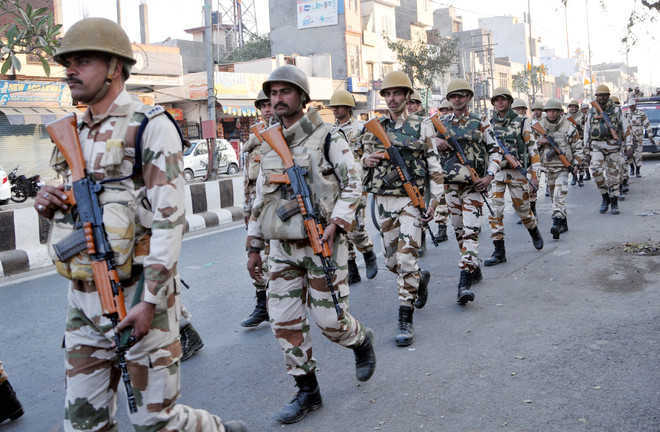
File photo for representation.
New Delhi, March 17
As many as 40,096 personnel of the Central Armed Police Force (CAPFs) and the Assam Rifles have sought voluntary retirement in the last five years, while another 6,529 resigned during the same period, Parliament was informed on Wednesday.
More than half of these voluntary retirements (VR) have been sought by the personnel of the Border Security Force (BSF) alone, while the maximum resignations have been witnessed in the Central Industrial Security Force (CISF), Minister of State for Home Affairs Nityanand Rai stated.
Rai furnished the figures from 2016 to 2020 in a written reply in the Rajya Sabha while responding to queries over resignations and VRs sought by personnel of the CAPFs and the Assam Rifles during the last five years.
The CAPFs comprise seven central security forces of the country under administrative control of the Ministry of Home Affairs. They are the Border Security Force (BSF), the Central Reserve Police Force (CRPF), the Central Industrial Security Force (CISF), the Indo-Tibetan Border Police (ITBP), the Sashastra Seema Bal (SSB), besides the Assam Rifles (AR).
According to the data, 40,096 personnel of the CAPFs and the Assam Rifles have sought voluntary retirement from 2016 till 2020 while another 6,529 tendered resignation during the five-year period.
Among the forces, a maximum 20,249 VRs were sought by personnel of the BSF during the period followed by the CRPF (11,029), the CISF (2,858), the Assam Rifles (2,279), the ITBP (1,912) and the SSB (1,769), the data showed.
During the same period, 2,919 CISF personnel tendered resignation followed by the BSF (1,708), the CRPF (796), the ITBP (620), the SSB (412) and the Assam Rifles (74), according to the data. PTI
Army phases out two artillery weapons that had been in service for over 50 years
These weapon systems have been a part of the Regiment of Artillery for over half a century
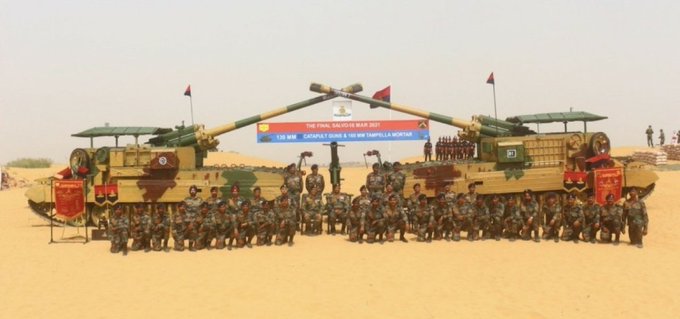
The decommissioning ceremony was held at the Mahajan Field Firing Ranges in north-western Rajasthan, where the last customary salvos were fired.
Vijay Mohan
Tribune News Service
Chandigarh, March 16
The Indian Army on Tuesday decommissioned two of the longest-serving artillery weapon systems, the 130mm M-46 Catapult self-propelled guns and the 160mm Tampella mortars.
These weapon systems have been a part of the Regiment of Artillery for over half a century. The decommissioning ceremony was held at the Mahajan Field Firing Ranges in north-western Rajasthan, where the last customary salvos were fired.
The Catapult was an integration of the Soviet origin M-46 towed artillery gun with the hull of the Vijayanta tank. While the Catapult was first produced in 1987, the army had started procuring the M-46 from 1986 onwards.
About 1,000 guns, which had a range of 27 km, had been inducted. In 2008, about 180 of these guns were upgraded to 155 mm caliber by Israel and some more were similarly modified by the Ordnance Factory Board.
Close to 100 Catapults using the 130 mm guns were built on the Vijayanta’s hull. Later, the Army carried out trials on the Arjun tank’s hull which reportedly proved to be successful and a requirement of 40 such systems had been projected.
The Tampella was a heavy mortar weighing 7,300 kg that fired a projectile weighing over 40 kg to a range of 8 km. Only a limited number of these weapons had been procured and given their weight, 7-member crew strength and range, were no longer relevant in today’s operational environment. They were last used in the Kargil conflict.
The K-9 Vajra 155 mm self-propelled howitzer, Dhanush 155 mm towed artillery gun and the US made M-777 155 mm ultra-light howitzer are among recent inductions in Regiment of Artillery to replace old obsolete weapons.
Will target corporates’ godowns if ‘black laws’ not repealed: Tikait
Says Samyukta Kisan Morcha to soon give a call to gherao Delhi from all sides
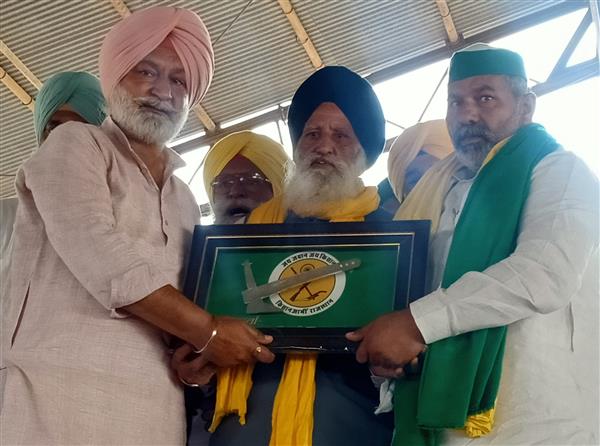
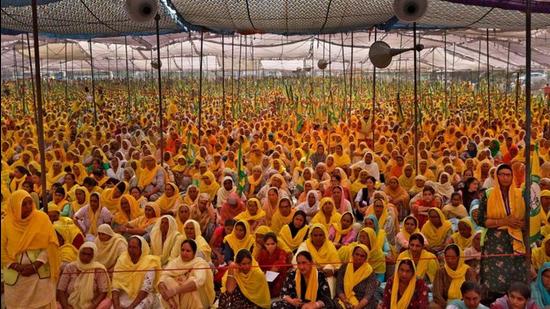
BKU spokesman Rakesh Tikait with other leaders at Kisan Mahapanchayat held at Sriganganagar. Tribune photo
Raj Sadosh
Abohar/Sriganganagar, March 17
BKU spokesman Rakesh Tikait on Wednesday warned the Central government in unambiguous terms that if the three “black” farm laws were not withdrawn, then the next action of the farmers’ ongoing agitation will be to demolish the huge godowns that some private companies had constructed to store grains.
At the Kisan Mahapanchayat held today on the call of United Kisan Morcha at the grain market in Sriganganagar, 40 km from Abohar, Tikait said a few private companies had constructed huge godowns and started storing grains at different places in the country even when new farm laws were yet to enacted.
“The BJP-led NDA government was planning to sell some banks, insurance companies and other government enterprises to private players. The government is going to bring laws that milk, electricity, fertilisers, seeds and motor vehicles marketing will go into the hands of a few corporates,” he claimed.
Giving a call to youth to take charge of the farmers’ movement, Tikait said there are no more jobs left in this country for them, youth should turn to their fields and create job opportunities in the fields itself.
He said in the districts of Barabanki and Muzaffarnagar in Uttar Pradesh, when paddy and sugarcane were not purchased at the MSP, the farmers piled up the agricultural commodities at the district collector’s offices. “The government will have to buy the produce on the MSP.”
Tikait said the media was not carrying the news of farmer movements in Karnataka, Tamil Nadu and other parts of the country, but we will reach out to people through social media. In Punjab, Haryana and parts of Rajasthan, agricultural produce was purchased on MSP only, but the farmers stir will get contentious agri laws repealed as well as implementing MSP across the country, he added.
In Odisha and Madhya Pradesh, the MSP procurement movement is going to start in the next 15-20 days. Farmers have made adequate arrangements in view of the scorching heat and the agitation will be intensified for the remaining eight months.
Revealing that the Samyukta Kisan Morcha will soon give a call to gherao Delhi from all sides, Tikait said millions of people will reach there. After Vidhan Sabha polls results in a few states, the NDA government will realise the heat of the farmers’ movement.
Morcha leader Yudhveer Singh said “Modi bhagao, desh bachao” call has to be given. Hardeep Singh Dibdiba, chairman of Rajasthan Gurdwara Parbandhak Committee (ad hoc), said he will not let the martyrdom of his grandson Navreet Singh go waste. A youth rally will leave Moga on March 25 for Singhu border, he said.
Army to equip all infantry battalions, not just frontline troops, with US Sig Sauer rifles
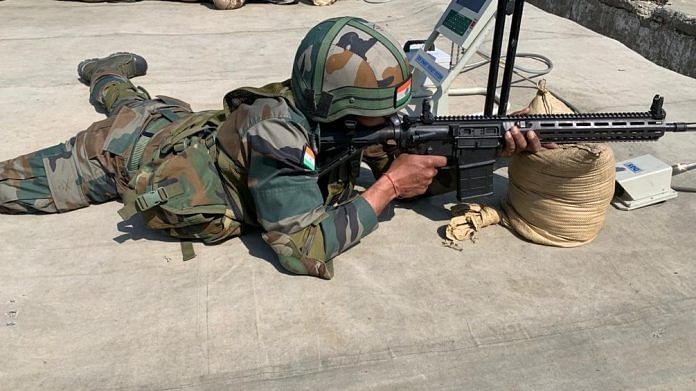
An Indian Army soldier with the Sig 716 rifle | Photo: Snehesh Alex Philip | ThePrintText Size: A- A+
Chaubatia (Uttarakhand): With the much awaited deal for AK 203 getting delayed, the Army is equipping its over 400 infantry battalions with the American Sig Sauer assault rifles, procured under fast-tracked process (FTP), as against the original plan to arm only its frontline troops with the latest weapon.
The Army had initially bought the Sig 716 G2 Patrol assault/battlefield rifles, chambered for the 7.62×51 mm rounds, in 2019 under FTP for frontline soldiers — posted at the borders and involved in counter-terrorism and counter-insurgency operations.
However, all infantry battalions are now getting equipped with the American rifles, sources in the defence establishment said.
This will replace some of the obsolete Indian Small Arms System (INSAS) 5.56×45 mm rifles in use for over two decades.
According to the plan, at least two companies (about 100 soldiers each) in all the infantry battalions are being given the Sig 716 — irrespective of whether they are in the field or at peace stations.
The quantity will, however, differ with some of the battalions getting more weapons and the others.
Each infantry battalion of the Army has four companies, commonly referred to as the Alfa, Bravo, Charlie and Delta companies.
However, certain battalions have their own unique names. For example, 1 Mahar as the Whiskey, X Ray, Yankee and Zulu company. 13 Kumaon does not have a Charlie company but is called Rezang La company in honour of the fallen soldiers of C company.
ThePrint had in December 2020 reported that while the initial lot of the modern assault rifles from the US was sent to those guarding the Line of Control with Pakistan and for counter-terrorism operations in Kashmir, troops at the LAC in the northern sector in Ladakh are also being equipped with it now.
In December, the Defence Acquisition Council had accorded approval for the procurement of additional 72,400 Sig 716 rifles for approximately Rs 780 crore. This was also done under FTP and is part of the option clause of the original deal signed in 2019.
The Sig 716 rifles are more accurate and lethal than the INSAS because it has a higher caliber — 7.62 mm as against 5.56 mm.
It was in the 1980s that the Indian Army sought a lighter assault rifle chambered to fire the 5.56×45 mm cartridge. It was meant to provide relief to the Indian soldiers who fought the Siachen battle and the LTTE in Sri Lanka with the 5.1 kg Ishapore 7.62×51 mm rifle, but the INSAS has faced constant issues since its introduction in 1998.
At that time, the Army’s logic was that the rifle should injure an enemy soldier. This meant at least 2-3 other soldiers will be required to take away the injured soldier. However, with warfare tactics changing and the Army getting involved in counter-terrorism and counter-insurgency operations too, the force wanted a high caliber weapon that is a “shoot to kill system”.
SiG 716 an instant hit with soldiers
Weighing just 3.82 kg without the magazine, the American rifles were welcomed by the infantry soldiers that ThePrint spoke to.
They explained the rifle has an effective kill range of 600 metres and with greater accuracy than that of the INSAS.
With corking from behind than the side, which is the case in most of the small arms, the rifle becomes ambidextrous.
Even though the butt of the rifle is not collapsible, it comes with six adjustable positions, and hence comes handy in operations.
While the 2019 order for the Sig rifles included a limited set of ammunition, the Army is now using the Ordnance Factory Board rounds meant for the SLR rifles of the late 1980s.
“The Sig 716 is good for operations at the border and also in CI/CT. With a shorter barrel than that of the INSAS, it is good for room intervention operation and for urban warfare,” an officer explained.
AK 203 to be the mainstay of Army
The formal process to replace the INSAS began over a decade ago, but never saw the light of the day. Among the many reasons was the fact that the Army changed specifications for the replacement twice.
It first wanted a dual-caliber rifle which could shoot two types of cartridges — the AK-47 bullet and the INSAS bullet, much to the dismay of every small arms manufacturer in the world. The Army eventually scrapped the process and then demanded a modified INSAS.
However, in 2018, India and Russia announced a deal to jointly manufacture the AK 103, which was then upgraded to AK 203.
On 3 March 2019, Prime Minister Narendra Modi inaugurated an Indo-Russian joint venture, under which AK-203 will be manufactured at the Korwa Ordnance Factory in Uttar Pradesh’s Amethi district.
However, cost negotiations for the over 6 lakh rifles got stuck. This forces the Army to go in for emergency procurement of the SiG 716 rifles in 2019 and again in 2020.
Under the deal, the first 20,000 AK 203 rifles, which will be the mainstay of the armed forces for years to come, will be imported from Russia at a cost of about $1,100 (or Rs 80,000) a piece, depending on the conversion rate.
Strike to start from 6 am and will continue till 6 pm
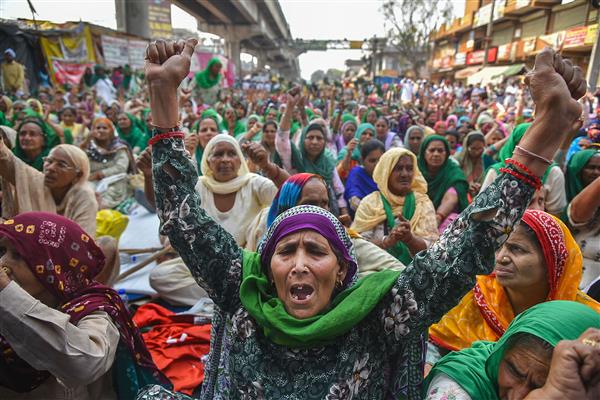
Women from Punjab and Haryana participate in farmers’ protest against the Centre’s new farm laws, at Tikri Border in Delhi. PTI file
New Delhi, March 17
Ahead of their Sampurna Bharat Bandh on March 26, farmer leaders on Wednesday said they were preparing to intensify the agitation against the three farm laws.
During the nationwide strike on March 26 that also marks four months of the farmers’ movement, all shops and other business establishments will remain shut for 12 hours, followed by the burning of the copies of the three laws during “holika dehan” on March 28.
“The strike will start from 6 in the morning and will continue till 6 in the evening, during which all shops and dairies and everything will remain closed.
“We will burn the copies of the three laws during Holi and hope that better sense prevails within the government, and it repeals the laws, and gives us a written guarantee for MSP,” said Ranjit Raju of Ganganagar Kisan Samiti addressing a press conference.
The bandh has found support in all trade and transport unions, students’, youth and women’s unions.
“We are also trying to create such meetings at the state level so that the strike is observed everywhere,” said another farmer leader Purushottam Sharma.
All India Kisan Sabha (AIKS) leader Krishna Prasad said the fact that the movement had managed to continue for as long as 112 days was an achievement in itself, and it would only get stronger from now.
He added that the Bharat Bandh will happen at “state, zila, tehsil and village levels”.
“The protest has been going on for 112 days. That itself is an achievement. Neither you, nor us had thought that we could do this, and the public has shown that it supports us,” he said.
Prasad also expressed concerns over the central government’s move to introduce the Electricity Amendment Bill 2021, claiming that any amendments made to the act would be in violation of the government’s commitment made to the farmers in January.
“During the 11 rounds of talks that we have had with the government, Agriculture Minister Narendra Tomar said that they accepted our demands over the electricity bill.
“The media wrote that 50 per cent demands of the farmers’ movement were resolved. But, now they are trying to introduce the act again. This is cheating,” he said.
Enacted in September, the three farm laws have been projected by the Centre as major reforms in the agriculture sector that will remove the middlemen and allow farmers to sell their produce anywhere in the country.
The protesting farmers, on the other hand, have expressed apprehension that the new laws would pave the way for eliminating the safety cushion of the Minimum Support Price (MSP) and do away with the “mandi” (wholesale market) system, leaving them at the mercy of big corporates. PTI
Probe in Army recruitment scam finds candidates in defence academy who paid ‘bribes’ to get in
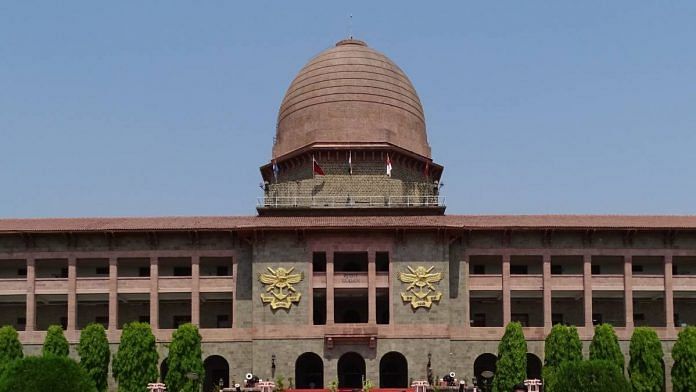
New Delhi: An internal probe by the Army revealed that at least two candidates made it into the prestigious Officers Training Academy (OTA), Chennai, and another cleared the Service Selection Board (SSB) of the National Defence Academy (NDA) in December 2020 through corrupt practices, ThePrint has learnt.
The investigation, sources in the defence establishment said, also revealed that a Non-Commissioned Officer (NCO) managed to become an officer in the Grenadiers regiment after paying close to Rs 10 lakh to the main accused, a Lieutenant Colonel rank officer.https://f4fde36d4c2d7edfe8b04b9ef1532ee8.safeframe.googlesyndication.com/safeframe/1-0-37/html/container.html
The alleged scam is believed to involve several serving personnel, including five Lt Colonel rank officers and two Majors.
The probe began last month after the Army’s Military Intelligence wing got a tip-off about the alleged payment of bribes to clear rejected officer candidates during their review medical exam at the Base Hospital in New Delhi, sources told ThePrint.
The Army investigation led to the identification of some of the accused. However, the Army chief, sources said, suspected that the scam may run deeper and directed that the case be handed over to the CBI, which filed an FIR in the matter Monday.
“The Army first did an internal investigation and found that there were many others who were involved, including serving officers and their family members. Having realised that the scale could be higher, the Army chief decided to hand over the case to the CBI so that a proper investigation could be done and this case be made an example of,” a source said.
Based on this direction, the Additional Directorate General, Discipline & Vigilance, Adjutant General’s Branch in the Army Headquarters, wrote to the CBI on 13 March, giving full details of the alleged scam. The case, the officer said, “involves wider network of service personnel and civilians”.
“To take this case to the logical conclusion, the case is being shared with CBI. The same will ensure that culprits do not go scot-free,” the Army note to the CBI said.
The CBI Monday booked 17 Army officers and personnel — including a Lt Col, Major, Naib Subedar, and Sepoy — and six private individuals, among others, for alleged bribery and irregularities in recruitment of officers and other ranks through SSB.
In a statement, the CBI said it had conducted searches at 30 places, including the Base Hospital, Delhi Cantonment, other Army establishments, and civilian areas covering 13 cities — Kapurthala, Bathinda, Delhi, Kaithal, Palwal, Lucknow, Bareilly, Gorakhpur, Visakhapatnam, Jaipur, Guwahati, Jorhat and Chirangon — and recovered several “incriminating documents”. The documents are being scrutinised as the investigation continues, the CBI added.
The aforementioned source said the allegations will lead to a lot of noise against the force, and questions on the recruitment format, but added that Army chief Gen M.M. Naravane “felt that a firm example should be made of all those who took part in this corrupt practice
The Army’s internal probe led to the identification of Lt Col. MVSNA Bhagwan of the Army Air Defence as the alleged mastermind of the scam. Lt Col. Bhagwan is currently on study leave in Visakhapatnam.
Naib Subedar Kuldeep Singh, posted at the Base Hospital, Delhi Cantonment, is believed to be the main middleman who scouted for candidates willing to pay money for selection through the SSB.
Naib Subedar Singh is accused of seeking assistance from Lt Col Bhagwan for SSB exams “in lieu of money” and “touted aspiring candidates” to him, according to the Army probe.
Along with him, the Army has identified Major Bhavesh Kumar, Group Testing Officer, Selection Centre North, Kapurthala, Lt Col Surender Singh, 31 SSB Selection Centre North, Lt Col Y.S. Chauhan, 6 Mountain Division Ordnance Unit, Lt Col. Sukhdev Arora, Directorate General Recruiting, New Delhi, and Lt Col Vinay, Group Testing Officer, Selection Centre South Bangalore, as “facilitators”.
Besides them, the Army has identified Lieutenant Navjot Singh Kanwar of 12 Grenadiers for “fraudulently” clearing SSB for SL (Special List) Commission, a way for NCOs to become officers.
Others accused are Cadet Hemant Dagar, SSC (Tech)—53 OTA, along with Cadet Inderjeet NCC (SPL) Entry—47, OTA.
Havildar Pawan Kumar is accused of paying money to get his son Neeraj Kumar to clear the SSB. The son cleared the SSB at the NDA in December 2020.
The CBI FIR mentions more Army personnel as accused, including Major Amit Fagna of 422 Field Hospital Delhi Cantonment.
Modus operandi
Sources said the scam revolved around clearance of candidates rejected temporarily by the medical board. One of the accused, Havildar Rajesh Kumar, Independent Recruitment Organisation, Delhi Cantt, used to collect a list of such rejected candidates and divulged the merit list prematurely.
It is suspected that payments for these transactions used to be made through cash and UPI to family members of the accused, including parents.
Military Intelligence, sources said, managed to track down several UPI payments and also video footage of “packages being exchanged”.
The CBI FIR says Major Bhavesh Kumar allegedly accepted bribes for 10-11 candidates, while Lt Col Surender Singh is alleged to have “accepted bribe for selection of 10-15 candidates”.
Role played by the crucial Akhil Bharatiya Pratinidhi Sabha of RSS, which meets this week
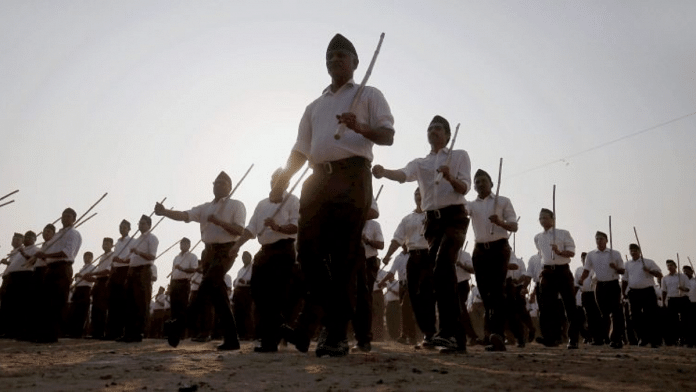
ashtriya Swayamsevak Sangh (RSS) volunteers taking part in ‘Path-Sanchalan’ in Ahmedabad (representational image) | PTIText Size: A- A+
New Delhi: The Akhil Bharatiya Pratinidhi Sabha (ABPS), the top decision-making body of the Rashtriya Swayamsevak Sangh (RSS), is all set to hold its annual meeting in Bengaluru on 19-20 March.
In recent years, there has always been a great deal of buzz and speculation around these meetings, especially since the Bharatiya Janata Party (BJP), an ideological mentee of the RSS, came to power in 2014.https://1fa97e4ab79b4ddf37dc400f6e55f2f5.safeframe.googlesyndication.com/safeframe/1-0-37/html/container.html
Due to lack of an understanding about the structure and functioning of the ABPS, observers and commentators often end up interpreting these organisational meetings from a unidimensional perspective, with the RSS-BJP relationship as the reference point. The reality is quite different, though.
The structure of the ABPS itself defines its functioning. It is, therefore, important to understand it, although it may appear to be a little complex for a rank outsider.
Who all participate in the meeting & what all is discussed
The RSS functionaries at prant (state/province) level and above, take part in the ABPS meetings. In addition, representatives of more than three dozen organisations, which are ideological mentees of the RSS, also participate.
The list of these organisations include Vishwa Hindu Parishad, Sewa Bharati, Vanvasi Kalyan Asram, Bharatiya Mazdoor Singh, Bharatiya Janata Party, Akhil Bharatiya Vidyarthi Parishad, Vidya Bharati, Bharatiya Shikshan Mandal and Swadeshi Jagran Manch.
The meeting generally lasts between two and four days, and is attended by RSS brass, including the sarsanghchalak (chief mentor) and sarkaryavah (general secretary), who preside over it. There are several sessions during the day where issues are discussed, presentations about RSS activities on the ground are put forward and future plans made.
A report on the status of the RSS is also presented at the meeting by the sarkaryavah, and the challenges faced by the nation as well as a way forward for the organisation are also discussed. The representatives of different organisations also share an overview of their works, highlighting the new initiatives they have undertaken.
The objective is to replicate good practices in social work across sectors and throughout the country, while facilitating synergy among various organisations and initiatives taken at different levels by the swayamsevaks.
The members of the ABPS go back after every meeting with a message from the brass as to what is going to be the broad direction of the RSS work for the coming year.
This message is then percolated down to the shakha-level through a series of meetings. The shakha is the basic unit of the RSS, which is held daily for an hour at more than 60,000 places across the country. It is broadly a one-hour meeting of RSS volunteers (swayamsevaks) where they take up activities aimed at creating people with noble character who keep the nation ahead of everything.
The ABPS usually also passes resolutions on issues of national significance, spelling out the RSS’ stand and approach on them. In the past, it has passed resolutions on issues ranging from cow protection, Sabarimala to India’s foreign policy.
The ABPS also forms an electoral college as according to the RSS’ constitution, the sarkaryavah has to be elected after every three years. The election of the sarkaryavah has always been unanimous ever since the process started in 1950 when ABPS met for the first time and elected Bhaiyya ji Dani to the position. This year the ABPS meet will elect a new sarkaryavah.
Over 1,000 members
The ABPS comprises delegates of RSS shakhas from all over the country — sanghchalaks (mentors), karyavahak (chief executive) and pracharaks (full-time workers) of kshetras (regions) and prantas (provinces).
It also comprises members of Akhil Bharatiya Karyakari Mandal, another key decision-making body of the RSS, although a smaller body than ABPS.
According to the constitution of the RSS, “The ABPS shall review the work of the sangh and lay down its policies and programmes. Sarkaryavah may invite certain categories of workers to attend the meetings of the ABPS. However, such special invitees shall not be entitled to vote.
“There are certain permanent invitees in the ABPS that include heads of different spheres of sangh work in Kshetra Karyakari Mandals (Regional Executive Councils) and Kshetriya Pracharak Pramukh (Regional in-charge of full-time workers) and Prant Pracharak Pramukh (State level in-charge of full-time workers).”
The ABPS is supposed to meet at least once a year. Every third year, the meeting is held in Nagpur. Last year, the ABPS meet, which was scheduled to be held in Bengaluru, was postponed due to the nationwide Covid-19 lockdown.
Had this meet not been postponed, then this year’s meeting would have been held in Nagpur. But the RSS decided that since the meeting in Bengaluru couldn’t be held last year, so it would be held in Bengaluru this year.
The ABPS currently has more than 1,000 members, but due to the prevailing situation of the pandemic, the meeting would be physically attended by only a handful of delegates, while the rest would participate online from their states, districts and regions.
The last ABPS meeting was held in 2019 in Gwalior, Madhya Pradesh, where sarkaryavah Bhaiyya ji Joshi mentioned in his annual report that the number of daily shakhas stood at 59,266. In March, 2018, this number was pegged at 58,967.
The writer is research director with the Delhi-based think tank Vichar Vinimay Kendra. He has authored two books on RSS.
The Veterans’ Association of Ontario is bringing together representatives from Hindu and Sikh organisations to resolve differences over the laws that have divided the Indo-Canadian community
A file photo of women farmers attending a protest against farm laws on the occasion of International Women’s Day at Bahadurgar near Haryana-Delhi border, India on March 8, 2021. (REUTERS/File)WORLD NEWS
Canada: Armed forces veterans’ body seeks to end rift over India’s farm laws
The Veterans’ Association of Ontario is bringing together representatives from Hindu and Sikh organisations to resolve differences over the laws that have divided the Indo-Canadian communityBy Anirudh Bhattacharyya I Edited by Nadim SirajPUBLISHED ON MAR 14, 2021 11:30 AM IST
A group of armed forces veterans in Canada has started a campaign to try to mend a growing rift between various communities in the country over farm laws passed in India last year that have sparked protests.
The Veterans’ Association of Ontario, which comprises Indian-origin members who have served in the armed forces in India and Canada, is bringing together representatives from Hindu and Sikh organisations to resolve differences over the farm laws that have divided the Indo-Canadian community.
Brigadier (Retd) Nawab Heer, chair of the association, told HT he was “hopeful” the situation will be “defused”, adding, “I don’t know why we should be creating tensions among ourselves. Views should be respected on both sides. If the Indian diaspora has to flourish here, we have to be together.”
The association has facilitated dialogue between some leaders of the two communities, while religious establishments like gurdwaras have also been brought into the process of trying to create harmony.
Union of India/ PCDA/ IAF have lost a petition in Supreme court against Veteran
Union of India/ PCDA/ IAF have lost a petition in Supreme court against Veteran JWO Bharat singh khatana for grant pension as per last Rank held. This is applicable for Pre 2006 retirees only. Now every one who held the rank for less than 10 months are eligible for pension of retired rank as per the supreme court judgement. Earlier, everyone who approached CDA/AFRO/DAV were getting reply that the case is under appeal in supreme court. I request every individual to write a letter to DAV/PCDA and seek revision of pension as per last rank held
State Stalwarts
DEFENCES FORCES RANKS
ARMY, NAVY, AIRFORCE RANKS
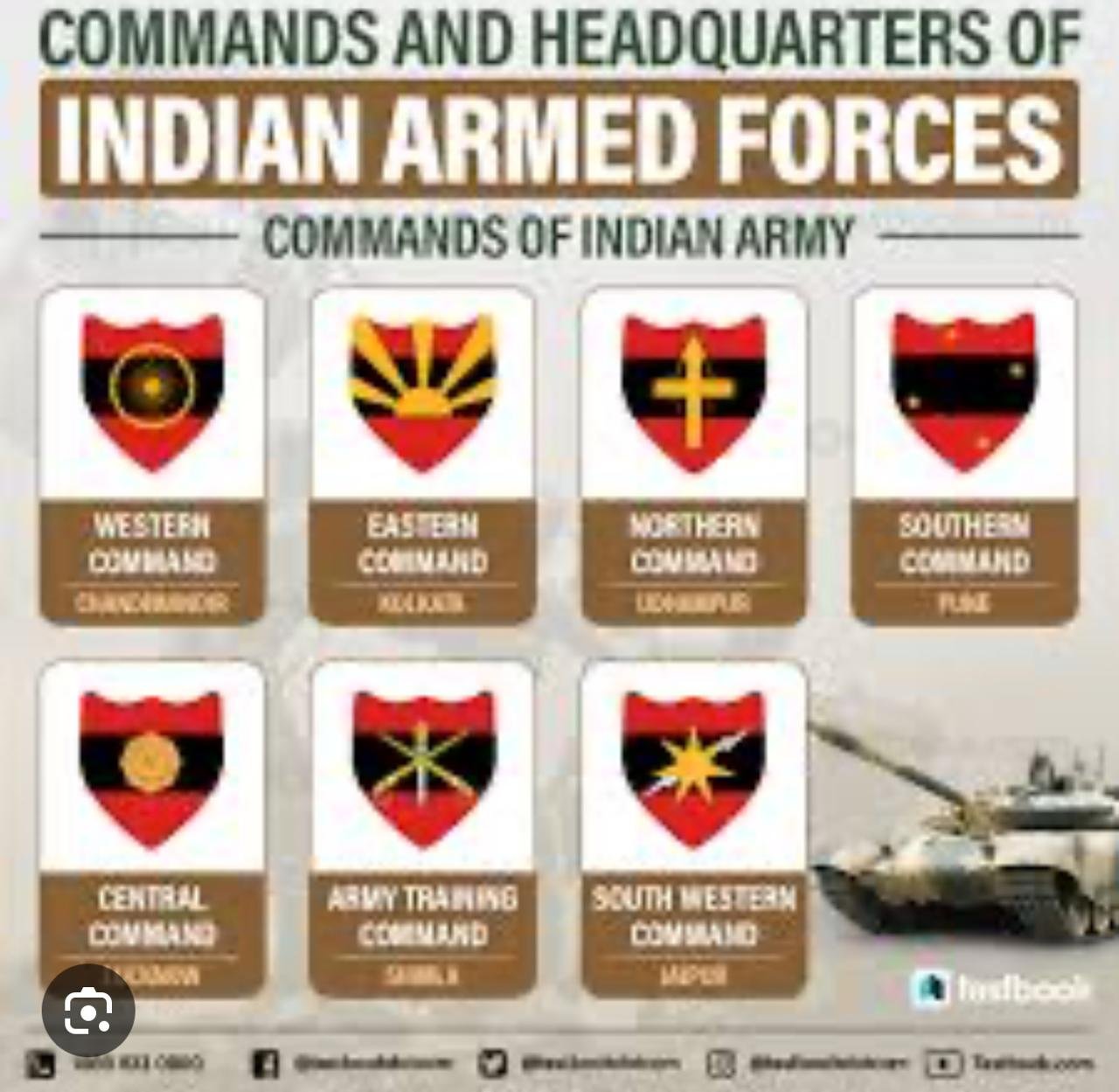
FORMATION SIGNS
FORMATION SIGNS
ALL HUMANS ARE ONE CREATED BY GOD
HINDUS,MUSLIMS,SIKHS.ISAI SAB HAI BHAI BHAI
CHIEF PATRON ALL INDIA SANJHA MORCHA
LT GEN JASBIR SINGH DHALIWAL, DOGRA
SENIOR PATRON ALL INDIA SANJHA MORCHA
MAJOR GEN HARVIJAY SINGH, SENA MEDAL ,corps of signals
.
.
PATRON ALL INDIA SANJHA MORCHA
MAJ GEN RAMINDER GORAYA , CORPS OF
sanjhamorcha303@gmail.com
PRESIDENT HARAYANA STATE CUM COORDINATOR ESM
BRIG DALJIT THUKRAL ,BENGAL SAPPERS
PRESIDENT TRICITY
COL B S BRAR (BHUPI BRAR)
PRESIDENT CHANDIGARH ZONE
COL SHANJIT SINGH BHULLAR
.
.
PRESIDENT PANCHKULA ZONE AND ZIRAKPUR
COL SWARAN SINGH
PRESIDENT SAS NAGAR (MOHALI)
COL BALBIR SINGH , ARTY
INDIAN DEFENCE FORCES
DEFENCE FORCES INTEGRATED LOGO
FORCES FLAGS
15 Th PRESIDENT OF INDIA SUPREME COMMANDER ARMED FORCES
Droupadi Murmu
DEFENCE MINISTER
Minister Rajnath Singh
CHIEF OF DEFENCE STAFF (2nd)
General Anil Chauhan PVSM UYSM AVSM SM VSM
INDIAN FORCES CHIEFS
CHIEF OF ARMY STAFF(29th)
General Upendra Dwivedi, PVSM, AVSM (30 Jun 2024 to Till Date)