Chinese display banners near the LAC in Demchok The Chinese, comprising Army personnel and civilians, came in five vehicles and raised banners near the village community centre Chinese soldiers and some civilians appeared on the other side of the Sindu river in the Demchuk region of Ladakh and displayed banners and Chinese flag in protest when Indian villagers were celebrating the birthday of the Dalai Lama. The incident occurred on July 6. The Chinese, comprising Army personnel and civilians, came in five vehicles and raised banners near the village community centre where the Dalai Lama’s birthday was being celebrated. Last week, Prime Minister Narendra Modi greeted the Dalai Lama on the occasion of his 86th birthday. This is the first time Narendra Modi has publicly confirmed speaking with the Dalai Lama since he took over as prime minister in 2014. In a tweet on Tuesday morning, PM Modi said, “Spoke on phone to His Holiness the @DalaiLama to convey greetings on his 86th birthday. We wish him a long and healthy life.” President of the Tibetan government-in-Exile Penpa Tsering told India Today TV last week that the Dalai Lama was expected to meet Prime Minister Narendra Modi after the Covid-19 situation stabilises. PM Modi’s tweet shows a significant shift in India’s Tibet policy vi’s-a-vi’s China and a strong message to Beijing. The Indian government had not wished China on the 100th anniversary of the Chinese Communist Party. India and China have been in a military stand-off since April-May last year and are yet to find solutions to de-escalate tensions at the friction points, including the Hot Springs-Gogra heights.
India wants complete disengagement and de-escalation along 823 km of the LAC in eastern Ladakh.
More than three months after senior military commanders of India and China met to defuse posturing along the Line of Actual Control (LAC), dates for a fresh round of talks are being firmed up while the agenda for the talks has been exchanged.
Respective stance
China doesn’t want to bring up the issue of Depsang buildup at the forthcoming dialogue
India wants complete disengagement and de-escalation along 823 km of the LAC in eastern Ladakh
At present, the two sides are not unanimous on the dates, but the matter is expected to be sorted soon, sources say. The People’s Liberation Army (PLA) has posted a new commander on its side. The Indian side would be led by Lt Gen PGK Menon, Commander of the Leh-based 14 Corps.
Both sides aim to complete the unfinished agenda of disengagement and de-escalation along the LAC in eastern Ladakh. Since June last year, both sides have conducted 11 rounds of talks at the Lieutenant General-level, the last being on April 9 this year.
The Working Mechanism for Consultation and Coordination (WMCC) on India-China Border Affairs met on June 25. The Ministry of External Affairs (MEA) coordinates this meeting on the Indian side. It was discussed to hold talks on “disengagement and de-escalation” of troops, weapons and equipment from Gogra and Hot Springs.
Sources said as an immediate measure, achieving a breakthrough at these two spots was possible.
For most Indians China is an adversary, a source of cheap products or the home of chow mien. China has risen on the foundations of its human capabilities and Indians ought to have a better appreciation of that by Sanjaya Baru This is a historic month for China. The Communist Party of China (CPC) came into being 100 years ago, in July 1921. Communist China entered the international mainstream a half century ago, in July 1971, when the United States decided to come to terms with the reality of its existence. China’s spectacular rise over the past quarter century, as a global trading superpower, the “factory of the world”, and as Asia’s most powerful nation, ready to challenge America’s global dominance, is the stuff of legend. Yet, even as China celebrates these landmark events, large parts of the world have become increasingly concerned about its assertion of newly acquired hard power — economic and military. In looking back at China’s rise a large part of the public discourse in India has been dominated by commentators on foreign policy, security and defence. Regrettably, very little has appeared in print on the social, cultural and human dimensions of China’s transformation and rise. In his recently published pithy narration of the events at Beijing’s Tiananmen Square in the summer of 1989 (Tiananmen Square: The Making of a Protest, A Diplomat Looks Back), former foreign secretary and a former Indian ambassador to China Vijay Gokhale observes in passing: “Indians can no longer afford to have a superficial understanding of events involving their largest neighbour and to-be-hegemon, other than at their own peril”. Mr Gokhale is spot on. Yet so much about what appears in print in India about China is about foreign affairs and the economy, written mostly by Westerners or Indians living in the West, and so little from Indians with a first-hand knowledge and experience of life and people in China. For most Indians China is an adversary, a source of cheap products or the home of chow mien. At one level this is not surprising. The fact is that the interaction between the neighbours has been limited through most history. More important, people-to-people interaction between the two republics over the past three quarters of a century has been even more limited. Little wonder then that even today we depend so much on retired diplomats to educate us about contemporary China. Only a couple of bright Indian journalists and a handful of scholars have been able to bridge the public awareness gap between the two. This worryingly low level of social and cultural interaction between China and India has dipped further thanks to renewed tensions between the two and the post-Galwan and post-Covid freeze in bilateral interactions. The China-India relationship has moved from the honeymoon days of “Hindi-Chini bhai-bhai”, and the post-Cold War phase of increased economic and business interaction – “India-China buy-buy”, as someone put it — to the current “Cold War” phase of “India-China bye-bye”. This is not a satisfactory state of affairs. Whatever the differences between the two countries, and there are many, there ought to be both a better understanding of each other within both societies and increased people-to-people interaction. For over a century Indians fought Western imperialism and colonialism and yet not only acquired an intimate knowledge of Western culture, science, literature, music and so on, but also benefitted from such knowledge. India’s attitude towards China today should not be very different from the view that Mahatma Gandhi famously expressed of the kind of relationship that he sought with Britain and its people in the midst of the national movement for Independence. When asked by a Briton in that period “How far would you cut India off from the Empire?”, Gandhiji replied: “From the Empire, completely; from the British nation, not at all, if I want India to gain and not to grieve. The British Empire must go and I should love to be an equal partner with Britain, sharing her joys and sorrows. But it must be a partnership on equal terms.” Even as India rejects China’s hegemonic ambitions, as it did the hegemony of the West, and disapproves of its authoritarian political system, Indians must acquire a better understanding and appreciation of Chinese society, culture and its knowledge-creating institutions. China is not merely an authoritarian, militarised Communist regime, which it is, but it is also a highly creative and productive knowledge-based society and economy. China has risen on the foundations of its human capabilities. Indians ought to have a better appreciation of that. The Xi Jinping regime is itself to blame for the acute focus in Indian public discourse on China’s negative attributes. However, it is in India’s interest to balance that with a better understanding of life in China. The Chinese too should realise that Indians are a proud people with their own memory of their civilizational inheritance and can be nobody’s cat’s paw. The history of Indian nationalism is in many ways greater than the history of Chinese nationalism. Mahatma Gandhi and the Indian National Congress did not fight for India’s liberation alone. They fought for the liberation of all colonised people and against imperialism and colonialism in all its manifestations. Whatever strategic and foreign policy compromises India might make in the short run cannot be a deviation from its “tryst with destiny”. In July 1971, when then US national security adviser Henry Kissinger met Chairman Mao Zedong in Beijing and proposed a US-China condominium against the Soviet Union, China did not give up its civilizational inheritance of being an independent-minded nation. It walked a path that gave it the strategic space for its own rise. India too seeks that space for its own development. Over the past 50 years the people-to-people contact between the United States and China has been intense and extensive. It has created the foundation for a durable relationship even when the two seek today greater strategic space for themselves. It is in the interests of both China and India that there is similar engagement between their people, even as the two states jostle with each other for strategic space within Asia and the world. People-to-people relationships must stand on their own footing and not always be subject to state-to-state relations.
Unconventional raid, exemplary valour by Lt Gen Raj Kadyan (Retd)
For his daring act of bravery in leading the charge despite being gravely wounded, Capt Umaid Singh Mahra was awarded Ashok Chakra in 1972
Lt Gen Raj Kadyan (Retd)
Our battalion 19 Rajputana Rifles moved to Nagaland in late 1970. Insurgency was active. We occupied a string of posts. As Adjutant, I was located at the battalion headquarters in Jessami. Our 2IC having been wounded and evacuated, I was also doing that job, being next in seniority. By a strange coincidence, on the day of the operation, the Commanding Officer too was away on short leave and I was officiating CO.
On July 5, 1971, Capt Umaid Singh Mahra called me on radio from his Kizare post in the Sema area. While attending Sunday church service the previous evening, Capt Mahra had noticed an unfamiliar face and had brought him to the post. During overnight interrogation, the man had confessed that he was an active underground (UG) soldier posted to a self-styled brigade HQ. He was then ‘persuaded’ into leading us to the camp.
The indicated camp location fell in the area of our neighbouring battalion. It was rare to get such a vital lead. Any sharing of this information outside the strict need-to-know loop could jeopardise success. I, therefore, did not inform our brigade headquarters or the battalion concerned (my elder brother was their 2IC). Any risk of a friendly patrol clash was worth taking.
I asked Mahra to move immediately. The indicated location was nearly 14 hours of walking distance from Kizare. It also culminated into climbing a steep hill. The plan was to raid at dawn so that any escapees could be easily apprehended in daylight; this was the standard Army tactic.
A rivulet had to be crossed before starting the climb. Because of monsoon, it was in spate. The party kept moving upstream to find a shallow crossable site. This caused delay.
Having reached the top, the party of Company less a platoon, moved along the thickly wooded crest, taking all precautions against a possible ambush. The guide had his hands tied at the back and was secured with a rope. It was nearly 6:30 am and the party was still moving. Luckily, because of rain and thick fog, visibility was limited to a few metres, creating near-darkness conditions. Since it was well past the planned raiding time, there was palpable disenchantment among the men, who were out practically every third night searching for the elusive UGs.
At one point, the guide became visibly restive and sat down. It was clear the camp was close by. On being prodded, he vaguely waived a hand towards one of the slopes. Capt Mahra, with a small party of four, started descending in the indicated direction for confirmatory reconnaissance. It was very steep and they had to literally sit on their rumps and glide down. The undergrowth was waist high.
Suddenly, they came upon the well camouflaged camp barely 15 feet away, hidden in a depression. The sentry spotted the raiding party, raised an alarm and opened fire. Capt Mahra was hit in the abdomen. Undaunted, and despite being wounded, he charged into the camp firing from his hip and exhorting his party. He shot the sentry through the head, killing him instantly. Some UGs were injured and fled down into the thick jungle, leaving a blood trail. They were rounded up subsequently.
The actual shootout lasted barely a few seconds, with the UGs running away confusedly. A total of 13 weapons, including a light machine gun, a large quantity of ammunition and important documents were captured.
The brigade headquarters was now informed and I asked for air evacuation of Capt Mahra. Poor visibility precluded helicopter flying. He had to be brought down on an improvised stretcher slowly along a trackless precipitous slope. Unfortunately, before he could reach the waiting ambulance on the road, Capt Mahra succumbed to his injury at 2:30 pm; his liver had been ruptured.
The GOC flew in the next morning to congratulate the battalion. He termed the success of the raid and the haul unprecedented.
The timing of the raid, the actual number involved at the point of contact, non-deployment of the usual support and cut-off groups, etc, made the raid totally unconventional. The UGs, who were well aware of our modus operandi, were taken totally by surprise.
For his daring act of bravery in leading the charge despite being gravely wounded, Capt Umaid Singh Mahra was deservedly awarded the Ashok Chakra. His young widow received it from the President on the Republic Day, 1972.
This was the first Ashok Chakra in our regiment, the Rajputana Rifles.
WORRYING: CHINA IS CREATING PERMANENT STRUCTURES IN LADAKH
Sources in the security establishment said that “the Chinese have been creating permanent structures, including those required for defences and habitation of the troops” NEW DELHI: The apprehensions of a long haul along the Line of Actual Control (LAC) in eastern Ladakh have started manifesting on the ground as the Chinese forces have been creating permanent structures in areas wherever the Peoples’ Liberation Army troops are deployed. This comes after the Indian Air Force Chief confirmed that the Chinese are improving their air infrastructure. Sources in the security establishment said that “the Chinese have been creating permanent structures, including those required for defences and habitation of the troops”. In view of the Chinese move, India has also been building permanent defences and structures for habitation but these will take some time, added the source. Air Chief Marshal RKS Bhadauria had said in the first week of July that China had strengthened its infrastructure and improved the efficiency of its air operations. Since May 2020, the PLA has moved its soldiers along the LAC at several points, forcing the Indian army to counter the Chinese move with its own deployments. Although there has been disengagement of troops and equipment from the north and south banks of Pangong Tso since then, the standoff continuing in areas like Hot Spring, Gogra Post and Depsang. Defence Analyst Maj-Gen SB Asthana (Retd) calls it a furtherance of the Chinese ‘incremental encroachment strategy’. “China, in the overall design under incremental encroachment strategy, is trying to enforce the infra development and its claim along its perception of LAC and in that context, is trying to settle down villages and make permanent structures so that over a period, its claim gets strengthened.” “We should also improve our infrastructure along our perception of LAC and also make permanent structures and settle down villages so that the Chinese don’t succeed in their game plan,” he suggested as a counter move. India has ramped up road-building along the LAC and has also mobilised the troops with more than 50,000 personnel stationed in eastern Ladakh to thwart any move by the PLA men.
WITH EYE ON INDIA’S SFF, CHINA RECRUITS TIBETAN TROOPS FOR ‘SPECIAL OPERATIONS’ ALONG LAC: REPORT
India-China Standoff: Sources, quoted by news agency ANI, have said that China is trying to create a new special forces unit similar to India’s SFF that will have several Tibetans New Delhi: After failing to cope with the soldiers of the Indian Army in the extreme weather condition of eastern Ladakh, the People’s Liberation Army (PLA) of China is now training its Tibetan troops for special operations in high altitude areas of the Line of Actual Control (LAC). Sources, quoted by news agency ANI, have said that China is trying to create a new special forces unit similar to India’s Special Frontier Force (SFF) that will have several Tibetans, who have specialisation in mountain warfare. The sources said that China’s PLA recently also held an exercise for its Tibetan troops after going through a number of ‘loyalty tests’ including learning the mainland Chinese language and following their practices. “The Tibetan troops of the Chinese Army are being trained for special operations and recently held drills in their rear areas,” ANI quoted the sources as saying. India and China were engaged in standoff along the LAC in eastern Ladakh after the deadly Galwan Valley clash that claimed the lives of 20 Indian soldiers, including a Colonel-rank officer. Though the two sides have withdrawn troops from several friction points, they are yet to find solutions for de-escalating the tensions at several areas including the Hot Springs-Gogra heights. The two sides, however, have held multiple rounds of talks at both military and diplomatic levels but without much yield except for the limited mutual withdrawal of men by both sides on both northern and southern banks of the Pangong Tso. Last month, Army Chief General MM Naravane had said that there can be no de-escalation without complete disengagement at all friction points in eastern Ladakh and that the Indian Army is prepared for all contingencies in the region. He had also said that India is dealing with China in a “firm” and “non-escalatory” manner to ensure the sanctity of its claims in eastern Ladakh and that it was even open to initiating confidence-building measures.
JAWA SPECIAL EDITION COMMEMORATES INDIA’S VICTORY IN THE 1971 WAR
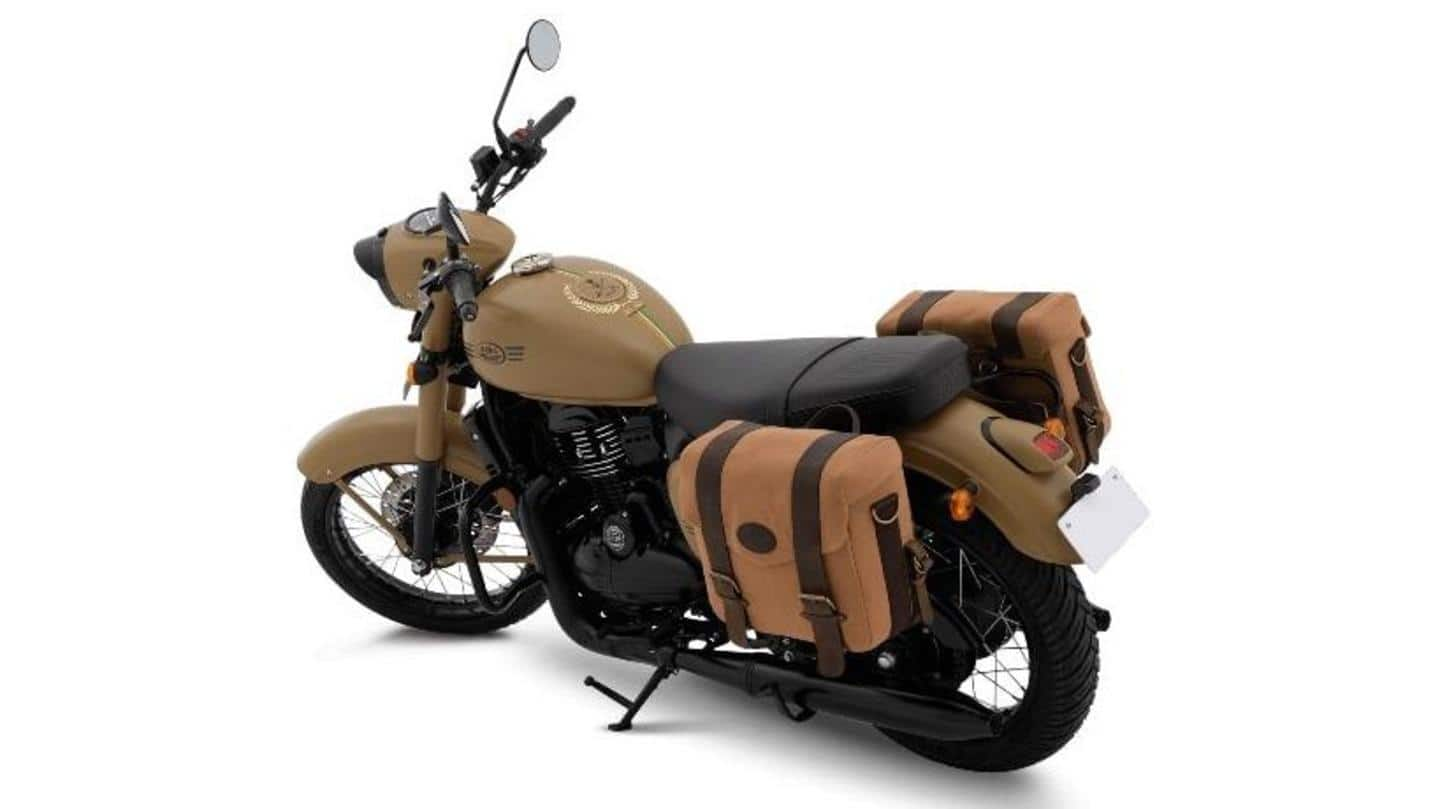
As part of the Swarnim Vijay Varsh, Jawa Motorcycles has launched a special edition of its Jawa model to commemorate India’s victory against Pakistan in the 1971 war. The bike is available in two special shades namely, Khakhee and Midnight Grey, and sports cosmetic upgrades over the standard two-wheeler. However, there are no mechanical changes. Here are more details. History” Over 3,000 Indian Armed Personnel Lost Their Lives This year marks the 50th anniversary of the 1971 Indo-Pakistan war which lasted 13 days, making it one of the shortest battles in history. It was fought on both the eastern as well as western fronts. Following Pakistan’s surrender, our eastern neighbour Bangladesh, then known as East Pakistan, became independent. Over 3,000 Indian army personnel lost their lives while over 10,000 were injured.
Design: Tri-Colour And Indian Army Emblem Are Present On The Tank The Jawa Special Edition has a muscular fuel tank with the tri-colour and Indian Army emblem on it. There is also an insignia that reads ‘Commemorating 50 years of the 1971 war victory’ and ‘1971-2021 Special Edition.’ The body paintwork as well as the headlight bezel, twin exhaust pipes, suspension forks, and the engine exhibit a matte finish. Information: It Is Fuelled By A 27Hp, 293Cc Engine The Jawa Special Edition draws power from a BS6-compliant 293cc, single-cylinder engine that generates a maximum power of 26.9hp and 27.02Nm of peak torque. The mill is linked to a 6-speed gearbox.
Safety: There Are Disc Brakes On Both The Wheels To ensure the safety of the rider, the Jawa Special Edition is equipped with disc brakes on both the front and rear wheels, along with dual-channel ABS for better handling on the roads. Suspension duties on the motorcycle are taken care of by telescopic forks on the front side and dual shock absorbers on the rear end. Information: Jawa Special Edition: Pricing And Availability In India, the Jawa Special Edition can be booked online via the company’s website. It carries a price-tag of Rs. 1.93 lakh (ex-showroom), making it Rs. 6,000 more expensive than the standard Jawa.
Each of the 17 existing commands is headed by a secretary-level three-star officer. Assuming that Ministry of Home Affairs (MoHA) is willing to play ball, integrating them with the Integrated Theatre Commands (ITCs) structures is not going to be an easy task by Amit Cowshish Speaking at a webinar organised by the Global Counter Terrorism Council, Chief of Defence Staff (CDS) described the Indian Air Force (IAF) as a ‘supporting arm’ akin to artillery and engineers that support the combatant arms of the Indian Army (IA). He also added, somewhat patronisingly, that the IAF must understand that its charter is to provide support to the ground forces in time of operations, belittling the force that turned the tables in the last war fought in Kargil in 1999. Coming from someone who is tasked with the responsibility of bringing about operational jointness by compressing the existing 17 commands, the three services presently operate, into five Integrated Theatre Commands (ITCs), the statement was iniquitous and untimely. The IAF’s role is not confined to air defence. In recent years, it has played a stellar role in Humanitarian Assistance and Disaster Relief (HADR) operations, which are not a part of military operations. More importantly, IAF has an important role to play in future wars that are more likely to be fought in air and space. While Air Chief RKS Bhaduria quickly refuted the CDS saying that ‘airpower has a huge role to play’, mirroring the reservations IAF has had for more than two decades, it is unlikely to stall the inadequately planned move to create the ITCs. However, this disagreeable and entirely avoidable public spat indicates that other complex issues -and there are several of them- impacting establishment of the ITCs may also get similarly brushed under the carpet. Each of the 17 existing commands is headed by a secretary-level three-star officer. With the requirement coming down to 5 after ITCs are established, one of the immediate challenges would be to accommodate 12 three-star officers who would become redundant after the ITCs are formed. Additionally, some Principal Staff Officers (PSOs) at the Services Headquarters (SHQ) who also enjoy the same status may become redundant in the new command and control structure. The problem may seem insignificant, but it is not a trivial matter for an organisation that is extremely sensitive about pay, perks and status, especially vis-à-vis the civilians. Talking of civilians, the indications are that the ITCs would subsume not only some of the entities presently administered by the Ministry of Defence (MoD), like the Border Roads Organisation (BRO) and the Indian Coast Guard (ICG), but also the paramilitary forces like Assam Rifles and the Indo-Tibetan Border Police that are presently controlled by the MoHA. Assuming that MoHA is willing to play ball, integrating them with the ITC structures is not going to be an easy task. The organisational ethos of the services, especially the IA, is largely incommodious and domineering. The prejudices, biases and grudges have got ingrained in their outlook which is not conducive to integration of ‘outsiders’, generally considered inferior. This attitude is more pronounced when it comes to dealing with the civilian officers who too are expected to be inducted into the ITC set-up. No thought seems to have been given to how this attitudinal change will be brought about to not only get over the decades long inter-services rivalries and turf wars -amply demonstrated by the CDS’s statement and the Air Chief’s rejoinder- but also the adversarial views about having the civilian bureaucracy as a part of the decision-making in the new set-up on an equal footing. This too may not be so easy for the protocol-conscious services. These issues are not as fanciful as they may appear; those familiar with the inner functioning of the BRO and ICG, or the Military Engineer Service (MES) which has a fair sprinkling of civilians, would vouch for it. And so would the officers of the Armed Forces Headquarters Service (AFHQ) which is a civilian cadre manning the SHQs. This attitudinal propensity is best illustrated by the posting of two civilian officers to the Department of Military Affairs (DMA), headed by the CDS as its secretary, who have been assigned the mundane tasks of managing the establishment, coordination, works and parliamentary affairs. Last but not the least, one of the first things the impecunious MoD needed to do was to estimate the cost of establishing the ITCs, but this does not seem to have been done. Going by common sense, huge sums of money will be required to create the infrastructure for the ITCs as it is almost certain that the existing infrastructure at none of the stations where the existing command headquarters are located would be considered adequate by the ITC commanders. For example, going by the media reports, the Western Theatre Command is likely to be located at Jaipur which is where the IA’s South Western Command (SWC) is presently located. Set up on 15 April 2005, the SWC’s infrastructure may not be adequate to accommodate the entire establishment of the new Western ITC. Expansion of infrastructure would involve acquisition of additional land which, apart from being an expensive and time-consuming process, can get mired in litigation. This is precisely what happened in Karwar in Karnataka, which is being developed as a naval base. The first phase of this naval base, called INS Kadamba, was completed after several years of work in 2005. The second phase of development that started in 2011 is yet to be completed. For quite some time, the project was embroiled in court cases filed by the landowners, whose land was acquired for the project, for higher compensation. Besides, establishing other essential services like water, electricity, approach roads, schools, and shopping centres can be an equally onerous exercise. It would require careful planning to pre-empt such delays in raising or augmenting the infrastructure of the new ITCs. Meanwhile, at least 12 of the existing Command Headquarters will have to be downgraded, possibly rendering some of the infrastructure surplus to the requirement. It is not known to what use the surplus infrastructure is planned to be put. Financial planning is critical to minimise the cost by making optimum use of the existing infrastructure and resources. While it is important to resolve the larger operational issues, such as the new command and control structure, before the ITCs are created, it would be a mistake to play down the above mentioned seemingly mundane issues as these could frustrate the process.
India has been striving for indigenisation of defence production for close to three decades. To give impetus to the efforts, the Ministry of Defence (MoD) had constituted a committee in the early 1990s under Prof APJ Abdul Kalam. The committee suggested a 10-year roadmap to increase the indigenous component in the total expenditure on capital procurement from 30 per cent in 1992-93 to 70 per cent by 2005. This goal could not be achieved and there continues to be some confusion about the present state of indigenisation. Present State of Indigenisation Several steps have been taken in the last 20 years, but the outcome of these efforts remains a matter of debate as the available data on indigenisation is confusing. According to a recent report of the Standing Committee on Defence (SCoD), only 93 of the 213 contracts worth about Rs 1,76,569 crore were awarded to foreign vendors of the USA, Russia, Israel, France, and some other countries between the financial years (FYs) 2016-17 and 2019-20.1 The same report shows that the proportion of expenditure on imported defence equipment in the total expenditure went up from 30.41 per cent in the FY 2010-11 to 43.22 in the FY 2019-20, and though in the first three quarters of the following year (FY 2020-21), it plummeted to 32.39 per cent,2 it is possible that the percentage jumped up again by the end of the year. These figures give the impression that the goal set by the APJ Abdul Kalam Committee has largely been met. However, this is not borne out by other empirical evidence. In the last five years alone, several contracts have been awarded to the foreign vendors for an assortment of platforms like Dassault’s twin-engine Medium Multi-Role Combat Aircraft (MMRCA), Boeing’s multi-role combat AH-64E Apache and vertical-lift Chinook helicopters, Lockheed Martin’s C-130J Super Hercules four-engine turboprop military transport aircraft, and Russian Almaz-Antey’s S-400 Triumf Air Defence System. The Strategic Partnership Model adopted in 2016, which envisages manufacturing of foreign-origin platforms by the Indian companies with the transfer of technology from the former, is another indication that presently India does not have the capability to design and develop state-of-the-art fighter aircraft, helicopters, submarines, and armoured fighting vehicles/main battle tanks. But, above all, according to Stockholm International Peace Research Institute (SIPRI), India was the second-largest importer of arms in 2016-20 after Saudi Arabia.3 Indigenisation In High-Technology Areas Lagging Behind The best explanation for these contradictory sets of facts is that while the Indian industry has done reasonably well in manufacturing foreign-origin equipment with the help of technology transfer from the foreign Original Equipment Manufacturers and in indigenising components, it still lacks the capability to indigenously design and develop major platforms, with a few exceptions like the Light Combat Aircraft Tejas, which is what indigenisation should be all about. Even in respect of components and assemblies, no data/information is available to show whether these are critical parts of the equipment/platforms in which these are used. This is important because the extent of indigenisation of a product matters little if a critical part, even if it constitutes a miniscule percentage of the overall product, is not indigenised. In hostile circumstances, the OEM or the country of its origin could deny the export of such items and paralyse production in India. Seen in this perspective, the level of indigenisation of defence production in India is quite low. Broadly, there are four reasons for this. Absence of An Overarching Policy Framework The primary reason is the absence of a pragmatic overarching indigenisation policy. What comes closest to it is a notification issued by the Department of Defence Production (DDP) in 2019.4 It cannot be the guiding document for a concerted effort as it only contains the policy for indigenisation of components and spare parts used by the Defence Public Sector Undertakings (DPSUs) and the Ordnance Factory Board (OFB) in the manufacturing process. Be that as it may, this document too suffers from many conceptual and procedural inadequacies. For example, the stipulation that the ‘indigenised product should invariably be cheaper and meet all technical and functional specifications of the imported component which it seeks to replace’5 , makes it unrealistic and unworkable as the indigenised products are not always cheaper. No wonder then that the focus of the DPSUs/OFB has been mainly on the indigenisation of items that can be manufactured in India at a cheaper cost vis-à-vis the cost of importing them. Such items do not generally account for a substantial proportion of the technologies that go into the making of a high-technology product and, therefore, the extent of indigenisation of critical components in various defence products continues to be low. Absence of An Overarching Organisation The second reason is the absence of an overarching organisation to channelize the efforts being made by several agencies towards a pre-defined goal. Besides DPSUs and the OFB, other agencies presently involved in indigenisation efforts include the Indigenisation Directorates of the Services, Defence Research and Development Organisation (DRDO), and the Defence Innovation Organisation (DIO).6 The efforts being made by these agencies are largely disjointed and lack synergy, and no mechanism is in place to facilitate their interaction with the armed forces which are the primary stakeholders in the indigenisation efforts. Procedural Complexities And Financial Viability Procedural complexities are the third reason for the slow pace of indigenisation. Though some efforts have been made in recent years to smoothen the process, agencies involved in indigenisation continue to follow their own procedures and norms. A typical example is the process of selection of partners from, and giving assurance of orders to, the private sector industry, especially the Micro, Small and Medium Enterprises (MSMEs), who play a critical role in developing niche technologies and providing solutions that are critical for indigenisation. Besides, no satisfactory system is in place to address the issue of Intellectual Property Rights violations that are bound to arise if import substitutes are to be designed and developed in India. Budgetary Constraints Lastly, there is a severe budgetary constraint, making it difficult to earmark substantial sums of money to undertake large-scale efforts, especially for indigenous design, development and production of futuristic equipment, platforms, and weapon systems, which is essential for achieving self-reliance. Indigenisation depends heavily on research and development (R&D), on which the public spending in India has consistently been quite low. Barring a few notable exceptions, even the private sector has been reluctant to make heavy investments in R&D because of the uncertainty that the MoD will procure the indigenously developed product. What Can Be Done As the first step, the MoD needs to formulate a composite policy that focuses on indigenisation in high priority technology areas, shedding the notion that it must necessarily result in savings. The commercial viability of the identified projects and institutional arrangement for financing them, apart from a mechanism to accommodate the cost of failed efforts, must form the bedrock of the policy. As a matter of policy, a distinction needs to be made between indigenisation of major systems-equipment, weapons, and assorted platforms – that of components, assemblies, and sub-assemblies. This is important because the challenges faced in the indigenisation of these two categories of defence materiel are different. The approach to indigenisation in these two distinct areas will have to be different. Secondly, there must be an overarching organisation to coordinate indigenisation efforts currently being made almost independently by several institutions mentioned above. This organisation will have to work out a system for ensuring deeper involvement of the private sector in the indigenisation effort, apart from engagement with other scientific institutions, innovators, foreign entities, and academia. The private sector, especially the MSMEs, and Start-ups, can play a major role in achieving the intended results. However, funding is a major issue for them, as also the assurance of the follow-on orders being placed on them. These issues will require to be addressed. Thirdly, procedural issues need to be resolved to ensure that the testing, quality assurance and certification agencies work more as a part of the team engaged in indigenisation rather than as external technology audit entities. This may also require the quality assurance personnel to acquire and upgrade their domain expertise, as well as test procedures, equipment and methodologies. This is just an example of the procedural tangles besetting indigenisation. Many other issues, such as the setting of extremely stringent specifications by the services and lack of clarity about the aggregated long-term demand for the indigenised product – for special alloys, for example – also slow down indigenisation as action cannot be taken in such cases in the absence of economy of scales. Fourth, legal issues that often come in the way of indigenisation of products need to be tackled. This is more relevant in the case of substitution of parts and assemblies fitted in the imported equipment through indigenisation efforts which pose a problem because of the legal constraints imposed by the warranty/guarantee clauses in the contracts awarded by the MoD/Services to the technology provider concerned. Lastly, indigenisation is driven by commercial considerations. No seller will opt for indigenisation if it involves the risk of conceding a competitive edge to another seller because of the additional cost of indigenisation, or if the delivery schedule is inflexible allowing no room for indulging in time-taking indigenisation efforts, or there is uncertainty about the MoD’s ability to place follow-on orders for indigenised products because of the enduring financial constraints it has been facing for long. A more modest and focussed mission-mode approach to indigenisation can produce better results.
State Stalwarts
DEFENCE MINISTER
Minister Rajnath Singh
ALL HUMANS ARE ONE CREATED BY GOD
HINDUS,MUSLIMS,SIKHS.ISAI SAB HAI BHAI BHAI
CHIEF PATRON ALL INDIA SANJHA MORCHA
LT GEN JASBIR SINGH DHALIWAL, DOGRA
SENIOR PATRON ALL INDIA SANJHA MORCHA
MAJOR GEN HARVIJAY SINGH, SENA MEDAL ,corps of signals
.
.
PATRON ALL INDIA SANJHA MORCHA
MAJ GEN RAMINDER GURAYA ,MADRAS REGIMENT
sanjhamorcha303@gmail.com
PRESIDENT SOUTH ALL INDIA SANJHA MORCHA
COL SS RAJAN BOMBAY SAPPERS,
PRESIDENT UTTARAKHAND ALL INDIA SANJHA MORCHA
COL B M THAPA ,BENGAL SAPPERSS
PRESIDENT HARAYANA STATE CUM COORDINATOR ESM
BRIG DALJIT THUKRAL ,BENGAL SAPPERS
PRESIDENT TRICITY
COL B S BRAR (BHUPI BRAR)
PRESIDENT CHANDIGARH ZONE
COL SHANJIT SINGH BHULLAR
.
.
PRESIDENT PANCHKULA ZONE AND ZIRAKPUR
COL SWARAN SINGH
INDIAN DEFENCE FORCES
DEFENCE FORCES INTEGRATED LOGO
INDIAN AIR FORCE
Air Officer C-in-C WESTERN AIR COMMAND
AIR MSHL S PRABHAKARAN AVSM VM
AOC-IN-C, EASTERN AIR COMMAND
Air Marshal Inderpal Singh Walia
AOC-in-C SOUTH WESTERN AIR COMMAND
Air Marshal Vikram Singh
AOC-IN-C, SOUTHERN AIR COMMAND
Air Marshal J.Chalapati
AOC-IN-C TRAINING COMMAND
AIR MARSHAL SK GHOTIA VSM
AOC-IN-C MAINTENANCE COMMAND
Air Marshal Jagdish Chandra
Flag Officer Commanding in Chief, Western Naval Command
ice Admiral R Hari Kumar, PVSM, AVSM, VSM
Flag Officer Commanding in Chief, Eastern Naval Command
Vice Admiral Sanjay Bhalla, AVSM, NM
Flag Officer Commanding in Chief, Southern Naval Command