



Sanjha Morcha

What’s New

Click the heading to open detailed news

Current Events :

web counter

Print Media Reproduced Defence Related News

RETIRED CHINESE MILITARY OFFICIAL MOOTS ‘BUFFER ZONES’ TO PREVENT INDO-CHINA BORDER CONFLICT

Says, previously agreed CBMs should be revisited and the less-contentious ones enforced
A retired senior Chinese military official has proposed that China and India should implement the existing confidence building measures (CBMs) and follow up by taking the “boldest step” of establishing “buffer zones” in the “most dangerous areas” along the Line of Actual Control (LAC) to prevent any border dispute from spilling over into a conflict.
In an article titled “China and India should look back to move forward on border impasse” in the Hong Kong-based South China Morning Post newspaper on Tuesday to mark the first anniversary of the Galwan Valley border clash between Indian and Chinese troops, Senior Colonel (Retd) Zhou Bo of the People’s Liberation Army said, “The deadly incident was dreadful in that it came closest to breaking a decades-old tacit agreement between the two countries not to use force.”
In the first deadly clash in the border area in nearly five decades, 20 Indian soldiers were killed on June 15 last year in the Galwan Valley in fierce hand-to-hand combat with Chinese troops, triggering a large deployment of troops and heavy weaponry by both armies at the friction points in eastern Ladakh.
In February, China officially acknowledged that only five Chinese military officers and soldiers were killed in the clashes with the Indian Army though it is widely believed that the death toll was higher.
Significantly Bo, who is a senior fellow at the Centre for International Security and Strategy at Tsinghua University here, chose to publish the article containing his proposals to defuse the tensions in the Hong Kong media instead of China’s official media.
“A year after the shock of a fatal border clash, tensions remain high with no consensus on how to resolve the issues over an unverified LAC,” he noted.
The aftermath is still being felt today. Beijing was given the cold shoulder when it offered to help pandemic-devastated India. Such resentment speaks volumes of the frosty relationship, he pointed out.
“To prevent conflict, both sides should dust off previously agreed confidence-building measures and enforce the less-contentious ones,” he suggested.
It has been more than a year since the military stand-off between China and India erupted in eastern Ladakh on May 5, 2020 during which there were fatalities on both sides. The two sides have made limited progress in achieving disengagement at the Pangong Lake area while negotiations for similar steps at other friction points remained deadlocked.
In his lengthy article, Bo, while addressing the question on “how to prevent the dispute from spilling over into a conflict”, did touch upon India’s demand for withdrawal from the remaining areas of eastern Ladakh.
“The way forward is to look back. Between 1993 and 2013, China and India reached four agreements on confidence-building measures at governmental and military levels. This is more than any bilateral agreements China has signed with other countries. And they are substantive, too, which is impressive,” Bo noted.
The four agreements India and China signed in that period included the 1993 Agreement on the Maintenance of Peace and Tranquillity along the LAC and the 1996 Agreement on Confidence-Building Measures in the Military Field along the LAC.
In the agreements, both the countries “reaffirm that they shall reduce or limit their respective military forces along the LAC to minimum levels”, Bo points out.
“If only these measures were being implemented. In fact, both sides are strengthening their military presence in the region. This is no surprise in the wake of a crisis. But when the situation cools down, both countries will have to think about how they can best make the border areas peaceful and tranquil,” he noted.
“Perhaps the boldest step might be to establish buffer zones in the most dangerous areas along the LAC. Without prejudicing their respective positions on the boundary question, this is the most effective way to disengage and prevent conflict,” he said.
“Both sides agree they shall not follow or tail patrols of the other side in areas where there is no common understanding of the LAC. Building buffer zones is a step further. And it is possible, too,” Bo noted.
“From the mountains around Pangong Lake, a de facto buffer zone has already been established after the mutual withdrawal of troops,” he pointed out.
Another way is to resume the joint working group and ask the diplomatic and military experts working under it to find the “low-hanging fruits” in the confidence-building agreements, he said.
New confidence-building measures could also be ushered in, he said.
While the 11 rounds of Corps Commander-level talks helped to de-escalate the situation, “such regular meetings of front-line senior military officers should be maintained”, he suggested. Both sides should also consider establishing hotlines for real-time communication, he said, pointing out that China has military hotlines with Russia, the United States, South Korea and Vietnam.
“India often uses its hotline with Pakistan. There is no reason the two immediate neighbours with territorial disputes should not have similar instruments,” he said.
“Since the Line of Actual Control in the border areas is not demarcated, it is not rare for face-offs between Chinese and Indian troops,” he said.
“The complexity of the China-India border dispute is daunting. Even the length of the border is not necessarily agreed on. China believes it is 2,000-km-long, while India believes it is 3,488 km,” he pointed out.
“It is ridiculous if, in the 21st century, Beijing and New Delhi are still hijacked by a dispute that is a colonial remnant, not least because apart from this dispute, they have no outstanding problems with each other,” Bo said.
“Gone are the days when India said “Hindi Chini bhai bhai,” Bo noted. “But China and India have every reason not to become foes. The border issue should not be a perennial curse. The two nuclear neighbours can ill-afford even a conventional war,” Bo added.

India, Pakistan, China appear to be expanding nuclear arsenals: Swedish think tank

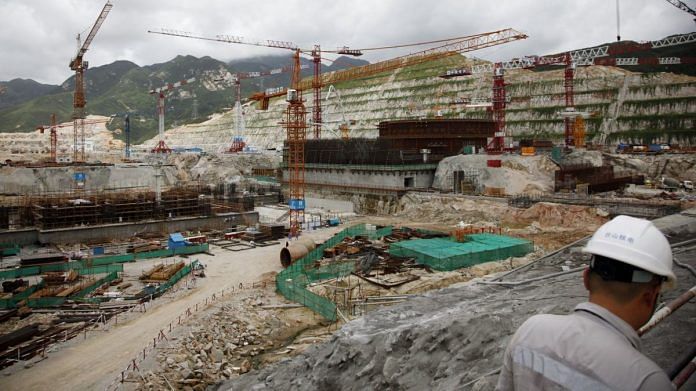
Construction takes place at the China Guangdong Nuclear Power Group Co. atomic plant in Taishan, in July 2020 | Photographer: Qilai Shen | Bloomberg

New Delhi: China, Pakistan and India have 350, 165 and 156 nuclear warheads respectively as of January this year and the three countries appear to be expanding their nuclear arsenals, a study by Stockholm International Peace Research Institute (SIPRI) has said.

It also said as per its assessment, Russia and the US together possess over 90 percent of the estimated 13,080 global nuclear weapons.

China, Pakistan and India had 320, 160 and 150 nuclear warheads respectively as of January last year, the SIPRI’s study said on Monday.

There are nine countries in the world that have nuclear weapons: the US, Russia, the UK, France, China, India, Pakistan, Israel and North Korea.

“China is in the middle of a significant modernisation and expansion of its nuclear weapon inventory, and India and Pakistan also appear to be expanding their nuclear arsenals,” the study said.

It has been more than a year since the military standoff between the armies of India and China erupted in eastern Ladakh on May 5, 2020, during which there were fatalities on both sides for the first time in 45 years.

India and China have made limited progress in achieving disengagement at the Pangong lake area while negotiations for similar steps at other friction points remained deadlocked.

India and Pakistan had on February 25 this year released a joint statement announcing a ceasefire along the Line of Control, following talks between their Directors General of Military Operations.

The SIPRI’s study also talked about the fissile raw material stocks that the countries have for their nuclear weapons.

“The raw material for nuclear weapons is fissile material, either highly enriched uranium (HEU) or separated plutonium…India and Israel have produced mainly plutonium, and Pakistan has produced mainly HEU but is increasing its ability to produce plutonium,” it said.

China, France, Russia, the UK and the US have produced both HEU and plutonium for use in their nuclear weapons, the study mentioned.

“The governments of India and Pakistan make statements about some of their missile tests but provide no information about the status or size of their (nuclear) arsenals,” it noted.

Approximately 2,000 of the total 13,080 global nuclear warheads in the world are “kept in a state of high operational alert”, said the study mentioned in the SIPRI Yearbook 2021.

It also said Saudi Arabia, India, Egypt, Australia and China were the five largest importers of major arms in the world between 2016 and 2020.

Saudi Arabia had 11 percent share and India 9.5 percent in the global imports of the major arms in this time period, it added.


Also read: China’s nuclear leak is no Chernobyl, but how it was handled is troubling


GALWAN WAS CATALYST THAT SHAPED INDIA’S NEW FOREIGN POLICY APPROACH

For years, India said border row was one of many issues in relationship with China. Sometimes, there needs to be a catalyst
For India, Galwan was the catalyst that helped bring out many foreign policy ‘indecisions’ for review, and shaped India’s new approach. It also completely changed the template of engagement with China.
For years, India had maintained that the border issue with China was one of the many issues of the bilateral relationship and had continued to engage with the neighbour in other arenas. Post Galwan, the writing is clear, and underscored, that the border issue is central to ties. Harsh Pant of the Observer Research Foundation notes that External Affairs Minister S. Jaishankar has made this aspect of India’s foreign policy very clear over the last few months.
India, for a long time, had been hesitant about making certain choices, which, in a changing world order, were becoming abundantly clear that it should. Teaming up with the western world was one of these. India tried balancing its options, and both China and India thought that giving the chance for a personal rapport to develop between their leaders might help. Thus there was the Wuhan Spirit and Chennai Connect post Doklam. This time, though, there is no such soft diplomacy effort in the offing. Of course, India continues to engage with China and the endless meetings at the military and diplomatic levels, including those between senior ministers, continue. But India is now clear that unless the border issue is resolved, the bilateral cannot proceed.
The most obvious outcome has been India’s willingness to have the Quad meeting at the level of heads of governments, although it was an online one. Upgrading Quad meetings to the highest level was only a matter of time, given that after years of meeting at bureaucratic levels, the Quad finally met at foreign ministers’ level in New York in September 2019. Galwan made the decision clear for India on the Quad, even though India has been careful in insisting that this is not a military grouping, and has stressed on post-pandemic rebuilding as one of the major thrust areas of the Quad. The Quad development certainly has China worried, notes Pant. “Their bullying of Bangladesh to keep away from the Quad shows their worry,” he emphasised.
The timing of the Galwan clash was certainly not in China’s favour, happening right at a time when the world was grappling with the pandemic and blaming its origin and poor handling on China. Global sympathies, thus, were staunchly with India, even if the support was rhetorical.
Given the vast differential in the economic relationship between the two countries, it hasn’t been easy for India to punch above its weight. But the clash clearly pointed out that even for the minimal impact on China that cutting our trade links can manage, India has to either be self-reliant or look at other supply chains. For it came as a shock to the country to realise that its drug diplomacy hinged on procurement of active pharmaceutical ingredients from China! Of course, India hasn’t been able to wean itself off China, and might not do so in the foreseeable future, but the very fact that it is looking at alternative supply routes with Japan and Australia means that India is now an active part of the efforts to stem Chinese monopoly.
The G7’s initiative of the ‘Build Back Better World Partnership’ minces no words in stating it is to provide strategic competition to China and help build infrastructure in low- and middle-income countries. For a long while, India has been careful to avoid annoying China on its Belt and Road Initiative (BRI) and presented the China Pakistan Economic Corridor (CPEC), which passes through Pakistan-occupied Kashmir and therefore impinges on India’s sovereignty, as the reason for being against the BRI. Now, there are alternatives being discussed, and the west is keen to have India aligned with these partnerships. India will not have to worry about balancing with China when it decides to join such initiatives now.


Army remembers Galwan heroes

Army remembers Galwan heroes

Maj Gen Akash Kaushik, Chief of Staff at 14 Corps, pays tribute to Galwan martyrs in Leh.

Tribune News Service

New Delhi, June 15

The Army on Tuesday remembered the bravehearts of the Galwan clash with China on June 15 last year, saying their sacrifice and valour would remain etched in memory of the nation.

Twenty Indian soldiers had died in a bloody clash in eastern Ladakh. In February, China officially acknowledged that its five military officers and soldiers were killed in the clash with the Indian Army though it is widely believed that the death toll was much higher.

The Indian Army tweeted: “General MM Naravane and all ranks of Indian Army pay homage to the bravehearts who made supreme sacrifice in Galwan Valley, Ladakh, while defending the territorial integrity and sovereignty of the country. Their valour will be eternally etched in memory of the nation.”

Today is the first anniversary of the deadly clash. The Army said it was in the face of unprecedented Chinese aggression that 20 Indian soldiers laid down their lives defending our land and inflicted heavy casualties on the PLA. The gallant soldiers fought in the most difficult high-altitude terrain, said the Army. The clash occurred at an altitude of 15,000 feet.

At Leh, the headquarters of the 14 Corps, a solemn ceremony was organised where Major General Akash Kaushik, Chief of Staff of the Corps, laid a wreath at the war memorial. Military posturing by India and China continues on either side of the Line of Actual Control (LAC).


Galwan incident exposed Chinese vulnerabilities

Following operations on the Kailash Range in early September last year, the Indian Army captured commanding heights to give themselves an advantageous bargaining position for the future. Also, the determination with which the ground manoeuvres were conducted, in the backdrop of the pandemic, conveyed a clear message to an unpredictable adversary.

Galwan incident exposed Chinese vulnerabilities

Lesson from Galwan: India should have seen China’s misadventure coming. PTI

Group captain Murli Menon (retd)

Defence Analyst

It was on the intervening night of June 15-16 last year that Colonel Santosh Babu, the unassuming Commanding Officer of 16 Bihar Regiment, and 19 of his men sacrificed their lives in the Galwan valley in eastern Ladakh. The Chinese had overwhelmed India at the same locale during the 1962 debacle. As the 20 brave warriors died fighting, another posse from the same battalion, along with two adjoining units, took on the Chinese PLA army in retaliation.

The Galwan incident exposed the vulnerabilities of the Chinese as a combat-proven entity and the limitations of a rigid party-affiliated PLA. It is reported that their conscripts expressed admiration for the unarmed combat prowess of the Indian Army, wishing to learn the ropes of hand-to-hand combat themselves for future use. The adversary’s famous ‘human wave’ tactics of 1962 had no doubt been replaced by crude, unconventional weaponry such as wire-reinforced clubs and stones. But it was clear even after a series of military and diplomatic meetings that the rules of engagement would change forever. Following operations on the Kailash Range during early September last year, the Indian Army captured commanding heights to give themselves an advantageous bargaining position for the future. Also, the determination with which the ground manoeuvres were conducted, in the backdrop of the pandemic, conveyed a clear message to an unpredictable adversary. The stand-off that lasted for a good part of last year also showcased the integrated battle culture of our defence mechanism.

India should actually have seen China’s misadventure coming, threatened as the latter was along India’s motorable road from Shyok to Daulat Beg Oldi. Pushed to the wall due to international opprobrium over the origin of the novel coronavirus, the Chinese leadership perhaps resorted to the border moves as a pressure-relieving measure. India needs aggressive diplomatic forays to call out the aggressor whenever that happens and the invoking of traditional goodwill with other friendly nations, as highlighted by Prime Minister Narendra Modi during his visit to Ladakh after the Galwan violence.

Going forward, such posturing would be as important as actual military capability for a high-altitude border war, when push comes to shove. With its mouthpiece such as Global Times and its cyber warfare, China would leave no stone unturned to create trouble for us by opening up a front with Pakistan to throw us off balance. Needless to say, the Indian Air Force would play a critical role in any future military confrontation in Ladakh. Inductions such as the Rafale jets would be the key to achieving favourable end results in any future military situation versus China.

India’s preoccupation with the ongoing Covid crisis could present an opportunity to China to attempt misadventures along the northern border, which has become ‘hot’ akin to the LoC with Pakistan, but with several additional challenges of high-altitude warfare. The Department of Military Affairs would have its hands full for the foreseeable future.

Innovative national policies and measures to spend adequately on defence need not be overstated, especially as military assets to conduct a high-altitude campaign would come at a price.

But there is a limit up to which arrangements such as Quad could help to counter the Chinese threat. A Quad Plus proposition and beefing up our maritime capability across Malacca and even into the South China Sea are possible options, should a war be thrust upon us. Malacca is an Achilles’ heel for the Chinese as nearly 60 per cent of their energy needs flow through it and here is where India, sitting atop an otherwise non-militarised Indian Ocean, could call the shots. Continued strong military ties with Russia and Israel are also crucial to ensure state-of-the-art, assured military wherewithal, as also is the arming of nations such as the Philippines and Vietnam with equipment such as the Brahmos, the Tejas LCA or associated training facilities. Afghanistan is another sector, especially after the American and NATO withdrawal from there, where India could end up directly jostling for strategic elbow room with China. One also can’t overlook China’s attempts to gain traction in terms of its footprint in India’s neighbouring countries such as Nepal, Bangladesh and Sri Lanka.

Thus, the time ahead promises to be challenging, tricky and critically important for our country to maintain its international reputation as a viable secular democratic power in South Asia. In doing so, our measures — military and diplomatic — to counter China’s ‘salami slicing’ attempts hold the key. And towards this end, the international goodwill we have may need cashing in, as exemplified in recent statements by American power brokers such as Republican Mitch McConnell and commentator Ashley Tellis.


213 BSF men honoured

213 BSF men honoured

As many as 213 BSF personnel of Jammu frontier were awarded ‘Police Antrik Suraksha Seva Padak’ on Tuesday. File photo

Jammu, June 15

As many as 213 BSF personnel of Jammu frontier were awarded ‘Police Antrik Suraksha Seva Padak’ on Tuesday. Inspector General NS Jamwal presented the medals to 27 officers, 59 subordinate officers and 127 from other ranks during an investiture ceremony, a spokesman said.

So far, 8,111 BSF personnel from the Jammu frontier have been honoured, he said. — PTI


Col Santosh Babu’s statue unveiled in Telangana

Col Santosh Babu’s statue unveiled in Telangana

Suryapet: A statue of Col Santosh Babu, who died in the Chinese army attack at the Galwan valley in eastern Ladakh in June last year, was unveiled at Suryapet by Telangana Minister KT Rama Rao on Tuesday. Col Babu was a native of Suryapet, 140 km from the state capital Hyderabad. PTI


Without naming China, India reiterates for ‘rule-based order in Indo-Pacific’

China has created several man-made islands to extend its claims at the sea

Without naming China, India reiterates for ‘rule-based order in Indo-Pacific’

Rajnath Singh addressed the ADMM-plus meeting virtually.

Ajay Banerjee

Tribune News Service

New Delhi, June 16

Without naming China, India on Wednesday once again said it stood for a rule-based order in the Indo-Pacific based upon respect for sovereignty and territorial integrity of nations, peaceful resolution of disputes through dialogue and adherence to international rules and laws.

Defence Minister Rajnath Singh, speaking at the eighth ASEAN Defence Ministers’ plus meeting (ADMM-Plus) said: “India calls for a free, open and inclusive order in the Indo-Pacific.”

The ASEAN (Association of Southeast Asian Nations) is a group of 10 countries and five of those nations — Brunei, Malaysia, the Philippines, Taiwan and Vietnam – are locked in a dispute with China over claims in the hydro-carbon rich South China Sea.

China has created several man-made islands to extend its claims at the sea.

Rajnath Singh addressed the ADMM-plus meeting virtually.

With regards to developments in the South China Sea, he said it has attracted attention in the region and beyond. “India supports freedom of navigation, over flight and unimpeded commerce in these international waterways,” he said.

He hoped that the Code of Conduct negotiations will lead to outcomes that are in keeping with international law, including the UNCLOS (United Nations Convention on the Law of the Sea) and do not prejudice the legitimate rights and interests of nations that were not party to these discussions.

A few years ago, China lost its case on claims at a hearing under the UNCLOS, it did not accept the verdict and forced other parties to the dispute to enter into negotiations.  

He said the maritime security challenges were another area of concern to India.https://ba0aaf8a968633d922e67047f2e8e32a.safeframe.googlesyndication.com/safeframe/1-0-38/html/container.html

The Sea lanes of Communication were critical for peace, stability, prosperity and development of the Indo-Pacific region.

He said: “India has strengthened cooperative engagements in the Indo-Pacific based on converging visions and values for promotion of peace, stability, and prosperity in the region.”

The centrality of ASEAN and utilisation of ASEAN-led mechanisms are important platforms for implementation of our shared vision for the Indo-Pacific, he added. 


ARMY COMMEMORATES INDIA’S HISTORIC VICTORY OVER PAKISTAN IN 1971

The event was attended by Veterans, NCC Cadets and senior Army officers of Udhampur Military Station
To commemorate the decisive and historic victory of the Indian Armed Forces over the Pakistan Army in December 1971 and to pay homage to the Swarnim Vijay Mashaal (Victory Flame), a solemn Wreath Laying Ceremony was held at ‘Dhruva Shaheed Smarak’ at Headquarters Northern Command in the Udhampur Military Station on Monday.
Lt General YK Joshi, Army Commander, Northern Command, laid the wreath to honour the Swarnim Vijay Mashaal lit in remembrance of the valiant soldiers who have given the ultimate sacrifice in service of our nation. The event was attended by Veterans, NCC Cadets and senior Army officers of Udhampur Military Station.
The Swarnim Vijay Mashaal had arrived at Udhampur on 13 June from Nagrota and was received with full ceremonial honours. The Victory Flame was then escorted to the local unit quarter guard.

On 14 June after the customary ‘Last mile run’ the Victory Flame was handed over to the Station Commander, Udhampur Military Garrison who placed the Victory Flame at Dhruva War Memorial. The wreath-laying was thereafter carried out by JCOs and Veterans followed by Wreath Laying by the Army Commander, Northern Command.

On culmination of the Wreath Laying Ceremony, the Swarnim Vijay Mashaal was further handed over to the Counter Insurgency Force (Delta) where it will be taken to various units to commemorate the unforgettable victory of 1971.
The year 2021 has been named “Swarnim Vijay Varsh” by the government of India and the Nation started the celebrations of the 50 years of the Indo-Pak War which had resulted in the largest military surrender after World War II. The inaugural event was held at the National War Memorial (NWM) in New Delhi on 16 December 2020 where Prime Minister Narendra Modi, Raksha Mantri Rajnath Singh, Chief of Defence Staff and Tri-Services Chiefs laid a wreath and paid homage to the fallen soldiers.
Modi lit the ‘Swarnim Vijay Mashaal’ from the eternal flame of NWM on the occasion. Four Victory Mashaals (flames) lit from the Eternal Flame of NWM were then carried to various parts of the country including to villages of Param Vir Chakra and Maha Vir Chakra Awardees of the 1971 War. Soil from the villages of these Awardees and from areas where major battles were fought in 1971 is being brought to the NWM.