Sanjha Morcha

What’s New

Click the heading to open detailed news

Current Events :

web counter

Print Media Reproduced Defence Related News

New marching tunes, no more pre-1947 battle honours — armed forces set to get more ‘Indian’

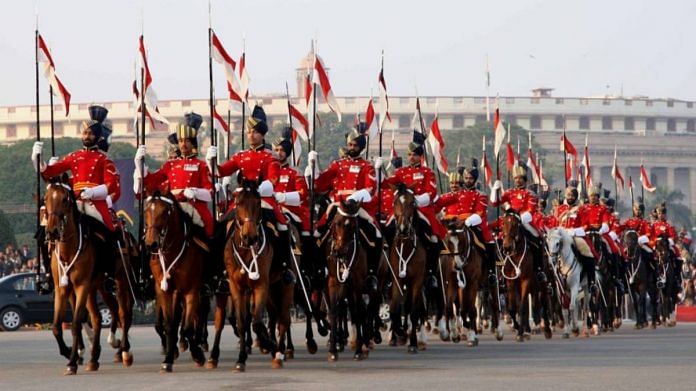
Representative Image | File photo of Beating the Retreat ceremony | Source: Ministry of Defence

Representative Image | File photo of Beating the Retreat ceremony | Source: Ministry of DefenceText Size: A- A+

New Delhi: Changing of military band tunes, pre-independence era battle honours, mess procedures and a greater emphasis on Indian war heroes in military studies — these are some of the changes being examined by the Indian armed forces as part of a larger push towards ‘indianisation’ of the forces, ThePrint has learnt.

Currently, a large number of military band tunes are of British-origin. Some of these tunes have also become a part of long-standing traditions and played during specific ceremonies. For example, Auld Lang Syne and Abide With Me, are played on all Passing out Parades and Beating the Retreat ceremony, respectively.https://953c77da90f2f91c5bec7c4b42738c0c.safeframe.googlesyndication.com/safeframe/1-0-38/html/container.html

Defence sources told ThePrint that it was being examined whether some of these iconic tunes can be replaced with suitable Indian tunes, which could continue to convey the same message.

“The search for replacing some of these tunes has started. The endeavour is to implement the changes by the time India celebrates the 75th year of Independence next year,” a top defence source told ThePrint.

Sources said that it was also being discussed whether it will be prudent to lay to rest some pre-independence era battle honours, which were awarded to units for exhibiting exceptional collective bravery during wars. One of the important traditions of the armed forces is to celebrate the bravery of the troops in wars and it is done in the form of celebrating battle honour days.

Many of these honours were awarded to units of the then British Indian Army, for fighting against local Indian kings. For example, battle honours were won by units during the first Indian uprising against the British, in 1857, including in the battle with Rani Lakshmibai.

Some were also won during the two World Wars and in other battles, such as Battle of Haifa, against the Ottoman Empire.

Sources said that while a few British-era mess procedures, especially those observed during dinner nights – formal sit down dinners –  have been modified since Independence, it was now being examined if and how any further changes can be made.

Another defence source told ThePrint that most military studies in the country refer to the writings of Sun Tzu, who authored the ancient Chinese military treatise Art of War and British strategists such as Liddel Hart and the German General Clausewitz, while there are comparatively fewer references to indigenous works such as Kautilya’s Arthashastra.

“This is likely to be given more emphasis in strategic studies (in the future),’ the source said.

In addition, strategies enunciated in the Indian epics would also be studied in greater detail, alongside the battle tactics of Shivaji – for guerilla tactics – and Raja Raja Chola I and his son Rajendra Chola – for naval warfare. There will also be a greater emphasis on Indian languages in the military, sources said.

Some of these ideas were discussed before. But, the plans and discussions have taken a renewed vigour after Prime Minister Narendra Modi, while speaking at the Combined Commanders Conference in Gujarat’s Kevadia in March, talked about enhancing indigenisation in the national security system. This was not just in sourcing equipment and weapons, but also in the doctrines, procedures and customs practised in the three services.

There had also been a discussion on indianisation of traditions and culture in defence services on the first day of the three-day Conference and a separate session on the subject on the third day of the event.

Major General Birender Dhanoa (retd), however, told ThePrint that militaries world over follow a similar equipment and training pattern as required for modern warfare, while drawing on its own culture and experience, and changes in the armed forces should not be politically motivated.


Also read: India’s military is apolitical. But hold up the mirror before it starts fraying


Was discussed in 2016 combat paper

A combat paper published by the Army War College, Mhow, in 2016 – titled Interpreting Ancient India’s Strategic Military Culture – took examples from the Mahabharata and Arthashastra, to correlate aspects of warfare and statecraft between the ancient and present times.

Defence sources told ThePrint that the paper had stated that “indigenous strategic thoughts and art of war found in the Arthashastra, Mahabharata and other literature are not only organic to Indian psyche, but are also relevant even in today’s context”.

It had also listed certain scriptures which could be used as a source of ancient ideas on statecraft and classical Indian military thought. This included the Dhanurveda (which talks about defence planning, tactics, constitution of defence forces, selection and training of defence personnel, military arrays, divisions of fighting, equipment, long range weapons etc).

The paper had also referred to chapter 7 of Manusmriti, stating that it deals with statecraft and rules of war, Shukra Niti (which it said refers to military aphorisms of sage Shukracharya) and the Puranas like Agni Purana, Brahma Purana and Brahmanda Purana which deals with diplomacy and theories on war.

It had also discussed the evolution of military strategy in India through the eras, and emphasised on the information warfare strategy by Kautilya, the Indian art of war and foreign policies.


Also read: What’s DGAFMS, Indian military’s medical wing leading the fight against Covid


“Army needs to be careful”

Major General Birender Dhanoa (retd), however, advised caution while bringing in such changes.

Talking to ThePrint, the former Army officer said that there is a belief, not entirely unfounded – “but for reasons that aren’t what politicians have understood them to be” – that the Indian Army continues to hold on to traditions and customs which are archaic and a vestige of a colonial past, which has no place in “new India”.

He said the army has been anyway changing older norms and uniforms that are more suited to a modern India, doing away with some outdated traditions. “This is a gradual process, not very visible to outsiders,” he said.

Maj. Gen. Dhanoa said issues of officers’ messes, the divide “perceived at times” between the men and their leaders, in terms of the way a regiment system is set up, also lead to an incorrect assumption that the army clings on to colonial ideas, which is not so.

“As for doctrines and leadership examples that are Indian, we’ve been doing so for ages, while also imbibing the best practices and doctrine from others. Militaries world over follow a similar equipment and training pattern, as demands of modern war dictate so,” he said.

“But then you draw on your own culture and experiences as well, to enable the men to absorb and apply that which works for you. So we’ve been doing this in schools of instruction since ages and it is not a new idea,” he said.

He cautioned that some of these ostensibly good suggestions are “politically loaded” and that the army needs to be careful in going in one direction, just because “the flavour of the period dictates so.”

‘It must retain its apolitical character and be capable of doing what the constitution and the state ask of it, and this calls for adopting good ideas and saying a polite yet firm no to those that are not in its long-term interests,” he said.

(Edited by Poulomi Banerjee)


PAKISTAN VIEWS KASHMIR THROUGH AFGHAN PRISM

The ceasefire continues to hold, despite the odd incident along the Jammu border
Connecting dots flowing from recent statements and incidents provide an understanding of the dilemma faced by Pakistan on ties with India and Afghanistan, especially with the ongoing withdrawal of US and NATO forces. Currently, a ceasefire, part of backchannel talks, is underway between India and Pakistan, while the US withdrawal has opened doors for internal strife in Afghanistan which could spill across the Durand Line into Pakistan. Pakistan cannot risk two active frontiers alongside increasing internal turmoil.
This scenario could break Pakistan’s economy and overstretch its military capabilities. The emerging scenario in Afghanistan and its impact can best be summed up by statements from Pakistani politicians. Foreign Minister SM Qureshi mentioned during a discussion in their senate, “what we were fearing and are concerned about is that a vacuum created in Afghanistan can drag the country back into the 1990s. There could be anarchy and God forbid, a civil war.”
Qureshi had earlier threatened the US that unless Kashmir was resolved, Afghanistan would remain in turmoil. He tried pushing the US into viewing Kashmir through the Afghan prism. The recently concluded Pakistan corps commanders’ conference resulted in the military leadership expressing concern on, “regrouping of terrorist leadership and outfits across the border”. Prime Minister Imran Khan, addressing the Economic Cooperation Organisation summit last week, stated, “It is imperative that there should be a peaceful transition in Afghanistan, otherwise 1989like chaos will occur when Soviet Union’s forces had left.”
An editorial in Dawn of 3 June states, “What Pakistan and many other regional states fear is a return to total anarchy in Afghanistan.” Pakistan knows what a civil war in Afghanistan will imply. It has faced it earlier. This scenario is Pakistan’s own creation. It was warned on multiple occasions that it was backing the wrong horse (Taliban) but refused to listen. Hillary Clinton had stated, “snakes are going to turn on whoever has them in the backyard.”

Pakistan’s Afghan narrative stemmed from fear of growing Indian influence in the country. Hamid Karzai, the exAfghanistan President stated in a recent interview, “Pakistan actually would like Afghanistan to break off relations with India.” Finally, snakes are returning to bite.
The US withdrawal, announced by President Joe Biden without any preconditions, has pushed any peace deal between the Taliban and Afghan government further away. Violence levels are rising as the Taliban assumes it possesses the upper hand and can take Kabul. Despite reports of the Afghan army abandoning some posts to the Taliban, the road to Kabul continues to be littered with roadblocks. The Afghan government currently controls 50 per cent of the country.
Realistically accepting the possibility of a civil war, Afghan President Ghani stated in an article last month, “If the Taliban choose the latter path (chaos and violence), Afghan Forces will fight them.” Pakistan’s NSA, Moeed Yusuf, stated “US has assured that Pakistan will not be made a scapegoat amidst the withdrawal, but only time will tell whether they stick to their words.” Zalmay Khalilzad, the US special envoy for Afghanistan, in an interview, mentioned, “Pakistan will be blamed (for the civil war) because much of the Taliban’s leadership lives in Pakistan.”
Global pressure is already increasing on Pakistan to rein in the Taliban and push it for talks. An editorial in Dawn last week stated, “while Pakistan can urge the group to make peace, the decision would be that of the Taliban alone. Indeed, the situation does not look promising.” Added to this is the reality that even if the Taliban does reach Kabul, there are collections of militias and terrorist groups willing to challenge it. Most challengers of the Taliban will be funded from abroad increasing instability.
Afghanistan will witness violence for a prolonged duration. Last month there were multiple attacks on Pakistani troops from across the Afghan border. The worsening security situation in Afghanistan opened space for Anti-Pak terrorist groups to enhance attacks on its army. Some of these groups are being supported by the Taliban to maintain pressure on Pakistan. The targeting of the Chinese ambassador in Quetta, in April, was claimed by the anti-Pak Tehreek-iTaliban Pakistan (TTP), backed by the Haqqani network.
Pakistan’s fear is that the CPEC would become a major target, and this would stall investments from China, adding to their economic woes. Fahd Hussain writing for Dawn stated that a civil war in Afghanistan could impact Pakistan in multiple ways. It could enhance influx of refugees as also regenerate violence and militancy in border areas, including Baluchistan. The TTP, currently sheltering on Afghan soil, could gain fresh traction and enhance attacks on Pakistani forces. The Baluch freedom groups would exploit this opportunity to target the Pakistan army and CPEC. Thus, for Pakistan, securing is western borders and provinces is gaining greater strategic prominence than backing terrorism in the Kashmir valley.
Pakistan currently has no choice.
Its only option is to seek peace with India along the LoC and reduce support to Kashmir militants. It was with this background that backchannel talks with India gained steam. Pakistan’s serious intentions can be gauged from the fact that no terrorist leader has made any counter comment on the ceasefire. The ISI has tightened its leash over them. Pakistan Army Chief General Bajwa admitted backchannel discussions are ongoing, adding that article 370, India’s red line, is of no concern, while the country’s polity opposed it.
Imran Khan and Qureshi initially insisted on restoration of article 370 as a prelude to talks; however, in a climbdown, possibly prompted by the army, Imran mentioned that Pakistan is willing for talks even if India gives a road map for restoring the article. With no comments flowing from India, the message conveyed is that statements by Pakistani politicians are solely for domestic consumption, as discussions are ongoing between the Pakistan army and the Indian government.
The ceasefire continues to hold, despite the odd incident along the Jammu border. Pakistan, which had claimed that the US must view Afghanistan through a Kashmir prism is now itself compelled to view Kashmir through the Afghan prism.


INDIAN ARMED FORCES REQUIRE A ‘POSITIVE IMPORT LIST’ FOR DEFENCE EQUIPMENT

The DAP therefore gives priority to the ‘capability development’ over ‘indigenous procurement’ specifically if time is a constraint and security cannot be compromised
by Captain Vikram Mahajan (Retd)
In May 2020, the Prime Minister Narendra Modi gave a clarion call for an ‘Atmanirbhar Bharat’ or a ‘self-reliant India’. The announcement found favour in all sectors, including defence. Following the announcement, a ‘negative import list’ of defence equipment last year was released. The list designated 101 defence products and a time frame beyond which there would be an import ban on the equipment that could thereafter only be manufactured domestically. The ‘list’ also found mention in the new Defence Acquisition Procedure (DAP), which was released in October 2020.A second list containing 108 items, rechristened as ‘positive indigenisation list’ was released this month.
The scope of Atmanirbharta has expanded to segregate the defence budget into ‘equipment mandated to be manufactured domestically’ vs ‘equipment that will be imported.’ According to the defence capital budget, the allocations for domestic manufacturing has been increased from 58% amounting to Rs 51930 crore($ 7 Billion)} for the year 2020-21, to 63% {amounting to Rs 71438 crores(around $10 billion)} for the year 2021-2022.
Many other initiatives have been undertaken in the defence sector since the call for Atmanirbharta, including, the draft ‘Defence Production and Export Promotion Policy’ (DPEPP) mentioning the doubling the share of ‘domestic procurement’ over a period of five years. The Defence Research and Development Organisation (DRDO) released a separate list of 108 systems and subsystems which will be designed and developed exclusively by the Indian industry. The government and defence experts have held seminars and webinars on ‘Atmanirbhar Bharat’ to discuss the impact. Additionally, the Aero India 2021 held earlier this year focused on the ‘vibrant defence manufacturing ecosystem in India.’
As the government and its agencies focus on the concept of self-reliance, two critical areas have taken a back seat: overall capability development of the armed forces and the role played by the 40 percent of the defence material that will still be procured from abroad.
Capability development of the Indian armed forces comes from the Integrated Capability Development Plan (ICDP), a document that lays down the planned procurement of desired equipment over a span of 10 years. ICDP lays down the military equipment that the Indian Army, Navy and Air Force requires, but does not define the ‘source of procurement’. The prioritisation of the source of procurement is summed up in Chapter 2 of DAP 2020, as:
“Preference will be given to indigenous design, development and manufacturing of defence equipment. The time required for the procurement and delivery from foreign sources vis-à-vis the time required for making it within India, along with the urgency and criticality of the requirement will be examined before deciding to proceed on categorisation. Therefore, wherever Indian Industry is capable of manufacturing the required equipment within the timelines required by the Services, the procurement will be made from indigenous sources….”
The DAP therefore gives priority to the ‘capability development’ over ‘indigenous procurement’ specifically if time is a constraint and security cannot be compromised.
Let us take a step back and identify the products that were procured through emergency powers, or were being expedited, after the Balakot skirmish in 2019 and during the Indo-China standoff in 2020. Other than speeding up the purchase of 21 MIG-29, 12 SU-30 fighters, there were BVR missiles, precision bombs, anti- radiation missiles, anti-tank missiles, Sig Sauer rifles and light tanks amongst others. All were procured from foreign countries. Procurement of the equipment was in immediate response to the threats at the border. However, as the threat subsided, the acquisition of indigenous equipment has taken priority over capability development.
This change is evident from the signing of the six Pinaka Rocket Launcher regiments and 118 Arjun MK-1 tanks for the Indian Army, 83 Tejas Mark 1A fighters for the Indian Air Force, and the SDR radio for the Indian Navy. However, any major procurement from 42% of the balance budget has been conspicuous by its absence. The last big contract signed from the balance budget was the 24 MRH in February 2020.
The only other induction of significance is the ‘leasing’ of two Sea Guardian drones by the Indian Navy. The decision on the purchase of around 30 drones, 10 for each service, has been pending for over two years. It is pertinent to mention that a similar request for purchase of 18 MQ-9Bs by UAE (a country one fourth the size of the state of Maharashtra) was approved by the U.S. Government earlier this year.
There is no doubting the skill of the Indian citizens, or the capability of Indian industry to develop equipment with advanced technology. After all, when the U.S. downgraded the Indian request for a supercomputer for weather prediction from CRAY XMP-24 to CRAY XMP-14 in 1987, India built its own supercomputer PARAM. However, high technology equipment takes time to develop, and the Indian armed forces need to always be equipped given the current geo-political and strategic challenges at its borders.
It is imperative that the equipment that falls under critical requirements should be identified and when needed imported without delay to enhance the capability of the Indian Armed Forces. Just like the ‘negative import list’, a ‘positive import list’ with a timeline should be released to ensure Indian forces have what they need for other near-term contingencies. This would provide foreign vendors foresight of the procurement plan, requirements, and will prevent situations where the Indian Armed Forces has to resort to emergency purchases or leasing defence equipment. While it is critical that procurement and production of military equipment in India should continue, it is key that a balance between domestic manufacturing and import of weapons is maintained, to keep up with the required ‘capability development’ which is decided by the technological prowess of the adversary.


US, CHINA AND INDIA EXPAND UNDERSEA DETERRENCE IN INDO-PACIFIC

Ballistic missile subs seem undetectable, but drones and geography hinder use
“There’s no Wi-Fi, no TV, no radio or anything like that. When I first joined, everybody got very excited when the Navy’s movie service sent you a new box of videotapes or DVDs,” former submariner Tom Shugart, who served on three submarines including as commander of the nuclear-powered fast-attack submarine USS Olympia, said.
But besides the inherent challenges from the isolation of conducting missions underwater, there is another aspect to many submarine operations: secrecy. Unlike a fast-attack submarine carrying conventional weapons, the U.S. Navy’s Ohio-class SSBNs cannot make foreign port calls easily due to the 20 Trident D-5 ballistic missiles they carry. “Boomers,” as SSBNs are called in the Navy, have one mission: to hide in the world’s deepest oceans waiting for an order to launch a nuclear strike.
For the six decades since the world’s first operational SSBN took to the high sea, that order has yet to arrive. However, the world’s major powers are quietly building their undersea deterrence capabilities. In the Indo-Pacific, the U.S., China, Russia and India operate SSBNs, while Pakistan and North Korea also are exploring submarine-launched nuclear firepower, albeit on diesel-electric subs.
The Pentagon, in its recently released 2022 budget request, allocated $5 billion for development of the Columbia-class SSBN, which is to replace the Ohio class in 2031. Many in the defence community criticized the overall budget request as not growing enough to meet the great power competition with China, but the Columbia program stood out as one of the few items that went unscathed.
American naval officials have stated for the past several years that the Columbia-class sub is the Navy’s top priority program. “This means, among other things, that from the Navy’s perspective, the Columbia-class program will be funded, even if that comes at the expense of funding for other Navy programs,” a Congressional Research Service report on the Columbia program noted, adding the italics for emphasis.
The aging 14 Ohio-class SSBNs are to be replaced with 12 Columbia-class vessels. Unlike the Ohio class, which all need to undergo a lengthy midlife upgrade for nuclear refuelling — like getting a fresh tank of gas — the Columbia class is designed to have one reactor core for its entire life and never needs to be refuelled. That configuration lets the Navy operate 10 SSBNs at all times, meeting the requirement from the combatant commander of U.S. Strategic Command, the section of the U.S. military in charge of nuclear weapons.
But keeping 10 nuclear subs at sea is expensive. The procurement cost for the 12-boat program totals $109 billion, as of the May 12 CRS report.
“Nuclear deterrence is what underpins the rest of the conventional deterrence,” said Shugart, now an adjunct senior fellow at the Centre for a New American Security. “If you don’t have a reliable, survivable nuclear deterrent, then all the rest of what you’re doing may not matter. That makes the program the No. 1 priority.”
The three components of American nuclear strategy are the land-based intercontinental ballistic missiles, the air-based strategic bombers and the submarine-launched ballistic missiles. Of the three, the sea-based SSBN is considered the most survivable because the vessels are virtually undetectable once in a deep ocean.
But the U.S. is not the only power honing its undersea deterrence.
In a February 2020 study by the National Security College at the Australian National University titled, “The Future of the Undersea Deterrent: A Global Survey,” scholars from around the world analysed the SSBN plans of China, Russia, India, France and the U.K., as well as the diesel-electric ambitions of Pakistan and North Korea.
Rory Medcalf, head of the National Security College, wrote that one credible explanation for Beijing’s campaign of building and militarizing islands in the South China Sea is its wish to make that area a bastion where the country’s SSBN fleet can operate in relative safety from detection or attack by U.S. and allied forces.
China is thought to possess six Jin-class SSBNs (Type 094), of which the latest, the Long March 18, was delivered in April. The submarine carries 12 JL-2 ballistic missiles with an estimated range of 7,200 km. That range could let Jin-class subs attack targets in Alaska from protected bastions near China, targets in Hawaii from locations south of Japan and even targets in the western U.S. mainland from mid-ocean locations west of Hawaii, the CRS estimates.
But to hit Washington, Chinese submarines would have to travel east of Hawaii, navigating hostile waters. China’s biggest obstacle to SSBN operations is its geography, surrounded by shallow waters and having to pass choke points before entering the deep waters of the Pacific.
“Whereas the SSBNs of the United States, France, Britain, India and Pakistan have direct access to the world’s ocean basins, those of China do not,” Stephan Fruehling, associate dean of the ANU College of Asia and the Pacific, wrote in the university’s report.
Shugart agrees. “China’s military advancement has eroded the U.S. advantage in so many areas. But one area that the U.S. still has a significant advantage is in undersea warfare,” the ex-submariner said.
Yet if future Chinese missiles have a longer range, then Beijing potentially could keep its SSBNs in the South China Sea and still target the U.S. The distance from its fortified base at Hainan to San Francisco is around 11,600 km, while it would be 13,500 km to Washington.
“Over a time span of several decades, it seems likely that the Chinese could produce a sea-based missile with sufficient range to reach anywhere in the United States from the South China Sea,” American naval analyst Norman Friedman wrote in the report.
New Delhi commissioned its maiden SSBN, the INS Arihant, in 2016, making India the first country outside the five permanent members of the United Nations Security Council to build such a vessel. Its second SSBN, an upgraded INS Arighat, is to be commissioned later this year.
The older Arihant carries 12 short-range K-15 ballistic missiles with a range of 700 to 1,000 km, but could be modified to launch four K-4 ballistic missiles that can travel 3,000 to 3,500 km. Either way, the Arihant’s current area of operations appears limited to the Bay of Bengal, from where it could target Pakistan or China if ordered.
But down the road, “Like the United States, India has geographic advantages for SSBNs to go on open ocean patrol, once they field long-range” submarine-launched ballistic missiles, retired Rear Adm. Sudarshan Shrikhande, the former head of Indian Naval Intelligence, wrote in the same report.
“We need to move beyond bastions where an enemy’s offensive [anti-submarine warfare] is effective,” he added.
Pakistan’s sea-launched cruise missile capability, meanwhile, remains “far from operational,” according to Sadia Tasleem, a lecturer at Islamabad’s Quaid-i-Azam University. “Most defence analysts claim that Pakistan will likely use the three Agosta-90B diesel-electric submarines purchased from France in 1999, 2003 and 2006,” she wrote.
The breakthrough for Pakistan will likely come through the assistance of China. China has agreed to provide eight modified Type 093 and Type 041 Yuan-class diesel-electric submarines to Pakistan, with the first batch comprising four submarines arriving in 2023 and the last four to be assembled in Karachi by 2028.
“The addition of these Chinese submarines will tremendously boost Pakistan’s ability to defend its coastal areas as well as sea lines of communication,” Tasleem wrote in the report.
For years, SSBNs have engaged in games of hide-and-seek with the latest anti-submarine warfare capabilities. Much has been made of technological advancements that could make oceans more transparent, thus eroding the survivability of SSBNs. These include swarms of underwater drones capable of big data analysis and new sensing technologies.
“CubeSats now provide high-resolution imagery on a daily basis of the entire planet — this type of imagery, combined with appropriate search algorithms, might reveal SSBN operational signatures that have so far remained unobserved,” wrote James Wirtz, dean of the School of International Graduate Studies at the Naval Postgraduate School in California.
But the ocean is vast. Retired U.K. Rear Adm. John Gower calculated that covering just the open-ocean segments of the North Atlantic and Norwegian Sea could require nearly 4 million unmanned underwater vehicles.
“That would pose a currently unimaginable command, control and communications challenge for these UUVs,” he wrote.
But till the robots take over, SSBNs likely will continue to prowl the world’s cold ocean depths undetected.


SWEDISH DEFENCE MINISTER PITCHES FOR SALE OF GRIPEN AIRCRAFT TO INDIA

NEW DELHI: Swedish defence minister Peter Hultqvist on Tuesday made a pitch to sell SAAB’s Gripen fighter aircraft to India as New Delhi looks to acquire 114 fighter aircraft to replace its old fleet as well as make up the numbers in its depleting squadrons.
This is the second time a top Swedish government figure is pushing the Swedish made aircraft. Sweden’s Prime Minister Stefan Lofven had raised the matter with Prime Minister Narendra Modi in March during a virtual summit.
Swedish company SAAB is one of the handful of firms vying for the estimated ₹1.3 lakh crore tender to make the fighter jets in India. SAAB had previously promised to build a production line in India should New Delhi choose the Gripen, which is in contention with France’s Rafale, the American F/A-18 and F-21, MiG-35 and Sukhoi-35 of Russia and the Eurofighter Typhoon for the deal.
Addressing an event hosted by the Society of Indian Defence Manufacturers Hultqvist said that the Swedish government will continue to work with the Indian government to support increased exchanges, research and innovation between the defence industries of the two countries.
“The Make in India concept provides excellent opportunities for cooperation that would serve both our countries’ interests. The ongoing multirole fighter aircraft procurement where the Gripen fighter concept offered by SAAB is a good example of transfer of technologies and is supported 100% by the Swedish government,” Hultqvist said. He also noted that Swedish Prime Minister Lofven had conveyed the same message to Prime Minister Modi during their March meeting.
On his part, Indian Defence Minister Rajnath Singh pitched for more Swedish investment in India.
“FDI liberalization and improved ‘ease of doing businesses’ has already attracted top defence companies of the world and have Joint Ventures in India,” Singh said in his speech. “Further, the Government of India has allowed FDI up to 74% through automatic route and up to 100% through the government route wherever it is likely to result in access to modern technology,” he said.
Foreign original equipment manufacturers (OEMs) can set up manufacturing facilities individually or partner with Indian companies through a JV or technology agreement to capitalize on the ‘Make in India’ opportunity, the Indian minister said. “There is a lot of scope for Sweden and Indian defence Industries for co-production and co development. Indian industry can also supply components to Swedish Industries. Swedish firms such as SAAB already have a major presence in India and I am confident that other Swedish firms will find India as a major investment destination for Defence Manufacturing,” he said.
Highlighting India’s advantages — a substantial defence industrial base with 41 ordinance factories and nine defence public sector units, besides over 12,000 micro, small and medium enterprises — the minister said Indian companies had expertise in making a wide range of high tech defence systems for air, land, sea and space. India also had well-developed ship building capabilities, the minister said.
“I once again take this opportunity to invite Swedish firms to invest in the dedicated Defence Corridors of Uttar Pradesh and Tamil Nadu where they can benefit greatly from the unique incentives being offered by the State Governments and the availability of a highly-skilled workforce in India,” the minister added.


Time for farmers to have a say in politics

2020 marked a watershed in the farmers’ struggle as Punjab’s farm unions with divergent leanings came together to wage a united protest against the three Central farm laws. With farmer leaders now expanding the outreach through mahapanchayats in different parts of the country, the crucial issue related to the withdrawal of the laws and the demand for making MSP a legal right has reached every nook and cranny.

Time for farmers to have a say in politics

Rethink: By being apolitical, the farmers would remain at the mercy of the political leaders. Tribune photo

Devinder Sharma

Food & Agriculture Specialist

In a tweet, the popular Indian Historypics handle recently shared the cover story of erstwhile Hindi weekly Dharamyug (September 1972) titled Ann Upjaaye Kisan! Bhookho Mare Kisan! (Farmers grow food! Farmers die of hunger!). The focus was on how the people who produce food for the country were themselves living in hunger. That was a time five years after the Green Revolution had set in and valiant farmers in the north-western region had literally pulled the country from the throes of a ‘ship-to-mouth’existence.

Nearly 50 years later, the iconic farm protest at the doorstep of New Delhi showcases the piteous condition of farmers who have somehow survived against all odds and produced a record harvest year after year. Faced with mounting indebtedness, the spate of farm suicides over the years leaves a trail of neglect and apathy.

With the policy focus remaining on increasing crop production, successive governments have turned a blind eye to the deplorable living conditions of farmers and farm workers. This was the outcome of a flawed economic thinking that aimed at pushing farmers out of agriculture to join the army of daily wage workers in the cities.

For several decades now, farmers have been protesting in one part of the country or the other, demanding a guaranteed price for their crops in the form of a higher minimum support price (MSP). They have been invariably been asking for karza mukti (loan waivers). These two demands actually reflected the urgent need to address the crying need of providing economic justice to the farming community, languishing at the bottom of the pyramid.

But nothing tangible has come about, with the states either ignoring the protests or, at best, offering a temporary reprieve. The agrarian crisis, in the process, has only worsened.

According to the National Crime Records Bureau, recorded farm protests across the country were 4,837 in 2016, 3,300 in 2017 and 2,008 in 2018. A CSE study quoting media reports, however, showed the number of major farm protests in the country increasing fivefold between 2017 and 2021. Besides local issues, most of these protests highlighted the economic disparities that the farmers were living with.

Realising that the continuing farm protests had failed to draw the nation’s attention to the acute farm crisis and knowing that farmers and farm workers had been routinely treated by various political affiliations as nothing more than a vote bank, farmer leader Balbir Singh Rajewal had invited me way back in 2015 to take an initiative to bring farm leaders from across the country on one platform. We deliberated on the objectives as well as the challenges it posed, considering that farm unions were broadly divided on lines of caste, religion and political ideologies and bringing them together was not that easy.

Two stalwarts of the farm movement in the country — Mahendra Singh Tikait of the Bhartiya Kisan Union (BKU) and Prof MD Nanjudaswamy of the Karnataka Rajya Ryot Sangha (KRRS) — had, a few decades back, toyed with the idea of a unified farm front, but somehow the idea didn’t materialise.

Not many of the 52 farm leaders, representing the major factions of unions/organisations spread across the country, who assembled for a three-day conclave at Chandigarh in August 2015 actually knew one another. That was, perhaps, the first time that several farm leaders, cutting across ideologies and political affiliations, sat on the same table. During the intense discussions that followed, aimed at bringing the farm unions together, the leaders acknowledged the need of working together and agreed to form a loose network called the Kisan Ekta. More importantly, the Chandigarh conclave helped create a strong camaraderie and bonhomie among farmer leaders.

In the next three conclaves held at Bangalore, Akola and Shimla, an effort was made to reach out to some other farmer leaders as well. While the general consensus was that the farm movement in the country should remain apolitical, a few were strong votaries for forming a political party.

Among them were some whose argument was that by being apolitical, as experience had shown, farmers would remain perpetually at the mercy of the political leaders. Vote-bank politics would continue to keep the farming community divided, and the farmer leaders should, therefore, consider forming a political party.

Farmer leaders agreed in principle, but they were not willing to take a political plunge for reasons they understood better. In a TV interview at Shimla, to a question whether the Kisan Ekta would soon be a political party, my response was that the objective behind uniting farm unions was to ‘influence’ the political process.

The year 2020, however, marked a watershed in the farmers’ struggle as Punjab’s farm unions with divergent leanings came together to wage a united protest against the three Central farm laws. This has spread in other parts too. Not only have farmer leaders from Punjab emerged taller on the national scene but also those from Haryana and Uttar Pradesh. So have many other regional leaders emerged stronger in their parts of the country. The rush for clicking selfies with them is an indication of their growing popularity.

With farmer leaders now expanding the outreach through mahapanchayats in different parts of the country, the crucial issue related to the withdrawal of the Central laws and the demand for making MSP a legal right for farmers has reached every nook and cranny. In addition, their effort to reach out to other communities, which certainly has political ramifications, is bearing fruit.

In any case, considering that more than 50 per cent of the population is engaged in agriculture and allied activities, the time has never been so ripe for the collective farmer leadership to rethink its role — whether to go political or remain apolitical.

After all, reversing the flawed economic design that has kept farmers deliberately impoverished all these years in the name of economic growth will require farmers to emerge stronger on the political front and play a pivotal role in decision-making.


Two farmers released, Samyukt Kisan Morcha calls off sit-in at police stations in Haryana

Tribune News Service

Hisar, June 7

The Samyukt Kisan Morcha (SKM) today called off a plan to hold protests at all police stations in the state after the release of two arrested farmers on bail late last night. They have lifted the dharna from the Tohana police station.

The two farmers were arrested for allegedly trying to gherao JJP MLA Devendra Singh Babli’s residence last week.

“Ravi Azad and Vikas Sisar were released from jail in the early hours after which today’s programme to gherao all police stations in the state has been put off,” Bharatiya Kisan Union leader Joginder Ghasi Ram Nain told the media here.

Farmer leaders said the Fatehabad administration had agreed to cancel FIRs against protesters.

SKM leaders, including Rakesh Tikait, Joginder Singh Ugrahan and Gurnam Singh Charuni, held a meeting with district officials today.

After the meeting, Tikait said the police had agreed to release another activist Makhan Singh. “The process for his release has been set in motion.”

Speaking to reporters after coming out from jail, Azad said the farmers’ agitation against the three controversial farm laws had now become a “people’s movement”.

“This is a fight for farmers’ honour and the government will have to roll back the farm laws,” said Azad.

A large number of farmers led by BKU leader Rakesh Tikait have been staying put in the Sadar police station compound in Fatehabad since Saturday.

On June 1, Babli had faced a protest by a group of farmers who showed him black flags and raised slogans. He had alleged that some of the protesters resorted to unruly behaviour and smashed the windscreen of his SUV.

Farmers, however, had accused Babli of using abusive and threatening language.

Subsequently, two FIRs were registered. In one of the cases, the police had booked about 50 persons under Section 307 (attempt to murder) of the IPC. Makhan Singh was arrested in connection with the attempt-to-murder case.

On June 3, another FIR was registered against Sisar, Azad and others for allegedly trying to gherao Babli’s residence in Tohana.

Cases to be withdrawn

  • Farmer leaders say the Fatehabad administration has agreed to cancel FIRs against protesters
  • SKM leaders, including Rakesh Tikait and Gurnam Singh Charuni, held a meeting with district officials on Monday
  • After the meeting, Tikait said the police had agreed to release another activist Makhan Singh

Rumour mills working overtime as 6,000 jawans return to J&K

ADGP rules out fresh deployment of forces

Rumour mills working overtime as 6,000 jawans return to J&K

The rumours started spreading after the return of around 60 companies of the paramilitary force who had been stationed in the UT since revocation of J&K’s special status. File photo

Srinagar, June 8

The return of around 6,000 paramilitary personnel to J&K after election duty elsewhere has triggered large-scale rumours, ranging from further bifurcation of the UT to announcement of elections after realigning districts, for the last three days.

The rumours started spreading after the return of around 60 companies of the paramilitary force who had been stationed in the UT since revocation of J&K’s special status. Officials said these paramilitary companies were returning after completing election duty in Bengal and Tamil Nadu.

However, the movement of troops and a series of meetings, including Lieutenant Governor Manoj Sinha’s deliberations with Home Minister Amit Shah and officials in Delhi since Saturday, fuelled the rumours and repeated attempts by officials were failing to put an end to it. ADGP Mukesh Singh took to Twitter to rule out fresh deployment of forces but his assertion found no taker on social media.

Many social media users talked about further splitting of J&K, with Jammu being given a status of state and Kashmir remaining as a UT.

People enquired about the possibility of any shutdown of internet and phone services. The sudden visits of JK Apni Party chief Altaf Bukhari and People’s Conference chief Sajjad Lone to Delhi have added fresh fuel to the rumours.

Some politicians were seen enquiring whether the reports about the MLA hostel in Srinagar being cleaned up for their fresh lodging were true.

Senior National Conference leader Tanvir Sadiq tweeted, “While rumours are flying thick and fast, should we be ready for second semester? MLA’s hostel 2.0?” — PTI


Rajnath invites Swedish firms to invest in defence sector

Rajnath invites Swedish firms to invest in defence sector

Defence Minister Rajnath Singh

Tribune News Service
New Delhi, June 8

Defence Minister Rajnath Singh on Tuesday told Swedish military equipment making industries that foreign companies could set up manufacturing facilities individually or partner with Indian companies through a technology agreement to capitalise on the ‘Make in India’ opportunity.

He was speaking at the India-Sweden Defence Industry Cooperation, with the theme ‘capitalising opportunities for growth and security’. An MoU was signed between the Society of Indian Defence Manufacturers (SIDM) and Swedish Security and Defence Industry (SOFF) to promote bilateral defence industrial relations. A dedicated Joint Working Group will be formed to take forward mutual objectives. The Defence Minister of Sweden, Peter Hultqvist, was the guest of honour. Rajnath invited Swedish firms to invest in defence corridors in Uttar Pradesh and Tamil Nadu, saying they could take advantage of the unique incentives being offered by the state governments and the availability of a highly skilled workforce in India.