















Sanjha Morcha

What’s New

Click the heading to open detailed news

Current Events :

web counter

Print Media Reproduced Defence Related News

LADAKH STANDOFF: CHINA DEPLOYED J-20 STEALTH FIGHTERS AGAINST INDIA IN SEPTEMBER 2020, SAYS US DEFENCE INTELLIGENCE AGENCY CHIEF

In August 2020, India had pre-empted China by taking control of tactically advantageous heights on the Kailash Range
During the military standoff in eastern Ladakh, China’s People’s Liberation Army Air Force (PLAAF) had deployed its modern fighter jets, including J-20 stealth fighters, against India, Scott Berrier, a lieutenant general in the United States Army who serves as the Director of the US Defence Intelligence Agency, has said.
In a statement before the Senate Committee on Armed Services, Berrier revealed that the PLAAF had deployed the J-20 fighter against India in September 2020.
“The PLA Air Force continues fielding modern fighters, including the deployment of J-20 stealth fighters in September to China’s border with India during their military standoff,” the Director of the US Defence Intelligence Agency said.
Tensions between New Delhi and Beijing had escalated after India pre-empted the People’s Liberation Army by taking control of tactically advantageous heights on the Kailash Range near the Spanggur Lake, south of the Pangong Lake, in August 2020. The move made China’s positions in the area vulnerable.
India had received the first batch of Rafale fighters in July 2020.
Apart from deploying its stealth fighter jets against India, China also upgraded infrastructure at its air bases on the Tibetan Plateau during the military standoff with India. As reported earlier, infrastructure was upgraded at the Ngari Gunsa Airbase, located just east of Pangong Lake, and at the Lhasa Gonggar Airport, a base of the PLAAF not very far from Sikkim and Arunachal Pradesh.
At the Ngari Gunsa base, China is building hardened shelters used for shielding fighters from enemy missiles. The construction of shelters suggests China plans to increase the deployment of fighters at the base. In Lhasa, China has finished upgrading the main surface-to-air missile site adjacent to the airport.
During the standoff, a Chinese military insider had told the South China Morning Post that the PLAAF had deployed its J-16s at Ngari Gunsa for “regular training” but decided to retain the aircraft at the base “because of the stand-off”.
An assessment published by the US-based China Aerospace Studies Institute (CASI) says 12 unidentified variants of Flanker (Su-27) were stationed at the Hotan base, located north of Aksai Chin. The assessment, based on satellite imagery from June 2020, said China had deployed 24 aircraft at the airbase.
The Indian Air Force had also deployed fighters, including MiG-29s, Su-30s and Mirage-2000s, at its frontline bases to deter the PLAAF.


CHINA’S PLA RESUMES BUILDING BORDER POST ALONG KAURIK IN HP

ITBP patrol spots Chinese soldiers inspecting road and foot bridges on Pareechu besides operational stone-crusher supplying raw material
Himachal Pradesh shares a 260-km border with China in Kinnaur and Lahaul and Spiti districts. Of the total border length, 140km is in Kinnaur district, while 80km falls in Lahaul and Spiti district.

With snow melting in the high-altitude areas, China’s People Liberation Army has begun constructing a post along the Indian border in the sensitive Kaurik sector of Himachal Pradesh’s tribal Lahaul and Spiti district.
Residents of border villages of Shaktot and Churup, who have started sowing crops, noticed that the PLA has operationalised its stone-crusher for raw material to build the post. An Indo-Tibetan Border Police (ITBP) recce team also reported seeing PLA officials inspecting the road and foot bridges across the Pareechu, a tributary of the Spiti river.
Pareechu originates in Indian territory but meanders back in the mountains of China before reaching the confluence with Spiti. A glacial lake burst on the course of the Pareechu on the Chinese side in 2004 and damaged road bridges on the banks of the Spiti and its main Sutlej river, also known as the powerhouse of the Himalayas for its hydel potential.
During the routine recce recently, the ITBP patrol reported seeing PLA soldiers, who had arrived in a vehicle, negotiating with the stone-crusher owner to supply construction material. The PLA is building more roads and buildings in the upper regions of Barangkali.
A permanent army camp of China is located at Dunmur village close to the Indian border post at Lepcha. There has been no construction activity along the Indian border for the past one year.
Himachal Pradesh shares a 260-km border with China in Kinnaur and Lahaul and Spiti districts. Of the total border length, 140km is in Kinnaur district, while 80km falls in Lahaul and Spiti district.
Five battalions of the ITBP guard the border with China in the state. In all, there are 20 ITBP posts along the border and Kaurik is a sensitive one being the last village beyond Sumdoh.
Last year, after the standoff between Indian and Chinese troops at Galwan valley in eastern Ladakh, China accelerated road construction at Tango and Yamrang, which are close to Chitkul and Charang villages on the Indian side. Both Yamrang and Tango are in China-controlled Tibetan Autonomous Region.
China stepped up activity in the region after air incursions in Kaurik sector in April last year. Chinese helicopters violated Indian airspace twice in April 2020.


Cadets can choose NCC as elective subject

Cadets can choose NCC as elective subject

The NCC, Punjab, Haryana, Himachal Pradesh and Chandigarh (PHHP&C) Directorate has allowed its cadets to choose NCC as an elective subject under the choice-based credit system.

Tribune News Service
Rohtak, May 4

Here is some good news for students, who are fascinated by the defence services and join the NCC to be part of a uniformed force to contribute in nation-building. The cadets of the universities and technical institutions can now study NCC as a subject.

The NCC, Punjab, Haryana, Himachal Pradesh and Chandigarh (PHHP&C) Directorate has allowed its cadets to choose NCC as an elective subject under the choice-based credit system.

“The underlying idea behind the move is to motivate students of educational institutions in the domain states to join the NCC to nurture discipline and instil among them patriotism,” said Major General JS Sandhu, Additional Director-General, NCC (PHHP&C Directorate).

The initiative, which is planned to be implemented with effect from the forthcoming academic session, is likely to benefit nearly 37,000 students in 12 universities of Haryana.

The venture is based on the guidelines issued by the University Grants Commission (UGC) on April 15, 2021, for making CBCS an integral part of the education system as per the proposal mooted by the Directorate General, National Cadet Corps, New Delhi.

“This will offer a major advantage to the cadets, especially those appearing in ‘B’ and ‘C’ certificate examinations after the stipulated training period of two to five years. These certificates offer several privileges, ranging from reservation in admissions to institutions of higher learning and getting jobs in government organisations as well as the private sector,” said an official statement.

“The move has far-reaching ramifications and is in consonance with the National Education Policy-2020, wherein students can select subjects of their choice, rather than being confined to only those being offered by the institutions. It aims to make learning more holistic

and skill-oriented, eventually facilitating career prospects. On successful completion of the course, the students are awarded credit points that will enable them qualify for their respective degrees,” it stated.


WHY INDIA’S MARITIME INTERESTS ARE CLOSER TO CHINA THAN THE US

Like India, China does not accept arbitration on all disputes and is concerned with foreign military activities in its EEZ. Expediency might sell in the short term for India, but it seldom pays off in the long run and, worse still, it might backfire
India was surprised when the USS John Paul Jones, a 9,000-tonne guided missile destroyer, asserted navigational rights some 130 nautical miles west of the Lakshadweep Islands on April 7, inside India’s exclusive economic zone (EEZ), without requesting prior consent.
Taken aback by the suddenness of the operation, India’s Ministry of External Affairs made a mild protest, saying the operation was unauthorised. It also said its concerns had been conveyed to Washington “through diplomatic channels”.If India had a choice – that is, if the US Navy made no mention of it – New Delhi would probably have pretended nothing had happened. However, the fact the incident took place less than a month after the first Quad summit and during US presidential climate envoy John Kerry’s visit to New Delhi was too much to ignore.
India and the United States have been part of the chorus chanting about the “free and open Indo-Pacific” in recent years, but they are not birds of a feather flocking together. The decision to challenge India’s EEZ suggests that Washington does not consider millions of square kilometres of water in the Indian Ocean “free and open”.
Otto von Bismarck is famously reported to have said, “Laws are like sausages, it is better not to see them being made.” The UN Convention on the Law of the Sea (UNCLOS) is probably the longest sausage ever made. It was negotiated for nine years, and understandably compromises were made and ambiguities that could be flexibly interpreted were found.
Almost four decades have passed since the convention was adopted in 1982. The US still has not ratified the convention, yet it behaves as if it is the guardian of maritime law. From October 1, 2019 to September 30, 2020, US forces operationally challenged “28 different excessive maritime claims made by 19 different claimants throughout the world”, according to the Pentagon.
A simple question arises. If the convention is good, why hasn’t the US ratified it? If it is not good, why would the US challenge others in the name of it?
It is no secret Delhi is not happy with China’s growing influence in the Indian Ocean, which India jealously guards as its own backyard. The deadly brawl between Chinese and Indian soldiers in the Galwan Valley in the border areas last year made its trust towards China “profoundly disturbed”, as Indian Foreign Minister Subrahmanyam Jaishankar said.
But when Delhi mimics Washington to tout the “free and open Indo-Pacific”, it almost has a comedic effect. India has more in common with China than with the US when it comes to international maritime law.
For example, like India, China does not accept arbitration on all disputes referred to in Article 298 of the convention. In its protest to the US, India said it believed “the convention does not authorise other states to carry out military exercises or manoeuvres, in particular those involving weapons or explosives, without the consent of the coastal state in the exclusive economic zone and on the continental shelf”.
Like India, China is concerned with foreign military activities in its EEZ. China has criticised America’s high intensity and large scale close-in reconnaissance. China and India are not alone. More than 20 countries in the world have restrictions on foreign military activities in their EEZs, to varying degrees.
A key difference, though, is that Beijing’s response to America’s behaviour is robust, unlike that of Delhi. The US has conducted freedom of navigation operations (FONOPS) directed at Indian maritime claims since at least 1992, but “the [Indian] government and navy prefer to remain silent on US operations in the EEZ”, Indian analyst Manoj Joshi wrote in 2019. “There is no record of the Indian Navy having attempted to thwart US Navy ships.”
China’s response ranges from protests and ship-to-ship warnings to interceptions, particularly when American ships enter into the 12-nautical-mile territorial waters off Chinese rocks and islands in the South China Sea. There have been a number of dangerous encounters at sea.
I once asked a senior American naval officer at an international conference how China and the US might prevent accidents that neither wants in the South China Sea. Without hesitation he said, “The Chinese ship commander can say whatever he wants, but don’t sail in my way.”
This is impossible. If American FONOPS increase in China’s waters in the South China Sea, an ever-stronger PLA Navy can only become more determined to check them. Therefore, at least in theory, it is only a matter of time before another crisis occurs.
In Kishore Mahbubani’s book Has China Won?, he assumes that by 2050, when the Chinese economy could effectively be twice as large as the US economy, America could withdraw from the western Pacific Ocean and retreat back into its hemisphere and live 11,000km away from China. Maybe. But what would happen before then?
For Beijing, a fundamental problem exists – if the US does not want the water to boil, why does it keep throwing wood into the fire? It is the American ships that come regularly to China’s doorstep and not the other way round.
It is not clear why the US Navy chose to publicise its operation in India’s EEZ at a time when Washington wants Delhi to take its side in its competition with China. It is a useful lesson for India. Expediency might sell in the short term, but it seldom pays off in the long run and, worse still, it might backfire.


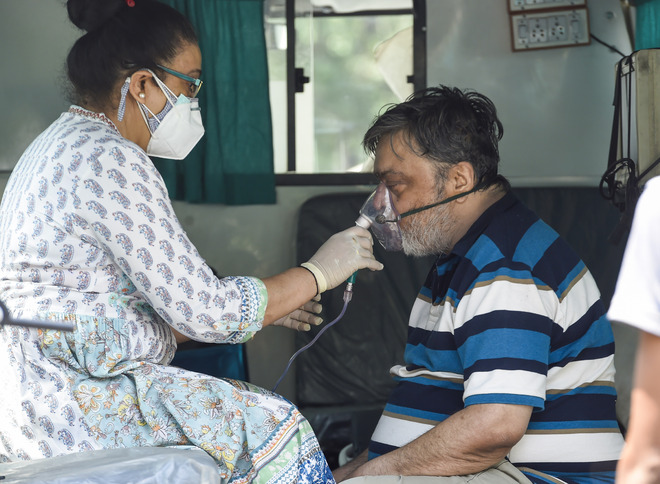
State gasps for oxygen, Capt seeks PM, Shah’s urgent intervention

Wants additional allocation of 50 MT of medical oxygen, 20 more tankers

State gasps for oxygen, Capt seeks PM, Shah’s urgent intervention

Tribune News Service

Chandigarh, May 4

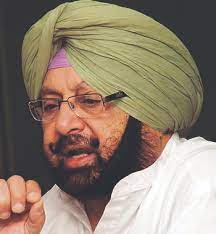
Chief Minister Capt Amarinder Singh on Tuesday sought the immediate intervention of both the Prime Minister and the Union Home Minister to ensure uninterrupted supply of medical oxygen to the state, along with additional allocation of 50 MT liquid medical oxygen (LMO) from a nearby source and 20 additional tankers (preferably conducive to rail travel) for timely evacuation of LMO from Bokaro.

Supply erraticDespite assurance that adequate supply will be ensured to us from alternate sources, I regret to point out that this has not happened. —Capt Amarinder Singh, Chief Minister

The Chief Minister sent out separate letters to Prime Minister Narendra Modi and Home Minister Amit Shah, as the number of Covid patients on varying levels of oxygen support in the state went up to 10,000.

Expressing deep concern over the imminent loss of lives due to oxygen shortage across the state, the Chief Minister said with mounting caseload, he was unable to increase Level 2 and Level 3 beds due to oxygen availability constraints. The state was facing the prospect of shortage of oxygen beds, he said, pointing out that the Government of India had expressed its inability to even allow Punjab’s local industry to undertake commercial import of LMO from Pakistan through the Wagah-Attari border, which is geographically proximate.

Pointing out that Punjab had now been given to understand by the Centre that there would be likely disruption of LMO supply from today from Panipat and Barotiwala, the Chief Minister said this would cause great stress on the already limited oxygen availability in the state, thus causing a medical emergency, including risk of loss of life for the large number of patients who are in critical condition and on regular oxygen support. The disruption should be avoided, he said, adding that, if necessary, the state must be compensated immediately from a nearby additional source.


Status of life-saving gas

  • 225 MT is the daily consumption of oxygen in the state
  • 195 MT  is the total oxygen allocation from outside the state
  • 90 MT comes from Bokaro, 105 MT from Haryana, Himachal & U’khand
  • 80 MT is generated daily within the state
  • 10,000 Covid patients on oxygensupport in the state currently

REACTIVE DEFENSIVE STRATEGY WILL NOT WORK AGAINST CHINA

The need for dedicated Mountain Strike Corps for India is inescapable, to create worthwhile punitive deterrence against China, which can also be used elsewhere
by Major General S B Asthana (Retd)
For decades, the strategic planners of India have been boosting offensive capability along western borders for credible deterrence and remained contented with limited offensive capability with reactive mindset along northern and eastern borders, against the basic military strategy which says “Offense is the best form of defence” and a defender can at best respond to offensive as he doesn’t have the initiative. The number of Strike Corps earmarked for western borders versus northern/eastern borders bears testimony to this observation.
Was Our Strategy Against China Reactive?
One of the reasons for adopting reactive/dissuasive strategy against China by various decision-makers was unwarranted faith in the Confidence Building Measures (CBM) between China and India, in the form of various Border Peace and Tranquillity Agreements (BPTA), although the basis of the faith was unrealistic, in light of Chinese repeated misadventures like 1962, Sumdurong Chu, Doklam, to name a few.
The fact that Chinese have been dragging their feet on demarcation of LAC/Border settlement also proves the fragility of any agreement with them. Except for few proactive actions at tactical/operational level like Pangong Tso heights, Nathu La and Doklam, by and large, the Indian strategy against China has been reactive at strategic plane.
Voices for “China being enemy No 1” and proposals to have mountain strike corps have been on the tables of South Block since long, but the delay in complete raising of Mountain Strike Corps apparently has been due to economic and bureaucratic reasons, together with the idea of not disturbing peace and tranquillity on borders, due to over-reliance on CBMs, BPTA and other agreements, despite China violating them repeatedly. The fact is that incidences of patrol clashes and soldiers pushing each other, having different perception of LAC have been quite frequent, which remains an unsatisfactory arrangement for any professional force to guard borders/LAC without firing.
Hasn’t The Need of Having Mountain Strike Corps Become Inescapable?
After China junked all the CBM’s in Eastern Ladakh, and now reluctant to disengage in ‘other areas’ after disengaging North and South of Pangong Tso, it’s evident that de-escalation is nowhere in sight. The campaigning season is approaching with summers, which can again lead to heavy troop concentration by both sides. With many similar actions taken by China along LAC in past few decades, it is evident that a reactive, defensive strategy will not influence China to negotiate LAC/borders, which is important to avoid repeated standoffs.
The need for dedicated Mountain Strike Corps for India is inescapable, to create worthwhile punitive deterrence against China, which can also be used elsewhere. As per media reports, some re-alignment/rebalancing of existing offensive forces, grouped with adequate mechanized forces and other elements is being done to create corps level offensive capability for Northern Theatre and partially raised ‘Mountain Strike Corps’ for eastern theatre, with adequate flexibility of application in other theatres. It makes strategic sense to meet the offensive requirements of various theatres and is a reasonably practical option, till India completes further capacity building.
Strike Corps Headquarters Versus Integrated Battle Groups Under Theatres?
The much-referred division/independent brigade-sized ‘Integrated Battle Groups’ (IBG) is a concept tried in many exercises in the recent past with adequate media coverage, but there is a need for all such forces to operate under offensive Corps Headquarters, tasked for an offensive role in adversary’s territory so that they are oriented, trained and equipped accordingly, which is a time-consuming process. Historical experience of operations in these areas indicates that the theatre commanders by virtue of such long borders and wide span of control, had a tendency to manage their defensive posture as a higher priority.
To create deterrence and not be reactive, India needs offensive Corps Commanders to be looking for objectives into adversary’s territory and posturing accordingly. The logistics requirements and equipment profiling of an offensive corps have to be much different in terms of light tanks, guns, clothing and other equipment. It needs detailed planning and earmarking resources, which IBG’s are not designed to handle, and Theatre Headquarters will find it difficult to concentrate on offensive build-up, due to large span of control.
The Mountain Strike Corps Commander will be able to pick up his objectives across LAC, capable of threatening its vital objectives, oriented, trained, equipped and organized with logistics set up to sustain forces across LAC, which will improve punitive deterrence capability of India. There may be a need to locate parts of such offensive corps at heights to minimize the acclimatization requirements, to cut short the mobilization timings. It is therefore recommended that the Mountain Strike Corps must be developed with Corps Headquarters, IBG and other components as part of it, on priority. This will impose required cost on China, making settlement of LAC/border issue a better option than not doing so.
Future Military Strategy In Dealing With Aggressive China
India needs to adopt multi-pronged strategy to include military, economic, diplomatic and other elements of power. Preparing for ‘Two Front War’ for India is not a choice, but a compulsion, although it may/may not happen. The only way to avoid ‘Two Front War’ for India, is to convince the potential adversaries that it is capable of fighting it successfully and posing multiple front for China. This convincing has to be backed by building capability to do so. India seems to be working on it, fast-tracking procurements and boosting indigenous production of necessary equipment through ‘Atmanirbhar Bharat’, besides a tough stance by forces on borders. India needs to be prepared to pose a threat to Chinese vulnerabilities in maritime domain in collaboration with Quad and other friendly navies. The overall strategic approach has to be proactive at tactical, operational as well as strategic level.


DRDO to set up five oxygen plants in NCR

DRDO to set up five oxygen plants in NCR

ribune News Service

New Delhi, May 4

In a good news for the national capital, reeling under a ‘medical oxygen crisis’, the first lot of oxygen plants to be provided by the Defence Research and Development Organisation (DRDO) has arrived and these will be installed over the next two-three days.

2 oxygen units reach Delhi

  • Two of the five oxygen plants to be provided by the Defence Research and Development Organisation arrived in Delhi on Tuesday
  • These will be installed over the next two-three days

These are part of the 500 oxygen plants ordered for the country under the PM Cares Fund to tackle the surge in Covid-19 cases. The National Capital Region will get five plants this week at the AIIMS Trauma Centre, Dr Ram Manohar Lohia Hospital (RML), Safdarjung Hospital, Lady Hardinge Medical College and one at AIIMS, Jhajjar, Haryana. Each of these plants are designed for a flow rate of 1,000 litres per minute. The system can cater to 190 patients at a flow rate of 5 LPM and charge 195 cylinders per day. The technology has been developed by DRDO based on the on-board oxygen generation system of the fighter jet, Tejas.

Two of these plants reached Delhi on Tuesday and are being installed at AIIMS and RML. These have been supplied by Trident Pneumatics, Coimbatore which is the technology partner of DRDO and has been given an order to make 48 such plants. An order of 332 plants have been placed with Tata Advanced Systems Limited and the delivery will start from mid-May.

Meanwhile, the IAF today landed additional oxygen cylinders. To date, the IAF had brought in 54 cryogenic containers and 900 oxygen cylinders from outside India — Singapore, Dubai, Bangkok, Frankfurt and UK. Within India, the IAF has transported 180 empty cryogenic oxygen containers, apart from other relief material like oxygen cylinders, oxygen plant equipment, essential medicines and hospital equipment. 


Punjab CM comes to aid of 10-year-old selling socks to support family

The chief minister went on to say Rs two lakh would be given as immediate assistance to the boy’s family

Ludhiana, May 7

A video of a 10-year-old school dropout selling socks on Ludhiana streets to support his family of seven moved many on social media, including Punjab Chief Minister Amarinder Singh, who announced state aid to fund his education.

The chief minister went on to say Rs two lakh would be given as immediate assistance to the boy’s family.

This comes after Vansh Singh was seen in the video, which has been viewed by millions and shared widely, refusing to accept Rs 50 over and above the cost of socks he sold to a customer

Image
Image

Moved by the gesture, Singh spoke to the boy and his family on a video call on Friday, and said he was impressed by his self-esteem and dignity.

The chief minister then directed the Ludhiana deputy commissioner to ensure that Vansh Singh goes back to school, saying all expenses for his education would be borne by the state government, an official statement said here.

Vansh Singh’s father, Paramjit, is a sock seller too and his mother, Rani, a homemaker.

He has three sisters and an elder brother, and the family lives in a rented accommodation in the Haibowal locality. PTI


Nearly 15% Covid beds in select military hospitals could be made available to civilians

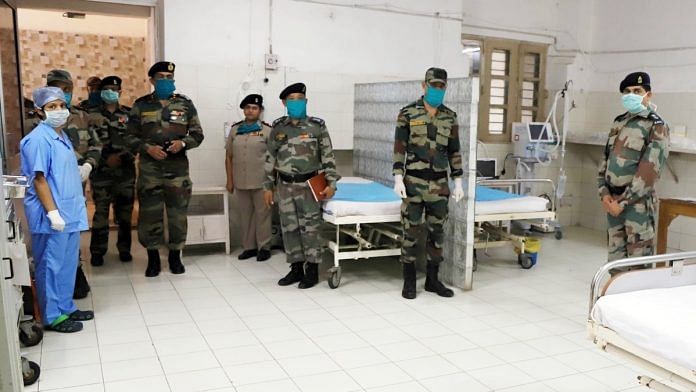
A file photo of a Covid ward set up at an Army hospital, in Prayagraj. | Photo: ANI

New Delhi: Select military hospitals will make 10 to 15 per cent of their designated Covid-19 beds available to the civilian population in cases of specific referrals from the local administration, ThePrint has learnt.

The select facilities will be among the 50 Armed Forces Medical Services (AFMS) hospitals that have been allowed to treat civilians, subject to availability of beds and other conditions.

According to defence sources, civilians requiring beds in the designated military hospitals will first have to get a referral from the chief medical officer, after which they will have to send a requisition to the collector. This would be forwarded to the local military authority, which will then take the case forward depending on availability of beds.

“The process has to be followed given that all existing military hospitals across the country have little beds available since the pandemic surged in the last few weeks, affecting many military personnel and veterans and their dependents,” a source told ThePrint.

“The number of beds in the existing hospitals is inadequate to meet the number of critical Covid positive patients,” the source said, citing the examples of the Army base hospital in Delhi and INHS Ashwini, one of the biggest naval hospitals in Mumbai, which have been running full in the last several weeks.

Last week, Army chief General M.M. Naravane said the force is setting up temporary hospitals across the country and also opening up its own facilities for civilians wherever possible.


Also read: States seek Army help to fight Covid but ‘overstretched’ forces have limited doctors to spare


Other measures

On Sunday, the Army clarified that the Ministry of Defence has allowed 50 AFMS hospitals — including 42 Army, five Air Force and three Navy hospitals (dedicated and mixed Covid hospitals) — in which civilians could get treated subject to referral by the local health authority after ascertaining bed availability.

This is besides the entitled clientele of AFMS hospitals, which comprise serving personnel and veterans and their dependents.

The Army is also learnt to have assured the veteran community that there will be no restrictions on their admission, treatment and consultations, and they would be accorded priority for treatment in military hospitals.

Meanwhile, the AFMS Directorate General last week asked veteran officers to pitch in the fight against Covid and offer their services in advising and counselling.

The three services have put in their resources to create the requisite infrastructure and medical and quarantine facilities to support India’s ongoing fight against the massive Covid wave.

The defence ministry has also granted the services emergency powers to expedite critical procurement needed to build additional infrastructure to tackle the growing burden of the pandemic.


Also read: Too many CT scans to diagnose Covid could increase cancer risk, AIIMS chief 


US urges citizens to return home from India through available flights

Both the travel advisories have been marked ‘Level 4’ which is the highest warning level

US urges citizens to return home from India through available flights

Washington, May 7

The US, which has urged its citizens not to travel to India due to an unprecedented surge in the COVID-19 cases there, on Friday encouraged those in the country to book their tickets to return home through currently available flights.

The United Airlines and Air India are continuing to operate numerous direct flights weekly from India to the US, a State Department health alert said.

Additional flight options remain available on Air France, Lufthansa, and Qatar Airways via transfers in Paris, Frankfurt, and Doha.

US citizens who wish to depart India are encouraged to book tickets through the airlines, the health alert said.

It is mandatory for anyone travelling to the US (2 years and older) to take a COVID-19 test no more than 3 days before travel and show a negative result to the airline before boarding the flight, it said.

The passengers should be prepared to show documentation of recovery from COVID-19 (proof of a recent positive viral test and a letter from a healthcare provider or a public health official stating clearance for travel).

Travellers are encouraged to follow post-travel guidance once in the US, it said.

The US this week reissued its travel advisory on India, urging its citizens not to travel to the country due to an unprecedented surge in the COVID-19 cases there.

“Do not travel to India due to COVID-19. Exercise increased caution due to crime and terrorism,” the State Department said on Wednesday in its latest travel advisory that looked identical to the one issued on April 28.

Both the travel advisories have been marked ‘Level 4’ which is the highest warning level.

On April 28, the Department approved the voluntary departure of family members of US government employees.

On May 5, the Department approved the voluntary departure of non-emergency US government employees.

“US citizens who wish to depart India should take advantage of available commercial transportation options,” it said.

Last week, the Centers for Disease Control and Prevention (CDC) issued a Level 4 Travel Health Notice for India due to COVID-19, indicating a very high level of COVID-19 in the country. PTI AKJ