A medical oxygen generation plant, which has been sent by Italy to tackle the Covid-19 health emergency in India and can support 100 patients at one time, was operationalised at a CAPF hospital located in Greater Noida on Thursday.
Officials said the machinery for the plant was brought to India onboard a special flight a few days back and the Centre had deployed it at the CAPF referral hospital.
“Italian Ambassador to India Vincenzo De Luca switched on the plant at a ceremony that was attended by senior ITBP officers. The plant has been installed and made operational at the hospital campus within 48 hours, the border guarding force stated.”
It will supply medical oxygen to more than 100 Covid-19 beds available at the hospital, it added. The CAPF hospital primarily caters to the personnel of various police and paramilitary organisations, their families, veterans of these forces that function under the command of the Union Ministry of Home Affairs (MHA).
Speaking at the switching-on function, Luca said the plant would be at the hospital “permanently” and it was a sign of friendship and solidarity between the two countries.
Recounting as to how some Italian tourists in India were treated at the ITBP medical set-up when they contracted Covid last year, he said, “We do not forget this (gesture by India)… this friendship and solidarity with India will continue…”
Our Defence forces are battling COVID-19 in full gear, and they are making a big difference As India grapples with the pandemic’s second wave, our armed forces are contributing silently, though swiftly and significantly, in the all-out effort. A case in point about the citizenry’s unwavering faith in the institution is the Delhi Government seeking the military’s “urgent help” and the Patna High Court, while slamming the Bihar Government for its shoddy handling of the contagion, saying it wanted the armed forces to take over the State’s health infrastructure. These two recent instances speak volumes about the credibility of the Services in general and the women and men in uniform, in particular. All the arms of the military establishment — the Army, Navy and the Air Force — are now in the thick of action in the war on the accursed virus: Setting up hospitals for Corona patients, ferrying the much-needed oxygen from abroad and rushing medicines and related equipment to all parts of the country. Even as nearly 65 military stations across India have thrown open their medical facilities for civilians, the Defence Research and Development Organisation (DRDO) has set up an oxygen generation plant at the AIIMS, New Delhi. Four more such plants capable of generating more than 1,000 litres of oxygen per hour will soon start functioning in the RML Hospital, Lady Hardinge, Safdarjung and the AIIMS in Jhajjar, Rohtak. The system can cater to 190 patients at a flow rate of five litres per minute and charge 195 cylinders per day. The Medical Oxygen Plant technology has been developed by the DRDO based on the on-board oxygen generation for the Tejas light combat aircraft and will help overcome the logistics issues of oxygen transportation. Besides coming up with innovative solutions to beat the oxygen shortage, the DRDO has set up COVID-19 hospitals in Delhi, Lucknow and Ahmedabad. More such centres, equipped with ventilators, oxygen and an ICU, will soon come up. Called in on April 23, the IAF is making relentless sorties, especially to airlift oxygen from abroad. One of its C-17 aircraft flew 35 hours to fetch cryogenic oxygen containers from England. Earlier, another C-17 flew 14 hours non-stop to get cylinders from Germany. Looking at the serious situation, the IAF has to date brought in more than 60 cryogenic containers and 900 oxygen cylinders from Singapore, Dubai, Bangkok, Frankfurt and the UK, clocking over 140 flying hours. Battling the pandemic, the armed forces have not been impervious to the safety of their own personnel. The Army and the IAF have vaccinated nearly their entire strength. The Army even ensured that its troops, deployed in Ladakh amid the ongoing standoff with the Chinese, are administered both doses of the vaccine. Prime Minister Narendra Modi and Defence Minister Rajnath Singh are consistently monitoring the diligence of the Defence forces in meeting the COVID-19 challenge. Truly, the nation’s people always look up to our armed forces in times of crisis. Their great hope and trust have never been belied, and our uniformed personnel ain’t going to let them down, now or ever!
Defence forces engaged in helping Covid-hit: Defence Minister Rajnath Singh
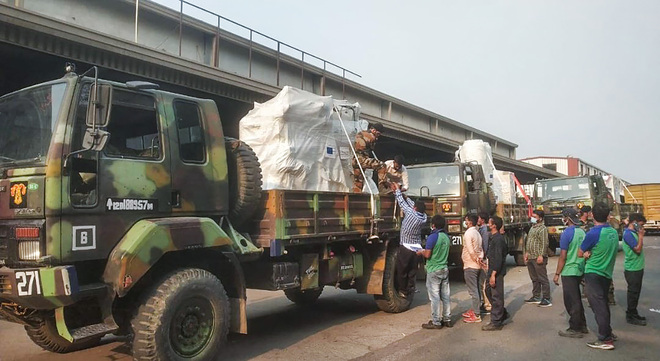
Army personnel receive an oxygen generator plant sent by Ireland. The plant will be installed at Base Hospital in Delhi Cantt. PTI
Tribune News Service/PTI
New Delhi, May 6
The armed forces as well as organisations like the Defence Research and Development Organisation and National Cadet Corps (NCC) are engaged in mitigating the sufferings of the people amid the Covid-19 surge, Defence Minister Rajnath Singh said here on Thursday.
In a blog post on his website, Rajnath enlisted the steps, including mobilisation of health professionals and setting up of new Covid facilities, taken by the defence ministry’s organisations to deal with the surge.
Some 200 drivers of the armed forces are on a standby for driving oxygen transporters to various parts of the country, he said in a post. Also, 10 TATRA (a truck used to transport heavy equipment) and 15 large vehicles are on a standby to trans-ship any medical supply arriving at the Palam airport.
The Army on Friday mobilised two of its field hospitals from Northeast by air to Patna to assist the government of Bihar, while separately setting up an exclusive Covid management cell in Delhi with a Lt General-rank officer heading it. The cell will coordinate real-time responses to address the exponential rise in Covid cases across the country, including Delhi where assistance to civil administration in the form of testing and transportation of medical equipment is already being provided.
Bangladesh sends 10,000 vials of Remdesivir
Dhaka: Bangladesh on Thursday sent to India 10,000 injections manufactured locally on the instruction of Prime Minister Sheikh Hasina. PTI
Oz’s Victoria state to provide $41 mn aid
Melbourne: The Australian state of Victoria on Thursday announced $41 million worth of aid and medical equipment, including 1,000 ventilators, for India. PT
Air Force, Navy intensify efforts to help tackle COVID-19 situation
On May 5, the Indian Navy deployed nine warships to bring liquid oxygen and other medical supplies
INS Talwar with 40 metric ton of liquid medical oxygen arrives from Manana Behrain to NMPT Port, in Mangaluru. — PTI
New Delhi, May 7
The Indian Air Force (IAF) has conducted 59 sorties to airlift 72 cryogenic oxygen storage containers and 1,252 oxygen cylinders from seven countries across the world, the Defence Ministry said on Friday.
These seven countries are Singapore, Dubai, Thailand, the UK, Germany, Belgium and Australia, the ministry said in a statement.
India has been badly hit by a second wave of COVID-19, and hospitals in several states are reeling under a severe shortage of vaccines, oxygen, drugs, equipment and beds.
As on Friday, the C-17 aircraft of the IAF have conducted 400 sorties within the country, including 351 to airlift 252 oxygen tankers of total capacity of 4,904 metric tonnes, the ministry stated.
Along with the IAF, the Indian Navy has also intensified its efforts to aid the civil administration in tackling the current COVID-19 situation by ferrying oxygen containers and medical equipment.
The ministry said the Indian Navy deployed INS Talwar, INS Kolkata, INS Airavat, INS Kochi, INS Tabar, INS Trikand, INS Jalashwa and INS Shardul to ferry oxygen containers, cylinders, concentrators and related equipment from friendly foreign countries.
On May 5, the Indian Navy deployed nine warships to bring liquid oxygen and other medical supplies from several countries in the Persian Gulf and South East Asia.
With a record 4,14,188 new coronavirus infections being reported in a span of 24 hours, India’s total tally of COVID-19 cases climbed to 2,14,91,598 on Friday, while the count of active cases crossed the 36-lakh mark, according to the Union Health Ministry.
The death toll has increased to 2,34,083 with 3,915 fatalities being reported in a day, data uploaded by the ministry showed.
Since April 23, the IAF has been airlifting empty oxygen tankers and containers to various filling stations across the country.
Along with oxygen containers, the IAF has transported essential medicines as well as equipment required by COVID hospitals in various parts of the country. — PTI
The Covid-19 tsunami is expected to continue in India till at least the end of May, and remain an issue of concern for the rest of the year. Hence maximising the institutional capacity of the military in the war against Covid-19, without diluting its primary operational orientation, in the backdrop of a resource crunch, is the task ahead for the Indian political and defence leadership by C Uday Bhaskar India’s Covid-19 crisis and the extraordinary surge in the second wave have become a matter of global concern. Public policy experts have offered professional advice based on their own national experiences. In a recent interview with The Indian Express, Anthony S Fauci, the chief medical adviser to the president of the United States, compared the current public health challenge to a war and referred to the Indian military. He noted: “What is the role of the (Indian) military? Can the military come in and help?” Fauci added: “You should think of this, in some respects, like a war. The enemy is the virus. It is almost like wartime because it’s an emergency.” Since the pandemic was acknowledged as a major national challenge in March 2020, the Indian military has been providing “aid to civil power” in a variety of ways. When the virus was spreading slowly last year, the fauj helped set up quarantine facilities and assisted in the evacuation of Indian citizens stranded abroad. Special military medical teams were also sent to some neighbouring nations to help establish Covid-testing facilities. In recent weeks, when the virulence of the second wave called for emergency measures, transport aircraft of the Indian Air Force ferried much-needed oxygen and other medical supplies from donor nations. The Indian Navy carried medical supplies from the neighbourhood. The Indian Army, which has the largest footprint across the nation, created dedicated Covid-19 facilities for civilians, and military medical personnel are at the forefront in hospitals set up by the Defence Research and Development Organisation (DRDO). Prime Minister Narendra Modi has also met with the military top brass and emergency measures have been put in place to enable the military to provide assistance to the Covid-19-afflicted. However, while recognising the contribution of the military to India’s Covid-19 effort, the answer to Fauci’s query (can the military come in and help?) is yes — but only when such help is sought by the civilian government. Every nation evolves its civil-military template — and it is important that this balance is not upset. The military must and will help, but it cannot be suddenly expected to fill in all the deficits caused by entirely avoidable policy mistakes of the civilian domain. The primary role of the military is to safeguard national integrity, counter territorial challenges and prepare for war to deter any adventurism. The past year has been particularly taxing for the Indian military — China’s incursions across the Line of Actual Control, and the subsequent Galwan setback, occurred due to the pandemic-induced disruption of the Army’s annual deployment in Ladakh. The Covid-19 tsunami is expected to continue in India till at least the end of May, and remain an issue of concern for the rest of the year. Hence maximising the institutional capacity of the military in the war against Covid-19, without diluting its primary operational orientation, in the backdrop of a resource crunch, is the task ahead for the Indian political and defence leadership. The military’s core characteristics are professional competence, innovation in the face of adversity, proven organisational acumen and a deeply ingrained spirit of selfless service. Add to this the intrinsic training ethos of the military and some policy options can be identified. A key immediate, and medium-term, Covid-19 management objective for India will be to create across-the- broad capacity to avoid the kind of tragic situation of today, most visible in oxygen shortages. Only last week, to address the dire shortage of oxygen in Agra district, the local army and air force helped the district administration set up a new oxygen plant that was completed in a record seven days. Further, the army’s technical corps, the electronics and mechanical engineers (EME) in Agra, repaired a local oxygen manufacturing unit that was non-operational for a few years. It has now been entrusted with a similar task to repair a plant in Saifai. Policymakers must think about whether this kind of civilian-military partnership to boost oxygen production can be replicated on a wider scale and under what conditions. The next Covid-19 crisis for India will be a shortage of trained medical staff — doctors-nurses-paramedics. A large number of under trainees are in the final stages of completing their courses in medical colleges, and the military can play a role in bringing them into the mainstream with focused and rigorous final grooming — in a matter of weeks. Just as the Indian military had trained thousands of young citizens in the mid-1960’s in a warlike environment, it can significantly augment medical human resources capacity. A few high-risk, meagre infrastructure districts can be entrusted to the military for relief and can be scaled up judiciously. Further, the community of retired military veterans is a large, disciplined pool and can be encouraged to join the effort. They can be pulled in for the tasks of coordination, logistics management, and direct medical assistance in the case of trained personnel, among other measures. But all such initiatives will need careful planning, based on envisioning an effective role for the military in pandemic management. Exploiting the military for short-term political advantage and optics (for instance, the location of the first set of DRDO hospitals in Varanasi, Lucknow and Ahmedabad have generated questions) must be avoided. When the death toll is moving towards half a million, the situation, alas, is grim and warlike, requiring all of India’s institutions to weigh in.
Covid-19 Second Wave Is Similar To India’s 26/11 Moment:::by MP MANISH TEWARI
India started getting hit by Pakistan-sponsored terror from 1980 onwards. However, for the substantive bulk of this country, especially for the influential middle classes it was but a remote occurrence in some back of the beyond part of the country. Throughout that decade as Punjab bled and then in the 1990’s when Jammu & Kashmir followed suit, the well-healed and upwardly mobile classes generally remained nonchalant about the enormity, gravity and barbarity of what was being unleashed on hapless people who were at the receiving end of these depredations.
By and large the chattering classes viewed terror as something far removed from their daily existence. If bombs exploded in suburban trains or even marketplaces it was matter of concern but, something to be taken in one’s stride.
On October 29, 2005, bomb blasts ripped through the Sarojni Nagar Market in Lutyens Delhi leaving 62 people dead and over 210 maimed. Three days later, on 1st November it was Diwali.
That evening as I stood out on the balcony of our home, I was nauseated to see the vigor and unabashed enthusiasm with which crackers and rockets were going off all over the night sky in Delhi as far as the eye could see. People were celebrating as if there was no tomorrow. The insensitivity was sought to be normalized by spinning it off as ‘Oh we are not going to allow the terrorists to interrupt the rhythm of our daily lives’.
Then 26/11 happened. For three days ten Pakistani terrorists relentlessly hunted down and mercilessly butchered people in the watering holes of the rich and famous. Terror suddenly acquired a new meaning. It had come home. The penny suddenly dropped- it could have been me in that hotel.
I recall the frenzied discussion’s on television channels, where well-healed members of the middle class bayed for the blood of the the then UPA government and rightly so.
The second wave of Covid -19, is the 26/11 moment for the Indian middle class. The virus-like-terror has acquired a totally new meaning in the past three weeks.
When the first wave started in March last year and an ill-conceived national lockdown was announced at a four-hour notice, the middle classes were able to retreat to the safety of their homes. That luxury was unfortunately not available to the poor.
Millions of migrant workers pored out on to the highways of India and made a dash for there hearth. As they walked back they were caned, forcibly doused down with chlorine water, mowed down by speeding trucks and forced to march through rivers and ravines to somehow reach their villages. The Middle Classes expressed concern but then again it was not kind of happening to them. It was the underclass that was being brutalized.
I recall a conversation with my driver early into the lockdown. He told me how ten men from his village walked back to their village in Nepal because their respective employers just tossed them out of their lodgings without even an iota of concern for their safety. They walked at times hundred kilometres a day and reached their homes in ten days –and ironically many of them were compelled by the force of their circumstances to come back and work for the very same heartless employers once again.
Then the second wave came. Everyone had let their guard down. Some people had got vaccinated others were contemplating getting the jab. The masks had been taken off. The government was totally preoccupied in fighting and trying to win elections. The Prime Minister thought nothing of catcalling the elected Chief Minister of West Bengal when he should been calling and confabulating with medical experts who had been warning of the second wave. Earlier in the February of this year he had taken very serious umbrage to my unfortunately prophetic assertion in Parliament –that God had saved us during the first wave.
In fact on the 17th of March 2021 when I had opened the debate on the Demands of Grants of the Ministry of Health and Family Welfare I started by warning the government- “This discussion is taking place at a point of time when the world being engulfed if not overwhelmed by the Second wave of Coronavirus infections” I also flagged the absence of the Health Minister from the house when perhaps the most vital Public Health and National Security challenge was being discussed. However, the government was completely blasé and unconcerned about the mutating demon of death that had already commenced the slow march of devouring people even back then
A month later the virus struck with full force and people started tumbling like nine pins. An AWOL – Absent without leave government just folded up and vamoosed. Suddenly there was no oxygen, no hospital beds, no Remdisivir, no Tocilizuamb and no ventilators for the number of people falling sick.
For the middle classes- money, social networks, contacts and even plain simple ‘Jugaad ‘that is a way of life in India suddenly stopped working as people died in the parking lots of hospitals or searching for hospital beds as they were ferried from one hospital to another. Others died because hospitals where they had gone to heal just ran out of oxygen- and these were some of the best hospitals in the National Capital of an aspiring great power.
Even the cremation grounds are out of wood, burial grounds out of space and top hospitals are still rushing to courts every day to pray for the next day’s supply of oxygen.
It is the 26/11 moment for the middle classes again. Like terror earlier the rampaging virus has tragically hit home. As a very senior retired Civil servant very heartbreakingly put it “Many people like me perhaps thought that it couldn’t happen to them! But it did happen! My mother and husband, both, died without any treatment. We failed to have access to all top-notch Delhi hospitals we used to visit! Yes, after death they declared COVID positive,”. Should this not make us hang our heads in collective shame.
The poor understand very well that they have just no chance if a catastrophe were to hit them now even the middle classes are unfortunately realizing this much to their peril. They are angry, seething with rage. When god willing this dance of death ends let us not forget the lesson that we are learning at great personal costs. Let us internalize it to build a more caring, empathetic and compassionate nation.
The nightmare is not yet over. What is required today is that everybody must hold each other’s hand rich and poor alike so that all of us together vanquish this wretched virus.
(The author is a lawyer, MP and former Union minister of Information and Broadcasting Government of India. Views expressed are personal and do not necessarily reflect those of Outlook Magazine.)
Three more Rafales head for India; to take IAF’s count to 21
The new squadron of Rafale jets will be based in Hasimara airbase in West Bengal
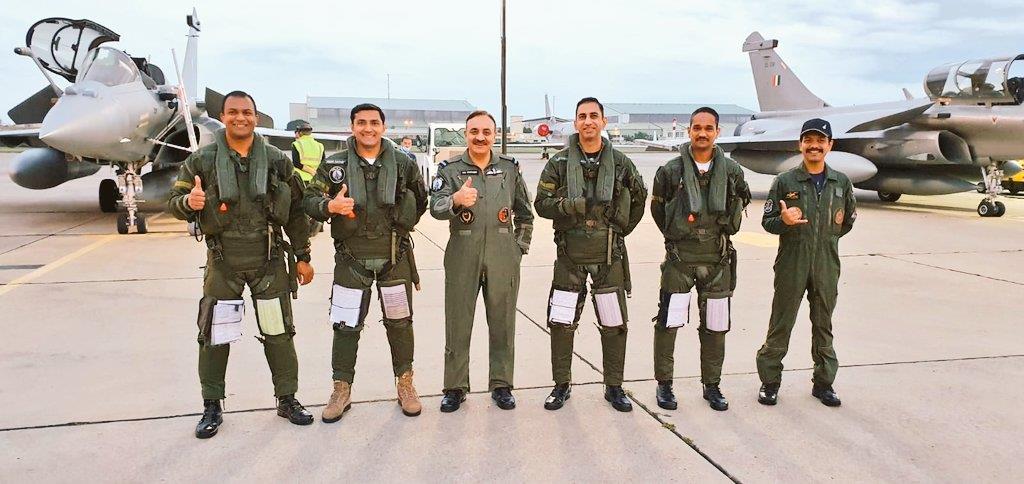
Next batch of three Rafales leave from France to India today. PTI
New Delhi, May 5
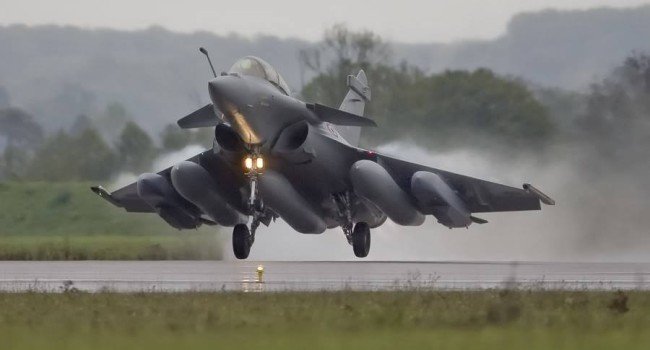
The sixth batch of three more Rafale fighter jets took off from France for India on Wednesday, the Indian embassy in France said.
They will be part of the Indian Air Force’s second squadron of the Rafale jets.
“Next batch of three #Rafales leave from France to India today; wished the pilots smooth flight and safe landing,” the Indian embassy in France tweeted.
After the arrival of the new batch, the number of Rafale jets with the IAF will go up to 21.
The new squadron of Rafale jets will be based in Hasimara airbase in West Bengal.
The first Rafale squadron is based in Ambala air force station. A squadron comprises around 18 aircraft.
India had signed an inter-governmental agreement with France in September 2016 for the procurement of 36 Rafale fighter jets at a cost of around Rs 58,000 crore.
The first batch of five Rafale jets arrived in India on July 29 last. The fifth batch had landed on April 21.
Last month, Chief of Air Staff Air Chief Marshal RKS Bhadauria visited France, during which he took stock of the delivery of the remaining Rafale aircraft to India. PTI
Mourning relatives at a hospital in Prayagraj, Uttar Pradesh. PTI
New Delhi: The Indian Medical Association (IMA) has written to the Health Ministry, asking for a nationwide lockdown to give a breather to health systems and doctors and asking why the Centre was hiding deaths. Questioning the vaccine pricing policy, it flagged the deepening oxygen crisis. “We lost 756 doctors in the first wave and 146 in the second. Hundreds of deaths are being shown as non-Covid. Why are we trying to hide the actual deaths?” the IMA asked. — TNS
ARMED FORCES USE LEASE ROUTE TO CUT RED-TAPE, STAY PREPARED FOR ADVERSARIES
India will buy 30 Predator MQ9 drones, 10 each for three services, after completion of training on two leased drones at Arakkonam in Tami Nadu The leasing of two Predator unmanned aerial vehicles from the US, a nuclear power submarine Akula class to replace the presently leased INS Chakra from Russia, and the proposal to lease a Airbus 330 multi-role transport tanker from France are examples in this direction. Rather than getting caught in the laborious defence acquisition process, the armed forces are using the financial powers of vice-chiefs to lease out critical weapon platforms from strategic allies like the United States, France and Russia. The vice-chiefs have the power to purchase ₹300 crore worth of equipment as part of capital purchases as well as half of ₹500 crore can be used for emergency requirements for the service but outside capital outlay. According to South Block officials, the leasing of two Predator unmanned aerial vehicles from the US, a nuclear power submarine Akula class to replace the presently leased INS Chakra from Russia, and the proposal to lease a Airbus 330 multi-role transport tanker from France are examples in this direction. While the leasing process allows the armed forces to train on a platform that it plans to acquire, it also short-circuits the labyrinth of acquisition process like acceptance of necessity, request for information, request for proposal, defence acquisition committee, finance ministry approvals and finally the Cabinet Committee of Security (CCS). Faced with a northern neighbour who is constantly inducting stand-off weapon systems like weaponized drones, nuclear powered submarines, fifth generation aircraft and large warships, the leasing system at least allows the Indian armed forces to be prepared for future wars. “The leasing of two Predator drones from US allows India to train and be prepared to induct 10 such drones in each of the three services. The MQ9 Predator drone is a highly versatile UAV with capacity to target the adversary through Hell-fire missile and laser guided bombs. The process for acquisition of drones has already begun,” said a top admiral of Indian Navy. The Navy is also eyeing to lease Rafale maritime fighters for its upcoming indigenous aircraft carrier INS Vikrant as the American fighters like F-18 and F-15 are too heavy and large for 45,000 ton flat-top warship. After its tender to purchase mid-air refuelers was canned by the Defence Ministry, the Indian Air Force is now leasing one Airbus 330 MRTT while eyeing further lease of five more refuelers currently with France through the proper acquisition route. While the Indian Army has no plans to take weapon platforms on lease as of now, the military purchased anti-tank weapon systems, UAVs and laser guided shells from Israel under emergency purchases powers with the vice-chief at a time when India and China were locked eyeball to eye ball at Pangong Tso in eastern Ladakh. While Chinese President Xi Jinping has offered support to Indian Prime Minister Narendra Modi to ride out of Covid-19 crisis, the paramount leader has refused to budge on the Gogra-Hot Springs issue in eastern Ladakh as if the present government will allow the land dispute to be swept under the carpet or to be left to future generations. With Beijing determined to play hardball on the border with India, the latter will have to be in advanced state of preparedness with high tech weapons in case the balloon goes up when the pandemic with origins in Wuhan sweeps India.
Army veteran’s family donates his body to medical college
Sen is survived by his wife, two daughters and grandchildren
Photo for representation only. Source: iStock.
Jaipur, May 8
Family members of Shaurya Chakra recipient Lt Col (retd)Ratan Kumar Sen on Saturday donated his body to a medical college here, a day after he passed away due to prolonged illness.
He was bid final adieu at the Mission Compound following the COVID-19 protocols. The funeral procession was taken out in an Army vehicle to reach the JNU Medical College, Jagatpura, for body donation, his family said in a statement.
It stated that no member in the family has so far been infected with COVID-19.
Sen is survived by his wife, two daughters and grandchildren.
He was commissioned into the Armoured Corps in 1972 and deployed to Jammu and Kashmir in 1994 as part of 2nd Rashtriya Rifles for counter-insurgency operations.
During one such operation in Anantnag district, on March 17, 1994, he found himself ambushed by terrorists and was pinned down under heavy gunfire. He was shot in the head by a terrorist with an AK-47 at point-blank range. Despite severe loss of blood and exhaustion, he continued to fight saving precious lives, according to the family.
He was evacuated and promptly provided medical treatment by the Army doctors which gave him a new lease of life. For his brave and gallant act, he was awarded the Shaurya Chakra on January 26, 1995 by the President of India.
Sen faced several medical issues due to the gunshot and was forced to take premature retirement in 1997 at the age of 46. — PTI
State Stalwarts
DEFENCES FORCES RANKS
ARMY, NAVY, AIRFORCE RANKS
FORMATION SIGNS
FORMATION SIGNS
ALL HUMANS ARE ONE CREATED BY GOD
HINDUS,MUSLIMS,SIKHS.ISAI SAB HAI BHAI BHAI
CHIEF PATRON ALL INDIA SANJHA MORCHA
LT GEN JASBIR SINGH DHALIWAL, DOGRA
SENIOR PATRON ALL INDIA SANJHA MORCHA
MAJOR GEN HARVIJAY SINGH, SENA MEDAL ,corps of signals
.
.
PATRON ALL INDIA SANJHA MORCHA
MAJ GEN RAMINDER GORAYA , CORPS OF
sanjhamorcha303@gmail.com
PRESIDENT HARAYANA STATE CUM COORDINATOR ESM
BRIG DALJIT THUKRAL ,BENGAL SAPPERS
PRESIDENT TRICITY
COL B S BRAR (BHUPI BRAR)
PRESIDENT CHANDIGARH ZONE
COL SHANJIT SINGH BHULLAR
.
.
PRESIDENT PANCHKULA ZONE AND ZIRAKPUR
COL SWARAN SINGH
PRESIDENT SAS NAGAR (MOHALI)
COL BALBIR SINGH , ARTY
INDIAN DEFENCE FORCES
DEFENCE FORCES INTEGRATED LOGO
FORCES FLAGS
15 Th PRESIDENT OF INDIA SUPREME COMMANDER ARMED FORCES
Droupadi Murmu
DEFENCE MINISTER
Minister Rajnath Singh
CHIEF OF DEFENCE STAFF (2nd)
General Anil Chauhan PVSM UYSM AVSM SM VSM
INDIAN FORCES CHIEFS
CHIEF OF ARMY STAFF(29th)
General Upendra Dwivedi, PVSM, AVSM (30 Jun 2024 to Till Date)