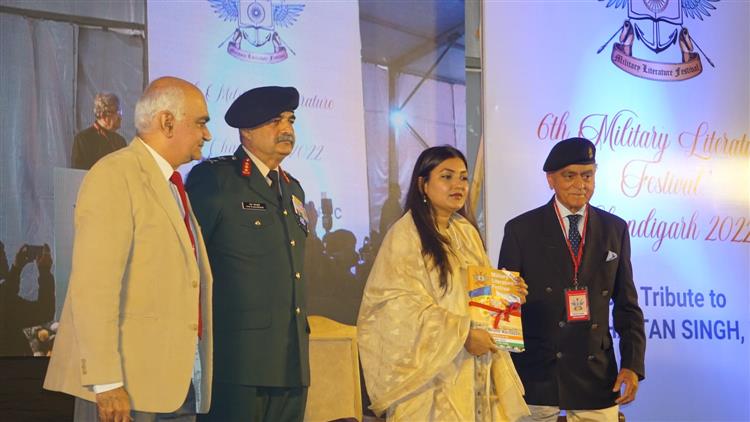
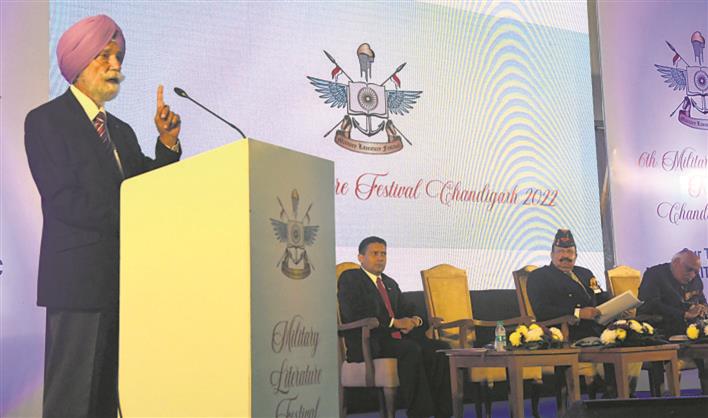
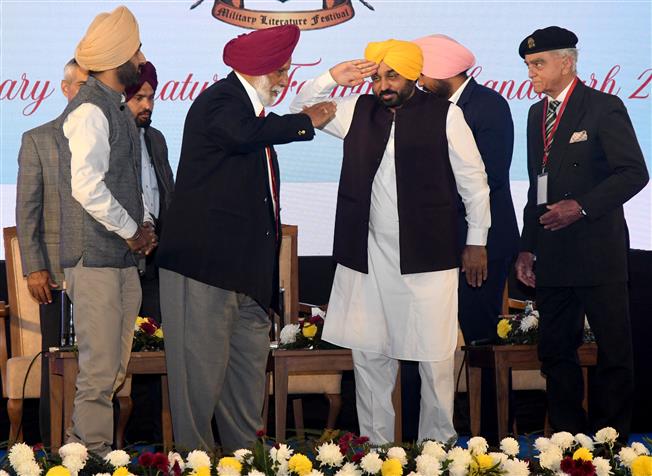
The 6th Military Literature Festival-2022 was inaugurated by Anmol Gagan Mann, Cabinet Minister for Tourism and Cultural Affairs, Punjab, at Sukhna Lake in Chandigarh on Saturday. Photo Credit: Twitter/@prodefencechan1
The Sixth Military Literature Festival – 2022 was inaugurated at Sukhna Lake here on Saturday by Punjab Minister for Tourism Anmol Gagan Mann.
To commemorate the 75th anniversary of Independence and the services of the armed forces, the festival was jointly organised by the Military Literature Festival Association in association with the Punjab government, Western Command and the Chandigarh Administration.
The festival is being celebrated under the theme ‘The Armed Forces: Defending Free India for the Last 75 Years’. It will conclude on Sunday.dressing the youth, the minister said the purpose of the Military Literature Festival is to remember the sacrifice of the brave soldiers who fought on the borders and served the country at the risk of their lives.
She explained that the contribution of military warriors to the security of the country cannot be forgotten. She added Punjab is the land of warriors and history is a witness that the warriors here never allowed Punjab to be looted. India, especially Punjab, has always shown unparalleled bravery on the war fronts and sacrificed their lives for the country and the nation.
She appealed to the youth of the new generation to join the military and make their valuable contribution to serve the country. She said Punjab is the land of Gurus and warriors, the warriors of Punjab have always fought against crime.
0She said every citizen of India lives a happy life only if the soldiers secure the country. She said that the service of the country by the soldiers is a matter of pride and the state government is always available with the soldiers for all possible help.
Military Literature Festival: Scholar-warrior, Army’s ethos changing, says ex-commander
Military Literature Festival: Scholar-warrior, Army’s ethos changing, says ex-commander
Experts discuss Pakistan
Experts discussed the prevailing instability in Pakistan and its impact on India during a panel discussion, with the opinion being that the neighbouring country would continue to face problems.
Defence Intelligence Agency former head Lt Gen Kamal Davar said the “deep state” in Pakistan, manifested by unbridled powers and undying greed, had worsened relations with India.https://4b63a39b3badfcdf5ac8e1414001da38.safeframe.googlesyndication.com/safeframe/1-0-40/html/container.html
Shalini Chawla, a fellow at the Centre for Air Power Studies, New Delhi, said: “The newly appointed Pakistan army chief has a daunting task ahead as he needs to revive the army’s position and respect in society.”
‘Democratic institutions robust’
Punjab Chief Minister Bhagwant Mann has said democracy in India is flourishing only because the armed forces maintain a constant watch on the borders in adverse conditions, while other citizens sleep comfortably in their homes.
“Democratic institutions in India remain strong and robust. Though the country attained Independence 75 years ago, it is important to preserve freedom,” he said at the closing ceremony of the literature festival.
CM Bhagwant Mann salutes an exserviceman.Photos: Vicky
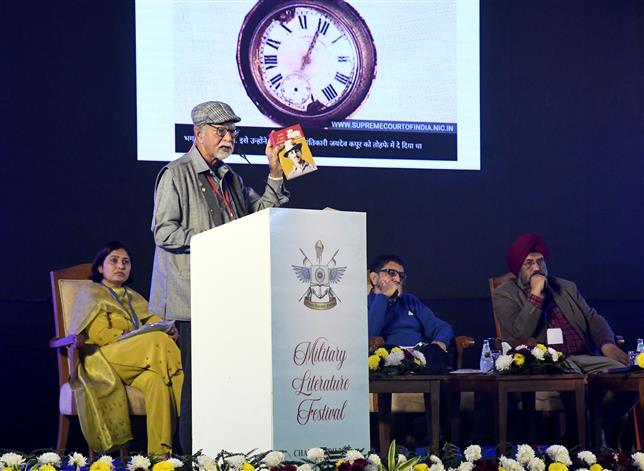
Prof Chaman Lal makes a point. Photos: Vicky
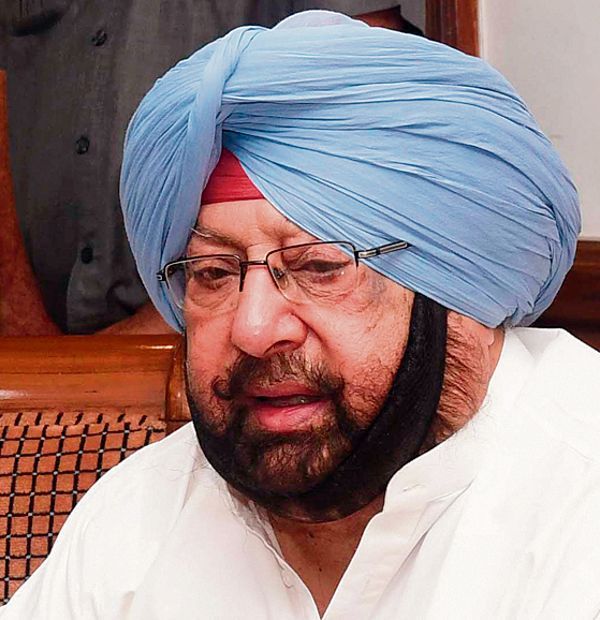
Act before it’s too late:former CM Capt Amarinder Singh
Terming the daylight murder of Pardeep Singh in Kotkapura disturbing, the BJP has asked the Chief Minister to start focusing on law and order before the state transcends towards the dark era of the 1980s.
In a tweet, former CM Capt Amarinder Singh said murders and daylight firing had become the orderof the day and Punjab was heading towards total lawlessness and the inexperienced Bhagwant Mann-led government had not been able to do anything to stop all this.
Canadian, British Missions host ceremony on Remembrance Day
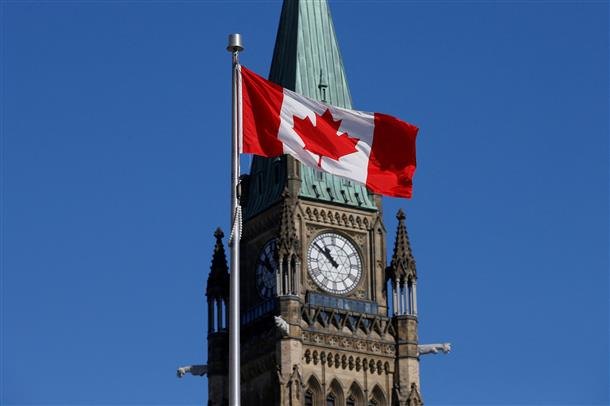
The Consulate General of Canada and the British Deputy High Commission here on Friday hosted a joint Remembrance Day ceremony to remember the members of the armed forces of the UK, Canada and India who died serving their countries.
The event was attended by the Consul General of Canada, Patrick Hebert; the British Deputy High Commissioner, Caroline Rowett; Canada’s Defence Attache Colonel Todd Braithwaite; UK Defence Adviser Brigadier Nick Sawyer;Armed Forces veterans from the tricity; cadets from Maharaja Ranjit Singh Armed Forces Preparatory Institute; women cadets from Mai Bhago Armed Forces Preparatory Institute; and government officials.
Speaking on the occasion, Consul General Hebert and Deputy High Commissioner Caroline Rowett paid tributes to the soldiers who lost their lives defending freedom, peace and democracy in the world.
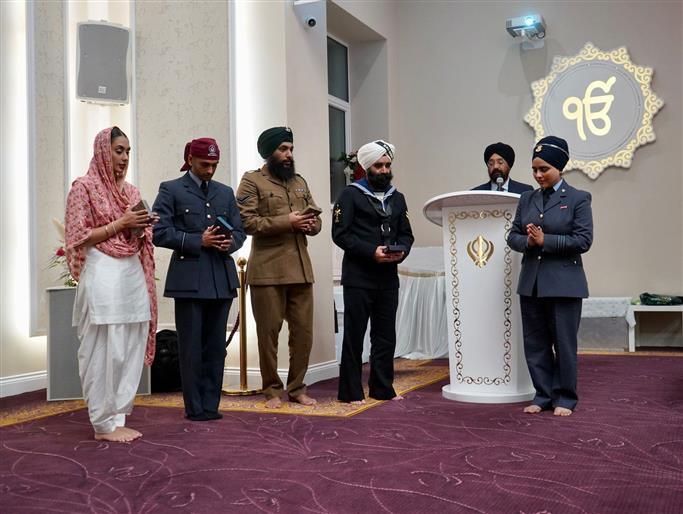
Nitnem Gutkas, the prayer books of the Sikhs have been issued to military personnel in the British Army for the first time in a century, a media report said on Thursday. A move the Ministry of Defence said will “directly support Sikh practice, a key component of their faith”.
Prayer books
For Sikhs, our scriptures are not just words, they are the living embodiment of our Guru. We draw moral strength and physical strength from reading these scriptures every day. Diljinder Singh Virdee, British army official
The prayer books were issued by the UK Defence Sikh Network at a ceremony in London, as per reports.
“The Army has been providing Christian religious texts for many years and I saw the opportunity there to open the door for the Sikh faith to provide Sikh texts,” Major Daljinder Singh Virdee, who is in the British Army and has spent two years campaigning for the return of the religious books, was quoted as saying as per reports.
The Nitnem Gutkas were printed in Wiltshire and placed on a throne in a purpose-built vehicle for Sikh scriptures, the report said.
They were transported to the library of the Central Gurdwara temple in London, where they were officially issued to military personnel on October 28, it said.
“For Sikhs our scriptures are not just words, they are the living embodiment of our guru. We draw moral strength and physical strength from reading the scriptures every day, it gives us discipline and it grows us spiritually,” Virdee was quoted as saying in the report.
Nitnem Gutkas were first issued to military personnel more than a century ago, along with other articles of the Sikh faith, including steel daggers, bracelets and wooden combs, but have never been issued again since.
There is an original military-issued Nitnem Gutka in the National Army Museum’s archives, in London, the report added.
Sikh soldiers were recruited to the British military from the 1840s onwards, and have fought at the Battle of Saragarhi; in the First World War, as the “Black Lions”, as well as during the Second World War in Malaya, Burma and Italy.
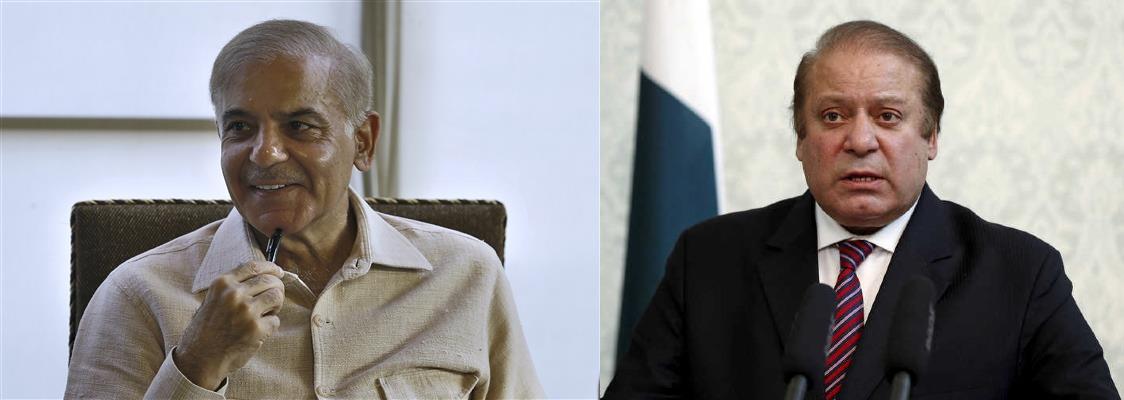
Pakistan PM Shehbaz Sharif meets elder brother Nawaz Sharif in London, duo decides not to succumb to any pressure on new Army chief appointment
The meeting between Pakistan Prime Minister Shehbaz Sharif and his elder brother Nawaz Sharif in London has decided that the government will not succumb to any pressure, including from Imran Khan, on the appointment of the successor of army chief Gen Qamar Javed Bajwa, according to media reports on Friday.
Shehbaz Sharif met Nawaz Sharif, the supremo of Pakistan Muslim League-Nawaz (PML-N) this week and decided to not give in to Pakistan Tehreek-e-Insaf (PTI) chief Imran Khan’s demand to announce early polls, the Dawn newspaper reported.
The Sharif brothers have maintained that the power to appoint the army chief rest with the country’s premier and will not be surrendered at any cost, the report quoted a source as saying.
According to a PML-N insider, Shehbaz’s government had ‘certain pressures’ from some quarters over the issue of the army chief’s appointment and fresh polls, which is why the prime minister sought to discuss it with the party supremo to decide whether to accept these demands or not, the report said
The sources also said that the possibility of Gen Bajwa’s extension was also discussed during the meeting.
Gen Bajwa’s tenure is set to end on November 29.
However, the Pakistan Army has denied speculation about its chief Gen Bajwa having another tenure as he has already begun paying farewell visits to various garrisons as part of the tradition.
Pakistan’s Defence Minister Khawaja Asif who was in London with Prime Minister Shehbaz and others also confirmed that the primary discussion of the meeting was key issues related to the country’s developments, the appointment of the new army chief, along with the recent statements made by military’s media wing on General Bajwa’s farewell, and government’s strategy to deal with the PTI’s long march, the Express Tribune newspaper reported.https://0ae13eea3b27c49579275323210c9c3f.safeframe.googlesyndication.com/safeframe/1-0-39/html/container.html
Khan has persistently critisised the Prime Minister for consulting his elder brother in crucial government decisions, saying it violated the Official Secrets Act and was a breach of his oath.
However, Khan appeared to have changed his stance a few days ago and said that he has no issues with the Shehbaz government appointing the new army chief.
Shedding some more light on the discussions in London, the PML-N sources told the Express Tribune newspaper that the government would prefer someone as a military chief who would likely be in sync with the ideas of the ruling alliance and in no way force early polls.
The top leadership of the party is also mindful of where Imran stands in the political arena, especially after the recent accusations against the prime minister, interior minister, and a military officer in connection with an attempt on his life at a PTI rally in Wazirabad in Punjab province.
The government is ready to ‘confront’ than to ‘compromise’ irrespective of the pressure the opposition puts, the source said.
The source said that a “long or short march” is not going to change the government’s mind as they cannot afford elections right now after “burning their political capital”, the Express Tribune reported.
Shehbaz took a detour to London on Wednesday on his way back from the COP27 climate conference in Egypt to have the ‘final word’ from his elder brother, who was issued a diplomatic passport with a five-year validity on Thursday.
Nawaz Sharif has been living in London since November 2019 when he was allowed to go there for medical treatment but never returned.
In a brief conversation with the media in London, Shehbaz said, “Mian Sahib (Nawaz Sharif) is coming, failure is destined for Imran Khan”.
Humanitarian Assistance and Disaster Relief (HADR) serves as an important diplomatic tool whilst assisting neighbouring nations during natural disasters. India had helped Pakistan after the 2004 earthquake. But Pakistan refused Indian assistance during the recent floods, much to the agony of its citizens. If relations were better and MoUs had been in place between our countries, India could well have stepped in to provide aid to Pakistan.
Gp Capt Murli Menon (Retd)
Defence Analyst
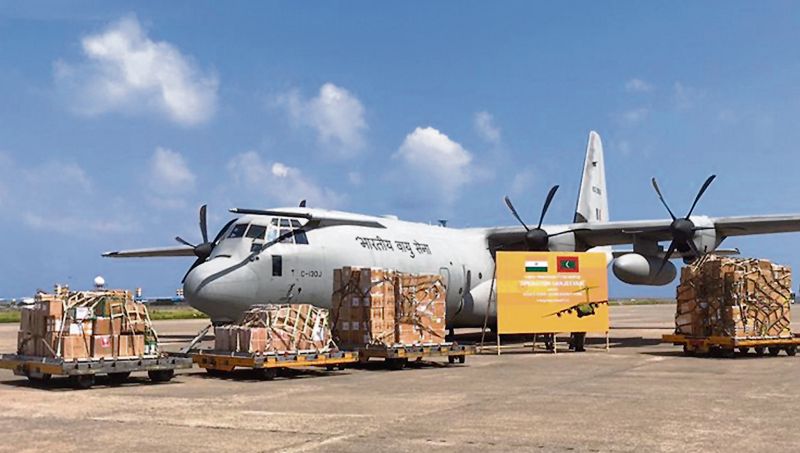
HUMANITARIAN Assistance and Disaster Relief (HADR) has traditionally been an important peacetime mission for the Indian armed forces. The recent accretion of heavy-lift C-17s, all-terrain C130 J Super Hercules aircraft and Chinook helicopters have added substantial capability in this domain.
Operation Sanjeevani was launched during the worst days of the Covid pandemic to move medical supplies and specialists to different parts of the country and the neighbourhood. Enhanced aerial wherewithal, along with appropriate MoUs with friendly neighbouring nations, orchestrated by an efficient triservice organisation under the Chief of Defence Staff, is expected to further hone our country’s capabilities in HADR.
The evacuation of 58 Indians from Iran after the Covid outbreak in March 2020, 76 Indians and 36 foreign nationals from Wuhan (China) in February 2020, besides the transportation of much-needed medical supplies to China and ferrying of over 336 tonnes of medical supplies, rations and other commodities all over the country since March 2020 have been the notable HADR achievements of the IAF in recent years.
Medical assistance to the Maldives and Nepal has, likewise, been a part of the recent HADR efforts. The IAF’s inherent strengths of range, mobility and flexibility have enabled and continue to enable effective HADR in our neighbourhood in peacetime Non-Combatant Evacuations (NCEs) and from war zones such as Iraq and Yemen, too.
The IAF’s HADR assumed credible proportions during Operation Sea Wave relief, rescue and evacuation during the 2004 tsunami, which impacted India, Sri Lanka, the Maldives and Indonesia. The IAF quickly provided HADR succour to several citizens in Sri Lanka, the Maldives and as far out as Indonesia. The breakdown of the RO water plant in September 2014 saw the IAF lift 374 tonnes of drinking water to the Maldives via Op Neer.
India sent cyclone relief to Fiji in February 2016 and was the first responder to provide medical assistance and relief supplies to cyclone- and flood-hit Sri Lanka and Bangladesh in May 2017.
The HADR serves as an important diplomatic tool whilst assisting neighbouring nations during their trying times caused by natural disasters. The recent climate change-induced floods in most of Pakistan, more so in Sind and Baluchistan, have seen over 1,700 casualties. India had helped Pakistan after the 2004 earthquake. But that country refused Indian assistance during the recent floods, much to the agony of its suffering citizens. If relations were better and MoUs had been in place between our countries, India could well have stepped in to provide HADR to Pakistan.
Another area where the IAF’s speedy assistance could be of use to the neighbouring nations is that of organ transplant. Especially in key organ transplant situations, such as for hearts and liver, time is of essence to facilitate safe implantation in the recipient. Like, for heart transplants, the donor heart has to be installed in the recipient in a four-hour time frame. Depending on the harvest locality, air transportation of the organ is critical to meeting time frames and widening the areas of organ availability, more so in a large country such as ours.
With suitable MoUs in place, this could also be extended to friendly neighbouring countries by facilitating medical air ambulances and other high speed means of organ transportation between hospitals in the subcontinent.
Depending on the distance of the organ harvesting station and the receiving unit and the time criticality of having the organ installed, the IAF could consider higher speed platforms for transportation, including fighter aircraft, if need be, considering the goodwill that would be generated by such missions within the country and also between donors and recipients even in the neighbouring countries. Norway employed an air force F-16 to bring an entire heart-lung machine to a critically needy patient. This, of course, is for the air force top brass and the government to take a call on.
One recalls the Timber Trail helicopter rescue of passengers from a crippled cable car at Parwanoo, near Chandigarh, 30 years ago. As demonstrated therein, the payoffs of an HADR mission are out of proportion to what is to be normally expected. Even in comparatively inconspicuous locations and ordinary victim profiles, the media along with the IAF’s public relations setup would ensure that considerable mileage is derived for the service and crew involved. And where foreigners are involved, naturally, the eyeballs would tend to get accentuated, besides, of course, directly contributing to bilateral goodwill between the nations.
Frequent HADR exercises and appropriate standard operating procedures would contribute to the credibility of the IAF and government agencies. Close cooperation between the IAF HQ and MEA would, of course, be called for to ensure smooth prosecution of overseas HADR missions. Joint HADR missions, such as high sea rescues and assistance to hijacked ships or skyjacked aircraft, would pose peculiar inter-service challenges.
Search and rescue of civil aircraft would be another key area of HADR for the IAF professionals. The deputation of IAF medical teams to friendly countries and possible air ambulance roles may also be envisaged.
A joint survey of the topography of vulnerable areas is another aspect for the planner. Even if mission capability exists for undertaking such out-of-area contingency operations, proper memorandums of understanding with the neighbouring countries ought to be in place to avoid confusion.
Besides these, considering the international footprint of Indian nationals worldwide, which stands currently at around 30 million heads, the possibilities of unforeseen evacuations from trouble spots are high, indeed. Performance in war situations is the raison d’être of any air force, no doubt. But the great goodwill generated in the country and internationally by way of successful HADR missions adds mettle to any air force’s viability as a guarantor of national security.
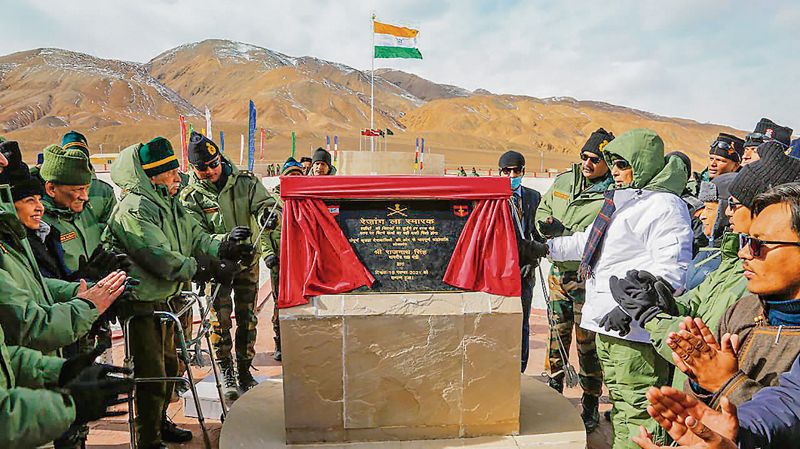
History was rewritten on August 30, 2020, when Kailash Ridge was secured by the Indian Army in response to PLA’s unprovoked transgressions to change the status of the Line of Actual Control in Aksai Chin, three months earlier. This action took the Chinese by complete surprise, neutralising gains made by the PLA along the northern bank of Pangong Tso, besides rendering its position at Maldo Garrison untenable.
Maj Gen GG Dwivedi (retd)
Former Defence Attaché to China
ON October 20, 1962, China launched a two-pronged aggression against India. The main offensive was in the east, complemented by a subsidiary in the west — directed towards eastern Ladakh to capture areas up to the 1960 Claim Line and gain complete control over Aksai Chin, which entailed the elimination of 43 Indian military posts.
The People’s Liberation Army’s (PLA) operations in Aksai Chin were executed in two phases. In the first phase (October 20 to 28, 1962), the Chinese cleared Indian positions at Daulat Beg Oldi, Galwan, Pangong Tso and Dungti-Demchok areas. The second phase was launched three weeks later on November 18 to capture strategically important Kailash Range — it originates from the southern bank of Pangong Tso and stretches over 60 km from northwest to south. The key features on Kailash Ridge include Helmet Top, Gurung Hill, Spanggur Gap, Muggar Hill, Mukhpari, Rezang La and Rechin La — heights varying between 4,000 m and 5,500 m.
During the lull following phase one, the Indian Army reorganised its defences, including raising of 3 Infantry Division at Leh. Its three infantry brigades — 70 was assigned the Indus Valley sub-sector, 163 was earmarked for the protection of the Leh Garrison and 114 was responsible for the defence of Chushul — were deployed in this way: 1/8 GR (Gorkha Rifles) in the north of Spanggur Gap with two companies on Gurung Hill, a company to the north and fourth company in Spanggur Gap and Battalion Headquarters with an ad hoc company at the Chushul airfield. The 13 Kumaon was deployed south of Spanggur Gap with two companies on Muggar Hill, a company at Rezang La and fourth company along with the Battalion Headquarters south of it. Brigade Headquarters along with 1 JAT, two troops of AMX-13 tanks was located at Chushul. 13 Field Regiment minus a battery (25 pounder guns) was positioned in support.
The Chinese planned to capture Rezang La and Gurung Hill concurrently with three battalions (ex-4 Infantry Division). Attacking troops were concentrated in Retuzong, 40 km from the border. The C Company of 13 Kumaon, responsible for the defence of Rezang La, was deployed two platoons up (strong points 7 and 9) with the third platoon and Company Headquarters at Point 5150 (strong point 8) in the centre, along with detachments of 3-inch mortars, heavy machine guns and rocket launchers.
The Chinese plan was to outflank the position at night from the north and south. Accordingly, the attacking force was divided into two; one task force composed of 3rd Battalion (less a company) of 11th Regiment was to attack strong point 9 from the south and the second comprising two companies (one each from 3rd Battalion of 10th & 11th Regiments) was to attack strong point 8 from the north. The 3rd Battalion (less a company ex-10th Regiment) and 3rd Cavalry (less two companies) were earmarked as reserves.
The two task forces started from Retuzong at 8 pm on November 17 and were in respective firm bases by 6 am the following morning. After brief artillery bombardment, the attack on Rezang La commenced from both directions at 9.15 am. A fierce battle ensued, the defenders beating back successive Chinese attacks. With communication snapped and the position encircled, leaving no possibility of being reinforced, it was a “do-or-die” situation for C Company under Major Shaitan Singh. Finally, the Chinese did manage to break through and Rezang La fell by 10 pm on November 18.
It was an epic battle, literally fought to ‘the last man, the last round’. Of the 141 personnel at Rezang La, 135 ‘fought to the finish’; five were taken prisoner, with one survivor. Major Shaitan Singh was awarded Param Vir Chakra (posthumously). China’s 21 personnel were killed and 98 wounded.
Gurung Hill was held by two companies of 1/8 GR (strong points 16, 5 and 6) located northeast of Spanggur Gap. Strong point No. 16 at 5,100 m was held by a company minus platoon, supported by a troop of AMX-13 light tanks.
The task to capture strong point 16 was assigned to a task force of Ali Detachment, which consisted of eight sections duly reinforced by a platoon each of engineers and flamethrowers, one heavy machine gun, one 57-mm recoil-less gun and 12 82mm mortars. One company of the 3rd Cavalry was to act as reserve.
The attack on strong point 16 commenced at 9.22 am on November 18, preceded by artillery fire. Facing stiff resistance, the Chinese suffered heavy casualties and the attack was stalled, but resumed again at 11 am. After repulsing repeated attacks with no reinforcements coming by, the position fell towards the last light. The intensity of fighting could be gauged from the casualties; 50 personnel of 1/8 GR were killed and several wounded, while Chinese witnessed over 80 casualties and many wounded. The PLA could not capture strong points 5 and 6 i.e. the remainder portion of Gurung Hill.
Whereas only Rezang La and a part of Gurung Hill had been captured, a decision was taken at the highest level to pull back from Kailash Ridge and redeploy the west of Chushul on the intervening night of December 19 and 20. The Chinese did not follow Indian withdrawing troops. Incidentally, the PLA had only division plus at their disposal for the operations in Aksai Chin and were severely constrained to undertake any further operations.
On the other hand, the 3rd Infantry Division had the capability to launch a limited counter-offensive. After declaring ceasefire on November 21, Chinese forces fell back to depth positions due to logistic constraints.
Fifty-eight years later, history was rewritten on August 30, 2020, when Kailash Ridge was secured by the Indian Army in response to PLA’s unprovoked transgressions to change the status of the LAC in Aksai Chin, three months earlier. This action took the Chinese by complete surprise, neutralising gains made by the PLA along the northern bank of Pangong Tso, besides rendering its position at Maldo Garrison untenable. Although, as part of the disengagement process, Indian troops have pulled back from the Kailash Range, the heroic deeds of our valiant soldiers remain etched in golden letters at Rezang La and Gurung Hill.
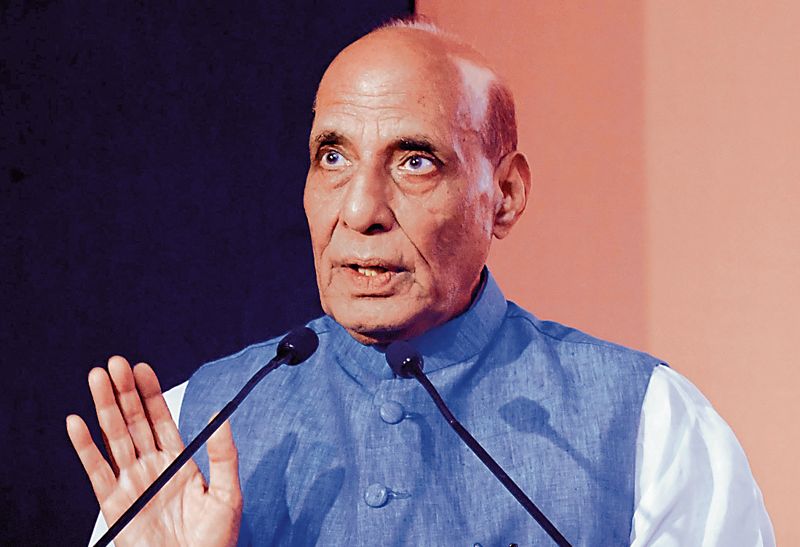
Defence Minister Rajnath Singh said today that the country was facing new dimensions of threats, making it difficult to categorise these into internal and external ones.
He was addressing officers of the armed forces and civil services at the convocation of the 60th course of National Defence College (NDC) today.
“Terrorism, which is generally considered part of internal security, is now classified in the category of external security because the training, funding and arms support of such organisations is being carried out from outside the country,” said the minister.
Rajnath called on international community to counter “grave” emerging security threats such as cyberattacks and information warfare. “Information war has the potential to threaten the political stability of a country. An organised use of social media and other online platforms is engineering the opinion of the masses,” he said.
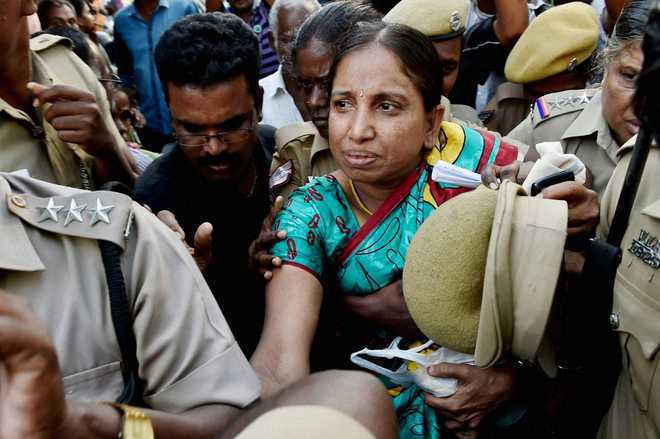
Supreme Court orders release of 6 convicts serving life sentence in Rajiv Gandhi assassination case
The Supreme Court on Friday directed the premature release of six convicts, including Nalini Sriharan and RP Ravichandran, serving life sentence in the assassination case of former Prime Minister Rajiv Gandhi.
A bench of Justices BR Gavai and BV Nagarathna said the judgement of the top court in the case of AG Perarivalan, one of the convicts in the case, is equally applicable in their matter.
“In so far as the applicants before us are concerned, their death sentences were commuted to life on account of delay…We direct that all the appellants are deemed to have served their sentence…The applicants are thus directed to be released unless required in any other case,” the bench said.
Nalini and Ravichandran had moved the top court seeking premature release.
Both had challenged a June 17 order of the Madras High Court, which rejected their pleas for early release, and cited the apex court judgment ordering the release of co-convict Perarivalan.
Nalini, Ravichandran, Santhan, Murugan, Perarivalan, Robert Payas and Jayakumar were sentenced to life terms in the case.
Invoking its extraordinary power under Article 142 of the Constitution, the top court had on May 18 ordered the release of Perarivalan, who had served over 30 years in jail.
Gandhi was assassinated on the night of May 21, 1991 at Sriperumbudur in Tamil Nadu by a woman suicide bomber, identified as Dhanu, at a poll rally.
In its May 1999 order, the top court had upheld the death sentence of four convicts Perarivalan, Murugan, Santhan and Sriharan.
However, in 2014, it commuted the death sentence of Perarivalan to life imprisonment along with those of Santhan and Murugan on grounds of delay in deciding their mercy petitions. Nalini’s death sentence was commuted to life imprisonment in 2001 on the consideration that she has a daughter.
The Tamil Nadu government had earlier favoured the premature release of Nalini and Ravichandran, saying its 2018 advice for remission of their life sentence is binding upon the governor.
State Stalwarts
DEFENCE MINISTER
Minister Rajnath Singh
ALL HUMANS ARE ONE CREATED BY GOD
HINDUS,MUSLIMS,SIKHS.ISAI SAB HAI BHAI BHAI
CHIEF PATRON ALL INDIA SANJHA MORCHA
LT GEN JASBIR SINGH DHALIWAL, DOGRA
SENIOR PATRON ALL INDIA SANJHA MORCHA
MAJOR GEN HARVIJAY SINGH, SENA MEDAL ,corps of signals
.
.
PATRON ALL INDIA SANJHA MORCHA
MAJ GEN RAMINDER GURAYA ,MADRAS REGIMENT
sanjhamorcha303@gmail.com
PRESIDENT SOUTH ALL INDIA SANJHA MORCHA
COL SS RAJAN BOMBAY SAPPERS,
PRESIDENT UTTARAKHAND ALL INDIA SANJHA MORCHA
COL B M THAPA ,BENGAL SAPPERSS
PRESIDENT HARAYANA STATE CUM COORDINATOR ESM
BRIG DALJIT THUKRAL ,BENGAL SAPPERS
PRESIDENT TRICITY
COL B S BRAR (BHUPI BRAR)
PRESIDENT CHANDIGARH ZONE
COL SHANJIT SINGH BHULLAR
.
.
PRESIDENT PANCHKULA ZONE AND ZIRAKPUR
COL SWARAN SINGH
INDIAN DEFENCE FORCES
DEFENCE FORCES INTEGRATED LOGO
INDIAN AIR FORCE
Air Officer C-in-C WESTERN AIR COMMAND
AIR MSHL S PRABHAKARAN AVSM VM
AOC-IN-C, EASTERN AIR COMMAND
Air Marshal Inderpal Singh Walia
AOC-in-C SOUTH WESTERN AIR COMMAND
Air Marshal Vikram Singh
AOC-IN-C, SOUTHERN AIR COMMAND
Air Marshal J.Chalapati
AOC-IN-C TRAINING COMMAND
AIR MARSHAL SK GHOTIA VSM
AOC-IN-C MAINTENANCE COMMAND
Air Marshal Jagdish Chandra
Flag Officer Commanding in Chief, Western Naval Command
ice Admiral R Hari Kumar, PVSM, AVSM, VSM
Flag Officer Commanding in Chief, Eastern Naval Command
Vice Admiral Sanjay Bhalla, AVSM, NM
Flag Officer Commanding in Chief, Southern Naval Command