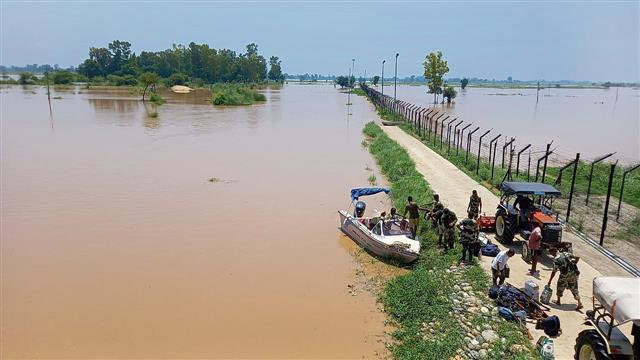
As floodwater has submerged villages along the Sutlej in Ferozepur district, the cross-border smugglers are constantly trying to push huge quantity of contraband along with arms and ammunition inside the Indian territory.
In the past one month, the counter intelligence wing has seized over 132 kg of heroin in the Ferozepur sector. Lakhbir Singh, AIG, Counter Intelligence Wing, Ferozepur Range, said the cross-border smugglers had become active as the raging Sutlej submerged villages along the International Border.
The river enters Pakistan nine times and again flows into India, only to finally drain into the neighbouring country.
Sources said smugglers were usually expert divers who were using floods to their advantage.
With several border outposts of the BSF getting inundated at certain locations, the BSF has enhanced vigil and patrol the area on motorboats. Today, the 182 Battalion of the BSF and the CI apprehended two Pakistan-based smugglers and seized close to 30 kg narcotics during the wee hours in a joint operation near the border.
The AIG said the joint operation was conducted along the banks of the Sutlej near Gatti Matar village. “Around 2:45 am, our teams noticed some persons coming from Pakistan towards India. Sensing imminent threat, jawans fired at them. As a result, a person was hit on his hand,” said a BSF officer.
Subsequently, troops apprehended two Pakistani smugglers along with 26 packets containing 29.26 kg of heroin. The smugglers have been identified as Muhammad Ajmal Riyan of Kanganpur village and Sivna of Alipur village, both residents of Kasur, Pakistan.
After administering first aid, the injured smuggler was admitted to the Civil Hospital from where he was referred to Faridkot.
A case under Sections 21-C, 29 and 30 of the NDPS Act, besides Section 3, 34 and 20 of the Indian Passport Act has been registered in Fazilka.
*PLAN B : MEDICAL INSURANCE – SSS (SAINIK SEVA SAMITI)*
PLAN B : MEDICAL INSURANCE – SSS (SAINIK SEVA SAMITI)*
*(Shared By Cdr Sudhir Dua, IN)* *(Secretary SSS)*
*Plan B because we can use ECHS* which is our service entitlement but is subject to funds constrained by MoD. Service HQ tries their best to help ESM and Serving. *But many times ECHS and MH cannot cater to our Needs.* *Then Medical Insurance can be the Saviour.* ECHS rates are low only about the 30 to 40% of normal rate ,the payments are delayed by EcHS due to Poor funds disbursement by MOD, if their occupancy is high they refuse ECHS patients even in emergency and we are unable to act as we have not paid our bills. A Small Mediclaim Insurance helps meet emergencies as Hospitals generally don’t refuse Insurance Patients as they get timely Payments and almost 80 % of rack rates. *Due our Service exigencies and Age or Sometimes lack of facilities in MH, it is advisable to have a Small Mediclaim Plan as Option B*
Parents, Parent- in- laws , Children and Grandchildren can also avail sss policy. Many Children have a Corporate plan but when they shift jobs they land up in shadow zones without V medical cover for themselves and family
Under present norms parents and dependents are subjected to financial restrictions. To get their support with present transparent direct tax systems is difficult through ECHS.
Today Medical costs can be high and youngsters take high value plans for 1 CR, But due to ECHS support we can just have a small Rs 5 to 10 lakhs Cover with no Age limit and all Pre existing diseases covered from Day One.
Icing on the cake is dedicated Helpdesk from TPA and Broker
Helpdesk at Sss helps for Membership only Paid Members can buy a Mediclaim plan or even opt for additional OPD plan *For details take membership on www.ssamiti* Org using join us and primary membership form. Members can see all details on website seek help to answer all queries from sss help desk. After getting confident about sss and the plan, please log-in with your sss id pay for Membership on the website and also Optional OPD plan.
Besides this all Members can get discounted Group Policies for their cars ,international travel and soon to start a comprehensive home care plan
*Cdr Sudhir Dua* *Secretary Sss*
Note pls call Helpdesk for all queries Pooja
Sss is a proven plan and operational since last 3 years Rs 5.8 CR premium already transfered to new india assurance .
*Sss caters as an excellent plan B*
Depsang on table, India, China hold third meet in 4 days
Military officers of India and China today met for the third time within four days to resolve the border standoff, especially at the sensitive Depsang plains.
Major General-level officials met at two locations —Chushul and Daulat Beg Oldie — in eastern Ladakh on Monday. This was the third meeting since Friday.
The push to resolve the deadlock also comes just ahead of the expected bilateral between Prime Minister Narendra Modi and Chinese President Xi Jinping on the sidelines of the BRICS summit from August 22 to 24 in South Africa.
Major General-level officers have been tasked with finding a workable solution that could be implemented along the undemarcated Line of Actual Control (LAC).
There are differences over the pulling back of troops from the Depsang plains and Charding Nullah near Demchok. The two sides have been locked in a standoff since April 2020. Talks have been deadlocked over the dispute over the 972-sqkm plateau Depsang. The two sides have issues over troop positions, especially at the “bottleneck” on the eastern edge of Depsang. India has been objecting to the People’s Liberation Army (PLA) deliberately blocking Indian patrols on the patrolling route that goes east of the “bottleneck” in Depsang. Prior to April 2020, Indian patrols were using the patrolling route, but since then the PLA has been craftily using a clause in the 30-year-old border agreement to block Indian patrols.
As per the border agreement, patrolling parties of one country have to return on encountering the patrol party of the other country.
One of the options being discussed now is that Indian troops would coordinate with the Chinese when patrols go east of the “bottleneck”. This would mean the creation of a new buffer zone and not carrying out patrols independently.
The claims of both sides overlap, especially in the Depsang plains. Some of these locations hold strategic value as they overlook the Aksai Chin plateau which is under illegal control of China.
India has already suggested to China that a graded three-step process is needed to ease the standoff. The first is disengagement of troops within close proximity in grey zones along the LAC and getting back to positions as on April 2020.
The next two steps — de-escalation and de-induction — will entail pulling back troops and equipment to the pre-April 2020 levels. Till that is agreed upon and complied with, it cannot be assumed to be business as usual.
The military loss data of Russia and Ukraine disclosed by Mossad, Israel’s world-renowned intelligence agency:
Russian military losses: 23 aircraft, 56 helicopters, 200 drones, 889 tanks and armored vehicles, 427 artillery pieces, 12 air defense systems, 18,480 killed, 44,500 injured, and 323 captured. The number of soldiers involved in the war was 418,000.
Ukraine lost 302 aircraft, 212 helicopters, 2,750 drones, 6,320 tanks and armored vehicles, 7,360 cannons, 497 air defense systems, 157,000 killed, 234,000 injured, 17,230 prisoners, and 734,000 soldiers , is in the ninth domestic mobilization of 100,000 soldiers to fill the gap.
234 NATO officers, trainers, and agents died (US, UK)
2458 NATO soldiers died (Poland, Germany, Lithuania…) A total of 5360 mercenaries died.
The war between Russia and Ukraine has made us to focus on international affairs more deeply. The victory or defeat of Russia will affect the international scenario and any predictions are all wild guesses.
But there are a few signs that have been exposed. In this war, United States stands defeated, the EU fooled, NATO stunned, Ukraine smashed, public officials silenced, and the third world awakened. It has made private property unholy, free speech, science and art have borders, cats and dogs have original sins, Switzerland is no longer neutral, and the hegemony of the US dollar is no longer stable. The Americans found that the third brother was disobedient. The Germans discovered that no matter how high the GDP is, it cannot keep them warm.
The Chinese discovered that no matter how loud the speech is, it is not as good as having a strong military. It is also known that in recent decades, some wealthy Chinese have deposited money in American banks, Swiss banks, and European Union banks. Now they are restless and regretful! This is like putting meat next to a wolf’s mouth, and sooner or later the wolf will gulp it!
I don’t know how this war will end, but the above facts are an education. This war will cause the brainwashing and rhetoric techniques that the West has painstakingly worked on for a hundred years, to collapse and destroyed. It is an awakening. If you have ammunition in your hands, you must have food too. The real economy plays a leading role. This war further shows that peace depends on a strong military force!
*LONG BUT WORTH READING. FOR THOSE NOT HAVING TIME PLEASE GO TO CONCLUSION GIVEN AT THE END*
*LONG BUT WORTH READING. FOR THOSE NOT HAVING TIME PLEASE GO TO CONCLUSION GIVEN AT THE END*
( *Shared By – Brig Dhananjay Vinayak Vidwans (Retd)*)
1. Very recently we were able to solve a case of migration to SPARSH of an EME officer who retired in 2003. 2. The officer received a SMS from his bank that *Rs xxxxx has been credited on xxJul 2023 by NEFTINWARD RBIXXXXX/PRINCIPAL CO* of Jul 2023. 3. The officer referred the SMS to me, it was evident that he had been migrated to SPARSH. I suggested that we wait for a fortnight for the userid and Pw. No userid and Pw were received in 15 days ( and would not have been received at all ( came to know later ) since the mobile number in use was not registered in ePPO / SPARSH database). 4. After waiting for 15 days and no userid and Pw, we set to take action for SPARSH registration. 5. The first task was to upload the Aadhar number of the officer as it was not available with SPARSH. We had to wait for a week for the Aadhar number to be approved by ORO(MP5) /RODRA. 6. After that the mobile number linked to Aadhar was required to be uploaded since it was not available with SPARSH ( Later on we came to know that an old number was present in the SPARSH database but was not in use by the officer and not linked to Aadhar). Since the old out of use mobile number was present in SPARSH we could not proceed with the Aadhar authentication and had to use the secret question option in which the bank account number, personal number, date of retirement and the Aadhar number were required to be input. 7. After approval of the mobile number we could then get the SPARSH PPO number and able to login with the forgot password option. 8. Subsequently the change of password and declaration were esigned. 9. After that the pension slip, PDV and Corr PPO were downloaded. 10. The whole process took 25 days in all. 11. The task of updating / correcting the information in the PDV is required to be undertaken on priority by the officer.
*CONCLUSION* – *a. Officers should register and/or update RODRA data*. *b. For those who have not been migrated should check their Bank Passbook for the description of pension paid entry for the following words NEFTINWARD RBIXXXXX/PRINCIPAL CO*
THE immediate compulsion for the British to quit India arose with the erosion of loyalty to the Crown among the Indian armed forces’ personnel as a result of Netaji Subhas Chandra Bose’s military activities. The Indian National Army (INA) was founded with the collaboration of Indian soldiers, prisoners of war, expatriates and Japanese allies in Southeast Asia; it also had a women’s regiment, the Jhansi Ki Rani Regiment, led by Lakshmi Sahgal.
Things came to a head when the British committed a grave error — they set about putting on public trial members of the top brass of the INA at the Red Fort in Delhi during 1945-46 on the charge of waging a war against the King-Emperor.
Col Prem Sahgal, Major Gen Shah Nawaz Khan and Col Gurbaksh Singh Dhillon had served as officers in the British Indian Army. They had been taken prisoners of war at Malaya, Singapore and Burma. Later, they joined the INA along with a large number of Indian Army troops and fought for the liberation of India. Their trial spread disenchantment against the British within the armed forces. The public, too, rose in unison.
On February 18, 1946, Indian sailors of the Royal Indian Navy (RIN) mutinied; the mutiny spread to over 70 ships. Bringing down the British flag on their ships, the mutineers hoisted flags of the Congress, the Muslim League and the Communist Party. Vociferously raising the demand for Independence, thousands of sailors went around Bombay holding portraits of Netaji. The mutineers were joined by the people of Bombay, who wholeheartedly extended support. Within 48 hours, the British had lost control over the navy, even as the mutineers rechristened RIN as the Indian National Navy.
It is estimated that around 220 people died in police firing and about 1,000 were injured during the unrest. The RIN mutiny was followed by a rebellion in the Royal Indian Air Force and in some Army units, mainly at Jabalpur.
The British painfully realised that a mortal blow had been inflicted on the Raj, and that they no longer controlled the Indian armed forces. They feared more such mass movements. The mutinies, coupled with the uproar in the Indian armed forces and the sacrifices of freedom fighters, convinced the British to expedite the process of quitting India. Clement Attlee, then British Prime Minister and the Leader of the Labour Party from 1935 to 1955, was left with no option but to approve the decision to grant Independence to India.
As World War II ended, Britain had already exhausted Indian resources, finances and manpower for its war effort. Britain’s economy was left severely depleted. The state of affairs had a tremendous impact on British foreign policy, even as the tumultuous events of 1945-46 played a key role in hastening the colonial power’s exit from India.
Ukrainian aspirations to join NATO cannot fructify unless the war ends, as laid down by the current US administration.
Gp Capt Murli Menon (Retd)
Defence analyst
Russian President Vladimir Putin’s ‘special military operation’ will be 18 months old on August 24, with little indication of an end anytime soon. US President Joe Biden has sanctioned the transfer of 80-odd F-16s from Denmark and the Netherlands to beef up Ukraine’s air power, which has been dealt a severe blow by the Russians in recent days.
While the US is fighting shy of a direct involvement in the conflict, Biden said in Poland recently that “Ukraine will never be a victory for Russia”, indicating his resolve to bankroll the war effort indefinitely. In America’s eyes, even a prolonged stalemate would be a defeat for Russia. Analysts think that for Ukraine to win, it needs to regain all territories lost to Russia, including Crimea.
With the Ukrainian counter-offensive making a painful progress, the Russian military, battered and demoralised as it is, has put up a resilient show against western weapons and war tactics. The US backing and weaponry, however, are unlikely to render early results; some experts say that it could take a couple of years to tilt the balance in Ukraine’s favour. Meanwhile, Russia appears to be willing to sacrifice any number of its young men for its war cause.
The US presidential election next year is bound to have a profound impact on the US and the West’s inclination to indefinitely support Ukraine. Republican presidential contender Donald Trump has made it clear that he will end support for Ukraine, should he get elected. With some European leaders having a similar mindset, a ‘forever war’ would definitely favour Russia and not Ukraine. Recent Saudi efforts to rally 40 nations, including China and the USA, in support of Ukrainian President Volodymyr Zelenskyy’s 10-point peace plan are aimed at bringing about full Russian withdrawal from the Ukraine territory, the return of abducted children and justice for war crimes.
Diplomatic options to terminate the war or achieve an armistice are thus unlikely to bear fruit, considering that Russia under Putin has never chosen to end a conflict at the negotiating table.
Meanwhile, Ukrainian aspirations to join the NATO cannot fructify unless the war ends, as laid down by the current US administration. Protection to the Ukrainian territory under the NATO treaty’s Article 5 would be similar to what happened in Korea and Germany after World War II. Thus, any plausible democratic Ukrainian accession into NATO and its ratification by parliaments of NATO members would serve to frustrate Russia’s efforts to prolong the war indefinitely. Joining NATO while pursuing unification within its 1991 borders is a call for Ukraine to take to consolidate the gains, if any, as a NATO member. That would also preclude any scope for a future Russian offensive on Ukrainian territory.
Now, what could be India’s stand while this uncertain European saga plays out? Clearly, a diplomatic one, considering the goodwill garnered over the years with both warring parties. Ukraine has categorically stated that it would welcome any ‘bigger and greater’ Indian role in ending the war, as stated by Ukrainian Deputy Foreign Minister Emine Dzhaparova during her April visit to India.
Meanwhile, having avoided any direct condemnation of Russia as an aggressor and having abstained several times from voting on UN resolutions, India has shown its inclination to contribute to peace efforts. India’s stand is clearly motivated by its dependence on Russia for 60 per cent of its defence hardware and the purchase of low-priced Russian oil, both strategically vital national considerations.
The Indian ambivalence in taking a pro-West stand amid its need to balance ties with an old ally has played out as a ‘diplomatic coup’. New Delhi has managed to keep its ties with Russia intact while deepening its links with the West through its Quad membership and G20 presidency. India has also been firm on not calling the Ukraine conflict a ‘war’ in its G20 communiques.
Be that as it may, western observers have tended to put much stock in the US supply of F-16s to Ukraine. While apprehensions were initially expressed about how it would take years to familiarise Ukrainian pilots — with their limited English proficiency — with western fighter platforms, US professionals have been training them on F-16 simulators. Ukraine is bound to encourage the entry of ‘volunteer’ F-16 pilots from the world over to cut down time frames for operationalising them on the new aircraft. This could alleviate the Ukrainian problem of finding an adequate number of Russian-origin fighters for the Ukrainian air force. The proclaimed aggressive professionalism of the Ukrainian fighter pilots is bound to contribute to their transition to operating F-16s.
Considering that the UK has been the other key backer of the Ukrainian war effort militarily, it is surprising why the Eurofighter Typhoon is not on offer. Possibly, on account (as, indeed, was the case with the US) of the UK wishing to neither up the ante against Putin nor make him cross the nuclear Rubicon. Also, it’s a fact that a comparatively limited number of any advanced fighter platforms would have to compete against the substantive Russian Comprehensive National Power to achieve favourable outcomes in the ongoing conflagration. The multiple war fronts in eastern Ukraine, Crimea and the Black Sea region would pose even bigger challenges for both adversaries to achieve their war objectives conclusively.
The advent of drone warfare only adds to the convoluted mix of tactical options. Though some countries, such as Pakistan, peddling heavy 155-mm shells to Ukraine shows an opportunistic trend implicit in a global conflict, India as a neutral entity needs to be careful about its licensed hardware, such as the indigenous BrahMos, finding its way into the battle zone, more so because of Russia’s desperation for accurate long-range missilery.
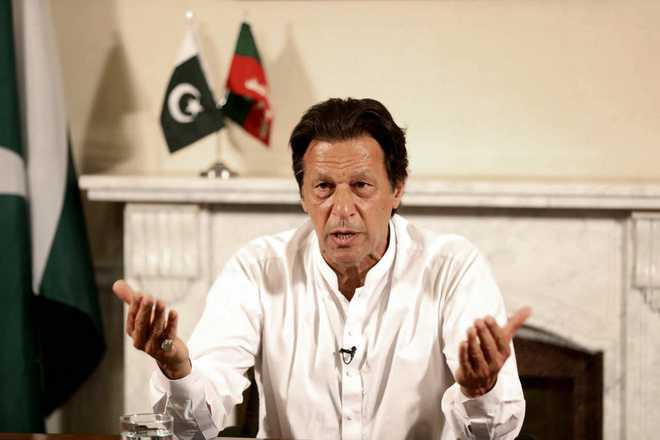
THE Prime Minister of Pakistan till April last year, Imran Khan is now reduced to being Prisoner No. 804 in the Attock jail. Five years ago, former PM Nawaz Sharif was rendered ineligible to contest elections after being sentenced to 10 years of imprisonment. Imran had been the beneficiary as Sharif was knocked out of the fray weeks before the polls. Pakistan’s deep state was suspected to have orchestrated the judicial verdict against Sharif. A similar misgiving prevails in Imran’s case. Pakistan’s current economic freefall has remained unattended in this clash of institutions, making the common man sceptical of their ability to deliver the goods.
Imran has been facing relentless prosecution after his relationship with the army soured; he is now pinning hopes on the Supreme Court for his release. But in a polity where the system of negotiations and compromise has collapsed, the deep state and its political allies will try their best to make him ineligible for the elections scheduled for November. Not surprisingly, the global guardians of political rectitude have held their peace. Western powers seem to have green-lighted the impetuous and unpredictable rabble-rouser PM’s removal last year itself.
As if this internal turmoil were not enough, after two years in power, the Taliban in Afghanistan are unwilling to play the ISI’s game, having concluded that Islamabad has no economic heft and is hardly a model Islamic state. The ISIS seems to have got its second wind as the Taliban are apparently doing little to check its attacks on the Pakistani state. The recent suicide bombing that targeted a pro-army political party was claimed to be the handiwork of the ISIS. The onus is now on caretaker PM Anwaarul Haq Kakar to ensure a conducive environment for the elections.
Army men shot dead two terrorists from Pakistan during an infiltration bid in Balakote sector of Poonch district early on Monday morning. An AK-47 rifle, two magazines, 30 rounds, two hand grenades and Pakistan-made medicines were recovered during a search operation.
Took cover of fog
The terrorists tried to infiltrate when there was poor visibility due to dense fog and inclement weather.
Injured by gunfire, the terrorists turned away but later succumbed, said the Army.
Lt Col Suneel Bartwal, PRO, Defence, said intelligence inputs received from multiple intelligence agencies and the police suggested that the terrorists had been waiting to cross the LoC from Balakote sector. “Based on these inputs, our surveillance grid was placed on heightened alert and multiple ambushes were placed at suitable location,” he said.
On Monday morning, two terrorists were detected trying to cross the LoC during inclement weather, dense fog, thick foliage and undulating ground in Hamirpur area of Balakote sector.
As the terrorists approached the ambush sites set up by the Army, they were challenged and also fired upon. This forced the terrorists to flee. “However, effective fire resulted in one terrorist falling down on the ground near the LoC. Additional troops were then moved into the area and a search operation was started in the afternoon after the improvement of the weather and the visibility,” said Lt Col Bartwal.
“During the search, blood trails leading towards the LoC were detected. As per intelligence inputs, the two terrorists who attempted to infiltrate were injured but still managed to return across the LoC. They later succumbed to their injuries,” the PRO informed.
For three days, nearly 5,000 villagers cast away their deep-rooted political affiliations and also buried village rivalries to execute the onerous job of plugging a 300 feet wide, 30 feet deep breach at the Beas, a task which had become essential to their survival.
Officials say lives, livelihoods and livestock of hundreds of villagers living in 25-30 villages could have been washed away had the project been delayed by even a few hours.
Drainage officers said they were stunned at the speed and swiftness at which the mission was completed. They claimed under normal circumstances, it takes 20-22 days to finish such an exercise.
On August 17 evening, DC Himanshu Aggarwal was informed that a ‘dhussi’ had been breached at Jagatpur Tanda village. “It was imperative for us to start work immediately as the breach was getting bigger and bigger,” he said.
Two hours later, work started in right earnest. Hundreds of tractor-trolleys started bringing in soil from nearby districts. By the end of the exercise, 2.5 lakh sand-bags had been used. In all, the DC had to requisition 1,200 trolleys and 15 JCB machines from different departments.
As many as 18 floodlights were set up at four vantage points by Mandi Board officials. Four generators, too, were placed nearby. It was as if a country was preparing for a war. The supply of food packets and drinking water bottles seemed to be never ending. Youngsters had their two-wheelers ready just in case of a medical emergency.
Trolleys had to dump soil 200 metres away from the site because of the uneven terrain. From there, villagers carried sand bags on their back. “Indeed, where there is a will, there is a way,” said the emotionally drained DC at the end of the mission.
Mammoth task
5,000 villagers worked round the clock
2.5 lakh sandbags used
18 floodlights set up at four vantage points
4 generators for night operations
1,200 trailers brought in soil from nearby districts
15 JCB machines requisitioned by DC from various departments
State Stalwarts
DEFENCE MINISTER
Minister Rajnath Singh
ALL HUMANS ARE ONE CREATED BY GOD
HINDUS,MUSLIMS,SIKHS.ISAI SAB HAI BHAI BHAI
CHIEF PATRON ALL INDIA SANJHA MORCHA
LT GEN JASBIR SINGH DHALIWAL, DOGRA
SENIOR PATRON ALL INDIA SANJHA MORCHA
MAJOR GEN HARVIJAY SINGH, SENA MEDAL ,corps of signals
.
.
PATRON ALL INDIA SANJHA MORCHA
MAJ GEN RAMINDER GURAYA ,MADRAS REGIMENT
sanjhamorcha303@gmail.com
PRESIDENT SOUTH ALL INDIA SANJHA MORCHA
COL SS RAJAN BOMBAY SAPPERS,
PRESIDENT UTTARAKHAND ALL INDIA SANJHA MORCHA
COL B M THAPA ,BENGAL SAPPERSS
PRESIDENT HARAYANA STATE CUM COORDINATOR ESM
BRIG DALJIT THUKRAL ,BENGAL SAPPERS
PRESIDENT TRICITY
COL B S BRAR (BHUPI BRAR)
PRESIDENT CHANDIGARH ZONE
COL SHANJIT SINGH BHULLAR
.
.
PRESIDENT PANCHKULA ZONE AND ZIRAKPUR
COL SWARAN SINGH
INDIAN DEFENCE FORCES
DEFENCE FORCES INTEGRATED LOGO
INDIAN AIR FORCE
Air Officer C-in-C WESTERN AIR COMMAND
AIR MSHL S PRABHAKARAN AVSM VM
AOC-IN-C, EASTERN AIR COMMAND
Air Marshal Inderpal Singh Walia
AOC-in-C SOUTH WESTERN AIR COMMAND
Air Marshal Vikram Singh
AOC-IN-C, SOUTHERN AIR COMMAND
Air Marshal J.Chalapati
AOC-IN-C TRAINING COMMAND
AIR MARSHAL SK GHOTIA VSM
AOC-IN-C MAINTENANCE COMMAND
Air Marshal Jagdish Chandra
Flag Officer Commanding in Chief, Western Naval Command
ice Admiral R Hari Kumar, PVSM, AVSM, VSM
Flag Officer Commanding in Chief, Eastern Naval Command
Vice Admiral Sanjay Bhalla, AVSM, NM
Flag Officer Commanding in Chief, Southern Naval Command