Sanjha Morcha

What’s New

Click the heading to open detailed news

Current Events :

web counter

Print Media Reproduced Defence Related News

Spectators’ gallery at Attari-Wagah gets a facelift

Rs 6 cr project to be ready by March 2017, will accommodate 20,000 people

Spectators’ gallery at Attari-Wagah gets a facelift
The new spectators’ gallery in Attari. Photo: vishal kumar

GS Paul

Tribune News Service,Amritsar, January 27

The spectators’ gallery at the Attari-Wagah Joint Check Post (JCP) is being redesigned not only to expand its capacity but to raise the sitting pedestals’ height to provide a better viewing angle to watch the flag-lowering Retreat ceremony between the two border forces of India and Pakistan. The ‘Swarn Jyanti’ dwar (gate) is also being dismantled for a fresh structure.In the wake of the revamp, scores of people throng the spot, especially during weekends. The existing gallery can accommodate 5,000 people and has been partially dismantled to pave way for the new one meant for 20,000 visitors.The Central Public Works Department (CPWD), which is undertaking the project, has targeted to execute it within 13 months. The work is being carried out in a phased manner so that the lowering of the flags ceremony, which attracts thousands of tourists daily, doesn’t get affected.Officials said the project had commenced in May 2015 after Union Home Minister Rajnath Singh laid its foundation stone on March 22, 2015.Sumer Singh, BSF DIG, Amritsar Sector, said the expansion of gallery would be readied by March 2017. “The work is on war footing. It will cost around Rs 6 crore. Special emphasis is on giving the gallery a curve so that people sitting at the last get better viewing angle. Normally, over 15,000 people visit the spot daily,” he said.However, once executed, it will also be a big relief for the BSF too. The extraordinary rush at the check-post is no less a headache for the on-duty jawans who virtually struggle to accommodate people. Sometimes, they have to remove the chairs to accommodate the visitors while being standing. The construction underway for new gallery had also reduced the sitting capacity. Consequently, a large number of tourists had to return without being able to see the ceremony.On their part, the BSF authorities have put up an LED screen at the ‘Swarn Jayanti’ dwar so that tourists, who could not sit inside the gallery, should at least watch the ceremony on the screen.Another added attraction would be the museum coming up parallel to this project. It has been learnt that this museum would depict the glorious history of Border Security Force (BSF), its achievements, weapons and other related aspects.


A trimmed R-Day Parade this year

Celebrations cut short by 25 mins to break monotony, address security concerns

Ajay Banerjee,Tribune News Service,New Delhi, January 1

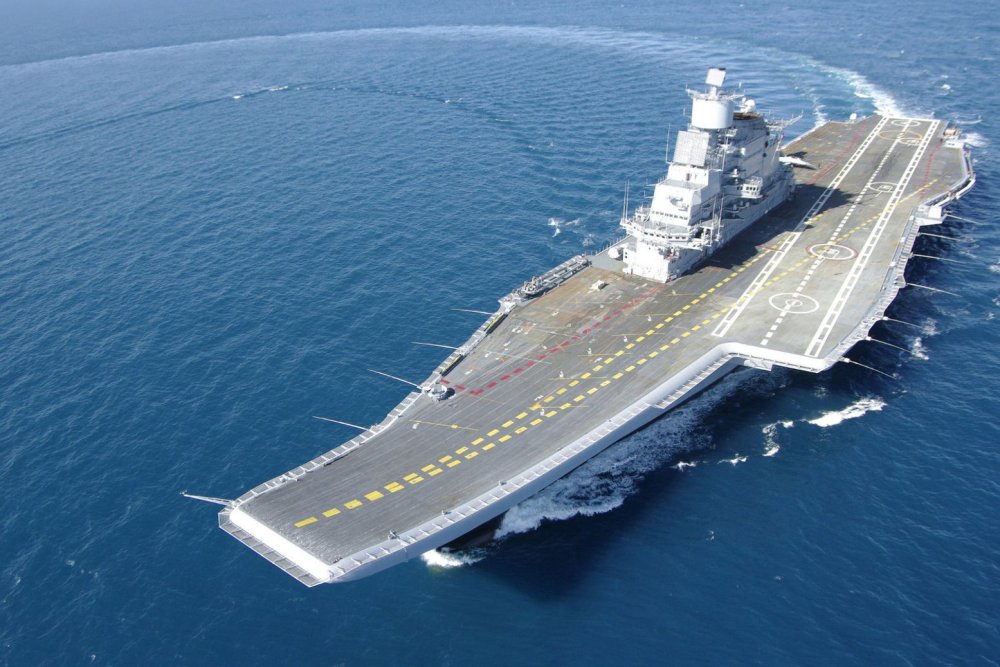
This year’s Republic Day Parade will be shorter by 25 minutes to address security concerns and break the monotony of witnessing repetitive marching contingents of uniformed personnel.The parade, which marks the country’s annual show of military might and cultural diversity, will be 90 minutes long, down from 116 minutes in 2015. Even “Beating the Retreat” on January 29 to mark the end of the Republic Day celebrations will see new “fusion” music instead of the long tradition of only military music.The march-past — conducted down the Rajpath, New Delhi’s central vista at the India Gate — has been trimmed in terms of number of marching contingents. The parade is organised by the Ministry of Defence.Officials said the decision had been taken at the “highest level”. After a review of last year’s parade, in which US President Barack Obama was the chief guest, it was felt the march-past was too long, said senior officials today.The authorities also took into view the monotony of witnessing almost-identical marching contingents and the security risk surrounding VVIPs, who remained seated for longer periods out in the open.Unlike previous R-Day celebrations, all tableaux and music bands will be showcased for three days — till January 29 — at the Red Fort. The bands will play at regular intervals. Sources said the number of Army marching contingents had been reduced from eight to six. Marching contingents of the Navy had also been reduced. The IAF will put up a single marching contingent.Unlike previous years, veterans will also not march past the Rajpath this year. Instead, they will ride in a truck-mounted tableau.The six central paramilitary forces will put up only three marching contingents instead of one each. The flypast by the IAF, however, has been retained.The Navy will showcase its “Make in India” efforts by putting up models of under-production indigenously made aircraft carrier INS Vikrant and submarine INS Kalvari.The IAF will showcase its “Humanitarian and Disaster Relief” activity during the year. The force had last year rescued 14,000 people in different operations in Yemen, Nepal and Chennai.The Army will go out with its theme “Marching ahead with Incredible India”. The bullet proof enclosure this year will have a roof, unlike last year when dignitaries sat through pouring rain. French President Francois Hollande will be the chief guest this year.

The changes

  • This year’s parade will be 90 minutes long, down from 116 minutes in 2015
  • The ‘Beating the Retreat’ on January 29 will see ‘fusion’ music, besides military music
  • All tableaux and music bands will be showcased for three days at the Red Fort
  • Veterans will not march past the Rajpath and will be part of a tableau
  • The bullet proof enclosure will have a roof

Indo-China border personnel meet held on the eve of New Year

A ceremonial Border Personnel Meeting (BPM) was conducted on January 1, 2016 at Chinese BPM hut at Moldo Garrison of Chushul Sector of eastern Ladakh.

jammu_647_010116064147

 A ceremonial Border Personnel Meeting (BPM) was conducted on January 1, 2016 at Chinese BPM hut at Moldo Garrison of Chushul Sector of eastern Ladakh. The delegations were led by Brig Vijyant Yadav, from the Indian side and Senior Colonel Fan Jun from the Chinese side.The ceremonial border personnel meeting was marked by saluting the National flag of China by both the delegations members. This was followed by the ceremonial address by both delegations leaders. Greetings were exchanged, wishes and vote of thanks and reflected the mutual desire of maintaining and improving relations at functional level at the border. Thereafter, a culture programme showcasing vibrant Chinese culture and traditional grandeur was organised, followed by sumptuous lunch.Both the delegations interacted in a free, congenial and cordial environment. The delegation parted amidst feeling of friendship and commitment towards enhancing the existing cordial relations and maintaining peace along the LAC. Both sides also sought to build on the mutual feeling to uphold the treaties and agreements signed between the governments of the two sides to maintain peace and tranquility  along the LAC.During the recent visit of Lt Gen DS Hooda, Army Commander, Northern Command to Lanzhou Military Region, measures to maintain cordial relations, peace & tranquility were discussed between the two top military commanders of Northern Command & Lanzhou Military Region.


Par panel asks MHA to increase women in Delhi Police to 33 pc

New Delhi, Dec 27 (PTI) A parliamentary panel has found that women personnel constitute only a little over 9 per cent of the Delhi Police force and asked the Home Ministry to ensure that their numbers are enhanced and reaches up to 33 per cent.

The department related parliamentary standing committee on Home Affairs said that the set objective of enhancing the representation of the women in Delhi Police to 33 per cent should be achieved within a time-frame.

“The committee notes that as on date, the representation of women in Delhi Police is 9.27 per cent only.

kaaw3al48zbbbnfewmfa

“However, on March 20, 2015, Government of India has approved reservation of 33 per cent for women horizontally and in each category (SC, ST, OBC and others) in direct recruitment in non-gazetted posts from constable to sub- inspector in the police forces of all Union Territories, including Delhi Police,” the Committee observed.

The panel noted the steps taken by Delhi Police in the post December, 2012, Delhi gangrape phase to curb crimes against women, including instilling confidence in girls through various gender sensitisation programmes and propagating fear of the law among sexual offenders.

“However, the incidents of crimes against women have a disheartening trend, be it incident of recent murder case of Anand Parvat or alleged molestation of American citizen. The Committee, therefore, feels that there is a need for sensitisation programmes on behaviour towards women,” it said.

The Standing Committee, meanwhile, also said that Delhi Police must ensure, through the education department of Delhi government, that all schools designate one teacher as road safety coordinator so that regular road safety programmes are organised for raising awareness among children in this regard.


‘Keep talking’ key agreement of talk

Simran Sodhi,Tribune News Service,New Delhi, December 26

2015_12$largeimg27_Sunday_2015_010139969

During his “surprise” visit to Pakistan yesterday, Prime Minister Narendra Modi discussed the means to take forward the bilateral talks with his Pakistan counterpart Nawaz Sharif.Sources privy to the discussions said the two leaders assessed the Bangkok meeting of the National Security Advisers (NSAs) and External Affairs Minister Sushma Swaraj’s recent visit to Pakistan, where she met Sartaj Aziz, Foreign Adviser to the Pakistan PM.Sources said the two leaders “agreed to keep talking” amid a realisation that there were elements who would disrupt the process. “It was a personal meeting between the two Prime Ministers and by stopping over in Lahore, Modi wants to send across a message that leaders should be able to visit each other normally, without any hype,” a source said.Sources also discounted reports that the two leaders discussed Kashmir though Pakistani news channel Geo TV claimed: “The two leaders reportedly discussed a range of bilateral issues, including Kashmir.”Though projected as a surprise visit, Modi’s Lahore stopover now appears to have been planned with a few being informed about it.Modi had travelled to Russia in an Air India Jumbo flight. However, an Indian Air Force plane later reached Russia with greater security apparatus onboard, which surprised quite a few people. In a parallel move, security personnel were moved from Delhi to Kabul for the PM’s Friday stopover.Once the PM’s trip to Russia got over, most of the official delegation boarded the Air India flight and returned to the National Capital. However, Modi along with National Security Adviser Ajit Doval, Foreign Secretary S Jaishankar and a few other officials boarded the IAF plane for Kabul. Sources said there was some speculation of a possible stopover in Pakistan but Sharif was in Lahore, not in Islamabad. Later, Modi called up Sharif to convey birthday greetings and reportedly told him that he would have loved to meet his Pakistan counterpart, who was busy with his granddaughter’s wedding in Raiwind, near Lahore. To this, Sharif reportedly replied that they could meet in Lahore.However, the arrangements in place point to the fact that the plan to stop by in Lahore was already in the PM’s mind, with very few people in the PMO and MEA being aware of it. One, the enhanced security arrangements in Kabul were a sign that the security setup would give them the leeway to stop in Lahore. Geo TV in Pakistan reported that the visit “was not that surprising” as the Lahore Air Traffic Control had been told about it on Thursday.Apparently, the plan was kept a secret even from the Indian High Commission officials in Islamabad who were informed about it only in the noon after which they rushed to Lahore.


OROP in with one change, but veterans reject outright

The announcement comes a day after Defence Minister Manohar Parrikar had assured ex-servicemen on OROP implementation before Diwali.
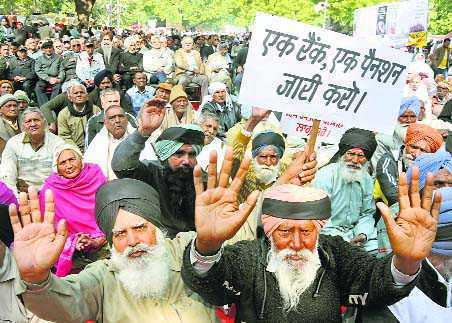
The defence Ministry issued the official notification for One Rank One Pension (OROP) for ex-servicemen late on Saturday evening. The government has reversed its contentious proposal to exclude ex-servicemen who had sought premature retirement from the ambit of OROP, but has not conceded the demands for an annual equalisation of revised pension, for pegging the pension to the maximum of the current pensioners, and for appointing an expert commission with serving military personnel and ex-servicemen representatives.
According to the notification, the government will pay the arrears of OROP in four equal half-yearly installments. However, all family pensioners, including those receiving special or liberalised family pension and gallantry award winners, will get their arrears in a single installment. The pension of past pensioners would be fixed on the basis of the pension of retirees of 2013, and the benefit will be granted from July 1, 2014.
Defence Minister Manohar Parrikar had announced on Friday that the notification would be issued before Diwali.
The notification, which was to follow Parrikar’s formal announcement of the acceptance of OROP on September 5, was delayed after the Model Code of Conduct for the Bihar assembly elections came into effect.Ex-servicemen who have been protesting at Jantar Mantar in New Delhi since June, rejected the notification issued by the defence ministry. “This is not OROP. At best, it is a one-time increment. We totally and outrightly reject it. It reflects a lack of maturity on the part of the political leadership of the government,” Wing Commander (retd) C K Sharma, treasurer of Indian Ex-Servicemen Movement (IESM), told The Sunday Express. On Friday, Group Captain (retd) V K Gandhi, IESM general secretary, had announced that ex-servicemen across the country would return their medals at prominent locations in their cities on November 9-10. The veterans had also announced that they would observe a Black Diwali this year. OROP means military personnel retiring in the same rank with the same length of service would get the same pension, irrespective of their date of retirement. Currently, a Colonel who retired earlier — under the mandate of earlier pay commissions — receives lesser pension than a Colonel who retired after the Sixth Pay Commission came into vogue in 2006. With the Seventh Pay Commission scheduled to submit its report by the end of the year, this difference would have increased further. The demand for OROP had been accepted by the Koshiyari Committee in its report to Parliament in 2011. At an election rally in Rewari in 2013, Narendra Modi, who was then the BJP’s prime ministerial candidate, promised the implementation of OROP. In his first budget in July 2014, Finance Minister Arun Jaitley announced an allocation of Rs 1,000 crore for OROP, but that amount lapsed at the end of the last financial year. As protests by ex-servicemen intensified this year, with some veterans going on an indefinite hunger strike, the defence ministry considered various formulae for OROP. The proposal forwarded by Parrikar to the finance ministry entailed an expenditure of around Rs 8,300 crore this year. That proposal was modified during the announcement made by Parrikar in September, when it excluded veterans who had sought premature retirement. The veterans protested the exclusion, saying that keeping premature retirees out of OROP would exclude 70 per cent of military pensioners. That clause has been removed in the notification, but the government has said that the benefit of OROP will not be extended to military personnel who seek premature retirement now on. The government has, however, stood its ground on other demands of the ex-servicemen. The veterans wanted equalisation of pension every year, or at least every two years, but the government has notified that it would happen only once in five years. They had wanted the revised pensions to be fixed at the maximum of the pension being received by current retirees, but the government has announced that only an average of the maximum and minimum will be given. But the pensions of those who are receiving a higher pension than average will not be reduced. The government has also notified the appointment of a judicial committee to look into anomalies of OROP. The panel will submit its report in six months. The veterans had wanted representation from the military and ex-servicemen in the committee, and its report within 90 days.


In Kabul, Modi calls for end to cross-border terror

Inaugurates new Afghanistan Parliament built with $90 m assistance by India

Kabul, December 25

2015_12$largeimg26_Saturday_2015_003937941

Prime Minister Narendra Modi on Friday called for an end to cross-border terrorism as he inaugurated country’s new parliament building here.Without naming Pakistan, Modi said in an address to Parliament here: “Afghanistan will succeed only when terrorism no longer flows across the border; when nurseries and sanctuaries of terrorism are shut and their patrons are no longer in business.“Terror and violence cannot be the instrument to shape Afghanistan’s future or dictate the choices Afghans make,” he said.Modi reached Kabul early on Friday on his way back from a two-day visit to Russia. He, along with Afghan President Ashraf Ghani, inaugurated the new Parliament building that has been constructed with Indian assistance of $90 million. One block of the building has been named after former PM Atal Bihari Vajpayee.“Bahut dhanyavaad India 4 giving us a new house of democracy. Its a testimony to our unyielding friendship,” Ghani stated in a tweet. In his address, Modi said there were “some who did not want us to be here”. “There were those who saw sinister designs in our presence here. There are others who were uneasy at the strength of our partnership. Some even tried to discourage us.”  He said “those waging war from outside must seek a path to this building and this hall”.The PM said Afghanistan’s success would require the cooperation and support of each of its neighbours.Modi expressed hope that Pakistan would “”ecome a bridge between South Asia and Afghanistan and beyond”. A joint statement issued after a meeting between Modi and Ghani said Afghanistan needed to eliminate terrorism perpetrated from “sanctuaries and safe havens” for peace while identifying terrorism, narcotics and extremism as “serious challenges”. The Mi-25 helicopters India is giving to Afghanistan were also mentioned in the statement, and both sides agreed to expand training opportunities for Afghan security and defence forces. Modi thanked Afghan authorities for ensuring the safety of the Indian embassy in Kabul, the four consulates in Jalalabad, Kandahar, Herat and Mazar-e-Sharif, and Indian nationals in Afghanistan, including those working on various development projects.Earlier, after Modi reached Kabul, Ghani tweeted: “India and Afghanistan enjoy a friendship that dates back to antiquity. We have stood by each other in the best and worst of times.” The two leaders had delegation-level discussions over breakfast.After his address to Parliament, Modi met Afghanistan’s Chief Executive Officer Abdullah Abdullah and former President Hamid Karzai.He also interacted with Indian aid workers in Afghanistan, ITBP personnel and embassy officials. — IANS

Reaching out

Modi pats ITBP men guarding embassyModi spent some time with Indo-Tibetan Border Police personnel deployed to secure the Indian High Commission in Kabul. He lauded their courage and dedication by complimenting them with a “keep it up” remark. The armed contingent is stationed to guard the facility and diplomatic staff in Kabul since 2002. The ITBP also guards India’s four consulates in Jalalabad, Mazar-e-Sharif, Kandahar and Herat.500 scholarships for martyrs’ childrenThe PM announced 500 scholarships for children of the martyrs of Afghan security forces. The Prime Minister, in his address in Afghan Parliament said: “You know India is here to lay the foundations of future, not light the flame of conflict; to rebuild lives and not to destroy a nation. Today, I announce 500 scholarships for children of the martyrs of Afghan security forces while scheme of 1000 scholarships will continue.”

US, UN welcome Modi-Sharif meet

  • The US on Friday said improved ties between the two countries will benefit the entire region. “Better relations between neighbours will benefit the people of the entire region,” said a US State Department spokesman
  • UN Secretary-General Ban Ki-moon hoped the dialogue would be strengthened further

…Invokes ‘Sher Khan’ and ‘Kabuliwalla’

Kabul, December 25

2015_12$largeimg26_Saturday_2015_005733243

The memorable portrayal of a Pathan — Sher Khan — by actor Pran in Bollywood movie “Zanjeer” found its way into diplomacy as PM Narendra Modi mentioned it to underscore how Indians view Afghans as true and magnanimous friends.And not just Sher Khan, the character “Kabuliwalla” in story by that name penned by Rabindranath Tagore too figured in Modi’s speech to Afghan Parliamentarians, as did the successes of Afghan cricket team to highlight the strong cultural and people-to-people bond between the two peoples. In his address, Modi lauded the Afghan people for their valour, courage and magnanimous friendship and then went to recite lyrics of a song in “Zanjeer” filmed on “Hindi cinema’s most favourite Pathan character — Sher Khan”.“Yaari hai imaan mera, yaar meri zindagi”, a smiling Modi said and then translated it for Afghan parliamentarians, that “friendship is my faith and friend is my life”. This, he said, is how India views Afghans in its centuries long relationship, the Prime Minister said. — PTI


OROP notification hailed

Mandi, November 8
Retired personnel of the armed forces have appreciated the Central Government for issuing a notification regarding nearly 45-year-old demand of one-rank one-pension (OROP) scheme.
In a statement issued here today, Honorary Commissioned Officers’ Welfare Association of Himachal Pradesh president Capt Jagdish Verma (retd) said the implementation of the scheme would benefit more than 25 lakh ex-servicemen and their families.
Capt Verma said all members were obliged by the Centre for issuing the notification regarding OROP and making it a reality. He further stated that today was a historical day and more than 1.45 lakh ex-servicemen are going to benefit. — TNS


The rebels who wrote history

Ravjot Grewal

A little more than a hundred years ago, on November 16, 1915, seven patriots were hanged to death after the culmination of what became popular as the first Lahore Conspiracy Case. These included Bakshish Singh, Jagat Singh, Vishnu Ganesh Pingle, Surain Singh s/o Boor Singh, Surain Singh s/o Ishar Singh, Harnam Singh and Kartar Singh Sarabha. These trials were to have an enduring impact on the psyche of Punjab and reverberations on India’s history. These hangings by the colonial government were one of the many in order to curb the war declared by the Ghadarites on the colonial government in India in February of 1915.

Events that led to Ghadar

A week after Britain declared war on Germany on August 4, 1914, a clarion call had appeared in Ghadar, a weekly revolutionary newspaper published from San Francisco, summoning its overseas Indian readers to return to their homeland and fight. It said the opportunity to free their country from slavery had arrived. 

This was so because Britain was quite vulnerable due to depletion of troops and resources. Also, its arch-enemy Germany was offering support to various revolutionary movements which had the potential of undermining the strength of the Empire. These included the Indian and Irish national revolutionists and the pro-Ottoman pan-Islamists. This was how the Ghadar Movement was launched among the Punjabi migrant workers in North America in 1913. It was characterised by a predominant Punjabi male participation and was a ringing explosion in the ears of the imperial government of the time.

The Ghadar Party was established by the Punjabi Sikhs of the USA and Canada in June 1913 also known as the Hindi Association of the Pacific Coast. The word ‘Ghadar’ means “mutiny” or “rebellion” or “revolt”. On November 1, 1913, the Ghadar Party issued their first newspaper from University of California in Berkeley. This party was originally built around the weekly paper Ghadar. For the first time, a true picture of the British rule was shown in the journal, simultaneously enunciating a vision for the future of India. In fact, the founders envisioned that the Ghadar would do the work of preparing the Indians for revolt until the actual war. 

Today, it is important to remember the martyrs and the specific conditions that led the erstwhile loyal ‘Sikhs’ to turn against their imperial benefactors. At the heart of the movement was the Punjabi farmer-soldier-turned-labourer abroad, driven out by the accretion of economic problems at home.

In the decade before the seeds of this large-scale unrest were sown by the imperial government in Punjab, the agrarian legislation, the colonisation Bill, issues of water rates and enhancement of land revenue had largely contributed to Punjabi men being forced to migrate in search of economic opportunities. At the same time the Indian National Association, the Indian National Congress, the Swadeshi Movement and the activities of Zamindara League (Unionist Party) had contributed to the political awakening of the Punjabis.

The Sikh connection

It is a curious question of history as to how the Sikh community in Punjab which was given the distinction of being a ‘martial race’ by the British, turned around to demand complete independence and plan a violent stratagem against their benefactors. The spectacular display of material prosperity, the spring of freedom in the steps of white people and the opportunities of economic mobility in the USA and Canada led the pioneer migrants to understand their own depravity induced by slavery to an imperial power. The white Canadians and Americans believed that they belonged to a superior and civilised race whereas Indians and other Asians were considered uncivilised.

During the first decade of the 20th century, 5,000 Indians reached Canada. Out of these more than 90 per cent were Sikhs. The harsh racial differentiation, violent attacks by white labourers and hoodlums led to a feeling of humiliation and shame among these Indian migrants. They believed they were subjected to this treatment because they were citizens of a slave nation. The British at that time did not want Indians associating or interacting with white people. This led to measures being taken by the Canadian government, then a colony of Britain, discouraging immigration from India. The freedom offered by these countries to the migrants propelled the transition to a demand for a more just social order.

These socio-political conditions led to the birth of the Ghadar Party, a party that gave expression to the evolved understanding of the repercussions of colonial rule in India. Although strict interpretation of its character is difficult without being unfair to its secular participants, numerically the Ghadar was largely a Sikh movement. The Komagata Maru incident was the final spark that ignited an already inflamed Sikh pride. The aftermath of this incident was a burst of revolutionary activity in the migrant Sikhs to redeem themselves from both the shame of allegiance to the British government in 1857 and their own cursed status as a slave nation.



Literary legacy

The Ghadar was no ordinary movement neither in its scope of influence nor its tactics. Maia Ramnath has observed in her book, Haj to Utopia that the Ghadar’s printed material served as connective tissue or switching circuit, capable of linking various elements among the Indian radicals abroad. It also linked Indian radicals to other networks, and  also connected pre to post-war revolutionary movements inside the country. This movement in its overall assessment has been termed as a “heroic failure” by Ghadar historian Harish K Puri. Although it largely failed to impact the colonial government in ways its members had originally anticipated, its cultural reach extends to this day.

The literature of Ghadarites was strikingly separate from any talk of fatalism. Instead it spoke to the higher ideal in men while looking at the ultimate fate in its eye. It remains a shiny reminder of the refusal of a population which formed the spine of the military prowess of the colonisers to yield to exploitation, a doomed attempt of unthinkable courage and splendid patriotism. It is a story of our forefathers which merits remembrance and retelling.

The Ghadar Movement was the first Indian movement with truly global linkages that effectively kick-started the movement of immigrants for equal rights and consolidated the integration of migrants into their new nations. It needs to be remembered that the participants being largely Sikh, the ideas of egalitarianism, sacrifice, service and martyrdom formed the bedrock of the political thinking of this and the later resistance movements in the region.

A struggle like Ghadar which failed in its overall objective and did not gain the large-scale support of the citizenry has a tendency to be relegated into historical insignificance. However, this is the exact reason why it must be remembered that not every battle is about victory.

Parallels can be drawn with the widespread desire of today’s Punjabi youth for migration abroad. The fact that it speaks volumes about the socio-economic conditions here is not lost to anyone. The demand for fair migratory opportunities is a prominent legacy of the Ghadar.

The rejection of sectarianism, calling out for social justice and demand for a just society, are vestiges of its cultural impact. In line with Kartar Singh Sarabha’s daring conviction ‘the blood of martyrs never goes waste’, the failure of the Ghadar Movement proved to be a landmark in the struggle for freedom. It inspired the likes of Bhagat Singh who considered Kartar Singh Sarabha his role model towards a revolutionary change. It will be right to conclude that the dreams of these primal modern revolutionaries must be remembered on the day of their martyrdom to serve as a light post for the future we aspire to as a society and a country and to forever be grateful.

Revolutionary literature 

Another enduring legacy of the Ghadar Movement was the poetry and the prose published in the Ghadar newspaper. The idea being to stir its readership in East Asia, North and South America, Mesopotamia and East Africa into revolutionary action. The Ghadarites spoke of confrontation with the British even before the actual ailan-e-jung (declaration of war) was declared at the outbreak of World War 1. The Punjabis had been occupied by the colonial rulers six decades prior and certainly had an evolved political sensibility by then. The Ghadar poetry was a pithy analysis of the causes of their condition and provided ample inspiration for dramatic activity. Giving vent to the migrant experience, it evoked deep emotions in a people who had historically learnt to fight injustice through arms. Their folklore and the 18th century history of Punjab had led to a belief that arms will be more decisive than words. However, words would prepare a template in the form of a population egging to revolt. Ghadar di Gunj, the nationalist and socialist literature published in the weekly Ghadar, was filled with details of exploitation and loot which filled its readers with uncontrollable resentment. The Ghadarites, in fact, were the first to emphasise that to live with dignity and pride even in a foreign land, it was essential to drive the foreigners out of their motherland.