Soldier found alive under 25-ft snow in Siachen

Current Events :


Action to Be Taken By Retired Personnel When Still In Good Health And Sound Mind.
Dear Veterans ,
Ex-Servicemen Joint Action Front (Sanjha Morcha) has compiled these guide lines for the veterans ,so that each none of us ensure appropriate action is taken during our life time with positive stride ,so that our defendants do not have to suffer or run around trying to make both ends meet to get the benefits and avoid legal battles after our inning in this world. Let us at least try and make few changes so that our loved ones would not suffer after we go. We do not know what will happen in the future. But, as the Scout motto goes: “Be prepared
Endorsement of Family Pension and Age of Spouse in
Pension Payment Order (PPO).
Normally accepted proof.
NOTE: The original PPO should contain an endorsement about the family pension indicating an enhanced rate of family pension and an ordinary rate. If there is no such endorsement, please take it up with the authorities concerned as indicated in paras 1 and 2 above. In the event of the pensioner’s demise before the age of 67, the spouse/family pensioner is entitled to the enhanced rate for seven years or till the date on which the pensioner would
have attained the age of 67 whichever is earlier. Thereafter the ordinary rate would apply. In both cases, the rates as periodically revised, along with the revision in pensions by successive Pay Commissions, would apply.
Bank Account for Pension
ECHS Membership
Check all your nominations
Therefore, kindly check your Nominations for :-
– Bank Accounts
– Fixed Deposits, NSC
– Bank Lockers
– Demat Accounts
– Insurance (Life, Bike or Car or Property)
– Investments
– PF & Pension Forms
Passwords
Investments
Liabilities
MASTER FOLDER FOR SPOUSE/ FAMILY MEMBERS
‘ACTION TO BE TAKEN IMMEDIATELY ON THE DEATH OF
(YOUR NAME).
This folder will contain all relevant documents, letters and instructions to facilitate appropriate and timely action by the spouse/family members when the time comes.
Will
individual circumstances. It is also necessary to ensure that the nomination as mentioned in Para 4 and 5 above and the provisions of the will are consistent with each other. You and your spouse may also consider her/his executing a separate will to cover all contingencies such as her/his predeceasing you.
(a) Original and one copy of the Pension Pay Order (PPO) (the latest) issued by PCDA (Pensions) Allahabad / PCDA (N) as applicable to you.
(b) Original and one copy of the bank nomination Performa (refer para 3) received from the bank/Pension Disbursing Office if applicable.
(c) Original and a few signed copies of the will (refer para 11)
requirements, formalities, pension and benefits. Several other agencies, (eg associations, clubs, time share companies, credit card agencies etc), besides service ones, with whom you have dealings, will have to be informed and have to take appropriate action when the time comes. You may prepare letters and addressed envelopes as suggested in para 13 above to cover such cases also.
INSTRUCTIONS TO (SPOUSE/ RELATIVES) ON ACTION TO BE TAKEN IMMEDIATELY ON THE DEATH
On the occurrence of Death
Funeral
Death Certificate
authorized to receive the application and issue the death certificate. 24. Normally death certificate is issued in 3 to 4 days. As soon as you get it make several copies of the death certificate, about a dozen or so, as they will be required to be submitted for several purposes.
Action Relating to Service – for Record, Family Pension and other Benefits
(a) Date and cause of death in para 1
(b) Death certificate number, date and issuing authority in para2.
(c) Para 4. Retiring pension- at the time of making these instructions, the retiring pension is Rs (basic) pm. If there is no further change till date, enter this amount; if there has been a subsequent revision, enter the latest figure. The PPO Corr mentioned is the latest available. If a Corr has been subsequently issued, add the reference No of the same at the end of this para and also enclose a copy of this Corr in the envelope for Dept of Sainik Welfare.
whole exercise, the details contained in the instruction sheet and the place where the master folder is kept. Make sure that they understand all the requirements and will be able to take action as necessary when the time comes. They should also know whom to approach if they are in trouble and need assistance.
Have you already done this or else do it now?
ensure bank gives you.
01/07/2009.This increase is not for Widows.
the criminal procedure code (Act-V of 1898).
(XVI of 1908).
drawing pension from Banks.
committee of a village.
form IAFA-319 of Commissioned Officers, departmental Officers and Warrant
Officers.
EXECUTION OF WILL
General
Choice of an Executor
the concerned Will, legally and expeditiously.
Choice of Witnesses
Contents of a Will
Disclosure generally leads to un-necessary arguments, and harassment of the Testator.
A WORD OF CAUTION
ACTION TO BE TAKEN ON DEMISE OF LIFE PARTNER
Certificate of Death from a doctor. Intimate location, date and time for ‘Chautha’/Prayer meeting to all concerned preferably through an insertion in the News Paper(s).
Registration of Births and Deaths. These are required to be submitted with all claims.
relevant details of the deceased to the following: –
(a) PCDA (Pension), AG’s Branch MP 5 (b), PS-4 and Army Officer’s
Benevolent Fund.
(b) AGI For life Insurance cover as applicable.
(c) Bankers For family pension, FDs, Loans (if any) and Locker.
(d) Station HQ Surrender Identity card of the deceased and issue of Canteen
Card.
(e) Clubs For transfer of membership or refund of security deposit as
applicable.
(f) Municipal Authority/AWHO/DDA (as applicable) For transfer of
House/Apartment to single name of the surviving spouse as per the WILL of the
deceased.
(g) MTNL For transfer of tele connection and future billing.
(h) DVB For future billing for power consumption.
(j) ITO For closing the IT file of the deceased and linking up with the Files of
beneficiaries. Also applicable for wealth Tax assessment.(k) Licensing Authority For Motor Vehicles, and Personal Arms and farm Machinery
– Tractors etc.
(l) LIC/GIC For insurance policies covering Life, Medical, Property etc.
(m) Rajya Sainik Board For issue of Ex-servicemen Widow’s Identity
Card.
Succession Act 1925.
ACTION TO BE TAKEN ON DEMISE OF A PENSIONER
(b) Do obtain two ink signed copies of Medical certificate specifying cause of death from the Hospital or the authorized Medical Practitioner. One of these is required by the authorities at the cremation/ burial ground. The other is required by the authorities (Registrar of Deaths & Births) who issues Death Certificates. Obtain cremation/burial certificate from the cremation/burial ground.
(c) A close relative should apply for issue of Death certificate within 15 days of the death of the pensioner/ deceased. Obtain at least 20 ink signed & equal number of Photostat copies duly attested by a class one officer.

(d) Write to the Pension paying Bank Intimating them of demise of the pensioner, asking them to discontinue the pension of the pensioner and payment of the family pension of the spouse l N O K (give name). Enclose ink signed death certificate & copy of the original P P O having joint photograph of the pensioner & spouse/ NOK. Also state PPO and pension S /B A/C numbers.. Sample Application form as at Annexure.
(e) If the Pension A/c is a joint account or the spouse is a nominee in it Then it is simpler to operate the same A/C for family pension, otherwise a fresh S/ B A/C is to be opened in the same bank. It requires proof of Identity and proof of Residence. Photo copy of voter I Card! PAN card will suffice- with three copies of attested photographs.
(f) Write separately to Pension sanctioning Authority, PCDA ( P) to start family pension, on demise of the pensioner and enclose ink signed copy of death certificate:-Sample Application is at Annexure
(g) In the case of Retired Army Pensioner Write to the A Gs branch (MP-5, CW 4) to update their records. & to Pay Platinum Grant if Applicable As per Annexure.
(h) If the age was less than 70 years write to Army Group Insurance Fund (AGIF) to Make payment of life insurance amount. Application Performa at Annexure.
(i) Return Retired Officers I Card to Area HQ (lnt Br.) for further Disposal. (j) If there are other Insurance Policies write to them to pay Insurance amount.
(k) Write to all banks wherein the pensioner has his accounts to transfer closing balances to the spouse / N O K giving bankers address, a/c number.

(I) Write to Regional Transport Officer to transfer the Automobile to the NOK.
(m) Write to Arms Licensing Authority to transfer the weapon (if any) to the NOK meanwhile deposit the weapon(s) in concerned Police Station Arms Dealer for safe custody. The NOK should apply forArms License at the earliest.
(n) Write to Electricity Providing Agency to transfer the meter in the name of spouse/NOK and start further billing against that name.
(o) Write to the Telephone providing Agency to Change the name of the subscriber, transfer the connection to the name of the Spouse/NOK for further billing (p) Apply to AWHO to transfer the dwelling unit to the spouse/NOK. Performa for Application should be obtained from the AWHO / Welfare Society . The Society has to render No Objection Certificate (NOC).stating that there is No encroachment of common land, No major modification to theApproved design and all Dues to the Society has been cleared. If not already done you may have to do it before they issue NOC.
(q) Write to all the clubs & societies to transfer the membership to the spouse/NOK (r) Write to all Debtors to clear all dues and make payment to the Spouse/NOK.
(s) Clear the outstanding dues if any of the Creditors and credit cards and loans taken if any. Return the credit cards to the Bank concerned.
(t) Some of the banks may have issued Insurance certificate for the amount of FD/Bank Balance then claim it.
(u) Write to Income Tax authorities to intimate death of the Pensioner to close his Income Tax file and open Income Tax file in the name of the Spouse/NOK Quoting PAN number of both.
(v) Write to the Municipal Authorities to Close Property case file of the deceased person and open it in the name of the spouse/NOK.
(w) Approach the district Courts for Probate of the WILL, if it is in possession, otherwise obtain a Succession Certificate. From the District Judge. (x)
Annexure — DRAFT LETTER FOR FAMILY PENSION
From
Name. Address Tele No. Date
To,
The Manager Name of Bank Address
Sir,
Subject:- GRANT OF FAMILY PENSION ON DEMISE OF PENSIONER.
1. Reference- Our Joint Pension SB A/C No. held in your Bank.
2. I regret to inform you that my husband, IC No, Rank ………….. Name has expired on at due to Certificate of his death is enclosed for ready reference. He was drawing his pension through your bank. Kindly, stop his payment of his pension with effect from and Start payment of family pension at the rate prescribed vide Annexure three to 6th Pay Commission Report i.e. Rs; 15630/= + DA @ 51 % or as applicable to me through the same Pension SB A/C No. Held in your Bank. We have no dependent children.
3. You are requested to forward the attached copy of this letter along with Copy of his Death certificate duly endorsed for its correctness.
Yours faithfully ,
Signature &n bsp;
; (Name)
Copy to :
PCDA (P), Dropadi Ghat, Allahabad 211014: for similar action.
***************** *************** **************** ****
Annexure ::
DRAT LETTER FOR ARMY GROUP INSURANCE EXTENDED POLICY
From: Name Tele No : Mob ………………..
Address………………………………………. &n bsp; Date
To,
The Chairman,
Army Group Insurance Fund,
AGIF House, Rao Tularam Marg, NEW DELHI – 110010
Sir,
Sub:- ENCASHMENT OF EXTENDED ARMY GROUP INSURANCE POLICY Ref.
Extended Army Group Insurance Certificate No. issued to IC No.Rank Name of Corps of signals. (Encl in original)
1. I regret to inform you that my spouse, I C. No. Rank Name has expired on……. at………. His/Her Death Certificate issued by …………… is enclosed for ready Reference.
2. I am enclosing the Extended Army Group Insurance Certificate for encashment duly completed in all respect. His date of birth is………………………… Kindly send the cheque of the sum assured to me on my address as given above. My Bank details are as under:-
SSB A/C No. Name and address of my Bank.
Thanking you in anticipation,
Yours Faithfully,
Signature (Name) ************ ************ ************ *********************
Annexure-
DRAFT LETTER FOR ARMY OFFICERS BENOVELENT FUND – RS 50,000/-
From; Name House No./Sector LocalityTeleNo. City& PIN File No. Date
The AOBF (Accts Sec), AG’s Branch, IHQ of MOD (ARMY) Room No 279a, South Block DHQ PO, New DeIhi110011
Sir,
Subject:- Payment of Platinum Grant (AOBF) On Demise of IC No IC Rank Col Name (Late) of Corps of Signals.)
Reference PPO No. ……………….. (Photocopy enclosed)
Thanking you in anticipation.
Yours Faithfully,
Signatures ( Name- Mrs xxxxx xxxxxx xxxxx xx) W/O Late xxxxx xxxxxxxx xxxxxxx
Copy to:- MOD IHD, Army/HQ AG ( MP 5/ CW 4) For Similar Action
CHECK LIST — ACTION TO BE TAKEN ON DEMISE OF PENSIONER.
To the following:
(a) PCDA (Pension), AG’s Branch MP 5 (b) and PS4.
(b) Army Officer’s Benevolent Fund for Payment of Platinum Grant.
(c) AGIF For settlement of life Insurance cover as applicable
(d) Station HO To surrender Identity Card of the deceased Officer and Issue of CSD Canteen Card.
(e) Bankers forfamily Pension, FD’s Loans (if any), PPF and Locker:
(f) Clubs For transfer of membership or refund of security deposit as applicable.
(g) Municipal Authority/AWHO/DDA/NDA/GNDA/HUDAILOCAL Development Authority For transfer of House /Apartment to a single name of the surviving spouse as per WILL of the deceased.
(h) MTNUBSNUTELECUM COMPANEY For transfer of tale connection and future billing.
(i) BSES/NDPULOCAL ELECTRICITY DEPARTMENT For transferring of electric connection and future billing in the name of the house owner.

(j) ITO For closing of file of the deceased and linking up with the files of the beneficiaries and for wealth Tax assessment.

(k) Licensing Authority for motor vehicles, Personal Arms and Tractors etc For Transfer of Ownership.
(I) LIC/GIC/Insurance Companies/Banks for insurance policies covering Life, Medical, Vehicles and property etc. (m) Secretary Zila Saink Board For issue of Ex-Servicemen widow’s Identity card.
A year ago, no one could have predicted that Prime Minister Narendra Modi would continue to put faith in dialogue with Pakistan despite the Pathankot provocation. Till then, his Pakistan policy was floundering. Then the NSAs and the Foreign Secretaries met in Bangkok. The game changed, and Modi made his famous touchdown in Lahore. The dialogue in Bangkok must have produced a meeting of minds; despite Pathankot, the guns are silent on the line of control — a vast improvement over things a year ago.Pakistan too has acted differently. For once, its reflex action was not to deny the possible involvement of its citizens in the Pathankot attack. The immediate detention and questioning of Jaish-e-Mohammed leaders helped India concede “there has been considerable progress in investigations”. The two Foreign Secretaries remain in communication and the door remains open for a formal interaction in the near future. International pressure too must have played a role. The US and Russia will meet soon to discuss Syria, the Iran file is nearing closure and the quadrilateral meeting on Afghanistan will happen soon. It would not behove Modi and Nawaz to squabble and divert the attention of the big boys.Given the history of Indo-Pak ties, it does not pay to become overoptimistic. Modi can still lose face if Pakistan fails to “deliver” on Pathankot. And what if another such incident takes place? Any imponderable can upset the Modi-Nawaz understanding on persisting with talks. The answer will be to stay nimble and conduct vigorous back-channel talks, if such conversations are not already taking place. Modi has ample political capital to accomplish whatever he and his advisers have set out to achieve. With the Pak army chief almost on his side, Nawaz Sharif seems to be in a similar position. The two sides can achieve closure on some easily resolvable disputes. This will enlarge the pro-peace constituency and act as insurance against another attack or if Islamabad is unable to book the masterminds of the Pathankot attack.
The haste with which the Army was deployed in Haryana by airlifting troops to Rohtak is a serious matter. The Army is the last resort for quelling civilian riots, not the first one. What Haryana did is akin to using a sledgehammer to kill a fly.

In the midst of military operation to quell the Jat protest in Haryana there was an innocuous media report suggesting that Army personnel had been put under the command of BS Sandhu, Additional DGP (Law and Order). The report also said that the state government has asked the Army to be called in eight districts. In this matter the “Chief Secretary had spoken to the Army Chief and the Chief Minister to the Defence Minister”. The effort was to deploy the Army as soon as possible to control the situation. This report went viral on the veteran’s email circuit with some senior officers, including former Generals, venting their spleen at the humiliation meted out to the Army by placing its men under the command of the police. Lt Gen (retd) SK Bahri shot off an angry letter to the Union Home Minister. Lt Gen Shokin Chauhan, GOC, 1 Corps quickly intervened and clarified the position in an email: “The troops in Haryana are from 1 Corps, which I command and there is no question about they being under anyone’s command other than mine… I visited them yesterday and today the Army Commander was with them. We have a commander in each district commanding his troops. The police assist us in identifying local people, tracks and disturbed areas.” This assuaged the veterans and the anger faded away. But the bitter fact is that there is a huge trust deficit between the government and the veterans, which is also has a ripple effect on serving soldiers. This is not in national interest. The Haryana government seems to have goofed up the entire handling of the situation. The provision of the Army in aid of civil authority is governed by Section 130 of the Criminal Procedure Code (CrPC). This legal clause states that decision to requisition “armed forces” to disperse “violent assembly of people,” which cannot otherwise be dispersed by the police or other forces available, should be taken by the “Executive Magistrate of the highest rank,” which is the District Magistrate, called the Deputy Commissioner in Haryana. Such Magistrate “may require any officer in command of any group of persons belonging to the armed forces to disperse the assembly with the help of the armed forces under his command, and to arrest and confine such persons forming part of it as the Magistrate may direct, or as it may be necessary to arrest and confine in order to disperse the assembly or to have them punished according to law.” Law also says that “every such officer of the armed forces shall obey such requisition in such manner as he thinks fit, but in so doing he shall use as little force and do as little injury to person and property, as may be consistent with dispersing the assembly and arresting and detaining such persons.” Law and the standard operating procedure are clear. District Magistrates are the competent authority to requisition the Army as the local situation demands. After requisition, when the situation is handed over to the Army by a written order from the Magistrate, the Army is entirely in control with the officer-in-command in charge. Only that the Army is expected to bring the situation under control quickly and hand it back to the civil authorities and exit the scene. The Army presence, at best, should be just about for a week.Under no circumstance can the Army be placed under the command of the police. This is an essential part of fair civil administration because the Army is expected to be totally impartial and unprejudiced while dealing with an explosive law and order situation, which might have arisen because of excess committed by the police resulting in a head-on confrontation with the rioting public. Neither is there any provision for “bulk requisitioning” of the Army by the Chief Secretary or the Chief Minister directly dealing with the Army Chief or the Defence Minister. These are serious distortions that have crept into basic governance over a period of time due to civil servants pandering to the whims of politicians. The haste with which Army was deployed in Haryana by airlifting troops to Rohtak is another serious matter. Army is the last resort for quelling civilian riots, not the first one. What Haryana did is akin to using a sledgehammer to kill a fly. What is strange is that Army Chief, General Dalbir Singh Suhag, who belongs to Haryana, appears to have taken personal interest in this “show of extreme force.” As the Eastern Army Commander, he had taken more than four days to move the Army when Kokrajhar and a few other districts of Assam were burning from communal violence and the death toll had crossed 100. District Magistrates there had requisitioned the force directly and the Army was already in deployment near district towns. Yet Suhag had cited procedures for the delay, which is contrary to the mandate of Section 130 CrPC. There is a lurking suspicion that he may have become an unwitting accomplice to a well-manipulated plan to silence democratic dissent sweeping all over the country.This has happened despite the presence of nearly 50 companies, or around 5,000 Central Reserve Police Force (CRPF) personnel in the state, in addition to over 60,000 Haryana policemen, including Special Armed Police based in Madhuban near Karnal. In addition, there are several other paramilitary forces with huge strength whose services could have been requisitioned.The Army Doctrine-2004 clearly defines its role in national security and maintenance of law and order. The primary role is to preserve national interests and safeguard sovereignty, territorial integrity and the unity of India against any external threats by deterrence or by waging war. The secondary role is to assist Government agencies to cope with “proxy war” and other internal threats and provide aid to civil authority when requisitioned for the purpose. Relegating the Army to its secondary role by constant troop deployment on internal security duties, dilutes the Army’s authority, corrupts ranks and compromises efficiency through lack of training. Besides, over time soldiers of the Army are looked upon merely as riot controllers in olive green, losing the respect and mystique they traditionally enjoyed. This also lulls the bloated civil police and paramilitary forces that continue to grow, but remain incapable of maintaining law and order. Haryana’s proud Jat community reducing themselves to seek charity from the government in the form of quota is bad enough. But resorting to such violence and rioting is a permanent blur on this martial community. There must very strong socio-economic compulsions for Jats to take to this inglorious path. Powers that be in Haryana must learn one lesson from this royal goof-up. That is, to properly diagnose the causes for this flare-up and take remedial steps before it is too late. Letting loose the Army’s might is certainly not the answer.The writer is a former IAS officer of the Haryana cadre.


Arteev Sharma,Tribune News Service.Jammu, January 15
Cross-border terrorism continues to bleed Jammu and Kashmir as the state has witnessed on an average eight terror-related incidents in a day during the past 25 years.During this period of turmoil and bloodbath, as many as 18,881 civilians and security personnel have been killed in over 69,000 terrorism-related incidents across the state since 1990, while around 21,800 terrorists have been gunned down in encounters with security forces during the period.This information was provided by the Union Ministry of Home Affairs in response to an RTI application here.“A total of 69,387 terrorism-related incidents have taken place in Jammu and Kashmir till December 13 last year since 1990. However, the number of terror incidents has shown a declining trend after 2002. The highest number of terrorism-related incidents was reported in 1995 when the state saw 5,938 such incidents followed by 5,829 terror incidents in 1994. Only 170 incidents, the lowest-ever in past 25 years, were witnessed in 2013,” the Union Home Ministry said.It said a total of 13,920 civilians have fallen to the bullets of terrorists from across the border since 1990. “In 1990, 461 civilians lost their lives, while the highest number of civilians (1,341) fell to the bullets of terrorists in 1996 followed by 1,031 civilians in 1995. The civilian causalities, too, have recorded a declining trend after 2003,” it said.After the eruption of insurgency in J&K, the Centre had to extend the Armed Forces Special Powers Act (AFSPA), which gives sweeping powers to the armed forces to detain suspects and use force, as the Armed Forces (Jammu and Kashmir) Special Powers Act, 1990, in the Kashmir valley in 1990 and the Jammu region in 2001, to deal with the terror situation.“A total of 4,922 security personnel laid down their lives while fighting terrorists during the past 25 years. Security forces suffered the maximum collateral damage in 2001 when 536 of their personnel were killed followed by 453 in 2002,” the Union Home Ministry said, adding that the collateral damaged being suffered by forces was significantly brought down in 2012 when only 15 personnel lost their lives. However, as many as 39 security personnel were killed last year till December 13.The security forces eliminated 21,777 terrorists till December 13 last year since 1990 and the maximum number of terrorists (2,020) was gunned down in 2001 followed by 1,707 terrorists in 2002. Last year alone, 105 terrorists were gunned by security personnel in the state.
India may have 71 of its warships anchored off Visakhapatnam for the International Fleet Review (IFR), but that does not reduce India’s preparedness, naval sources say, adding that “minimum force level” is maintained all along its maritime area. Highly placed sources told that the Indian Navy’s submarines, which are absent from the fleet review, are on task, “lurking around” to keep an eye under the waters. At the IFR in the Bay of Bengal, the largest military exercise organised by India with about 50 global Navies, 24 foreign naval ships and 71 Indian ships, security is tight and a constant vigil is being maintained from the water and the sky.
“Minimum force level is always in place. Guarding India’s maritime interest is the first responsibility of the Indian Navy,” a senior official told. Highly placed sources told that as the bigger ships are here for the review, long-range maritime reconnaissance aircraft P-8I are scanning India’s maritime boundaries to detect any trespassing. The patrol by the P-8Is is done in a manner that once an area is scanned, it is ensured there will be no boats entering that zone in the next eight hours at least. To top that, coastal patrol vessels, Indian Coast Guard and maritime police are at their job as well.
About 100 vessels anchored off the Visakhapatnam coast are also “armed to teeth”, said an official. On deployment also for safety are mine sweepers, missile boats, and patrol vessels. Fast Interceptor Crafts and Fast Attack Crafts are constantly moving around in the waters. “The navy is the primary agency, we have the Coast Guard, maritime police, state governments, home minister, IB, RAW, and all other agencies coordinating to ensure a fool-proof security,” an official told.
A fleet review is a ceremonial and stately inspection of naval warships by the supreme commander of the armed forces, the President of India. This is the second time an IFR is being held in India. The last was held off Mumbai in 2001 when A.P.J. Abdul Kalam was the President. Twenty-nine countries participated in that event.
All-women patrols along Himalayan frontier on the cards
Vijay Mohan
Chandigarh, January 15
The Indo-Tibetan Border Police Force (ITBP) is beefing up its strength on the Himalayan frontier with China by adding eight new battalions. Four of these battalions will be deployed in the Ladakh Sector and the remaining four in Arunachal Pradesh.“We will be getting the additional battalions for Ladakh first and thereafter for the north-east,” ITBP Director-General Krishna Chaudhary said on the sideline of a passing out parade of women constables at the force’s Basic Training Center at Ramgarh near here today. “The overall plan is to raise 16 new battalions of which these eight are being raised in the near future,” he added.He said at present the distance between border outposts (BOPs) along the Himalayas ranged up to 25 km, which will be reduced with the induction of new battalions and facilitate more effective border management.The ITBP is also planning all-women patrols along the border with China. It has decided to post women personnel on BOPs on regular border guarding and combat duties. “Initially, women would form part of joint patrols with men and once they get the desired experience, all women teams would be constituted for both short range and long range patrols,” a top officer said. Many of the newly inducted constables have been posted to battalions deployed on the front.The ITBP is deployed at altitudes ranging up to 18,000 feet in remote snow bound areas with temperatures remain below zero. To provide better amenities for its troops, the force is experimenting with a new design for BOPs in Ladakh, which would be centrally heated and have solar power back up and other facilities required to alleviate the tough conditions. The design is being vetted by the Indian Institute of Technology, Roorkee.On the issue of transgressions across the Line of Actual Control, he reiterated that since the border is not demarcated, perceptions on both sides differ and patrolling is carried out accordingly and movements are monitored.

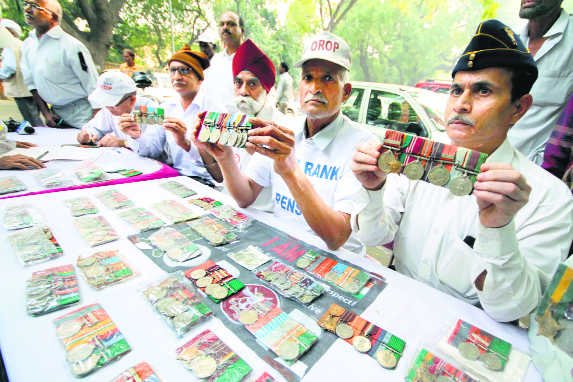
The Indian ex-servicemen movement has decided to take the Narendra Modi government to court for what they claim is a nonimplementation of the ‘one rank one pension’ (OROP) as agreed by the Ministry of Defence.
The veterans want the government to implement OROP as approved by the Koshiyari Committee of Parliament. The veterans have roped in experienced lawyer Ram Jethmalani to fight their case in the Supreme Court.
A group of veterans led by Major General (retd) Satbir Singh have been agitating for OROP implementation for the past 238 days at Jantar Mantar.
The governing body of the agitating veterans’ has decided to challenge the government in court and not submit its case to the one-man commission set up by the Modi government to look into the anomalies in OROP implementation.
Adverse effects
“We are in the final stages of our paperwork to be submitted in court. The government did not fulfill the promise made to veterans on OROP and we will challenge the government in a court of law for OROP,” Major General (retd) Satbir Singh told Mail Today. The veterans have also decided to continue their agitation at Jantar Mantar till OROP is implemented.
The government had on February 3 announced the notification of the tables regarding the implementation of OROP.
The Ministry of Defence (MoD) in a statement said that the annual recurring cost of OROP would be `7,500 crore and arrears from July 1, 2014 to December 31, 2015 would be an additional Rs 10,500 crore.
The government had claimed 86 per cent of this money would go to personnel below officer rank (PBOR).
“This is one rank five pensions. The government is silent on the equalisation of pensions. So within two years juniors will draw a higher pension than seniors, again defeating the purpose of OROP. The government has also cleared one increment less,” Singh claimed.
The agitating veterans are also miffed with the fact that instead of taking the highest pension at a particular rank and years in service as bench mark for OROP, the government has gone in for the average of pensions, which will affect the veterans adversely.
The government on the other hand insists OROP was finally granted for veterans by the Modi government after four decades of agitation by the veterans.
“Veterans have been agitating for OROP for the past 42 years. Prime Minister Narendra Modi has fulfilled his promise to the veterans. Most are happy, only a section is agitating. They may approach the commission to discuss anomalies that remain,” a senior MoD official said.
The defence budget for pension is estimated to go up from Rs 54,000 crore to around Rs 65,000 crore, that is by almost 20 per cent, on account of OROP.
Government sources are of the opinion that some of the agitating veterans are politically inclined and will keep up their protests ahead of the crucial Punjab elections to create trouble for the government.
“If there are anomalies then the one-man commission, that has been set up, will address them and come up with necessary solutions within six months. Instead of agitating on streets the veterans should submit their issues to the commission,” sources at MoD said.
The war for these veterans is far from over.
Ajay Banerjee,Tribune News Service,New Delhi, January 15
India and France are not likely to ink the much-awaited deal for the Rafale fighter jets when French President Francois Hollande arrives in India on a three-day visit as chief guest at the Republic Day function. As some issues still remain, India will go for a better price than take a hasty step at this stage, top sources said, indicating the deal may not be inked during Hollande’s visit.In April last year, Prime Minister Narendra Modi announced a decision to buy 36 Rafale fighter jets from France in a “fly-away” condition. After that, the cost negotiation committee met to fix a price for the jets and also the arsenal. Initially, the IAF had projected the need for 126 such fighter jets and a global tender was floated, which is now in cold storage after the decision to buy Rafale was announced.Already faced with a dwindling fleet of fighter jets, the Indian Air Force (IAF) has formally told the Ministry of Defence (MoD) that it needs at least 80 Rafale-type multi-role combat fighter jets to be battle ready in the next few years. These need not be the Rafale, but should be jets of similar capability.The IAF has conveyed the need for five squadrons and estimated a squadron at 16 jets each, instead of the normal number of 18 jets, as the Rafale with its high-end technology is available to fly at short notice and has a shorter maintenance “turn-around”.This works out to be 80 jets of Rafale or planes of such type. The number is more in tune with creating minimum facilities for servicing and training of pilots and on-ground technicians. A “mere” 36 jets – presently on order — would not meet the shortfall due to the phasing out of fleet of MiG-21 and MiG-27 jets by 2022. There are some 260 obsolete MiG-21s and MiG-27s (Soviet Union-era single-engine fighter jets) in the fleet. The IAF needs 400 jets over the next 10 years. As of now, the IAF has 35 fighter jet squadrons (having 16-18 planes each) against its projected requirement of 42 squadrons to tackle any simultaneous war with China and Pakistan.