Sanjha Morcha

What’s New

Click the heading to open detailed news

Current Events :

web counter

Print Media Reproduced Defence Related News

Burhan Wani’s killing dents Kashmir’s new militancy

Burhan Wani’s killing dents Kashmir’s new militancy
Burhan Wani

Azhar Qadri

Tribune News Service

Srinagar, July 8

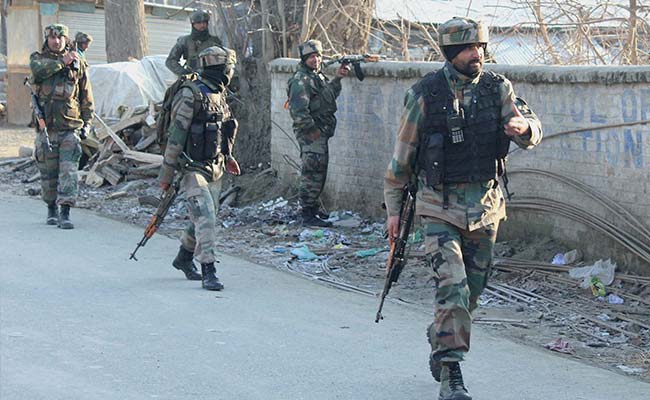
Burhan Wani’s six-year-long journey from a teenage boy who left home in 2010 to the most wanted militant ‘commander’ in the Kashmir valley brought ‘glamour’ to the region’s militancy.Wani (21) was killed in a gunfight in the Kokernag area of south Kashmir this evening. The first image of his corpse showed his bloodied face.His killing has dented new-age militancy as it will be hard for it to find a new poster boy whose images and videos can become instantly viral across the region.Wani joined militants in October 2010 and operated in the forest of Tral sub-district. A resident of Sharifabad locality of Tral, Wani was initially tutored by his cousin and militant ‘commander’ Adil Mir.He was made ‘commander’ of militants following Mir’s killing in 2014. He instantly became the face and voice of a new generation of Kashmir’s militants which relied little on Pakistani backing and counted heavily on local support.Wani made a mark on insurgency by introducing its largely anonymous and underground ranks to the public through social media.Wani’s image first got leaked into the public domain in May 2013 when a militant, mistaken to be him, was killed in a forest near south Kashmir’s Tral sub-district.The accidental leak of his images made Wani the poster boy of insurgency. For the past three years, he made its optimum use. His images and videos gave militants a new face and a new voice and generated sympathy and support for them.Last year, Wani made a video statement in which he imitated the style and monologue of global ‘jihadi’ groups and called for establishment of a caliphate.He featured in pictures with other militants, images which became viral in the age of social media and gave a new lease of life to militancy.Wani is believed to have led very few militant attacks himself, but his social media presence made him the most known face in Kashmir.From October 2010 to July 2016, Wani survived nearly six years as a militant, changing the dynamics of militants that looked hard for security agencies to reverse.

clip

Restrictions imposed in Srinagar areas

  • Srinagar: The administration has decided to impose restrictions in old Srinagar and volatile Maisuma localities on Saturday to maintain law and order situation in wake of killing of militant commander Burhan Wani. Deputy Commissioner Farooq Lone said restrictions would be imposed in areas falling under jurisdictions of six police stations, including Rainawari, Nowhatta, MR Gunj, Khaniyar, Safakadal and Maisuma. — TNS

Omar says ‘disaffected’ have got ‘new icon’ in Wani

Omar says 'disaffected' have got 'new icon' in Wani
Omar Abdullah. PTI photo

Srinagar, July 9

Former Chief Minister Omar Abdullah said on Saturday that Kashmir’s “disaffected” found a “new icon” in Hizbul Mujahideen commander Burhan Wani and voiced fears that his death could lead to more youngsters being radicalised.

“Mark my words — Burhan’s ability to recruit into militancy from the grave will far outstrip anything he could have done on social media,” Abdullah wrote on microblogging site Twitter.

“After many years, I hear slogans for ‘Azadi’ resonate from the mosque in my uptown Srinagar locality. Kashmir’s disaffected got a new icon yesterday,” the National Conference leader said.

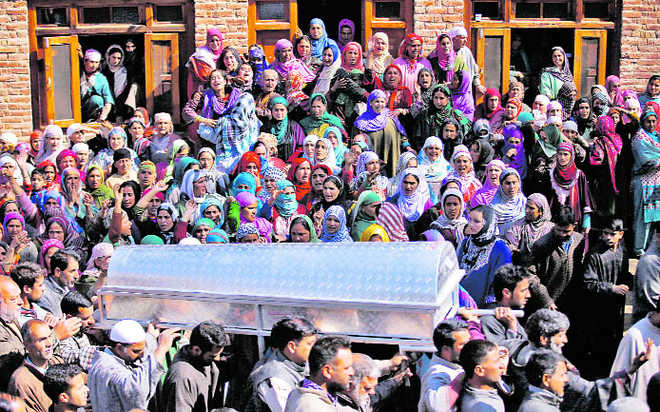
People assembled in Tral — Wani’s hometown — in Pulwama district for Wani’s funeral.

The former chief minister said on Friday that Wani was not the first, nor will he be the last, to take up arms, so long as the Kashmir problem remained unresolved.

“For all Burhan’s social media activity I don’t recall any militancy incident attributed to him while I was in office. Not sure after that,” said.

Wani, considered to be Hizbul Mujahideen’s most prominent face, was among the three militants security forces shot dead on Friday in Anantnag’s Kokernag. — PTI

Lashkar-e-Toiba, Hizb working in tandem in south Kashmir

Suhail A Shah

Anantnag, July 8

The recent uptick in militant attacks, particularly in the south Kashmir region, might be due to Hizb-ul-Mujahideen and Lashkar-e-Toiba cadre working in close coordination, believe security agencies.There have been some audacious attacks in June along the Anantnag-Srinagar stretch of the national highway. Thirteen security force personnel, including eight CRPF men, three BSF personnel and two members of the Jammu and Kashmir Police, have been killed in the three attacks carried out in Pampore, Bijbehara and Anantnag town. As many as 22 personnel of the CRPF were also injured.The Pampore attack , which was most gruesome of the three and probably one of the biggest-ever in the Kashmir valley in terms of casualties, was later claimed by Lashkar-e-Toiba; the Bijbehara attack by Hizb and the Anantnag attack was traced to Lashkar. Despite separate claims for attacks, security agencies believe the militant outfits are working in an absolute tandem, at least, in south Kashmir.A senior police official, on condition of anonymity, said they had inputs that meetings between the cadre of Lashkar and Hizb had taken place before every attack to finalise the modalities and chalk out strategy.“They have planned every attack together and have provided each other logistics and in some cases even manpower,” the police official said.He said Lashkar commander Abu Dujana, who took over after Abu Qasim was killed last year, had been instrumental in bringing the two outfits together. Dujana is thought to be the mastermind of many attacks, including Pampore on June 25.Security forces came across one such meeting of the militant outfits on June 30 in Pulwama district, a day ahead of Home Minister Rajnath Singh’s visit to the Valley. Two militants, including a local and a foreigner, were killed during the gunfight that followed.South Kashmir region has a total of around 60-65 militants presently operating within the five police districts, including Kulgam, Pulwama, Anantnag, Awantipora and Shopian.Only 17 of the total are Lashkar cadre, seven of them foreign nationals.Officially Anantnag and Shopian do not have any Lashkar cadre. However, the June 5 attack on policemen in Anantnag stands testimony that the militants cross over to other areas to strike.“They operate from different areas under different aliases, particularly the non-locals. Obviously they are provided support by the locals active in that particular area regardless of the outfit,” said a police official from Kulgam district which has highest number (five) of Lashkar men active.

The Abu Dujana link

  • Despite separate claims for recent attacks, security agencies believe the militant outfits are working in an absolute tandem, at least, in south Kashmir
  • Police have inputs that meetings between the cadre of Lashkar and Hizb took place before every attack to finalise the modalities and chalk out strategy
  • Lashkar commander Abu Dujana, who took over after Abu Qasim was killed last year, has been instrumental in bringing the two outfits together, said a police official


OROP Pension Discrepancies:

Details of Nodal Officers of respective PSA
Nodal Officers:

In case of any doubt relating to revision of pension in terms of these orders, PDAs may immediately take up the matter with Nodal Officers of the respective PSAs by name as under:-

For commissioned officers

Army: Shri. R.B.Sharma, Sr. AO(P)
O/o the PCDA (P) Allahabad- 211014
Phone – 0532-2421877 Extn. 144
Email – cda-albd@nic.in

Navy: Smt Vandana Shetty, Sr. AO
O/o the PCDA (NAVY), Mumbai- 400039
Phone – 022-22696139
Email – pcdanavy@nic.in

Air Force: – Shri Ravinder Grover, Sr. AO
O/o the JCDA (Air Force) New Delhi- 110066
Phone – 011-25695012
E-mail- dcdaaf-delh.cgda@nic.in

For JCOs/ORs

Army: – Shri S.C. Saroj, Sr. A.O(P)
O/o the PCDA (P) Allahabad- 211014
Phone – 0532-2421877 Ext. 206
Email – cda-albd@nic.in
Authority  pcda circular 555

PENSION ADALAT 2016—PATIALA CANTT—08-09 JUL 2016

LOCATION:–      ONE ARMD DIV SIGNAL REGIMENT

TIME             : 9 A.M ONWARDS

SUBJECTS:      PAO,ECHS,DPDO,ELECTRICITY,WATER,RTO,POLICE DEPARTMENT,VSK,ARO,APN,AWHO,CSD,SMART CARD ISSUE WILL BE DISCUSSED.

ALL ESM,WIDOWS,VEER NARIES REQUESTED TO BRING ALL DOCUMENTS

IMG-20160704-WA0054


That July 4th Gen V.P. Malik (retd) The capture of Tiger Hill was a turning point

That July 4th
Tiger Hill regained: Though picturesque, dominating and difficult, Tiger Hill is a war symbol to every Indian

Seventeen years ago, on July 4-5, 1999, the Indian army fought and won a magnificent battle victory during the Kargil war. There were two turning points in the Kargil war: the capture of Tololing which started the ‘turn in the tide’ and the back-to-back capture of Tiger Hill and Point 4875. Although Point 4875 was tactically more important, it was the capture of Tiger Hill which caused a physical and psychological blow to Pakistan and the ‘end in sight’ for us. Tiger Hill is 5,062-metre-high with sharp conical features and stands majestically among the mountaintops a few kilometres north of Dras. One cannot miss it, or help admire it, as one drives along National Highway 1A (NH 1A) from Zojila to Kargil. During the Kargil war, it was a delight for photojournalists as it provided some of the best pictures of that war. From Tiger Hill, the enemy (one company of Pak 12 Northern Light Infantry) had a clear view of NH 1A from Dras to Bhimbat, and the road leading to Marpola on the Line of Control (LoC). They could effectively interdict vehicular movement on these roads with observed artillery fire. We were clear that unless Tiger Hill and Point 4875 (located 2 km to its South-West) were secured, movement along NH 1A will never be safe. Although Point 4875 was closer and dominated a larger stretch of NH 1A, Tiger Hill occupied by the enemy was more difficult to climb and assault.In the second week of May, 1999, 8 Sikh moving from Udhampur to the Kashmir valley was diverted to Dras. On arrival, the Brigade Commander launched the unit into battle without acclimatisation and snow clothing to clear Tiger Hill. The unit suffered heavy casualties in its attempt to get close to the objective. It was then ordered to occupy dominating heights in the vicinity in the area called ‘Parion ka Talab’. No further attempts were made to capture Tiger Hill for the next six weeks till we were able to clear the approaches and fully ready for it.On June 27, 1999, I visited HQ 8 Mtn Div and 56 Mtn Bde at Dras. That evening, 2 Raj Rif was preparing to attack Three Pimples, another very difficult feature west of Tololing. After GOC, 8 Mtn Div, Maj Gen Mohinder Puri briefed me on the ground situation, I asked him about his next objective. He told me that after a few days, 192 Mtn Bde will attack Tiger Hill and Point 4875. The attack on Tiger Hill was to precede the attack on Point 4857 by a day so that enemy attention would be diverted from the latter more strongly held objective. That I thought was a sound decision. Tiger Hill extends about 2,200 metres from west to east and about 1,000 metres north to south. The main extension is towards west on which there are two prominent protrusions. The first, approximately 500 metres west of Tiger Hill, had been named ‘India Gate’. The second, another 300 metres to the west, was called ‘Helmet’. 18 Grenadiers along with 8 Sikh, which were already in the area, were tasked to capture Tiger Hill on the night of July 3-4, 1999. They were provided a team of the High Altitude Warfare School, adequate artillery, engineer and other support. The Air Force could easily identify the prominent conical shape of Tiger Hill. It engaged the objective on July 2-3, 1999, and was able to score many bull’s eyes in its missions.The multi-directional infantry assault began at 1900 hours on July 3, 1999, with direct and indirect firing by artillery and MBRLs. 8 Sikh provided the firm base and engaged the enemy from ‘obvious’ approaches as part of a deception plan. 18 Grenadiers moved towards the objective from the south and north east. The weather assisted the battalions in achieving surprise. Lt. Balwan Singh led the Ghatak Platoon of 18 Grenadiers on the most difficult, north-eastern approach. His Platoon made use of ropes to reach the top at 4.30 hours and totally surprised the enemy which had already suffered due to heavy artillery shelling and air attacks. In the ensuring hand-to-hand fighting, the enemy lost 10-12 personnel. 18 Grenadiers suffered six fatal casualties. Grenadier Yogendar Singh Yadav, who was in the lead on the rope and wounded badly, earned India’s highest gallantry award of Param Vir Chakra. The Ghatak Platoon with some reinforcements firmed in on the Tiger Hill top but came under enemy fire from the Western Spur. Brig Bajwa, Commander 192 Mtn Bde, quickly moved a company of 8 Sikh to occupy India Gate and Helmet. It was reinforced by another company of 18 Grenadiers. On the morning of July 5, the enemy launched a fierce counter-attack led by two officers. One, Capt Kamal Sher fought gallantly and was killed. Later, he was awarded Pakistan’s highest gallantry award when we returned his body to Pakistan.In New Delhi, I remained anxious all night till Lt. Gen Krishan Pal, GOC 15 Corps, rang up at 0600 hours on July 4, 1999, to inform me that 18 Grenadiers had reached the Tiger Hill top and heavy fighting was going on. After consulting him and the Director General Military Operations, we decided to wait for confirmation from Maj Gen Puri. At 0730 hours, Puri spoke to me and confirmed that the enemy would not be able to dislodge 18 Grenadiers from the Tiger Hill top. By then the Defence Minister was on his way to Amritsar. When he landed at Amritsar airport, I gave him this exciting news. I also informed the Prime Minister, who was to address a public meeting in Haryana at 10 am.July 4, 1999, was an important date. Despite heavy commitments of Independence Day, President Clinton had agreed to meet Prime Minister Nawaz Sharif of Pakistan, who had conveyed desperation in wanting to meet. The meeting was to take place in the evening –early morning of 5th July in India. We made sure that the whole world got to know about the capture of Tiger Hill and thus, the likely outcome of the Kargil war.That was a hard psychological blow for the Pakistan army. Initially, it tried to deny the existence of Tiger Hill and labelled the entire operations as a figment of the imagination. But with Indian media beaming live war pictures into drawing rooms, that kind of fooling was no longer possible. The Indian victory made Pakistanis realise the writing on the wall. In India, there was a wave of jubilation and relief in the mood of the people! — The writer is a former Chief of the Army Staff






SOLDIER’S PRIDE IS NATION’S SECURITY By Lt Gen PG Kamath (Veteran)

It was post 1971 and the nation was euphoric. Our countrymen were lauding the Indian Armed Forces for a spectacular victory that had changed the geography of the sub-continent. The nation was savouring the victory and more than 97,368 prisoners were in our Prisoners of War Camps. It was the second largest surrender in the Military History; second only to the surrender of Gen Von Paulus, German, 6th Army at Stalingrad in the Second World War. The Armed Forces were feted everywhere for its courage and the people were convinced that it was one instrument that would never let the country down.
Amidst this euphoria there were 4000 families, who had lost their fathers/sons/husbands in the war. Another 10,000 were wounded and maimed for life. They were picking up the lost threads of life to continue their journey in the forbidding world. However their sorrow was lost amidst the mirth, laughter and jubilation of victory.
Unknown to the services a band of bureaucrats were conspiring as to how to cut the Armed Forces to size. Defence Secretary was Mr K B Lal, who was literally there for the entire duration of the Third Pay Commission. He was the one, who provided the inputs to the Third Pay Commission. The Commission was constituted a year before the war and concluded two years after the war. It’s final recommendation marginalising the Armed Forces was made public two months after Fd Marshal Manekshaw relinquished the post of Chief. Indeed it was a clever move as the most popular person in the country was not able to take cudgels against the government. This Pay Commission cut the Armed Forces to size for winning the war for the country. Even Fd Mshl Manekshaw was not spared; more of it later. ‘Ingratitude unkinder than the winters wind’ to adopt Shakespearean phrase to an ungrateful government. How did the Government go about the act?
Firstly they abolished a separate Pay Commission for the Armed Forces and formulated an equivalence between the Armed Forces and Civilians. It was here that the Pay Commission struck its vilest blow when they considered that ‘a trained infantry soldier with three years of service is below a skilled labour. Little do they know that it is the infantry soldier who does the actual fighting and charges the enemy with naked bayonet literally on the very front edge of the battle and makes eye and steel contact with the enemy. He is the one who bears the brunt of more than 90% of casualty in all wars and yet he was considered the lowest strata to base their comparison. It also means that the infantry soldier with less than three years’ service was considered an semi-skilled/unskilled labour? Just mark the irony of the sinister and ignorant move? Rest of the soldiers were equated based on this preposterous formulae?
Next step was to reduce the percentage of pension for the Armed Forces. The OROP that was effective till 1972, was annulled after the third pay commission. A soldier then served only for 15 years and went on pension at the ages ranging from 33 years to 36 years of age. In view of this, his pension was 70% of his basic pay and an officers pension was 50% of his basic pay as the bulk of them retired at 50 years of age. The civilian counterparts were getting only 30% of their basic pay as pension. Please note they served till they were 58 years of age (now 60 years) and the soldiers retired a quarter century earlier. The wretched Third Pay Commission did not consider the additional 25 years of service his civilian counterpart served and raised their pension to 50% and reduced a soldiers pension from 70% to 50% in order to achieve the so-called parity. Further the government put mandatory 33 years of service for full pension fully knowing that the soldier then retired after 15 years of service. They further as a largesse made a seemingly generous gesture to the Armed Forces by pegging the mandatory service for full pension (50%) to 25 years. Just look at the clever move; fully knowing that the soldier retired after 15 years of service. Thus the soldier in effect got only 30% of pay after 15 years of service, as extrapolated from full pension of 50% of pay with 25 years of service. Thus the Government ingeniously cut a soldiers pension from 70% to 30% of pay at the same time enhancing the civilian pension from 30% to 50%. Look at the perfidy; how can possibly a Government run down her own Armed Forces? It is indeed a remarkable feat from a nation that was a slave nation for over two centuries, yet disregards her Armed Forces who ensure her hard earned freedom?
Our Defence Ministry were hand in glove with the proposals. There was not a whimper of protest to set right the injustice. The soldiers had to pay heavily for having won the war for the country. Their travails were not over; more was yet to come!
One would wonder why the soldiers did not protest against the brash injustice perpetrated on them? It would be difficult to believe, as those were the times the officers in particular were told that politics and pay were not to be discussed. They were naïve and had full faith in the government that in the long run; no injustice would be done to them? The disarming naivety of our officers appear incomprehensible now; but it was true then. Hence the entire master stroke of cutting the armed forces to size by impoverishing them was done with so much of dexterity, it took us couple of decades to realise its negative impact.
Mrs Gandhi was feted and was called ‘Durga’ and she basked in the limelight of victory and self-adulation. However, she proved to be the daughter of her illustrious father by sharing the same antipathy and disdain towards the Armed Forces. She was a smart women hence concealed it to a great extent with outer façade of support and derived maximum political mileage of the victory. The running down of the Armed Forces in the Third Pay Commission could not have been done without her active and positive consent?
Their next target was the most popular figure in the country Fd Marshal Manekshaw. He was made a Field Marshall and the appointment is active for life, though ceremonial in nature. A Field Marshall does not retire and continues to wear his five star rank for life. He was entitled to Pay and Allowances for life. The bureaucrats who were literally jealous of his popularity ensured that he did not get his pay and allowances; low and behold! for the next 36 years, and finally a lump sum of ₹ 1.60 crore of arrears was released to him on intervention by then President Abdul Kalam. A non-descript bureaucrat gave him his pension dues on his deathbed in Jun 2007 a few days before he breathed his last. Isn’t it a national tragedy? Don’t you sometimes feel whether the country deserves selfless service from its soldiers? Can any country on this earth be more ungrateful towards her soldiers than ‘Mother India? What a great victory for the MOD for destroying the soldiers pride?
Let us now analyse as to why a soldier fights? Why does he give his life for a cause? What makes him charge through a fusillade of bullets and splinters against sure death and injury overcoming the instinct of self-preservation? Why is he prepared to make his ultimate sacrifice and bid goodbye to the world? Why does he not think of his loving wife, his innocent children, his aged parents and the living world of mirth and bliss; knowing he has not even spent a quarter of his life? Why all his near and dear ones pale in to insignificance and he sees only his mission like Arjuna only seeing the eye of the bird? All these questions can be answered in two words; His Pride.
It is his professional pride that make him a hero. He wants to be a hero before his comrades; before his superiors, in his unit and in his country. He is a hero of his village and hero in front of his parents. He is a hero to his wife and a super hero to his children. He also knows he is the last bastion of the nation and he is the last trump card in the hands of his nation. He knows that if he fails the nation fails. It is this emotion that drives him towards mission accomplishment. It is all the way Pride! Pride! And Pride. It is nothing else but ‘Pride’.
Sad to say; it is exactly that the Governments of his own country wants to deprive him of? He has been badgered, humiliated, impoverished and made a laughing stock in all the successive pay commissions. His status has been lowered time and again by an insensitive government. How can noble thoughts like sacrifice, mission, cause, patriotism and pride be ever understood by self-serving, sly and scheming bureaucracy? A soldiers pride has taken a beating and believe me sir! It would be a long and painful time to build it again?
Mr Prime Minister! Before you forget history; In Jun 1932 President Herbert Hoover, the 31st President of US ordered firing on the veterans of First World War for demanding the promised bonus. Two veterans were killed and several injured. Herbart Hoover lost the election with a devastating defeat and has gone down in history as a lack lustre President. The Great Depression may have contributed to his rout but the firing on veterans brought him great disrepute. Mr Prime Minister! You are certainly made of a better stuff than Herbert Hoover?
Enough has been said of ‘OROP’ and nothing more needs to be said about it. Supreme court has granted it and parliamentary committee has approved it. Not a single political party has opposed it but it is still undone? For the past 70 days agitation is on and brute force of police has been unleashed on them. Dear Prime Minister! I hope you have seen the sad picture of a proud veteran trying to fight his tears and another veteran whose shirt with medals torn asunder withstands the criminal use of force against him with quiet dignity and equanimity. It is still not too late to make amends.
Reminds me the words of Edmond Burke “ Invention is exhausted, Reason is fatigued, Experience has given its judgement but Obstinacy remains unconquered”. Mr Prime Minister ! I believe you have still the ability to overrule small minions around you, who do not have the nation in their heart and are bent upon the murdering the ‘ Pride in a Soldier’. Remember ‘Soldiers’ Pride is Nation’s Security’. You kill his pride; you endanger the nation’s security.


Pay Scales for PBORs of Armed Forces

7TH CPC PAY CALCULATOR

Pay Scales for PBORs of Armed Forces

7th PAY COMMISSION PAY SCALE FOR PBORs OF ARMED FORCES

Army

Post Pay Band Grade Pay Military Service Pay# X Group Pay *
Sepoy 5200-20200 2000 2000 1400
Naik 5200-20200 2400 2000 1400
Havaldar 5200-20200 2800 2000 1400
Nb Sub 9300-34800 4200 2000 1400
Subedar 9300-34800 4600 2000 1400
Sub Major 9300-34800 4800 2000 1400

Air Force

Post Pay Band Grade Pay Military Service Pay# X Group Pay *
AC/LAC 5200-20200 2000 2000 1400
Corporal 5200-20200 2400 2000 1400
Sergeant 5200-20200 2800 2000 1400
Jr Warrant Officer 9300-34800 4200 2000 1400
Warrant Officer 9300-34800 4600 2000 1400
MWO 9300-34800 4800 2000 1400

Navy (X-Group)

Post Pay Band Grade Pay Military Service Pay# X Group Pay *
Apprentice 5200-20200 2000 2000 1400
Artificer – V 5200-20200 2400 2000 1400
Artificer – IV 5200-20200 2800 2000 1400
Artificer III – I** 9300-34800 3400 2000 1400
Chief Artificer 9300-34800 4200 2000 1400
MCPO – II 9300-34800 4600 2000 1400
MCPO – I 9300-34800 4800 2000 1400

Navy (Y-Group)

Post Pay Band Grade Pay Military Service Pay#
Seaman II /  I 5200-20200 2000 2000
Leading Seaman 5200-20200 2400 2000
Petty Officer 5200-20200 2800 2000
Chief Petty Officer 9300-34800 4200 2000
MCPO – II 9300-34800 4600 2000
MCPO – I 9300-34800 4800 2000

Pay Matrix Table for Central Government Employees


Pay Matrix Table for Defence Personnel


OROP PENSION ARREARS ESTIMATOR 2016

Pay matrix table-6
Matrix Defence Personnel 3 to 5Matrix Defence Personnel 5A to 9Matrix Defence Personnel 10 to 11Matrix Defence Personnel 12A to 14


What does the 7th pay panel mean for govt. employees?

Here is an overview of the beneficiaries – central government employees and pensioners – and the budgetary implication of these recommendations.

On Wednesday, the Union Cabinet approved the recommendations of the 7th Pay Commission (PC) on pay and pensionary benefits.

Here is an overview of the beneficiaries – central government employees and pensioners – and the budgetary implication of these recommendations.

How much would this cost?

If all recommendations of the 7th PC are considered, it will cost the government an additional amount of Rs.1,02,000 crore.

The government has cleared the pay (increase in expenditure by 16 per cent) and pension (increase in expenditure by 24 per cent) related recommendations that will cost Rs. 84,933 crore. Of this, Rs. 60,608 crore will be borne by General Budget and Rs. 24,325 crore from Railway Budget. Note that Rs. 70,000 crore was allocated in the Union Budget for implementation of the 7th PC.

For the remaining amount, which concerns recommendations around various allowances (increase in expenditure by 63 per cent), the government has set up committees to review the recommendations.

How much would be spent on Pay, Allowances and Pension as a proportion of GDP?

Over the last few years, Pay, Allowances and Pension (PAP) spending constitutes around 2.8 per cent of GDP. Additional expenditure, that includes all recommendations, will lead to an increase in 0.65 per cent of GDP on PAP, which is less than 6th PC, which led to an increase in 0.77 per cent of GDP on PAP.

Source: 7th Pay Commission Report

The 7th PC report says: “The Commission is of the view that this represents an extremely reasonable increase in the PAP-GDP ratio in the initial year of award. In future years this ratio will in fact decline, as GDP growth is expected to be faster than the growth rate of inflation in future years.”

How much proportion of total Union Budget is spent on salaries and pensions?

As of 2014-15, 7.8 per cent of total expenditure is spent on salaries and 4.6 per cent of total expenditure is spent on pensions.

Source: Indian Public Finance Statistics, Ministry of Finance; PRS

*2013-14 (Revised Estimates)

*2014-15 (Budget Estimates)

Spikes were observed after recommendations of 5th and 6th Pay Commissions were implemented.

What does Economic Survey 2016-17 say about 7th PC recommendations?

a. 7th PC implementation will bring increased spending from higher wages – boosting consumption.

b. The experience of 6th Pay Commission – with greater hikes – suggests that 7th PC will not destabilise prices nor will it increase inflation.

How many people will be benefitted?

The Pay Commission concerns salaries and pensions of the Central Government employees. As of 2014, there were around 47 lakh central government employees. Armed forces happen to be the biggest employer, with 14 lakh employees. Pensioners – 52 lakh – are more in number than working employees.

What is Central Government’s share in organised sector employment?

The Central Government employed 8.5 per cent of the organised workforce in 2012. Its share in organised sector has declined over the past 15 years.

Source: Economic Survey of India; PRS

Between 2006 and 2014, all ministries (except Ministry of Home Affairs) witnessed a decrease in number of employees.

Who are the pension beneficiaries?

Source: 7th Pay Commission Report; PRS

Of the 52 lakh Central Government pensioners, 46.5 per cent belong to defence personnel – the largest proportion. PRS Legislative Research report says that “the large proportion of defence personnel among pensioners may be due to the early retirement age of defence services personnel as compared to other government departments.”

Railways comes next which has a share of 26.5 per cent among pensioners.

How do government salaries compare to the private sector?

As per the 7th PC report, at lower levels, salaries in government jobs are higher than in the private sector. These are understood to be Group C employees – those providing assistance – which constitute 88.7 per cent of all employees.

For example, a general helper – lowest ranked employee in the government – earns Rs. 22,579 per month in government job but around Rs. 9,000 in private job.

Source: 7th Pay Commission Report; PRS

But at the highest echelons of governance, the compensation in government is nowhere comparable to their counterparts in the private/public sector, says the 7th PC report. These are understood to be Group A employees – occupying higher administrative positions in government – which constitute 2.8 per cent of all employees. In light of this, the Commission has accorded slightly higher index of rationalisation at the level of Senior Administrative Grade and above.


Doubt SOP properly followed: Parrikar on Pampore attack

Doubt SOP properly followed: Parrikar on Pampore attack
on Sunday expressed doubt if the Standard Operating Procedure (SOP) was

Bhubaneswar, June 26

Defence Minister Manohar Parrikar on Sunday expressed doubt if the Standard Operating Procedure (SOP) was followed properly by the bus-borne CRPF personnel at Pampore in Jammu and Kashmir who were attacked by terrorists leading to eight jawans being killed.

He said he “doubted if the SOP was followed properly” while noting that the clear picture will emerge after the inquiry.

(Follow The Tribune on Facebook and Twitter @thetribunechd)

“We will only get to know the exact reason after the inquiry,” Parrikar told reporters here.

The minister termed the killing of CRPF personnel at Pampore as an act of “frustration” on part of Pakistani terrorists several of whom were killed by Indian forces in past one year.

“In last one year, we have eliminated over 25 terrorist from Pakistan who had infiltrated into our country. It was an act of frustration,” he said.

Eight Central Reserve Police Force (CRPF) personnel were killed and 21 others wounded when terrorists rained bullets on the bus carrying them in Pulwama district yesterday. — PTI


Pak’s N-programme has increased risk of conflict with India: US report

Pak’s N-programme has increased risk of conflict with India: US report
Pakistani military personnel stand beside the long-range ballistic Shaheen-II missile during the Pakistan Day military parade in Islamabad on March 23, 2015. — AFP file photo

Washington, June 17

Pakistan’s “full spectrum deterrence” nuclear doctrine and increasing fissile production capability have increased the risk of a nuclear conflict with India, a Congressional report has said amid Pakistan’s efforts to drum up support for its NSG membership bid.

“Islamabad’s expansion of its nuclear arsenal, development of new types of nuclear weapons, and adoption of a doctrine called ‘full spectrum deterrence’ have led some observers to express concern about an increased risk  of nuclear conflict between Pakistan and India, which also continues to expand its nuclear arsenal,” the bipartisan Congressional Research Service (CRS) said in its latest report.

Pakistan’s nuclear arsenal probably consists of approximately 110-130 nuclear warheads, although it could have more, said the report ‘Pakistan’s Nuclear Weapons’, authored by Paul K. Kerr, analyst in non-proliferation, and Mary Beth Nikitin, specialist in non-proliferation.

According to the copy of the report dated June 14, which was obtained by PTI, Pakistan’s nuclear arsenal is widely regarded as designed to dissuade India from taking military action against it.

CRS is the independent research wing of the US Congress, which periodically prepares reports on issues of interest to American lawmakers for information purpose only and does not represent the official position of the US Congress.

Running into 30 pages, the report comes in the wake of Pakistan lobbying at the Capitol Hill and before the US government in support of its membership to the 48-nation Nuclear Suppliers Group.

Though noting that Pakistan in recent years has taken a number of steps to increase international confidence in the security of its nuclear arsenal, the CRS report observed that instability in Pakistan has called the extent and durability of these reforms into question.

“Some observers fear radical takeover of the Pakistani government or diversion of material or technology by personnel within Pakistan’s nuclear complex. While US and Pakistani officials continue to express confidence in controls over Pakistan’s nuclear weapons, continued instability in the country could impact these safeguards,” CRS said in its report meant for the lawmakers to take an informed decision.

CRS said the current status of Pakistan’s nuclear export network is unclear, although most official US reports indicate that, at the least, it has been damaged considerably.

Referring to Pakistan’s NSG membership application, the CRS said according to US law, the Obama Administration could apparently back Islamabad’s NSG membership without congressional approval.

In the past few weeks, top Pakistani leadership, including its Ambassador to the US, has been writing letters to lawmakers and meeting government officials to push for its NSG bid. — PTI


VVIP CHOPPER DEAL ED files second charge sheet, names Michel

ED files second charge sheet, names Michel

New Delhi, June 15

The Enforcement Directorate (ED) has filed a second charge sheet in the Rs 3,600-crore VVIP chopper deal naming British national and alleged middleman Christian Michel James, his two Indian associates and an Indian company for the first time in connection with its money-laundering probe.The 1,300-page prosecution complaint (ED’s equivalent for charge sheet) was placed before a special Prevention of Money Laundering Act (PMLA) court last week.It said the agency’s investigation into the case had found that Michel allegedly received Euro 30 million (about Rs 225 crore) from AgustaWestland that was nothing but “kickbacks” paid by the firm to execute the deal for sale of 12 helicopters to India in favour of the firm in the “guise of” of genuine transactions for performing multiple work contracts in the country.The court is expected to take cognisance of the supplementary charge sheet soon, sources said.Apart from Michel, the agency has also named Media Exim Private Limited and its directors, RK Nanda and JB Subramaniyam in the charge sheet. The firm was created by Michel along with the two individuals.Michel is one of the three middlemen being probed in the case, apart from Guido Haschke and Carlo Gerosa, by the ED and the CBI. Both agencies have also notified an Interpol Red Corner Notice (RCN) or the global arrest warrant against him after the court issued non-bailable warrants against him.Michel was extensively interviewed by Indian media in Dubai recently and the agencies want him to join the probe.The second charge sheet delves into the detailed role of Michel in the deal, his multiple visits to India and his transactions. The first charge sheet in the case was filed in November 2014. — PTI

Agusta: ED files second charge sheet; names middleman Michel

Prove you are Indian, Ministry tells RTI activist

Agusta: ED files second charge sheet; names middleman Michel
File photo of AW101 helicopter

New Delhi, June 15

The Enforcement Directorate has submitted another charge sheet accusing British national Christian Michel James, a suspected middleman of the deal — and his few Indian associates in connection with its money laundering investigations in the Rs 3,600 crore VVIP chopper deal.The over 1,300 page prosecution complaint (the ED’s equivalent of charge sheet) has been placed before a special Prevention of Money Laundering Act (PMLA) court early this week and it has said that agency’s investigation into the case has found that Michel received Euro 30 million (about Rs 225 crore) from AgustaWestland, which it claims were “kickbacks” paid by the firm to execute the 12 helicopter deal in favour of the firm in the “guise of” of genuine transactions for performing multiple work contracts in the country.(Follow The Tribune on Facebook and Twitter @thetribunechd)The court is expected to take cognisance of the supplementary charge sheet soon, agency sources said.Michel is one of the three middlemen being probed in the case, apart from Guido Haschke and Carlo Gerosa, by the Enforcement Directorate and the Central Bureau of Investigations. Both agencies asked the Interpol for a red notice after court issued a non-bailable warrant against him.A red notice, also known as ‘Wanted notices’, are issued for offenders wanted at international level. The notice may either ask that the subject be arrested or extradited to the country where he is wanted. Michel was extensively interviewed by Indian media in Dubai recently.This is the second charge sheet filed in the case by ED that goes into the detailed role of Michel in the deal, his multiple visits to India and his transactions. The first charge sheet was filed by the agency in the case in November 2014.It is understood that filing a charge sheet against Michel was necessary as ED has sought his extradition from the UK and hence such a court complaint against an accused is necessary in order to execute the treaty between the two countries.The agency has also brought on record, in the charge sheet, that the three middlemen “managed to” make inroads into the Indian Air Force in order to influence and subvert the stand of the air force regarding reducing the service ceiling of the helicopters from 6,000-meters to 4,500 meters in 2005 after which AgustaWestland became eligible to supply the dozen helicopters for VVIP flying duties.ED investigations have found that remittances made by Michel through his Dubai-based firm Ms Global Services, FZE to a media firm he floated in Delhi, along with two Indians, were made from the funds that he got from AgustaWestland SpA through “criminal activity” and corruption being done in the chopper deal that led to the subsequent generation of proceeds of crime.The PMLA probe found that AgustaWestland CEO Bruno Spagnolini was paying “kickbacks” to Michel and the two other middlemen, which they are suspected to have passed off numerous “consultancy contracts”. Michel is suspected of having received Euro 30 million in his Dubai company accounts and others under this arrangement.Investiations into the deal have gathered steam after an Italian court Italian defence and aerospace major Finmeccanica’s former chief Giuseppe Orsi and Spagnolini on corruption charges in the sale of these helicopters to India.The Milan court order also mentions former IAF chief SP Tyagi several times.On January 1, 2014, India cancelled a contract with Finmeccanica’s British subsidiary AgustaWestland for supplying 12 AW-101 VVIP choppers to the IAF over suspected breach of contractual obligations and charges of paying kickbacks to the tune of Rs 423 crore for the deal. — PTI


Internal security operations: The rub::::::::::::::::: Lt Gen RS Sujlana (retd)

When the Army is called to aid the civil authorities, the operations are extremely sensitive. Patience and deliberation are of utmost importance. Minimum force and minimum collateral at the risk of own casualties is the thumb rule.

Internal security operations: The rub
A tightrope walk: The Army had to proceed with caution and avoid collateral damage. Foreigners being airlifted from Rohtak, during the Jat agitation. Tribune Photo

The Jat Agitation in Haryana in February and the followup Prakash Singh report has brought to the fore key issues related to deployment of the Army in aid of the civil government. Both have received widespread coverage and discussion in the media, specially on the social media. The issue needs to be placed in perspective. It is necessary to understand the functioning and psyche of the Army in internal security operations; be it to aid civil authorities during natural calamities, rioting and unrest etc. or the more professional task in counter-terrorist operations. The Army always means business and therefore terms these as operations, however by nature these are offensive only while countering armed terrorists/ insurgents. Otherwise they have nothing to do with muscle and firepower. On the contrary, these operations are extremely sensitive, where patience and deliberation rule and there is no scope of instigating the population or getting carried away by any provocation by nefarious elements. The conduct has to be rational, minimum force and minimum collateral at the risk of own casualties is the thumb rule.The Army started its learning process in dealing with populations in a hostile environment in the North-East during the early years of countering insurgency in Nagaland (starting in late 1950s) and later in Mizoram. Lessons were there to learn from similar operations the world over but there were no copy-book solutions. One lesson was clear, that every insurgency had peculiarities and required ingenuity in handling. Strategy and tactics to be adopted also depended on whether operations were conducted in a foreign land against an alien people; or, within your country to handle misguided population. While in the former situation, strong-arm tactics to kill, collateral or imposing disliked measures like grouping of villages to isolate the insurgents were of no concern to the security forces but in the latter, strong-arm tactics are unacceptable and no contentious methods can be undertaken. Thus, over decades of operations in insurgency/terrorist-affected areas the Army evolved the concept of an “iron fist in a velvet glove,” while the iron fist is to counter the terrorists or other anti-national elements but more importantly was the velvet glove to deal with the majority peace-loving population. Collateral is a red herring and has immediate adverse affects; it is exploited by the terrorists/ insurgents/ rioters and their ilk to ignite the people which adversely affects operations. A hostile populace is a sure recipe for unsuccessful operations. Therefore, winning the confidence and goodwill of the local population is a must. Towards this the Army evolved the concept of a velvet glove or “Winning the Hearts and Minds (WHAM)” of people. WHAM is a well-articulated policy that has evolved and matured over years of experience and learning. It drives home the goodwill of the Army, and drives home that for a peaceful environment  is conducive for progress and prosperity. Once the confidence of the majority population is won it becomes that much easier to initially isolate and finally bring back the hostile elements back to the mainstream. WHAM activities by their very nature are carried out in close liaison with the civil administration and the involvement of the population who identify their wants and join hands with the Army. This policy has been successful in gaining the confidence of the locals; from initial small-scale projects like constructing playfields, minor water projects, road building, medical camps, veterinary camps etc. to major commercial, educational and technological spheres under Operation “Samaritan” in the North-East and Operation “Sadhbhavna” in the North. Cultural visits by schoolchildren and elders to places of interest have increased people-to-people contact countrywide, showcasing the progress of the nation and enhancing integration. However, in this entire well-meaning and humanitarian effort, the goodwill gained can be lost in a matter of hours. Collateral damage of any dimension, true or false, is a flashpoint and erupts without warning. It is often is a figment of imagination, created by anti-national elements or rioters etc. to up the ante and place the security forces on the defensive. Despite best efforts and repeatedly taking avoidable casualties to minimise collateral, a spark can always be created. For example, take  the recent alleged molestation case in Handwara, Kashmir, where a mountain was made even where there was no molehill.  It is against this backdrop that the conduct of the Army has to be seen when involved in any internal security action; the last thing that one would want is a hostile population to handle.The Army was called out during the Jat agitation. It was later construed that the presence of the Army had no effect. Did anyone rationalise the options available to the Army columns? Under no circumstance did the Army columns have the option of blasting their way through with tanks; infantry combat vehicles (which by the way are located in large numbers close at hand), heavy fire or even resorting to any violence. Despite incitement from the rioters, there was only one option to adopt a peaceful method and ensure no or minimal collateral and that is exactly what they did. To avoid any clashes or an adverse situation, troops were flown in by helicopters to begin with. As the situation improved, columns on foot moved forward to complete their allotted tasks.The Prakash Singh report mainly concluded a long-known fact that the Army should be used in internal security only as a last resort; and that repeated exposure of the Army in such operations will only reduce its effectiveness in internal security situations. However, the question here is whether or not the deployment of the Army in the agitation was a right step to bring the violent situation under control? Taking that the civil administration, the state police and the Central Police Forces abdicated their respective duties, leading to an “administrative paralysis,” with clear indications of internecine communal riots erupting, calling the Army in was possibly the right decision. This saved the situation from developing into another anti-Sikh mayhem as it happened in Delhi, where the Army arrived only when the damage was done. The report also goes on to add that the Additional Chief Secretary (Home) who evidently was sitting “dormant” at Chandigarh but had no hesitation in saying that the agitators were not daunted by the Army and that it is a matter of concern that the presence of the Army had “limited effect”. Strangely forgotten was the fact that 2,000 men of the Army effectively brought the situation under control where tens of thousands of the police/ CPOs failed.The Prakash Singh report seems to have ruffled some feathers and may finally not achieve its aim as is gradually becoming evident. The bureaucrats named are shouting blue murder, comments on an MP have been withdrawn, the role of the state police / CPOs seems to have been softpedalled, it reeks of an anti-Army bias. But the complete silence on appropriating any blame on the political leadership is indeed jarring. 

The writer is a former Commandant, IMA & ex-Chairman, PPSC.