































































Below is a letter that I believe the army wives intend to send to the RM. Well articulated and encompasses most of the issues. However many more could be added to make the RM of where the priorities should lie If the army man is unable to be sure of the safety of his Kith and Kin what security is he likely to provide to the nation. It is a sad day to see that army wives are going to take up the cudgels since their menfolk seem to have given up the role of the security provider under the garb of , ‘I am following order. My superior officer has thus ordered”.
What a bloody shame 🏻
🏻
To
The Raksha Mantri
South Block
Central Secreteriat
New Delhi 110011
Ref: The review of closure of roads undertaken by the MoD on 19 May 2018
Dear Madam,
We are the families of armed forces personnel living in various cantonmnents in India. With regard to the referred matter we would like to put forth the following points
1. The cantonments ( herein after referred to as cantts) are our homes for the duration and time of service of the member of our family serving the country in uniform. We take extreme pride and care in maintaining high standards of living within its premises.
2. Our children play in parks fearlessly, study in schools mostly located within the cantt premises and grow up in these cantts learning to be respectful of the environment and abide by the motto that cleanliness is next to godliness.
3. The soldiers who are posted to border areas can do their duties without any worry about their families back home because usually they are safe and secure in the Separate Family Accomodations in cantt areas.
4. Most family accomodations, parks, shopping complexes, movie theatres and other places where we avail of fauji amenities are not enclosed by boundaries in most cantt areas. Your order regarding the opening of roads will greatly affect the security of these places.
5. Each one of us has lived in cantts for several years and has never heard of events such as eve teasing, littering and other petty crimes. Your decision has lead to removal of all barricades and check posts and stoppage of all checking by sentries leaving us seriously vulnerable to such incidents.
6. Till date we could stay safely within the cantts knowing no matter what the dangerous nature of the jobs of our serving family member is, his/her family is secure in a cantt. The sense of safety and security was wiped away in an instant with your order to open cantt roads.
7. In today’s civilian society even the smallest apartment complex, mall, theatre has security guards put in place by the management. In your eyes we do not deserve even this minimum security that our civilian counterparts enjoy. With your order you have taken away the right of the armed forces personnel to protect his own home.
8. It is moot to bring to your notice once again that the attacks by terrorists on army camps have increased in recent times as we, the family members are seen as soft targets. Before your decision is defended on the grounds that cantts in sensitive areas will not be opened for public thoroughfare let us assert strongly that every single cantt is a sensitive area. Nothing stops an anti national element from attacking a unguarded soft target with open access anywhere in the country.
9. In the case of occurrence of such an incident as abovementioned PLEASE inform us who in your Government will take responsibility for the same.
10. We have been extremely aggrieved by this decision to open all roads and the methodology that is being followed to implement the said order as it puts us in the path of mortal danger and affects our rights enshrined in the Constitution under Article 21.
11. Also kindly note that the State has a moral duty to ensure the minimum safety of families of armed forces personnel living within cantts while our men/women in the forces are gone for long hours, months or years protecting our country.
12. We proudly state that we are the pillars on which our armed forces stand and we shall come forth and fight, adopting all legal recourses available to us, when our security, our safety and OUR WAY OF LIFE is threatened.
13. In light of the above mentioned points, please review your order regarding opening of roads in cantts and the methodology being used to enforce the said order.
Thanking you
Yours faithfully

comments
Gradually the narrative is changing to one of assertion of civil supremacy and authority. Fine, that’s how it should be in a democracy. However, if I am not mistaken, I get the message that there is an underlying sense of vanity and superiority. I feel that, that is where a mistake is being made. You do control the Armed Forces since you are the elected Government of the day, but each one has a clearly proscribed role under the law. BOTH YOU AND THE ARMED FORCES ARE SUBJECT TO IT. It’s a fine line that no one should transgress.
The Armed Forces are your own people, any respect extended to them, will help them perform better. They, in turn, must be of high character, respectful and obedient to the Government.
Let’s not talk about J&K for a moment. Let’s take a look at Haryana. There was a Jat agitation in Feb 2016, which 56,000 policemen of Haryana Police could not control. It is ridiculous to see that after the situation was handed over to the Army, only 5,000 army men quickly controlled it. So too the agitation when Ram Rahim was arrested, in August 2017. The police were unable to control his followers who were blatantly rioting. Only one infantry battalion quickly brought it under control, without breaking into a sweat. Does this prove that the Army is superior to the police? ABSOLUTELY NOT, if anything, the best of the rural stock opt to join the police. The only explanation is that the police is heavily politicised and completely subservient (not obedient) to the political bosses. They are not free to act and their response is dictated by their political bosses In return, they are absolved of any accountability. The janta also recognises that in a mass agitation, even if they out rightly flaunt the law, the police will stop them because of vote bank politics. They know that the Army means business, so they simmer down and slowly slink away.
After the Jat agitation, Mr Prakash Singh a respected ex DGP of UP, Police, investigated and blamed both, the Haryana Government and the Haryana Police. I am not aware of any action taken against the Home Secretary or the police or anyone else for gross negligence or incompetence. Nor have we heard of any police reforms having been undertaken, even though the Supreme Court ordered it more than a decade ago. Why no contempt of Court, in this case? Can anyone expect a similar attitude in the Armed Forces?
The nation will benefit by engaging with the Armed Forces, and listening to them. This institution is, possibly, one of the most respected in our nation. It is also like a glue that binds the nation together, therefore, it should never, ever, get politicised.
While the history of military cantonments is readily available on the internet, a few relevant issues seem to be missing. The British established cantonments to keep the Army ensconced but away from the public, providing it areas for habitation, training and recreation.
However, since these were orderly locations and the hub of all activity in the region, the future city grew around the cantonments and spread. Business establishments were first established in areas surrounding cantonments.
Therefore, cantonments initially away from the city, became the centre of growth of the town. Presently, most cantonments possess prime lands in almost all major cities and are surrounded by the best of localities. Bangalore, Secunderabad, Lucknow, Allahabad and even Kolkata are some of the examples. The Bangalore, Secunderabad parade grounds and the Kolkata Maidan have always been viewed by state governments and builders due to their prime locations.
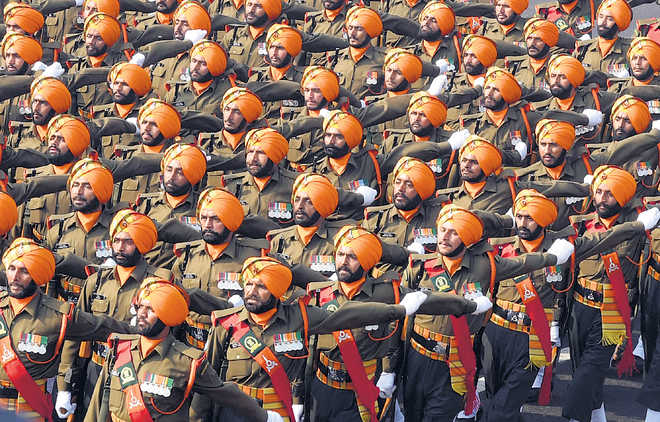
Representational Image
It has been on the insistence of the Army, backed by the government, that the lands were protected from becoming concrete jungles. Dhaula Kuan in Delhi was an isolated location in the 1970s, but at present controls access to many parts of a growing city, including to the airport.
Most Army cantonments are grounds where the local public come for their daily walk and fresh air. Cantonments possess greenery and open spaces which result in a difference in temperatures and low levels of pollution, and thus must be so maintained and prevented from being concrete jungles.
Expanding cities began to surround cantonments and colonies mushroomed outside cantonment limits, with its residents freely using cantonment roads for commuting. Issues started arising once Army authorities began placing restrictions on movement on roads within the cantonment for security purposes, especially in the wake of terrorism and terror strikes within the country.
Land in military stations come under two different entities. Some roads and land are under cantonment boards, which are developed and maintained by them, while other roads and land belong to the Army and are termed as A1 and B defence lands, meant solely for Army use. Some land is occupied by the Army, while others earmarked for its future use while the balance is with cantonment board for maintenance and security including local markets and civilian-populated colonies.
Among the cities where use of Army land has become a bone of contention isSecunderabad, where multiple mushrooming colonies surrounding the cantonment are impacted with closure of roads. The battle for opening of roads in this city has been raging for a few years, as increased colonies mushroom in areas around cantonments. For the residents, movement through cantonments save them time and distance, which has financial implications.
Mohan Guruswamy, a noted policy analyst, even published a scathing article on the issue of closure of roads in the Deccan Chronicletitled, “This is not Pakistan, General Saab” a few days ago. He claimed that arbitrary closure has impacted the movement of civilians and the Army is unwilling to hand over land for construction of roads and flyovers claiming market cost. He went on to accuse the Army of being in business, taking arbitrary decisions and refusing to heed to public demand.
There are some issues, which need to be elaborated for explaining to those unaware of government rules. Transferring land from the Army to civil authorities is not under any Army officer, unless the land is A1 or B defence land. It remains under the purview of the cantonment board. However, Army views are taken. Rules were tightened by the government of India, post the illegal transfer of defence land in Pune by a defence minister, who had personal interest.
All transfer of lands, irrespective of classification, needs the approval of the MoD, the local authorities can only recommend.
Land has been given where essential, Kolkata and Bangalore for Metro and Lucknow for flyover and rail over bridges being recent examples. In the case of Kolkata, the land handed over was A1 defence land, on which a part of the army hospital existed. Thus, it is incumbent on the state government to process the case with the ministry. Blaming the Army is meaningless and it is the easiest target, especially for a renowned individual, as it would not respond to criticism, as is its norm.
Security of cantonments is a primary responsibility of the local military commander. It is a bigger headache when the cantonment is open and surrounded by colonies in every direction. There are regular intelligence inputs of militant threats to Army cantonments.
Inside cantonments, there are small colonies of family accommodation which are vulnerable spots, many of which house families of soldiers deployed in insurgency operations or along troublesome borders. Their concern for security of their families, while they battle militancy or a hostile enemy, is paramount.
Incidents of militant attacks on family quarters in recent times in Jammu are examples of anti-national elements seeking to target army morale, by hitting at weak spots. The May 14, 2002 Kaluchak massacrewhere militants attacked the family accommodation and killed 23, including women and children still haunts the army. The latest in February this year in Sanjuwan also involved living accommodation. Attacks have also taken place in Nagrota and Pathankot. Hence, the Army would need to ensure security of its own areas. An attack in the interior of the country would be more demeaning.
If the Army imposes caution by deploying soldiers in uniform along major roads, then the public feels it is overbearing and approaches the courts, Allahabad being an example. Hence, it has to adopt deterrent measures. An attack on a military cantonment is an embarrassment to the nation and severely impacts military morale, especially if families are targeted. The recent attack on an Army school in Pakistan resulted in the army launching a major counter-militant operation, mainly because it hurt the soldier’s morale and dented the image of their army.
No army in the world has that luxury of soldiers that it can deploy them all over the cantonments to ensure security, as demanded by Guruswamy. It, therefore, adopts a methodology of employing quick reaction teams moving through the cantonment in vehicles at random while guarding major installations and monitoring traffic by restricting movement through certain roads.
The national public should understand that the Army, which has stood by the nation in every aspect and would do so all through history, but has to act to ensure its own security. It must ensure security of cantonments to prevent embarrassment to the nation and itself. It may at times behave in a manner to cause inconvenience to the local public, which can always be resolved by a civil-military liaison conference. This is a regular conference attended by senior civil and military members of the city to discuss problems and arrive at solutions.
Surplus Army lands can only be granted by the government, the local Army authorities have no right. This could easily be resolved through the same channel, which has failed in the state of Telangana for unknown reasons. If the state authorities do not adopt this approach, then they must be blamed for their own highhandedness and lack of interest in helping the public.
Blaming the Army may be easy, but understanding its constraints is difficult. Channels of resolution always exist, employing them is more important rather than throwing the blame on an institution which maintains a studied silence because of its ethos.
Also read: The ‘demise’ of Kashmiri
#Defence Ministry, #Army,#Secunderabad Cantonment Board, #Defence land
The views and opinions expressed in this article are those of the authors and do not necessarily reflect the official policy or position of DailyO.in or the India Today Group. The writers are solely responsible for any claims arising out of the contents of this article.
Writer
HARSHA KAKAR @kakar_harsha


 PTI FILE





























