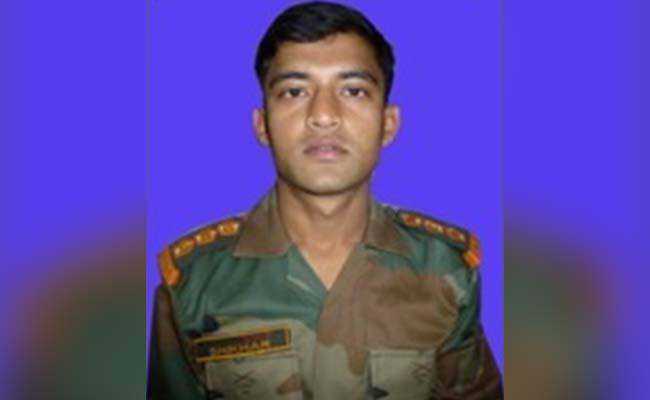
PATHANKOT: The Indian Army has begun a multi-pronged search operation to locate one of its officers, Captain Shekhar Deep, who has been missing since February 7, 2016.
Captain Deep, son of Lt Col Anant Kumar, and a resident of Mahenderpur, Purnia, in Bihar, was posted at Rajouri in Jammu and Kashmir. He was on 30-day leave from January 11 to February 10, 2016, and was travelling from his native place by a train to join his duty when he went missing.
According to a press release by the army, he had boarded Mahananda Express (Train No 15483) from Katihar in Bihar to Delhi on February 6. The officer was travelling in coach AB-1 in AC-2 and had last contacted his family members on the intervening night of February 6-7.
“The luggage of the officer was found by the railway and army authorities in Delhi and nothing except for the cash from the wallet was missing from the luggage,” the release said.
“A Court of Inquiry will be ordered by the Army authorities as per the procedure and an FIR had been lodged by the relatives of the officer with the railway police in Katihar on February 8,” the release stated.
A second generation officer, his father Lt Col Anant Kumar is currently posted in Ranchi.
The unit of the officer has initiated numerous steps to trace him, including dispatching a party of a junior commissioned officer along with a noncommissioned officer to Katihar on February 9 to investigate the matter. “At this stage, criminal as well as accident angle cannot be ruled out. However, search and investigation by the state police, NIA, IB, railway police and army authorities is going on,” the release said.
No trace of missing Capt yet
Captain Shikhar Deep
Tribune News Service
Jammu, February 11
The Army has initiated massive efforts to trace an officer, Captain Shikhar Deep, who is missing since February 7.A native of Purnia district in Bihar, the officer was posted at the LoC in Rajouri district of Jammu region and was returning from leave to resume his duties.Defence spokesman Lt Col Manish Mehta said Captain Shikhar Deep, son of Lt Col Anant Kumar, aged 25 and was wearing black/brown blazer, off-white T-shirt, blue jeans and green jungle shoes.“The officer was on 30-day leave from January 11 to February 10 and was returning to duty via Mahananda Express from Kathihar in Bihar to Delhi on February 6. He was travelling on a reserved berth number 14 of AB-1, AC-2,” Lt Col Mehta said.He was last contacted by his relatives on the intervening night of February 6 and 7. “The luggage of the officer has been traced by Railway and Army authorities in Delhi and nothing except cash from wallet is missing from his luggage. A court of inquiry will be ordered by Army authorities as per the procedure,” Lt Col Mehta said.An FIR was lodged by the officer’s relatives at the Railway Police, Katihar, on February 8. The officer took keen interest in unit’s operational and administrative matters on the Line of Control and had availed 53 days of annual leave in 2015.His father is a serving Lt Col in the Army and is currently posted at Ranchi. Search efforts are on by Bihar DGP Pramod Thakur, Army units at Kanpur and Katihar, and the Railway Police of Delhi and Bihar.
Airlift review – India’s historic Kuwait evacuation retold as a one-man mission::must watch
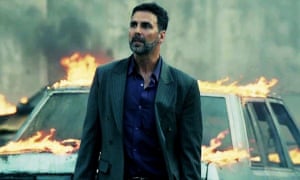
Akshay Kumar in Airlift … ‘ill-served by the material’.
In August 1990, an estimated 170,000 Indians were stranded in no-man’s-land after Iraqi tanks rolled into their adopted home of Kuwait. Frantic backroom negotiations followed between the Indian and Iraqi authorities; eventually, 488 Air India flights were cleared to leave for Bombay from near neighbour Jordan. To this day, the action remains the biggest civilian evacuation in aviation history, and a source of great – if underreported – pride to the parties involved. New movie Airlift, however, simplifies this incredibly complex operation to become little more than a vehicle for one man’s redemption.
That man is Ranjit Katyal (Akshay Kumar), fictional composite of several businessmen then operating in the Gulf. Early scenes in Raja Krishna Menon’s film go out of their way to ensure even the most dunderheaded of multiplex nacho-guzzlers will understand just what a wretch he is. He ignores his wife’s pleas not to drink too much; he upbraids his driver for listening to backward Bollywood hits. We get the idea pretty quickly: Ranjit is the picture of the bad Indian who’s forsaken his homeland in pursuit of bigger bucks – a sharp-suited mercenary who needs shaking from his complacency.
He will be, and the writers sound their cleverest note as the Iraqis invade. Generally keen to self-identify as a forward-thinking Kuwaiti – the pal of princes, a chum to CEOs – Ranjit is only too quick to wave his Indian passport, and thus claim immunity, when the invaders threaten his upward mobility. As this retelling has it, seeing their underlings shot was just the jolt callous penny-pinchers like Ranjit needed to redirect their resources towards getting their countrymen home. Yet while Menon has time to finesse this transition – for two hours, we’re watching characters getting nowhere by boat and bus – it’s never remotely convincing.
‘Airlift’ Made Me Proud Of Being Indian, But Also Left Me Feeling ‘Appalled’ And ‘Useless’
Yeh sub news main mein dekhta tha, par aisa kabhi nahi laga ki ek din hum bhi news material bun jaate (I used to see all this in the news, but I never thought that one day we would ourselves become news),” said Poonawala (played by Kaizaad Kotwal) in the recently released movie Airlift, starring Akshay Kumar, as Ranjit Katyal, the protagonist, and Nimrat Kaur, as Amrita Katyal.
I will not waste any time in describing the movie because the true description of this marvelous piece of art can be done justice only when witnessed by one oneself. To me, this is a movie that is a portrayal of a plethora of character traits like pride, dignity, respect, courage, intrepidity, love and sympathy for those around you, trust and a burning want to live another day, to survive and be rescued, saved, airlifted.
This movie has truly succeeded in creating a conflict in my mind. On one hand, I am proud of being an Indian. Because we Indians executed the world’s largest evacuation. Because we saved 1,70,000 people of our country. Because we cared so much for our people. And mostly, because we Indians stood by each other when we really, desperately needed that moral support and help. On the other hand, I am appalled by the moral slackness showed by people, where one human doesn’t stand for a fellow human, where one human will readily shoot another with a gun, rape another with their hands and bodies, run over the other with tanks, steal another’s food, where one human will forget their humanity and only see the futile aspects of life which, sadly, do include even nationality.
A common government ‘babu’, Sanjeev Kohli without having known any of those people, fought with the Indian government, persuaded pilots, woke up in the middle of the night, and worked relentlessly, just to save those people, even when all the credit would be taken by a useless, good-for-nothing politician. In this movie, a businessman, a man who could have escaped from the terrors of that war, the Iraqi soldiers and the cheap, contemptible, immoral politics, and the entire conflict itself, stayed behind and stood alongside humanity. And I am not saying he took the side of Indians. No, I am saying humanity. Not just because he helped save a Kuwaiti, but because he didn’t see her as Kuwaiti even when the people around him did. He saw or rather perceived her to be, more than that, to be a mother, a woman, a person who was suffering just like he was, and most importantly, a human. He saw beyond the confines of seeing people by their nationality. He saw beyond and above futile labels and names given to people on the basis of their place of birth, skin colour or mother tongue. And he could have sent her away, he could have easily given her into the hands of the Iraqi soldiers at the checkpoint when her identity was revealed, where she would have been raped and stripped off her dignity, her pride, and her humanity. But he did not; he courageously fought for her life, indirectly fighting for humanity.
There are some movies that actually make me want to respect and honour the story and the way it is portrayed, and this was definitely one of those.
It had me in tears, because the country whose government I believed to be redundant and slack, today in my eyes did more than any other government.
Although this movie does revolve around Indians, it also gives a wide vision of the utter plight and predicament that any country would go through during war. This was the story of Kuwait, what happened when the vile, inhumane, president of Iraq, the ‘Great’ Saddam Hussein, launched a surprise attack on Kuwait, killing civilians and damaging property, and life. It may be local in its setting, but it is global in its reach. Kuwaiti’s are not Palestinians, but they know how it feels when one’s land is stolen from them. So do Syrians, Yemenis, and Afghanis.
I write this to honour each person who was affected physically, mentally or emotionally during this invasion. Rather, this story is for humanity, so I write this in honour of all those affected by the game of monopoly in political, geographic, or economic interests, and all those affected by war.
My heart goes out to the girls who are groped by soldiers like Poonawala’s daughter was when the Iraqi soldiers came to loot the Indian camp, or when the soldier said, “let my boys have some fun” when the Kuwaiti woman was taken away from the protagonist Ranjit Katyal. My heart goes out to those children who have to listen to the noise of bombs exploding, or guns shots echoing instead of lullabies, and play with bullets instead of toys. My heart goes out to each man who has to act like the man of the family and always keep a strong façade for his family, to prevent them from loosing hope. My heart goes out to those who grieve for their lost ones, and mostly my heart goes out for humanity because this is what we have been reduced to.
This movie is a must see because it makes you feel like a proud Indian, albeit a useless human being and also utterly fortunate for not having to experience the events depicted first hand.
Nimrat Kour is the daughter of Major Bhupinder Singh
The lead actress Nimrit Kaur in “Airlift” movie is daughter of late Major Bhupinder Singh (Shaurya Chakra) from Engineer Corps 64 ER who was abducted on 17 jan 1994 by Hizbul Mujahideen terrorists and brutally killed after 6 days when Nimrat Kaur was just 11 yrs…. Must see the movie. Encourage the Martyrs daughter and publice it..
Mahavir Chakra (MVC)
Awardee: Maj Bhupinder Singh, MVC
Gazette Notification: 127 Pres/65,16-10-65 Operation: 1965 Riddle Date of Award: 11 Oct 1965
Citation:
Major Bhupinder Singh of Hodson’s Horse led his squadron with distinction in the battle of Phillora and Sordreke in Pakistan between 11 and 19 September 1965. With skilful deployment and bold action, his squadron was able to cause large-scale destruction of Pakistani tanks and other equipment. Although his tank was hit on several occasions, he continued to remain in effective command and by several acts of personal gallantry inspired his men to fight courageously On 19 September in the battle of Sordreke his tank was hit and caught fire. While abandoning the tank he was burnt severely and though evacuated subsequently died.
Major Bhupinder Singh displayed great determination and courage under heavy enemy fire by continuing to fight with only two tanks after most of his tanks had been disabled. He had set an inspiring example of personal sacrifice and bravery in the best traditions of the Indian Army.
Nimrat Kaur: My father was killed by the Hizb-ul-Mujahideen for not conceding to their demands in Kashmir
Times. Excerpts from our conversation.You became a star with The Lunchbox. Tell us about your background?
I am a sardarni and was born in Pilani, Rajasthan, but my father was in the army, so we travelled everywhere. I changed schools and friends every 2-3 years, so I find it very fascinating when people tell me that they have lived in the same house for 30-40 years. As an army child, you don’t have the luxury of throwing tantrums and you learn to make good with what you have. It makes you into an adjusting person. My father was very intelligent as he never put us in army schools till he was alive. He wanted us to study in convents or public schools as he wanted us to also be exposed to the civilian life not protected by the army. Since I was academically strong, I was fortunate to get admissions to schools in every city.
Is there a city where you feel a sense of belonging?
Patiala. I was there for very important 3-4 years of my life. I remember every thing about Patiala. There was a market called AC market, which had an escalator so I would keep going up and down on a loop. That was the first time I had been on an escalator. Patiala for me is Punjab, very endearing. It was also the last time that we were all there as a family with my father before he went to Kashmir. He was a young army major, an engineer posted on the border roads of the army in a place called Verinag (if you travel to Srinagar from Jammu, there is a tunnel called Jawahar Tunnel that comes on the way. And the first valley after that is Verinag). Kashmir was not a family station, so we continued living in Patiala when he went to Kashmir. We were on our winter vacation in January 1994 and visiting our father in Kashmir, when the Hizb-ul-Mujahideen kidnapped him from his place of work and after seven days, terminated him. They had made some ridiculous demands of some terrorists to be released that he obviously did not agree to. He was just 44 when he died. We got the news and flew back with his body to Delhi and I saw his body for the first time only in Delhi. We then moved to Noida and lived with my nana-nani for a few months before my mother bought her own place (with my father’s pension money and our savings) and we moved out. We never went back to Patiala again except after a few months to pick up our luggage. The government gave us a piece of land in Rajasthan and my father was posthumously awarded the Shaurya Chakra.
How difficult was the transition for you post moving to Noida?
There was extreme discomfort. My life had turned upside down. I had no idea of what to take up and how to address life. My nana-nani became my surrogate parents. But my mum is very strong and that helped us pick up the pieces and start a new life. And her spirit was always about moving forward and never about self-pity. I finished schooling from DPS Noida, did my BCom Honours from SRCC and then, I just knew that I could study no more. I am told that right from when I was just 40 days old, I had started imitating my nanaji. And imitation is the first seed of acting, they say. I have always loved being on stage. At school, I loved reactions and would make up stories just to get reactions. It was a tough decision, but I got a portfolio clicked from a family friend and just moved to Mumbai post college. I made multiple sets of my pictures and roamed around and gave my pictures to every production house. For nine years, I did a lot of modelling but felt no sense of belonging. So then I started to watch plays. And figured people I wanted to work with and did a play with Sunil Shanbag. Ritesh Batra, director of The Lunchbox, was looking for a new face and had heard about me as an actor and I got chosen for the role that changed my life.
Who do you love the most in the world?
My mother. She is everything to me and is really the strength in my bones. Everything I am today is because of her faith and her courage to let me do what I wanted to do. She is a proud mother today.
What does your mother like the most about you?
That I don’t trouble her. I think she would like the fact that I am absolutely independent and that I have not needed anyone to make things happen for me. I think I remind her of my father. I am told that I have a lot to do with how he was as a person. He was a people’s person, he would make anyone comfortable right away, even if you met him for half a minute. I speak like him. The way I lead my life, my principles, my morals of not cheating anyone ever, to keep things clear and honest. It’s actually difficult for me to lie and I have no tolerance for hypocrisy.
Do you miss your father?
I have been different from outside and very different from inside when it comes to exhibiting your emotions. I miss him dearly more and more with age. I wish that he was around for me, specially at times when you achieve something in school and you want to turn around and show him that. There have been many many times like that when I have missed him in the last 3-4 years when things have really changed for me, when my life had changed, my career had taken a different turn.
Have you been in love?
Yes I have, a few times, but never with a film star. I have not been in a relationship since I did The Lunchbox.
You are working with Akshay Kumar for the first time in Airlift.
Akshay has been very exciting to work with for someone like me. I have actually grown up watching his films and literally to act with him, I have already had many out-of-body moments even though they are now settling down a bit. He has been fantastic to work with, so grounded and so funny. He is so Punjabi, so lovely and so warm. He is that person who will make sure everybody is comfortable and not star-struck. I am absolutely charmed by him. Forget being a girl, I have seen even men being rosy-eyed with him.
Which was the lowest period in your life?
Has to be my father’s death. My life changed. It was not a financial threat. But that life that I had lived with those orderlies, those army cars went away overnight. It was difficult moving to a civilian life. In the army, you are living in a shell and that’s why my father never sent me to an army school. You are used to three sevadars around you and suddenly, there are no army get togethers, so to just adjust to the new life without any fauji kids for friends was tough. I was undergoing puberty that time and that compounded my agony. But the army stands by you like a rock. They are your family and even today, they will come at the drop of a hat if you need something and they will do anything for you. I also think it’s to do with my father’s goodwill and his relationship with people. Coincidentally, he got awarded the Shaurya Chakra on my birthday, March 13. (His name is now written as Bhupinder Singh SC, SC standing for Shaurya Chakra). I remember my The Lunchbox premiered in Cannes and I immediately went back to Kashmir in June for the first time after my father’s death. I could sense that my life was going to shift in a big way and I wanted to go back to Kashmir for my closure and I did. I spent 10 days there all alone. I went to Verinag ( there’s a point there dedicated to my father). I came back and got a tattoo done on my wrist which reads, ‘Zenab’, meaning a father’s precious jewel that brings glory to his name.
Army officer missing under mysterious circumstances
Ajay Banerjee,Tribune News Service,New Delhi, February 11
An Indian Army officer, Capt Shikhar Deep, of Sikh Light Regiment, has gone missing under mysterious circumstances after boarding a train in Bihar.He was travelling on train Mahananda Express from Katihar to Delhi during the intervening night of February 6 and 7.The officer did not reach his destination and went missing during transit.His father Lt Col Anant Kumar has told the Army that his son had spoken to him from onboard the train on February 6 at 10.40 am.Sikhar Deep (25) has told his family that two persons who did not have confirmed tickets were in his compartment.The Captain’s relative arrived at Delhi station and did not find him but his belongings were in the train, this included shoes clothes and an empty wallet.The phone of the Captain was last at a location at a hotel in Bihar Sharief in Bihar in the morning on February 7 before being switched off.
Lt-Gen RS Sujlana (retd) :::Trust deficit poor way to counter terror
A unified, multi-pronged approach to national security is a must. Union Home Minister, Rajnath Singh and the national intelligence and investigative agencies and law-enforcement officers of 12 state governments and the Union Territory of Delhi, discuss issues relating to the ISIS, in New Delhi. PTI
The growing trust deficit and one-upmanship not only amongst the security agencies but also individuals responsible for security-related matters is a matter of concern. A cursory analysis of the two recent anti-terrorist operations in Punjab drives home this point.
A typical post-terrorist strike scenario is re-enacted time and again in our country. The attack on the Air Force Base (AFB), Pathankot, despite available prior intelligence brings to the fore the same weather-beaten shortcomings; poor intelligence sharing, lack of coordination and standing operating procedures between security agencies, command-and-control problems, inadequate and inappropriate equipment etc. Availability of early and actionable intelligence is the start point for effective counter actions but has seldom been provided by intelligence agencies. In the case of Pathankot air base, prior intelligence was available but timely dissemination to security agencies concerned was definitely not done. A clear indicator was the confused planning and inappropriate response. At what stage the BSF was provided (or not provided) this information/ intelligence is not clear. Now to expect them to admit and pinpoint undetected infiltration is very unlikely and mere conjecture.The terrain along the International Border (IB), especially the stretches of the riverine terrain, is vulnerable. The shortcomings have long been assessed and requisite counter-measures should have been in place. We repeatedly shut the stable gate with moth-eaten wood, thereby providing a recipe for reoccurrence sooner rather than later. The Air Force and the Army were also clearly out of the dissemination loop. Nothing could be more telling than the fact that the terrorists managed to breach the perimeter of the AFB and the Defence Service Corps personnel were caught napping, busy with their daily chores. The early induction of the NSG and late arrival of the Army on the scene is clearly indicative that the latter had no initial information. The delay in dissemination of real-time information available with the Punjab Police (PP) to the military is unpardonable. The flaws at Gurdaspur were distinct; complete lack of intelligence enabled the terrorists to reconnoitre and ensconce themselves in a building before the police reacted. The Army was requisitioned by the civil authorities but strangely they were not permitted to get into action. as evidently the DGP, PP wanted to prove his credentials and that of his force in handling such situations. This one-upmanship took toll of precious time and human loss as the DGP drove down from whereever he was and the Army columns just stood by twiddling their thumbs. Post the operation, amidst much bravado by the police SWAT personnel and the din of loud cheers, the poor conduct of the operation and the wasteful act of not utilising the Army were forgotten. Also, since the state did not allow the National Intelligence Agency to investigate, opportunity was lost to take remedial measures. At Pathankot, a high-ranking police officer was kidnapped under mysterious circumstances. As he yelled blue murder, no heed was paid to him for almost 14 hours. Was it sheer disbelief or trust deficit within the police force (affected by the past nefarious conduct of the police officer in question) or an effort to cover up some tracks? Post this operation, the Deputy Chief Minister’s statement that there is a need to strengthen the deployment of the BSF along the India-Pak border in the state and the intention to make Punjab Police a second line of defence carries merit. However, for this to fructify while the onus of upgrading the BSF troops is on the Home Ministry, for Punjab Police to change tack lies with the state government. The foremost need is to make a dramatic shift in the present work culture of the state’s police — from a “Politicians’ Police” to a “Peoples’ Police”. They need to reorient their intelligence grid (upwards from the village level) in close coordination with the Army and BSF intelligence setups and neutralise the drug nexus (reportedly involving politicians, central and state police forces personnel, rich businessmen and the smugglers’ cartel). This requires additional manpower, which is readily available if the politicians are willing to reduce the number of police personnel on their protection duty (which basically fulfils their desire for personal aggrandisement) and the red, blue and orange lights culture! Availability of manpower will allow the police to train better and perform wholeheratedly their duties, particularly patrolling and traffic control. The problem of command and control between various security agencies is perennial. The BSF, or for that matter all CAPFs and even a paramilitary force like the Assam Rifles, officered by Army officers, function under the Home Ministry. These seldom agree to function under the Army and are always looking back towards their line of command rather than operational requirements. Repeated display of one-upmanship in handling such situations at the Centre’s level definitely shows a trust deficit in the Army. Like in Mumbai 26/11, also in Pathankot, the National Secuirty Adviser (NSA) took the call to send in the NSG ahead of the Army. The NSA has an advisory role but he seems to be moving to an executive role against all norms. The roles of the Army vis-a vis the NSG, are clear and criss-crossing of turfs only adds to confusion. Nothing could be more flawed then remote controlling a situation like this, sitting at Delhi without any knowledge of ground realities. In calling in the NSG, no lessons seem to have been learnt after Mumbai 26/11, where vital hours were lost in getting the NSG into the act. No attempt was made to requisition the trained Infantry battalion located close by at Colaba or for that matter, to drive in infantry troops from Pune. At Pathankot it was a repeat. Again time was lost in flying in the NSG; whereas the immediate call should have been to rush in troops from the large trained force of infantry available close at hand; or, to fly in the crack special troops at Nahan. Forgotten was the fact that all Infantry battalions are well trained and capable of handling varied terrorist-related situations. Even in peace stations, especially in the vicinity of the International Border in sensitive areas like the Pathankot corridor, the vulnerable areas or points are identified, operations planned and rehearsed with quick-reaction teams on standby. An enhanced surveillance grid can be established in a very short time. The AFB, Pathankot, without doubt is an important vulnerable area, so keeping the Army out of the loop made no sense. One-upmanship showed up between ministries too. The Home Ministry was at the forefront, with the Ministry of Defence visibly on the backfoot. While the Defence Minister blows hot, the Home Minister shows a carrot. Handling of grave situations cannot be done in such a lop-sided way or to prove a point. There is no shortcut to unity in security matters. For comprehensive national security, turf wars and parochialism has to be shed, issues of command and control have to be resolved without delay. A must is NSG must be headed by an Army officer and immediate intelligence sharing with those who have to act on it. Requirements of hi-tech equipment have to be met. For this, the post of a Chief of Defence Staff (CDS) has to be created. We need to move from trust deficit and one-upmanship to mutual trust and unity. The writer is former Commandant, IMA & ex-Chairman, PPSC.
Col Ramesh Davesar (retd)
The country needs more Muslims in armed forces
Let us for a moment set aside the politico-religious aspects and purely focus on the socio-economic aspirations of Muslims. Due to various factors, Muslims are devoid of requisite employment opportunities. This needs to be addressed on priority.
In the backdrop of the socio-political scenario and to counter developments to destabilise the communal equilibrium for myopic interests, one finds that so-called “minority-welfare initiatives” launched are counter-productive. The net result is, let alone improve the socio-economic status of Muslims, it has made them easy prey to politicians and, to some extent, also to the fundamentalists.Explore job opportunities for approximately the 10 crore Muslim youth not only to enhance their mainstream presence but also keep them away from being exploited by vested lobbies is a crucial issue. I often wonder, while all other employment avenues are discussed, why are the armed forces, which provide equitable opportunities to all sections, are ignored and not promoted amongst the Muslim youth by their own leaders? The result is that the representation of Muslims in the armed forces is woefully low. Therefore, we need to discuss the genesis of poor representation and explore the remedial measures to facilitate their entry into the armed forces. This would assist in mitigating their socio-economic inequalities and incentivise their participation in nation building. Before proceeding further, it is imperative to understand the recruitment modalities. After Independence, keeping in mind our multi-ethnic society, and in order to provide equal opportunity to all citizens (particularly the under-represented sections), in 1949, the erstwhile British legacy of “Fixed Class Composition” was replaced with the indigenised policy of “All India All Class Composition,” thus implying that the units would have “mixed class culture”. In order to ensure equality to all, it was further streamlined during the 1970s, whereby the states were allotted the recruitment quota based on their “Recruitable Male Population” (RMP).To sum up, the current procedure provides equal opportunities to all Indian subjects, irrespective of religious affiliations. Thus it makes it all the more incumbent on Muslims to explore a military career. It is prudent to highlight the contributions of Muslims in the armed forces. A majority of us, including Muslims themselves, are unaware of their sacrifice in defending the nation, which irrespective of numbers, has been on a par with others. Brigadier Usman and his brother Brigadier Gufran, in spite of professional luring from Pakistan, chose to stay back with the Indian Army. The former, known as “Saviour of Jhangar” laid down his life and was awarded the Maha Vir Chakra (MVC). Later, Havaldar Abdul Hamid was awarded the Param Vir Chakra (PVC) in the 1965 war. His martyrdom is an embodiment of a supreme sacrifice for the nation. Contributions in military hierarchy have been equally commendable. So far, we have had one Air Chief, two Army Commanders and a host of two and three-star generals. Brigadier Sharif, known for his administrative skills, was picked up to to set up the Lal Bahadur Shastri National Academy of Administration (LBSNAA), Mussoorie.They have carved out an indelible niche in academics and defence research. The present Vice Chancellor of Aligarh University is a retired three-star general. A leading defence analyst is also an Army veteran and a retired Lt-General commendably commanded the Corps in the Valley and is a voracious writer on security matters. Iconic sacrifices and services must be utilised by Muslims to motivate their youth to join the armed forces. Why should Muslims, with a 14.3 per cent population share, just account for 2 per cent in the armed forces. In striking contrast, despite mass-scale immigration and attractive employment options, the Sikhs, another minority with a paltry 1.72 per cent population share, have 15 and 20 per cent share in other ranks and officers’ categories, respectively. Similarly, the Christians, with 2.3 per cent population share, have matching representation in the armed forces. Of late, there is welcome increase of Muslims’ intake in the civil services and the IPS by over 3 per cent and is presently pegged at 3.31 and 3.66 per cent, respectively. Similarly, there is a perceptible increase in the states’ police and the Central Armed Police Forces. Why has the option for the armed forces been stagnant?Primarily, it is parents, society and academics who play important role in shaping and motivating the youth to select a career. All Punjabis, (including those in West Punjab) in general and Sikhs in particular, have imbibed family and community support, motivation by the educational and religious institutions to channel youth to opt for a military career. Rightly so, the Punjabis not only enjoy a sizeable presence in India but also dominate the military in Pakistan. As a Punjabi, I vividly recall my formative years and the preaching of elders highlighting the nobility of an Army career during various social, family and the religious congregations calling upon youth to join the armed forces. With great pain, one finds these aspects are inexplicably missing amongst Muslims. Apart from the national effort, which undoubtedly must speed up, it is the “in-house” initiatives which must provide initial grooming and motivation. First of all, the parents, who, by citing the contributions made by their community both during the pre and post-Independence epoch, must encourage and motivate their wards to choose an Army career. Educational institutions, most importantly the “community-run” institutions must take over to further channel the youth towards a military career. In order to achieve the desired recruitment trajectory, Muslim military veterans must get together to plan long-term strategy and organise seminars, workshops and conduct lectures as also hold “Defence Exhibitions” to motivate youth at school, college and university levels. Further, to promote “inclusive community participation”, the services of Muslim political as well as religious leaders who are looked up to and heeded with reverence must be solicited. Their influence on the youth must be utilised to shed diffidence and opt for a career in the Army. The writer is a veteran.
Last-serving hero of key Siachen victory finally walks into sunset
NEW DELHI: Lachhman Dass was barely 22 when he faced formidable military challenges on the planet’s most unforgiving battlefield as a member of a hand-picked assault team assigned to capture the highest post on the Siachen glacier in June 1987.
Subedar Major and Honorary Captain Lachhman DassThe team’s last serving soldier that carried out the dangerous mission against an enemy firmly ensconced in those heights will hang up his boots in April, bringing down the curtains on a magnificent chapter in India’s military history.
The death of 10 soldiers killed in an avalanche at Siachen’s 19,600-ft Sonam post last week has turned the spotlight back on the glacier and the hardships faced by the men defending it, aware of death lurking at every step. “There’s no guarantee you will come back alive. Soldiers have to endure an endless cycle of extreme conditions. But the job has to be done and we will do it no matter what the cost,” says Subedar Major and Honorary Captain Dass, who was awarded a Vir Chakra for capturing Pakistan’s Quaid post.
Dass is from 8 Jammu and Kashmir Light Infantry, a battalion designated as Bravest of the Brave for winning two highest gallantry awards. He gets goosebumps when he strings together the events that led to the capture of the Pakistani post perched at a height of 21,153 feet, a vantage position in the western Himalayas from where Indian military activity could be easily monitored.
Several attempts to take the post had failed, the battalion suffered casualties, guns were fro z en and soldiers deployed along icy peaks were frostbitten. “It was a scene from hell. We were fighting for our own survival and the enemy was holding high ground,” says Dass, part of one of the four teams formed to mount the final assault on June 24. The next 72 hours saw the battalion’s finest fighting men, including the legendary Bana Singh who was awarded the Param Vir Chakra, stretched to their limit.
Bana Singh, after whom the Quaid post was renamed, and Dass were in the same team. They used a rope to climb an ice wall standing more than 1,200 feet to get near the enemy. “There was only one approach to get closer to the post. Even a handful of soldiers at those dominating heights can hold out against an attack by 100 soldiers. We knew we had to produce a miracle,” he says.
Sonam and Amar posts were providing them cover fire but the soldiers went without food and sleep for three days before they crept up on the enemy bunker and lobbed grenades, killing almost eight Pakistani soldiers.
In 1987, soldiers deployed on the glacier received an avalanche allowance of a mere ` 100 a month.
The Seventh Pay Commission report has raised their hardship allowance from ` 14,000 to ` 21,000 and for officers from ` 21,000 to ` 31,500. However, bureaucrats will receive ` 55,000 to ` 75,000 a month as tough area allowance for serving in places like Leh and Guwahati, an anomaly that the three service chiefs have taken up with the government.
Parrikar regrets snow deaths
Visakhapatnam: Terming the death of 10 soldiers in an avalanche on the Siachen glacier “painful”, Defence Minister Manohar Parrikar on Sunday said the decision to deploy troops in the world’s highest battlefield was based on security needs, despite the hostile conditions there.”Decision about (deployment of troops in) Siachen is based on the security of the nation. If somebody wants to go there and they have to understand its importance, why we are maintaining it (security presence) in spite of hostile conditions…I think you will understand if you go to that place,” he told reporters on the sidelines of an international maritime conference here. PTI
Indian Army dog squad to march on the Republic Day after 26 years
Army Dogs have been an integral part of the Armed Forces since time immemorial but their silent service to the nation will be showcased in the Republic Day parade after a 26 year hiatus.
Chiku is clearly the most affectionate of the lot while Oscar and Ceaser are no nonsense kinds. The dogged persistence of their handlers leaves no room for faltering on Republic Day when the Indian Army dogs return to Rajpath after 26 years.
They have been an integral part of the Armed Forces since time immemorial but their silent service to the nation will be showcased in the Republic Day parade after a long hiatus.
A bunch of labradors and German shepherds will march with their handlers in a display of India’s canine power along with military might and the soft outreach.
The army dogs are no ordinary pets as their history is full of valiant tales and testifying the martial credential is the fact that Remount Veterinary Corps is decorated with a Shaurya Chakra and close to 150 commendation cards.
In August last year, sniffer dog Mansi was killed in an encounter with militants in the Tangdhar area of Jammu and Kashmir along with her handler rifleman Bashir Ahmed War.
The army dogs are integral part of operations in Jammu and Kashmir and the northeast where they have assisted in recovering munitions and Improvised Explosive Devices (IEDs).
26-year hiatus
The last time an army dog squad had participated in Republic Day parade was in 1990 and before that in 1963. The RVC Centre and College in Meerut Cantt has put in great effort to prepare the squad for the march past. A vigorous training programme is underway for the dogs and their handlers.
The RVC itself was founded in 1779. The army has around 1,000 trained dogs in its ranks and the RVC is tasked to maintain the strength.
German Shepherd and labradors are the most preferred army dogs because of their natural ability to adapt to any training schedule. They are easy to train and have the special ability to perform the tasks required by the army.
Chiku, Oscar and Ceaser are ready to bask in their moment of glory on Rajpath where French President Francois Hollande will be the chief guest.
Interestingly, unlike the other contingents where selection takes place on the basis of marching prowess of the personnel involved, the parameters here are different.
“We need those men who can keep the dogs fully under control. Since dog behaviour is critical to the success of the show, how well the men march comes second. We have been practising three times a day since the last four months,” said Captain Anurag Boruah from the RVC.
Since dogs are known not to react favourably to increased noise levels like those on Rajpath, there is practice for that too.
The special qualities of great sniffing power and loyalty make dogs a natural aspect of warfare tactics. The handlers claim that the inherent desire of the dog to please its master makes the task of training easier.
The RVC centre prepares the dog for specialised army training as there is plenty of work cut out for them from mine detection to infantry patrol and search and rescue missions.
In the parade, 36 “silent warriors” and their handlers will take part in the march past. There is already a buzz surrounding the inclusion of dog squad in the prestigious parade which will have several new dimensions this year.
The dogs have undergone special training for the rigorous march past drill.
Officials point out that a relation between a soldier and the dog is as old as the battlefield. Romans were the first to use trained dogs in close combats.
The Indian Air Force (IAF) has agreed to vacate the airbase at Leh district which will be used for expansion of the civilian airport by the Jammu and Kashmir government.
This was stated at a meeting held by the Divisional Commissioner Kashmir, Asgar Hassan Samoon, with the officials of IAF, Airport Authority of India Limited (AII) and civil administration at his office here on Friday, an official spokesman said.
Mr. Samoon was informed that the state government has identified land in lieu of the existing IAF airbase in Leh.
Similarly, the district officials of Kargil informed Mr. Samoon that in exchange for an alternate site, the Army has agreed to vacate a large tract of land presently under its control, which will be used for the expansion of the town.
The IAF officials, who attended the meeting, said the alternate site offered by the state government in Leh has been examined by experts and they are ready to take over if the state government finalises the deal.
The Divisional Commissioner was also informed that the modalities are being worked out to shift the existing airbase in Leh to Airport Authority of India which will expand it for civilian purposes.
Mr. Samoon said the paperwork to finalise the deals should be done on priority so that it is transferred to the civil government by the end of February.
The Divisional Commissioner said the administration will transfer the airbases to the Airport Authority of India for development.
He said that the transfer agreements should be taken up on priority to fully exploit the huge tourism potential of Leh and Kargil which in turn would generate much needed employment opportunities for local youth.
Meanwhile, the Divisional Commissioner also directed the Airport Authority of India to ensure proper sanitation at the Srinagar airport so that it does not become a breeding ground for dogs and birds, which can pose a threat to the safety of air passengers, besides local population.
Mr. Samoon also directed the Airport Authority of India to explore the modalities for starting night operations at the Srinagar airport.
The Air Force officials informed him that they have already given in writing that they have no issues if the airport hosts flights during night.
The meeting was attended by Deputy Commissioner Budgam Mir Altaf Ahmad, Senior Manager Airport Authority of India Manjeet Singh, Air Commodore AOC 21 wing, AOC Srinagar and other officers of civil administration and Air Force.
Prime Minister Narendra Modi reads the digital copy of a document declassified by his government in New Delhi on Saturday. PTI
Coinciding with Netaji Subhas Chandra Bose’s 119th birth anniversary, the government today made public 100 classified files related to the leader and handed these over to the National Archives of India (NAI). Of the declassified files, one sparked a controversy, with the Congress alleging that a forged document labelling Bose as a “war criminal” was being used to target first Prime Minister Jawaharlal Nehru for electoral gains, a charge that the BJP denies.PM Narendra Modi pressed a button at the NAI premises to release the files. Present on the occasion were Bose family members and Union Ministers Mahesh Sharma and Babul Supriyo. The first lot of 33 files were declassified by the PMO and handed over to the NAI on December 4 last year. The NAI has set the target of releasing 25 declassified files in digital form every month. The Ministries of Home Affairs and External Affairs too had initiated the process of declassification of Bose files in their collections, which were then transferred to the NAI. Netaji’s disappearance 70 years ago has remained a mystery with many theories being propounded. In October last year, the PM had during his meeting with Netaji’s family members announced that the government would declassify files related to the leader. Two commissions of inquiry had concluded that Netaji had died in a plane crash in Taipei on August 18, 1945. A third one headed by Justice MK Mukherjee had suggested that Bose had escaped alive.
Died in 1945: ’95 note
Netaji died in an air crash in Taipei on August 18, 1945, a Union Cabinet note dated 1995 said. Five days after the crash, a top official of the British Raj had weighed the pros and cons of “trying” Bose as a “war criminal” and suggested the “easiest way” would be to leave him where he was and not seek his release, suggesting he may be alive then. This was revealed by documents that form part of 100 declassified files. PTI
Successive govts knew but kept mum
BACKLASH FEARS Documents show though governments believed Netaji was killed in 1945, fear of public anger forced them into keeping a lid on their findings
HT Correspondent
SONU MEHTA/HTPeople at an exhibition after the release of digital copies of 100 declassified files related to Netaji Subhas Chandra Bose, at the National Archives of India in New Delhi on Saturday.NEW DELHI: Successive governments believed that Netaji Subhas Chandra Bose was killed in an air crash in August 1945 but never went public with this assessment for fear of a public backlash, documents declassified by the Modi government on Saturday indicated.
At one point, then Prime Minister PV Narasimha Rao had to withdraw his announcement to award a Bharat Ratna to Netaji posthumously after criticism that this amounted to the government confirming that the INA chief had indeed died.
Three years later, the government took the position in its internal papers that Netaji had died in the crash.
“There seems to be no scope for doubt that he died in the air crash of 18th August 1945 at Taihoku. Government of India has already accepted this position. There is no evidence whatsoever to the contrary,” a Cabinet note of February 6, 1995, signed by then home secretary K Padmanabaiah, said.
“If a few individuals/organisations have a different view, they seem to be more guided by sentimentality rather than by any rational consideration,” the note prepared for the government to take a stand on bringing the mortal remains of Netaji from Japan to India said.
In early 1990, then PM Chandra Shekhar had agreed with this assessment when he approved a proposal rejecting demands for setting up a third inquiry to ascertain the facts about Netaji’s death. The third inquiry was ordered by the NDA government a decade later.
But in November 1977, the Janata Party government, in which Atal Bihari Vajpayee and LK Advani were ministers, too had found it unnecessary to launch any fresh inquiry.
A home ministry note stated that the Cabinet had approved a proposal that “no fresh inquiry into the disappearance of Netaji is necessary”.
In February 1978, chief priest of the Renkoji Temple in Tokyo wrote to the government of India asking for recognition “in the form of a letter or medal” from the government for the trouble taken by him in retaining the ashes in his safe custody under difficult circumstances.
The government was then paying ` 5,000 per year to the chief priest. It refused to give any medal but agreed to send a letter acknowledging his contribution. The then Intelligence Bureau joint director, TV Rajeshwar, said in August 1976 that the Bose family and Forward Bloc would never accept that the ashes belonged to Netaji.
Rajeshwar said, “The government of India would be accused of foisting a false story upon the people of West Bengal and India, taking advantage of the emergency and this may well figure as an important plank of propaganda if and when the elections are announced.”
Bose’s daughter received monetary assistance from Cong, show files Only report to challenge death theory was trashed as ‘flawed’
Divide in family over air crash assumption
NEW DELHI: His rivals often accused former Prime Minister Jawaharlal Nehru of unfair treatment to Netaji Subhas Chandra Bose, but related documents declassified by the government have revealed that the Congress had set up a trust through which a monthly sum of ` 500 was paid to Bose’s daughter, Anita.
HT FILE/ RAVI CHOUDHARYProtests were held in New Delhi seeking declassification of secret files on Netaji, in August 2015. Anita Bose Pfaff, Netaji’s daughterThe documents also revealed a series of exchanges between Nehru and then West Bengal chief minister BC Roy on how to provide Anita the assistance. The All India Congress Committee (AICC) had contributed an initial sum of ` 2 lakh to set up the trust under Nehru and Roy. Until 1964, the AICC sent Anita ` 6,000 annually and stopped it in 1965 after her marriage.
“Dr BC Roy and I signed and executed today a trust deed in favour of Subhas Chandra Bose’s child in Vienna. I gave the original document to the office of the AICC for safe custody,” reads a document signed by Nehru on May 23, 1954.
Subsequently, the Prime Minister’s Office (PMO) in a letter to Justice GD Khosla in 1978 informed that “despite certain doubts being raised, it has been acknowledged that Emilie Schenkl was Subhas Bose’s widow and Anita Schenkl his daughter”. NEW DELHI: Two of the three commissions set up by the Centre over the years to demystify the death of Netaji Subhas Chandra Bose had concluded that he died in a plane crash in 1945, but the Justice Mukherjee Commission of Inquiry (JMCI) set up in 1999 did not agree with the premise.
The commission was mandated to find out if Netaji had died in the air crash, if the ashes kept in the Japanese temple were his, whether he died in any other manner in any other place or if he’s still alive.
Unlike the Shah Nawaz Commission of 1956 and the oneman Khosla Commission of 1970, both of which concluded that Bose died in Taipei in 1945, the JMCI expressed doubts over the testimonies of the crash survivors who reportedly said Netaji died because of the third-degree burns that he suffered when petrol from the fuel tank splashed on him.
The commission pointed out that if the plane had nosedived, as was mentioned by Netaji’s associate Habib Ur Rehman, there would have been no survivors.
The Mukherjee Commission that submitted a three-volume report in 2005 and had recommended a DNA test of the ashes kept in the Renkoji Temple in Japan concluded that Netaji did not die in the 1945 plane crash.
Though the JMCI had declined to accept the assumption that Gumnami Baba, a monk who lived in Faizabad till his death in 1985 was Netaji, it suggested that the plane crash was used as a cover to allow Netaji to escape. It also suggested that the Japanese army wanted to pass off the death of one Okara Ichiro, supposed to be a Taiwanese army man, as that of Netaji.
The UPA government, however, rejected the report, pointing out that it has “many weaknesses” and although it differs from the earlier committees and commissions, it does not come out with “adequate and solid reasons, justifications and grounds for coming to the conclusions”.
The home ministry found the Mukherjee Commission report conclusions “hasty and bristled with flaws”.
To buttress their reasons for not accepting the report, the MHA, in its file notings, said: “…acceptance of the report may lead to hue and cry by those who still want to bank on and exploit the issue.”
It further says, “…The report is not going to solve the mystery of Netaji’s death, on the contrary, it makes the issue more mysterious.” To keep his death under the wraps, the death certificate issued for Subhas Chandra Bose was in the name of Ichiro Okura. The certificate was issued by the bureau of Health and Hygiene, Taipei Municipal office on July 24, 1956. The Japanese government had handed it over to India in 1996. Though it was decided at the highest levels in government to shift the purported ashes of Bose from Renkoji temple to the embassy premises, Indian mission in Tokyo expressed reservation, saying the move would upset the Japanese The Congress had been sending ` 6,000 per year to Bose’s daughter Anita until 1964. The money stopped after Anita Bose got married to Martin Pfaff, an American national. In 1960, Anita had stayed at the official residence of The Janata Party government, in which BJP leaders Atal Bihari Vajpayee and LK Advani were ministers, found it unnecessary to launch any fresh inquiry into Netaji’s death, akin to the Congress government before it that wanted to avoid controversies NEW DELHI: Anita Pfaff ’s statement that she believes her father Netaji Subhas Chandra Bose died in the 1945 air crash has not been received well by the extended Bose family.
The assumption that Netaji died in a crash has been supported by two commissions set up by the government to inquire into his mysterious death.
On Saturday, after Prime Minister Narendra Modi unveiled 100 digitised declassified files related to Netaji, Bose family members said they were hopeful the documents would help unravel the mystery.
But family members were dismayed over Pfaff’s comments. In an interview with HT on January 22, Pfaff said she had come to believe that her father died in the crash and did not support the “asinine theories” that he lived in the mountains as ‘Gumnami Baba’.
the PM when she visited India A declassified file from the external affairs ministry’s political division says Netaji’s wife Emilie Schenkl didn’t take any money. In another declassified
In 2007, Pfaff wrote a letter to the chief priest of Tokyo’s Renkoji Temple saying the Mukherjee Commission of Inquiry, set up by the government, had concluded there was no documentary proof of Netaji’s death and “much to my distress some of the persons sharing the view are also members of my and my father’s family as well document, Jawaharlal Nehru, as PM, talks of setting aside ` 2 lakh for “some kind of a trust for Netaji’s daughter” A report in a Russian publication with dwindling circulation that Netaji was allegedly working for MI 6 had the government worked up and make a note on the issue. as some dedicated devotees of my father”. Netaji’s ashes are supposed to be preserved in the temple.
Surya Kumar Bose, Netaji’s grandnephew, said he was disappointed with Pfaff accepting the air crash theory. He said Netaji’s wife, Emilie Schenkl, did not believe he died in the crash, which was evident from the fact that she did not sign the document agreeing to accompany the ashes to Japan.
On Pfaff ’s letter agreeing to accept the ashes as that of her father’s, Surya said: “She may have some reasons. She did so after meeting Pranab Mukherjee, who was then handling external affairs.”
Anuj Dhar, author of India’s Biggest Cover-Up, an investigation into Netaji’s death, also differed with Pfaff ’s view. “She (Anita) did not support the declassification of files. It was only after the PM announced the files would be declassified that she came around. Beside, her mother never believed that Netaji died in the crash.”
This is not the first time the family has disagreed on Netaji’s death. Historian and TMC MP Sugata Bose had also said he believed Netaji had died in the crash.
In a letter to LK Advani, then deputy Prime Minister, Sugata said: “I believe the time has come for Indian people to come to terms with the mortal end of a deathless hero.”
‘Netaji’s treasure trove a poor show’
NEW DELHI: The controversy over the fabled Indian National Army (INA) treasure, the war chest consisting of gold, jewellery and cash raised by Subhas Chandra Bose to fight the British, and how it reached India from Japan form part of the files released by the government on Saturday.
The INA treasure was secretly brought to India from Japan and was inspected by then Prime Minister Jawaharlal Nehru, who called it a “poor show” as “some evidence of the aircraft and subsequent fire” in a signed note dated January 9, 1953.
“Apart from some gold pieces, it consists of charred remains of some rather cheap jewellery chiefly some silver and gold articles, all broken up,” Nehru wrote.
However, the issue was dug The INA treasure was secretly brought to India from Japan and was inspected by then Prime Minister Jawaharlal Nehru In a signed note dated January 9, 1953, Nehru called it a “poor show” as “some evidence of the aircraft and subsequent fire” “Apart from some gold pieces, it consists of charred remains of some rather cheap jewellery chiefly some silver and gold articles, all broken up,” he said. up decades later in 1978 when the Janata Party was in power.
The Lok Sabha at the time was then informed that the contents of the treasure box were sealed and consigned to the vaults of the National Museum in Delhi for safe custody in December 1953, while the cash component, or ` 267, was transferred to the INA welfare fund.
In a report in 1978, the Japan Times quoted then Prime Minister Moraji Desai’s statement in Parliament that the treasure box handed over by the Japanese contained precious stones, nose rings and ear studs.
A letter from the then joint secretary (administration) IP Khosla to Indian ambassador to Japan Eric Gonsalves that same year said that on December 30, 1953, the contents of the box were re-checked against the list sent from the mission in Japan and found everything was in place.
The treasure had found its way into India from Japan at the insistence of Nehru. It was conveyed to the Indian ambassador in Japan in 1952 that the Prime Minister would like to know whether the treasure or its equivalent can be brought to India.
A top secret telegram on October 27, 1952, informed that Damle, a joint secretary in the agriculture ministry, would be bringing the treasure “in a steel attaché case”.
Despite several charges of misappropriation, no records were found to substantiate then Janata Par ty leader Subramanian Swamy’s claims that Nehru the official to carry the “two trucks directly to his residence”.
BAND BOND For members of the Scindia School band, playing at the Republic Day parade is a matter of great pride, and regular practice keeps them disciplined too
India’s Republic Day is a joyous and festive occasion, made solemn too because of remembrance and honouring of acts of valour and sacrifice by the bravest and most valiant of its people .
SUSHIL KUMAR/HT PHOTOSThe Scindia School band, Gwalior, is participating in the 66th Republic Day parade with its contingent of 45 members.Participating in the Republic Day parade is, therefore, something that many school students look forward to. Braving the winter chills, hours of practice with their bands, delicately working out the balance between trials, rehearsals and studies is not easy but many youngsters manage things expertly. HT Education chased a few bands to find out more about how they are prepping up for the big day.
The Scindia School, Gwalior, with its contingent of 45 students will be a part of the main Republic Day parade in the Capital. “Many students, all of whom are part of the National Cadet Corps, have attended the camp at least two to three times. They are also privileged to have given the guard of honour to dignitaries,” says Dr Madhav Deo Saraswat, principal of the school.
Scindia students have been participating in the Republic Day Parade since 1973. Most of those who are selected for the military band are from classes 7, 8, 9 and 11. They have to dedicate as many as seven hours every day for practise: in the morning, after lunch and dinner. Some are even made to report for ‘duty’ during the winter and summer vacations. They play patriotic music and martial tunes, says Ramesh Sharma, bandmaster, of the school.
At any given point of time, there are 100 to 110 boys ready to perform, he says.
Students say that the rigorous practise regime teaches them to be punctual, inculcates discipline and helps them learn how to balance time between academics and co-curricular activities. “But most important is the sense of pride we get by participating in the Republic Day parade,” they say.
Besides January 26, students who are part of the military band get to participate in several intra-school competitions such as the Indian Public Schools Conference, which is a prestigious annual event.
Most schools ensure that students spend a lot of time practising with their bands. Captain A J Singh, principal, Pinegrove School, Solan, says his students in the brass band generally practise for 40 minutes every day, but during inter-school competitions the time stretches to over four hours before the main competition. Most schools encourage students to start young and they have to be “strong enough” to blow into the instrument. That’s why most of the band members are selected from Class 7 onwards as they then get about six years on the instrument before they finally leave school. The school band at Lawrence School, Lovedale, Ootacamund, is part of the school heritage which is almost 130 years old. “We even have student buglers who wake up the school during the founder’s day month held between April and May,” says Sangita Chima, principal.
Madhav Nair, band major of the school’s brass band says that they get to practise between 2.30 pm to 3.30 pm every day. “I’ve been part of the school band for the last five years and can play the bugle, the drums and, euphonium, trombone, cornet and the saxophone. We practise patriotic music such as kadam kadam, sare jahaan se accha etc. During competitions we spend around five to six hours of practise. The band room is open for us throughout the day.”
Being part of the band has taught these students a thing or two about punctuality and even leadership skills. “It has taught me how to approach each individual differently, everybody takes time to get used to an instrument and needs a friendly atmosphere to be able to perfect a melody or a tune,” says Nair.
Consequent to certain back channel initiative, A Meeting between ESM delegation and Mos Fin, took place in a very cordial environment between 0030 and 0115h last night. Despite the late hours past mid night. MOS was instructed by the PMO to discuss the issue and request the veterans to call off the Dharna.
MOS then rang up FM in presence of the delegation members however, he could not be reached. He gave an assurance that he would ring up the FM again in the morning and accordingly info Gen Satbir.
He further confirmed to the delegation that a meeting would take place by Wednesday for an unlimited time to resolve the total details of the issue. As he is a finance man, it is hoped that he may be able to resolve the issue Finally. More as the nod last night seems to have come from. PMO.
Based on this assurance 2 km Marg was vacated and the protesters returned to JM.
The above message was received from Ground Zero last night.
ओआरओपी : वित्त मंत्री अरुण जेटली के घर के बाहर धरने पर बैठे पूर्व सैनिक
नई दिल्ली: वन रैंक वन पेंशन की मांग को लेकर जंतर मंतर पर बैठे पूर्व सैनिकों ने केन्द्रीय वित्त मंत्री अरुण जेटली के बाहर अपना नया ठिकाना बना लिया है। रविववार सुबह नौ बजे से ही पूर्व सैनिक वित्त मंत्री के घर के बाहर धरने पर बैठ गये हैं।
ये सैनिक जेटली को ही सही तरीके से ओआरओपी लागू नहीं होने के लिये जिम्मेदार ठहरा रहे हैं। इससे कृष्णा मेनन मार्ग का एक ओर का रास्ता बंद हो गया है। वैसे पिछले 216 दिन से दिल्ली के जंतर पर भी ओआऱओपी को लेकर पूर्व सैनिकों का धरना जारी है।
पिछले हफ्ते भी इन सैनिकों ने वित्त मंत्री के अधिकारिक निवास के बाहर धरना दिया था लेकिन भरोसा मिलने पर फिर वहां से उठ गए। लेकिन अब इन्होंने तय किया है कि जब तक सरकार बातचीत के लिये आगे नहीं आती है, ऐसे ही सैकड़ों पूर्व सैनिक सड़क पर बैठे रहेंगे। इस महीने की शुरुआत में पूर्व सैनिक वित्त मंत्री से मिले थे और उन्हें ओआरओपी में हुई विसंगतियों के बारे में बताया था। तब सरकार ने भरोसा दिया था कि इस हफ्ते वो कुछ जबाब देगी।
इंडियन एक्स सर्विसमेन मूवमेंट के चेयरमेन मेजर जनरल सतबीर सिंह ने कहा कि हमने तीन जनवरी को जेटली से मुलाकात की औऱ उन्होंने कहा कि एक हफ्ते के भीतर वो रक्ष मंत्री मनोहर पर्रिकर से बात करेंगे। फिर 9 जनवरी को हमने चिट्ठी लिखी और उनके दफ्तर में बात की लेकिन कोई जवाब नहीं आया। लिहाजा हमलोगों के पास घेराव करने के अलावा कोई और रास्ता नहीं बचा। अब हमने तय कर लिया है जब तक रक्षा मंत्री और वित्त मंत्री आकर हमसे बात नहीं करते तब तक हम यहां से नहीं उठेंगे।
VIDEOS SPEAK BY THEMSELVES
State Stalwarts
DEFENCE MINISTER
Minister Rajnath Singh
ALL HUMANS ARE ONE CREATED BY GOD
HINDUS,MUSLIMS,SIKHS.ISAI SAB HAI BHAI BHAI
CHIEF PATRON ALL INDIA SANJHA MORCHA
LT GEN JASBIR SINGH DHALIWAL, DOGRA
SENIOR PATRON ALL INDIA SANJHA MORCHA
MAJOR GEN HARVIJAY SINGH, SENA MEDAL ,corps of signals
.
.
PATRON ALL INDIA SANJHA MORCHA
MAJ GEN RAMINDER GURAYA ,MADRAS REGIMENT
sanjhamorcha303@gmail.com
PRESIDENT SOUTH ALL INDIA SANJHA MORCHA
COL SS RAJAN BOMBAY SAPPERS,
PRESIDENT UTTARAKHAND ALL INDIA SANJHA MORCHA
COL B M THAPA ,BENGAL SAPPERSS
PRESIDENT HARAYANA STATE CUM COORDINATOR ESM
BRIG DALJIT THUKRAL ,BENGAL SAPPERS
PRESIDENT TRICITY
COL B S BRAR (BHUPI BRAR)
PRESIDENT CHANDIGARH ZONE
COL SHANJIT SINGH BHULLAR
.
.
PRESIDENT PANCHKULA ZONE AND ZIRAKPUR
COL SWARAN SINGH
INDIAN DEFENCE FORCES
DEFENCE FORCES INTEGRATED LOGO
INDIAN AIR FORCE
Air Officer C-in-C WESTERN AIR COMMAND
AIR MSHL S PRABHAKARAN AVSM VM
AOC-IN-C, EASTERN AIR COMMAND
Air Marshal Inderpal Singh Walia
AOC-in-C SOUTH WESTERN AIR COMMAND
Air Marshal Vikram Singh
AOC-IN-C, SOUTHERN AIR COMMAND
Air Marshal J.Chalapati
AOC-IN-C TRAINING COMMAND
AIR MARSHAL SK GHOTIA VSM
AOC-IN-C MAINTENANCE COMMAND
Air Marshal Jagdish Chandra
Flag Officer Commanding in Chief, Western Naval Command
ice Admiral R Hari Kumar, PVSM, AVSM, VSM
Flag Officer Commanding in Chief, Eastern Naval Command
Vice Admiral Sanjay Bhalla, AVSM, NM
Flag Officer Commanding in Chief, Southern Naval Command