Sanjha Morcha

What’s New

Click the heading to open detailed news

Current Events :

web counter

Print Media Reproduced Defence Related News

Civil-military meet: Security of airfields, ammo depots taken up

Vijay Mohan

Tribune News Service

Chandigarh, November 2

In the backdrop of heightened tension between India and Pakistan and recent terror attacks in the region, the topic of security of airfields and ammunition depots in the state featured prominently in the annual civil-military liaison conference (CMLC) of the state government and the Western Command here today.Sources said the prime concern was large-scale unauthorised constructions adjoining the perimeter of sensitive installations, which not only posed a security threat for these but also raised the issue of the safety of the civilian population residing in the vicinity.“Some specific observations in this regard concerning ammunition depots near Bathinda, Ludhiana, Dappar and Pathankot were made and these will be pursued at appropriate levels further. Safety and security issues pertaining to airfields as well as some civilian airports, including those at Amritsar and Chandigarh, were also discussed,” an official said.Illegal constructions and encroachment around military installations has been a long-standing issue and the issue has also been dragged into courts, where some cases are pending. The issue has cropped up repeatedly during CMLCs. The meet today was conducted by Additional Chief Secretary, Home, Jagpal Singh Sandhu and Chief of Staff, Western Command, Lt Gen IS Ghuman. The Chief Minister, who traditionally presides over the CMLC, was not present as his helicopter could not take off from Amritsar due to bad weather.Sources said the Army had also raised the issue of damage being caused to the ditch-cum-bunds (DCBs) along the Indo-Pakistan border due to agricultural activities and sand mining. The state government was asked to undertake repairs of the DCBs that stretch over several kilometers and are designed to check enemy advances by flooding the ditches.The Army has sought allocation of about 23 acres of land in Nangal from the state government to meet its administrative requirements. It also pointed out that it is unable to carry out construction for the Services Selection Board at Rupnagar, which at present is running from an interim location at Kapurthala, due to recurring flooding of the site.In addition, the Army also wants to set up Ex-Servicemen Contributory Health Scheme polyclinics in four non-military stations in Punjab. While the state government has agreed to provide government land, where available, for the polyclinics, it will facilitate the Army in procuring land at other places.Filling up vacancies in the state government earmarked for ex-servicemen, welfare schemes and financial assistance to veterans and widows were among the other items of the 18-point agenda.

Other issues

  • Illegal constructions and encroachment around military installations
  • Damage being caused to the ditch-cum-bunds along the Indo-Pakistan border
  • Land sought by the Army in Nangal
  • Setting up of Ex-Servicemen Contributory Health Scheme polyclinics
  • Filling up of vacancies in the state government earmarked for ex-servicemen

India can’t unilaterally revoke Indus Treaty: Pak

Simran Sodhi

Tribune News Service

New Delhi, October 7

Pakistan today hit back at India saying it cannot unilaterally revoke the Indus Waters Treaty (IWT). The reaction follows India’s recent change of stand with regards to the historic water-sharing treaty between the two nations. After a meeting chaired by Prime Minister Narendra Modi reviewed the treaty and took the decision that India, while staying within the legal limits of the treaty, would squeeze Pakistan more, the tensions over a growing “water war” have grown.In Islamabad, Pakistan foreign office spokesperson Nafees Zakaria said, “The IWT is not time-barred and was never intended to be time or event-specific. It is binding on both India and Pakistan and has no exit provision.”He went on to add that according the sub-provisions (3) and (4) of the Article XII of the IWT, it cannot be altered or revoked unilaterally. “The international community should take notice of Indian claims that are indeed a violation of India’s obligations and commitments under the treaty,” he said.Since the Uri attack of September 18, the India-Pakistan tensions have only increased with the passage of time. This is the first time that India is using the threat of tweaking the IWT to bring pressure on Pakistan to act against terrorism that targets India time and again. The treaty was signed in 1960 and has stood the test of time, so far.At the review meeting, Modi reportedly said “blood and water can’t flow together”. In another significant development, Pakistan told the US that the “road to peace” in Kabul ran through Kashmir. This is the first time Pakistan has clubbed Afghanistan and Kashmir together.

Indus Waters Treaty: Nehru’s Original Himalayan Blunder

Indus Waters Treaty: Nehru’s Original Himalayan Blunder

SNAPSHOT

How did India come to sign the Indus Waters Treaty when it was disproportionately in favour of Pakistan? Read here:

“No armies with bombs and shellfire could devastate a land so thoroughly as Pakistan could be devastated by the simple expedient of India’s permanently shutting off the source of waters that keep the fields and people of Pakistan green.” – David Lilienthal, former chief of the Tennessee Valley Authority, US

The ‘Aqua Bomb’ is truly India’s most powerful weapon against Pakistan. As the upper riparian state, India can control the flow of the seven rivers that flow into the Indus Basin. And yet, in the last 69 years, only once has it exercised this great power – and not very well.

On 1 April, 1948, with India and Pakistan battling for control of Jammu & Kashmir, engineers in Indian Punjab shut off water supplies from the Ferozepur headworks to the Depalpur Canal and Lahore. Around 8 per cent of the cultivable command area in Pakistan was impacted during the critical kharif sowing season. The city of Lahore was deprived of the main sources of municipal water, and the supply of electricity from the Mandi hydroelectric scheme was also cut off. Water rationing was introduced in Pakistan’s second largest city.

When India had its foot on Pakistan’s parched throat, when a little more pressure would have forced Islamabad to behave, and when Indian soldiers were fighting – and dying – to liberate Indian territory, Prime Minister Jawaharlal Nehru committed his first Himalayan blunder by relaxing India’s chokehold on Pakistan.

Later, it was to be under his leadership that India inked the Indus Water Treaty (IWT), giving away 82 per cent of the total water to Pakistan. Niranjan D. Gulhati, India’s chief negotiator, exemplified India’s muddled thinking: “We had to keep in view the interests of the other side: they must live; we must live. They must have water; we must have water.”

In his book Indus Waters Treaty: An Exercise in International Media, Gulhati narrates Nehru’s reaction to the stoppage of the waters: “Officially, the provincial government had acted without the federal government’s prior approval, and were to elicit little sympathy from some sections of the Indian central government. In fact, Nehru is thought to have castigated the East Punjab government and their engineers, in September 1949, for having taken matters into their own hands.”

Engineers in Indian Punjab had a valid reason for stopping the water to Pakistani Punjab. While the borders of India and Pakistan were demarcated haphazardly by British officials panicking in the backdrop of mutinies by India’s defence forces, the distribution of water resources was not discussed at all. Therefore, as a stopgap measure, India and Pakistan signed the Standstill Agreement on December 20, 1947, which maintained the status quo till March 31, 1948.

In the absence of any formal agreement, according to the engineers, had East Punjab had not closed the water temporarily, it might have led to West Punjab acquiring legal rights to the canal waters in that area. In effect, East Punjab was concerned about allowing a precedent to arise that would prove detrimental to it at a later stage.

On 24 April, 1948 Pakistani Prime Minister Liaquat Ali Khan asked for the “immediate restoration of the water supply”. Nehru replied on 30 April that he had instructed East Punjab to restore supplies to Lahore and Dipalpur. He also agreed to the Pakistani proposal for a conference to settle the dispute.

Delhi Agreement: Pakistan wriggles out

With Lahore screaming for water, Pakistan signed the May 1948 Delhi Agreement, which restored the water supply – but at a cost. Firstly, Pakistan was to pay for the transport of water through India. Secondly, India was to be allowed gradually to diminish this supply to Pakistan. India’s contention was that colonial rulers had built the irrigation system in West Punjab but neglected East Punjab completely. Such a state of neglect could not continue after independence, and therefore it would need to draw some water that flowed into West Punjab.

The ink had barely dried on the Delhi Agreement when Pakistan started to dig a channel from the River Sutlej in order to circumvent the Ferozepur headworks. It justified its decision to dig as a precautionary measure against India closing down the water supply in the future. India warned that it would take retaliatory action, and dig a channel further upstream of Pakistan’s channel.

Pakistan said the Delhi Agreement had been signed under duress, and gave notice of its expiry, in a note to the Indian government on 23 August, 1950. With both countries embarking upon competing – and conflicting – river diversion projects, Nehru wrote to Liaquat Ali Khan, proposing a joint declaration that their countries would not go to war over any dispute between them.

And typical of how Nehru had always acted – and would do so over and over again to the detriment of India’s interests – he proposed that both countries would seek peaceful means to resolve their differences, including third party intervention in the form of mediation, agencies especially set up to resolve the matter, or an international body recognised by both countries. This was like free money for Pakistan – Liaquat Ali Khan agreed.

Enter the World Bank

While India favoured a water sharing tribunal with an equal number of experts from each side, Pakistan kept demanding foreign mediation, preferably the International Court of Justice. It was even prepared to take the dispute before the UN Security Council. However, it was the World Bank – in reality an American bank – that waded into the dispute.

While Pakistan was happy with the outcome, there were many in India who doubted the World Bank’s intentions. One of these sceptics was President Rajendra Prasad. However, Prasad was softened up by Nehru’s nephew B.K. Nehru who was the Indian Executive Director of the World Bank. In early 1952, he allayed the President’s fears of falling into a debt trap by telling him that “international debts were never meant to be repaid”.

The World Bank also hinted that funding for the Bhakra-Nangal project, which was to usher in India’s Green Revolution, depended on the successful settlement of river disputes. A country on the brink of war would hardly be regarded by the World Bank’s bond investors to be a good investment opportunity, the bank’s representative pointed out.

The pressure worked. India agreed to World Bank mediation, surrendering all its advantages as the upper riparian state. Incredibly, Nehru refused to link the Indus river dispute to the settlement of the Kashmir issue. In a letter to the World Bank, the Prime Minister made it clear: “The canal waters dispute between India and Pakistan has nothing to do with the Kashmir issue; it started with and has been confined to the irrigation systems of East and West Punjab.”

The Pakistanis couldn’t believe their luck. Liaquat Ali concurred with this opinion, stating that the parties should “refrain from using the negotiations in one dispute to delay progress in solving any other”. How convenient.

Generous to a fault

After nearly three years of negotiations, in 1953 India and Pakistan presented their respective proposals. Again, typical of Nehru’s misplaced magnanimity, India was more generous than Pakistan was towards India. India was willing to give Pakistan 76 per cent of all the waters of the three eastern rivers, whereas Pakistan was allocating a meagre 13 per cent to India. Even the Indian claim to 7 per cent of the western rivers was drawn from the River Chenab flowing through Indian controlled Jammu and Kashmir.

Keeping in view how much each side was willing to yield, and sensing Nehru’s soft side, the World Bank Plan allocated 82 per cent to Pakistan and a mere 18 per cent to India. Nehru gave the thumbs up to the plan.

The Indian negotiators believed there was enough water within the entire Indus Basin to meet India’s requirements. Nehru stated: “We are convinced that there is more than enough water in the Indus Basin to satisfy the needs of both India and Pakistan, provided it is properly exploited.”

China on his mind

There was another critical factor that contributed to the undue haste with which Nehru gifted the Indus Basin to Pakistan. In the early 1950s, China had began its incursions, first into Tibet, and then into the Indian border regions themselves. For years, Nehru had dismissed the Chinese threat, sidelining and even rebuking loyal army officers who pointed out the fallacy of his China policy. He had even declined a permanent seat in the Security Council, saying that it belonged to Beijing. With Chinese troops making provocative incursions across the McMahon Line, Nehru realised he now had more than the Pakistani boundary to defend. He believed he could buy peace with water.

Pakistan’s mindset

The treaty provides a peek into the Pakistani way of thinking. For Pakistan, anything that involves India is the unfinished business of Partition, which was essentially the Islamist vision to establish a beachhead from where it could launch jihad or “holy war” on India. Islamabad’s constant cribbing is in keeping with that mindset. From Pakistan’s perspective allocation of “only” 82 per cent of water as against 90 per cent of irrigated land violated the principle of “appreciable harm”, writes Moin Ansari in the book India’s Aqua Bomb.

Western involvement

For many Indians it’s a mystery why the West rushes to Pakistan’s defence every time it gets into trouble. Well, it’s not such a mystery. Pakistan was midwifed by Britain and the United States as a bulwark against Russia. There was no way they would have allowed it to fail.

In all its wars against India, Pakistan was rescued by its patrons in the West before it was destroyed as an entity by India. The IWT was backed by the governments of Australia, Canada, New Zealand, the UK, the US, West Germany and the World Bank itself. It is clear the Anglo nations did not want their future satellite to fail or be absorbed by India.

Pakistan is today the Ivy League of terror but the West isn’t ditching its baby yet. The Anglo countries continue to describe the IWT as the “treaty that has survived four wars”. These are the same words the leftist media and Lutyens crowd use, urging India not to abrogate the treaty.

The IWT should have been abrogated in 1965 when Pakistan launched a war in Kashmir. But many liberal Indians continue to believe India is Pakistan’s older brother and reckon that being generous towards Pakistan will buy peace. Well, that theory has been proved wrong hundreds of times – most lately in Uri – by Pakistan. At any rate, after Uri, the treaty is past its use by date.

If India walks out of the treaty, Pakistan is in big trouble. Even with the plentiful waters of the Indus Basin, it remains a semi-arid country where drought has parched many parts. Its water table is falling rapidly. Pakistani Punjab, which has the largest canal density in the world, is getting waterlogged. Its vast reservoirs – that were built to offset the loss of the three eastern rivers to India – are silting up. India, which never quite stopped building dams and hydro-power projects in Kashmir in keeping with the spirit and letter of the IWT, is ideally placed to divert water to its own parched cities.

The impact of the Aqua Bomb will indeed be greater than being imagined now. India should use it wisely to make Pakistan wind up its terror industry and give up its anti-India policy.



Missing AN-32: Govt seeks US help, says scope of sabotage ‘very less’

Missing AN-32: Govt seeks US help, says scope of sabotage 'very less’
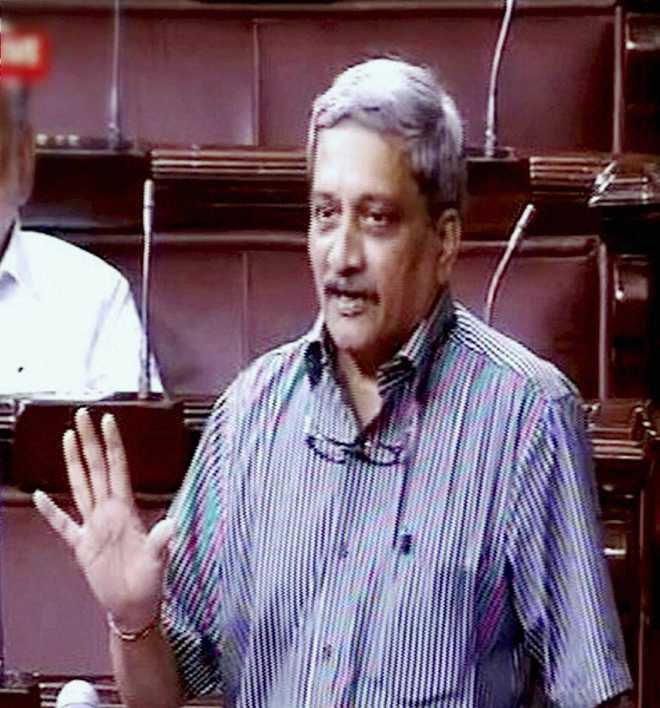
Defence Minister Manohar Parrikar speaks in the Rajya Sabha in New Delhi on Friday. — PTI/TV grab

New Delhi, July 29

The government on Friday said in the Rajya Sabha that the possibility of sabotage in the mysterious disappearance of AN-32 aircraft of IAF was “comparatively very less” and informed that the help of the US has also been sought in locating the plane.

All types of techniques are being used to locate the aircraft, Defence Minister Manohar Parrikar said while replying to clarifications sought by members on his suo motu statement on the disappearance of the aircraft on July 22.

As members expressed concern and raised questions over how the plane went missing, he said, “I can’t speculate because we are searching for it and I will not like to speculate. But I can say only this much. The possibility, although we are checking all angles, of any sabotage is comparatively very less because they have standard operating procedures.”

While sharing the concern of the members, he gave details of the operation being carried out for the last one week in trying to locate the plane, carrying 29 people, which went missing during a flight from Tambaram in Tamil Nadu to Port Blair.

“I appreciate anxiety of members. I am also disturbed at the sudden disappearance of the plane. I have spoken to several experts and former air chiefs who were also puzzled by the sudden disappearance,” Parrikar said.

The Minister said that at the time of disappearance, the aircraft was on “secondary/passive radar” and that “There was no SOS or transmission of any frequency. It just disappeared, so that is the worrying part”.

The government has sought help from the US for detection of images and is seeking help from American defence forces to ascertain whether their satellites had picked up any signal before the disappearance of the plane.

“It is total blank. There was not even a single signal recorded. That is the reason we are contacting American defence forces to ascertain whether their satellites picked up any signal,” Parrikar said.

“Besides our own satellite imagery, we have asked the US for their imagery for the detection of emergency frequency to space based assets. Foreign countries we have already asked. I only hope that our efforts succeed,” he added while replying to queries whether foreign help has been sought.

Queried about the age of the aircraft, the Defence Minister said it was “almost as good as new aircraft”.

Elaborating he said, “I don’t know exact age but it is well within lifetime. It has undergone first overhauling. Lot of replacement has been done…. They are considered as one of the safest aircraft.”

He said the accident rate of Indian Air Force is 0.23 out of 10,000 hours of flying against the global rate of 0.023 and assured the House that maximum efforts would be made to ensure that the mishaps come down.

“If aircraft is not fit for flying we don’t fly it. We have decided to check up whether we can improve the signalling system,” he added.

About the missing aircraft, Parrikar said that after the first overhaul, the plane had already done 279 hours and the pilot was experienced, having put in 500 hours on this route.

The Defence Minister, who had made suo motu statement on the plane’s disappearance in both Houses of Parliament yesterday, said, “Let us hope that we track it down. I can assure that maximum efforts will be taken.” Sharing details of the search operation so far, he said 10 Indian Navy ships as well as submarine ‘Sindhudhwaj’ are carrying searches and “virtually checking up everything”.

Twenty-three inputs had been located, out of which 6 were of the nature of blinks and all inputs have been checked, he said.

“If we locate something, then we can send deepwater equipment to pick up. We have also diverted ‘Sagar Nidhi’ (vessel) from Mauritius. It will reach on August one and it can go up to 6,000 metres depth. But we have to locate objects.

“We have to locate it because at this depth you cannot keep on scratching the bottom,” Parrikar said.

The Defence Minister said he was personally monitoring the situation. “We owe that much to the people, I have seen (to it) that every family is kept in touch.” Yesterday, he had said that “several inputs and leads” regarding floating objects have been picked up but there is no concrete evidence so far with respect to missing AN-32 aircraft of the IAF. — PTI


ASEAN should cooperate to destroy terror networks: Parrikar

ASEAN should cooperate to destroy terror networks: Parrikar
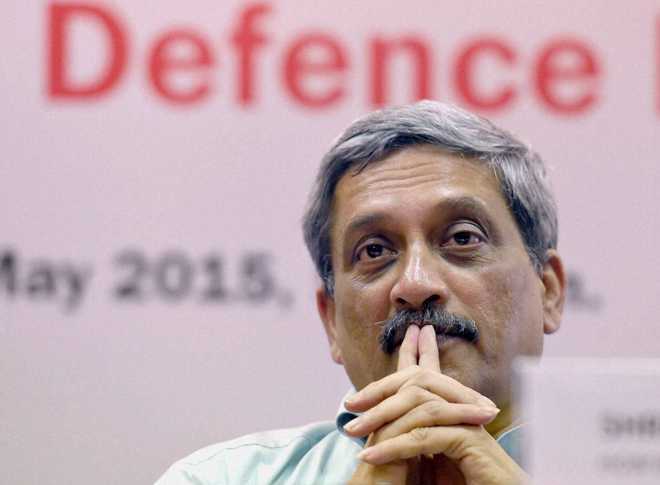
Defence Minister Manohar Parrikar.

New Delhi, October 6

Terming terrorism as the foremost challenge in the region, Defence Minister Manohar Parrikar on Thursday said it should be delegitimised as a state policy and urged ASEAN countries to “cooperate unreservedly” to locate and destroy terror networks.

Security frameworks in ASEAN region still do not give enough attention to terrorism. This must change, he said at 20th ASEAN Regional Forum Heads of Defence Universities Meet here.

(Follow The Tribune on Facebook; and Twitter @thetribunechd)

“Terrorism remains the foremost challenge to our region.

“We need to oppose terrorism resolutely everywhere, delegitimise it as an instrument of State policy and cooperate unreservedly to locate and destroy terrorist networks,” he said

The Association of Southeast Asian Nations (ASEAN) has the Philippines, Singapore, Thailand, Brunei, Cambodia, Indonesia, Laos, Malaysia, Myanmar and Vietnam as members.

Parrikar’s remarks came on a day when terrorists launched another attack on an army camp in Jammu and Kashmir. Three terrorists, believed to be Pakistan backed, were killed in the attack on the army camp north Kashmir’s Kupwara district.

19 soliders were killed in a militant attack on an army camp in Uri on September 18. The Army had launched surgical strikes targeting terror camps located across the LoC on September 28 night. —PTI


Navy buys 4 more spy planes from Boeing

New Delhi, July 27

India today inked a deal with the US defence and aerospace giant Boeing to procure four more P-8I submarine hunter planes worth $1 billion.The Navy has already purchased eight P-8Is for $2.1 billion and deployed some of these in Andaman and Nicobar islands near the busy shipping route passing through the Malacca Straits.The P-8I, classified as a long-range maritime reconnaissance aircraft, is based on the body of Boeing’s 737-800 commercial aircraft. It is the Navy variant of the P-8A Poseidon that Boeing has developed for the US Navy. It has a range of 4,500 nautical miles.  The Navy’s anti-submarine and surface warfare capabilities will be augmented once the planes join the fleet. — TNS


Tab on China

  • The acquisition of additional P-8Is will be a shot in the arm for the Navy as the country has been building up its naval surveillance capabilities to check China’s presence in the Indian Ocean.

Discussions on surgical strikes will be insult to Army, says Naidu

Discussions on surgical strikes will be insult to Army, says Naidu
Says no need to respond to irresponsible comments

New Delhi, October 5Hitting out at those “seeking proof” of the surgical strikes in PoK, Union Minister M Venkaiah Naidu on Wednesday said further discussions on the operations would be an “insult” to the “commendable” task carried out by the Army.“There is no need to respond to such irresponsible comments and demands. Fortunately, the Congress has also realised its mistake and distanced itself from the comments of its leaders. The AAP has also made it very clear,” he told reporters on the sidelines of an event here.He said nobody had any doubt about the “credentials and commitment” of the Army which had done a “commendable” job and further discussions on the operations would be an “insult” to the force.

(Follow The Tribune on Facebook; and Twitter @thetribunechd)

“I don’t think any Indian citizen has got any doubt. Nobody doubts the credentials and commitment of the Army. It did a commendable job. It would be an insult to the Army if we further discuss it,” he said.Naidu said the Director General Military Operations himself had given the statement about the operations in full details and also shared the information at an all-party meeting.He wondered if giving further details would be in the interest of the nation.Observing that the entire country is happy about the surgical strikes, he said the world had also acknowledged the step. “Only Pakistan is saying something because they have to say something. They are not in a position to conduct funeral or last rites of their own citizens,” he said.Earlier, addressing the event, the minister said India did not want war with anybody, but would give a befitting reply if continuously provoked.“We never want a war with anybody. If somebody continuously provokes us, we will give them a befitting reply like our jawans gave the reply recently,” he said.Congress leader Sanjay Nirupam had accused the BJP of indulging in politics over national interest and called the surgical strikes on terror camps as fake, the comments which were slammed by his own party. PTI



Pak involved in K-crisis: Army Lt Gen Hooda says police, CRPF showing maximum restraint in handling protests

Pak involved in K-crisis: Army
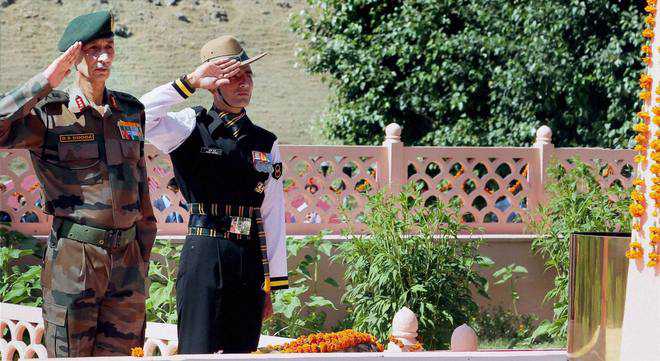
Northern Command Chief Lt Gen D S Hooda paying tributes at the Kargil war memorial on Vijay Diwas at Drass on Tuesday. PTI

Majid Jahangir

Tribune News Service

Srinagar, July 26

As the Valley continues to remain on the boil, Northern Command chief Lt Gen DS Hooda today said Pakistan had a “direct role in whatever was happening in Kashmir”.“There is no doubt in our mind that Pakistan has been sort of interfering in Kashmir and has a direct role in what we are calling the proxy war in Kashmir. We are seeing it every day along the border. We are seeing it from the manner in which support is being given to infiltrating groups. We have seen how sometimes ceasefire violations along the Line of Control are actually in support of people who are infiltrating inside,” the Northern Command chief told reporters at Drass on Kargil Vijay Diwas today.He said Pakistan takes direct advantage of the “internal disturbances” in Kashmir like the ongoing unrest erupted after the killing of Hizbul Mujahideen commander Burhan Wani.“If there is an internal disturbance, Pakistan will directly take advantage of it. You have heard statements by the Hizbul Mujahideen and the Lashkar-e-Toiba that they are supporting whatever is happening in Kashmir. The support is not only moral but it is absolutely physical and there is no doubt about that in our minds,” Lt General Hooda said.As the demand for the ban of pellet guns increases, the Northern Command chief said it was “better than using firearms or weapons” for mob control.“There is a requirement of non-lethal weaponry and pellet guns are classified as part of the non-lethal weaponry. Unfortunately, they have caused some casualties. It’s still a better form than using firearms or weapons. There is much better non-lethal weaponry available around the world,” he said. “The government is looking at even more non-lethal options to control a mob. The Home Minister has said that they are going to explore whether we can get some better and more modern non-lethal weaponry,” the Army officer added.The Northern Command chief said the police and the CRPF were handling the law and order situation and they were exercising restraint to handle the unrest in the region.“…the Army is not at the forefront of tackling the civil disturbance. It’s more of the police and the CRPF which is doing it. They are doing it with utmost restraint. We are there on the ground, we are seeing it happening. The police have been dealing with the situation for the last 20-25 years and they know exactly what is to be done. They know that restraint is to be exercised and that is exactly what they are doing,” Lt Gen Hooda added.He, however, said unfortunately one gets into a situation where one is “forced to adopt other measures”.“When police stations are being looted, there is a murderous mob attacking you, weapons are being looted, your own lives are in danger, it’s only in those situations that the police are forced to take some more strict measures,” he said.


White House shuts petition to declare Pak terror state

WASHINGTON: The White House has abruptly shut down on suspicion of fraud an ongoing online petition that asked it to designate Pakistan a state sponsor of terrorism, citing a law introduced in the House of Representatives last week.

In a blurb headlined Closed Petition, the White House’s We the People web page, which hosts the initiative inviting petitions to the administration, said on Monday, “This petition has been archived because it did not meet the signature requirements. It can no longer be signed.”

The petition had, until October 21, to gather 100,000 signatures to merit a response from the White House under the rules of the programme, which it had already collected, and several times more. At closure, the petition had 625,723 signatures.

The website said no more, but a White House official told HT on condition of anonymity that there were “some technical issues with some of the signatures” that needed to be looked into. Some of the signatures “could potentially be removed if there is evidence of fraud” consistent with the terms of participation, the official added.

Supporters of the petition, which had generated considerable excitement among Indian Americans and in India, will be disappointed, especially as a counterpetition demanding a similar designation for India — as a “terrorist state” — was still up on the We the People page; although way behind, with nearly 66,000 signatures.

The first petition seeking the Pakistan designation was started by an individual known by initials ‘RG’ on September 21, the day after Republican congressmen Ted Poe and Dana Rohrabacher introduced a legislation in the House of Representatives demanding Pakistan be designated a state sponsor of terrorism.

Citing the legislation in the petition, the sponsor wrote it (designating Pakistan a state sponsor of terrorism) was “important to the people of United State of America, India and many other countries which are continuously affected by Pakistan sponsored terrorism”.

The White House official did not explain the kind of suspected “fraud” that shut down the petition. It was also not clear if it had been suspended and will return after the bad signatures were weeded out or whether the process will have to start afresh.

Anyone can start a petition after opening an account — just a name and email would do. (This reporter opened an account on Monday, and it took barely a few minutes.) But you don’t need one to merely sign an ongoing petition.

Under the terms of participation, every individual is allowed only one email account, whether the intention is merely to sign or start a petition.

The individual must be over 13 and cannot sign the same petition more than once.


Seeking Kashmir is wishful thinking, Pak daily tells Sharif

Seeking Kashmir is wishful thinking, Pak daily tells Sharif
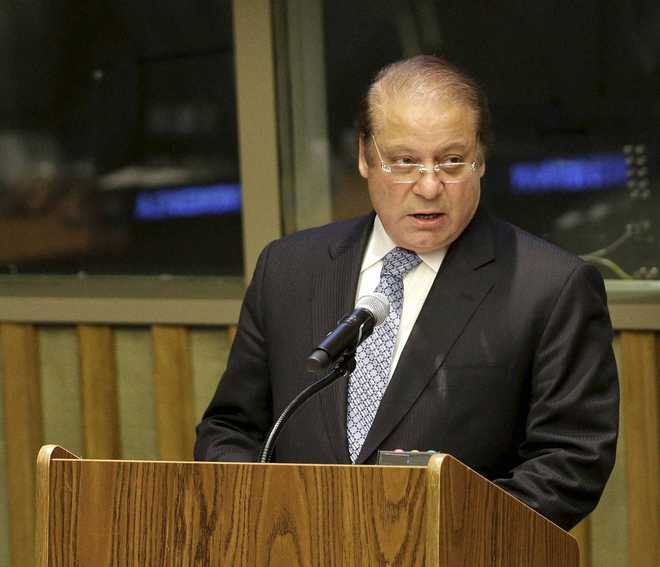
Tells him to focus on regional issues instead. PTI file

Islamabad, July 24

Slamming Prime Minister Nawaz Sharif for saying that he is waiting for the day Jammu and Kashmir would join Pakistan, a Pakistani daily on Sunday urged him not to indulge in “wishful thinking”.“Such statements are nothing more than rhetoric,” the Daily Times said in an editorial.“Instead of indulging in wishful thinking, the PM needs to sit back and think with a cool mind the ways to resolve the regional issues,” it added.Pakistan’s official stance on Kashmir is that it extends moral support to the Kashmiri struggle for freedom and will continue to raise its voice for their right to self-determination.“This stance is commendable but making statements about the accession of Kashmir without any clear policy seems inappropriate,” the daily said.“By uttering these words, the PM is challenging the authority of India and inviting more trouble not only for Pakistan but Kashmiris also.” The daily said talking about Jammu and Kashmir’s accession with Pakistan was easy but nobody knew how to make it happen.“It could only happen through talks or war. There is no other solution. Kashmiris are already paying a heavy price for this conflict.“What can Pakistan offer to Kashmiris when it is still coping with numerous challenges that are posing a threat to its own stability?” The editorial said that instead of talking about capturing more land, Islamabad needed to make Pakistani-governed Kashmir a model state. Islamabad holds the northern part of the divided state.For the past 67 years, Pakistan had failed to ensure good governance in its own Kashmir, known as ‘Azad Kashmir’, it said.The daily urged India and Pakistan to resolve their bilateral issues amicably.“They need to get engaged in the dialogue process to pave the way for further talks to help find common ground to end differences. Both Pakistani and Indian governments must take pity on their respective people and come to the negotiating table for striking a permanent peace deal,” it said. IANS


Indian Army, PLA discuss border on Chinese National Day

A cultural bonanza, showcasing the vibrant Chinese culture and traditional grandeur, was the highlight of the BPM. | EPS

GUWAHATI: Against the backdrop of purported incursions by the People’s Liberation Army (PLA) of China in Arunachal’s Anjaw district last month, a ceremonial border personnel meeting (BPM) was held on the occasion of 67th Chinese National Day at Bumla near the India-China border town of Tawang on Saturday.

According to defence sources, the Indian delegation was led by Brigadier MP Singh, Commander of Tawang Brigade, while Colonel Yao Shi Chen represented the Chinese side. The meeting was hosted by the PLA.

he sources said the BPM was inaugurated by unfurling the national flags of India and China and with the playing of the national anthem of both countries. It was followed by the formal address by the leaders of both sides.

“The proceedings reflected a mutual desire of maintaining and improving relations on the border. Both delegations interacted with each other in a congenial and cordial environment and expressed a commitment towards continued friendship, enhancing the existing cordial relations and maintaining peace along the Line of Actual Control,” defence spokesman Lt Col Sombit Ghosh told Express.