



Sanjha Morcha

What’s New

Click the heading to open detailed news

Current Events :

web counter

Print Media Reproduced Defence Related News

Maj, 3 jawans killed in Valley

Majid Jahangir

Tribune News Service

Srinagar, February 14

In one of the bloodiest gunfights this year, three soldiers and a top Lashkar commander were killed in north Kashmir’s Bandipore district today. At least 12 security personnel, including two officers, were wounded. Protests erupted even while the encounter was on with locals trying to march toward the site. The police lobbed tear-gas shells to quell them.In another encounter at Kralgund (Handwara) in Kupwara late in the evening, an Army Major from Narnaul in Haryana — identified as S Dhaiya of the Army Service Corps, who was attached with 30 Rashtriya Rifles — and three militants were killed, while a jawan was injured. (Follow The Tribune on Facebook; and Twitter @thetribunechd) Sources said a fierce gunfight erupted in the wee hours as the security forces cordoned off a house at Parrey Mohalla Hajin, 30 km northwest of Srinagar, following information that two Lashkar militants were hiding there. Cornered, the militants jumped out of the house, opened indiscriminate fire and lobbed grenades to break the cordon, inflicting heavy casualties.“In the initial gunfight, at least 14 security men, including an Army Major and a CRPF Commandant, who were leading the assault teams, were wounded. Three Army men later succumbed to injuries. A Lashkar commander too was killed,” the sources said. Another militant fled as protests erupted. Chetan Cheetah, Commanding Officer, 45 Battalion, CRPF, sustained multiple gunshots. His condition is  critical. He may be shifted to Delhi. The other injured are being treated at the Army’s hospital in Srinagar.There have been at least six gunfights in Hajin area in the past nearly three months in which seven Lashkar militants have been killed.  The encounter at Kralgund Handwara was backed by locals, the police claimed. “Frequently troubled by militants, the locals helped us. A combing operation was launched during which the militants opened fire, triggering a gunfight in which three Lashkar militants were killed,” Deputy Inspector-General of Police Nitish Kumar said.”In the past three days, three fierce encounters have taken place in Kashmir. Four militants, two soldiers and a civilian were killed in south Kashmir’s Kulgam on Sunday. In the subsequent clashes, another civilian was killed.


Major among four armymen killed in Valley gunfights

LASHKAR MAN, THREE OTHER MILITANTS NEUTRALISED IN BANDIPORA, HANDWARA

SRINAGAR: An army major was among four soldiers killed in two different encounters in Kashmir where an equal number of militants were neutralised on Tuesday.

HT PHOTOSoldiers leave the site of a gunfight at Hajin village in Bandipora district on Tuesday.

In an encounter in the afternoon in north Kashmir’s Handwara three militants were gunned down while Major Satish Dhaiya who was injured later died in hospital. Deputy inspector general of police, north Kashmir, Nitish Kumar told HT that during the cordon and search operation, militants fired from the house they were hiding. The security forces returned the fire.

Shortly after the encounter, the army said Major Dahiya had been evacuated. Late Tuesday night, a Srinagar-based army spokesperson said that Major Dhaiya who was leading the operation in Handwara succumbed to his injuries. Earlier in the morning, one militant and three soldiers were killed in a gunfight in northern Kashmir’s Bandipora, police and army said.

“Three soldiers have been martyred and five others are injured. The operation has been terminated,” the army spokesperson said. The gunfight started at 5.30 am after security forces launched a search operation after being tipped off about the presence of militants in Hajin area.

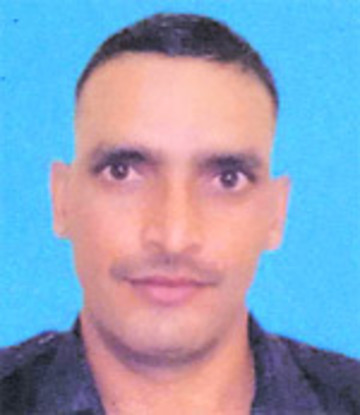
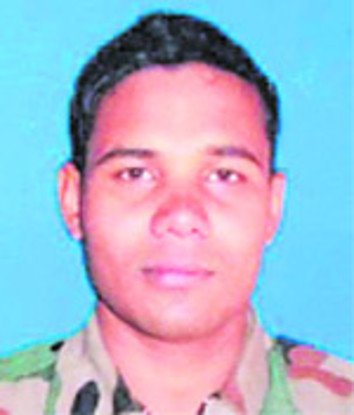
Police said that the slain militant belonged to the Lashkar-eTaiba (LeT) and was a foreigner. The Army said the three soldiers who were killed were paratrooper Dharmendra Kumar of Uttarakhand, rifleman Ravi Kumar of Jammu and Kashmir, and gunner Astosh Kumar of Uttar Pradesh. There have been three encounters in Kashmir since Sunday. Two soldiers, two civilians and four militants were killed on Sunday in south Kashmir’s Kulgam district. On Wednesday, there is a Kulgam Chalo march called by the separatist leaders. JAMMU: The Border Security Force (BSF) on Tuesday claimed to have detected another transborder tunnel, this time in Ramgarh sub sector of Samba district. The discovery effectively foiled a possible infiltration bid by terrorists into India.

“In view of security scenario in the past few months on international border of Jammu region and after assessing various threats from Pakistani side, Border Security Force had taken various innovative measures to ensure foolproof security. In this context, an anti-tunnel exercise is being carried out regularly along the border,” said BSF Jammu Frontier DIG D Pareekh.

On Monday, a BSF patrol specifically tasked to detect tunnels, came across the subway in Ramgarh sector, Pareekh said.

The tunnel of approximately 20 meters in length with a circumference of 2.5 feet by 2.5 feet originated from Pakistani side and ended 20 metres ahead of the barbed border fence in Indian territory, he added.

The officer said that the tunnel was yet to be completed and was detected before it reached the fence. “Efforts of alert BSF troops deployed in our multi-tier counter-infiltration grid once again resulted in neutralising another attempt of Pakistan rangers in connivance with terrorists to send them into India for terror attacks”, Pareekh said.

For the past few years Pakistan has been adopting the tunnel strategy to push terrorists into Jammu. Pakistan’s transborder tunnels have been found largely in the plains of Jammu from Chilyari in Samba district to RS Pura and Pallanwala areas of Jammu district.

ARMS, AMMUNITION RECOVERED IN POONCH

Security forces in a search operation on Tuesday recovered a rich haul of arms and ammunition from a forest area near Mendhar in Poonch district “In a predawn search operation, army and police busted a major cache of arms and ammunition in a forest near Mendhar,” said defence spokesperson Lt Col Manish Mehta. He said: “Based on inputs from sources, a team of Rashtriya Rifles and JKP personnel launched a joint search operation. Arms and ammunition was recovered from the hideout, including a Pika machine gun with 90-belted rounds, AK 74 rifle, AK 47 rifle, two UBGLs, 22 UBGL grenades, two Chinese grenades, ICOM radio set with antennae and approximately 500 AK 47 rounds.”

clip


COMMENTS BY COL CHARANJIT SINGH KHERA(Retd)

Maj Satish Dahiya (ASC) on attch with 30 RR, attained martyrdom today while fighting terrorists in Langate ( Handwara). The offr hailing from Narnaul haryana has put in 7 yrs of service, est contact with trts around 1700-1730 hrs.

The offr was fatally wounded in chest. Civilians came up and started stone pelting on soldiers in order to give cover to trts. 3 trts were however gunned down, the rest managed to escape under civilian cover.

The security forces, as in practice , were order bound to not hit civilians.

Yet again it’s the army and its brave hearts who are held up in the tussle between upholding human rights and upholding the anti-terrorist agenda of the Union.

Need to empower soldiers. Need to empower AFSPA. The offr was declared brought dead at base hospital Srinagar. May the brave soul rest in peace. A message to an ungrateful Nation??

Can we stop harping on surgical strikes  and encashing votes in states on cost of sacrifices made by brave hearts. Need to review 7CPC for degrading Defence forces to the level of para-military Forces.  A real shameful acts and speeches by National Leaders during campaigning . Which leader participated in the Surgical strike across border. Do they know how to hold a gun and handle a grande in self defence. Must stop degrading and winning elections on supreme sacrifice of soldiers and instead pay respect to them and honor them in public with two minutes silence during election rallies than the other way.

clip


Those Half-Baked Gold Biscuits

Police record shows a ‘closed’ case of theft and molestation in summer ’90, but no word on gold seizure

Those Half-Baked Gold Biscuits

Right from the time travails began chasing Second Lieutenant Shatrughan Singh Chauhan in 1990, a police station close to Srinagar’s central Lal Chowk filed an FIR against unknown army personnel, accusing them of theft. The complainant, Raja Begum, claimed army men took away two gold rings and Rs 3,000 from her home, after having harassed her daughters during a crackdown at her home in Batamaloo under Shergadi police station area.

Batamaloo, barely two km from the central Lal Chowk, is where Chauhan said the army recovered 147 gold biscuits (weighing 30 kg) in a search operation on April 11, 1990. According to the FIR filed the next day by Begum, wife of Abdul Wahat Matto, the incident took place near the Sufi shrine of Ziyarat Sharief. People of the locality say no such family lives there. Nor does anybody in the area remember a neighbour by the name of Begum’s husband. In the Banpora area of Batamaloo, which is a km from the shrine, a Mattoo family says they have no information about the 26-year-old matter.

Equally curiously, police records are silent on the 1990 incident narrated by Chauhan—more so about any recovery of gold biscuits. (Batamaloo today is a separate police station.) According to senior police personnel, the FIR Begum filed was registered under section 380 of Ranbir Penal Code (Jammu and Kashmir’s equivalent of the IPC). The officials are reluctant to disclose the name of the investigating officer of the case. They say the FIR was closed 14 months later as “untraced”.

“It was a case of simple theft. It was closed on June 8, 1991,” says Deputy Inspector General of Police (Central Kashmir) Ghulam Hassan Bhat. Reason: the army personnel said to be involved in the raid were not found.

A political observer, pleading anonymity, says there was a “strong rumour” in 1990 that the army that year recovered “a good quantity” of gold from Batamaloo, and sipho­ned it off without ever reporting the reco­very to the police. “Those days, it was normal to use cash and gold to fund hawala transactions for militancy,” he adds.

In the early 1990s, when militancy in Kashmir was at its peak, places around Lal Chowk were under the command of Mushtaq-ul-­Islam, who led the militant outfit Hizbu­llah. He recalls that the area would, ahead of any crackdown, reverberate with gunfights bet­ween the militants and army-backed paramilitary forces. The militants would challenge the forces and, after a tough battle, retreat—following which the forces would enter the area to conduct house-to-house search operations.

“During these crackdowns, some rogues in the army and other forces would steal money, gold and other jewellery. That was routine,” says Mushtaq. “But I don’t think of any incident in which the army seized 25 kg or more of gold. Had it happened, it would have been in everyone’s knowledge here.”

Police officials say the FIR 96/90 of April 12 had been lodged on the complaints of several people including Raja Begam. “All have alleged that the army personnel indulged in theft and harassment,” says an official. “Even a trader has alleged that money was taken from his shop.”

The official points out to “the only thing that goes to Chauhan’s benefit”: the army had conducted the (pertinent) crackdown on April 11 at Batamaloo and the FIR filed on the behest of locals substantiates it. “The FIR clearly mentions about a crackdown in the area on April 11, 1990 and the army was inv­olved in it,” he says. “All this supports one contention of the army officer that he was part of the crackdown.”

In 1990, when armed rebellion backed by mass uprising broke out in Kashmir, gunfights between militants and security forces used to be regular in the densely-populated Batamaloo. Paramilitary Centre Reserve Police Force personnel would frequently descend onto the area to raid and conduct crackdowns.


Armed forces to MoD: Don’t compare us with paramilitary

Armed forces to MoD: Don’t compare us with paramilitary
The armed forces are unhappy with certain recommendations of the 7th pay commission. A file photo

Ajay Banerjee

Tribune News Service

New Delhi, February 4

The armed forces have approached the Defence Ministry saying by no yardstick can they be compared, let alone be lowered, in hierarchy to the paramilitary forces.The three forces — Army, Navy and the Force — have petitioned Defence Minister Manohar Parrikar seeking a restoration of earlier status, which has been “disturbed” after the recommendations of the 7th pay commission. The government is yet to announce what all it has accepted or rejected.The representation has termed comparisons with paramilitary as “wrong and misplaced”, citing suggestions made by 7th pay commission.It talks about “progressive decline of status of the forces” and warns that self-esteem of the armed forces’ officers has been hit. Such is the seriousness of the matter that Parrikar called in Chiefs of the three services for a 90-minute meeting on the matter on February 2.The paramilitary forces included the Central Reserve Police Forces (CRPF), Border Security Force (BSF), Indo-Tibetan Border Police (ITBP), Central Industrial Security Force (CISF) and the Sashastra Seema Bal (SSB).In their representation, which covers an entire gamut of issues, the armed forces have said there can be no comparison with the paramilitary in terms of the mandate, duties, risks in service conditions and tasks assigned.Citing past records, the forces claim the 7th pay panel recommendations will upset laid-down seniorities and placing armed forces’ allowances lower than those of paramilitary forces will change rules for risk allowances like those applicable in the north-east or J&K. It points out the base levels to calculate pensions for the forces are lower than the others.The disability pension for armed forces has been lowered, but it has been maintained at same levels for paramilitary forces. Parrikar has been informed that the pay panel has disturbed the parity between Lieut-Colonels and Commandants of the paramilitary forces.


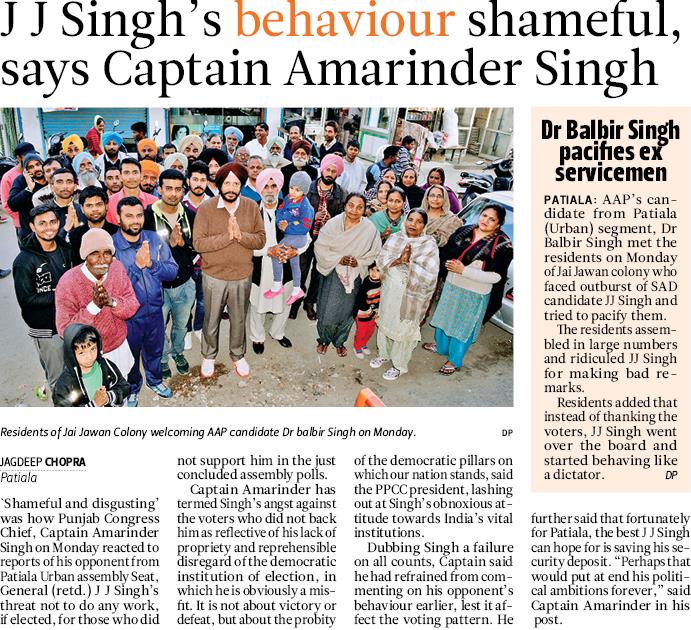
Capt raps JJ for ‘berating’ voters

Tribune News Service

Chandigarh, February 6

Reacting to reports that his opponent from the Patiala Urban constituency, Gen JJ Singh (retd), allegedly pulled up voters for not supporting him in the polls, state Congress chief Capt Amarinder Singh today called for a review of the process to select the Army chief.According to reports, the former Army chief and SAD candidate, during a visit to localities in Patiala yesterday, asserted that if elected MLA, he would not help those who didn’t vote for him.Terming Gen Singh’s angst against voters as disregard of the democratic institution of elections, Amarinder said the former had forgotten all that he had learnt in his Army career. “One must be humble and inspire the people with one’s leadership. He failed on all accounts,” he added.“From Field Marshal KM Cariappa and Gen KS Thimayya to Field Marshal Sam Manekshaw, we now come to Gen JJ Singh! Frankly, I thank the almighty that there was no war in his period of heading the Army,” Amarinder added.

a157878b-735c-425c-8477-26e453dd811f 58939


‘Don’t ask for help’: Gen grills voters

‘Don’t ask for help’: Gen grills voters
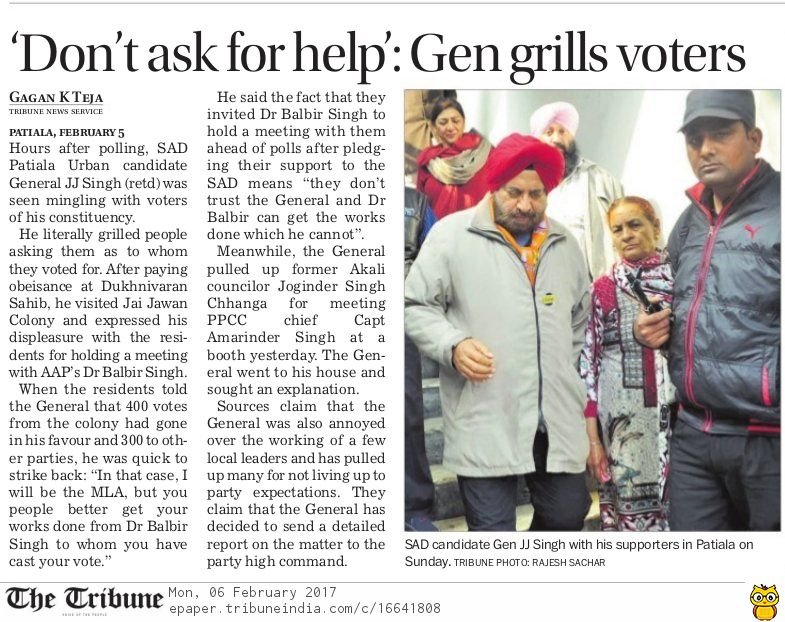
SAD candidate Gen JJ Singh with his supporters in Patiala on Sunday. Tribune photo: Rajesh Sachar

Gagan K Teja

Tribune News Service

Patiala, February 5

Hours after polling, SAD Patiala Urban candidate General JJ Singh (retd) was seen mingling with voters of his constituency.He literally grilled people asking them as to whom they voted for. After paying obeisance at Dukhnivaran Sahib, he visited Jai Jawan Colony and expressed his displeasure with the residents for holding a meeting with AAP’s Dr Balbir Singh.When the residents told the General that 400 votes from the colony had gone in his favour and 300 to other parties, he was quick to strike back: “In that case, I will be the MLA, but you people better get your works done from Dr Balbir Singh to whom you have cast your vote.”He said the fact that they invited Dr Balbir Singh to hold a meeting with them ahead of polls after pledging their support to the SAD means “they don’t trust the General and Dr Balbir can get the works done which he cannot”.Meanwhile, the General pulled up former Akali councilor Joginder Singh Chhanga for meeting PPCC chief Capt Amarinder Singh at a booth yesterday. The General went to his house and sought an explanation.Sources claim that the General was also annoyed over the working of a few local leaders and has pulled up many for not living up to party expectations. They claim that the General has decided to send a detailed report on the matter to the party high command.



Weather proves to be biggest enemy for the troops on LoC


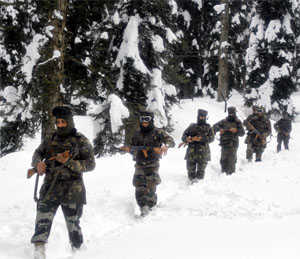
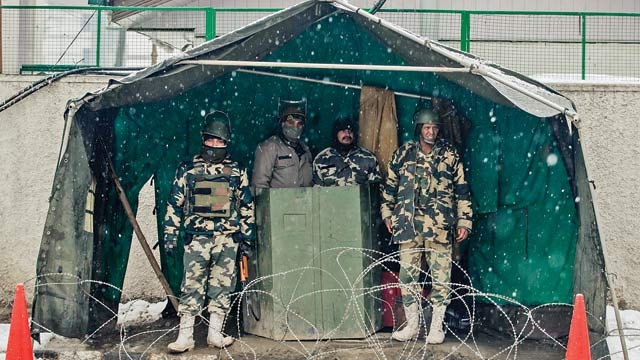
Forget terror, weather is proving to be the worst enemy for the Army troops on counter-infiltration operations at the high-altitude areas along the Line of Control (LoC) in the Kashmir valley.

As the snow breaks new record in the Valley, the Army posts and camps in the high-altitude areas are becoming increasingly vulnerable to the killer avalanches.

In the last four days alone, Army lost 15 soldiers in the avalanches in Gurez and Sonamarg areas in north and central Kashmir.

More than 14 soldiers were rescued from the snow at two places in the last 72 hours—latest being the five of an Army patrol who got trapped when the snow track caved in at Macchil sector of the LoC in Kupwara district on Saturday.

“All the five have been rescued,” said Shamsheer Hussain, Senior Superintendent of Police, Kupwara.

Indian Army has posts located at an altitude of 14,500 feet and more which witnesses 12 feet and more snow during winter. Troops are manning the posts and patrolling the areas despite the snow and freezing temperature to prevent infiltration from the Pakistan Occupied Kashmir.

For the last 18 years, the Army is not relocating troops from the high altitude and avalanche-prone areas given the 1999 experience when Pakistan troops, in the guise of jihadi intruders, occupied the strategic locations in Kargil sector.

“Earlier, the Army was vacating some of these posts in winter. But not after the 1999 Kargil war,” said an officer. The reason why troops suffered heavily in snow avalanches in the last 18 years. In February 2012, at least 16 soldiers were buried alive and six others injured when massive avalanches hit the sensitive army installations in Gurez and Sonamarg areas of north and central Kashmir.

Six soldiers were buried alive when a massive snow avalanche hit Siachen Glacier in Ladakh division of Jammu and Kashmir in December 2012 .

A major tragedy struck the Army troopers at prestigious High Altitude Warfare School (HAWS) at Khilanmarg-Gulmarg in February 2010 after a snow avalanche hit the trainees’ camp leaving 17 soldiers including an officer dead and 17 injured.

Eleven Indian army soldiers including a junior commissioned officer (JCO) were swept away by a massive avalanche at an altitude of 19,600 feet in world’s highest battlefield on February 3 last year.

This year there has been three back to back avalanches given the fact that the snow has broken decades-old record in certain areas of Kashmir in January. Srinagar broke the 11-year-old record in snowfall in January. “Pahalgam also broke previous record of snowfall this January,” said Sonam Lotus, Director of Meteorological Centre, Kashmir.

Figures released by Meteorological Centre, Kashmir revealed that Srinagar recorded 143mm snow in January. It has broken the previous record of 134.6 mm in 2009. Kokarnag recorded 265.4 mm snowfall in January this year. Last highest snowfall was recorded 194.7 mm.

“We had prolonged three months of dry spell. It has been followed by snowfall. Atmospheric process is very dynamic and complex. There could be many reasons. Deep low pressure system was developed over Jammu and Kashmir. There is continuous moisture incursion from the Arabian sea,” said Lotus.


The ritual of R-Day & memories of that day K. Natwar Singh

I was in my second year History (Hons) in 1950 at St. Stephen’s College that 26th Jan. What a parade it was!

The ritual of R-Day & memories of that day
Photo: Mukesh Aggarwal

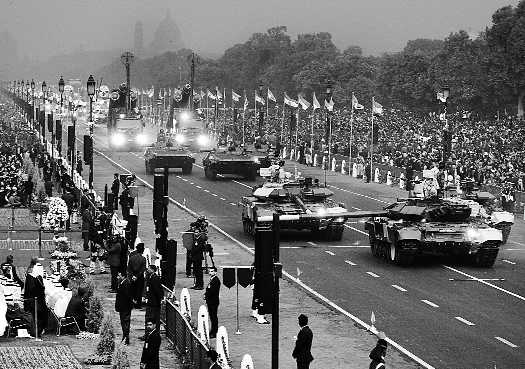
ON midnight of 14-15 August 1947, India attained independence, but as a Dominion, accepting the British King as the Emperor of India. This changed on January 26, 1950, when India became a Republic and the King was no longer Emperor of India. Incidentally, the resolution of the Congress Working Committee accepting the Partition was sent to the AICC. On Gandhiji’s pleading, the AICC passed the CWC resolution supporting the Partition by 157 for, 29 against, 32 neutral. That is how history is sometimes made.The Republic Day Parade this Thursday was threatened by thunder and menacing dark clouds. The gods held up the torrential rain till after the parade. I was in my second year History (Hons) in 1950 at St. Stephen’s College that 26th Jan. What a parade it was! President Dr Rajendra Prasad sat in the ceremonial coach escorted by the President’s Bodyguard (my elder brother was adjutant). The coach rode through Connaught Place, and finally, arrived at Irwin Stadium (now Shivaji Stadium) where a parade was held. Thanks to my brother I got a pass both for the parade and the President’s Reception at Rashtrapati Bhavan — no longer the Viceregal Lodge. I was most excited to see at close quarters President Prasad, the PM and Deputy PM, Maulana Azad and others. Is the Republic Day parade necessary? Crores are spent and it is over in 90 minutes. Apart from a grand and colourful spectacle, the parade has immense symbolic value. Also, it is a reminder that what is right with India is infinitely greater than what is wrong with India. Above all, it is a joyful day. The night glows with the illuminated Rashtrapati Bhavan, South Block, North Block, Parliament House and India Gate. It is wonderful sight.To organise such a vast undertaking involves thousands of people. They do a splendid job, working round-the-clock. We must not forget them. CRRID – the Centre for Research in Rural and Industrial Development — has its office in Chandigarh. The man behind establishing CRRID was PN Haksar, a man of towering intellect and luminous integrity. I looked upon him as a Guru.I am a member of the executive committee of CRRID. I infrequently attend the meetings of the executive. When I do, my interventions are not memorable. A few months ago, I sent my resignation to the energetic Rashpal Malhotra, the moving spirit behind CRRID and a friend of longstanding. He promptly turned down my resignation. This is a good example of the rigorous enforcement of the wishes of the Director General.CRRID does admirable work, invites scholars from various parts of the world to lecture and participate in CRRID seminars. I read the magazine, Man and Development regularly, partly to educate myself and on very rare occasions, use it as a sleeping pill (No offence meant).In the December 2016 issue, Manmohan Singh’s address to the IASSI (Indian Association of Social Science Institutions) is reproduced. Manmohan is not only erudite but a gentleman-politician and an inspiring teacher. He takes a lot of interest in the activities of CRRID. As I write this our Pekinese has put his front legs on the right arm of my chair and pulling at my sleeve. We have named him Li Po after the great Chinese poet. We acquired him when he was six weeks old. He was like a woolly little doll. Utterly irresistible.Now he is almost in his sixth year. Disobedient, it overeats, sulks when denied some eatables he wants. In some ways the little fellow runs our lives. Actually he is adorable, loyal and affectionate. And also sensitive. When he sees members of our staff packing a couple of suitcases, Li Po immediately knows that his masters are going somewhere, leaving him alone. He becomes almost tearful and immobile. It is painful to watch him suffer. When abroad, we telephone our private secretary to enquire how ‘master’ Li Po is? He is doing fine. He is taken for a walk in the park where he wants to take on dogs three times his size. Their indifference deflates him.He has now taken to catching pigeons in our little garden. Most of the time, he fails to catch even one. The other day he did. He walked into our sitting room, triumphantly with a pigeon in his mouth. By now Mr. Pigeon was the late Mr. Pigeon. Lip Po has breakfast, lunch, afternoon tea and dinner with us. He has not yet learned to use forks and knives. He is a strict vegetarian (he does not eat the birds he kills) a teetotaller (so we think). He hates being bathed. The ritual is performed twice a week.We have installed a lift in our home. Li Po insists in using the lift with us. Sometimes he refuses to get out and has to be bribed with a biscuit. Whatever would we do without Li Po?Alexander Sasha Kadakin was an outstanding, warm-hearted and skilful diplomat. He served the Soviet Union as a loyal diplomat and Russia with great distinction. Yes, India was his second home. Fluent in Hindi and English, he mixed with ease in diplomatic and non-diplomatic gatherings. We had known each other for over 32 years. It was a friendship I deeply cherished and valued (Kadakin died in Delhi on Thursday).


Deen-imaan in fauji langar Lt Gen KJ Singh (Retd)

TWITTERATI and the electronic  media is currently abuzz with accounts of self-appointed experts on food being served to troops in security forces. I also got caught in one such skirmish where considerable time was devoted to deciding if puris are ‘beloed’ or rolled, with the former winning the debate. There was also a suggestion to have the word ‘beloed’ included in the Oxford Dictionary. This debate has been triggered by Tej Bahadur, the langar crusader from the BSF, who, instead of keeping an eye on the Pakistanis across, seems to be focused on the dal and its ingredients. While the issue is being examined, it is simply not kosher to link a food-related complaint to his aberrant disciplinary track record. The simple maxim that I have learnt is that the bestest (sic) food has to be served to men, including prisoners. A defaulter has to be given good food and equally rigorous punishment.I am reminded of an incident during my command that I am very proud of and take it as a proof of a successful command. Two defaulters who were to undergo treatment at MH Patiala were asked the choice of unit for attachment. They opted for my regiment, 63 Cavalry, despite their unit people serving in my Brigade HQ, because food of my regiment was reputed to be the best in the entire station. Like they say, the Army marches on stomach and units take pride in their food and cookhouses, referred to as langars, as they have their own camaraderie, culture and even syntax.Now for an eternal lesson in secularism learnt in a langar, which relates to an old and famous regiment, 18 Cavalry. This regiment has three pure caste-based squadrons — Alpha-Jats, Bravo-Musalman, including Kayamkhanis, and Charlie-Rajputs. Following a violent storm, the roof of the cookhouse of the Jat squadron collapsed and they had to share it with another squadron. In the Armoured Corps, Jats follow the logic of the movie, Dangal — non-vegetarian food is not cooked in their cookhouse though die-hard ones manage to eat it on the sly in other langars, once in a while.Jats had traditional rivalry with Rajputs because of keen competition in sports, so they chose to share the cookhouse with the Musalman squadron. This obviously got my Commander worried and he deputed me, Brigade Major, to check if all was well. I went to the langar in the evening, on a meat-dish day, to take stock. I saw no problem with both squadrons cooking and sharing food under the same roof. When I asked the Senior JCO of the Musalman squadron if all was well, he told me not to worry as Islam had taught him to let everyone practise his own deen (religion) faithfully. He would ensure that the Jats remained vegetarian and followed their Vedic Dharma in the langar. Do we need any other proof of the Indian Army’s secular ethos?

clip