Sanjha Morcha

What’s New

Click the heading to open detailed news

Current Events :

web counter

Print Media Reproduced Defence Related News

A NEW WEAPON FROM DRDO LABS WAS BEING TESTED AT BORDER; PAKIS WERE SO SCARED, THEY STOPPED ARTILLERY FIRING

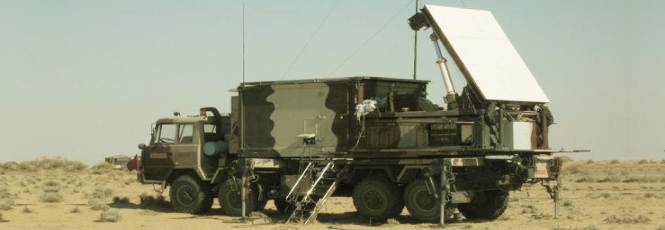
The Indian Army was handed over Swati – a weapon-locating radar – by the DRDO on Thursday. According to defense minister Manohar Parrikar, this deployment of Swati will help to tackle cross-border artillery firing to a great extent.

According to a Defense Source:

“The radars have been on the LoC for two months now for trials. Artillery fire has gone down.”


Applauding the scientists behind such a creation, Manohar Parrikar said:


“Swati could be a great equipment to ensure adversaries do not use artillery fire. If the LoC is devoid of any artillery fire in the near future, you can be sure Swati radar has gone there.”
Sources further said that the four radars placed along the LoC for trial have already proved their mettle since artillery firing from Pakistan have considerably reduced after their deployment. Thirty more radars have been ordered by the Indian Army.
Pakistani army is now aware of the simple fact that if they resort to shelling, Indian Army will not just retaliate but pinpoint the exact location of where the shells are coming from, and then, unleash hell within seconds.

Swati, the weapon locating radar, has been developed by the Electronic and Radar Development Establishment of DRDO. It provides fast and accurate location of enemy artillery including shells, mortars and rockets. It is also capable of guiding fire from an artillery gun attached to it, thus ensuring the destruction of enemy.

Terming the radar as created out of “passive array”, the minister also suggested the DRDO to develop a radar using “active array” in a couple of years.
He further congratulated DRDO for the successful trial of successful trial of exo-atmospheric Prithvi Defense Vehicle (PDV) interceptor missile and endo-atmospheric Advanced Air Defense missile, and said:
“Last year has been very fruitful for the DRDO. There were around 25 missile tests… usually they get criticism.”
61129 61510

Aircraft carrier INS Viraat decommissioned after 30 years of service

Aircraft carrier INS Viraat decommissioned after 30 years of service
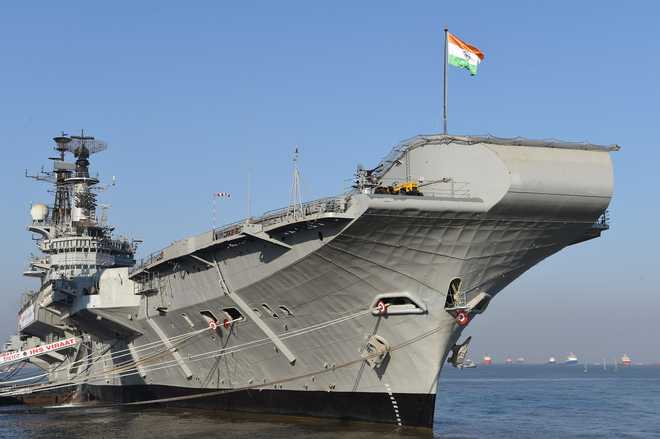
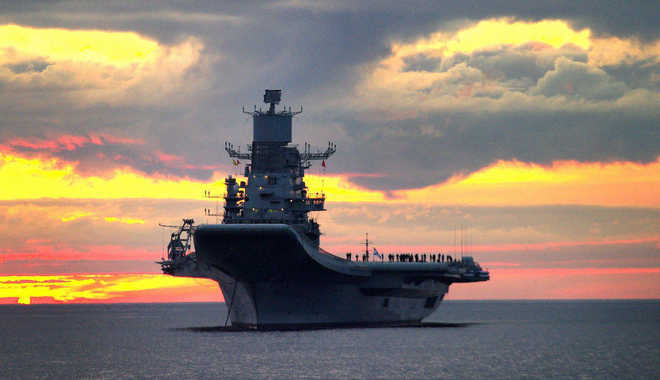
Indian aircraft carrier INS Viraat is docked on its final day as it is decommissioned in Mumbai on March 6, 2017. — AFP

Mumbai, March 6

Aircraft carrier INS Viraat on Monday sailed into sunset, after 30 years with the Indian Navy.The warship was decommissioned this evening, at an impressive ceremony onboard and in the presence of Navy chief Admiral Sunil Lanba and top armed forces officials.

(Follow The Tribune on Facebook; and Twitter @thetribunechd)

INS Viraat was the second centaur-class aircraft carrier which was in service with Indian Navy for 30 years.The aircraft carrier, in its earlier avatar, had won the Falklands War against Argentina in 1982 for the Royal British Navy.It weighs about 27,800 tonnes and served in the British Navy as HMS Hermes from November 1959 to April 1984 and after refurbishment, was commissioned into the Indian Navy.In the late 80s, Indian Navy purchased it at the cost of $65 million and was re-commissioned on May 12, 1987.On its last day in service today, the fate of the aircraft carrier remained unclear as to whether it will be converted into a luxury hotel or head to the scrapyard to be broken up.”We would like to have Viraat as a museum or a diving spot in Mumbai,” the Navy chief told reporters after the ceremony.A senior Navy official told PTI that the Defence Ministry is yet to take a decision on a proposal from the Andhra Pradesh government to convert it into an entertainment hub in Visakhapatnam through a joint venture with the Centre.The Navy is keen on an early decision to avoid INS Viraat meeting the same fate as its predecessor INS Vikrant, which eventually went to the scrapyard.On the AP government’s proposal to convert the decommissioned Viraat into a maritime museum, Lanba said, “We will examine the proposal. But (on) financing it for the conversion, the decision will be taken by the defence ministry.”To a query on whether there was a proposal from two-wheeler manufacturer Bajaj Auto, the navy chief said, “I have not heard of any such proposal.”The question was asked in the context of aircraft carrier INS Vikrant’s parts used by Bajaj Auto for making its limited edition two wheeler, after decommissioning of that warship.The Defence Ministry last wrote to all the coastal states to put forward proposals on INS Viraat, but only Andhra Pradesh proposed to convert it into an offshore luxury hotel and build a Marina along with an entertainment zone around it, a Navy official said. — PTI


Martyr’s widow seeks petrol pump, officer rank in police

Martyr’s widow seeks petrol pump, officer rank in police

Vishal Joshi

Tribune News Service

Kurukshetra, February 26

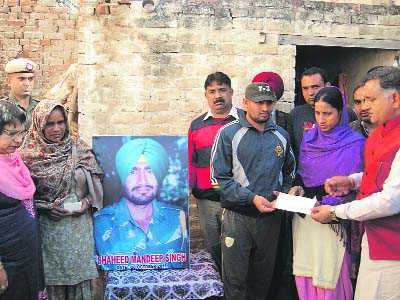
After a financial assistance of Rs 50 lakh from the state government, martyr Mandeep Singh’s widow today demanded an officer rank in the Haryana Police.Mandeep’s widow Prerna said she had sought an appointment with the Prime Minister to table problems faced by families of martyrs.At a simple ceremony at their house in Anteri village here, Ladwa MLA Pawan Saini and Deputy Commissioner Sumedha Kataria handed over three cheques to the family.Prerna is a constable in the state police and posted at the Shahabad Markanda police station.“I am a postgraduate and I should be promoted as Deputy Superintendent of Police. My promotion will be a tribute to my husband by the state government,” she said.Prerna said the family should also be given dealership of a fuel station or a domestic gas agency.“I hope for an early hearing from PM Narendra Modi. I want the Centre to frame a policy where various announcements by the state and Central governments are materialised on the spot. The policy should ensure that martyrs’ families do not have to run from pillar to post in government offices to get their due,” she said.Meanwhile, official sources said the state government had been working for the welfare of martyrs.“As per rules, the next of the kin of a martyr gets a government job. Though Prerna is already employed in the police department, the case to give job to martyr’s elder brother is being considered,” said a senior functionary.“For distributorship for petroleum products, one has to apply from martyr’s quota,” said an official.


Lt Gen Sandhu: Anxiety in security grid, but situation not worrisome

Lt Gen Sandhu: Anxiety in security grid, but situation not worrisome
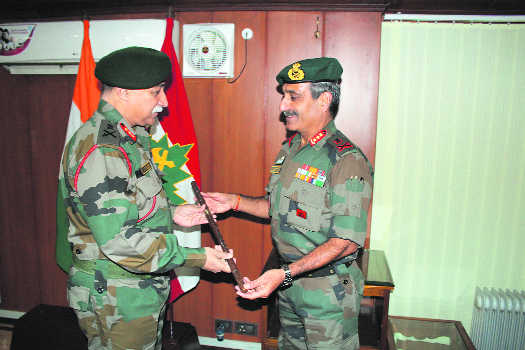
Lt Gen Satish Dua (right) hands over charge of the Srinagar-based 15 Corps to Lt Gen JS Sandhu. Tribune file photo

Majid Jahangir

Tribune News Service

Srinagar, February 26

Says stone-throwing to continue in foreseeable future, Army’s approach balanced

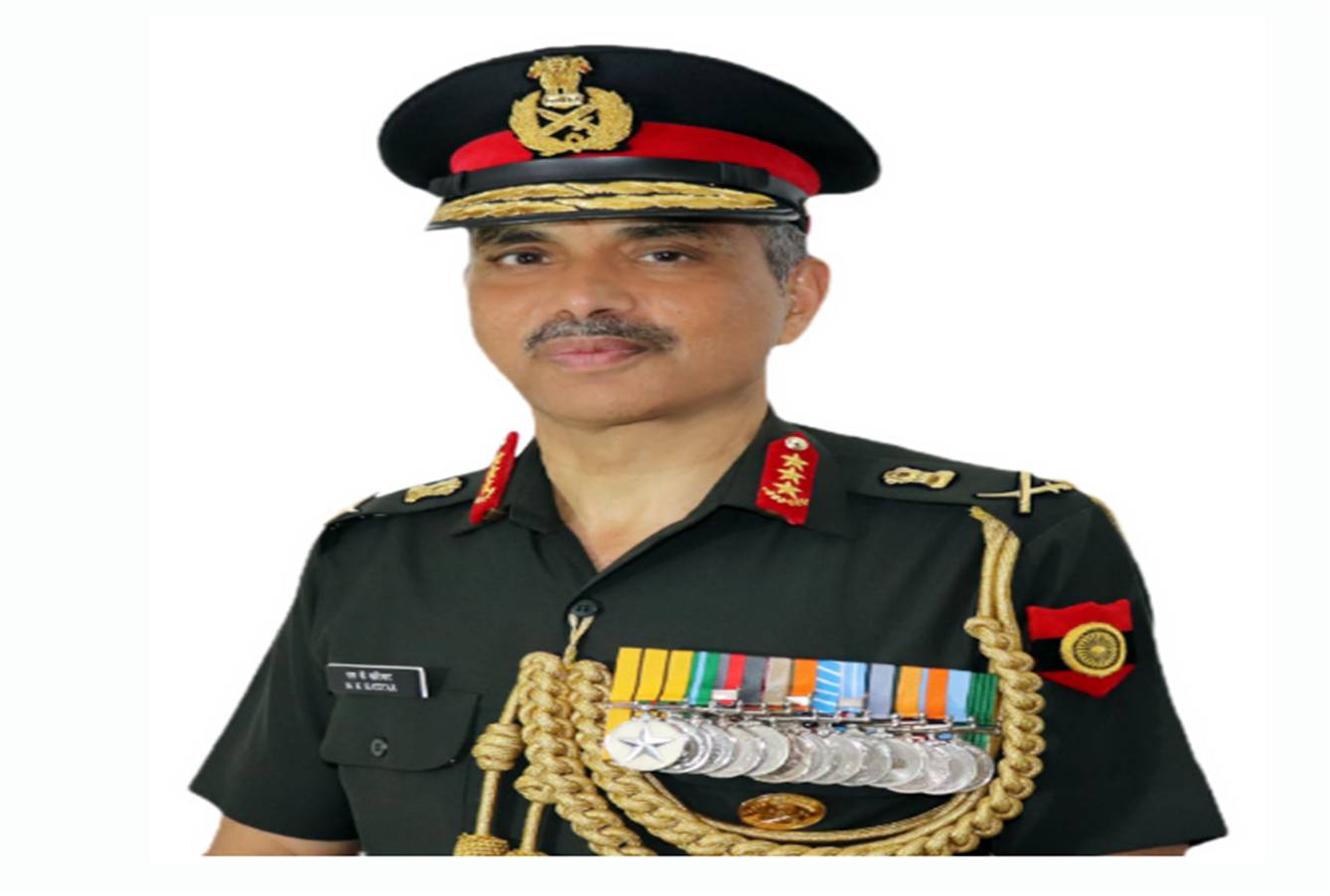
The Army’s topmost officer in Kashmir Lt Gen JS Sandhu has said the approach of the Army in Kashmir was balanced, making it clear that the Army would act if people resorted to stone-throwing during anti-militancy operations.This comes days after Army Chief General Bipin Rawat issued a stern warning to the stone-throwers in Kashmir.“The approach of the Army has largely been very balanced and mature over a period of time. We will continue focusing on our job of (taking on militants) but, simultaneously, we don’t want to antagonise the people. At times, we may have to get into conflict with people at places, where they may get into a stone-throwing situation with mob violence against us. Then we will have to act. So there is no doubt about it,” the General Officer Commanding (GOC) of the Srinagar-based 15 Corps, Lt General Sandhu, said in his first interview after taking over in November last year.The Corps Commander said there was anxiety in the security grid over the situation this year.“There is anxiety but it (the situation) is not too worrisome…. There is a sense among the security forces that we can handle it. There is a confidence that in case the turbulence increases, we will be able to handle it. Though last year it (the situation) escalated a lot, the security forces finally found means and ways to control it. And, it took two months may be. So, some confidence is there keeping in view the last year’s protests,” he said, adding that a large section of people are fed up with protests and would not want it to happen during the 2017 summer.There have been continuous incidents of protests and stone-throwing by locals during anti-militancy operations in the Valley.Sources said that during 80 per cent of the anti-militancy operations this year, in which 19 militants have been killed, forces had faced a law and order situation, resulting in the escape of over a dozen militants, including a topmost commander of the Lashkar-e-Toiba.Lt General Sandhu, who is also the security adviser to Chief Minister Mehbooba Mufti, is of the view that stone-throwing will continue in Kashmir in foreseeable future.“I know for certain that it (stone-throwing) is not something that I can just close. Stone-throwing will happen. But, we can control the magnitude. But as long as the violence levels are kept down, the situation should be okay,” Lt General Sandhu said.Making it clear that all anti-militancy operations in the Valley have not been hampered by protesters, the Corps Commander said various ‘localised’ measures were in place to avoid interference of people during the anti-militancy operations.“Two or three things have been done so far. The civil administration and the police have issued advisories to the people not to gather near the encounter sites. They have imposed Section 144 around encounter sites and people are also being counselled. Now, if it still happens and people act violently, the security forces will react and if the situation doesn’t come under control, they may have to increase the quantum of reaction against stone-throwers,” the Army officer said.The 15 Corps Commander, however, said that each and every situation had its own dynamics and was handled as per the local requirement.“…Every situation has a different reaction and that is what the security agencies have largely worked out. There is no single solution to the problem and we will keep handling the situation as per the local conditions,” he said.The Corps Commander of the most challenging and sensitive Corps of the Army said the forces were launching “targeted specific operations” to flush out the militants and reduce their numbers in Kashmir.“We are not going in for large-scale operations. We just go straight to the place and act against the terrorists. Our focus is on terrorists who are moving around here,” he said.


Forces conduct major exercise to test combat readiness

Forces conduct major exercise to test combat readiness
Aircraft carrier INS Vikramaditya at the Arabian sea. Representational photo/PTI file

New Delhi, February 26The Navy has carried out a mega exercise which saw participation of its strategic assets, including nuclear-powered submarine and aircraft carrier INS Vikramaditya, besides Su-30 and Jaguar fighter jets of IAF.The Theatre-level Readiness and Operational Exercise (TROPEX) was conducted to test combat readiness of the combined fleets of the Navy, the Air Force, the Army and the Coast Guard.The aim of the month-long exercise, which was carried out across the vast expanse of the Arabian Sea and the North Central Indian Ocean, was to test the combat readiness of the forces to deal with any possible threat.”TROPEX 2017 assumes great significance in the backdrop of current security scenario.”The exercise provided an apt-opportunity to test the combat capability of the Indian Navy, Indian Army, Indian Air Force and Coast Guard, and strengthened inter-operability and joint operations in complex conflict situation,” the Defence Ministry said.Over 45 ships from both the Western and Eastern Naval Commands, five submarines, including the nuclear powered Chakra, 50 Naval aircraft, 11 ships from the Coast Guard, troops from the Army, and 20 aircraft from the Air Force, including Su-30s and Jaguars, participated in the exercise from January 24 to February 23.”The exercise, in complete coordination with the Army and Air Force, was conducted in phases to test the various facets of war-fighting and joint combat capabilities of the armed forces to respond to given threat situations,” the Ministry said.It witnessed various weapon firings by ships, submarines and aircraft from both the Navy and the Air Force.The Ministry said the interaction of the forces helped validate operational war fighting concepts and provided valuable lessons to sharpen combat skills. — PTI 


BRO Chief Engineer meets Governor

Tribune News Service

Dehradun, February 18

Umesh Chander Mehta, Chief Engineer, Border Roads Organisation (BRO), Project Shivalik, met Governor KK Paul here yesterday.The Governor sought information from Mehta about road repairs in border areas before the rainy season. He also inquired about the action plan for strengthening roads and the progress in other works of the BRO.Paul said pilgrims would start arriving for the Char Dham yatra in May and keeping this in mind, all roads should be in a proper condition. The weather is also now right for repairing hill roads.He said road repairs should be completed soon. The repair work in the landslide-affected areas such as Lambagadh, between Joshimath and Badrinath, should be taken up on priority. Mehta had come to invite the Governor for the foundation day celebrations of the BRO.


Ashoka the Great & principles of co-existence by By K. Natwar Singh

The emperor’s name was restored to honour as a “result not of Indian researchers but the work of European scholars.”

Ashoka the Great & principles of co-existence
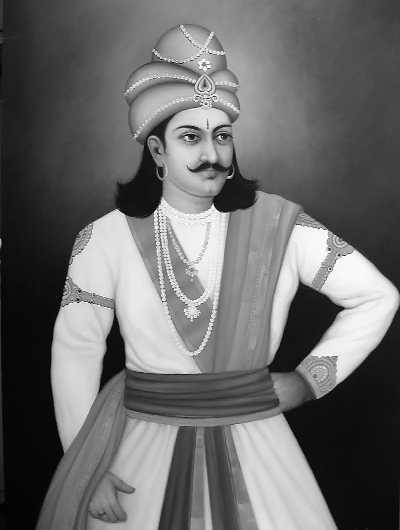
A portrait of Ashoka the Great.

HG Wells, the British author, a contemporary of Bernard Shaw and GK Chesterton, wrote in his, Outline of History: “Amid tens of thousands of names of monarchs that crowd the columns of history — their majesties, and graciousness, and serenities and royal highnesses and the like — the name of Ashoka shines and shines almost alone, a star…”He was Ashoka Devanampiya (beloved of the gods); ‘Piyadasi’ (pleasant to behold). He is the greatest ruler India has produced. He lived from 273 BC to 232 BC.Ashoka was the grandson of Chandragupta Maurya and the son of Bindusara. Ashoka’s empire extended from present-day Afghanistan to Madurai. The Dharama Chakra, incorporated into the flag of India, is taken from the Ashokan pillar at Sarnath.For almost two thousand years, Ashoka the Buddhist was all but forgotten. He himself left a detailed account of his reign on many pillars and edicts he built. Two pillars have survived in Delhi.Romila Thapar in her preface to her book, Ashoka and the Decline of the Mauryas writes: “The reign of Ashoka began to attract attention of historians well over a century ago. In 1837 James Prinsep came out with his work on Ashoka inscriptions in a series of papers. According to KM Panikkar, Ashok’s name was restored to honour as a “result not of Indian researchers but the work of European scholars.” I conclude this piece with two quotations from his edicts: “All sects deserve reverence for one reason or another. By thus acting a man exalts his own sect and at the same time does service to the sects of other people.” The second is: “All men are my children, and just as I desire my children that they should obtain welfare and happiness both in this world and the next, so do I desire the same for all men.”I have written this as I am reading Romila Thapar’s wonderful book, Ashoka and the Fall of the Mauryas.It gave me much pleasure when I read that the Nobel Prize citation and medallion (pure gold) which had been stolen by miscreants was recovered and returned to Kailash Satyarthi. I have so far not met him, but doubtlessly he is a noble and public spirited individual.It was in the early years of this century that Rabindranath Tagore’s Nobel medal was stolen from a room in which the poet lived. I was then External Affairs Minister. The Swedish government was gracious enough to send a replacement. This was handed over to me by the Swedish ambassador in New Delhi. I decided to take the medal to Santiniketan to give it to the Vice Chancellor. From Kolkata Pranab Mukerjee and I flew by helicopter to Bolpur and then by car to Gurudev’s creation. There we were joined by Governor of West Bengal Gopal Krishna Gandhi, Lok Sabha Speaker Somnath Chatterjee and economist Amartya Sen. The ceremony was short and simple. I had first been to Santiniketan in December 1954 escorting a Chinese cultural delegation, led by Chen Chen Tho, a great Tagore scholar. I remember his name because I saw much of him when I was posted in China 1956-58.One more significant memory of Santiniketan has stayed with me. The great Nandlal Bose (a pioneer of modern Indian art) showed me around Kala Bhawan, his creation. Here’s my list of the famous and the infamous politicians of the 20th century: Mahatma Gandhi (1869-1948), V. Lenin (1870-1924), Winston Churchill (1874-1965), M.A. Jinnah (1876-1948), Joseph Stalin (1879-1953), Franklin D Roosevelt (1883-1945), Adolf Hitler (1889-1945), Jawaharlal Nehru (1889-1964), Charles de Gaulle (1890-1970), Mao Tse Tung (1893-1976) & Nelson Mandela (1918-2013).Mahatma Gandhi is a class by himself. Lenin was a revolutionary, intellectual, founder of the Soviet Union, was ruthless. Winston Churchill arch-imperialist, racist, greatest Englishman and Nobel laureate. MA Jinnah was a brilliant lawyer, a clear-headed politician who knew what he wanted and got it (Pakistan). Joseph Stalin, founder of the USSR, killed millions of his own people. He led the Soviet Union to victory in 1945 World War-II. Franklin D Roosevelt was a great US President (four terms) except Lincoln. Adolf Hitler was a charismatic German leader and a brutal killer of millions of Jews. His autobiography Mein Kampf was a bestseller. He committed suicide. Jawaharlal Nehru was a noble humanist, a founder of modern India. Charles de Gaulle is the greatest Frenchman after Napoleon. He was an excellent writer in French and was President of France during 1958-1969. Mao Tse Tung was a revolutionary intellectual and the founder of the People’s Republic of China. He killed seventy millions of his people. Nelson Mandela is one of the great moral and political leaders of our time. He spent 27 years (1964-1991) in prison. A Nobel laureate, he was President of South Africa during 1994-1999. He died at the age of 95.


Army Chief on Kashmir Angry words no substitute for efficacy

The high casualty figures in Kashmir must have been extremely galling for the new Army Chief, Gen Bipin Rawat. For the first time in three decades, the government had breached the unwritten norm of seniority to appoint him as the Army Chief because General Rawat was said to have scored over his two superseded seniors on the strength of his presumed expertise in counter-insurgency operations. His outburst at best could be attributed to two very bad days this month in Kashmir that claimed the lives of six Army personnel, including a Major. What made the situation worse was the injured Major could not be rushed to hospital in time because of protesting mobs, resulting in his death. It is natural that such instances should trigger a temporary feeling of primitive blood lust in the closely-knit Army fraternity. But it does not behove an Army Chief — though schooled in the principle of using minimum force during anti-militancy operations — to overstep his jurisdiction and threaten the civilian population.

The Army has a well delineated role in anti-insurgency operations. That has been clearly breached. In fact, there is no provision in the extant laws that can make good his threat of treating all those who obstruct the Army’s operations during encounters as anti-national elements. Nor does the Army have the power to “go after” or declare elements who display flags of other countries   as “terrorists”.This is a task best left to the local police. By all accounts, the police had tear-gassed people moving to the encounter site.

The reason for crowds obstructing encounters in the recent past needs to be deciphered by the civilian authorities, who in turn, need to work out a solution after consulting all stakeholders, including the Army. As General Rawat would be aware, unbridled violence during the early years of insurgency in J&K made a bad situation worse and the wounds didn’t heal. A heavy hand can bring about a temporary and deceptive calm. It can even be misconstrued as a victory. But no one has won the battle by treating all civilians as the enemy.

RAWAT REMARKS ON J&K CIVILIANS SPARK ROW

THE GOVERNMENT DEFENDED THE ARMY CHIEF, SAYING HIS STATEMENT WAS IN NATIONAL INTEREST

Leaders in Kashmir criticised General Bipin Rawat’s statement warning local youth against creating hurdles. The NC said such posturing would increase hostility and the PDP said the Army must exercise restraint. SRINAGAR: Mainstream politicians as well as separatists in Kashmir have criticised army chief General Bipin Rawat’s statement warning local youth against creating hurdles during anti militancy operations even as the government came to his defence.

Both the camps said such a statement would fuel a spurt in militancy. Opposition National Conference expressed disappointment and dismay over the “belligerent remarks” of the army chief and said such posturing would compound the situation in the Valley. “Youth rushing towards encounter sites and incidents of stone-pelting on the forces during encounters are worrying and alarming signs of the sense of alienation and disenchantment in Kashmir,” NC Spokesperson Junaid Azim Mattu said in a statement.

“The need of the hour is to understand and acknowledge the deep sense of isolation in Kashmir and deal with it with statesmanship and magnanimity. Threatening and warning youth will only push them farther from reconciliation,” the NC statement said. PDP general secretary and vice-chairperson of Horticulture Development Board Nizamuddin Bhat said the army must exercise restraint. “This has not happened today, there have been occasions in the past also. That is why we say in any circumstances, a disciplined force observes restraint,” he said.

The government defended the army chief, saying his statement was in national interest.

clip

clip

General Bipin Rawat, please hold your fire

For the sake of the Kashmiris and soldiers, the national interest would be better served in engaging with the youth

Let’s start with a disclosure. I’m sympathetic to the fauj and to all men in fatigues who serve in conflict zones. It is far from easy to work in Kashmir where you are alienated from your own people; where you are seen as an oppressor and are constantly told that you’re an ‘Indian dog’.

APKashmiri youth throw stones at security forces during a protest in Srinagar, February 9. Army chief Bipin Rawat has said stone pelters will be treated as aides of jihadis

But even for me — and I have fauji blood in my veins — the words used by the army chief jarred. They should, actually, make most of us cringe. General Bipin Rawat, while speaking to the media after saluting the dead bodies of his own men, said that stone pelters in Kashmir would be treated as ‘aides of the jihadis.’ He said a lot more: That those who try to disrupt terror operations in the state would be treated as ‘over ground workers of terrorists’ and would be fired on.

It is understandable that no General likes to see his men in coffins and he may, therefore, have been overwrought. It is also completely understandable that as the leader of one of the largest armies, he was trying to motivate his men, who have taken two quick knocks in the Valley in the past week.

What is difficult to stomach, however, is the fact that Rawat — as the senior- most army officer — did not think of what impact his words would have on the people of Kashmir, particularly after last year’s uprising that followed the killing of Hizbul Mujahideen militant commander, Burhan Wani.

The stone pelting youth brought the Valley to a complete standstill. Boys aged nine to 15 took over the streets and were unafraid of walking up to armed garrisons that dot the landscape of a Valley. The Valley limped back to a semblance of normalcy after an intense phase of stone pelting in the summer of 2016 but the signs of another ‘hot’ summer are visible even before the snows have melted. Neither Rawat nor anyone from his organisation have tried to soften or even clarify the tough words that had almost the same lethal force as the pellet guns.

The General, in so many ways, articulated a policy that was being practised in the Valley, particularly during the summer of 2016, when hundreds were maimed, blinded and killed. Were they all ‘aides of the jihadis’ and ‘overground workers of terrorists’?

Rawat is partially right when he says that locals sometimes prevent the army from conducting their operations. There are several instances of a large group of Kashmiri women shouting slogans while the troops are out on operations. Is Rawat now going to shoot at women who dare to vent their frustration because they are tired of living wretched lives in a militarised zone?

The army has been a part of the protracted Kashmir problem for over two decades. As the head of an organisation that has lost ranks and officers at the hands of terrorists – and sometimes because jawans have turned their guns on their own colleagues – Rawat should be asking some basic questions.

Rawat, who superseded two competent officers, to don the mantle of the chief mainly because of his experience in dealing with counter-insurgency operations (so we were told) should be asking these questions in particular. Why are the youth so enraged? Why are they unafraid of dying? Why are the women unafraid?

Why is the Valley back in a phase where local Kashmiri militants outnumber the foreign terrorists? Why is an entire population alienated? The answers are obvious. Rawat, for the sake of his own men – who don’t deserve to be in coffins – should be gently nudging the government towards a political resolution of the problem. There is already a report, painstakingly put together by interlocutors, available with the home ministry.

The unfortunate bit is that Rawat sounds like the government in Delhi. Rajnath Singh promised to review the use of the pellet guns but stopped short of banning them and now his deputy, Kiren Rijiju has endorsed the General’s stance saying, “There should be action against the stone pelters and whoever works against national interest as national interest is supreme.”

The national interest would be better served in engaging with the Valley’s youth. For the sake of the Kashmiris, our nation and of course, our soldiers, I fervently hope the General does not carry through with the threat of opening fire.




Army Chief warns of tough action against stone-throwers

Says forces in J&K facing higher casualties due to local help for ultras

Army Chief warns of tough action against stone-throwers
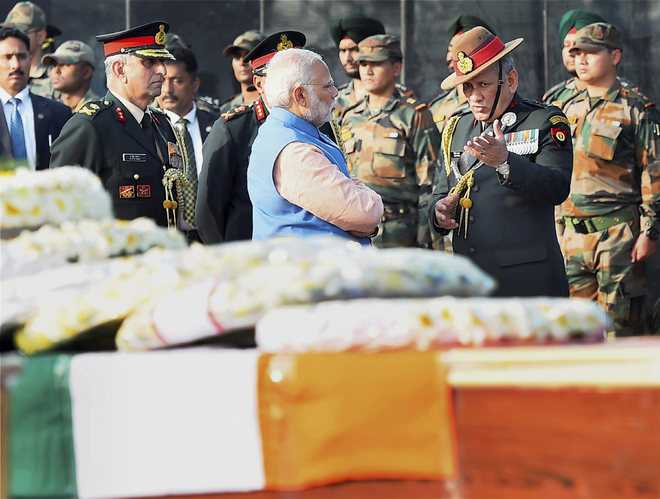
The Prime Minister and the Army Chief during the wreath-laying ceremony at Palam, New Delhi, on Wednesday to pay tributes to the soldiers killed in north Kashmir on Tuesday . PTI

New Delhi, February 15

Acknowledging that the hostile conduct of locals was causing higher casualties in the Kashmir valley, Army Chief Bipin Rawat today warned those attacking security forces during anti-militancy operations of “tough action.”The stern message from Rawat came a day after three soldiers faced heavy stone-throwing at Parray Mohalla of Bandipora in north Kashmir when they were about to launch an operation against the militants holed up there.Alerted by the stone-throwers, the militants got an opportunity to lob hand grenades and empty a few magazines from their rifles on the advancing troopers, leaving three jawans dead and some others, including a CRPF Commanding Officer, injured. One terrorist managed to flee the area.General Rawat said the security forces in Jammu and Kashmir were facing higher casualties due to the manner in which the local population was preventing them from conducting the operations and “at times even supporting the terrorists to escape.”Warning locals against supporting militants, General Rawat said: “We will request locals in Kashmir that people who have picked up arms — and these are local boys — and if they want to continue with acts of terrorism by displaying flags of the Islamic State and Pakistan, we will treat them as anti-national elements and go after them.”“They may survive today but we will get them tomorrow. Our relentless operations will continue,” the Army Chief told reporters here, sending out a stern message to those who support militants.General Rawat’s assertion came after PM Narendra Modi and he paid last respects here to three of the four soldiers, including a Major, who were killed in two encounters in Kashmir yesterday.The PM, in a tweet, said, “Paid tributes to the brave men who lost their lives fighting terrorists in J&K. India will always remember their valour and sacrifice.”General Rawat said those supporting terror activities were being given an opportunity to join the national mainstream but, if they continued with their acts, the security forces would come down hard on them.“We are giving them an opportunity, should they want to continue to (do what they are doing now) then, we will continue with relentless operations may be with harsher measures. That is the way to continue,” he said.Four terrorists were gunned down in two encounters yesterday. Four Army men, including a Major, were also killed in the encounters at Handwara and Bandipora. — PTI


The legend & a brash Cavalier by Maj Gen Raj Mehta (retd)

IT was 1984. I was a young Cavalry Major posted at Roorkee. The regiment was tasked to conduct a lecture on the evolution of the Armoured Corps. I was detailed to collect the material and do the basic research. The nearest big town was Dehradun and it was a military cantonment.  The research I managed, but pictures put me in a spot. They were needed to embellish the presentation and in colour, but for that I needed 300 slides to be projected and each cost Rs 50. My budget comprised of cavalry élan, panache and optimism; jugad, no cash.It suddenly struck me that a retired Colonel was heading the ONGC, on whose largesse much of Dehradun floated. I was at his office in minutes and asked his PA for an appointment, which was haughtily negated with a brusque ‘he is terribly preoccupied with a visit by the Prime Minister. Try your luck later’. No way buddy, I thought. I had no time! Pictures, script, rehearsals. It was either my way or the highway to perdition.I saw a crowd of preoccupied, weight-shifting ONGC honchos with weighty files waiting to enter Col SP Wahi’s plush office. The man had style all right, I mused. You could see his natty private helicopter parked outside his campus mansion with its litchi orchard bursting with fruit; his textured lawns. That’s when I chose to be Cavalry; uniformed Cavalry. With an apoplectic doorman behind me, I entered his hallowed space with an unnecessary ‘May I come in, Sir?’ I was already inside.Colonel Wahi, his trademark Hercule Poirot moustaches quivering, looked up, clearly annoyed: ‘Can’t you see I’m busy? Please leave.’ I was unruffled. ‘Sir, all I wanted to say is that the ONGC is Asia’s best performing behemoth. You’ve got us 29 million tons of oil a year and because of you, Bombay High has made India, the PM, the Army and the EME proud. Just wanted to say that.’ I swivelled to go, but was halted in my tracks by his imperious ‘Wait’! Getting up from his chair — it was an amazing office: deep sofas, fancy lights, velvet curtains, rich carpets, paintings — he told his hapless, stunned PA: ‘Major Mehta is an old friend. Send in tea and a crate of litchis.’The Cavalry had struck gold.I sat across his designer table munching ginger biscuits, heavenly cake; sipping Earl’s Grey in translucent chinaware. Colonel Wahi was —  behind his ferocious moustaches — full of childlike wonderment and warmth. ‘Let them wait,’ he chuckled, ‘you Cavalrymen are brash. I know that! So, how are Gurinder, Morris and Hanut? Is Hanut still unrelenting, tough?’ These were Cavalry icons and I sang their paeans…Post-tea and his recall of halcyon days, I made my 300-slide pitch. Collect tomorrow, he said. That was it. That was the man, and his astonishing efficiency and decision making. I still have the slides; wouldn’t part with them for anything.Colonel Wahi passed away on February 13 at Gurugram. His management style is studied worldwide.I miss him. India misses him.