Sanjha Morcha

What’s New

Click the heading to open detailed news

Current Events :

web counter

Print Media Reproduced Defence Related News

DEFEXPO Funds, policy key for defence investments

Funds, policy key for defence investments

An Arjun Mark II tank drives through sand during display at the DefExpo on the outskirts of Chennai on Wednesday. AFP

Ajay Banerjee

Tribune News Service

Chennai, April 11

When Prime Minister Narendra Modi arrives to formally inaugurate the ‘DefExpo-2018’ on Thursday, he may do well to assure foreign and national investors that New Delhi has the money for a steady flow of investments in the defence-manufacturing sector along with a committed timeline to implement key policy formulations.On the table of the Ministry of Defence is finalisation of the new defence production policy and a proposed amendment and implementation of the strategic partnership model on which hinges India’s military readiness—Tanks, copters, fighter jets and submarines. Speaking at the DefExpo on Wednesday, Defence Secretary Sanjay Mitra said, “There is no shortage of funds. Some 33 per cent of the country’s capital budget is allocated to defence.” He was responding to questions on how the parliamentary standing committee had, in its report on March 13, mentioned that the military budget was “inadequate”, “barely enough” to cater to inflation and “insufficient” for the existing liabilities. Maj Gen BC Khanduri (retd), a BJP MP from Uttarakhand, heads the panel.The MoD has received some 100 suggestions to the draft defence production policy that promises to turn India into an exporter (it currently is the biggest arms importer), increase FDI limit to 74 per cent and augment the domestic production. Ajay Kumar, Secretary, Defence Production, said, “The suggestions are being examined. We will soon come out with the policy following consultations with other ministries.” Defence Secretary Mitra has dismissed any apprehensions about the fighter jet procurement tender: “It will not be a re-run of the scrapped MMRCA (Medium Multi-Role Combat Aircraft) deal.” He was asked whether the fresh tender would be a re-run of the previous process to acquire 126 MMRCA, which started in 2004 and was scrapped in 2015. Last week, India kick-started the process to procure around 110 fighter jets by issuing an RFI (Request for Information) or initial tender for the deal. The Air Force is operating with 31 fighter squadrons as against the authorised strength of 42.Foreign or Indian-made, forces free to choose equipment: Sitharaman  Defence Minister Nirmala Sitharaman said at the DefExpo that the armed forces had been given the choice to choose their equipment — Indian or imported — as per their needs. “I am telling the forces to procure from indigenous sources, but they are free to decide what they need. They are free to choose their equipment. They are using indigenous products may be not as much as we would want. However, there is a fine line. The forces will have to take a call on what they need.” 




Gurgaon captain, 3 soldiers killed in firing along LoC

CASUALTIES ‘Unprovoked’ attack by Pakistan, says army

JAMMU:An army officer and three soldiers were killed and a Border Security Force (BSF) sub-inspector was injured in Pakistani firing along the Line of Control (LoC) in Tarkundi and Sunderbani areas of Rajouri district of Jammu and Kashmir on Sunday evening.

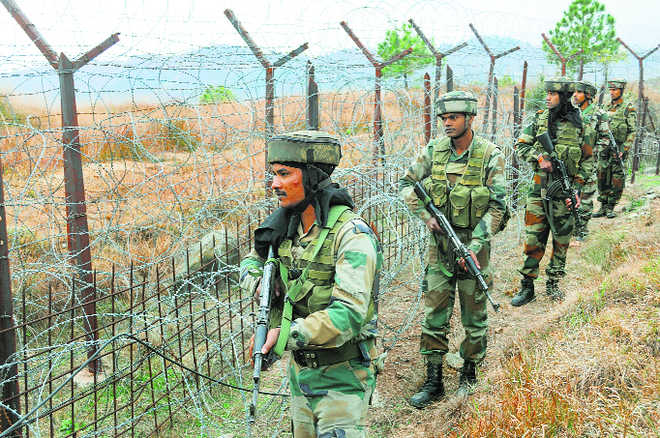
AP FILE■ A border villager holds mortar shells that landed allegedly in firing from the Pakistan side near Pindi in Arnia district of J&K.An officer of the rank of captain was among those killed in “unprovoked and indiscriminate” firing by Pakistan army around 3.30pm, confirmed the army in a statement.

“Indian Army retaliated strongly and effectively and heavy damage has been inflicted on Pakistani Army Posts. However, in the exchange of fire, one officer and three jawans were grievously injured and succumbed to their injuries and attained martyrdom,” the statement added.

“The martyrdom of Indian Army soldiers will not go in vain. The unprovoked action by Pakistani Army will be given a befitting response,” the statement added. Sources said the Pakistan’s border action team (BAT) took part in the attack.

The BAT is an amalgam of Pakistan army commandos and Lashkar-e-Taiba terrorists formed to inflict heavy casualties on Indian patrols along the Indo-Pak borders.

“LoC: One officer and 3 Jawans martyred in Rajouri . Most areas affected due to ceasefire violation,” Rajouri deputy commissioner Shahid Iqbal Choudhary posted on his Twitter account late on Sunday.


Choudhary said that all 84 schools located within 5km of the LoC from Sunderbani to Manjakote will remain closed for the next three days in view of the continuous ceasefire violation by Pakistan.

The deceased have been identified as captain Kapil Kundu from Gurgaon, riflemen Ram Avtar (MP) and Shubam Singh (J&K) and havildar Roshan Lal J&K). BSF lance naik Iqbal Ahmed sustained injuries. Earlier on Sunday, two teenagers and a soldier were injured as Pakistani troops violated ceasefire by targeting forward villages and posts along the LoC in Poonch and Rajouri districts, officials said. The injured were identified as Shahnaz Bano, 15, and Yasin Arif, 14, residents of Islamabad village, official said. Both of them were hospitalised. The firing started around 11am with Pakistani soldiers using small arms, automatics and mortars, the officials said, adding that Indian troops retaliated strongly.

In another ceasefire violation in nearby Rajouri district, six mortars fired by Pakistani forces exploded near Neaka Panjgrain and Tarkundi villages in Manjakote sector in the afternoon, a police official said. Nine security personnel have been killed this year in truce violation by Pakistan whereas 70, including civiliams, have been injured.


Officer with a ‘horrible, dirty’ duty

BUTCHER OF AMRITSAR Was he the wrong man at the wrong place, a soldier following orders, or devil incarnate? We can only speculate, but in 10 minutes Brig­Gen Dyer put India firmly on the path of freedom

From page 01 AMRITSAR : It’s widely believed that there would have been no Jallianwala Bagh massacre had it not been for one man, who decided to teach Indians a lesson for being “wicked”. Ninety-one years after his death, Col Reginald Edward Harry Dyer, also called the butcher of Amritsar, remains an enigma, painted in either black or white.

Few know that Dyer was born and raised in Punjab, or that he was as well-versed in Hindustani as in English or that one of his favourite possessions was the photograph of an unnamed Sikh officer. What is welldocumented is his action at the Jallianwala Bagh, which proved to be as much his undoing as that of the British empire in India. Held guilty by the Hunter Commission, the moustachioed officer was forced to resign and sent home.

DEATH BY DYER

On April 13, 1919, Dyer, 55, was like a man possessed. Giving a first-hand account of the day in “Amritsar: The massacre that ended the Raj” by Alfred Draper, Dyer’s bodyguard Sergeant William Anderson recounted how the crowd seemed to “sink to the ground in a flurry of white garments” as the first volley was fired. The kneeling soldiers selected their targets and made each round tell. When the soldiers had emptied their carbines, Dyer ordered them to reload and direct their fire where the crowd was the densest.

Anderson says he noticed Dyer’s brigade-major Captain Briggs crunching his face as if in pain and clutching at Dyer’s sleeve, but the latter did not notice, and instead directed fire towards the peepul trees where a large number of people were concentrated.

Later, when deposing in front of the eight-member Hunter Commission, he told Chimanlal Setalvad, vice-chancellor of Bombay University: “I did not like the idea of doing it… it was a merciful though horrible act… I thought I would be doing a jolly lot of good and they would realise that they were not to be wicked.”

Later, after his resignation, Dyer told a reporter: “And now, I am told to go for doing my duty — my horrible, dirty duty.” THE BOY WHO STAMMERED

The youngest of six children, Reginald Dyer, fondly called Rex, was born at Murree (now in Rawalpindi district) in undivided Punjab in 1864. His father Edward Dyer, a master brewer who started his first venture at Kasauli in the 1840s, shifted to Shimla soon after Rex turned two so that he could set up another brewery at Solan.

Ian Duncan Colvin, his biographer, says he grew up at Ladyhill House near Bishop Cotton School where he and his elder brother Walter studied until he was 11. Rex, who stammered, was often the butt of ridicule at school. He hated it. Years later, he told the Hunter Commission that had he dispersed the crowds by firing in the air, they would have returned to laugh at him.

Described as sensitive and hot-tempered, Rex ran into more trouble when he and Walter were sent to Middleton College in Ireland, where children mocked him as a “wild Indian”. Eager to return home, every night, he would read Hindustani classics to ensure he didn’t forget the language.

After officer training at Sandhurst—Winston Churchill was some years his junior—Dyer spent two

years in Ireland before joining the 39th Bengal infantry in 1887, where he married Anne Ommaney, daughter of his commanding officer, despite opposition from his mother Mary.

His stints in Burma and Persia, where the natives were brutally suppressed by the British, convinced Dyer that the best way to deal with revolutionaries was “to strike swiftly and to strike hard to forestall greater trouble”.

Mandeep Bajwa, a historian whose grandfather served with Dyer in Peshawar, said he was known for being friendly with his men.

A HERO BACK HOME

Though reviled by the Hunt Commission, Viceroy Chelmsford and the House of Commons, Dyer received a hero’s welcome from the House of Lords and many well-known Britons, including author Rudyard Kipling, in 1920. The Morning Post even started a fundraising drive, which was supported by many British Indian newspapers, including Calcutta Statesman, Rangoon Times and Press, and Madras Mail. Together they raised a princely £28,000.

Amid worsening health, Dyer penned “Raiders of the Sarhad”, an account of his campaign in Persia. Soon he was diagnosed with “arteriosclerosis”. After suffering a series of strokes that prompted the couple to retreat to a quiet cottage in Southampton, Dyer died of cerebral haemorrhage in 1927. On his deathbed, he reportedly said: “So many people who knew the condition of Amritsar say I did right… but so many others say I did wrong. I only want to die and know from my Maker whether I did right or wrong.”

Nigel Collett, the author of “The Butcher of Amritsar: General Reginald Dyer”, says: “What persuaded me that Dyer wasn’t a bloodthirsty bully was the fact that he went to his grave worrying about whether he was right or wrong.”

WHEN AKAL TAKHT HONOURED DYER

The then government-appointed Akal Takht jathedar Giani Arur Singh presented Dyer with a siropa (robe of honour) soon after the Jallianwala Bagh massacre. Ian Colvin, Dyer’s biographer, said when the officer returned to Amritsar, he and his Brigade-Major, Captain Briggs, were summoned to the Golden Temple. Colvin claims, the priests told him: “Sahib you must become a Sikh even as Nikalseyn Sahib (General Nicholson of the mutiny fame) became a Sikh.” When Dyer politely refused, they presented him with a siropa. This act triggered the gurdwara reform movement.

More than 80 years later, Arur Singh’s maternal grandson, Shiromani Akali Dal (Amritsar) chief Simranjit Singh Mann sought an apology from the panth. Calling the presentation of siropa to Dyer as a “panthic mistake”, Mann said his act of seeking apology would give peace to his nana’s soul.


Capt, 3 jawans killed in Rajouri LoC firing Missiles fired by Pak; soldier injured in Poonch too

Capt, 3 jawans killed in Rajouri LoC firing

Capt, 3 jawans killed in Rajouri LoC firing
Pakistan also shelled Shahpur sector of Poonch district. — Photo for representation
Amir Karim Tantray

Tribune News Service

Jammu, February 4

An Army Captain and three soldiers were today killed in heavy shelling by Pakistani troops along the Line of Control in Rajouri district of Jammu and Kashmir, forcing the Indian troops to retaliate.
The slain soldiers were identified as Captain Kapil Kundu (22) from Ransika village in Pataudi (Gurugram); Rifleman Ramavatar (27) from Baraka village in Gwalior (MP); Rifleman Subham Singh (23) from Mukandpur Choudharian village in Kathua (J&K); and Havildar Roshan Lal (42) of Ghagwal in Samba (J&K).
(Follow The Tribune on Facebook; and Twitter @thetribunechd)
Pakistani troops initiated unprovoked and indiscriminate firing of missiles, mortars, automatic weapons and small arms along the LoC in Bhimbher Gali sector of Rajouri district around 3.30 pm, an Army statement said.
“Indian Army retaliated strongly and effectively and heavy damage has been inflicted on Pakistani army posts,” a Defence PRO said.
“However, in the exchange of fire, one officer and three jawans were grievously injured and succumbed to their injuries and attained martyrdom,” he added.
This is for the first time that missiles have been used this year by Pakistani army to target Indian Army posts.
Earlier in the day, a jawan and two teenagers were injured in Shahpur sector of Poonch district in shelling from across the border, which started this morning. The injured civilians were identified as Shahnaz Bano (15) and Yasin Arif (14), residents of Islamabad village. They have been hospitalised.
Since January 13, five soldiers have died in LoC firing.
On January 13 and 19, Lance Naik Yogesh Muralidhar Bhadane and Lance Naik Sam Abraham were killed in Sunderbani sector. Sepoy Mandeep Singh was killed in KG sector of Poonch. Signalman Chandan Kumar Rai, injured in Mendhar sector, succumbed to his injuries on January 20. Naik Jagdish Kumar, who sustained injuries in the KG sector on January 20, died on January 24.


Officer who won back Tololing passes away

Officer who won back Tololing passes away

Col MB Ravindranath

Tribune News Service

Chandigarh, April 8

Col MB Ravindranath, the then Commanding Officer of 2 Rajputana Rifles that wrested Tololing Top from Pakistan intruders during the 1999 Kargil conflict, passed away following a heart attack in Bengaluru on Sunday. The capture of Tololing was one of the most important breakthroughs in the conflict.The 59-year-old officer had been decorated with the Vir Chakra for gallantry during the conflict. Though he had taken premature retirement from the Army, he was a regular speaker at some training and educational institutions.During Operation Vijay in 1999, he had been tasked with capturing the strategic heights of Tololing, Point 4590 and Black Rock in the Drass sector that dominated the Srinagar-Leh Road.According to his citation, he personally led the reconnaissance teams of his battalion under enemy artillery and small arms fire. During the assault on June 12, 1999, at Tololing, the troops were under constant enemy artillery shelling and heavy automatic fire. Realising the gravity of the situation, Colonel Ravindranath reached the spot and quickly restored the situation by his personal influence, which ultimately led to beating back the enemy counterattacks and consolidating the hold on Tololing and Point 4590.The battalion was again tasked with capturing area Black Rock on the night of June 28, 1999. During the attack, the assaulting company lost both its officers. Colonel Ravindranath personally led the assault once again and was instrumental in capturing area Black Rock.


Guardinan of Governance would work as eyes and ears of state government,” said Shergill.

Nawanshahr, February 3

The Senior Advisor to the Chief Minister Punjab, Lt Gen (R) T S Shergill, handed over the appointment letters to the 167 persons of SBS Nagar, Hoshiarpur and Kapurthala, by adding that the Guardians of Governance (GOGs) would contribute towards the social and administrative reforms by monitoring the welfare schemes in the state“By appointing ex-servicemen as GOGs,

Punjab Chief Minister Captain Amarinder Singh has given a big task to the retired army persons for providing good governance and these Guardinan of Governance would work as eyes and ears of state government,” said Shergill.

He said the feedback given by the GOGs would directly be monitored by the chief minister besides concerned SDMs, DCs and Adminsitrative Secretaries. He said Punjab would be the first state to roll out the scheme, in the country.He said the scheme has been partially rolled out up to tehsil level in state and more budget would be provided during the coming budget session. He said the scheme, aimed at ensuring efficient and effective implementation of government schemes at grassroots level, was now being extended in a phased manner across the state. — TNSdailypost


Fresh tenders for fighter jets Reinventing the wheel, again and again

Fresh tenders for fighter jets

The Defence Ministry’s disclosure about its plans to invite a foreign manufacturer to make 110 fighter jets in India has expectedly set the world’s major military-industrial complexes agog with expectations. Nearly three years after the Modi government scrapped the tenders for 126 fighters and then opted to buy 36 from the French, the wheel has come around in a full circle. The government had defended its retail-level purchase of just two fighter squadrons by hinting at another purchase plan up its sleeve that would bridge the gap between the requirement (42 squadrons) and the inventory (31 squadrons). It now appears that the government has formalised its often-aired intention of asking a foreign company to set up a combat jet manufacturing plant in India.This is an opportunity pregnant with several possibilities. If the plan succeeds, India will be able to lift itself in the technology adaptation ladder by several notches. The combat jet plant could become a strategic asset if the planes are exported to neighbouring countries. But as the UPA I discovered after ineffectually grappling with the 126 fighter jet tender for the bulk of its term, defence technologies are not readily available on tap. There may hardly be an example of a foreign defence behemoth transferring sensitive technology. They prefer to export ready-made jets or, at best, assemble them in the recipient country.India’s procurement culture is marked by a lack of transparency and often national security becomes the standard argument to avoid accountability for professional neglect. No heads are likely to roll for having kept the IAF fleet depleted for over a decade. The malaise extends to the other two services as well — outgoing service chiefs at times have drawn attention to the danger of India falling behind the equipment curve. Apart from failing to efficiently manage its arms procurement decisions, the absence of the Planning Commission means the government is unable to take into account national and societal needs while planning to induct expensive advanced weapons systems. This absence of a national planning system may prove costly for the country’s national security in the long run.


Will Gen Bajwa be able to rise to the occasion?

The Pakistan army’s conflict with India has paid no dividends and it’s time Rawalpindi gave peace a chance

IF PAKISTAN WERE TO STOP SUPPORTING EXTREMISM, END CROSS­BORDER TERROR AND EXTEND A HAND OF FRIENDSHIP, INDIA WILL RECIPROCATE WITH CONSIDERABLE ENTHUSIASM

General Qamar Javed Bajwa, Pakistan’s chief of army staff, has managed to increase his clout, especially over the civilian establishment. Many are already speaking of a “Bajwa Doctrine”. His statement recently that Pakistan will not seek resumption of US aid as it feels “betrayed” needs to be seen in this light.

In a recent, and rare, briefing to Pakistani parliamentarians, General Bajwa said the army will back the political leadership if it seeks to normalise relations with India. However, in the same speech, he defended 26/11 Mumbai terror attacks mastermind Hafiz Saeed, chief of the terrorist groups Jamaat-ud-Dawa (JuD) and Lashkar-eTaiba (LeT), to support the Kashmir cause.

For more than 70 years the Pakistan army has been waging a low-intensity limited war against India at the Line of Control, ostensibly to complete what it calls the “unfinished agenda of the Partition” — the merger of Jammu and Kashmir with Pakistan.

In keeping with its strategy to ‘bleed India through a thousand cuts’ Pakistan’s army and ISI have been supporting terrorist groups like LeT and Jaish-e-Muhammad, to launch terrorist attacks on military and civilian targets in India. The spate of incidents in the Valley is part of this strategy. The ISI designates terrorists as strategic assets and as good or bad terrorists. Good terrorists launch attacks in India and Afghanistan at the ISI’s bidding; bad terrorists target the Pakistan army. What Pakistan’s ‘miltabishment’ euphemistically calls the provision of political, diplomatic and moral support to so-called Kashmiri freedom fighters, in effect includes the recruitment, training, arming and launching of extremists to conduct jihad.

Maintaining half-a-million armed forces to ward off phantom threats has drained Pakistan’s exchequer and hampered its socio-economic development. The conventional wisdom in GHQ Rawalpindi is that India poses an existentialist threat to Pakistan. It is of the view that keeping India embroiled in countering cross-border, State-sponsored terrorism is a low cost, high pay-off option to destabilise India.

If the Pakistan army carries out a dispassionate analysis of the actual pay-offs of its policy of giving State patronage to terrorist groups within Pakistan, it will realise that it has created a Frankenstein. The GHQ will find that hostility with India over seven decades has yielded no dividends. Radical extremism is gnawing at Pakistan’s innards and its name has become synonymous with international terrorism.

The Balochis are fighting for their independence, despite the military jackboot riding roughshod over their human rights and dreams. The Shia-Sunni sectarian divide appears unbridgeable and creeping Talibanisation is posing new threats. Pakistan’s economy is in the doldrums and, with the $54 billion China-Pakistan Economic Corridor (CPEC) in full swing, the country is heading for an inevitable debt trap.

The international community is apprehensive of the likelihood of a few of Pakistan’s nuclear warheads falling into jihadi hands through subversion. Given the extent of radicalisation of the Pakistan army, even more worrisome is the possibility of a jihadiled coup from within the army. The consequences of such a coup are likely to be horrendous — both for the region and the international community.

India has shown immense strategic restraint in the face of the gravest of provocations to keep the level of conflict low. Among the world’s large economies, India’s economic growth rate has consistently been the fastest for over a decade. At less than 1.60% of the projected GDP for 2017-18, India’s defence expenditure is among the lowest in the world.

The leadership of the Pakistan army must realise that there is no point in continuing to pursue a fundamentally flawed policy. In war, a general never reinforces failure. Since conflict has not paid dividends, it is time to give peace a chance.

If Pakistan were to stop supporting radical extremism, put an end to cross-border terrorism and extend the hand of friendship, India will reciprocate with enthusiasm. General Bajwa can rise to the occasion like a statesman, or fall by the wayside as another also-ran — like many of his predecessors. The ball is in his court.


TAKEOVER ISSUE Gen Rawat, CM visit college

Tribune News Service

Dehradun, March 25

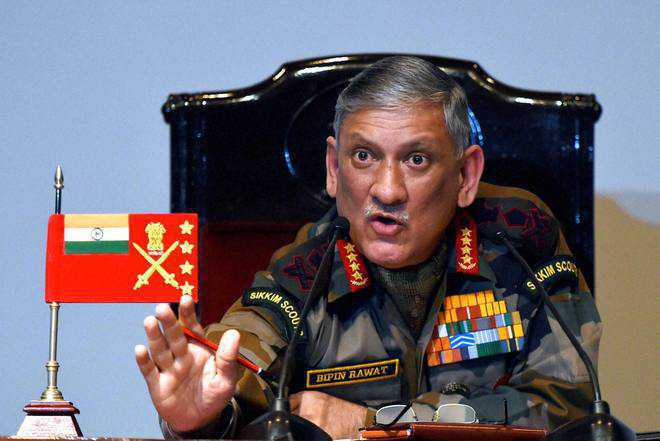
Chief of the Army Staff General Bipin Rawat along with Uttarakhand Chief Minister Trivendra Singh Rawat visited Veer Chandra Singh Garhwal Government Institute of Medical Science and Research, Srinagar Garhwal, at Pauri district of Uttarakhand today.The two spent time visiting various sections of the medical college and held a meeting with the management. The visit of the Army Chief to Veer Chandra Singh Garhwal Government Institute of Medical Science and Research holds significance as Army is preparing to take it over. The Army will develop it on the lines of Armed Forces Medical College, Pune.Since its inception some years ago, Srinagar Medical College has been facing manpower shortage. The hospital was set up to cater to the needs of patients from hill areas, who were forced to head to Dehradun or other cities in search of specialised treatment for serious ailments. But the medical college has failed to provide tertiary care to patients hailing from hill areas of the state.


INS KARANJ LAUNCHED:;Navy sets sail its 3rd Scorpene

Officials celebrate the launch of INS Karanj, the third made­in­India Scorpene­class submarine, at Mazgaon dock in Mumbai on Wednesday. MUMBAI: The S corpene class submarine ‘Karanj’ was launched at Mazagon Dock here on Wednesday. Karanj is the third of the six Scorpene class submarines being built by shipbuilder Mazagon Dock Limited (MDL) under the P-75I project. Admiral Sunil Lanba, chief of naval staff, who was the chief guest, said, “It is one of the most advanced submarines and better than those that the enemy country has.

PTI PHOTO

As of now, four to five companies have responded to the request for information (RFI) issued by the Indian navy.

The meeting has also been conducted with the navy and finalisation of the firm will soon be decided.”

The Indian Navy launched the third state-of-the-art Scorpene class submarine, Karanj, in Mumbai on Wednesday. Navy chief Admiral Sunil Lanba’s wife Reena Lanba launched the submarine, constructed by shipbuilder Mazagon Dock Limited in Mumbai.The submarine will undergo rigorous tests for one year before it is commissioned, Admiral Lanba said. He called for introspection in the ship building business in view of the delay in the construction and commissioning of submarines.The first three submarines of the Scorpene class have been named Kalvari, Khanderi and Karanj. The remaining three (to be launched in the future) will be called Vela, Vagir and Vagsheer, a Navy spokesperson said.