









MIAF Arjan Singh DFC (1919-2017)

Current Events :


Tribune News Service
Dehradun, October 12
Director General Military Operations Lt Gen Anil Kumar Bhatt said the Indian Army was fully capable of protecting the nation and giving a befitting reply to external aggressions. Gen Bhatt was in his hometown Mussoorie in Uttarakhand to participate in the annual day function of a boarding school. He said the Army had the capability to accomplish any task assigned to it with full dedication and valour.He exhorted the youths to join the Indian army and feel for themselves a sense of patriotism. He said Army provided the young a platform to serve the nation and also an opportunity for immense adventure. He also asserted that he was proud to be part of the Indian Army.However, when some reporters tried to put a query on the Doklam issue on the sidelines of the annual function, Lt Gen Bhatt refused to comment.

Tribune News Service
Hindon (Ghaziabad), October 8
The Indian Air Force (IAF) is ready to fight at short notice, if the need arises, said the IAF Chief, Air Chief Marshal BS Dhanoa, here today while addressing the Air Force day parade at this air base located east of the national capital.Dhanoa said, “Notwithstanding the pace of ongoing acquisition, modernisation, indigenisation effort and our desire for peace, we are prepared to fight at a short notice should the need arise.”“On behalf of all air warriors I assure the nation of our sacred resolve in defending sovereignty of our skies,” Dhanoa said.The IAF chief also said losses during peacetime were a cause of concern. On being asked about the role of the women fighter pilots, the IAF Chief said, “The present consideration is to put them to MiG 21 Bison squadron. Our opinion is that it will sharpen their skills as the aircraft has more manual features than other sophisticated aircraft.”The three women pilots — Avani Chaturvedi, Bhawana Kanth and Mohana Singh — are set to script history next month when they will fly military jets after completing a strenuous training programme.Today was the 85th Air Force Day. The IAF was established in 1932 as an auxiliary arm of the air force of the British Empire. Over the period, it has grown as one of the largest air force in the world, behind only the US, Russia and China.

Air Chief Marshal BS Dhanoa inspecting guard of honour on the occasion of 85th Air Force Day at Hindon, Ghaziabad, on Sunday. Tribune photo: Manas Ranjan Bhui

IAF’s Suryakiran jet trainers perform on the occasion of 85th Air Force Day Parade at the Air Force Station, Hindon, in Ghaziabad on Sunday. Tribune photo: Manas Ranjan Bhui
Ajay Banerjee
Tribune News Service
Hindon (Western UP), October 8The Indian Air Force is ready to fight at a short notice, if the need arises, said IAF Chief Air Chief Marshal BS Dhanoa on Sunday morning.(Follow The Tribune on Facebook; and Twitter @thetribunechd)He was speaking at the Air Force Day parade at Hindon air base located east of the national capital.He paid homage to the seven military personnel who died in a helicopter crash near Tawang on October 6.The IAF Chief, talking to mediapersons, said the copter crash in Tawang on October 6 was prima facie caused as the copter’s tail rotor was dis-engaged.“The exact cause will be known latter. Will not speak more on the issue as the court of inquiry is on,” he said. The Mi-17 v5 copter, like the one that crashed, is flying.On being asked about the role of the women fighter pilots, the IAF chief said, “We intend to put women on MiG 21 jets as these are the best to hone your skills.”Addressing the issue of fighter jets, the IAF Chief said an early decision on the Make in India project (for some 120 single-engine jets) will help matters. The IAF, he said, was progressively reaching network-centric warfare. “We have maintained operational readiness by way of exercises.”He also said the Air Force was acquiring multi-spectrum strategic capabilities and remained committed to building a “joint manship” with the Indian Army and the Navy.Dhanoa said security of all Air Force stations have been enhanced to combat any threat, including sub-conventional threats, after the terrorist attack on the IAF base station in Pathankot last year.In January last year, terrorists sneaked in from across the border and attacked the air base. The attack claimed the lives of seven security personnel while four terrorists were killed. — With agencies

A fauji finds himself being used as a symbol of misplaced patriotism whereas his concerns relating to pay and pension, welfare and other facilities are not being resolved.

Brig Gurinder Singh (Retd)
LAST month, when a friend posted a few photographs about the death of 10 safai karamcharis in Delhi on his Facebook page, he received a strange counter-argument, “So what? Aren’t the soldiers dying on the border?” That happened around August 15, when Indians are usually charged up with seasonal patriotic fervor, which this year was compounded by the Doklam crisis and the security situation in Kashmir. But it is quite distressing to note that the death of fellow citizens at the lowest rung of society, entirely due to callous and negligent contractors and officials, is trivialised by such insensitive references to the faujis. There is a growing trend of using soldiers as a shield to justify everything, invariably by those who have no knowledge of the structure, organisation, working ethos and culture of the defence forces.
Misconception in public
Code of conduct: There is a misconception in the public, especially after ‘surgical strikes’, that the day-to-day functioning of the Army is controlled/monitored/guided by the political leadership. In my four tenures (all before 2014) on the Line of Control in J&K in different capacities, including command of a brigade, I do not recall any incident where there was ever any ambiguity in the approach or condoning of any softness or lack of aggression by anyone. There has never been any doubt about the operational procedures and code of conduct, nor was there any looking back for the orders. But Sharmaji, our grocerywala, thinks that the Army has only recently been given permission to act aggressively (khuli chhoot) against infiltrators and terrorists. The utterances of Manohar Parrikar as Raksha Mantri, “The esteem of the Defence Services is lowered in the public as there has been no war in last so many years”, left one wondering about his understanding of security matters. His act of crediting the ‘Surgical Strikes’ to his own RSS training undermined the credibility of the armed forces.TV debates: To use border tension with Pakistan and China to whip up misplaced patriotic passion in TV debates is not a virtuous thought. It is okay for military officers to be taking part in such debates as defence analysts purely on military/security matters. But when they get drawn into noisy debates on nationalism, they do not enhance the reputation of the armed forces. At times, they are seen in such debates for their military demeanour as a symbol of nationalism, rather than their domain expertise. Then there is another category of self-proclaimed nationalists and well-wishers and spokespersons of the military, who have taken this pro-fauji discourse on TV and social media to altogether absurd levels. Do we need to belittle a businessman, an IT professional or a policeman by telling him that his contribution is nothing compared to that of a fauji? A soldier carries out his task because he is trained and conditioned that way and without any external considerations. Bollywood portrayal: Akshay Kumar, the film actor, recently displayed public pity on soldiers and the families of martyrs by giving a few lakhs in charity while promoting his film. Do we need to run the defence forces or the welfare of the families of the martyred soldiers on charity? This is because the public perception is largely based on inaccurate, fictitious and often larger-than-life portrayal of military men in our movies. Bollywood would serve the defence forces better if the nuances of military culture, warfare and the context are adequately researched before depicting a fauji character or theme in the movies. In this regard, our film industry should learn from Hollywood.This new-found fauji overdrive has been exploited by the advertisement industry, too. Though there is nothing wrong in exploiting the pro-military public sentiment for commercial gains, the depiction of soldiers/soldiering in such advertisements is nowhere near the real-life soldiering. A soldier deployed at the Line of Control or other operational areas is neither a Rambo nor Robot. He detests inaccurate representation of his hardships or sacrifices being used for electoral or commercial purposes.
Defence minister’s post
Since May 2014, the post of Defence Minister has been held as an additional charge or by someone who always preferred Goan fish curry to Delhi butter chicken. With 20 months to go, the nation may have finally got a ‘full time’ Raksha Mantri. The new Defence Minister is entitled to be photographed in the cockpit of the fighter jet and on board a ship or a submarine. But the ‘full time’ minister should now address these long-pending issues concerning the uniformed personnel of the defence forces.
Address soldiers’ issues
The soldiers will be better served if the issues related to their pay and pension are addressed, if the anomalies of the 6th and 7th pay commissions were tackled and the One Rank One Pension (OROP) was implemented in its entirety. The Reddy commission report to look into the shortcomings of OROP continues to lie in cold storage since November 16, while the faujis’ agitation at Jantar Mantar continues for more than two years. The misconceptions relating to free rations in peace stations, canteen facilities, buddy (sahayak) system must be seen in proper perspective. When the grant of Non Functional Upgradation (NFU) to defence officers is being contested by the government in the Supreme Court, even after a tribunal headed by a retired high court judge ruled in favour of defence officers, the faujis have reason to be angry. Inaction and indifference of previous governments to these matters cannot be an alibi or justification to defer or deny the soldiers their dues. A fauji finds himself being used as a symbol of misplaced patriotism while his concerns relating to pay and pension, welfare and other facilities are not being resolved. Therefore, he has reason to be upset and angry. The saying goes, ‘new broom sweeps the corners clean’. Military cantonments are much cleaner than civil areas in the true spirit of Swachh Bharat Abhiyaan. Some broom-wielding is needed in the Ministry of Defence, too.The JNU-educated minister must make the right choice; resolve pending issues pertaining to defence personnel and focus on delivery on promises to soothe the ruffled feathers. She also must see how this unnecessary and unwarranted discourse of hyper-nationalism in the name of faujis can be stopped.

Srinagar, October 2
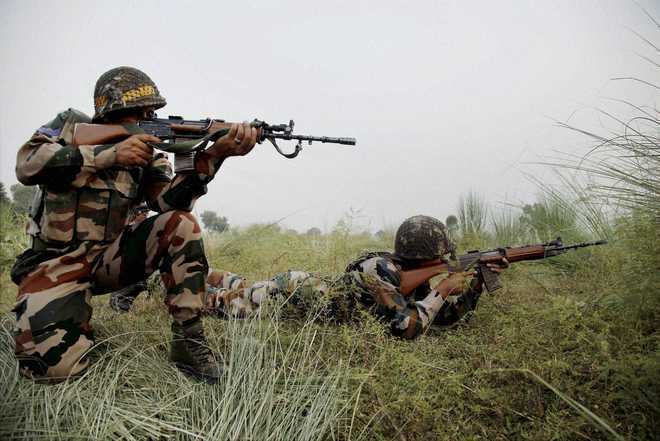
The Army on Monday foiled an infiltration bid along the Line of Control (LoC) in Tangdhar sector of Jammu and Kashmir.“An infiltration bid was foiled on Monday by alert soldiers along the LoC in Tangdhar sector in north Kashmir,” an Army official said.He said the soldiers noticed suspicious movement near the LoC and challenged the suspects.“An exchange of fire took place between the sides,” he said, adding that a search operation was launched soon after the gunfire stopped.Further details are awaited. PTI
Marshal Arjan Singh effortlessly transcended stereotypes. This teetotaller dapper fighter pilot was a soldier’s General and also a successful diplomat.

MIAF Arjan Singh DFC (1919-2017)

Marshal Arjan Singh was the only officer of the IAF to be promoted to a five-star rank.

Then Prime Minister Indira Gandhi with the then Chief of Air Staff, Air Chief Marshal Arjan Singh, during the late 1960s.

Celebrating togetherness Marshal of the Indian Air Force Arjan Singh with his wife Teji, who left for her heavenly abode in 2011.

Marshal Arjan Singh deboards a MiG 21. file photos
Roopinder Singh
India has lost a great man. The Indian Air Force’s only 5-star officer — a towering personality in all respects — Arjan Singh, DFC Marshal of the Indian Air Force, was a gentleman, soldier, and a diplomat. Above all, he was a leader who led from the front—in peace, war and even in philanthropy.Arjan Singh effortlessly transcended stereotypes. This teetotaller dapper fighter pilot was a soldier’s General and also a successful diplomat. His ramrod posture and piercing gaze gave him a commanding presence, but he had the knack of making people feel at ease while he was talking to them. I was a diffident college student when I first introduced myself to him, but he made me comfortable. Decades later, when I requested his permission to write his biography, he started off by saying that there was not much that could be written about him. He was truly modest, with not much to be modest about.(Follow The Tribune on Facebook; and Twitter @thetribunechd)MIAF Arjan Singh DFC passed away at 98. Risaldar-Major Bhagwan Singh’s grandson Arjan Singh was born to Kishan Singh and Kartar Kaur on April 15, 1919, at Kohali village in Lyallpur, now in Pakistan. Soon after the birth of his son, Kishan Singh went to Edinburgh University to study engineering and then worked with Ceylon Railways. Arjan Singh studied in Government School, Montgomery, and then at Government College, Lahore. He was in his fourth year when he was selected for the Indian Air Force. He trained in England and later joined No. 1 Squadron at Ambala in January 1940. He flew a Hawker Audax, which was shot down in the NWFP by the Pathans later that year. His gunner was injured in the crash.Squadron Leader Arjan Singh was in Delhi for a meeting in 1943 when he met the pretty, young and petite Teji. The rest, as they say, is history. The two married in 1948 in Delhi at the Janpath house of Sir Sobha Singh, father of noted writer Khushwant Singh. Promotions and postings followed. Arjan Singh was awarded the Distinguished Flying Cross (DFC) in June, 1944 by Lord Louis Mountbatten, Supreme Allied Commander of South-East Asia during World War II, for his bravery in defending the Imphal Valley.After Independence, Arjan Singh built up the Indian Air Force virtually from scratch and was a key force in all the three major wars. He was the first Air Chief Marshal of the Indian Air Force when, in recognition of the Air Force’s contribution in the 1965 war, the rank of the Chief of Air Staff was upgraded to that of Air Chief Marshal. He was also conferred the Padma Vibhushan that year. He retired as Air Chief Marshal in 1969.Two years later, he was appointed Indian Ambassador to Switzerland and the Vatican. In 1974, he was appointed High Commissioner to Kenya. He was Member of the Minorities Commission in 1980 and served as Lt. Governor of Delhi in 1989. He was conferred the rank of Marshal of the Indian Air Force on Independence Day in 2002. He was pleased that the adjunct Retd. would no longer be used with his name, ever. Field Marshal is a life-long appointment. Two years later, I got a call from Arjan Singh Aulakh. “I am no longer a Jat as you said in the book, I have no land now,” he said. I had written in his biography that the Jat in him was kept alive by the farm. “I discussed it with Teji and my children, and we sold the farm to set up The Marshal of Air Force and Mrs Arjan Singh Trust to provide finances for ex-IAF personnel and their dependents in need of help.” The couple had three children. Son Arvind teaches in a university in America, elder daughter died in a car accident in 1999 and is survived by her husband and two children and youngest Asha lives in Delhi. It was in 2011 that Arjan Singh lost his wife Teji, his partner in all his endeavours and the wind beneath his wings.After her, he continued to soldier on strongly as ever, making his presence felt on all important occasions, national and those connected with the Indian Air Force. His 97th birthday was celebrated in great style by the IAF and the Panagarh (West Bengal) air base was named after him. Today a heart attack sent him to hospital and eventually, as the Marshal of the Indian Air Force soared to meet his maker, he would certainly have looked back at the fulfilling sorties in a life well lived.
Ehsan Fazili
Tribune News Service
Srinagar, September 11
Union Home Minister Rajnath Singh today said there was “much improvement” in the situation in strife-torn Kashmir compared to last year and that the Centre had devised a strategy based on “five Cs” to resolve the crisis.Before leaving for Jammu as part of his four-day visit to the state, Rajnath said the “five Cs” stood for “compassion, communication, co-existence, confidence-building and consistency”. (Follow The Tribune on Facebook; and Twitter @thetribunechd)During his visit, Rajnath reviewed the security situation as well as implementation of the Prime Minister’s development package. He interacted with leaders of various political parties and other stakeholders. “What I have observed is that the tree of peace has not dried up in Kashmir. Green shoots of peace are visible on dry trees,” said the Home Minister, who is expected to follow the same schedule in Jammu. Rajnath said his visit was in the backdrop of PM Narendra Modi’s Independence Day remarks wherein he called for “hugging Kashmiris”. “That’s why I have come with an open heart to talk to all stakeholders.”On talks with separatists, he said there was no question of a formal or informal invitation as the government was “ready to talk to any stakeholder who wanted to talk for restoring peace in Kashmir”. About “abrogating” Article 35A, he said the Centre would not go against the sentiments of the Kashmiris. On Pakistan, Rajnath said the neighbouring nation must stop “terror infiltration” and respond positively to the peace moves initiated by New Delhi. “PM Modi has walked the extra mile to improve relations. Terrorism has destroyed many generations, but the government will not allow the future generations to get harmed,” he said. Appealing to outsiders to visit the Valley for tourism as well as business, Rajnath said a wrong message had gone out that Kashmir was unsafe to travel.

Beijing: Notwithstanding the Doklam standoff, Chinese military analysts say that India and China should sign a new boundary convention in the Sikkim sector to replace the 1890 Great Britain-China agreement and make it more contemporary.
“For China early harvest means, we want to have a new agreement with India, because the 1890 convention was signed between Great Britain and China,” Senior Colonel Zhao Xiaozhou, Director at the Centre on China-America Defence Relations of the Academy of Military Science, told an Indian media delegation here yesterday.
“At that time, it was not the People’s Republic of China, (PRC). India became independent in 1947. It is better we change the signatures of the convention, that is what I mean early harvest,” he said.
“It is very essential because there are territorial disputes in the eastern, central and western sectors of the India-China border. Only in the Sikkim section we have the fixed border. So, we want to start from the easiest, that is what we call early harvest,” he added.
The Chinese Foreign Ministry too in its August 2 fact- sheet on Doklam standoff referred to Beijing’s expectations of an “early harvest” in the Sikkim sector.
“The Chinese and Indian sides have been in discussion on making the boundary in the Sikkim Sector an ‘early harvest’ in the settlement of the entire boundary question during the meetings between the Special Representatives on the China- India Boundary Question,” it had said, referring to the 1890 convention.
“The boundary in the Sikkim sector has long been delimited by the 1890 Convention, which was signed between then China and Great Britain. China and India ought to sign a new boundary convention in their own names to replace the 1890 Convention. This, however, in no way alters the nature of the boundary in the Sikkim sector as having already been delimited,” it had said.
On the Sikkim part of the boundary, India’s Ministry of External Affairs (MEA) in its June 30 statement on the Doklam standoff had said, “Where the boundary in the Sikkim sector is concerned, India and China had reached an understanding also in 2012 reconfirming their mutual agreement on the ‘basis of the alignment’. Further discussions regarding finalisation of the boundary have been taking place under the Special Representatives framework.”
Therefore “it is essential that all parties concerned display utmost restraint and abide by their respective bilateral understandings not to change the status quo unilaterally. It is also important that the consensus reached between India and China through the Special Representatives process is scrupulously respected by both sides,” the MEA had said.
Of the 3,488-km-long India-China border from Jammu and Kashmir to Arunachal Pradesh, a 220-km section falls in Sikkim.
India and China have been locked in a face-off in the Doklam area of the Sikkim sector for the last 50 days after Indian troops stopped the Chinese People’s Liberation Army from building a road in the area.
China claimed that it was constructing the road within its territory and has been demanding immediate pull-out of the Indian troops from Doklam. Bhutan says Doklam belongs to it but China claims sovereignty over the area. China also claims that Thimphu has no dispute with Beijing over Doklam.