Sanjha Morcha

What’s New

Click the heading to open detailed news

Current Events :

web counter

Print Media Reproduced Defence Related News

US ignored Pak nukes in ’70s at China’s insistence: Papers

Washington, December 21

The US acceded to Pakistan’s demand to overlook its secretive nuclear weapons programme following the Soviet invasion of Afghanistan in the late 1970s after Chinese leader Deng Xiaoping convinced Washington to support Islamabad for the “stability” in South Asia, according to latest declassified State Department documents.

The documents reveal that the then Pakistani dictator Gen Zia-ul Haq and Chinese Vice Premier Deng Xiaoping were successful in extracting this price from the US in lieu of Islamabad’s support to America against the Soviet invasion of Afghanistan.

Deng also convinced the US to start giving more military and financial aid to Pakistan, according to the US Foreign Relations 1977-1980 volume on Afghanistan.

The voluminous document indicates that both Zia and Deng successfully convinced the then Jimmy Carter administration that India under Prime Minister Indira Gandhi would be pro-Soviet.

“There are limits on our ability to aid Pakistan because of their nuclear explosive programme. Although we still object to their doing so, we will now set that aside for the time being, to facilitate strengthening Pakistan against potential Soviet action,” the then US Defence Secretary Harold Brown said in a January 8, 1980, meeting with Deng.

“Pakistan has its own arguments, i.e., India has exploded a nuclear device but the world has not seemed to complain about this. So now you have decided to put this aside and solve the question of military and economic aid to Pakistan. We applaud this decision,” said Deng, who later emerged as China’s top leader.

He also convinced the US to not equate India and Pakistan when it comes to giving aid. “Regarding India, we have always felt that the United States should try to cultivate good relations, and this has had a good effect. But India is not a stabilising factor. Perhaps you already know the general election results,” he said. He was referring to the then just-concluded parliamentary elections in which Indira Gandhi came back to power with a majority. Observing that Gandhi had got 70 per cent of the vote, Deng said it was very difficult to judge how India will go. — PTI


Army commemorates Vijay Diwas Celebrations mark India’s victory over Pak in 1971 War

Army commemorates Vijay Diwas

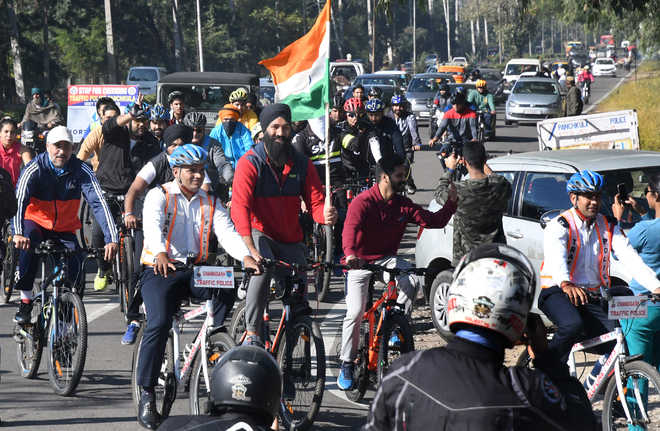
Residents take part in a rally organised to mark Vijay Diwas in Chandigarh on Sunday. The rally was flagged off from Sukhna Lake and ended at the war memorial in Chandimandir. NITIN Mittal

Tribune News Service

Chandigarh, December 16

Vijay Diwas was observed at the headquarters of the Western Command, Chandimandir, to commemorate the victory of the Indian armed forces in the 1971 War against Pakistan, which led to the liberation of Bangladesh.

Over 93,000 Pakistani troops had surrendered before the Indian Army and were taken prisoners of war.

A solemn ceremony was organised at the Veer Smriti war memorial in Chandimandir to pay homage to the martyrs who had made a supreme sacrifice during the war.

A wreath was laid at the memorial by Lt Gen Surinder Singh, General Officer Commanding-in-Chief, Western Command, on behalf of all ranks.

A large number of serving as well as retired officers attended the ceremony at Chandimandir.

On the occasion, the Army Commander exhorted all ranks to rededicate themselves to the service of the nation and be always ready to take to battle on a short notice and be prepared to make any sacrifice.

He said that the Western Command was ever ready not only to defend the nation from its adversaries but also to support the state governments in north India to maintain internal peace, provide humanitarian assistance in case of any disaster and assist military veterans and their families.


Capt hails Pakistan for corridor, Oppn wants project delinked from terror

Capt hails Pakistan for corridor, Oppn wants project delinked from terror

Rajmeet Singh
Tribune News Service
Chandigarh, December 14

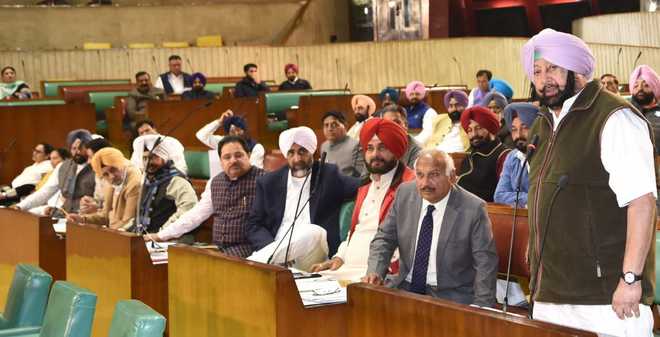
A resolution by Punjab Chief Minister Capt Amarinder Singh, thanking the Centre and Pakistan Prime Minister Imran Khan for the Kartarpur corridor initiative, saw him being advised by the members of Opposition, to not to see the project through the “prism of terrorism”.

While the Chief Minister missed out the name of Navjot Sidhu in the initiative, a Congress MLA praised the Cabinet Minister while at the same time endorsed concerns of the Chief Minister on Pakistan’s bid to revive terrorism.

The Opposition MLAs, including Sukhbir Badal, advised the Chief Minister to be positive and work for the corridor to come through. AAP MLA Kanwar Sandhu said Capt was relying on selective memory while forgetting about the peace initiatives that he had taken when he was the Chief Minister during his previous term.

Sukhbir Badal suggested resolution on swapping land of Kartarpur gurdwara with Pakistan. Minister Sukhjinder Randhawa endorsed the suggestion of Badal.

Amarinder, while appreciating the role of the Narendra Modi government and the initiative by Pakistani premier Imran Khan in paving way for opening of the corridor, warned the Opposition and countrymen to be wary of Pakistan’s designs to revive militancy in Punjab.

He said he would visit Pakistan once peace prevailed between the two countries. He advised Imran Khan to tame his Army in case he wanted peace to prevail.

He did not mention Navjot Sidhu’s name for the efforts put by him in the corridor issue.

Akali MLA Gurpartap Wadala, while speaking on the corridor issue, urged the Chief Minister to be positive on the issue. He appreciated the role of Navjot Sidhu.

In reply, the Chief Minister said while every Sikh was happy on opening of the corridor, politics and evil designs of the Pakistan army should be understood.

In reply, the Chief Minister said while every Sikh were happy on opening of the corridor, politics and evil designs of the Pakistan Army should be understood.

Kartarpur: Reckless throw of the dice

The government has often sacrificed the national interest for short-term, partisan electoral gains

Between 2008 and 2015, there was not a single Khalistani terrorismrelated fatality in Punjab. Each year thereafter has seen multiple fatalities. At the same time, Pakistani mischief in Jammu and Kashmir has been consistently escalating since 2013. India’s overtures, including personal initiatives by Prime Minister Narendra Modi, such as the self invitation to the then Prime Minister Nawaz Sharif’s birthday in December 2016, have been obvious and abject failures.

Each of the terrorist incidents in Punjab over the past years, including two major Islamist terrorist attacks (Gurdaspur and Pathankot), link back to Pakistan. The decision on the Kartarpur Corridor was announced just days after the terrorist attack on the Nirankari Bhawan at Amritsar, in which three persons were killed. State agencies identified Harmeet Singh, aka ‘Phd’, as the ‘mastermind.

Harmeet Singh is known to be sheltered by the Inter Services Intelligence in Pakistan. He is only one of the many Khalistani terrorists who finds safe haven in Pakistan more than two and a half decades after the comprehensive defeat of terrorism in the Punjab. Prominent among those who continue to be hosted by the ISI, and periodically prodded into launching — or attempting to launch — terrorist attacks in Punjab, are Wadhawa Singh of the Babbar Khalsa International, Ranjeet Singh Neeta and Paramjit Singh Panjwar of the Khalistan Commando Force and Gajinder Singh of the Dal Khalsa. Moreover, the ISI’s support to Khalistani extremists in the Sikh diaspora across the world was very visible in the mobilisation for the “London Declaration” in support of the Khalistani “Referendum 2020” campaign at Trafalgar Square on August 12, 2018. Though the Trafalgar Square demonstration was a damp squib, the reality is that Pakistan continues to liberally fund, facilitate and support Khalistani groups across the world.

Crucially, barely four days after the Nirankari Bhawan attack, even as continuous terrorist activity and relentless breaches of the ceasefire along the Line of Control in J&K persisted, there was no evidence whatsoever that Pakistan’s intentions or strategy with regard to the use of terrorism as an instrument of strategic extension in the neighbourhood had altered. In particular, it is well known that Pakistan has long exploited the major Sikh shrines in its territory — including Kartarpur Sahib and Guru Nanak’s birthplace, Nankana Sahib — for attempts to radicalise pilgrims. Indeed, in April 2018, when a jatha (group) of 1,800 pilgrims visited Pakistan, accompanying Indian officials and diplomats were forcibly separated from the group in explicit violation of bilateral protocols. India subsequently lodged a strong diplomatic protest, alleging that the pilgrimage had been used to raise the issue of Khalistan, and that the pilgrims were exposed to inflammatory statements and materials at various shrines they visited.

What, then, was the motivation or compulsion — despite Modi’s repeated declamations that there could be no dialogue with Pakistan till Islamabad ended its support to terrorism in India — for the abrupt agreement on the Kartarpur Corridor? Indeed, what could have provoked the comparisons with the fall of the Berlin Wall and the even more absurd claim that “the corridor will become a symbol of love and peace between both countries”?

Simply put, there are no rational grounds, no dramatic shift in the security situation or the support of Pakistan’s state agencies to terrorist formations targeting India, no conducive atmosphere, which could justify the abrupt fast forwarding of the long pending Kartarpur Corridor project. On the Indian side, the only visible compulsion is the proximity of the general elections in 2019, and the ruling Bharatiya Janata Party’s electoral interests — its bid to woo the conservative Sikh voter in the state. In all other aspects, Modi’s and the BJP’s postures and statements have remained consistently hostile to Pakistan and to any reopening of the peace process. Subsequent statements by Minister of Foreign Affairs Sushma Swaraj have reiterated that “a dialogue cannot start only with the Kartarpur corridor”. On the Pakistan side, this initiative represents an opportunity for further mischief, a continuation of its project to keep the Khalistani movement alive and use Sikh shrines and pilgrimages as opportunities for radicalisation and recruitment.

The ruling dispensation at South Block has displayed, in the decision on the Kartarpur Corridor and, indeed, in its broad approach to terrorism and its Pakistan policy, a disconnect with reality and neglect of facts. The regime has repeatedly sacrificed the national interest to a short term, partisan electoral calculus, and there is not a single reason to believe that this is not the case with regard to the decision on the Kartarpur Corridor. Ajai Sahni is the executive director of Institute for Conflict Management & South Asia Terrorism Portal The views expressed are personal


Remembering heroes of the Great War by Sqn Ldr Rana TS Chhina (retd)

The centenary of World War I has reignited literary and academic interest in the contribution of Indian soldiers
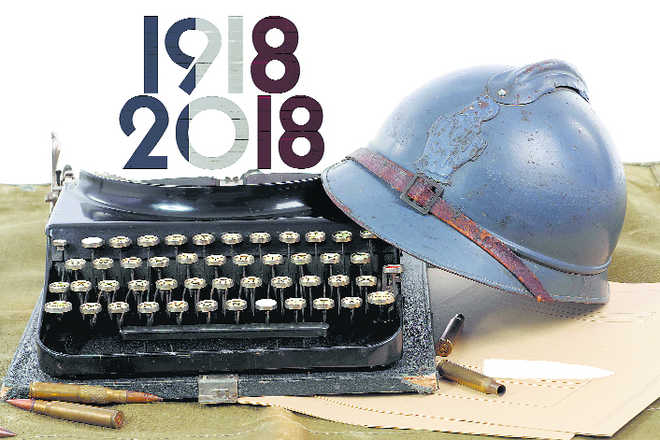
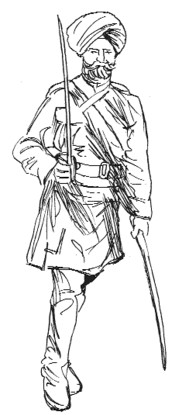
Forgotten heroes: The sacrifices of Indian soldiers in WWI were largely ignored in the writings and books on the subject
Sqn Ldr Rana TS Chhina (retd)

World War I (1914-1918) was undoubtedly one of the defining events of modern world history. The conflict set in motion a chain of events with far reaching consequences. While it is now a century since ‘the guns of August’ finally fell silent, the repercussions of that cataclysmic churning are felt around the world till this day.

In India, the war was initially seen as a means to prove India’s loyalty to imperial Britain. Mainstream political opinion in the country was whole-heartedly in support of the war effort with an intensity that took even the colonial administrators by surprise. The prevalent feeling, summed up by Mahatma Gandhi, was that if India wished to obtain greater political responsibility, it must offer its unconditional support to Britain in her hour of need. The ensuing Indian contribution to the war, both in terms of men and material, far exceeded both expectations and capability. However, the stresses and strains imposed by the wartime economy merely exacerbated the cracks that had already begun to appear in the edifice of imperial solidarity. By the time the war ended, Britain’s relationship with India had changed irrevocably. The contiguous social and political effects only hastened the process that would lead to the end of the British Raj less than three decades later in August 1947.

The Punjab disturbances of 1919 had altered the very meaning of memory in the Indian context of the Great War and in the period after Independence, the war was largely forgotten in India and Pakistan. The sacrifice of India’s soldiers was consigned to the dustbin of history in the post-colonial world. The Indian Army that had served with honour and distinction in France and Flanders, East Africa, Gallipoli, Aden, Egypt, Mesopotamia, Palestine, Transcaspia, Persia, and even China, was itself divided between the newly independent states of India and Pakistan. Although both these armies retained an institutional memory of the war in their battle honour days and regimental histories, the new States viewed it as a colonial conflict of little or no relevance to their history.

However, the centenary of the outbreak of the World War I gave global impetus to numerous commemorative activities, research, and public discourse that have all contributed significantly towards our understanding of the conflict and its legacies.

The centenary also generated wider interest in the role played by India in the conflict and gave fresh momentum to commemoration in India and abroad. Within India, the United Service Institution of India (USI) took the lead and spearheaded ‘India and the Great War’ centenary commemoration project with support of the Ministry of External Affairs (MEA), who supported it as a public diplomacy initiative. The project used the centenary commemoration as a medium to examine the involvement of India and its Army in the war effort as well as the political, social and economic effects of the war on India. It undertook and supported a number of commemorative activities, academic research and community engagement projects, all of which have combined to influence the manner in which the war, with its colonial roots and postcolonial legacies, is viewed and understood within India.

Similar commemorative projects were initiated by Indian diaspora communities in the UK, Europe, Australia, and Canada. Many of these projects overlapped, or formed part of, the framework of national commemorative activities of the diaspora’s host countries. The response and rationale for diaspora commemoration was varied, from adopting a uni-dimensional white-washed and sanitised narrative aimed solely at inclusion, to viewing commemoration within the matrix of institutional and individual racism, both contemporary and historical.

The ‘India and the Great War’ centenary commemoration project engaged with a wide spectrum of partners, from governments down to individuals, including descendants of veterans of the Great War both in India and Pakistan. For many, it was the first time in living memory that the contribution of their forebears was being recognised or remembered.

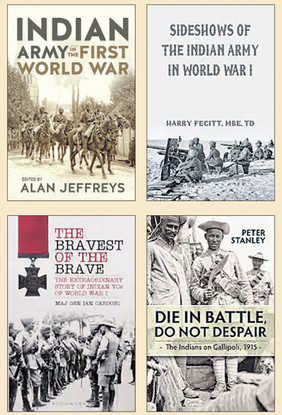
One of the longer lasting legacies of the centenary commemoration is the number of publications now available that shed new light on various aspects of India’s involvement with the Great War.

Apart from the literary and academic interest that it generated, the centenary also gave a fillip to remembrance. The USI’s ‘India Remembers’ project mooted the proposal to have the marigold as a uniquely Indian flower of remembrance. The Government of India, through the USI, has also built a national memorial in France. This memorial, located at Villers-Guislain, near the site of Lance-Dafadar Gobind Singh’s death-defying ride in December 1917, is distinct from the Indian Memorial at Neuve Chapple. It was inaugurated by the Vice-President of India on November 10, 2018, and is the second Indian national memorial overseas, the other being at the Menin Gate in Belgium.

The writer is a Secretary and editor, centre for armed forces historical research

Bookshelf

Honour and Fidelity: India’s Military Contribution to the Great War 1914-18, Amarinder Singh, Roli Books, 2014

Sowars and Sepoys in the Great War 1914-1918, Cavalry and Infantry Regiments of the Indian Army; Ashok Nath; Nathfoundations, Sweden, 2014,

The Indian Empire At War: From Jihad to Victory, The Untold Story of the Indian Army in the First World War, George ;Little, Brown Book Group; 2018

Sepoys in the Trenches: The Indian Corps on the Western Front 1914-15; Gordon Corrigan; The History Press; Reissue edition, 2015

The Great War: Indian Writings on the First World War; Rakhshanda Jalil; Bloomsbury India, 2018.

Les Hindous – The Indian Army on the Western Front ; Rana Chhina; USI CAFHR: 2016

India, Empire, and First World War Culture: Writings, Images, and Songs; Santanu Das; Cambridge University Press, 2018

Indian Troops in Europe: 1914-1918; Santanu Das; Mapin, 2017

The Indian Corps on the Western Front: A Handbook and Battlefield Guide; Tom Donovan and Simon Doherty; Tom Donovan Editions, 2014.


Refurbished ALGs, a boost to IAF along China border

Sources in the IAF’s eastern air command based in Shillong told DH that seven ALGs at Tuting, Mechuka, Along, Wallong, Ziro, Tawang and Pasighat have been upgraded and are ready for use for military purposes while work at another ALG in Vijaynagar was under way. (Photo credit: Taku Chatung, Ziro)

Sources in the IAF’s eastern air command based in Shillong told DH that seven ALGs at Tuting, Mechuka, Along, Wallong, Ziro, Tawang and Pasighat have been upgraded and are ready for use for military purposes while work at another ALG in Vijaynagar wa…

Read more at: https://www.deccanherald.com/national/refurbished-algs-boost-iaf-706161.html


Difference narrows

t is the “strength” of public support that is the power behind every bullet the soldier fires. Loose talk, catering to a limited audience, can ultimately prove enfeebling. Can the nation afford that?

Defence, General Bipin Rawat, Pakistan, Islamic state, Navjot Singh Sidhu, Sushma Swaraj, Nirmala Sitharaman

Defence and diplomacy are often said to be opposite sides of the same coin: with the uniforms adding that they are often tasked with clearing up the mess created by incompetent foreign offices. Yet it has been a sterling feature of India’s democracy that unlike what obtains across its western border, a healthy distinction has been maintained between those two facets of governance.

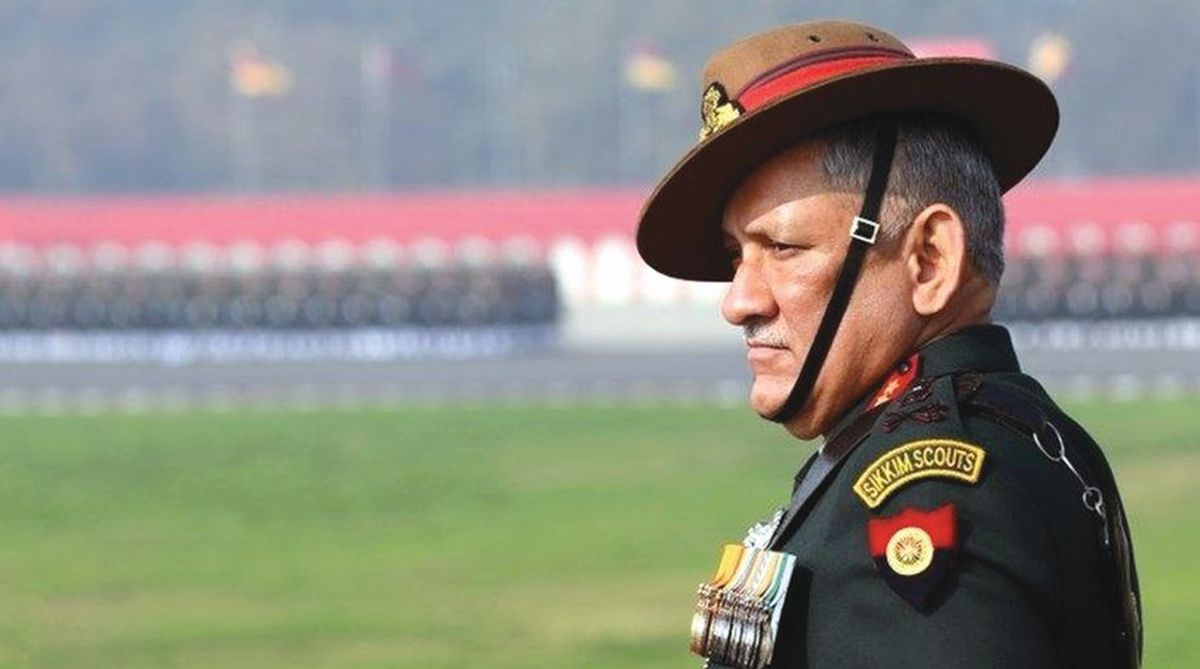
Until now at least. General Bipin Rawat, not for the first time, has turned established norms on their head by contending that Pakistan and India could never enjoy a cordial relationship until Islamabad revokes its status as an Islamic state. There has never been a dearth of Pakistan-bashers in the country (the Navjot Singh Sidhu’s and Mani Shankar Aiyar’s are maverick exceptions) but not even the most Nagpur-oriented of them has never gone as far as the Chief of Staff of an Army that took immense pride in its secular, apolitical credentials.

Not that Pakistan is the only Islamic nation on the planet, are they all to be slammed as pariahs? Does India not have excellent ties many with of them, are remittances from Gulf-based NRIs not a critical component of India’s foreign-exchange reserves? Gen Rawat could undermine the several successes of the MEA in general, Mrs Sushma Swaraj in particular. Not to mention under-cutting the essays of Gen VK Singh. And in a larger context, are Hindu and Muslim intrinsically incompatible?

The “simple soldier” alibi will just not work: Rawat could not have been unaware of the developments over Kartarpur, who authorised him to “take on” Imran Khan? Worse, he stepped out of line at a function at which the focus was on young, impressionable, military cadets.

Was this not a case of nurturing an equivalent of the Hate-India campaign for which we consistently condemn Pakistan? What if other countries cite cow vigilantes running amuck, desecration of churches etc to question India’s secular status? Lambasting Pakistan for its sponsorship of terrorism in J&K is one thing, questioning that nation’s religious status is something else.

And if Sushma Swaraj is unable to ensure that the General refrains from exceeding his brief the MEA risks international embarrassment. Do his “brother generals” endorse his politically-loaded line? The efficiency of a military force is established by its showing in the field, even if the politicians seek to capitalise on surgical strikes etc.

The apex court’s latest order/observations on the Army’s use of excessive force in Manipur, and its rejection of the government’s argument serve as a stark reminder that in public perception the image of the Army is losing its aura. And it is the “strength” of public support that is the power behind every bullet the soldier fires. Loose talk, catering to a limited audience can ultimately prove enfeebling. Can the nation afford that? Nirmala Sitharaman has to answer the query.


Govt approves military procurement worth Rs 3,000 crore

Govt approves military procurement worth Rs 3,000 crore

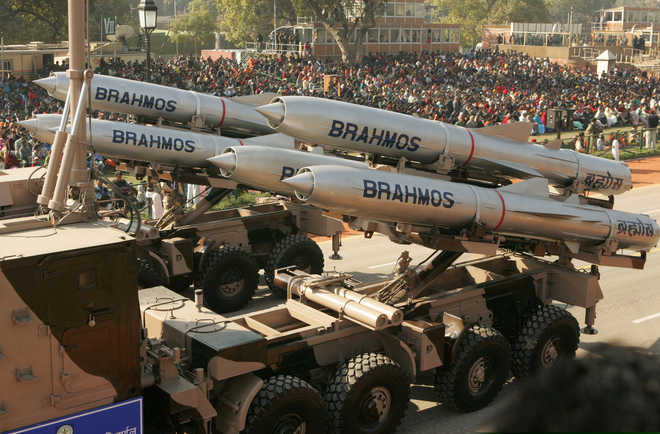
he indigenously designed BrahMos missile is a tested and proven supersonic cruise missile and will form the primary weapon on-board these ships, said the official.

New Delhi, December 1

The Defence Ministry on Saturday approved military procurement worth Rs 3,000 crore, including BrahMos supersonic cruise missiles for Navy’s two stealth frigates and armoured recovery vehicles for the Army’s Arjun main battle tanks, a senior official said.

The go-ahead for both acquisitions was given by the Defence Acquisition Council (DAC), the ministry’s highest decision-making body on procurement, the senior military official said.

“The DAC chaired by Defence Minister Nirmala Sitharaman accorded approval for acquisition of defence equipment worth about Rs 3,000 crore,” he said.

India is procuring two stealth frigates at a cost of USD 1 billion and both the ships will be equipped with indigenously developed BrahMos missiles.

“The indigenously designed BrahMos missile is a tested and proven supersonic cruise missile and will form the primary weapon on-board these ships,” said the official.

The DAC also approved the procurement of Armoured Recovery Vehicles (ARVs) for the Indian Army’s main battle tank, Arjun. The ARVs are designed and developed by the DRDO and would be manufactured by defence public sector undertaking BEML, the official said. PTI


Forces miffed over civilian hiring Say appointments made arbitrarily without consulting service headquarters

Forces miffed over civilian hiring

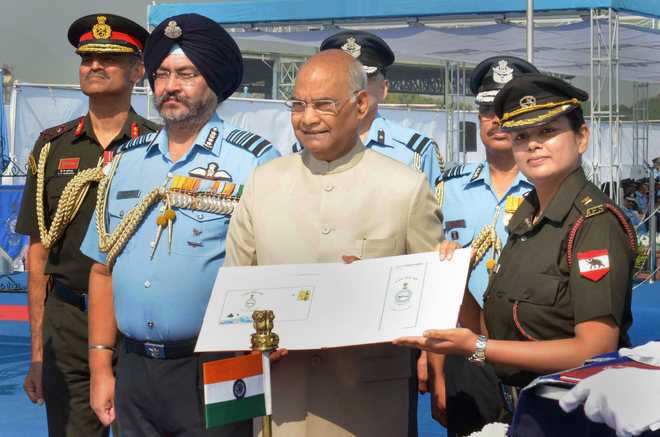
HONOURING EXCELLENCE: President Ram Nath Kovind presents President’s Colours to Air Defence College in Guwahati on Thursday. The Standards was awarded to 118 Helicopter Unit. PTI

Ajay Banerjee
Tribune News Service
New Delhi, November 29

The issue of rank parity between the armed forces and the civilian cadre has again surfaced. In a latest communication, the Army said ‘no cognisance’ has to be taken of a letter appointing civilian officers on several senior positions within armed forces.

A letter was written on November 26 by the administration and coordination branch of the Army in response to one written by the Joint Secretary and the Chief Administrative Officer (CAO) informing about the redistribution of posts from among the Armed Forces Headquarters, called the AFHQ cadre. This comprises civilians who work in the three services. The CAO had written the letter on October 30 to the three service chiefs and appended along lists of appointments.

The Army letter issued now cites a letter dated November 2, 2017, and has asked its various wings to take ‘necessary action’ as per the details mentioned in it. The previous letter had said ‘no cognisance’ should be taken of such communications. It says “it has been observed with concern that the CAO has been writing letters to the service chiefs”.

The CAO, who heads the AFHQ cadre, had issued a letter dated October 30, addressed to the chiefs of the three services. It listed the additional posts and appointments at the level of Additional Director General in separate wings of the armed forces.

This issue was raised in October last year too. The forces had said appointments had been made arbitrarily without consulting the service headquarters. The Principal Personnel Officers Committee on September 22, 2017, pointed out that the Union Cabinet mandates policy matters of the AFHQ cadre be dealt by the PPOC.

The MoD, in its letter earlier this year, said the cadre restructuring of the AFHQ, as approved by the Union Cabinet, would be implemented. Designations will be created in consultation with the armed forces.


Army with me on India ties: Imran Khan KARTARPUR CORRIDOR : Says if France and Germany can come close, why not us

Army with me on India ties: Imran Khan

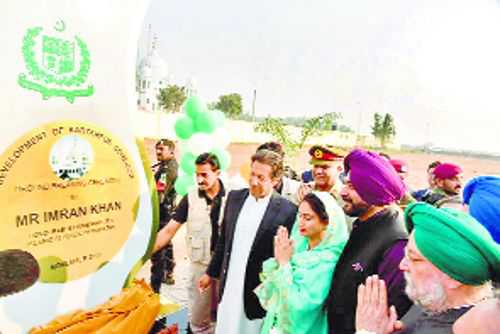
pakistan Prime Minister Imran Khan unveils the stone with Harsimrat Kaur Badal, Hardeep Singh Puri, Navjot Singh Sidhu and Pakistan army chief Gen Qamar Bajwa beside him. PTI

Kartarpur, November 28

Pitching for the normalisation of Indo-Pak ties, Pakistan Prime Minister Imran Khan today said his government, the army and all political parties in the country are on the same page to improve ties with India and asserted that all issues, including Kashmir, can be resolved with “strength and will” of leadership of the two countries.

Khan, who will complete 100 days in office on Thursday, laid the foundation stone for the historic Kartarpur corridor linking two revered gurdwaras on both sides of the border here and used the ceremony to reach out to India, favouring steps to improve strained ties.

He said if France and Germany can have close and friendly ties after the bitter history of fiercely fighting with each other, then why can’t India and Pakistan mend their relationship.

Khan mentioned Kashmir as the one major issue between the two countries but did not talk about cross-border terrorism, which India has been maintaining as a major stumbling block for resumption of talks between the two sides.

In New Delhi, the External Affairs Ministry criticised Khan for referring to Kashmir in such a pious ceremony and reminded Pakistan that cross-border terrorism is a major issue.

The event was attended by Union ministers Hardeep Singh Puri and Hasimrat Singh Badal and cricketer-turned politician Navjot Singh Sidhu. Praising Sidhu’s effort for peace between the two countries, Khan said he had become very popular in Pakistan and if he ran in elections here, he would win.

Khan said he understood the happiness of the Sikh community following the decision of both sides to develop the corridor linking Darbar Sahib in Pakistan — the final resting place of Sikh faith’s founder Guru Nanak — with Dera Baba Nanak shrine in India’s Gurdaspur.

“The happiness I see in you today, if I were to explain to my Muslim brother and sisters, is that imagine that you are standing 4 km outside Medina (a city in Saudi Arabia where the Prophet is buried) and cannot go in, and you are then given the chance to go. That is the happiness I see here,” he said. — PTI

Kashmir sole issue

  • We have one issue which is Kashmir. Humans have reached the Moon. Which issue can’t be solved? Can’t we solve one issue? We only need determined leadership on both sides. — Imran Khan, Pakistan PM

Regrettable: MEA

  • It is deeply regrettable that Pakistan PM chose to politicise the pious occasion meant to realise the long-pending demand of the Sikh community by making unwarranted reference to J&K. — MEA

Imran on Sidhu

  • I hope we do not have to wait till Sidhu becomes Wazir-e-Azam… I want a good relationship with India. People want peace… Pakistan will take two steps if India takes one step. — Imran Khan, Pakistan PM

clip

clip


Indigenous bomb for Air Force by March

Indigenous bomb for Air Force by March

Vijay Mohan
Tribune News Service
Chandigarh, November 23

By early next year, the Indian Air Force could be having a new indigenously produced bomb for use against high-vale targets like airfields, railway yards, fortified bunkers and docks.

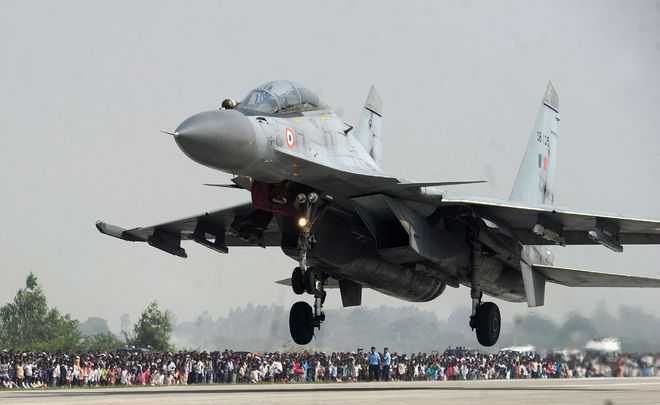
The Defence Research and Development Organisation has developed a 500-kg class bomb that would be manufactured by the local industry. “The design and development of the bomb has been completed and flight trials from Jaguar aircraft have already been undertaken,” a senior scientist said. “Certain trials of the bomb with the SU-30 fighter have been carried out and the remaining parameters would be evaluated in the coming weeks,” he added. Christened as the ‘500-kg General Purpose Bomb’, it is expected to be inducted into service by coming March or April.

The Defence Research and Development Organisation is looking at the private industry to transfer the technology for its commercial production. This is the heaviest bomb to be designed in the country so far. The bomb primarily consists of two main parts — the main body that would house the warhead and fuze and the tail unit with its fin assembly to stabilise its downward ballistic flight trajectory after release from the mother aircraft.

The bomb, made of specially forged high-grade steel, is about 10-ft in length and a little over a foot in diameter. It is expected to be armed with Torpex-4B type high explosive.