


Rescuers search for survivors at the site of a train derailment in Pukhrayan, south of Kanpur, Uttar Pradesh, on November 20, 2016.
REUTERS


Current Events :







New Delhi, March 10
A Parliamentary Standing Committee has slammed the Ministry of Defence for slow procurement of bulletproof jackets and expressed its unhappiness at the progress of the next generation Arjun tanks. It also questioned the slow pace of fighter jets’ acquisition for the Indian Air Force.The panel in its reports presented in both the Houses yesterday said “our soldiers continue to suffer due to the ‘insufficiency’ of BPJs (bulletproof jackets)”. The panel headed by BJP MP Maj Gen BC Khanduri (retd) said it “sternly wishes and hopes that the procurement of 1.86 lakh BPJs is made within a stipulated time frame, even though a huge deficiency of BPJs would continue to remain in the Army as compared to the requirement”. “The lives of our soldiers cannot be left in danger,” it said. The committee said the Army endured with a huge deficiency of arms and ammunition. The committee said it was ‘unhappy’ to find that the progress with regard to induction of Arjun Mark–II and termed it as ‘slow and tardy’.On the fighter jets, it said “It cannot help inferring that the intent of the government is not on the same trajectory as that of the Air Force”. — TNS

Beijing, March 6
Tibet’s second largest terminal began operations on Monday, officials said. The new terminal, the sixth to open in Tibet, is located at Nyingchi Mainling Airport, close to the India border. It covers an area of 10,300 square metres and will be able to handle 750,000 passengers and 3,000 tonnes of cargo throughput annually by 2020, Xinhua news agency reported.The airport is located close to the disputed Arunachal Pradesh border.China’s extensive development road, rail and air infrastructure in Tibet has sparked concerns in India because of possible military advantage.India has also initiated border infrastructure development in recent years.The Nyingchi airport will open new air routes to Xi’an, capital of northwest China’s Shaanxi province, resume routes to Beijing and increase more round trip flights to Lhasa, Guangzhou, Kunming, Chongqing and Shenzhen after the new terminal comes into service, said Liu Wei, deputy director of Civil Aviation Administration of China in Tibet.The airport has seen year-on-year increases in passenger flow since it was put into service in 2006. Passenger volume hit 390,000 in 2016, bringing the total passenger numbers to two million in the past years, Liu said, adding that the new terminal will effectively alleviate pressure brought by the growing number of passengers.Nyingchi is located in southeast Tibet at an average elevation of 2,950 meters above sea level. The city has attracted more visitors in the recent years due to tourist attractions such as its peach blossom festival, the report said. — PTI/ IANS
We want clarity about his death. I know he couldn’t commit suicide. We want a through probe. SAROJ, Roshan Singh A soldier hailing from Kal Banjara village near Lehragaga in Punjab’s Sangrur allegedly committed suicide by shooting himself with his service weapon in Lower Krishna Ghati sector of Poonch district on Sunday morning.
The deceased has been identified as Sepoy Roshan Singh, 35, of the 68 Engineering Regiment, who was posted with 39 Rashtriya Rifles in Poonch. The army has ordered a court of inquiry into the incident.
Roshan joined the army 14 years ago. Army and police authorities informed the family about his death on Sunday. The body will reach his native village on Monday where his last rites will be performed.
Roshan is survived by his wife Saroj and three children. The family lives in a one-room accommodation. Roshan’s parents are living with his brother.
Not able to come to terms with the tragedy, Saroj said the authorities informed the family that he sacrificed his life in line of duty. “I don’t know what happened with him,” she said.
“We want clarity about his death. I know he couldn’t commit suicide. We want a through probe,” Saroj added.
Tej Bahadur Yadav. — Photo courtesy: His Facebook account
New Delhi, February 27Asserting that his woes have gone unheard, Border Security Force (BSF) soldier Tej Bahadur Yadav in another video questioned Prime Minister Narendra Modi’s desire to eradicate corruption from the nation.
(Follow The Tribune on Facebook; and Twitter @thetribunechd)
Yadav who came in the limelight with his video on the quality of food
being served to the Army said after revelations made by him he is being subjected to torture and that no heed has been paid to the concerns raised by him.On January 9, the BSF soldier had posted a video alleging that sub-standard quality of food was being served to the troops.Yadav had also sought voluntary retirement from the force after posting the video online. However, his plea was rejected on grounds that a Court of Inquiry on his allegations was pending as also charges on disciplinary grounds against him.“I want to ask the Prime Minister, that the food quality I had shown in the video was true but despite no action has been taken. I am being harassed for posting that video. Why is this happening? It was the Prime Minister who wanted to eradicate corruption from the country and I have just shown an instance of corruption within my department. Is this the result of pointing out corruption,” he asks in his recent video.Responding to the reports where it was mentioned that Yadav had 17 per cent of his Facebook friends from Pakistan, he said his phone was seized on January 10 and that his social networking account has been used without his permission.“I came to know that my mobile phone has been meddled with and it is being said I have found some contacts of Pakistan. I request you to not believe in such false rumours unless I communicate to you directly through any video,” he added.Earlier, the BSF told the Delhi High Court that the allegations of sub-standard food made by Yadav were false and that no complaint was made in the matter.In a video that sparked outrage, BSF soldier Tej Bahadur Yadav of the 29 battalion Seema Suraksha Bal had stated that the troops are not even getting basic three square meals. — ANI
https://www.facebook.com/veteranjawans/videos/418272655182628/
~ Late Captain Saurabh Kalia
ORDERLY/batman/sahayak/buddy…these are terms to describe the same man. Who is he? He is one who has been, and remains, an intrinsic part of an Army officer’s life. Over the past few years, and more recently, he is mentioned in the media in a manner that gives a wrong idea to the civilian public. The idea being put across is that combat manpower is being misused for the benefits of officers and their families. There have been ripostes by some retired Army officers, mainly in social media, justifying the presence of a buddy (current term) in the retinue of an officer. Some mention the large number of men at the residences of police and IAS officers, being used for all kinds of domestic work, including cooking and house cleaning. It is a fact that police officers, DSP level onwards, use constables for domestic work and IAS officers at the district level maintain a large number of unauthorised staff at home. But I do not think an Army officer needs this to justify the allotment of his buddy. A batman/buddy is authorised to an officer because of the nature of his work in war and peace. It is a system which we have picked up from the British Indian Army. Although he is meant to look after the officer, he becomes a part of the family wherein the children call him ‘bhaiya’. Sometimes, he will see off/receive the kids at school bus stops. He is, however, never made to do menial work like cleaning the house or any kitchen work. This buddy forms a strong relationship with his officer that remains even after retirement. As a Commanding Officer, I had a number of buddies over a four-year period. After I retired, I was pleasantly surprised to get calls from them. They had retired and requested for help to get their sons recruited into the Army, or a job in the civil sector. I could never say no to their call for help. I felt it was my turn to be their buddy. So, I arranged for them to get good training for the recruitment tests. Some managed to join the Army, others got jobs in the civil sector. Recently my son, got married in the US, and we organised a reception in Delhi. He specifically asked me to invite his ‘bhaiyas’. I sent an invite to a couple of them. On the morning of the reception, I got a call from my old buddy, who had come all the way from his village in Bihar. I was overwhelmed. That evening, he came properly dressed to the Officers’ Mess, with a bouquet of flowers. My son, who had last seen him 30 years ago, embraced him. I made him sit with my regimental officers. When we parted company later that evening, it was with a big hug between two buddies. This is the buddy system of the Army. I do not think such a relationship exists in the civil services. Why compare?
CHANDIGARH: Two secret meetings set up between Rajiv Gandhi, then Congress member of Parliament, and militant preacher Jarnail Singh Bhindranwale in the run-up to Operation Bluestar were scuttled by then Punjab Congress chief minister Darbara Singh, reveals an upcoming book on Captain Amarinder Singh.
‘The People’s Maharaja’, an authorised biography of the erstwhile scion of Patiala royalty by young author Khushwant Singh, sheds new light on the sequence of political blunders that led to the 1984 army action at Harmandar Sahib – a catastrophic event which changed the course of the nation’s history.
Amarinder, who was a Lok Sabha MP at that time, had laid the ground for the Rajiv-Bhindranwale meetings on instructions from then Prime Minister Indira Gandhi in October 1982.
Realising that peace in Punjab could no longer be achieved without bringing Bhindranwale on board, she asked Amarinder to carry out back-end negotiations with the militant preacher, who was a ‘fellow Sidhu’ (both hail from the same Jat Sikh clan). Amarinder had not met Bhindranwale before. DARING MISSION
The 394-page book, slated for release on February 21, graphically reveals how on a freezing December night, Amarinder and his brother Malwinder Singh, armed with two pistols, drove to Bhindranwale’s native village, Rode in Faridkot district, on a secret mission.
Both brothers blissfully slept in Bhindranwale’s bed before the latter returned home past midnight. Amarinder broke the ice by bringing up the Patiala royal family’s historic ties with 10th Sikh master, Guru Gobind Singh.
Bhindranwale’s key demand was a meeting with Indira Gandhi on his turf in Punjab but later he agreed to see Amarinder’s Doon school mate Rajiv.
During the same meeting, the fiery preacher told Amarinder since the Patiala family had been blessed by his Bapuji, as he addressed the 10th Guru, no one will be allowed to harm them as long as he’s alive, says the book. ABORTED PLANS
On the first occasion, Rajiv and Amarinder were called back by Indira Gandhi from Delhi’s Safdarjung Airport just when they were about to take off in ‘godman’ Chandraswami’s aircraft for their destination.
Amarinder believes that intelligence agencies that had got a whiff of the meeting and conveyed the same to Darbara Singh, who contacted Indira Gandhi and convinced her that it was unsafe for her son to meet Bhindranwale.
Bhindranwale was infuriated at being ditched but he was persuaded after great efforts to give Rajiv another chance. But Rajiv did not turn up yet again. This time, Amarinder and Rajiv had even taken off from Safdarjung Airport only to be recalled midway.
The reason was the same as the last time. TESTY TIES WITH THE GANDHIS
Amarinder Singh sought an appointment with Sonia Gandhi, which she flatly declined. She was infuriated and refused to meet him for months together, as his step also involved the termination of the water treaty as prescribed in the 1985 Punjab Accord (signed by Rajiv Gandhi and Harchand Singh Longowal).
Eventually, after four months, a meeting did take place. Gandhi’s opening query was: “Why did you pass that Bill?”
“For the sake of peace,” replied Amarinder in his defence. He then shared his concerns if he hadn’t passed that Bill: “Ma’am you have lost your mother-in-law and husband to terrorism. Do you want to lose yourself and your children also,” he asked.
“If I hadn’t taken this step there was every possibility of history repeating itself. There would have been another Bhindranwale and another bout of terrorism if I had allowed the digging of the canal. The entire blame would have come on to you as the president of the Congress.”
Not convinced, Sonia asked him why he hadn’t asked her before introducing the Bill.
“Would you have allowed me ma’am?” countered Amarinder. Her answer was, “No”.
“That is why I didn’t seek your permission,” he said. The Congress president slowly cooled down.
SOLDIER TO SOLDIER: MEETING MUSHARRAF
“I hope we didn’t shoot at each other during the 1965 war,” was the unexpected opening remark made by General Pervez Musharraf when Amarinder called on the then Pakistan president in Islamabad on March 15, 2005. “Not at all, I’ve done some background check on you. You were in the 1 SP (self-propelled) regiment in the Sialkot sector and I was ADC to Lt Gen Harbakhsh Singh. But you do owe my brother-in-law, Major Kanwaljit Singh Dhillon, a leg.” “What did I do?” “It was your shooting… that knocked off his leg.”
After that, there was a peal of laughter in the room when Amarinder reminded Musharraf that he was senior to him in service. “Sir, your commission date is April 1964 and mine is June 1963, making me nine months senior.”
Once a cordial tone and tenor had been set and both were talking as one soldier to another, Amarinder took out a list of names. Handing the list over to Musharraf, he said: “Sir, before we move forward, I would appreciate it if you would consider this list. They are the names of my people languishing in Pakistani jails. Many of them have completed their jail terms.”
Musharraf took a prompt note and ordered the immediate release of 83 prisoners who had completed their terms and ensured they crossed the border along with Amarinder.
REVERSAL OF FORTUNES
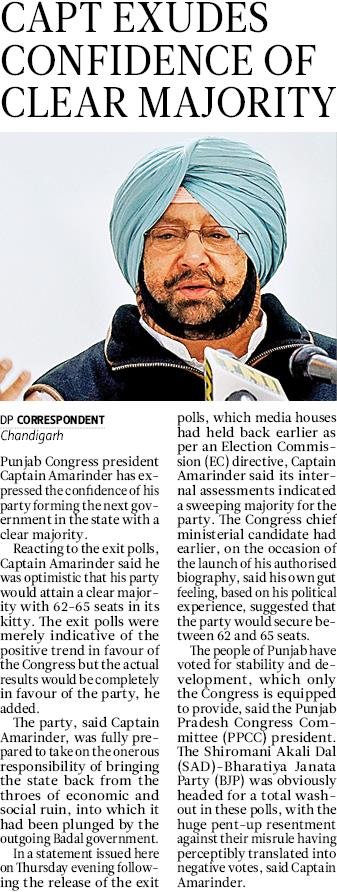
On the morning of March 6, 2012, in Chandigarh, when Amarinder stepped out of his bedroom to join aides to watch the Punjab assembly election results unfold on TV, he had mixed feelings. The presence of dholis, a cops and mediapersons reassured him that things would go well. Three hours later… “Can we order some sandwiches, please,” asked Amarinder. “Please make them vegetarian. There is a possibility that the results might turn around,” said the pandit sitting next to him, reciting a mantra. (The results were not going as expected by the Congress).
“Sir, please do as the pandit instructs,” said Bharat Inder Singh Chahal, who believed in soothsayers, and was probably responsible for bringing the astrologer.
“Pandit ji, we are half way through the results. The writing is on the wall. We have lost the election. At least let me have a chicken sandwich now,” said Amarinder. There was hushed laughter in the room but disbelief and shock were writ large on everyone’s faces.
“Sorry, Yuvie, I let you down,” chipped in Lt Gen Tajindar Singh Shergill, who had strategised a part of the election campaign and was earlier confident that the Congress would win close to 70 assembly seats.
“No worries Maun (Shergill’s nickname). You win some and lose some,” replied Amarinder and then got up and shook hands with his school buddy.
‘Can’t judge Amarinder by political successes or failures alone’
CHANDIGARH: An author of four books, a progressive farmer, a columnist, and a TV show host, Chandigarh-based Khushwant Singh wears many hats. But, in the past four years, he’s been increasingly sticking to one. He tells Manraj Grewal Sharma how he put everything else on hold to do justice to his latest, a biography, ‘Capt Amarinder Singh: The People’s Maharaja’.
What made you write this book on Amarinder?
It wasn’t my idea. Hay House (publishing company) had approached me before the 2012 Punjab elections. When I pitched it to him (Amarinder) three-four days after the Congress defeat, he asked who would read it. But then he agreed and the first interview took place
10-15 days later.
Was access a problem? Was it difficult to delve into his personal space?
No, he was cooperative, open and frank. I researched a lot and then framed my questions. We would chat for an hour or two before the trickle of people would begin. I must have read over 30 books besides the white paper on Punjab post-Operation Bluestar, old gazettes, and newspapers. I also interviewed his family members, friends, course-mates at the National Defence Academy (NDA), staff, and bureaucrats. The notes left by his German governess, Hede Dayal, with her son, Mickey Dayal, were particularly illuminating. I also got hold of his school reports.
Isn’t the title deferential?
I don’t think so. It was a working title, and it stuck. Also, people are really drawn to Amarinder. He used to be covered with blueblack marks while canvassing in Amritsar.
Did he ever try to control the book?
No, never. Not once did he ask me to delete or insert something. I corroborated all the information I got, and tried to make the narrative as accurate and objective as possible. I felt so much responsibility towards history, towards Punjab, towards the subject. Also, you can’t give Amarinder a report card based only on his political successes or failures. He has so many facets; he writes, reads, cooks, travels.
Why did Amarinder ally with Congress, perceived as the villain of the piece in Punjab after 1984?
Rukhsana Sultana (actor Amrita Singh’s mother) persuaded him to rejoin the Congress. He was in political oblivion after being refused a ticket by the Akali Dal in 1997. He had to park himself somewhere. For the Congress, he was the only face with which they could go to Punjab, given his heritage and resignation over Operation Bluestar (1984).
Why this timing of release?
It’s sheer coincidence. This project consumed four prime years of my life; it changed the way I look at Punjab; it made me mature. I never knew when it would end. I sent the manuscript to the publishers in August-September 2016.
New Delhi, February 18Army Chief General Bipin Rawat today visited injured CRPF Commanding Officer Chetan Kumar Cheetah and enquired about his health at the AIIMS Trauma Centre here. Cheetah had sustained grievous injuries in an encounter with militants in North Kashmir on February 14, following which he was airlifted to AIIMS, where he is battling for life.General Rawat visited Cheetah in the afternoon and enquired about his health from the doctors attending on him, AIIMS sources said. Yesterday, Union Minister Kiren Rijiju visited the centre to enquire about the condition of the injured CRPF officer. — PTI
ITBP to man Myanmar border? Cabinet security panel to decide
Assam Rifles may soon be replaced with the force guarding China border
Tribune News Service
New Delhi, February 18
The Indo-Tibetan Border Police may soon replace Assam Rifles on the Myanmar border as the Home Ministry has referred a related proposal to the Cabinet Committee on Security for its approval.Sources in the Home Ministry said the step was being taken in view of the recent unrest in Manipur as well as to allow free movement of people up to 16 km on either side of the border with Myanmar. The proposal to replace Assam Rifles with some other paramilitary force has been under consideration for long. The government had even constituted a task, headed by Joint Intelligence Committee Chairman RN Ravi, to work out the modalities. The panel had expressed concern over the infiltration of militants into India from their bases in Myanmar.The sources said the panel recommended replacing the Assam Rifles with ITBP, which had vast experience in guarding international border with China.In its report, the panel is learnt to have argued in the ITBP’s favour mainly on two counts: experience in dealing with border areas and the force requires its presence in plains so that it can rotate its personnel.The Home Ministry proposal, said sources, also stressed on streamlining the functioning of the Assam Rifles. At present, the force is under the administrative control of the Home Ministry while its operational control lies with the Defence Ministry. The dual control is learnt to be creating serious problems for the force’s smooth functioning and experts have suggested that it be brought under a single ministry.
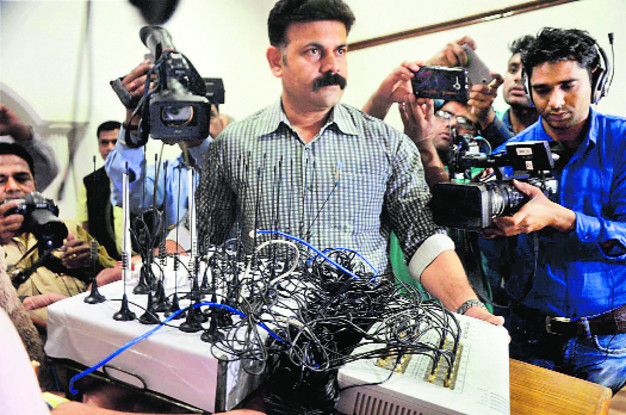
The arrest of several Hindu youths in UP and Madhya Pradesh in the fake phone exchange racket points to a dangerous cloak-and-dagger operation, where military secrets were being compromised
Rescuers search for survivors at the site of a train derailment in Pukhrayan, south of Kanpur, Uttar Pradesh, on November 20, 2016.
REUTERS
Sometime in later half of last year when Indo-Pak tensions peaked, military operation heads in J&K received unusual calls on their landlines. The callers posed as senior officers from Delhi ‘headquarters’ and asked for details such as troop movement and deployment. Military sources say at least half-a-dozen such calls were made, and barring the last one, the officers on duty provided the information sought by the caller(s). “The sixth call was received by a Major, who grew suspicious and hung up. Later he called up the officer concerned in Delhi to inquire if he had indeed made a call. When he got a negative response, the Military Intelligence was alerted,” said a senior Army officer.Military Intelligence personnel then checked the call details and tried to find locations of the calls. Nothing could be ascertained. Some ‘unverified technical indications’ pointed towards Uttar Pradesh and Madhya Pradesh. The Anti Terrorist Squads (ATSs) of the two states were tipped off.In a few weeks, the ATSs busted a racket running fake telephone exchanges to route international calls as local through VPN (Virtual Private Network) server locations and 16 Simboxes. The kingpin is said to be Gulshan Sen, who operated behind the façade of a fake coaching centre in the Mehrauli area of Delhi. He gave his interrogators several leads, which led to 10 more arrests from Lucknow, Sitapur and Hardoi districts in Uttar Pradesh. Similarly, in Madhya Pradesh, Dhruv Saxena and his friend Mohit Agrawal were arrested. The two ran a call centre ‘Vocal Heart Infotech Pvt Ltd.’ The state ATS arrested 11 more persons. Intelligence sources said all of them were working for Pakistan’s Inter Service Intelligence and were facilitating calls from Pakistan, Afghanistan, Dubai and several other countries. These international calls appeared local to the receivers. A major cause for concern for the security set-up is the fact that all the accused (total 24) belong to the majority community. Sleuths of Intelligence Bureau (IB), National Investigation Agency (NIA) and the police are now trying to assess the extent of ISI penetration in India.“For long there had been an ISI pattern of luring disgruntled Muslim youths into terror activities. But now it is different,” a senior IB official said. An NIA officer said: “Even those who have been arrested for their involvement in train accidents in Kanpur and planting bombs on rail tracks at Ghodasand in Motihari district of Bihar belong to country’s majority community. These accused, too, had ISI links through a conduit, Brij Kishore Giri, who worked as a front for one Nepal-based Shamul Hoda, who provided money for the subversive activities across India.”The trend shows the ISI changing its tactics in which criminal elements, irrespective of their caste and religion, are now on its radar. “They are aiming at unsuspecting elements to dodge Indian security agencies,” said a former top Home Ministry official. He said it was time for Indian agencies to “re-haul” their strategy and keep a close watch on criminal elements, irrespective of their religious affiliation, so that terror modules are busted well on time. Those arrested in UP in connection with fake telephone exchanges include Rahul Rastogi, Shivendra Mishra, Harshit Gupta, Vishal Kakkad, Rahul Singh, Vinit Dikshit, Rishi Hora, Shyam Babu, Uttam Shukla and Vikas Verma, besides their kingpin Gulshan Sen.Similarly in MP, Blram Singh ( having direct links with ISI operatives in Pakistan), Kush Pandit, Jitendra Thakur, RiteshKhullar, Jitendra Singh Yadav ,Trilok Singh were arrested by the state ATS.In Bihar too, the state police arrested Moti paswan, Mukesh Yadav and Uma Shankar Prasad while they were planting a pressure cooker bomb on the rail track near Ghodasand in Motihari district.