Sanjha Morcha

What’s New

Click the heading to open detailed news

Current Events :

web counter

Print Media Reproduced Defence Related News

Army to induct K9 Vajra, M777 howitzers today

Army to induct K9 Vajra, M777 howitzers today

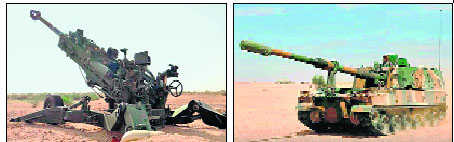
Army to get 7 regiments of 145 M777 howitzers (L) and 100 K9 Vajras

New Delhi, November 8

Defence Minister Nirmala Sitharaman will attend a ceremony on Friday to induct new artillery guns and equipment, including K9 Vajra and M777 howitzers, at Deolali artillery centre in Nashik, a ministry spokesperson said.

The induction of 100 K9 Vajra at a cost of Rs 4,366 crore is to complete by November 2020. The first batch of 10 guns will be delivered this month, Defence Ministry spokesperson Col Aman Anand told reporters on Thursday. The next 40 guns will be delivered in November 2019, and another 50 in November 2020, he said.

The first regiment of K9 Vajra, first-ever artillery gun manufactured by the Indian private sector, is expected to complete by July 2019.

The gun has a maximum range of 28-38 km. It is capable of burst firing three rounds in 30 seconds, intense firing of 15 rounds in three minutes and sustained firing of 60 rounds in 60 minutes, he said. The Army is also going to raise seven regiments of 145 M777 howitzers.

Five guns each will be delivered to the Army beginning August 2019 and the entire process will complete in following 24 months. The first regiment will complete by October next year, the spokesperson said. The gun, having a range of 30 km, can be moved to a desired location using helicopters and service aircraft. Compact gun tractor to tow 130 MM and 155 MM artillery guns will also inducted during the ceremony, the officer said.

It is fitted with a crane that can handle ammunition weighing two tonne. — PTI


Opening the doors Commonwealth soldiers for UK forces

Opening the doors

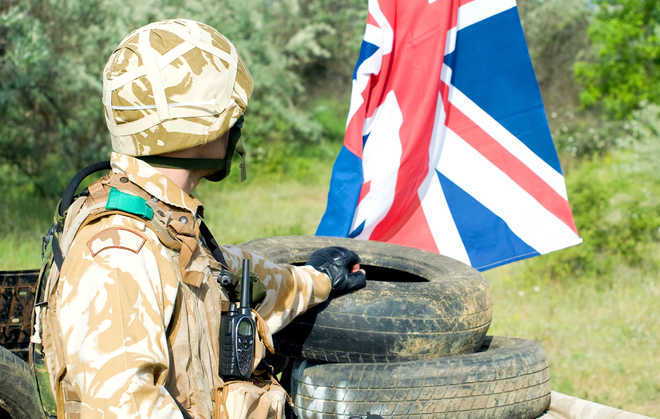
ON the eve of the World War I armistice centenary, the British government has announced that it is opening its doors wider for soldiers from Commonwealth nations to be enlisted in the UK armed forces. Before we get to that, let’s look at the conditions under which 15 lakh soldiers from India fought in the Great War. World War I commemoration events showed how the soldiers, disproportionately large number of who were from this region, faced brutality, racial discrimination and prejudice even as they fought heroically on battlefields in Europe and Africa, where an estimated 34,000 made the ultimate sacrifice.

Indians do not fight under a foreign flag, although persons of Indian origin who are citizens of other nations have long distinguished themselves in foreign armies. This is not going to change. The British Army, however, has maintained a component of Gurkha soldiers for over two centuries, but it was only in 2014 that these soldiers were allowed to settle in Britain after they had served their term. There have also been issues about their pay and pensions.

Unlike India, certain Commonwealth countries contribute soldiers to the British armed forces, but the 200-a-year cap was lifted in the face of a shortage of 8,200 personnel. Yes, this is not quite a floodgate, but then the British armed forces have been slow to change. Women were allowed to apply for all positions in the armed forces only last month. The new recruitment effort has come about because of a chronic shortage of candidates, which people from the Commonwealth countries are likely to fill. Naturally, such a move would also allow for more diversity, which is needed. The British army has to evolve with the times and needs fresh blood, but the irony of opening doors of the most vital and strategic arm of the country at a time when the political and rhetorical tide is against immigration, can’t be missed.


Lt Gen Ranbir Singh reviews Valley security

Lt Gen Ranbir Singh reviews Valley security

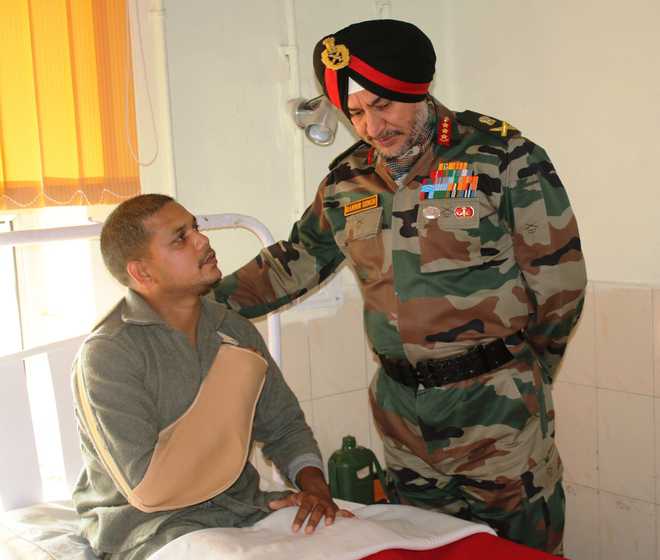
Lt Gen Ranbir Singh at the Army hospital in Srinagar on Monday.

Tribune News Service

Srinagar, October 29

Northern Command chief Lt Gen Ranbir Singh on Monday reviewed the security situation in Kashmir.

Lt Gen Ranbir Singh arrived in Srinagar on a two-day Valley visit and reviewed the prevailing security situation in the wake of the recent anti-militancy operations which have led to the elimination of a number of militants.

Accompanied by Chinar Corps Commander Lt Gen AK Bhatt, the Northern Command chief visited the formations and units in central Kashmir and was briefed by the Army officers about the current security situation.

“The Northern Command chief commended the troops for their dedication to duty and high standards of professionalism. The need to be prepared for effectively meeting the emerging security challenges was also reinforced,” an Army statement said.

The Northern Command chief also visited 92 Base Hospital at the Badami Bagh Cantonment in Srinagar and enquired about the health of the injured soldiers. He wished them speedy recovery, the statement said.


India seals S-400 missile deal with Russia Delhi’s balancing act to keep ties with Moscow and Washington

India seals S-400 missile deal with Russia

Ajay Banerjee
Tribune News Service

New Delhi, October 5

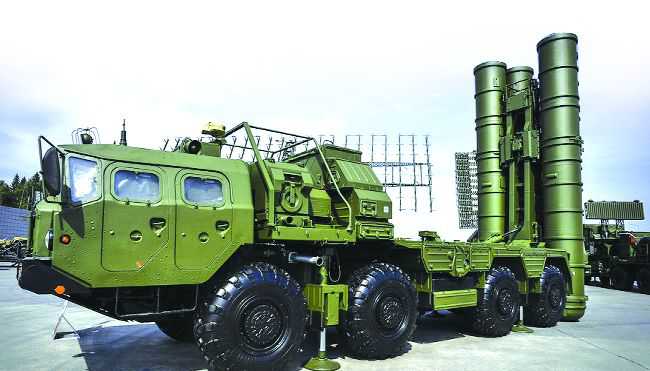
Ignoring threat of US sanctions, India on Friday went ahead with the deal to procure the S-400 “Triumf” air-defence missile system from Russia. The move comes a month after India and the US signed an agreement on exchange of military information — Communications, Compatibility and Security Agreement (COMCASA).

An Indo-Russian joint statement after the Narendra Modi-Vladimir Putin meeting in New Delhi read: “Both sides welcomed the conclusion of the contract for the supply of the S-400 long-range surface-to-air missile system to India.”

The move is a clear indication of the balance India has maintained between Russia and the US. The Tribune was the first to report in its September 7 edition that despite inking COMCASA, “India will run the course its military relations with Russia”.

India has a strategic partnership with the US  but has made it clear to Washington that India-Russia military relations  stand separate from India-US ties and that these are not inter-connected.

The US, in June, passed the Countering America’s Adversaries Through Sanctions Act (CAATSA) that requires imposing curbs on nations that have “significant” defence relations with Russia.

There is a provision for a waiver and New Delhi has argued out its case to the US. The US has reacted to the S-400 deal saying “the intent of CAATSA is to impose costs on Russia and is not intended to impose damage to the military capabilities of our allies (India)… The waiver authority is not a blanket waiver. Waivers are considered on transaction basis. We cannot prejudge any sanctions decisions”.

Alexander Mikheev, who heads Rosoboronexport, the Russian state-controlled intermediary for export of arms said “contract for S-400 is the biggest (ever) between Russia and India and the largest in the history of Rosoboronexport. Today we begin to execute it”.

Among the 39 entities listed by the US on the ban list is the Rosoboronexport.

India is buying five systems costing some $5.4 billion. These will provide an “umbrella coverage” against any air-borne threats, including nuclear missiles, stealth aircraft, fighter jets, missiles, UAVs etc. The radars on ground can track around 300 targets and then guide missiles to shoot down around three dozen targets simultaneously over a range of 400 km.

For example, an S-400 system deployed near Jalandhar in Punjab can track aircraft flying well over Islamabad and Peshawar in Pakistan. Moscow is the single largest supplier of weapons and military equipment to India. The Stockholm International Peace Research Institute (SIPRI), on March 12 this year, released its annual report “trends in international arms transfers”. Making an assessment for a five-year block (2013-2017) it said Russia accounted for 62 per cent of India’s arms imports.

India, Russia ink S-400 deal; no sanctions on ally, says US

NEW DELHI: India on Friday hammered out a ~39,000-crore deal for five S-400 Triumf air defence missile systems with Russia during the annual summit between the two countries led by Prime Minister Narendra Modi and visiting President Vlamidir Putin.

The deal has been inked despite concerns flagged by the US, which has slapped sanctions on Russia, about the purchase of the missile systems capable of knocking down jets, missiles and unmanned aerial vehicles at a range of 400km. New Delhi is seeking a sanctions waiver, given that Russian-origin weaponry is in widespread use in the Indian armed forces.

The two sides “welcomed the conclusion of the contract for the supply of the S-400 longrange surface-to-air missile system to India,” said a detailed joint statement issued after the two leaders met for the 19th edition of the summit.

The US passed the Countering America’s Adversaries Through Sanctions Act earlier this year, and said countries trading with Russia’s defence and intelligence sectors would face automatic sanctions under the sweeping legislation. State Department spokesperson said this week that the implementation of the sanctions act would be focused at countries acquiring weapons such as the S-400 missile batteries. Last month, the United States imposed sanctions on China’s military for its purchase of combat fighters as well as the S-400 missile system it bought from Russia this year.

After Friday’s landmark deal was signed, the US embassy said the sanctions were aimed at punishing Russia and not to damage the military capabilities of its allies, indicating that India would be spared from the sanctions.


Joint Indo-US Army exercise concludes at Chaubattia

The fortnight-long 14th Indo-US joint Army exercise in ‘Yudh Abhyas’ series, at Chaubattia in Uttarakhand’s Almora district saw one infantry battalion—350 soldiers—each carrying out field training drills under a joint brigade headquarters, an Indian Army spokesperson said.

The exercise that concluded on Saturday saw participation of US Army’s 1st Battalion of the 23rd Infantry regiment. It was the fourth such exercise at Chaubattia, the spokesperson added.

The Yudh Abhyas series started in 2004 under US Army Pacific Partnership Programme.

“Over the years, the two countries have decided to progressively increase the scope and content of the combined exercise,” said an Indian Army officer.

The commanders and staff officers of both sides worked in close coordination to receive and collate intelligence to issue suitable operational orders. The combined field training components executed these orders in simulated realistic situation, the spokesperson said.

The exercise curriculum, the spokesperson said, was planned progressively where the participants were initially made to get familiar with each other’s organizational structure, weapons, equipment and tactical drills.

The training culminated in a 48-hour consolidation and validation exercise in which troops carried out a daring rescue and destroy mission in the general area of Pilkholi near Chaubattia.

The final exercise was reviewed by senior officers from both sides, the spokesman added. — IANS


Eastern command posting puts Lt Gen Mukund Naravane in reckoning for top army job

NEW DELHI: A game of musical chairs is being played with the top brass of the Army with an officer who was relegated to a training command being shifted to the operationally sensitive East to give him a shot at the top post of Army chief next year.

Lt Gen Mukund Naravane, who was posted as the head of the Army’s Training Command in December last year, would be the senior most officer of the Indian Army when General Bipin Rawat retires next year. While in the past the seniority principle ..

Read more at:
//economictimes.indiatimes.com/articleshow/65864869.cms?utm_source=contentofinterest&utm_medium=text&utm_campaign=cppst

Artists claim bias against WW-I Indian soldiers

London, September 23

A group of Indian artists, in the UK to mark the centenary of World War I, has claimed they have uncovered documents that reveal bias against the Indian sub-continent soldiers fighting alongside the British Army in the 20th century war.

The Delhi-based artists from the Raqs Media Collective told the ‘Observer’ that papers from the British Library revealed the British forces systematically neglected to treat psychological problems among Indian soldiers and adopted unequal measures in the care of soldiers traumatised by their experiences from the battleground.

“The condition of shell shock was first diagnosed in 1915 by the English doctor Charles Meyers. But documents we found show Meyers quickly dropped the term because it was feared ordinary soldiers would find it easy to understand and so would ask to be seen by medics,” said Shuddhabrata Sengupta of Raqs.“Insted, Meyers suggested a more opaque diagnosis of NYD, or Not Yet Diagnosed — Nervous, which ordinary soldiers would find harder to use,” he said. Sengupta’s team is working on a new art project at Colchester in Essex, commissioned to commemorate the end of World War I — being marked in the UK since 2014 and set to end in November this year.

The term “trench back”, which features in their new installation ‘Not Yet At Ease’, was often adopted to describe symptoms that were actually psychological. “The idea of ‘trench back’ was derived from the condition of ‘railway back’, which was used for people who were thought to have been upset, or jolted, by the speed of rail travel,” said Sengupta. “It was a way of talking about wounds or damage to the spine, instead of mental health. ‘Trench back’ was supposedly caused by being knocked by falling debris in the trenches.”

Records show 1.3 million soldiers from undivided India served in WW-I as part of the British Indian Army. — PTI


The price of ‘national security’ by Shyam Saran

The phrase is misused by predatory States to wield power without responsibility

The price of ‘national security’

Hush-Hush: The 2013 Task Force on National Security report was never made public.

Shyam Saran
Former foreign secretary

The term ‘national security’ is a convenient catch-all for governments which wish to justify policies which abridge the rights of citizens. It is often used to deflect the need for transparency and hide incompetence and misgovernance. The shortcomings in one’s own defence preparedness and intelligence capabilities are camouflaged in the noise of blaming adversaries for their aggressive behaviour. Even when the spotlight is turned on one’s own failures in safeguarding national security, reports are kept from public scrutiny because, ironically, they may ‘compromise’ national security. Historians are denied access to archives even when these are decades old because, again, national security may be undermined. In sum, this means that citizens cannot be trusted with knowledge that might actually permit them to assess the performance of those who govern in their name. ‘National security’ is a magic phrase which allows predatory States to wield power without responsibility. In an age of international terrorism where citizens are rightfully fearful and anxious it has assumed even greater potency.

This phenomenon has become pervasive across the world, affecting democracies and non-democracies alike, though there may be differences of degree. But its impact is most corrosive in democracies as it erodes individual fundamental  rights which lie at the heart of democracy. The worst abuse of citizen’s rights appears to require no justification beyond citing national security.  Even courts are loath to question government actions when this phrase is bandied about darkly. India has not been immune to this international trend and successive governments have found this a convenient way of encroaching on the constitutional rights of citizens and evading responsibility for actually endangering national security through acts of commission and omission. Even on issues that do not directly relate to national security, such as data on river flows, public access is denied because such data is deemed to be ‘sensitive’. It should come as no surprise that we never seem to learn from our mistakes. Transparency is fundamental to democratic governance because only with transparency is accountability possible. And contrary to what governments may believe, it is the lack of transparency and accountability which represents one of the most significant threats to security. Behind this penchant for opaqueness lies the constant neglect of what is really required to safeguard the nation’s interest. Opportunities for corruption exist because facts can be hidden on grounds that national security may be compromised. This has been evident in several defence deals over the years. Governments make bona fide mistakes in managing security, but responsible governments submit themselves to scrutiny from respected and credible non-governmental entities to ensure that mistakes are exposed and acknowledged and remedial action taken. But even when governments have subjected themselves to such scrutiny they baulk at making  reports public. Even Parliament does not get a chance to exercise its role as a public sentinel.

The Task Force on National Security, whose very comprehensive report on both domestic and external security was submitted in May 2013, was never put in the public domain. If the UPA government was wary of doing this, so has been the successor government. It is argued that publicising the report may alert our adversaries to our security gaps and that the government is taking action to implement its various recommendations. This is a specious argument. Without transparency there is less incentive to move with a sense of urgency to implement corrective measures and this is quite apparent in our continuing failure to deal with cross-border terrorism or to eliminate left-wing terrorism. It is really the weakness in governance and political corruption which have undermined our security. We should condemn Pakistan for engaging in cross-border terrorism,  but why is there little or no focus on drug smuggling and contraband trade which facilitate such breaches of our border defences? Security forces are deployed to defeat left-wing extremism, yet its economic and social dimensions are ignored. Without acknowledging this, it is difficult to see how the Naxal challenge can be met, whether in its rural or urban manifestation. Detaining social activists who raise such uncomfortable questions about the State’s misgovernance and its pursuit of discriminatory policies against the most underprivileged citizens of our country is not going to promote national security.

Political sensitivity and desire not to be held responsible for failure are often the reasons for lack of transparency. But it is this political tendency which is most responsible for creating an insecure and vulnerable state. In-house inquiries do not deliver results because those guilty of mismanagement and even dereliction of duty are unlikely to make an honest assessment of their own failings or suggest reforms which may come at the cost of their personal or organisational interests. This is the reason why the constant examination and review of India’s security institutions and processes cannot be left to the discretion of political leadership or be subject to the veto of security agencies who have no interest in exposing their own failings and weaknesses. Finally, this points to the crying need for an Indian national security doctrine which alone can provide  a long term assurance of security in an era of rapid change. Ad hoc responses coloured by political compulsions will not do anymore. 


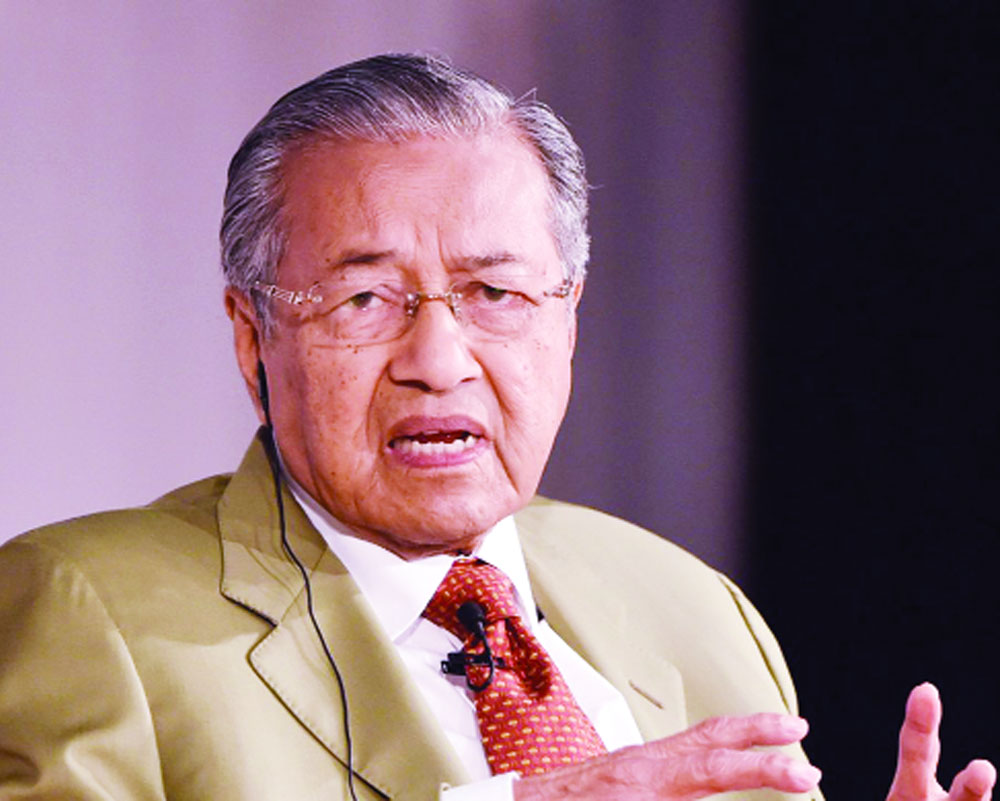
Mahathir’s spoke in the Chinese jugular BY LT Gen Bhopinder Singh

Mahathir’s spoke in the Chinese jugular

In calling the bluff on Chinese investments and recusing his country from earlier deals, the Malaysian Prime Minister may have eased India’s own concerns on Chinese presence around Malacca Straits

At 93, Mahathir Mohamad’s political career has spanned over 70 years and the wily nonagenarian has returned as the Malaysian Prime Minister after an itchy retirement lasting 15 years. The statesman, credited with transforming Malaysia from an agrarian to an industrial powerhouse in his first term of 22 years, has ostensibly returned to ‘save’ his country from the wrath of the multi-billion ‘1MDB’ scandal, substantial parts of which were linked to the Chinese involvement. Mahathir’s successful electoral campaign, pitched against the ‘great-grandmother-of-all-scandals’, was seen as a possible roadblock to the growing portents of Sinosphere under the previous Najib Razak regime, who had started courting mammoth Chinese investments into Malaysia.photo

Meanwhile, the Chinese have been on a relentless prowl to hook cash-strapped countries with its gargantuan Belt and Road Initiative (BRI) to create uninterrupted routes, connectivity and infrastructure along both land and seaways. The Chinese juggernaut towards this proposed solidification of interlinkages has led to infamous belligerence and appropriations in the South China Seas and the ‘String of pearls’ ports that dot along the life-sustaining maritime passages. The approach of the Chinese efforts varies from the simple ‘cheque-book diplomacy’ of funding investments (eg Philippines), coercion (eg Doklam in Bhutan) to surreptitious ‘debt-traps’ (eg Hambantota port in Sri Lanka).

A lethal and irresistible combination of financial, military and diplomatic muscle is leveraged to ensnare and ensure the requisite Chinese footprint. Often, this Chinese footprint initially comes under the guise of civil facilities and infrastructure, which later morphs into the dual-usage (civil and military) platforms, as was done recently at the mouth of the strategically placed Djibouti base of the Chinese Navy. The sophisticated pattern of patiently luring the bait follows the generous doles of ‘unpayable’ Chinese investments, which are, thereafter, settled with certain compromises in the form of invaluable bases, arrangements and irretrievable alignments. Recently, this had led the old warhorse and one-time critic of the West, Mohamad Mahathir, to presciently forewarn of the Chinese tact as a new version of colonialism.

Malaysia and the southern tip of the Indian Islands of Andaman and Nicobar overlook and physically dominate the most sensitive and vulnerable chokepoint of Chinese nightmares in the Malacca Straits. This ultra-narrow straits host the busiest shipping lanes in the world with over 100,000 ships plying nearly 30 per cent of the global trade. From a Chinese perspective, it sustains the ‘Chinese Dream’ fueled by trade and an unending appetite for energy sources. A potential doomsday scenario of a ‘choke’ in the Malacca Straits has led to two strategic actions: First, to attempt creating alternate corridors like the China Pakistan Economic Corridor (CPEC) or rail-linkages with the Eurasian nations, all dovetailed under the BRI initiative. Second, to invest disproportionately in the Strategic Petroleum Reserves (SPR) to create adequate energy buffer stocks to withstand any unforeseen disruption in these regime-sustaining seaways. However, given the best economic viability of the seaways as opposed to overland routes, the essential preference remains on ensuring the uninterruptedness of these seaways by way of establishing strong Chinese footprints all along the route.

Given that only India and Malaysia have the maritime real-estate around these vulnerable Malacca Straits (as narrow as 1.5 nautical miles wide at the Philips Channel) both from a sovereign and military perspective, any untoward presence of the Chinese could upset the applecart of power balance. Currently, this area is relatively free from overt militarisation, given that the traditional Chinese naval muscularity is restricted further up in the South China Seas and the Indian Andaman and Nicobar Tri-Services Command has also adopted a defensive posture and build-up. However, the presence of Chinese warships could undo the equations as they are threatening to do so in the Maldives, or in the Hambantota port in Sri Lanka, where the Chinese have acquired port control for a 99 year lease. Till the recent change in the Malaysian regime, amongst various investments that the Chinese were dangling was to invest $7.2 billion in the redevelopment of the Malaysian Malacca Port to a deep sea port (capable of handling aircraft carriers), a promise that could rival Singapore port facilities. This had the signature Chinese debt traps written all over it, which could ultimately lead to Chinese presence in these calm waters.

The sagacious Mahathir had to walk the tight rope of calling the bluff of Chinese investments, as also recognising the importance of maintaining cordial relations with its biggest trading partner. His first port of international call after assuming prime ministership was Beijing, where he was feted and honoured with the disconcerting realisation that Mahathir had personified the anti-Chinese sentiment and had to be charmed for future acquiescence. However, age hadn’t withered the blunt Mahathir who lost none of his chutzpah in declaring on Chinese soil, “We are not against Chinese companies, but we are against borrowing money from outside and having projects which are unnecessary, and which are very costly”, after he had announced the cancellation of three major Chinese contracts for an East Coast Rail Link and two gas pipelines, arguing the cost was inflated and the terms weren’t favourable to Malaysia. The Chinese are not known to take sleights of colonialism very easily but are cognizant of the fact that Mohamad Mahathir at 93 will be resolute on sovereign pride, independence and legacy that could militate against Chinese ambitions and debt-imperialism.

With a spiralling debt of $250 billion, declared concern on Chinese intent and non-issues with the existing infrastructure around Malacca Straits, Mohamad Mahathir may have inadvertently eased India’s own concerns on Chinese presence around the Malacca Straits. Even his remark that “free trade should also be fair trade” had unmistakable pointers of correcting the ‘China-first’ approach that dominated the Malaysian narrative. Mahathir will be welcomed into comity of the Sino-wary nations in the Asean region and will find alternate trading partners in the Japanese, Indian and Australian markets, who have their own long-term concerns and apprehensions with the formula of initial Chinese benevolence and its subsequent aftermath.

(The writer, a military veteran, is a former Lt Governor of Andaman & Nicobar Islands and Puducherry)



China wants to ‘keep alive’ border dispute, says parliamentary panel

China wants to ‘keep alive’ border dispute, says parliamentary panel

Ajay Banerjee

Tribune News Service

New Delhi, September 16

China seems to be interested in keeping alive the boundary dispute with India, a parliamentary panel has said. An overarching “border engagement agreement” should be concluded between the armies of the two counties, it has suggested.The panel, headed by former Minister of State for External Affairs and Congress MP Sashi Tharoor, said: “It is difficult for the committee to escape the perception that China sees it as being in its interests to keep the (boundary) dispute alive indefinitely for the purpose of throwing India off-balance whenever it so desires.”

Till such time as a definitive solution can be negotiated, maintenance of peace and tranquillity in border areas is an important pre-requisite for the smooth progression of bilateral relations.The committee said: “It would strongly desire that a comprehensive Border Engagement Agreement is concluded between the Indian Army and the PLA (Peoples Liberation Army)”.

This, it says, should subsume all established mechanisms for confidence building, including border personnel meetings, flag meetings, meetings of the Working Mechanism for Consultation and Coordination on border affairs (WMCC) and other diplomatic channels.

Since Parliament is not in session, the panel presented the report “Sino-India relations, including Doklam, border situation…” to the Speaker Sumitra Mahajan on September 4.

The committee requested “Direction 71A of the Directions by the Speaker” with the request to permit the printing, publication and circulation of the report under Rule 280 of the rules of procedure and conduct of business in the Lok Sabha. The report was made public on September 12.

It has suggested that baseless claims made by China on the limits of the boundary with India need to be fully exposed before the international community. These claims are devoid of any amount of credibility or justification.