
















Sanjha Morcha

What’s New

Click the heading to open detailed news

Current Events :

web counter

Print Media Reproduced Defence Related News

S Nihal Singh :::Distressing trends in our democracy

2015_12$largeimg18_Friday_2015_230409283
Intelligentsia must show the way

THERE have been rough patches in the functioning of parliamentary democracy in India — the roughest was of course the Emergency of the seventies — but seldom has the functioning of the two Houses been held hostage to serve partisan party purpose quite in the manner we are witnessing. Besides, the level of public discourse has reached a new low.There was the infamous boast of Ms Sushma Swaraj, then in the Opposition, before the beginning of a session that she would not let Parliament function for a day until her demands were met. And she proved true to her word. That benchmark has not been breached but the sorry spectacle of the Congress, seeking to emulate Ms Swaraj has presented an unedifying spectacle.  The Indian political world is out of joint. With all its imperfections, democracy has been functioning and a central part of the system has been Parliament. Prime Minister Narendra Modi in his avatar as chief minister of Gujarat succeeded in marginalising the state Assembly in achieving his goals, but this method cannot be replicated at the national level.  Indeed, we have reached the point when blaming one party or the other will not lead us anywhere. Rather, the need of the hour is to evolve a new consensus among all parties that disrupting Assembly or parliamentary proceedings is taboo. And civilised political discourse must have limits. The terminology employed by the Delhi Chief Minister, Mr Arvind Kejriwal, in scoring points against Prime Minister Modi was reprehensible.  What has led to this sudden explosion of invectives and tempestuous parliamentary proceedings that mocks the Westminster model we have borrowed. Nobody expected the Indian system to work quite like the British model. But Jawaharlal Nehru and his colleagues, many of them Western-educated and -influenced, did try to maintain a measure of decorum. The homegrown lot who followed the first generation of rulers did not hold legislatures in similar reverence.  A second reason for the turmoil and high-pitched verbal battles is the change of government in New Delhi. Mr Modi is a combative leader and does not follow the rules of the game. As Prime Minister, he has been the principal campaigner for his Bharatiya Janata Party in state Assembly elections, injecting bitter personal attacks on his political opponents to create a confrontational atmosphere.  The shrillness of the debate is also due to the travails of the Congress, a party whose perennially-in-waiting leader Rahul Gandhi has proved unequal to his task. With Ms Sonia Gandhi still seeking to groom her son for leadership, the party is, in a sense, leaderless.   There is no short-term prospect of a solution to the prevailing crisis because there is no overarching leader in the shape of a Mahatma Gandhi or a Jayaprakash Narayan who can knock heads together. The intelligentsia or the middle class is too feeble to call squabbling parties and leaders to order.   Logically, the Prime Minister, who is the leader of the country, should take the lead in calling for a reversion to more civilised norms of public debate and functioning of Parliament. But he himself is a combatant and his public persona does not lend itself to a meaningful mediator’s role.   Who then will bell the cat? Willy-nilly the intelligentsia must give the lead, despite its weaknesses. Indeed, the only solution is to help create a mass movement that will compel our legislators to earn their keep and perform the tasks they were elected for. There must be financial penalties for disturbing parliamentary and Assembly proceedings and citizens’ committees to police legislative proceedings. We could have the equivalent of lok adalats to assess individual and collective performance. If this portends direct democracy, so be it.   We must treat the prevailing crisis as a national emergency. It is fashionable to make light of the squabbles and name-calling in the functioning of our legislatures but their consequences can be deadly. It is true that many members of the middle class are more comfortable in holding armchair discussions than in leading a movement, but they must now rise to the occasion to lend their resources and skills to reform the political class.   Television has a special role to play in this campaign because of its reach and the nature of the beast. It is inherent in the medium to highlight squabbles and confrontations, which take up a disproportion amount of space. Yet as responsible members of society, TV bosses must annotate their visuals with meaningful discussions and commentaries condemning the misdemeanours of all parties. Writers made themselves heard recently by returning their awards as marks of protest against growing intolerance in the country.  They have an even more important role to perform in highlighting the back-breaking cost of non-functioning legislatures and Parliament to the public exchequer. Legislators are not doing a favour by performing the tasks they were elected for.  All politicians must also recognise that name-calling and use of vulgar language redound to their discredit. They do no credit to him and her and the political party he or she belongs to. In recent times, the level and frequency of invectives are becoming something of an epidemic.   If Mr Kejriwal calls himself an anarchist, he has no place as the leader of a party in the legislature or the chief minister of a state. Anarchy and parliamentary democracy do not go together. If his self-description was more in the nature of a populist slogan, he should be more careful in expressing his feelings and refrain from crossing the red line in abusing the Prime Minister.Have we reached the end of the road? That remains to be seen but the dangers of the path our politicians are employing are growing by leaps and bounds. After all, the distinction between democracy and anarchy is the distinction between political discourse and the lathi (force). This vital distinction has been blurred. It is therefore the duty of the middle class and all thinking men and women to show our politicians the way.


CBI probe ordered against two Maj Generals

Ajay Banerjee,Tribune News Service,New Delhi, January 28

2016_1$largeimg28_Thursday_2016_185211200

The Ministry of Defence has ordered a probe by the Central Bureau of Investigation (CBI) against two serving Major Generals of the Indian Army for allegedly having disproportionate assets.Defence Minister Manohar Parrikar today ordered the probe against Maj Gen Ashok Kumar and Maj Gen Surinder Singh Lamba.General Lamba was posted as Additional Director General in the Ordnance Directorate at the Army Headquarters in New Delhi.General Kumar is posted to the Bengal area. He was earlier posted as officiating GOC of the headquarters, Bengal Area at Kolkatta.When files for their routine promotions were taken up some two weeks ago, Parrikar had told the appointments committee of the Cabinet that the CBI has to clear them of the charges.


Conduct thorough probe into Pathankot attack: US to Pak

Washington, January 8

2016_1$largeimg08_Friday_2016_125234628

The US has pressed Pakistan to conduct a “thorough, fair and transparent” probe into the deadly terror attack on the IAF base in Pathankot and wants to see the outcome of the investigation.”We certainly look forward to and expect a thorough, complete, fair and transparent investigative process. We are going to have to let it work through,” State Department spokesperson John Kirby said yesterday.”We look forward to seeing the results of their investigation. We would all like them to be done as quickly as possible and transparently discussed when it’s complete. But this is for the government of Pakistan to sort out how long this investigation is going to take,” Kirby said.”They (Pakistan) said they’re going to investigate it. They said they’re not going to discriminate between terrorist groups when they conduct counter-terrorism operations,” the official said.He acknowledged that the US has reached out to Pakistan after the Pathankot terror attack.”It’s more important to us, as it is in our own investigative issues here in the United States, that it be a good, solid, thoughtful and comprehensive investigation, not that it be done by a certain timeline,” he said.Six terrorists, who had sneaked into the country from Indo-Pak border in Pakistan, had attacked Indian Air Force base in Pathankot during the intervening night of January 1 and 2.All the terrorist were killed during a counter-operation by Indian forces that lasted for about three days in which seven security personnel were killed.The US said it encourages an “aggressive” approach to counter-terrorism operations by Pakistan and other regional powers, Kirby said, and expressed willingness to support such operations as required or deemed fit by those nations.Meanwhile, the Pentagon has said communication between India and Pakistan is a “hopeful sign” that the two countries will be able to resolve their concerns bilaterally despite the terror attack in Pathankot.”The communication (between India and Pakistan) is a hopeful sign that they will be able to address these concerns, but I’ll leave it to the governments of Pakistan and India to respond to this particular situation,” Pentagon Press Secretary Peter Cook said while responding to questions about the cross-border terror attack.”This is a situation between India and Pakistan, and we encourage their continued communication and efforts to address these issues,” he said yesterday.Cook also said the US has a very good defence and military-to-military relationship with India. Defence Secretary Ashton Carter had hosted Defence Minister Manohar Parrikar at the Pentagon last month. —PTI


Lt Gen Bhopinder Singh (retd) :::::Army in Siachen must stay put

The glacier affords India strategic, diplomatic and psychological advantage

Army in Siachen must stay put
The hostile conditions test a soldier’s mettle.

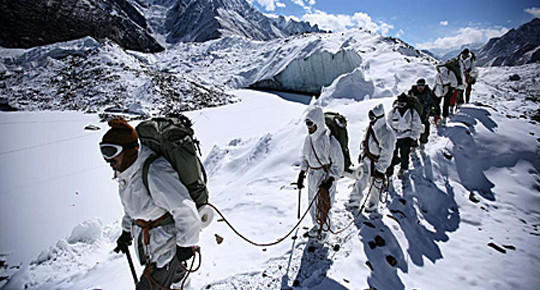
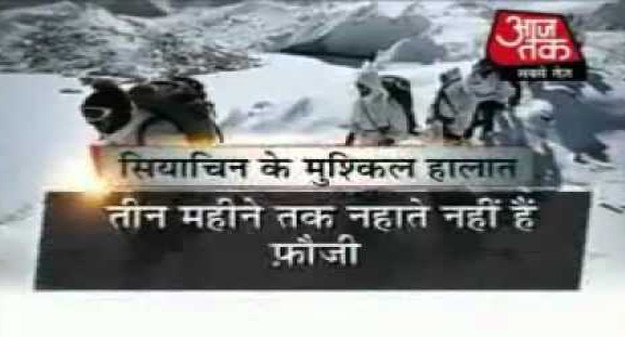
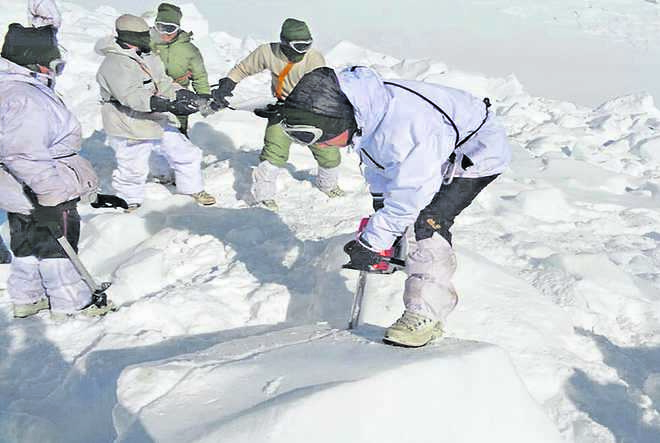
SIACHEN GLACIER is known variously as the ‘highest battlefield in the world’, ‘third pole’, ‘largest non-polar glacier’ and a supremely ambiguous cartographical description as ‘thence north to the glaciers’ (on official maps that thought it too desolate and unforgiving a region for physical inhabitation, to worry about proper demarcation beyond the coordinate NJ9842) — a historical curse of the incomplete task of defining boundary lines along the Indo-Pak borders. Today, it has evolved into a perennial flashpoint of potential military muscle-flexing and diplomatic saber-rattling. The recent horrific avalanche tragedy that swallowed 10 soldiers (one was subsequently and miraculously rescued), reiterated its infamy as the most inhospitable environment to be deployed under, with the unpredictable supremacy of nature’s fury, that accounts for higher fatalities than actual enemy-combat. Such tragedies inevitably resurrect the talk about demilitarising the glacier and the draining ‘cost’ of retaining it. To start with, it’s important to appreciate the evolution of the dispute, the historical conduct of the stakeholders in Siachen, prevailing ground situation and the potential stakes involved, and only then, juxtaposing the element of ‘cost’ to retain the current status of militarisation.The fractious Indo-Pak border relations of cloak-and-dagger moves got a surreptitious entry into the glacier in the 50s and 60s, which was hitherto unoccupied and barren, by Pakistan issuing ‘permits’ for international mountaineering expeditions, thereby sneakily establishing its ‘claim’ on the region — giving birth to a new form of strategic doctrine called ‘Oropolitics’, the abuse of mountaineering towards political purposes. In the 70s, India resorted to calling the bluff and counter the territorial allusions with its own mountaineering expeditions to establish its rightful territorial credentials and claims,  but this was still shadow boxing at best, with no permanent deployment to ‘hold’ the territory from a military angle. Traditionally, Pakistan has always dabbled in ‘low-investment-high-impact’ tactics of covert military activism. Immediately after Independence, the tribal influx of Afridi raiders into the Kashmir valley, with the tacit support from the Pakistani military, laid the pattern for all subsequent adventurism. Pakistan’s creative bent of similar tactics manifested again in 1965 via Operation Gibraltar, extreme policing brutality in 1971 to hold on to Bangladesh, recent Kargil misadventures and the multitude of support history to various internal insurgencies in India are reflective of the infamous Zia-ul-Haq’s ‘bleed through a thousand cuts’ philosophy. In almost all cases, Pakistan has initially feigned ignorance about the genesis of the contentious issues, or when exposed, attributed the same to ‘non-state’ actors — either way, consistently displaying malintent or duplicitous behaviour that does not augur well for any bilateral discussions that are to be based on mutual trust and respect of the terms of agreement. In an unparalleled and unprecedented act of strategic generosity, it officially handed over 5,180 km of territory in Aksai Chin to China in 1963 — thus drawing China permanently into the hyphenated Indo-Pak dispute and ensuring a strategic pivot to buttress its own counter claims. Thus now, the northern part of J&K theatre has a trilateral dimension.Even though Pakistan has a relatively easier access leading up to the glacier, the Indian Army holds the strategically vantage high-points to dominate it. This was achieved through a textbook military operation (Operation Meghdoot) by the Indian defence forces in 1984 to preempt the Pakistani move of capturing the glacier militarily, and then rebuffing the Pakistani counter-assaults in 1987 and 1989 (Brig Pervez Musharraf was personally involved in the ill-fated first assault that would have scared his mind to the geo-political reality, only to reopen the wounds in Kargil in 1999, as the chief of Pakistan army). This ground reality in Siachen explains the Pakistani amiability and willingness to discuss demilitarisation of the glacier to neutralise its obvious disadvantage on ground. Kargil is also a grim reminder in terms of the subsequent ‘costs’ of regaining a position once-held, though taken over by the enemy, clandestinely. Such a scenario is plausible given the pattern of military moves in the region.Importantly, the biggest ‘cost’ element is human life and the loss of limbs owing to the surreal environmental conditions of -50 degrees that test the spirit, instinct and existence of a soldier. No one understands the vagaries of nature better than a field soldier, but he does not act on individual volition, he is trained to execute the state’s order. It is imperative that no efforts should be spared to ensure the best quality equipment, infrastructural support to sustain operational efficacy and familial/monetary compensation to soldiers to endure such hardship. The glaring inequities on this front affronts the soldier’s sensibilities. It is more probable that the ‘cost’ being alluded to pertains to the bandied figure of Rs 5 crore spent on sustaining Siachen deployment, every day. While this is a serious amount, but, when contextualised to the ‘cost’ of retaining territorial integrity, it becomes immaterial. The oft-quoted status of land irrelevance by way of ‘not a blade of grass grows’, is the sort of alluvial appreciation not indulged by the defence forces in deciding if the said tract of national land is worth defending, irrespective of the ultimate price paid by the soldiers in doing so, the quality or fertility of soil be damned. Given the trilateral border disputes across J&K, and with China on Arunachal, creative pragmatism of demilitarising Indian lands is loaded with dangerous import as the same logic can be extended to other contentious areas as well. Besides, the critical issue of national integrity, the civil, administrative and political decision-making should also incorporate the notional future ‘cost’ from the repercussions of intentional or unintentional military withdrawals. The cost of rectifying or reclaiming lost ground is almost always prohibitively ‘expensive’. The soldiers need to be adequately enabled, empowered and meaningfully respected beyond platitudes. Soldiers who are physically present have never raised an excuse to surrender the hard-fought and well-earned positions on the glacier. The Pakistanis also suffered a similar avalanche-related incident in Gyari region in 2012, killing 140 persons. This is the sad truth of a soldier’s life. Militarily, despite the immense challenges, Siachen affords us the strategic, diplomatic and psychological advantage that could well reverse with the creative suggestions to demilitarise it, given the history, geo-politics and the stated intent of all the stakeholders in the region. — The writer is a former Lt Governor of Andaman and Nicobar Islands & Puducherry


Vijay Diwas observed at Fazilka, martyrs paid rich tributes

11 OFFICERS, 10 JCOS AND 185 SOLDIERS DIED WHILE 19 OFFICERS, 11 JCOS AND 334 SOLDIERS WERE WOUNDED DURING THE BATTLE OF BERIWALA

FAZILKA: The Amogh Division of the Army held a ceremony here on Wednesday to remember the heroism and valour of the brave soldiers, who laid down their lives fighting for the motherland during the 1971 IndoPakistan war.

The ‘Saviours of Fazilka’ fought the battle of Beriwala, which raged on uninterrupted for 14 days from December 3, 1971 onwards. It was undoubtedly one of the fiercest actions of the 1971 Indo-Pak war.

In this epic battle, 11 officers, 10 junior commissioned officers (JCOs) and 185 soldiers embraced martyrdom while 19 officers, 11 JCOs and 334 soldiers were wounded on the battlefield. For displaying conspicuous gallantry, one Mahavir Chakra, six vir chakras and four mention-indispatches were awarded.

The ceremony witnessed active participation by the general public. The civil administration came forward to assist the Army in organising and actively participating in the event.

Rich tributes were paid to the martyrs by laying wreaths at the Fazilka war memorial. A ‘marathon’ was organised wherein people participated with a lot of enthusiasm despite the chilly weather.

Prizes were given in various categories to the participants of the marathon.

The children of Fazilka presented a mesmerising cultural programme which filled everyone’s heart with patriotism.

Events such as painting, debate and various other activities were organised in schools across Fazilka on the eve of Vijay Diwas and the winners were felicitated.

General officer commanding (GOC) of the division Major General Bipin Bakshi exhorted all ranks of the division to rededicate themselves to the service of the nation and emulate the devotion of war veterans and martyrs.

The event was also graced by Santosh Rana, wife of late major KS Rana of 15 Rajput, who attained martyrdom during the operations in Fazilka and many war heroes and veer naris (war widows).


Cannot sidestep blame, heads have to roll: Govt

Role of BSF, Punjab Police and IAF officials to be examined

NEW DELHI: Heads are likely to roll for serious lapses leading to the terrorist attack on the Pathankot airbase, senior officials said on Wednesday, as calls for fixing responsibility grew shriller across the security establishment and political spectrum.

SAMEER SEHGAL/HTAir Force personnel pinning down the ‘suspect’ outside the Pathankot airbase on Wednesday night.Seven security personnel, including an officer of the elite National Security Guard (NSG), were killed in the siege of the airbase, one of the biggest and most strategic defence installations in the country. Six terrorists, who had managed to infiltrate the highly-guarded airbase, were also killed.

“It would be premature to fix accountability but there are several indications that people entrusted with specific tasks did not measure up. The role of officials from the BSF, the state police and the IAF will be minutely examined,” a top official said.

No agency would be allowed to sidestep blame and firm action would be taken after a thorough investigation into the circumstances leading to the attack, the official added.

Questions have already been raised about the role of the BSF after the terrorists exploited gaps in Indo-Pak border security to sneak into Punjab before infiltrating the high security base.

The terrorists also roamed freely for more than 20 hours without being detected by the state police, the officials said, and pointed out that security personnel at the airbase, already on a high alert, also could not prevent the attackers from infiltrating into the installation.

“If we have to prevent future attacks, heads have to roll. Organisations can’t shrug off blame and give themselves a clean chit,” the government officer said.

As several unanswered questions continue to baffle the security establishment, experts also demanded swift action against those responsible for the lapses.

“It’s quite obvious we failed to draw lessons from the 26/11 terror strike and other recent attacks. And that’s why we keep suffering casualties. Accountability has to be fixed at the earliest to prevent security lapses,” said General Deepak Kapoor (retd), who was the army chief when the Mumbai attacks took place.

He said the fighter base’s perimeter security should have been made foolproof as soon as hard intelligence about a possible strike was received.

Several IAF officials HT spoke to said the air force could not be expected to secure the perimeter of huge bases – Pathankot’s measures 25 km.

“The IAF can only guard its vital assets in such a scenario. We should not jump to any conclusions till all questions are answered. Remember no vital assets were lost,” said a former IAF chief, requesting anonymity.

Experts also flagged concerns about no lessons being learnt after last year’s Dinanagar attack. Former army vice-chief lieutenant general Philip Campose said, “The security establishment should have come up with some solutions after the Dinanagar strike… it was the first strike outside Jammu and Kashmir. But it’s clear no methodology of response was worked out.”


UT air force base vulnerable; shares wall with illegal shanties

 The air force transport base shares its boundary wall with a illegal building in Behlana. From the roof of this building, anybody can sneak into the transport base and shockingly such a major illegal entry point to the base is still unplugged, two days after the Pathankot attacks.

Air force officials have approached us and the administration will hold a demolition drive around the boundary walls of defence installations and facilities. Ajit Bala Joshi, UT deputy commissioner

 CHANDIGARH: Even as the Pathankot airbase attack has come as a major warning signal to the country’s defence establishment, an HT reality check has revealed that the city’s Air Force Transport Base and the newly operational airport in Mohali remain vulnerable to security breach. The danger for both vital installations comes from tall buildings, constructed illegally, in nearby villages that share boundary wall with the facilities.

KARUN SHARMA/ HTA high rise building next to the wall of the technical airport at Behlana in Chandigarh.The air force transport base shares its boundary wall with a illegal building in Behlana. From the roof of this building, anybody can sneak into the transport base and shockingly such a major illegal entry point to the base is still unplugged, two days after the Pathankot attacks.

Residents claim that with most buildings on rent, it would be difficult to trace miscreants in case of any attempted attack at the transport base.

BUILDINGS TALLER THAN AIRPORT BOUNDARY WALL

At the new airport in SAS Nagar, mushrooming illegal shanties and buildings at Jagatpur village are a major security threat. Some buildings in the village are even taller than the airport boundary wall and one is just a step away from gaining unauthorised access to the facility.

“It is ridiculously easy for someone to rent or build a shack there and just keep a watch on the security system at the airport. The consequences can be harrowing,” said a source in the police department. Intelligence officials claim that as per the guidelines issued by the supreme court, no structure could be constructed within 100m of the boundary wall of a defence establishment or an airport, the UT administration as well as the SAS Nagar mandarins had failed to implement the law. When HT brought the issue to light and contacted officials in administration as well as the air force, the attempt seemed to be to pass the nuck. Officials in the administration said that it was the duty of the air force officers to pursue the matter. A senior air force officer, however, claimed that it was the duty of the local administration to remove illegal structures.

OFFICIAL VERSION

Chandigarh deputy commissioner Ajit Bala Joshi said, “Air force officials have approached us and the administration will hold a demolition drive around the boundary walls of the defence installations.”

Zirakpur municipal council executive officer Parminder Singh Saroi said, “We have already demolished a godown. One of the structures we demolished was again erected and we have received an email to raze it again. I will take police along and demolish structures within 100m of the airport boundary wall.”


War with Pak not sole option to deal with terror: Sushma

Aditi Tandon,Tribune News Service,New Delhi, December 16

Ruling out war as the only option available to deal with Pakistan-sponsored terror in India, the government today said it was hopeful of resolving all outstanding issues with the neighbouring country through dialogue.Exuding hope of positive outcomes from the just resumed comprehensive bilateral dialogue with Pakistan, External Affairs Minister Sushma Swaraj today told the Lok Sabha that talks were always resumed on the basis of renewed hope in its ability to deliver the desired results.“War is not the only option when we (India and Pakistan) have started afresh and decided that we will resolve our issues through dialogue. We have made a new beginning, a new start and hope to eliminate the shadow of terrorism through dialogue,” Swaraj said in the Lok Sabha during the Question Hour when BJP member from Satna Ganesh Singh asked her pointedly if India would consider eliminating terrorists in Pakistan the way US eliminated Osama bin Laden sheltered in the neighbouring country.The minister, however, reiterated India’s stated position on a dialogue with Pakistan saying talks and terror could not go together.“We have said repeatedly that talks and terror cannot go together. The PM has best articulated this position by saying that the sound of talks will get drowned in the noise of bombs. Talks and terror cannot go together but then let us talk on terror. That is why the NSAs of the two countries met in Bangkok to discuss these issues. But one meeting is not enough. We have to continue to talk,” Swaraj said.

There’s no good or bad terrorism: Pak diplomat

  • Pakistan High Commissioner Abdul Basit has said there is no difference between “good and bad terrorism”. His comments signal perhaps a change in the long-held Pakistan policy of differentiating between a “good terrorist” and “bad terrorist” or, as in the case of Afghanistan, between “good Taliban” and “bad Taliban”. India has always maintained that this is a flawed approach and can never be successful in fighting the global menace of terrorism. — Simran Sodhi

Parrikar announces govt job for martyr’s daughter

HAILING HEROES Visits families of Honorary Captain Fateh Singh, Havildar Kulwant Singh, promises all support

GURDASPUR: Defence minister Manohar Parrikar on Tuesday visited the families of Honorary Captain Fateh Singh and Havildar Kulwant Singh, who laid down their lives fighting terrorists at the Pathankot air force base.

HT PHOTODefence minister Manohar Parrikar at martyr Kulwant Singh’s house at Chak Sharif village in Gurdaspur on Tuesday.

At Jhanda Gujjran village, Parrikar announced a job for Fateh Singh’s daughter Madhu Radha and free education for his younger son Nitin, a Class-8 student. Fateh’s elder son Gurdip Rana, who is serving in the 15 Dogra Regiment in Sikkim, will be transferred to Tibri Military Station near Gurdaspur, said Parrikar.

The minister also announced that Pathankot martyrs would be treated as battle casualties and corresponding benefits would be provided to the families.

Even the injured would get all due benefits, he said.

At Havildar Kulwant Singh’s house in Chak Sharif village, the defence minister said the families of the martyrs belonged to the nation.

He said he will instruct the officials of the army brigade nearby to take care of these families and ensure that they don’t face any hardship.

10 LESSONS FROM THE ASSAULT

Counter-terror ops to protect India’s largest operational air base near Pakistan spilled over three days and raised several questions. Security experts give key lessons to be learnt from the incident.

1 MORE MEN ON THE BORDER

HT FILE/SAMEER SEHGALThe bold attack by terrorists has raised eyebrows.In J&K, a BSF company (about 100 men) guards an average frontage of 2.75km. In Punjab it covers 5.6km, underling an urgent need of more men and equipment on international border.

2 STRENGTHEN INTELLIGENCE

Garner more real-time actionable inputs, especially from human sources. Also need better-trained officers to glean such intelligence more effectively.

3 BUST NARCO ROUTE

Thriving cross-border drug smuggling network is suspected to be providing an extensive logistics support to terror outfits based in Pakistan.

4 HIGH-VALUE SYSTEMS

As militants in the region are increasingly targeting defence bases, special plans and sophisticated force are required to ensure fool-proof security.

5 BETTER TRAINING

Terrorists are known to improvise. Every counter-terror operation is a new learning curve. Training designs need to be constantly upgraded.

6 CORRECT INFORMATION

Declaring the operation’s success even before it got over was a public embarrassment. A unified command centre for media briefing is needed.

7 A CLEAR STRUCTURE

For operations involving multiple security agencies like NSG, army and police, a clear command and control structure can check any gaps in coordination at operation level.

8 BRIDGING THE GAP

Experts pointed out huge gaps in vigilance, planning, coordination and counterterrorism force application during the operations.

9 BOLSTER AIR SURVEILLANCE

Air surveillance on Punjab and Jammu borders is currently done more on a special basis. A routine arrangement can act as a better scanner and plug the loopholes.

10 SECURITY AUDIT

A thorough security audit, in a timebound manner, at all vulnerable military installations to plug gaps in the existing security architecture.

Gaping holes make airbase vulnerable

PATHANKOT: Even as combing operations continued at the Pathankot air base for the fourth day on Tuesday which had led to the death of seven security personnel while neutralising six terrorists, various agencies involved in the operation are still grappling with the question how the terrorists, armed with loads of ammunition managed to enter the heavily guarded air force base.

RAVI KUMAR/HTThe wall near the main entry of the Pathankot airbase is adjoining to the residential area of Dhaki village.The air force station is spread across over 1,900 acres and its perimeter is over 24 kilometres long. The entire perimeter is enclosed by a 10-foot wall with an additional two feet of barbed wire on top. The wall is guarded by raised defence pickets at every half and kilometres and the wall is lit up at night with hundreds of lights.

Even though the air force station seems like a heavily guarded impenetrable complex, the fact is that over the years, the boundary wall has been rendered porous and it is no wonder that crossing over or across the wall of the station would have been the least of the problems for terrorists.

Addressing a press conference at the airbase, union defence minister Manohar Parrikar admitted that there have been some “gaps” which he could see but the entire set of facts would be clear only after investigations. “The biggest question before me is that how did these (terrorists) enter the air base?” he said.

The wall, near the main entry of the base is abutting the residential area of Dhaki, earlier a village and now within the municipal limits of Pathankot. The houses in this area are built in a manner that their walls are common with the boundary wall of the air force base. At one point where a house is under construction, the construction material has been stacked next to the air force station boundary wall and all it would take is a skip and hop to get across.

Secondly, the wall on one large tract runs parallel to a seasonal nallah (water channel) which also had inlets inside the complex. These inlets are channelised from under the wall through pipes. But over the years the sand around the pipes has eroded and holes have come up which are large enough for anyone to slip through. While it is generally believed that the terrorists used such an inlet to enter the base, Mangal Singh Bajwa, a resident of Dhaki says that these inlets have been converted into breeding grounds to pigs and generally the owners of the pigs live close by. “If the terrorists entered the base through the inlet, they would have been noticed,” he pointed out.

The lighting of the wall is also not complete, said Ashwani Sharma, BJP president of Dhaki ward who lives barely a hundred meters from the wall. “There are many times when the lights go bust and are not repaired for months. We used to think that we are living next to an air force base and are safe, not realising that we are living in such an unsafe place which will be attacked by terrorists,” said Sharma.

Parrikar’s tough
posers to BSF, military officials

INFILTRATION Defence minister perturbed over Punjab’s porous border

NEW DELHI: Defence minister Manohar Parrikar on Tuesday posed tough questions to the Border Security Force (BSF) and top brass of the Air Force and Army on continued cross-border infiltration and security along the perimeter of the Pathankot airbase, which was breached by terrorists.

Parrikar visited the air base even as forces continued mopping up operation at the airfield following one of the worst terrorist attack on a defence installation in the country in recent times.

Top South Block sources said Parrikar wanted to find out whether the Defence Security Corps personnel at the Pathankot base had been put on alert after an alarm was sounded by New Delhi on an impending terror attack on January 1 afternoon.

Both the defence minister and home minister Rajnath Singh are extremely perturbed over continued infiltration of terrorists through the international border in Punjab despite patrolling by the BSF and want serious investigation on whether the terror network was mixed up with the thriving drug-smuggling network along the border.

Parrikar also questioned the Western Command Air Force brass on whether the DSC was put on alert and how did the JeM terrorists enter the airbase which had eight feet walls and round-the-clock patrolling.

Only one Air Force jawan died in directly fighting the Pakistani terrorists. While the NSG managed to kill all six terrorists, there are some unanswered questions in the run-up to the attack.

Firstly, killed taxi driver Ekagar Singh received seven calls from Pakistan on his phone on December 31 and his vehicle was found with a puncture at a totally different direction from where he was to pick up a passenger.

The question that is being asked by the internal security establishment is whether Ekagar Singh had gone to pick up the terrorists or was he involved in any drug smuggling network across the border.

Secondly, why did the terrorists not touch the Gurdaspur SP Salwinder Singh but tried to slit the throat of his jeweller friend Rajesh Verma. Thirdly, the Jaish-e-Mohammed note left by terrorists in the SP’s vehicle talks about attacks in Tangdhar, Samba, Kathua and Delhi in revenge for hanged Afzal Guru. This raises questions if Delhi is the next target of Azhar Masood’s cadres?


US aid to Pak will be used against India: Ex-Pak diplomat

Washington, December 8
As the US prepares to sell F-16s to Pakistan, the country’s former top diplomat has warned the Congress that such fighter jets would end up being used against India and not against terrorists.
Describing sale of such military hardware and even reported talk of a civil nuclear deal as an appeasement policy towards Pakistani military, the former top Pakistani diplomat has urged the US to tell the leaders in Pakistan that their ambition of rivalling India is akin to Belgium trying to rival France or Germany.
“The Obama administration’s consideration of a nuclear deal with Pakistan, just like its decision a few months ago to sell almost USD 1 billion in US-made attack helicopters, missiles and other equipment to Pakistan will fuel conflict in South Asia without fulfilling the objective of helping the country fight Islamist extremists or limit its nuclear arsenal,” said Husain Haqqani, the former Pakistani Ambassador to the US.
In a prepared remark submitted ahead of a Congressional hearing on ‘Civil Nuclear Cooperation with Pakistan: Prospects and Consequences to the Terrorism, Nonproliferation, and Trade Subcommittee of the Committee on Foreign Affairs’, Haqqani said Pakistan’s failure to tackle its jihadist challenge is not the result of a lack of arms but reflects an absence of will.
“Unless Pakistan changes its worldview and its compulsive competition with its much larger neighbour even in violation of international commitments, American weapons will end up being used to fight or menace India and perceived domestic enemies instead of being deployed against jihadists,” he said.
Currently, director of South & Central Asia at the Hudson Institute, a top American think-tank, Haqqani said competition with India remains the overriding consideration in Pakistan’s foreign and domestic policies. —PTI




























