Sanjha Morcha

What’s New

Click the heading to open detailed news

Current Events :

web counter

Print Media Reproduced Defence Related News

Prakash panel to submit report by month-end

ribune News Service

Chandigarh, April 18

The Prakash Singh inquiry commission, appointed by the Haryana Government to look into lapses by officers during the Jat agitation, will now submit its report by month-end.“I will submit the report to the government by April-end. It is taking time given the volume of evidence collected during my visits to arson-hit districts. The report is at the halfway stage. It is, though, gathering momentum,” he told The Tribune.He further said the only copy of the report, which was still being prepared, was with him. “Nobody has access to the content. There is no way it can be known.”Earlier this month, the former IPS officer had hinted at dereliction of duty on the part of officers, resulting in large-scale violence.Having met about 2,500 people during the course of its visits, the commission collected recorded statements, written representations and several videos, besides oral testimonies.


Ties with China top priority: Parrikar

Ties with China top priority: Parrikar
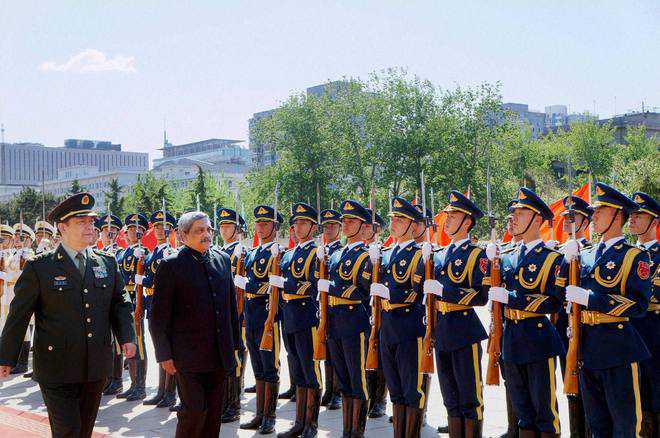
Defence Minister Manohar Parrikar along with Chinese counterpart General Chang Wanquan inspects the guard of honour at the PLA headquarters in Beijing on Monday. PTI

Beijing, April 18

Defence Minister Manohar Parrikar today kicked off his first visit here by holding talks with Chinese counterpart Gen Chang Wanquan stating that India attaches highest priority to its relationship with China and is committed to further develop the ties.“India attaches highest priority to relations with China and committed to further developing friendly and cooperative relations with China,” Parrikar told Chang in his opening remarks before the two delegations started the talks.Parrikar was accorded a ceremonial welcome at the headquarters of the Chinese military here by a contingent of PLA soldiers. Welcoming Parrikar, Chang said: “Hope your visit improve strategic mutual trust between the two armed forces.” After his meeting with Chang, Parrikar will hold talks with Gen Fan Changlong, Vice Chairman of the Central Military Commission, (CMC).In Chinese military hierarchy Gen Fan is ranked higher, as CMC is overall head of the 2.3-million-strong People’s Liberation Army (PLA).He is also due to call on Chinese Premier Li Keqiang and visit China’s recently-integrated western command military headquarters in Chengdu which has jurisdiction over entire borders with India.During Parrikar’s talks today with top Chinese military officials, recurring incidents of incursions, implementation of an agreement to reduce tensions between border patrols and Sino-India strategic concerns are expected to figure.While Indian officials said the talks were expected to review the whole gamut of bilateral ties, India’s concerns over aggressive patrolling by Chinese troops especially in the Ladakh sector remains high. China denies any incursions, asserting its troops patrol areas within its territory along the 3,488-km disputed border. The two militaries also have strategic concerns over each other’s military tie-ups with other countries.Ahead of Parrikar’s visit, China hinted that it may take up the recent decision by India to open up military bases to the US for logistics and efforts to conclude a pact to share aircraft sharing technologies. — PTI


Netaji’s driver becomes oldest human alive at 116

Azamgarh (UP), April 17

With rumors amuck of late freedom fighter Subhash Chandra Bose making an appearance as the mysterious godman Gumnami Baba, Netaji’s driver Colonel Nizamuddin is now set to make headlines by opening a bank account at the ripe old age of 116 years.

According to Colonel Nizamuddin alias Saifuddin’s voter identity card and passport, which he produced as proof of identity before the State bank of India for opening the account, he was born in 1900.

In February this year, a Japanese man, who was believed to be the oldest man alive, passed away at the age of 114.

That way, Colonel Nizamuddin is the oldest human being alive on the planet right now, as he completes 116 years 3 months and 14 days on Sunday.

Another startling aspect is that Colonel Nizamuddin’s wife, Ajbunisha, is 107 years old and the couple has opened a joint account with SBI.

Locals and the district administration were delighted to know about Colonel Nizamuddin amazing feat of being the oldest man alive. They are, in fact, proud of the fact that such an elderly person is part of their neighbourhood. — ANI


Army officers move SC over promotion policy

Indian Army soldiers

Over 300 officers of the Indian Army’s Combat Support arms have moved the Supreme Court over the non-implementation of the promotion policy. The officers claim that new ‘Colonel’ vacancies have not been created. This comes after the SC had directed the Defence Ministry in October last year to create 141 additional posts of ‘Colonel’ for the Combat Support stream.

More than 300 officers from Indian Army’s Combat Support Arms (Air Defence Artillery, Signals and Engineers) have knocked at the Supreme Court’s door taking on the Ministry of Defence and Army Headquarters over non-implementation of the promotion policy.
For these officers who usually take on hostile forces at the borders, this time they appear to be combating a hostile ‘system’ that has delayed the creation of 141 additional vacancies of colonels in the army for Combat Support Arms.
“The government had assured the court in October 2015 that 141 additional posts of colonels will be created and given to Combat Support Arms for a younger profile of commanding officers as per the Command exit policy. However, the same is still to be implemented,” says Advocate Neela Gokhale, representing a group of 100 serving Army officers in Supreme Court.

“We are praying for the Apex Court’s intervention and direction to the government so that the process is not delayed further,” she adds.
The officers of Combat Support Arms are also keen on a speedy solution to the issue as the promotion to the next rank – from colonels to brigadiers – depends on the vacancies. Vacancies for brigadiers is also dependent on the number of colonels in each arm.
“It is a double whammy for Combat Support Arms. The AV Singh committee had recommended lowering the age profile of commanding officers in the Army. It recommended creating additional posts of colonels. While the same was effectively implemented for Combat Arms – Infantry and Artillery, the Combat Support Arms and Services have got the short end of the stick,” an officer on strict condition of anonymity told MAIL TODAY.
The Supreme Court in October 2015 upheld the ‘Command Exit Policy’ not finding merit in the contention that it was perverse, unreasonable and unfair. “It was the Supreme Court that directed the MoD after due consultation to create 141 additional vacancies for combat support arms. The additional vacancies were for promotion over a period of five years of batches between 2009-2014,” Gokhale adds. The petitioners and the government are, however, not on the same page about whether the 2014 batch is to be included for consideration. The case comes up in the Supreme court on Tuesday.
Army sources, meanwhile told MAIL TODAY they are treating the issue on priority. “The matter will be discussed during the upcoming Army Commanders Conference. The Army does not differentiate between Combat Arms, Support Arms and Services. Each soldier is very important to ensure victory in battle. As soon as the MoD releases the vacancies the promotions will begin,” top sources said.


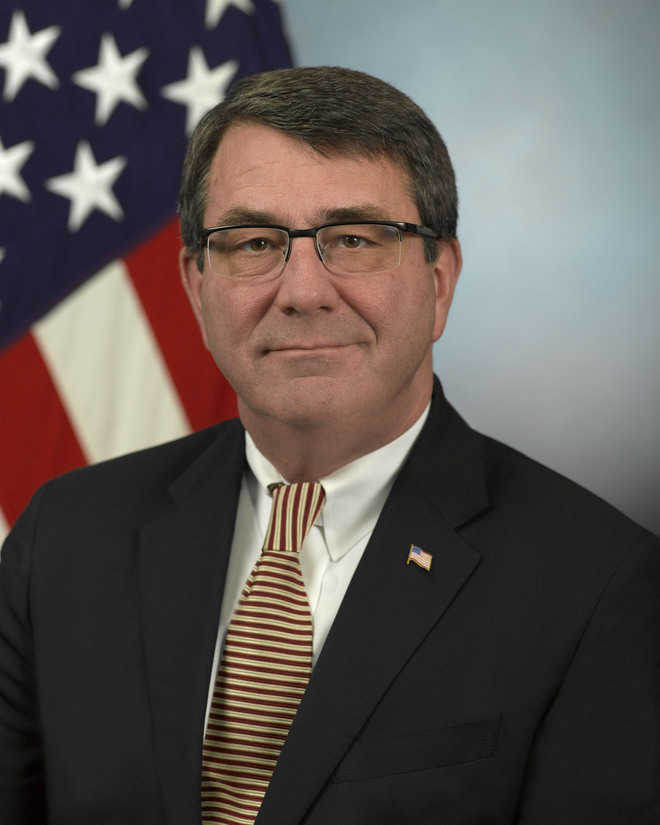
India very influential, powerful force in Asia Pacific: Carter Defence Secy’s three-day India visit begins tomorrow

India very influential, powerful force in Asia Pacific: Carter
US Defence Secretary Ashton Carter

New York, April 9

India is a “very influential and powerful player” in the Asia Pacific and is going to play an ever increasingly role in the region, US Defence Secretary Ashton Carter has said on the eve of his visit to India during which “exciting new projects” will be discussed to boost Indo-US strategic ties.

“India is already a very influential and powerful force in the whole Indo Asia Pacific region, starting with the Indian Ocean,” Carter told PTI.

He said that his three-day trip to India, beginning tomorrow, would be an important step in the implementation of some of the key decisions being taken by US President Barack Obama and Prime Minister Narendra Modi in the last two years.

However, Carter remained tight-lipped on the decisions to be taken during his India trip that would take him to Goa and New Delhi.

“We will talk about exciting new projects, the details of which I cannot got into this afternoon,” the Defence Secretary told a New York audience before the Council on Foreign Relations (CFR) yesterday for which he specially flew to the Big Apple to give a key policy speech on Asia Pacific.

Obama Administration’s “Asia Pacific rebalance” and Modi Government’s “Act East Asia” is what Carter described to the New York audience as “strategic handshake”, between the two largest democracies of the world.

“Obviously it (India) is going to play an ever-increasing role, a very positive role because of the values it stands (for).., championing of a co-operative approach to security,” Carter said in response to a question.

The Defence Secretary acknowledged that India’s “influence stems all the way around, South East Asia and into East Asia”, and also referred to the close relationship it now has with Japan in the Asia Pacific region.

Carter, who has played a key role in this new phase of India-US defence relationship – which started in his previous capacities at the Pentagon – believes that India-US relationship is destined to be one of the most significant partnerships of the 21st century.

And his second visit to India, in less than a year, is aimed to realise that, he said.

“It’s (India trip) to take some very important new steps and to implement what the President and the Prime Minister agreed last year and the (defence) framework (agreement) that I signed with Minister Parrikar last year,” Carter said.

Carter said the Defence Technology and Trade Initiative (DTTI), which was started in 2012 in his previous stint at the Pentagon, “grasps hands” with Modi’s “Make in India” campaign to expand the nation’s industrial and defence base.

“In the area of the DTTI, in the area of joint military exercises and activities, we would have the opportunity in a very tangible and significant way to signify our co-operation,” he said.

Carter said that enhanced co-operation in the maritime security would be another key feature of his India trip.

At the invitation of his Indian counterpart Manohar Parrikar, Carter would be spending nearly two days in Parrikar’s home town Goa.

“I would be visiting western naval base,” he said, adding that last year he had visited the eastern naval base.

When Parrikar was in the US in December last year, Carter took him to a nuclear-powered air craft career and the two leaders spend nearly one day.

His Goa trip is also expected to be marked by the India visit of USS Blue Ridge.

“The fact that there is a US navy vessel in port at the exact time, nothing could signify better close co-operation between us,” Carter said.

After spending two days in Goa on April 10 and April 11, Carter would fly to New Delhi where among others he would meet Prime Minister Modi and the National Security Advisor Ajit Doval.

Without going into details, he said the two countries would also be concluding several important agreements, including one on commercial shipping information exchange, which will “make many new things possible” in the future.

“US India relationship has grown incredibly over the past several years. And of course, Secretary Carter takes a strong personal interest in US-India defence relationship,” a senior defense official said, adding that Carter has a close personal relationship with Parrikar.

“That’s why he is going to the Minister’s home town of Goa,” he added.

The US is very interested in exploring the possibilities of co-production of fighter aircrafts and the issue is being discussed with India, the senior defence official said when asked about news reports of talks on manufacturing of fighter jets in India.

India, the official said, has also expressed interest in buying armed drones from the US.

Under the Modi Government, the defence official on condition of anonymity said there has been strong progress in bilateral relationship.

The scope and depth of US-India defence ties has become much stronger, he said in response to a question. — PTI



Assam Rifles inducts first batch of 100 women officers

The Assam Rifles on Wednesday formally inducted its first batch of 100 women soldiers at a ceremony in Nagaland, reported The Telegraph. Union Minister of State for Home Kiren Rijiju was present at the ceremony, which was organised to induct 212 new recruits.

The women will be attached to various units of the 181-year-old paramilitary force.

The Assam Rifles plan to use the women officers for search operations, frisking and interrogating female accused, and dealing with women protestors during agitations, said Lt Col Rahul Josan, the force’s public relations officer.

“Relief and rescue operations during communal tension and natural calamities, dealing with women protesters to avoid violation of human rights and projecting a clean image of the force would be the other important tasks of the women personnel,” he said.


Cabinet gives retrospective approval to OROP

short by Arjun Bhatia / 06:38 pm on 07 Apr 2016,Thursday
The Union Cabinet on Wednesday gave its ex-post facto approval for the implementation of the One Rank One Pension (OROP) scheme. The benefit will be extended to ex-servicemen with effect from July 1, 2014. The Defence Ministry said that 15.91 lakh pensioners had been given the first instalment of OROP till March 31, which amounts to ₹2,861 crore.

Now, encrypted WhatsApp data to protect user privacy

Now, encrypted WhatsApp data to protect user privacy

WhatsApp is rolling out end-to-end encryption, a move that will potentially protect texts and voice calls of its over one billion users from hackers and “regimes”. “WhatsApp has always prioritised making your data and communication as secure as possible. And today, we’re proud to announce that we’ve completed a technological development that makes WhatsApp a leader in protecting your private communication,” founder Jan Koum said. The latest version of the app will encrypt every call, message, photo, video, file and voice message that is sent on the platform by default, including group chats. “No one can see inside that message. Not cybercriminals. Not hackers. Not oppressive regimes. Not even us,” he said. PTI



Dangerous strategy

Dangerous strategy
Weapons of peace?: Nuclear Development Adviser to Pakistan’s National Command Authority, Gen Khalid Kidwai (retd)

In his inaugural statement at a seminar on nuclear security at a think tank in Islamabad, the Nuclear Development Adviser to Pakistan’s National Command Authority, General Khalid Kidwai (retd), made sure to get the deterrence message across to India. He warned that, “Cold Start or no Cold Start”, Pakistan’s adoption of “full spectrum deterrence” had brought  about “retention of strategic equilibrium in South Asia” by seriously neutralising any propensity in India for the “use of the military as an instrument of policy”. For their contribution to “peace and stability in the region”, he was inclined to echo the title of a book on India’s nuclear weapons by Raj Chengappa, calling Pakistan’s nuclear weapons, “weapons of peace”. On return from Islamabad, where Sushma Swaraj had gone for the ministerial meeting of the Heart of Asia conference on Afghanistan, briefing Parliament she acknowledged as much, saying: “war is not an option”. Whereas she did not specify why this was so, the nuclear factor also figures among other reasons to avoid war, such as the economic one. Since both states are close to embarking on a “bilateral comprehensive dialogue” brokered by Swaraj during her Pakistan visit last December, it would appear that Khalid Kidwai is at least partially right. However, since the promised dialogue has not taken off three months on since its announcement indicates the pitfalls. The terror attack on Pathankot airfield early in the year resulted in the foreign secretary talks scheduled for mid-January being postponed. Even if talks finally take off in wake of the visit of the joint investigation team from Pakistan to the site of the terror attack in Pathankot, the hiatus indicates a continuing fragility that cannot be wished away. This is compounded by India’s Pakistan strategy, likened by a former Indian ambassador to that  country as “manic pirouetting”. Since the strategy is controlled by National Security Adviser, Ajit Doval, his views are worth probing.Immediately prior to parliamentary elections, in which Doval had a major hand in generating the Modi wave, Doval laid  out his strategic world view at a talk in Sastra University. He called for a shift from a defensive strategy to one of “defensive offence”. Since this was not an offensive  strategy, the nuclear threshold was not of consequence. He preferred “Intelligence-led”, “covert”, operations to military action against Pakistan’s “vulnerable” areas, such as its “internal security”. Deeming “strategy without tactics is noise before defeat”, it can be expected that Doval as NSA is practising what he preached. Pakistan’s recent nabbing of an alleged Indian spy, former naval officer Kulbhushan Jadhav, is perhaps evidence of this. Alongside, in another preview of his Pakistan strategy, Doval as head of the Vivekananda International Foundation had instigated a press statement by 41 members of the strategic community. The statement had effectively tied down UPA II from contemplating a resumption of talks with Pakistan. It called for terrorism as being the sole agenda of talks. Today the promised “comprehensive bilateral dialogue” continues in abeyance, held hostage to terrorism. This explains Sushma Swaraj’s briefing to Parliament: “We have decided that through talks we will resolve the issue of terrorism as talks is the way forward so that the shadow of terror is removed.” The upshot is that India’s Pakistan strategy appears to have two prongs. One is to condition Pakistan to its underside by exposing it to Indian intelligence operations, while engaging in a dialogue restricted to terrorism.The strategy is not without its dangers. Firstly, while Indian interests are sought if not quite met this way, over time Pakistan’s national security estabishment’s interest in the dialogue  would lag. It is currently not averse to Sharif’s outreach to India that relies on personal equations reinforced with Indian Prime Minister Narendra Modi’s brief stop over at Sharif’s Raiwind residence. However, a status quo in India’s favour could prompt counter action by the Pakistan army to once again use its tried and trusted instrument, the ISI. Secondly, the Pathankot terror attack and Pakistani NSA’s tip off to his Indian counterpart of infiltration of ten terrorists on Mahashivratri eve into India suggests that terrorist forces can act autonomously. They can trigger off another crisis by a mega terror attack. During his Sastra University address, Doval had weighed in favour of an intelligence-driven response to 26/11. In effect, the intelligence game would now heat up, increasing propensity for either side eventually going military. It is then that the nuclear threshold, so cavalierly dismissed by both Doval and Khalid Kidwai, would kick in. Given such escalatory possibilities, the contrasting policies of the two states appear delusional. Whereas Pakistan loses no opportunity to foreground nuclear dangers to reinforce deterrence, as done most recently by Kidwai, India for its part has taken care to omit any mention of nuclear weapons in relation to military exercises since 2013. Foregrounding nuclear dangers thus continues to be important, if only to compel the two states to remain at the table. Ali Ahmed is the author of  ‘India’s Doctrine Puzzle: Limiting War in South Asia.’