



Sanjha Morcha

What’s New

Click the heading to open detailed news

Current Events :

web counter

Print Media Reproduced Defence Related News

A General & his loquaciousness by Harish Khare

Creeping militarisation of foreign policy discourse

A General & his loquaciousness
Ravi Parkash

Harish Khare

WE have been fortunate to have had a very large number of distinguished military leaders. There was a General KM Cariappa to begin with; then we had Marshal of the IAF Arjan Singh, General Sam Manekshaw, General K Sundarji, General Ved Malik, General S Padmanabhan. Other chiefs were not insubstantial leaders of men, either. Each led the force in the trying and exacting contexts of his time. But, perhaps, none was heard so often and so loudly as the present Chief, General Bipin Rawat. And, it needs to be noted that he remains unrebuked by the civilian-political leadership for his garrulity.In recent days, he hit the headlines with regularity. More than a month ago, he took it upon himself to respond to Pakistani army chief General Bajwa’s formulations before the Pakistani parliament. It was a significant speech, given the power-sharing arrangement in Pakistan. Its moderate tone and its expression of hope for some kind of normalcy between India and Pakistan were at variance with our officially-inspired understanding that it is the Pakistani generals who have acquired an institutional interest in enmity with India. It was too cute, too neat to be true, for our taste. The Ministry of External Affairs spokesperson, quietly and professionally, dealt with General Bajwa. Still, a few days later, inexplicably, our own Army Chief felt that he was called upon to rubbish the Pakistani General’s contrived overture. And then, a few days ago, General Rawat allowed himself to comment at a press conference on the educational system in Jammu and Kashmir and the imperfections and inadequacies of the textbooks in the government schools in the state. The good general pontificated on the “madarsas and masjids”. It was as political a statement as it could be; the General had chosen to stray into the politicians’ domain. And inevitably, invited the malicious politicians’ retort. Not at all a pretty sight. Curiously enough, there has been no indication as to what the South Block thinks of the Indian Army Chief’s loquaciousness. On the other hand, the usual suspects have started making the usual noises, in the print and on the social media, in defence of the Chief.Admittedly, considerable merit can be conceded in what the General had to say about the contents of the textbooks in Kashmir and about the nature of the larger process of ‘radicalisation’ in the Valley. But the pertinent point has to be that the offending textbooks were not introduced this week. For better or worse, these books have been part of the school curriculum for a while. And again, for better or worse, the ruling party at the Centre has been in power as a coalition partner in Jammu and Kashmir for many years. There is no public record of the BJP, either at the Centre or in the state, having made an issue of the unsuitability of these textbooks.If there is so overwhelmingly self-evident justification in the Chief’s observations, why have the “nationalist” voices kept quiet all these years? The vigilant and zealous deshbhakts must be very familiar with these “unacceptable” textbooks, yet they continue to be part of a self-serving power-sharing arrangement in the state. It must be presumed that the Chief had first raised this matter of Jammu and Kashmir’s education system within the inner councils of the national security apparatus. He possibly felt unattended and unsatisfied, and thought strongly enough about it to go public; whatever the context, he crossed a line, forcing everyone to take a position. However, there is another, old-fashioned name for this: agenda setting. That is not a one-off affair. For some time now, the Army Chief has regularly articulated very strongly— and, very bluntly — on the difficulties in our relationships with China and Pakistan. He has casually suggested crossing the border and has talked of calling Pakistan’s nuclear bluff. Granted, soldiers are not diplomats; granted, they are not well versed in the art of nuances and subtleties of diplomacy; but, it can well be asked, pray, why encroach upon the Foreign Office’s territory. The General’s volubility has been in direction proportion to the marked reticence, almost radio silence from the authorised managers and professional caretakers of the bluff and bluster of national security. Most mysteriously, we do not hear from the Raksha Mantri or the External Affairs Minister on these vital issues of national security.    On the other hand, we have a political dispensation that believes in and advocates a “strong” India; it projects itself as being more muscular than others in matters of national security and defence. It is not averse to encashing electorally and politically the soldier’s sacrifice and martyrdom. During the recent elections in Uttar Pradesh, Himachal Pradesh and Gujarat, “surgical strikes” became part of the politicians’ narrative.It ought to be clearly understood that even the most professional and most detached solider is not exactly a robot. He can size up the political crowd and its weaknesses — and, can most definitely smell the politician’s need for “success” against this or that “enemy”. What happens if an ambitious general senses the politician’s dependence upon the soldier for an electoral coup? What happens if the generals and the admirals begin to think of themselves as indispensable to a regime’s political fortunes? For now, it has suited the government’s electoral calculations to talk up the soldier. In turn, the soldier is fired up. The air is full of violence, hostility and aggression.A stage may come when it may not be all that easy to roll back this militarisation of our political narrative; it may not be easy to ignore the generals’ demarche. When a Nitin Gadkari dares to talk sense on the Navy’s demand for land in South Mumbai, the poor minister gets excoriated for wanting to deny the armed forces what is due to them.When claims made in the name of national security get pushed up on top of the national attention, a certain distortion creeps in. As it is, without our wanting, we have ended up countenancing a militarisation of our foreign policy and diplomacy. Are we comfortable with the idea of a general usurping the political leader’s prerogative? At the end of the day, it is difficult not to feel uncomfortable about the space and the visibility the Army Chief has come to command.
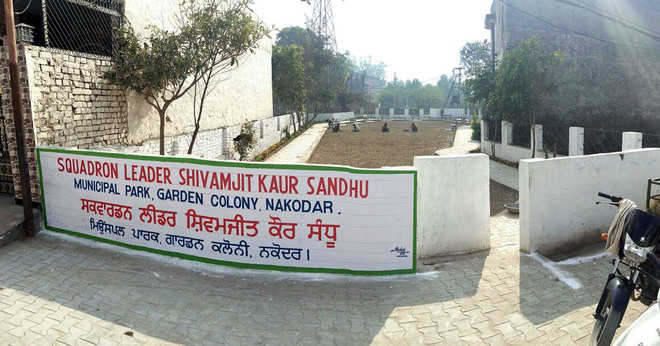

Park named after woman IAF officer

Deepkamal Kaur/tns

Jalandhar, January 13

Nakodar town celebrated Lohri in a different way today. The administration officials, civic authorities and public gathered at a park in Garden Colony and named it after the first woman Indian Air Force (IAF) officer from the town – Sqn Ldr Shivamjit Kaur Sandhu.The IAF officer, her husband Sqn Ldr Vivek Tewari, her parents and residents of her entire colony came out and celebrated Lohri in the park this afternoon.SDM Amrit Singh, who had mooted this kind of initiative by earlier naming a road after Capt Sonia Arora, the first woman Army officer from Nakodar, has made a second attempt of the kind under the “Beti Bachao, Beti Padhao scheme”.Nakodar Municipal Council president Aditya Bhatara said, “We had passed a resolution for naming the park after Sq Ldr Sandhu in September, which finally got cleared from the Local Bodies Department three days ago. It was a sheer chance that when the clearance came, Sqn Ldr Sandhu too was at her parents’ place for a break. We proposed to hold the function on Lohri, to which she agreed. A space for the park had been earmarked in the colony and we got it readied in just three days with boundary wall, inter-locking tiles, foliage planting and other works done within three days. The residents and the general public appreciated the step taken by us.”At the function, Sqn Ldr Sandhu shared her excitement with the young girls attending the event, “There is nothing that the girls of a small town like Nakodar cannot do. The girls in Delhi also study the same books, which we read here. All we need to do is to grasp and retain as much as we can with thorough understanding.”Great granddaughter of Naik Lal Singh, who laid down his life in the Saragarhi battle, Sqn Ldr Sandhu had studied at St Judes School in Nakodar till Class VI. After that, she had moved to Army Public School in Beas. She pursued her BSc in computer sciences from Lyallpur Khalsa College in Jalandhar. She appeared for the IAF entrance test and cleared it. It has been seven years since she joined the Air Force and is now posted at the Pathankot Air Force base.



Whose interest is Pak serving by spilling blood of Kashmiris?

Arun Joshi

It must be said that Pakistani diplomats have an expertise and can play their charm to turn the bad situation into a good one. A Pakistan foreign office spokesperson made such a powerful presentation on Friday, virtually proving that US President Donald Trump was not aware that how Pakistan’s fight against terrorism had served American interests. The illustration was simple that Pakistan had helped decimate Al-Qaida and other extremist groups that had shot into global fame because of the 9/11 — without, of course, making a mention that Al-Qaida chief Osama bin Laden was found in Pakistan before he was killed by Americans in a daring raid.Pakistan’s foreign secretary Tehmina Janjua while delivering a lecture on “Pakistan’s Foreign Policy issues” at the Institute of Business Administration, Karachi, on Saturday made a very significant point that Trump’s New Year tweet in which he accused Pakistan of “lies and deceit” in return for $33 billion aid over the past 16 years, was being analysed. The diplomats analyse each and everything, and then work out the things in favour of their country. Tehmina said, “President (Trump) might have got some feedback that he was prompted to tweet in the manner in which he did against Pakistan.”Having said that Pakistani politicians and diplomats claimed that its fight against terrorism has worked for the regional stability and it wants to work more on the front by continuing engagement with the US. Pakistan understands the strategic and logistic compulsions of the US. It wants to milk this cow as much as it can. The serious point is that it is mainly responsible for the regional instability in South Asia. It created a terror monster in Afghanistan and on its own soil to bleed its neighbours — India and Afghanistan. It’s angry with India on losing East Pakistan forever as Bangladesh appeared on the global map as an independent and sovereign nation. India did help the agitating people who were fighting against injustice and denial of democracy to them by the rulers and military of West Pakistan. Afghanistan, it believes, is its backyard, and any Indian presence there is that of an enemy. This kind of thinking is against the international law.Kashmir offers a classic example where Pakistan is using its terror machine to destablise the regional stability. Pakistan-trained terrorists are spilling blood of innocents. J&K Chief Minister Mehbooba Mufti reminded the world, including Pakistan, on the second death anniversary of her father Mufti Mohammad Sayeed, “No cause can be achieved by bloodletting.”Pakistan knows that its claim of working for the regional stability is a hoax and only a way to get more dollars from the US. Pakistan has bled Kashmir and continuously brands it as a nuclear flashpoint. Its troops have made the Line of Control that divides Jammu and Kashmir between India and Pakistan, hot. Alongside, it supports and funds the Haqqani network that is responsible for endless terror attacks in Afghanistan.Rawalpindi trusts terrorism more than dialogue. If Pakistan wants to sound genuine in maintaining regional stability, the least it can do is to stop ceasefire violations. Killing soldiers and civilians on the Indian side has its consequences. That doesn’t help the cause of regional stability.Pakistan owes an explanation to the international community that whose interests is it serving by making India and Afghanistan target of its terror networks. It should better learn a lesson by the advice of the then US Secretary of State Hillary Clinton gave to the Pakistani establishment. She said: “It’s that old story — you can’t keep snakes in your backyard and expect them only to bite your neighbours. Eventually those snakes are going to turn on whoever has them in the backyard.” That message is more relevant today. And Delhi needs to note that if Pakistan gets into deeper trouble, it would cause more terror and trouble for India as well. It is better that the two engage and sort out their issues bilaterally. That can lead to regional stability in reality.


CAPTAIN AMONG SPEAKERS AT HARVARD MEET

WASHINGTON: Eminent Indians, including Union minister Suresh Prabhu, Punjab chief minister Captain Amarinder Singh and movie superstar Kamal Haasan will address the 15th edition of the annual India conference at Harvard University.

The theme of this year’s conference, to be held on February 10 and 11, is “India – Disruptive Innovations”.

The conference will bring together business leaders, entertainment professionals, government officials, philanthropists, and many other leaders to engage in a conversation about India’s path to global leadership, a press release said.

“We aim to bring together India’s thought leaders for a weekend of discussions and brainstorming sessions to unravel these exciting opportunities that lay ahead for our country,” said the event’s student organisers.

Other panellists include Telangana minister for information technology, industry and commerce KT Rama Rao, BJP MP Poonam Mahajan, actress Divya Spandana, who is in-charge of social media for the Congress, and Nitin Paranjpe, ex-CEO of Unilever India and current president of Unilever Home Care.

Quality Council of India chairman Adil Zainulbhai, KKR India CEO Sanjay Nayar, Yes Bank CEO Rana Kapoor, eminent author Amish Tripathi, fashion designer Sabyasachi Mukherji and journalists Rahul Kanwal and Nidhi Razdan are expected to be among other speakers.


Happy New Year’: Sepoy Jagsir’s last call to mom

‘Happy New Year’: Sepoy Jagsir’s last call to mom
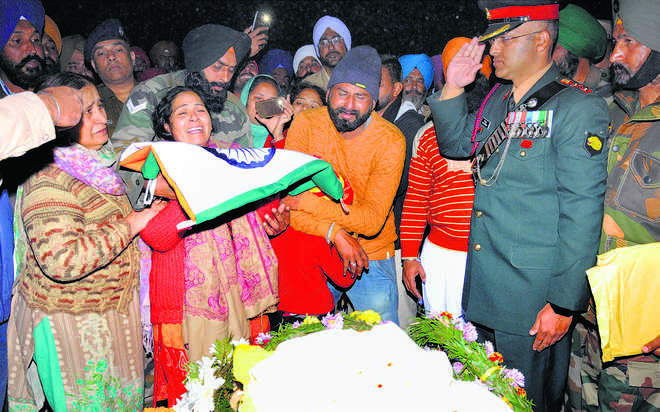
The family of martyred Sepoy Jagsir Singh at Lohgarh Thakran Wala village in Zira subdivision on Sunday. Tribune photo

Anirudh Gupta

Ferozepur, December 31

A pall of gloom descended on Lohgarh Thakran Wala village in Zira subdivision as the news of the killing of Sepoy Jagsir Singh (32) trickled in this afternoon. Jagsir attained martyrdom during early hours on Sunday following unprovoked firing by Pakistani forces on Indian Army posts along the Line of Control in Nowshera sector of Jammu and Kashmir.Sources said Jagsir was targeted by snipers of Pakistan’s Baloch Regiment.Defence sources said though the Indian Army retaliated strongly, Sepoy Jagsir of 19 Punjab Regiment got grievously injured during the exchange of fire. He later succumbed to his injuries.Jagsir had visited his native village last week and had promised to visit again in the New Year.“Jagsir had called yesterday night to convey his New Year greetings. Little did we know it will turn out to be our last conversation with him,” recalled the martyr’s mother, Gurmit Kaur, her voice choked.His wife Mohinder Pal Kaur was inconsolable as she remembered her seven-year relationship with her husband.“We got married in 2010 and were blessed with three kids — Nigamjit Kaur (7), Gurmeet Kaur (5) and Jagdeep Singh (2). On his next visit home, he had promised to take the kids on an outing,” she said.Army officials said Jagsir was a brave and sincere soldier. “The nation will always remain indebted to him for his supreme sacrifice and devotion to duty,” said an official.The martyr’s body would be brought to his native village on Monday in a helicopter, say sources.Jagsir had joined the Indian Army in 2004 and had been serving in the Kashmir valley for the last few years.He did his schooling from the government school in the village and was the youngest of the three siblings.Tehsildar Vipin Sharma along with other officials met the bereaved family and offered condolences.


NSAs of India, Pak secretly met in Thailand: Pak official

NSAs of India, Pak secretly met in Thailand: Pak official
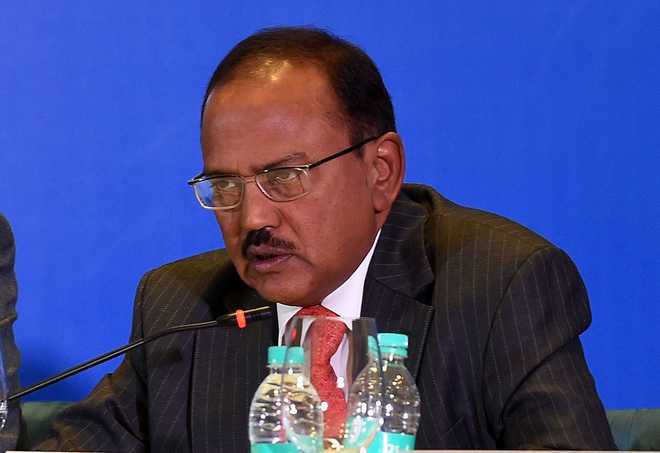
Ajit Doval. AFP file

Islamabad, January 1

National security advisers of India and Pakistan held a “secret” meeting in Thailand where the tone and tenor of India’s NSA Ajit Doval was “friendly and positive”, a senior Pakistani official said on Monday.A Pakistan national security division official, on condition of anonymity, said the meeting between Pakistan’s NSA Lt Gen Nasser Khan Janjua (retd) and Doval took place in Thailand on December 27, ‘The Dawn’ newspaper reported.“The meeting was good. Doval’s tone and tenor was friendly and positive,” the official disclosed. The official maintained that he was briefed about the Indo-Pak meeting.He was told that the meeting was “useful”. The report also quoted the official as saying that the interaction might help in restarting some sort of engagement at the diplomatic level as well.However, there was no word–officially or unofficially–from the Indian side.The meeting, which appeared to be pre-decided, came two days after Indian death-row prisoner Kulbhushan Jadhav met his family in Islamabad on December 25.

(Follow The Tribune on Facebook; and Twitter @thetribunechd)

The Jadhav-family meeting became the latest flashpoint in already strained Indo-Pak relations with Pakistan terming its decision to allow Jadhav’s family to travel to Pakistan to meet him as a humanitarian gesture and India accusing it of violating mutual understanding.New Delhi also hit out at Pakistan, asserting that the Indian national appeared coerced and under considerable stress during the tightly controlled interaction and also accused Pakistan of disregarding cultural and religious sensibilities of family members on the pretext of security.Jadhav, who was captured in March last year, was sentenced to death by a Pakistani military court for alleged spying, an accusation that India has dismissed as concocted.New Delhi says Jadhav was kidnapped in Iran where he had legitimate business interests, and brought to Pakistan. To save Jadhav, India moved the International Court of Justice, which ordered Pakistan in May to stay his execution.It was not the first meeting between the two NSAs in a third country.In December 2015 also, the two NSAs, along with the two foreign secretaries, had met in Bangkok, which was not revealed from both the countries till after the meeting. PTI


Pak sniper shot; shelling on LoC Army retaliates after killing of 4 soldiers, including Maj; ceasefire violated again

Pak sniper shot; shelling on LoC
Grieving family members of Lance Naik Gurmail Singh at Alkare village, near Amritsar, on Sunday. PTI

Rajouri, December 24

The Army today neutralised a Pakistan army sharpshooter in Jhangar sector of Nowshera even as the latter violated the ceasefire by resorting to heavy unprovoked mortar shelling and firing in Shahpur sector of Poonch district today.Hours after Pakistani troops killed a Major and three soldiers by violating the ceasefire in Keri sector of Rajouri yesterday, troops of Jat Regiment in retaliatory action today shot a sharp-shooter of Baloch regiment.(Follow The Tribune on Facebook; and Twitter @thetribunechd)Sources said around 1 pm, Pakistani troops resorted to heavy mortar shelling and firing on Indian forward posts in Poonch. “It was retaliated effectively and strongly by the Indian troops. No loss to life or property was reported,”  sources said.They added that local commanders had been directed to take appropriate retaliatory action and a strong military response could not be ruled out in the next few days in Nowshera sub-division.From May to July this year, Pakistan army had resorted to heavy mortar shelling on Indian forward posts and civil areas in Nowshera sub-division, resulting in the migration of over 4,000 people from border villages. The border dwellers (not from Jhangar area) have returned home recently.Meanwhile, the post-mortem of Lance Naik Gurmail Singh and Sepoy Pargat Singh was conducted at Rajouri’s district hospital. “Both bodies bore multiple splinter injuries,” said a senior doctor, even as the Army clarified that the bodies of its personnel killed in firing by Pakistani troops along the LoC were not mutilated. — TNS


Narendra Modi has to take risks like Rajiv Gandhi on defence deals, or he’ll stall

Illustration by PealiDezine

That’s what Narendra Modi has to do and launch defence modernisation like Rajiv Gandhi in 1985-89, but with lessons learnt. There are political risks, but isn’t that what holding public office is all about.

Bofors is the only gun in history to have won an election all by itself. Since we also like to say it is the man behind the machine that matters, V.P. Singh was also no mean performer at the gunsights.

He launched his challenge to destroy Rajiv with the Allahabad by-election in 1988. The seat had been vacated by Amitabh Bachchan, facing Bofors allegations. Singh campaigned on a motorcycle across the burnt out plains of rural Allahabad, stopping at villages, making a short point and carrying on. True shoot-and-scoot campaigning.

His message was simple: your homes have been burgled. How? When you buy a packet of bidis or a matchbox, a part of the few annas you pay goes to the government as tax. It’s from that tax that the government runs your hospitals, schools and buys weapons for your army. So, if somebody steals a part of that money of yours, what do you call it if not a burglary in your home?

It was brilliant so far. Except, he added two more things. One, the usual political hyperbole: the names of the Bofors “chors” (thieves) are on this slip of paper in my (kurta) pocket, so wait till I come to power.

And second, soldiers are shocked they’ve been given a gun which fires backwards, killing them instead of the enemy. Now, nobody was fooled by this. But the crowds were greatly amused.

It’s been 30 years. Nobody has been caught or punished for Bofors kickbacks. Everybody then charged, either in inquiries or folklore, is dead. The gun has performed brilliantly. It saved the day in Kargil, and not because it fired backwards. It remains the mainstay of the Artillery.

In the 30 years since, not one more Bofors has been ordered, not one manufactured although lately some prototypes called ‘Dhanush’ have been attempted. Such is the stigma that we got no more Bofors since then, no spares, no ammunition, nor any other guns, recovered no illegal commissions, sent nobody to jail.

You want me to tell you something to make us Indians feel more stupid: we named a major New Delhi avenue (a section of the Outer Ring Road) after Olof Palme who, as Swedish prime minister, struck the Bofors deal with Rajiv.

In polite language, we’d describe India’s defence purchase record as na khuda hee mila, na visaal-e-sanam (I got neither the God nor a look at my lover). Somewhat more apt though, is the story of the village idiot who was caught stealing onions. The panchayat asked him to choose his punishment: a hundred shoe-beating, or eat a hundred onions. The idiot chose the latter, gave up after 10 onions, switched to shoe-beatings, couldn’t endure after 10 so switched back to onions. And so on. He ended up having most of both. This is a fairer description of how India has managed its defence acquisitions post-1977. We take that year as a cut-off because India elected its first non-Congress government then and it also saw a departure from the by now settled practice of buying only Soviet equipment.

The first system the Janata government explored was the Anglo-French Jaguar, in the category then called Deep Penetration Strike Aircraft (DPSA). Its rival was the Swedish Saab-Viggen. There were immediate noises of kickbacks as rival agents thrived planting stories on journalists. This launched the phenomenon of “greenhouse” journalism in reporting defence purchases.

The Jaguar too became controversial, was more or less dumped by subsequent governments and never reached its initially imagined force levels. As to how good and capable the aircraft is: even today, 40 years later, the IAF employs 100-plus of these Jaguars. The description flying coffin will also feature in the archives.

Following this, Indira Gandhi returned to the Soviets. Until Rajiv changed the equation radically. It isn’t the most popular thing to say these days, and I risk the wrath of the Bofors generation, but the only real, determined tri-service modernisation in our history was during the Indira-Rajiv era. The defence budget was taken above 4 per cent of GDP against the norm of two or under.

The era saw a variety of systems being bought and inducted – Mirage-2000s from France, Bofors from Sweden, Milan and Matra (French) missiles and Type-209 submarines from Germany. It also included purchases of the MiG-25 trisonics, TU-142s, Il-76 heavy-lift and AN-32 medium transports. Each one became (or was made out to be) some kind of a scam. So each system remained at the initial purchase level. There was no real transfer of technology, no co-production, no realisation of optimal force levels.

Rajiv also bought large volumes of Soviet equipment, from BMP armoured fighting vehicles, new Kilo submarines and took a nuclear sub (the first Chakra) on lease. He paid for all this with the loss of power. I bet there were kickbacks and scams, but the cruel fact is even if India goes to war now, a lot of the equipment it fields would have been ordered by Indira-Rajiv or, later, followed up by Narasimha Rao.

It is a tough point to make, and it will hurt. But the BJP governments’ record in making defence acquisitions is dismal. Vajpayee, hit by the so-called coffin-gate (a purely imaginary scam) bought little, except war-time top-ups. Much was expected of the Modi government. So far its only order of any size is a mere 36 Rafales, slashed from 126 negotiated by the UPA. The rest is just continuation of the few orders the previous government made, treading cautiously just as A.K. Antony would – I had described his approach to defence purchases as “wrapped-in-latex” then. And there is much talk, Make in India and what not. So much talk, and all hot air. Funnily, it’s the BJP that carries the Bofors phobia on arms purchases.

An uncompromising posture on defence and filling up the acquisition gaps were among Narendra Modi’s most forceful campaign propositions. The balance sheet after three-and-a-half years is empty. The fear, indecision and lack of focus is evident in the fact that the Modi government has had four defence ministers already: Manohar Parrikar, Nirmala Sitharaman and Arun Jaitley for extended spells twice.

The one deal it signed, Rafale, is now under attack. It will test Modi’s nerve. Would he have the courage to say: I and my government (unlike Rajiv saying neither I nor any member of my family) have done nothing wrong, persist with the purchase and in fact, enlarge it? The IAF, otherwise, will be reduced to an insignificant force. Even the Su-30s are now almost 20 years old. He has to move on the rest too, for all three forces, or history will judge him poorly and his promises as campaign-bluster. The debate on Rafale has now brought back all the old jargon and mantras, the most ridiculous of which is that catch-all nonsense: transfer of technology (ToT).

For six decades, HAL and other defence PSUs have assembled imported systems with plenty of ToT. Yet, barring a helicopter they’re incapable of using any of this brilliant, transferred technology to produce anything of use. We are still ordering, cancelling, re-ordering and cancelling purchases of infantry rifles, shoulder-fired or Man-Pad missiles, flak-jackets and other basic equipment. ToT over the decades, has been nothing short of all boll****. I refrain from using the remaining four letters as we do not use it in conventional journalism. Does Modi have it in him to ensure that India buys what it needs, and stop the “banana republic” (humko yeh bhi banana hai) charade?

Either he takes the risks Rajiv took, and launches a defence modernisation to rival the 1980s. Or, given dwindling force levels, he should call Xi Jinping and General Qamar Bajwa, settle Kashmir and Arunachal, sign a treaty with the Americans/NATO to protect what remains of India and, like the Japanese after World War-II, commit to limiting India’s defence budget to 1 per cent of GDP.

Why even 1 per cent then? Because you might need some to fight the Maoists in our underbelly. And some for Republic Day parades and for the ministers to have their weekend photo-ops at military bases.


Boxed-in at the border by Pravin Sawhney

Boxed-in at the border
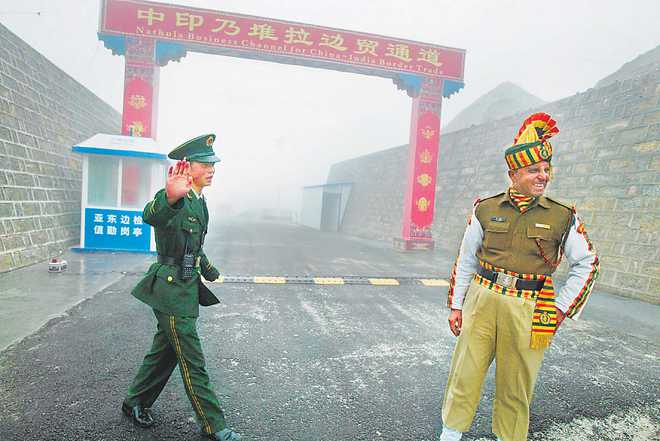
This file photo of 2008 shows a Chinese and an Indian soldier at the Nathu La border crossing between India and China in Sikkim. AFP

Pravin Sawhney
Editor, FORCE newsmagazineRENDERING a degree of permanence to its presence at the Doklam plateau, the Chinese have built roads, defences, pre-fabricated snow shelters, fighting and communication trenches, storage sites and helipads at the disputed territory also claimed by Bhutan. These are enough to accommodate over 1,800 Chinese border guards. These structures are about 7 km east of the stand-off site — also on Doklam plateau — between India and China.On June 16, Chinese border guards had sought to build a road close to Indian Army’s positions which India believed made the Chicken’s Neck area militarily vulnerable. Instead of accepting China’s offer of talks, the Indian Army, on the plea that Bhutan had sought its help under the 2007 bilateral friendship treaty, blocked Chinese construction on June 18, leading to the 73-day military standoff. Disengagement of troops happened on August 28 once the Chinese agreed to stop constructing that road. Indian soldiers withdrew from Doklam; the Chinese did not. On the new constructions by China in Doklam, India says they do not concern it as long as the status quo at the standoff site holds.

Difficult situation for Bhutan

This situation has left the King of sovereign Bhutan, Jigme Khesar Namgyel Wangchuck, also the commander-in-chief of the 9,000-strong Royal Bhutan Army, facing an unprecedented and difficult situation. For the first time, he has two rival militaries on his soil: Indian and Chinese.The Indian Military Training Team (IMTRAT), located at the picturesque Haa town since 1962 under bilateral treaties (1949 and now 2007), is meant to train Bhutanese soldiers and border guards. Its unsaid task is to be the eyes and ears of both Indian Army and Air Force’s eastern commands responsible for the Chinese theatre, as well as the protection of Bhutan.And now, Chinese soldiers too have entrenched themselves on its claimed territory. By now accepting the Chinese presence on ‘Bhutanese territory’ India is conveying the message to Thimpu that as long as the Siliguri Corridor is secure, the Chinese machination does not bother it.Given this, how long can Bhutan keep its side of the friendship with India? In 24 rounds of border resolution talks with China, Thimpu had consistently rejected the Chinese offer of a land swap — 495 sqkm of Chinese territory in eastern and central Bhutan (including grazing ground for cattle) for 269 sqkm in Doklam — to protect India’s security interests.If Bhutan were to resolve its border dispute with China, it could get the following: $10 billion development loan promised by China; road and railway network across the 470km-border that it has with China to boost its tourism industry; end to perceived hydro-electric power exploitation by India; and importantly, removal of foreign troops from its soil, as IMTRAT will have to be wound up. Interestingly, the Chinese troops will remain in Doklam, which would become Chinese territory after the swap. The geopolitical consequence in India’s neighbourhood needs little elaboration.China’s border threat to India upEven without the above scenario, China’s border threat, short of war, to India has increased manifold with its permanent presence. What if the Chinese border guards find a gap in the 3,488-km Line of Actual Control (LAC) and saunter in on Indian territory, as they did in April-May 2013 in north Ladakh? Forcing them to go back could escalate into a skirmish with its own escalatory dynamics.Unlike the Indian Army, China has border guards (paramilitary force equivalent of India’s Indo-Tibetan Border Police) on the LAC. China’s army cantonments are well behind in towns and cities, as its troops can be mobilised faster, given their five advantages over India: excellent roads, technology superiority, pre-acclimatised forces (Tibet is a high-altitude plateau), joint-ness at strategic and war-fighting levels, and mobile combat forces.This peculiar situation has downgraded the Indian Army’s role from border-guarding to border-policing, ie, physically blocking Chinese troops from walking into India. Explaining this drill, followed during the Doklam standoff, the then eastern army commander, Lt-Gen Praveen Bakshi recently said at the Military Literature Festival in Chandigarh: “The (Indian) troops, while forming human chains, refused to back down and not even once did they break ranks.” General Bakshi confirmed that, “Additional formations had been moved to the area beforehand and the troops were well acclimatised.” He added, “China now views India as a threat.”The reality is different. Consequent to the Doklam crisis, the Indian Army has moved thousands of troops forward for policing duties to cover innumerable gaps on the LAC. Besides braving sub-zero weather conditions, these troops would face accommodation, heating and logistics challenges against a non-existent enemy. Moreover, China, which is preparing to fight the modern war, does not view India as its enemy; its sights are fixed on the US in the Asia-Pacific. However, India, which seems to be preparing to fight the 1962 war better, sees China as the enemy.Perhaps, India should consider Chinese foreign minister Wang Yi’s suggestion. During his recent India visit, he urged that ‘lessons should be learnt’ from the standoff. The most important being that muscle-flexing should be the last resort. There is no substitute to dialogue.


Martyrs’ families get financial assistance on ‘Vijay Diwas’

Martyrs’ families get financial assistance on ‘Vijay Diwas’
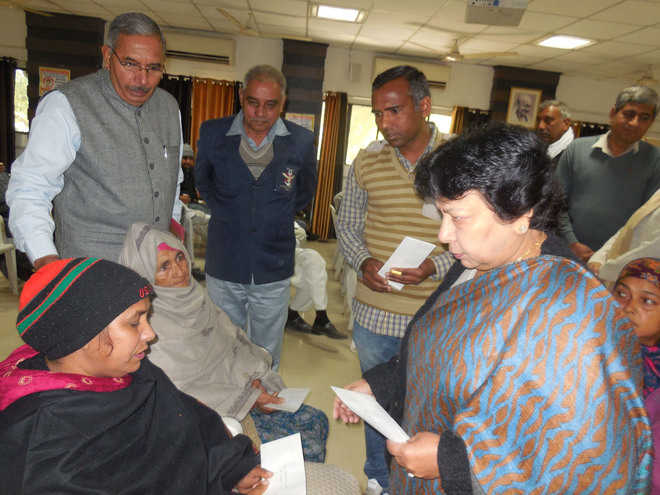
Deputy Commissioner Sunita Verma hands over a cheque to a war widow in Kaithal on Saturday. Tribune photo

Our Correspondent

Kaithal, December 16

The District Sainik Board organised a function on ‘Vijay Diwas’ here today. Deputy Commissioner Sunita Verma said the day reminds us of the supreme sacrifices made by soldiers. Such events not only provide information about historical events to the present generation but also keep the country united.She handed over cheques of financial assistance to war widows, including Savitri Devi, a resident of Rajound; Lakhvinder Kaur, a resident of Kakkar Majra; Shanti Devi, a resident of Deoban; Vidyawati, a resident of Jakholi; Leelawati, a resident of Siwan; Saroj Bala, a resident of Tara Garh; Guddi Devi, a resident of Kolekhan; and Chander Pati, a resident of Kithana.SDM Kamalpreet Kaur promised ex-servicemen that they would get full respect in government offices. City Magistrate Sushil Kumar, Subedar Ram Singh and other ex-servicemen were also present on the occasion.Kharga Corps pay tributes

Ambala: Kharga Corps celebrated 46th ‘Vijay Diwas’ in a solemn ceremony at the Vijay Smarak in Ambala Cantonment on Saturday. The General Officer Commanding, Lt Gen Jaiveer Singh Negi, laid a wreath at the war memorial to pay homage to the brave martyrs. ‘Vijay Diwas’ commemorates the victory of India in the 1971 war with Pakistan, which led to creation of Bangladesh. The war was fought for 13 days from December 3 to December 16, 1971. In one of the fastest and shortest campaigns in the military history, a new nation was born and 93,000 prisoners of war surrendered to the Indian Army at the end of the operation. — TNS