Sanjha Morcha

What’s New

Click the heading to open detailed news

Current Events :

web counter

Print Media Reproduced Defence Related News

Lt Col Sandhu hiding in UP, claim Mohali cops May be staying in Kanpur or Gorakhpur

Tribune News Service

Mohali, April 1

The Mohali police claimed to have got a tip-off that Lt Col BS Sandhu (retd) might be staying in Uttar Pradesh.A senior official of the Mohali police said they got the tip-off that Sandhu could be staying in Kanpur or Gorakhpur.“He is not using his phone number, but some new number. We are trying to locate him,” said the official.Notably, the Mohali police have got Sandhu’s non-bailable arrest warrants from a court in Kharar on Saturday as he (Sandhu) failed to join police investigations in the case of murder of CTU employee Abhishek Guleria so far. Sandhu was nominated in the case on March 27.Meanwhile, four persons, Ramesh, Ramesh Chand, Dharampal and Davinder, who were also named in the case by the Mohali police on Saturday, have also gone underground, said the police. The foursome are said to be security guards at Forest Hill Resort, owned by Lt Col Sandhu, at Nayagaon.The police said these four persons were not found at their respective residences when the police party went there to summon them for investigation. Despite instructions, they did not turn up so far.As per the police, these four persons were involved in stuffing the body of the victim in a sack and then in a polythene bag before disposing it off at a deserted place along the Pinjore-Baddi road. The body was recovered by the police on March 24.It is to be noted that a four-member SIT has been formed to work out the case.Four persons named in FIR go undergroundFour persons, Ramesh, Ramesh Chand, Dharampal and Davinder, who were also named in the case by the Mohali police on Saturday, have also gone underground, said the police. The foursome are said to be security guards at Forest Hill Resort, owned by Lt Col Sandhu, at Nayagaon.


The road out of Doklam MK Bhadrakumar

Need radical new thinking to improve ties with China

The road out of Doklam

MK Bhadrakumar

The summer is at our doorstep. With June approaching, memory mixes with anxiety. It’s going to be one year since the Doklam faceoff began. One year is not a long time in the life of a nation but in last June a terrible beauty was born in the India-China relationship. Alarmist reports appeared lately regarding Chinese deployments. Timely clarification at the official level dissipated the scaremongering. Compared to the impetuosity of the past three-year period, a sense of proportion is discernible in the government’s approach to the relationship with China.The question that begs an answer, nonetheless, is what it was that we had hoped to gain by crossing the established border into Doklam last year? A range of explanations may be possible and, indeed, the two most-popular ones are: the security of Siliguri Corridor (‘chicken’s neck’) demanded it, and/or two, that as the provider of security for Bhutan, India was obliged to act. Both explanations are heavily laden with emotions and appeal to public imagination, but are intrinsically fragile and insufficient to explain the gravity of what happened.In the recent exchange between our ambassador to China Gautam Bambawale and Chinese foreign ministry spokesperson Hua Chunying, a third unspoken leitmotif appeared — Doklam as a template of the India-China border dispute. Hua unequivocally refuted Bambawale’s innuendo of Doklam being a segment of the “un-demarcated and un-delineated” India-China boundary, where “we are discussing where the boundary will lie”. In Bambawale’s words, “I can tell you very frankly… The Chinese military changed the status quo in the Doklam area and therefore India reacted to it. Ours was a reaction to the change in the status quo by the Chinese military.” He did not even mention Bhutan. But Hua differentiated Doklam from the India-China border dispute, and remarked that India must learn lessons from last year’s faceoff. India keeps strategic ambiguity as regards the 1890 pact between India, Sikkim and Tibet.Amidst the triumphalism last August following the denouement to the Doklam faceoff, this was what M Taylor Fravel, professor at MIT and expert on China’s boundaries, had written in War on the Rocks magazine on September 1, in an essay titled “Why India Did Not Win the Standoff with China”: “Ironically perhaps, India’s actions underscored to China the importance of enhancing its military position in the Doklam bowl. Before the standoff in June, China’s permanent presence in the area had been quite limited. China had maintained a road in the area for several decades, but did not garrison any forces. In contrast, India has maintained and developed a forward post at Doka La (Sikkim) adjacent to Doklam.“Now that India has chosen to confront China at Doklam, however, China may well seek to rectify this tactical imbalance of forces… If China does this, it would likely build facilities farther away from India’s position at Doka La, making it more challenging for India to intervene and block China next time. When India challenged China’s construction crews in June, it only had to move its forces a hundred metres from the existing border. In the future, India may be faced with the uncomfortable choice of deciding whether to risk much more to deny China a greater presence farther inside Doklam or to accept it. This will be a tough decision for any leader to make. Even if India won this round, it may not win the next one.”What an extraordinary reading of tea leaves! No matter the caricaturing by elements in our strategic community or incitement from abroad, what Fravel predicted has happened and it puts Delhi on the horns of a dilemma. The big question here is how far Bhutan is interested in India pushing the envelope? It appears that Bhutan’s border claim is historically flimsy and a massive amount of Tibetan historical land records attest to the Chinese claim. Curiously, Bhutan over-asserted its claim over Doklam only fairly recently in the late ’90s. Of course, the Bhutanese claim is (partially at least) not without some historical foundation, although Doklam as such used to be under the control of the Tibetan administration in Lhasa. Put differently, China cannot be expected to relent, given the access Doklam gives to the highly strategic Lumbi valley that leads to Lhasa. Above all, the cut-off point is that “not a single inch of our land will be or can be ceded from China” — as President Xi Jinping stated on the concluding day of the National People’s Congress in Beijing on March 20.In the circumstances, megaphone diplomacy serves no purpose and could even be counterproductive. Meanwhile, time may not work in India’s favour, either. In Bhutan itself, there is no evidence of fear from Chinese invasion or even encroachment from north. Do the concerns voiced by Ambassador Bambawale find echoes in Bhutan? There are no easy answers. Some recent reports by travellers have cited a growing feeling of awe and admiration among the Bhutanese people regarding China’s economic miracle. Such inchoate feelings can arouse nationalist sentiments in unexpected ways. The fact remains that the sharply rising trajectory of China-Nepal cooperation, especially the economic spin-off from the Belt and Road Initiative, is also poised to transform Nepal phenomenally in the coming decade. Bhutan will watch with interest Nepal’s transition to a new mode of production relations and what it could mean for development, social mobility and prosperity. Suffice to say, Delhi should anticipate that given the irresistible pulls of modernisation, the quotient of “happiness” in Bhutan may give way.When the region is changing so rapidly, there is need for a radical new thinking on our part instead of reacting to emergent situations with the advent of summer in the Himalayas. Fundamentally, we ought to figure out whether we want China as friend and partner or continue to regard it as rival and enemy against whom we should prepare for the decisive war eventually. The former Soviet Union made that strategic decision when Mikhail Gorbachev travelled to Beijing in 1989; and, the two countries’ quasi-alliance ensued. One possibility is to “re-invent” SAARC. We had conceived it as a vehicle of regional leadership. Perhaps, we should now turn it around as a dynamic vehicle for regional cooperation. Does China’s SAARC membership damage Indian interests, or, can it provide a window of opportunity? Much as the thought seems preposterous today, we can be open-minded and receptive. It is entirely conceivable that our core interests over Doklam can be safeguarded within a matrix of regional cooperation involving China.The writer is a former Ambassador



ISI still providing covert support to Taliban: US media report

ISI still providing covert support to Taliban: US media report
The Pentagon said the US wanted Pakistan to take more steps against terrorism in the region. Reuters file

Washington, March 16

Pakistan’s intelligence agency ISI continues to covertly support the Taliban in the border region, a US media report on Friday claimed, naming specific neighbourhoods in the country that are being used as safe havens by the terrorists.The Washington Times’ investigative story alleged that Taliban terrorists from Afghanistan travelled freely to a Pakistani army garrison in Quetta where they met with military and Inter-Services Intelligence (ISI) officials.“We believe top Taliban leadership are operating from Pashtunabad, Gulistan and surrounding areas,” an unnamed intelligence source was quoted as saying by the daily.Killa Abdullah, a small border district about 44 miles from Quetta, is another area where the Taliban is working with the ISI. Within that district, an area known as Chaman that borders Afghanistan is a Taliban hub, where terrorists operate openly and are known to local residents as Talibs, it said.Taliban fighters have been spotted here along the road from and to Kuchlak “with automatic weapons either in motorbikes, or in four-by-four vehicles along with two to five companions,” the source said.The Washington Times said the ISI also conducted security patrols in facilitating Taliban transit along the main highway to Kuchlak, using a Toyota SUV that is owned by the ISI.Claiming that the ISI security is an open secret in the region, the daily said local police are not permitted to stop the Taliban from travelling from Afghanistan to Pakistan and the fighters refused requests at checkpoints for identification by simply stating they are Talibs.“These people freely travel in Quetta, Chaman and all surrounding areas. Civilian [police] forces cannot intervene because they work under ISI and military apparatus. The police are also powerless and are afraid for their own security,” American intelligence sources told the US daily.Guldara Baghicha, near Chaman city, which houses a Pakistani paramilitary garrison, is said to be a major residence for families of the Taliban. The ISI has banned the local police and Pakistan’s Frontier Corps from entering or patrolling that area.Kili Jahangir, in its neighbourhood, includes restricted zones because Taliban families live nearby, the daily said.The intelligence source further described Jungle Piralizia, south of Chaman, as a Taliban “resting place after their campaigns in Afghanistan against Western forces”.“The region has been scene of clashes between local police and Taliban fighters, who are known to retaliate against local police who try to arrest them, in one case blowing up a police vehicle and killing several policemen,” the daily said.“In such cases, the Taliban are arrested by local police then the ISI intervenes immediately and promptly releases them,” the daily said.Meanwhile, the Pentagon on Thursday said the US wanted Pakistan to take more steps against terrorism in the region.“The (Defence) Secretary has said there is more that Pakistan can do. And we look forward to them taking more steps to combat terrorism in the region,” chief Pentagon spokeswoman Dana White told reporters at her weekly news conference. PTI


9 CRPF men die in Chhattisgarh blast Mine-protected vehicle blown up

9 CRPF men die in Chhattisgarh blast
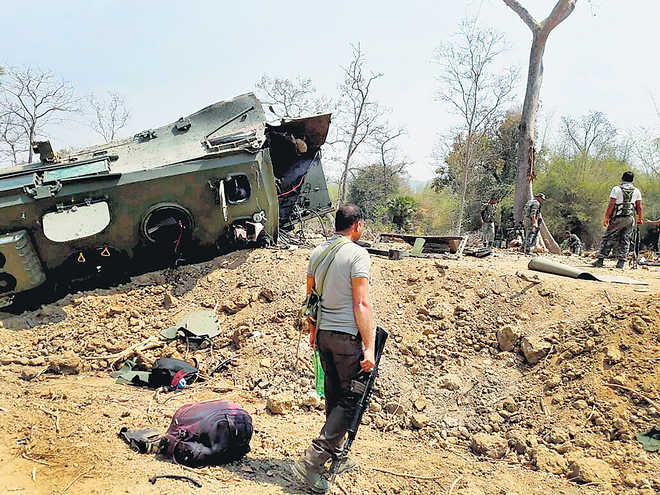
Security personnel inspect the site of an IED blast where nine CRPF men were killed in Sukma district. PTI

Raipur/New Delhi, March 13

Nine Central Reserve Police Force (CRPF) personnel were killed and two injured after Maoists blew up their mine-protected vehicle (MPV) in Chhattisgarh’s Sukma, a year after a dozen jawans were killed in a similar ambush in the district. Officials said the incident took place around 12.30 pm along the 5-km under-construction Kistaram-Palodi road when the troops of CRPF’s 212th Battalion were out for an operation.(Follow The Tribune on Facebook; and Twitter @thetribunechd)Home Minister Rajnath Singh said the incident was “deeply distressing” and asked CRPF Director General RR Bhatnagar to rush to Chhattisgarh. Over 50 kgs of improvised explosive devices (IEDs), concealed under the track, were used in the blast. The armoured MPV went 10 feet into the air before crashing, officials said.Those killed have been identified as Assistant Sub-Inspector RKS Tomar, Head Constable Laxman and Constables Ajay K Yadav, Manoranjan Lanka, Jitendra Singh, Shobhit Sharma, Manoj Singh, Dharmendra Singh and Chandra HS. “The troops were going towards a new post in Palodi. Naxals were first spotted in the area at 8 am and the CoBRA teams retaliated and broke the ambush. However, when a convoy was crossing the area in the noon, the second mine-protected vehicle got caught in the blast,” the DG said. — PTI


The opening with Pakistan Return of veneer of normality

The opening with Pakistan

The India-Pakistan saga has taken many strange twists and turns. One of them would be India’s sudden offer to break bread with Pakistan on humanitarian issues even as soldiers take potshots at each other along the border in J&K. Equally surprising is Pakistan’s quick acceptance of the offer to de-escalate the hostilities on the border. It may not be hard to detect the inspiration behind the abrupt realisation that the border needs peace and that women and the elderly are the worst sufferers in the absence of regular diplomatic relations. The US is trying to regain its lost geopolitical footing following quicksilver moves in the region by the Chinese. Washington allows New Delhi to do the heavylifting in the contest with Beijing for island-nations in the Indian Ocean or the countries between Tibet and India. But it has taken matters in its own hand to check the Af-Pak drift away from the Western camp.The US interest in easing tensions between India and Pakistan is obvious. It has just offered an olive branch to the Taliban and warm words to coax Pakistan into relocating bulk of its army on the Afghanistan border to bottle-up militants out to sabotage the talks. A prime requirement for the US game in Afghanistan to succeed is peace on the Indo-Pak border. For both countries uninterested in normalising ties because of the divergence in their core concerns, the humanitarian angle is a convenient cover to announce a break from the mutually unhelpful and endless skirmishing on the border.Appearances can be deceptive but Pakistan has offered more than a formal breaking of bread by dangling the prospect of a comprehensive dialogue. This is the ideal opening for diplomats to step in. India needs space to strengthen its internal political processes in J&K as well as allow smooth implementation of its Iran trade corridor and the gas pipeline from Turkmenistan, even as it keeps turning the screws on Pakistan for harbouring militants. A stoppage of dialogue has so far only added more files to the folder of bilateral negativity.




How forces got Jaish chief in 10 minutes

How forces got Jaish chief in 10 minutes

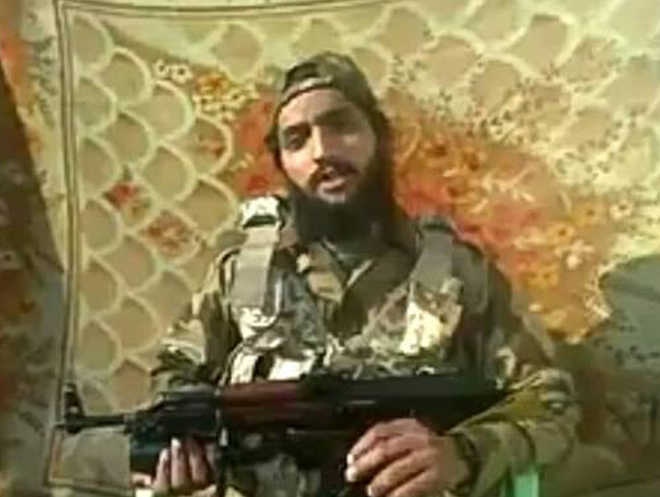
Majid Jahangir

Tribune News Service

Srinagar, March 6

Barely a few minutes of gunfight led to the killing of Jaish-e-Mohammad top militant in Kashmir who masterminded all recent fidayaeen attacks in J&K.Jaish operational commander Mufti Waqas, a resident of Pakistan, was killed in a meticulous operation on Monday evening at Hatiwara, Awantipora, nearly 20 km from Srinagar.Upon receiving “pinpoint” input about Waqas’ presence in a house with a small attic in the village on Monday afternoon, security forces planned the operation. The police suspect that Waqas had arrived in the village late Sunday. A joint operation was launched by the police, 50 Rashtriya Rifles Battalion and 130 Battalion of the CRPF in a congested locality, though the suspected house was located in an open area, sources said, adding that the security forces had considered the possibility of the operation continuing through the night.“After the cordon was laid around 5 pm, the militant commander was offered surrender through the house owner, which he declined. The inmates of the house were taken out. The militant commander came out running and fired in a bid to escape. In the nearly 10-minute gunfight Waqas was killed,” a security officer in south Kashmir said. “It was a crisp and clean operation.”The anti-militancy operation was called off by 7 in the evening.After infiltrating into the Valley last year, Waqas was operating in the Tral area of Pulwama district, said police sources. Waqas and the 3-foot-tall local militant commander Noor Mohammad Trali together revived the Jaish outfit and planned fidayeen attacks. Trali was killed in December last year close to the village where Waqas was killed last evening. “Waqas was close to Jaish founder Maulana Azhar Masood, whose nephew Talha Rashid worked under Waqas,” another police officer in Srinagar said while terming the killing of Waqas as the biggest success of the year. Talha was killed in November last year in a gunfight in Pulwama.A police spokesman on Monday had said the slain militant commander was the chief architect of attacks on the security forces, including the strikes at District Police Lines, Pulwama, on August 26 last year, Lethpora CRPF camp on January 1 and Sunjuwan Army camp on February 10.Meanwhile, Tral, Awantipora and Pampore towns observed a shutdown over the killing of Waqas.

Crisp encounter

  • A joint operation was launched at Hatiwara, Awantipora, after input about Mufti Waqas’ presence in a house in the village.
  • After the cordon was laid around 5 pm on Monday, the Jaish commander was given the surrender offer through the house owner, which he declined.
  • The inmates of the house were taken out. Waqas came out of the house running and fired in a bid to escape. In 10 minutes, he was killed in a crisp and clean operation, said a security officer.

Violence in Tripura Not the change voters were looking for

Violence in Tripura

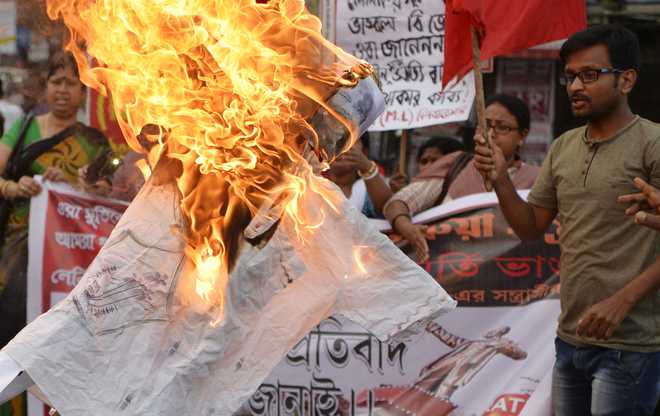
TRUE to its election-time slogan of Chalo Paltai (let us overturn), the BJP has put its battle cry into practice even before an elected government could be sworn in. The overexcitement among its cadres has given way to frenzy. A statue of Lenin was overturned and several CPM offices were torched or vandalised. The BJP activists seem to have borrowed the idea of bulldozing Lenin’s statue from Eastern Europe where thousands of Lenin and Marx statues were pulled down rowdily as a joyous expression of the end to a deeply prescriptive and intrusive ideology. Matters ended at that. The practice has continued in Ukraine more because it is a country deeply at odds with itself and vandalism of the other’s cultural and political symbols is part of the tit-for-tat violence that has engulfed the land.But in India, the vandalism of the Lenin statue and the larger script of political violence sit uneasily with the traditional Indian practice of cohabiting with opposing binaries and philosophies. The true Indian willingly imbibes the essence of the atheistic-materialistic Charvak as well as the Sanatan Dharma’s spirit of renunciation and embedded ritualism. Rather, the BJP betrays comfort with static ideas much like its vanquished opponent when it rationalises the demolition of the statue of a “foreigner”, overlooking the continued relevance of his ideas.Union Home Minister Rajnath Singh needs to be commended for quickly sensing the vacuum in governance and instructing the police to take charge of the situation. At the real-politic level, he would be conscious that the BJP has so far only successfully peddled a dream. It needs to summon the spirit of cooption and cooperation even for its partial realisation; though the Left Front lost the polls, it drew in a significant 45 per cent of the vote. The BJP’s cadres should also realise that the pattern of wins and losses in a democracy are cyclical and so is retributive violence; good governance, by which it swears, will be the casualty if mayhem in the bazaars of Tripura is allowed to continue unchecked.


Veterans educated on Army welfare schemes

Veterans educated on Army welfare schemes
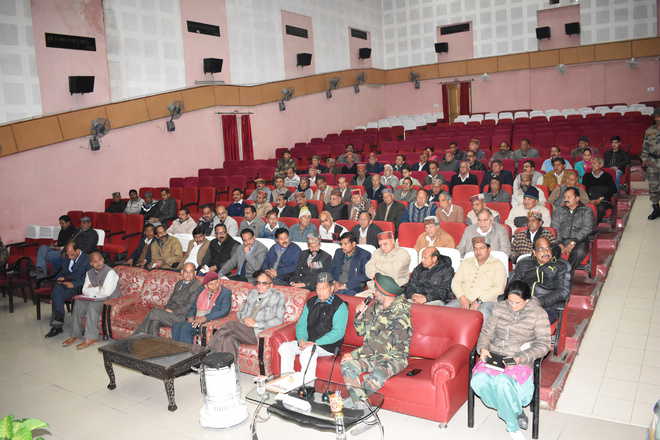
The meet was aimed at addressing issues of ex-servicemen and acquainting them with various schemes and programmes for improving the quality of life.

Our Correspondent

Palampur, February 11

The DAH division of the Army in continuation with its effort to reach out to veterans organised an ex-servicemen meet at the local Army cantonment today.The meet was another stepping stone towards educating the veterans and veer naris on various welfare schemes and measures for uplifting the ex-servicemen.The meet was attended by hundreds of ex-servicemen and ‘veer naris’ coming from different parts of Kangra, Mandi and Hamirpur districts.The meet was aimed at addressing issues pertaining to the ESM (ex-servicemen) and acquaint them with various schemes and programmes for enhancing the quality of life of the veterans.Brigadier Charandeep Singh, Station Commander of Palampur, addressed the ex-servicemen and educated them on the ECHS facility available in the state. He encouraged the ex-servicemen to register themselves so that they could avail all medical facilities provided by the Army free of cost.The ex-servicemen enquired regarding extension of these facilities to the remote areas for which the Station Commander assured that necessary steps were being taken. The ex-servicemen were assured that the local Army authorities’ endeavour was to educate the veterans on various welfare schemes and address their grievances for an early resolution, it said.The veterans showed great enthusiasm by actively participating in the meet. The vibrant atmosphere of the ex-servicemen meet was truly reflective of their energies. Ex-servicemen were also educated how to apply online for the ECHS smart card. The paramedics team from the ECHS polyclinic conducted screening of patients from among the ex-servicemen.


1962: MAKING THE CASE AGAINST CHINA

Author Bertil Lintner believes India and China are destined to remain rivals

There is a Neville Maxwell school of historiography regarding India’s 1962 war with China. It has reigned in much of the external world and left a footprint even in India. The Maxwell school has a lengthy curricula, but its principal text is that Jawaharlal Nehru’s Forward Policy provoked China into launching a full-scale military offensive. Maxwell believed the likeliest time for Mao Zedong to have made the decision to attack was thus “in mid-October 1962” just after India’s forward movement had led to an outpost being set up in Dhola, in the eastern Himalayas. Lintner argues that “Chinese preparations for the war obviously began long before October 1962… Even if there already were new roads and military camps in the area, tens of thousands of more PLA troops and tons of supplies, including heavy military equipment, had to be moved over some of the most difficult terrain in the world.”

CORBIS VIA GETTY IMAGESIndian troops in Ladakh during the war between India and China, 1962. ■The evidence that he furnishes for this, however, is circumstantial. One, Deng Xiaoping had said in 1959 when the Dalai Lama fled to India that “When the time comes, we certainly will settle accounts with [the Indians].” Mao also told foreign delegations that he believed India had designs on Tibet. Two, a known export on Chinese intelligence, Nicholas Eftimiades, has written that Chinese agents began entering what is today Arunachal Pradesh two years before the actual fighting. Three, Indian POWs, most notably Brigadier John Dalvi, noticed that the Chinese had been building POW camps and truckbearing roads well before the fighting broke out. This is a warm but hardly a smoking gun. Fortunately, better evidence has been provided by the Chinese themselves. Research by the Chinese scholar Jianglin Li, in his book When the Iron Bird Flies and on his blogspot site War on Tibet (http://historicaldocs.blogspot.in/) has Mao telling his central committee in 1959, “When the time comes, we will settle accounts with [the Indians].” Chinese General Yin Fatang is cited saying orders to “resolutely fight back” India were given in May 1962. Lintner is on firmer ground as he describes how India, China and various Himalayan regimes have sparred for influence over the past several decades. Lintner is at his best describing this playing out in the ethnic mosaic of the Northeast and Upper Burma, areas which he knows intimately, but chapters also look at Nepal, Bhutan and, less ably, Kashmir. Post-1962, he argues, China shifted to supporting insurgents like the Nagas and Assamese to trouble India – though even Beijing found the Naxalites too extreme. Parallels are drawn to China’s use of concocted territorial disputes to assert influence elsewhere, whether invading Myanmar in 1968, Vietnam in 1979 and today grabbing most of the South China Sea.

He develops scholar Claude Arpi’s argument that the 1962 war was useful for Mao to restore his authority at home. While this sounds nice, it is questionable given at least one Chinese general’s account that Mao was nervous as to whether his army would be able to defeat the Indian military.

Short work is made of other parts of Maxwell’s thesis. The Chinese, for example, have no historical right to Arunachal Pradesh. Lintner shows the Chinese set up border posts in that area for a brief period in 1911-12 and then, finding it impossible to hold, never returned again. He refutes Maxwell’s claim that the British Raj’s designated Outer Line in the Northeast was treated by London as a de facto border. British authorities defined the Outer Line as a limit of administrative capacity not sovereignty. Maxwell’s claim that the Indian military’s post mortem of 1962, the Henderson Brooks report, blamed the Forward Policy was a lie. The report focused on tactical issues – as became evident when Maxwell posted it on the internet years later.

Among the insights the book provides is that the Chinese 1962 inroads into Arunachal Pradesh were limited to Arunach Tibetan language areas because they lacked surveillance agents trained in other languages. Lintner has a curious admiration for Krishna Menon and General Brij Mohan Kaul, both universally seen as culpable for India’s defeat. He rightly reminds Indians of the shameful decision to put Chinese-Indians in a concentration camp. Ultimately, he believes, Asia’s two giants are destined to be rivals because they are simply too different. “It is hard to imagine two cultures that are more different than India and China in terms of history, social structure and political culture” and the relations between them represent a true “clash of civilisations.”


China no to another India ‘flashpoint’

China no to another India ‘flashpoint’

Beijing/Washington, Feb 9

China today said it is in touch with India to discuss a way to resolve the political turmoil gripping the Maldives and underlined that Beijing doesn’t want the issue to become another “flashpoint” in ties with New Delhi. This comes on a day the White House said Prime Minister Narendra Modi and US President Donald Trump in a telephonic conversation expressed concern over the political crisis.“Both (Trump and Modi) expressed concern about the political crisis in the Maldives and the importance of respect for democratic institutions and rule of law,” the White House said in a readout of the phone call, the first between the two this year.(Follow The Tribune on Facebook; and Twitter @thetribunechd)While China officially continues to maintain that there should not be any external interference, especially in the light of reports of India’s Special Forces ready for deployment, Beijing is in touch with Delhi to resolve the crisis, Chinese official sources said. The standoff between India and China in Doklam and Beijing’s opposition to declaring Pakistan-based Masood Azhar as a global terrorist at the UN had been major irritants in bilateral ties in the past. Maldives President Abdulla Yameen sent his Economic Development Minister Mohamed Saeed to China but India said it did not find the dates “suitable” for the visit of Maldives’ foreign minister as a special envoy to New Delhi. — AgenciesMEA: Hope nations can play constructive roleNew Delhi: India on Friday hoped that countries, including China, could play a constructive role in Maldives. An MEA statement said, “We note that China has said that Maldives Government has the ability to protect the security of Chinese personnel and institutions. We hope all countries can play a constructive role in Maldives, instead of doing the opposite.” TNS