Sanjha Morcha

What’s New

Click the heading to open detailed news

Current Events :

web counter

Print Media Reproduced Defence Related News

Court of inquiry ordered into Major Gen’s death

CHANDIGARH: Western Command has ordered a Court of Inquiry into the death of its dental centre commandant, Major General Sanjeev Harbans Gupta, 58, who was cremated on Monday at the Sector-25 cremation ground with full military honours.

Gupta had died on Sunday morning at the golf park of Chandimandir Military Station after his golf cart wobbled while crossing a bridge, due to which he fell into a drain. Gupta was rushed to Command Hospital, Chandimandir, where he succumbed to head and spinal injuries.

A senior officer at Western Command said that there was no railing on the bridge.

He added that a Court of Inquiry is underway on the death of the officer and truth will come out, after which any safety measure, if required, will be taken.

However, Panchkula police have denied any foul play in the official’s death. His family has not filed any complaint in the matter as of now.

Born on March 13, 1959, Gupta, who hailed from Gurdaspur, was commissioned into the Army Dental Corps in September 1981.

A senior dental officer with a distinguished professional repute, he had an outstanding career having performed with great distinction in all courses and appointments held by him, according to the Western Command.


Pak: Considering visa request of Jadhav’s mother

Pak: Considering visa request of Jadhav’s mother
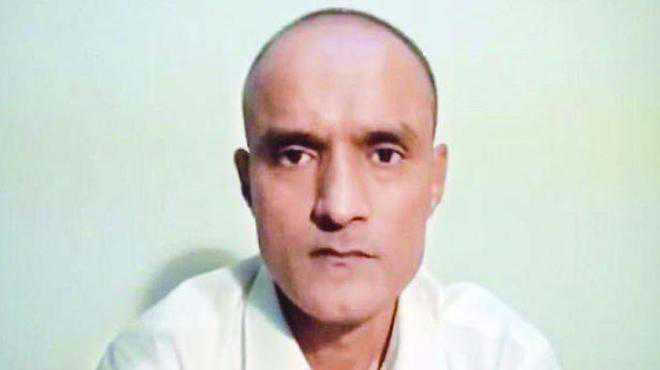
Kulbhushan Jadhav. — File photo

Islamabad, July 13

Pakistan today said it was considering a visa application of Kulbhushan Jadhav’s mother to meet her son, sentenced to death by a military court.External Affairs Minister Sushma Swaraj had two days back said she had written a “personal letter” to Adviser to the Prime Minister on Foreign Affairs Sartaj Aziz asking for approval of Avantika’s visa.She also said that Aziz did not even respond to her letter.(Follow The Tribune on Facebook; and Twitter @thetribunechd)A Pakistan foreign office official said asking for recommendations from Aziz to grant visas was against “diplomatic norms”.Jadhav, 46, was sentenced to death by a Pakistani military tribunal in April on charges of espionage and terrorism. India maintains he was kidnapped from Iran. — PTI


J-k martyr cremated with honours

J-k martyr cremated with honours
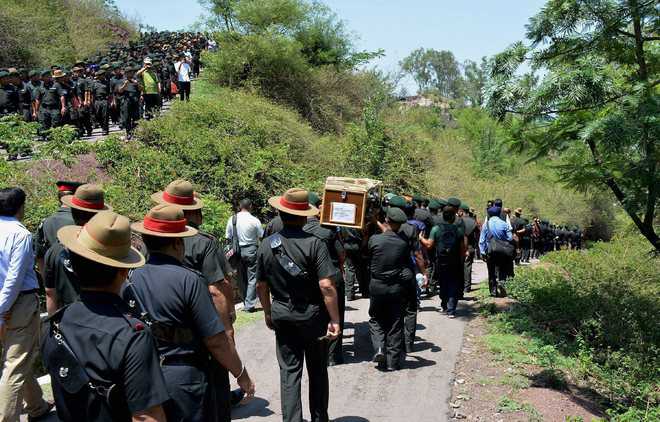
Army personnel carry the mortal remains of martyr Tara Bahadur, who was killed in Jammu and Kashmir, in Subathu in Solan on Saturday. PTI
  • Rifleman Tara Bahadur Roka was cremated with full state honours at the 14 Gorkha Training Centre at Subathu in the presence of senior Army and civil officers from the district administration
  • Roka was martyred while countering an infiltration bid in Jammu and Kashmir’s Nowgam sector on Thursday. His body was brought to Kasauli yesterday and was brought to Subathu on Saturday
  • The cremation took place after the arrival of his family from Nepal. Heart-rending scenes were witnessed as the family members paid their last respect to him
  • Deputy Commissioner Rakesh Kanwar was also present on the occasion. Solan, TNS

Army organises summer camp

Palampur: The military authorities organised a summer adventure camp for children of Army Schools and wards of Army personnel and civil defence staff of the Northern Command under the aegis of DAH Division from June 5 to 10. In the one-week camp, the children will undergo a flurry of activities. OC


Kargil war: When an IAF Jaguar had Sharif, Musharraf in its crosshairs

In a report titled ‘War no solution to problems, says Nawaz’, the Pakistani newspaper The News, said in its edition of June 25, 1999: “Prime Minister Muhammad Nawaz Sharif on Thursday reiterated his call for dialogue with India for defusing a war-like situation along the Line of Control (LoC).
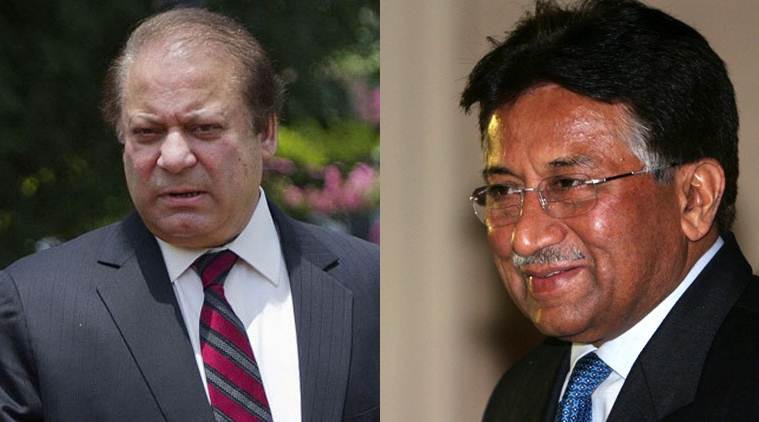
 

Pervez Musharraf , Musharraf, Nawaz sharif, Pakistan, Pakistan prime minister, Pak PM Nawaz sharif, Pakistan Muslim League-Nawaz, Pakistan government, world news

Around 8.45 am on Thursday, June 24, 1999, at the height of the Kargil War, an Indian Air Force Jaguar flying close to the Line of Control “lased over” — that is, acquired for bombing using its laser-guided system — a forward base of the Pakistan army. Ultimately, however, the pilot of a second Jaguar that was following close behind — who was supposed to fire the bomb — targeted it “outside the laser basket”; that is, he did not fire it at the military base.

At that precise time, Pakistan Prime Minister Nawaz Sharif and Pakistan Army chief General Pervez Musharraf were present at the base, shows an official document accessed by The Indian Express. The events of what might have been a day of catastrophic disaster have not been made public before.

“On 24 June 1999, Jaguar CLDS [Cockpit Laser Designation System] engaged Point 4388. The pilot had lased over Gulteri across LoC but the bomb did not reach the target as it was released outside the laser basket,” says the document of the Government of India. It then notes, in bold type, that “Later, it was ascertained that the PM of Pakistan, Mr Nawaz Sharif, was present at Gulteri when the target was attacked.”

When the first Jaguar targeted Gulteri base, it was not aware that Sharif and Musharraf were present at the target. An Air Commodore, who was airborne at the same time, however, advised the pilot to not fire the bomb. The bomb was then dropped on the Indian side of the LoC.

Kargil War: When An IAF Jaguar Had Sharif, Musharraf In Its Crosshairs

Gulteri, also called Gultari, a forward administrative base of the Pakistan Army, was at the forefront of providing logistics support to Pakistani soldiers during the Kargil War. It is approximately nine kilometres inside Pakistan Occupied Kashmir (PoK) from the LoC, opposite India’’ Dras sector.

On that day, Sharif, accompanied by Musharraf, was on his first visit to forward areas along the LoC in Shakma sector. In a report titled ‘War no solution to problems, says Nawaz’, the Pakistani newspaper The News, said in its edition of June 25, 1999: “Prime Minister Muhammad Nawaz Sharif on Thursday reiterated his call for dialogue with India for defusing a war-like situation along the Line of Control (LoC). “I invite the government of India to adopt the way of reconciliation,” so that all disputes including Kashmir could be solved through peaceful means, he said while addressing the troops at the height of 11,600 feet here. Chairman Joint Chiefs of Staff Committee and the Army Chief Gen Pervez Musharraf, Defence Secretary Lt Gen (Retd) Iftikhar Ali, Hummayun Akhtar, the Chairman Board of Investment, were also present on the occasion.”

Air Marshal Vinod Patney (retd), who was then the Air Officer Commanding-in-Chief of the IAF’s Western Air Command, and directly responsible for the air operations in the Kargil War, told The Indian Express about the incident of June 24, 1999: “It was a target in Mushkoh Valley, where a logistics dump was seen by the Jaguar aircraft. The first Jaguar lased against the target and the second Jaguar was to fire a laser-guided bomb. When the captain of the lasing aircraft suddenly had a doubt and told him not to fire, he came back and found from the video that it was Gulteri.”

‘Lasing the target’ happens when the laser guidance system locks on to the target, puts the crosshairs on it, and continues to keep it in the crosshairs, which is visible to the pilot on a screen in the cockpit. As the CLDS system was then fitted on trainer Jaguar aircraft which could not carry weapons, the bombing had to be done by a second Jaguar aircraft. Following at a distance of about three kilometres, the second Jaguar would pick up the laser beam from the target using the LRMTS (laser range-finder and marked-target seeker), and deliver the bomb with pinpoint accuracy.

Air Marshal Patney clarified that “I was neither informed nor aware” about Sharif’s presence at Gulteri. In any case, “hitting Gulteri was against the rules”, said the Air Marshal, who is now director general of the Centre for Air Power Studies (CAPS) in New Delhi.

The government of Prime Minister Atal Bihari Vajpayee had chosen to restrict operations to India’s side of the LoC, and denied the IAF permission to cross the Line while executing missions. Air Marshal Patney’s Air-1 (a senior staff officer) in HQ Western Air Command then, Air Marshal A K Singh (retd), a Jaguar pilot, was airborne in that area during the same time, and was in communication with the pilot of the leading aircraft when this incident occurred. Air Marshal Singh, who was an Air Commodore during the Kargil War, retired as AOC-in-C of the Western Air Command a decade ago, and now leads a retired life in Delhi.

“The time was around 8.45 am. I was also airborne that day in the same area in a Jaguar aircraft, which I had flown from Adampur air base. The flight commander of the leading Jaguar was a Squadron Leader who was my youngster when I had commanded the squadron,” Air Marshal Singh told The Indian Express.

According to Air Marshal Singh, “The flight commander excitedly called me on the radio and said, ‘I have the target in sight. It is a big military camp with a large number of people. I have it on the CLDS.’ I told him not to fire and to tell me whether he was on this side of the river or the other side.”

The flight commander of the first aircraft had lased on to Gulteri while Sharif and Musharraf were there, and the second aircraft was ready to fire the bomb when Air Marshal Singh told them not to fire. The second Jaguar then fired the bomb in Mushkoh Valley on the Indian side of the LoC.

“I was very sure that he was across the LoC as I had overflown that area earlier myself. I also knew the flight commander personally who was excitable and known for his impetuousness. As it was on a riverbank and with a large number of people, the base could only be Gulteri,” Air Marshal Singh said.

“I then told the flight commander, ‘let me fix the position’. It means that my aircraft had to come to a position where I could physically see his aircraft. When I did that, I saw that he was 10-12 kilometres to my right, clearly in Pakistani territory,” said Air Marshal Singh. But Air Marshal Singh refused to fully blame the pilot, ascribing it to “the aircraft equipment which was so inaccurate in terms of border marking and the maps; and where you were, you could not be sure.”

When Air Marshal Singh and the flight commander returned to base and saw the video recorded by CLDS, it was confirmed that the target lased by the Jaguar was indeed Gulteri. The large number of men seen at the post in the video were listening to the speech being delivered by Sharif.

Was it pure luck that a disaster was averted? “It was purely coincidental that I was airborne at that time,” Air Marshal Singh said. “Else, once a pilot is in the air, acquires a target and confirms it, he has orders to bomb it.” In this case, the target of the bombs would have included Nawaz Sharif and Pervez Musharraf, in the middle of a war between two nuclear-armed neighbours.

When contacted by The Indian Express, the IAF spokesperson said, “The IAF would not like to comment on any operational details.”

For all the latest India News, download Indian Express App


Hiked pension for pre-’96 retired Majors

Vijay Mohan

Tribune News Service

Chandigarh, June 3

The Chandigarh Bench of the Armed Forces Tribunal (AFT) has enhanced the pension of Majors who retired before 1996. They will get pension as applicable to the higher rank of Lieutenant Colonel with effect from January 2006, bringing them on a par with similarly placed officers who retired after 1996.In 1997, the Ministry of Defence (MoD) had issued a letter granting pay of Lieutenant Colonel to those Majors who had completed 21 years of service. Such officers were also released the pension of a Lieutenant Colonel since pension is based upon last pay drawn. Though the new dispensation did not make much financial difference initially, it resulted in heavy disparity after the Sixth Pay Commission.In 2013, the MoD issued fresh orders for releasing the pension to Majors with more than 21 years commissioned service on a par with Lieutenant Colonels with effect from January 2006, but only those officers who had retired between 1996 and 2006 were covered. This resulted in pre-2006 retirees of the same rank breaking into two groups. While Majors with 21 years of service who retired between 1996 and 2006 were getting a pension of Rs 26,265 per month, others who retired prior to 1996 but had same length of service were getting Rs 18,206.Based on earlier Supreme Court judgements, the AFT Bench comprising Justice Bansi Lal Bhat and Lt Gen Sanjiv Chachra has held that it would be discriminatory to make such a division among pre-2006 retirees based upon a cut-off date. The Bench has directed that a pension applicable to Lieutenant Colonels, as is being given Majors with 21 years of service who retired between 1996 and 2006, be extended to pre-1996 cases also with financial effect from January 2006.The AFT has also directed the MoD to extend the benefit to all affected officers without forcing them into litigation.


Anomaly addressed 

  • In 2013, Majors with over 21 years of service were allowed pension on a par with Lt Cols
  • But the MoD order only benefitted those who had retired between 1996 and 2006
  • As such, pre-2006 retirees with 21 years of service were divided into two categories
  • Those who retired between 1996 and 2006 were getting a pension of Rs 26,265 per month
  • Others who superannuated prior to 1996 but with same length of job were getting Rs 18,206

Ex-soldier working as priest killed

Abohar, July 10

An ex-serviceman, who had been working as priest in Hanuman Mandir near the bus stand in Nagrana village in Hanumangarh, was found killed on Sunday.Preliminary investigation indicated that Surmukh Singh, formerly of the Sikh Regiment and native of Manupur village of Samrala sub-division in Ludhiana district, had deserted the Army following the 1984 riots. After court-martial proceedings, his services were terminated.In 1995, he took over as priest at the Hanuman Mandir and was known as Pujari Somgiri. Yesterday, three youths found his blood-stained body on a bed in the open at the temple complex and informed the police. His mobile phone was missing. When a constable dialled his phone number, a person responded and confessed to having killed the priest. He said that 20 persons, including the priest, were witness to his accident in 2012, but none helped him.“I have decided to kill all of them,” the man reportedly warned. — OC


Aspects of military training showcased

Aspects of military training showcased
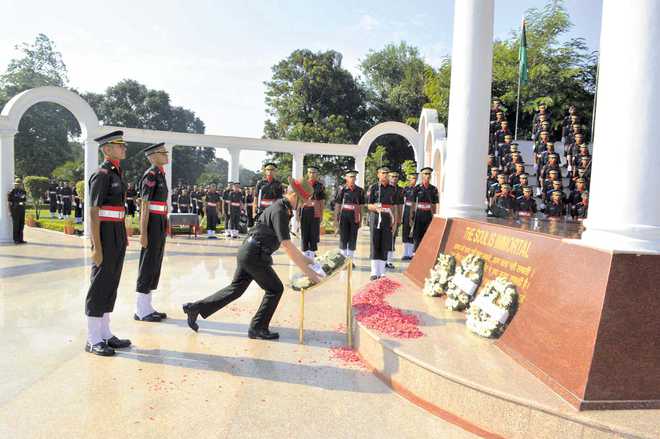
Lt Gen SK Upadhya, Commandant, IMA, lays a wreath at the martyrs’ memorial in Dehradun on Friday.

Tribune News Service

Dehradun, June 9

It was a day full of activities today at the Indian Military Academy (IMA), Dehradun, as the Gentlemen Cadets anxiously waited for tomorrow’s (June 10) passing-out parade that will have Chief of Army Staff Gen Bipin Rawat as the reviewing officer.It started with a wreath-laying ceremony held at the War Memorial, IMA, in the morning. The solemn ceremony, held a day ahead of the passing-out parade, is observed to pay homage to the brave alumni of the academy. IMA Commandant Lt Gen SK Upadhya, along with officers, laid wreaths and offered floral tributes to the martyrs.As a prelude to the passing-out parade, a multi-activity display showcasing various facets of military training imparted to the Gentleman Cadets coupled with awe-inspiring acts by the Motorcycle Rider Display team of Corps of Signals, popularly known as “The Dare Devils”, was also staged at the IMA. The display was witnessed by a large number of spectators, which included the passing-out course, their parents and relatives and other dignitaries.Later in the evening, a sound and light show for the parents of the passing-out course was organised which was held at the historic Chetwode Drill Square. The sound and light show included a multimedia, audio-visual presentation on the theme “Indian Military Academy Through the Ages”.


Major Gogoi and Farooq Dar – Grey is the colour of decision making in hybrid conflicts such as Kashmir by Lt Gen Ata Husnain

Major Nitin Gogoi faded from the limelight after the army and the Attorney General justified his action of taking Farooq Dar as a supposed ‘human shield’ to save lives of election officials and some policemen on 9 April. He has returned all guns blazing, with the army’s decision to allow the media to directly interact with him and also award him an army chief’s commendation.

Even as the incident allowed extreme ideologues of the right and the liberal camp to take aim at each other, the reality of sub-conventional hybrid conflict isn’t easily understood. The situation in Jammu and Kashmir has many grey areas, even if it seems black or white to most people. Let me explain.

In 2008, when the Amarnath Shrine Board land case triggered street turbulence no one had much idea how to handle it. In the initial days of the agitation the army imposed restrictions on movement of all its vehicles except as part of large convoys. But someone erred somewhere.

A small three vehicle convoy was stopped by a mob near Khunmoh. Just like Gogoi’s case, this was not a copy book situation. The mob looked menacing and was armed with missiles including petrol bombs. The havaldar had the choice to open fire, kill a couple of local citizens and bash his way through to the nearest army or police camp. Instead he left one vehicle to the mob, withdrew into the remaining two vehicles, turning them around and making haste to an army camp a kilometre away.

The vehicle, a large truck, was gleefully burned by the mob. My superiors were livid at the ignominy of an army vehicle being burnt and soldiers withdrawing in the face of threats. I refused, however, to order an inquiry or chide the havaldar.

For people who have lived these situations all their lives it is second nature to look for out of the box solutions, right or wrong. There is little room for procrastination. By his action the havaldar achieved minimum possible loss to the state and did not embarrass his superiors into defending possible killings. The issue was played down in the media but a stern message to the people of Khunmoh was passed through local police that a repetition would invite tough reprisals.

Armchair warriors are good people. But they know nothing about how such situations pan out into the most awkward threats at different levels. There are no neat, black and white solutions. If Major Gogoi is telling the truth – and i see no reason why a professional soldier will choose to lie – then all his actions fall in the zone of grey.

Like my havaldar he chose to prevent loss of life but by an ingenious method, which many senior veterans and highly educated people say amounts to gross violation of dignity and human rights of an Indian citizen. As an educated military leader with full awareness of the necessity of following the rules of engagement i will always work towards maximising human rights, but never at levels even close to absolute because that is practically never possible in a conflict zone.

This is because i know that i am mostly dealing with people who are not adversaries but acting on behalf of them. If they have chosen to take public order in their hands then they have abrogated certain rights too. Gogoi respected almost all those rights except the right to dignity of Farooq Dar, whose innocence or otherwise from stone throwing has yet to be established. In such situations there are no ideal solutions.

Was putting Gogoi in front of the media incorrect? What the army did not take into account was the unnecessary raking up of an issue that had receded. To announce an award when an individual is under investigation is not something which even i, an ardent army loyalist, find easy to defend.

Grey is the colour of decision making in hybrid conflicts. The security forces should know it, as should the political leadership and media. It will save everyone much embarrassment. For now, putting this affair behind it is the best option for the army.


Sikkim standoff: Army ready for long haul in Doka La Soldiers pitch tents, stock up supplies

Sikkim standoff: Army ready for long haul in Doka La
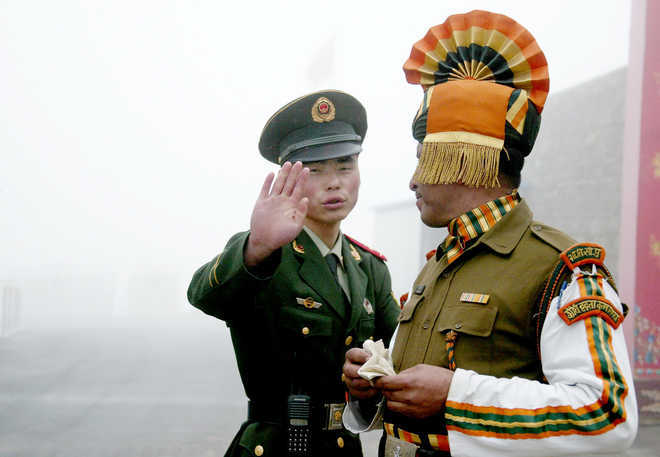
A Chinese soldier (L) next to an Indian soldier at the Nathu La border crossing between the two countries in Sikkim. — AFP file

New Delhi, July 9

The Indian Army is ready for a long haul in holding onto its position in Dokalam area near the Bhutan tri-junction, notwithstanding China ratcheting up rhetoric against India demanding pulling back of its troops.

The Indian soldiers deployed in the disputed area have pitched tents, in an indication that they are unlikely to retreat unless there was reciprocity from China’s PLA personnel in ending the face-off at an altitude of around 10,000 feet in the Sikkim section.

A steady line of supplies is being maintained for the soldiers at the site, official sources said, signalling that the Indian Army is not going to wilt under any pressure from China.

At the same time they sounded confident of finding a diplomatic solution to the dispute, citing resolution of border skirmishes in the past through diplomacy.

Read: India pushes troops in Doka La

Chinese envoy terms situation ‘grave’, rules out compromiseChina issues safety advisory for its citizens in India

Though China has been aggressively asserting that it was not ready for any “compromise” and that the “ball is in India’s court”, the view in the security establishment here is that there cannot be any unilateral approach in defusing the tension.

Both the countries had agreed to a mechanism in 2012 to resolve border flare ups through consultations at various levels.

The mechanism has not worked so far in the current case as the standoff near the Bhutan tri-junction, triggered by China’s attempt to build a road in the strategically important area, has dragged on for over three weeks.

New Delhi has already conveyed to China that such an action would represent a significant change of status quo with “serious” security implications for India. The road link could give China a major military advantage over India.

Doka La is the Indian name for the region which Bhutan recognises as Dokalam, while China claims it as part of its Donglang region.

China and Bhutan are engaged in talks over the resolution of the dispute in the area. India argues that since it is a tri-junction involving the three countries, it also has a say in the issue, especially in the backdrop of 2012 agreement between special representatives of the two countries, that have till now held 19 rounds of talks.

Bhutan has no diplomatic ties with China. As a close friend and neighbour, Bhutan enjoys diplomatic and military support from India.

Of the 3,488-km-long India-China border from Jammu and Kashmir to Arunachal Pradesh, a 220-km section falls in Sikkim. PTI


Rawat meets his generals in Srinagar as LoC burns

WESTERN DISTURBANCE Jaitley says India dominates line, Pak summons Indian envoy

NEW DELHI: Army chief General Bipin Rawat and his top commanders landed in Srinagar on Thursday for a security review, even as cross-border shelling and gunfire escalated and Pakistan summoned India’s deputy high commissioner in Islamabad over casualties.

HT FILEA soldier takes position near the Line of Control in Nowshera sector, about 145 km from Jammu.

It is rare for the army’s seniormost generals to congregate in Jammu and Kashmir to review the security situation and operational preparedness of soldiers posted in the state and along the Line of Control (LoC), the de-facto border between Indian and Pakistan. The air force was also represented at the review.

In New Delhi, defence minister Arun Jaitley said Indian soldiers are in a commanding position along the LoC.

“In the past few weeks, our armed forces, the Indian Army and BSF, are dominating the Line of Control,” he said.

At least five Pakistani soldiers were killed and six more were wounded in retaliatory firing by the Indian military in the Bhimber and Battal sector of Jammu and Kashmir.

The army was responding to unprovoked ceasefire violations by Pakistani forces, which fired machine guns and 82mm and 120mm mortar shells at Indian outposts and villages across the border. A General Engineering Reserve Force labourer was killed, while two more men, including a BSF trooper, were wounded on Thursday in Pakistani firing in Rajouri and Poonch districts.

But Pakistan accused India of targeting civilians in border towns, killing a villager.

The Pakistani foreign office summoned the deputy high commissioner JP Singh and condemned the ceasefire violation.

The border burned on a day Rawat was in Srinagar for a twoday security review after the killing of Hizbul Mujahideen commander Sabzar Bhat on May 27. The army gunned down a number of militants in the past weeks, but has been unable to tamp down on local anger. Thousands showed up at the funeral of Bhat on Sunday.

Jaitley dismissed reports of mounting unrest and public anger in the Valley, saying the situation was mostly normal. “The situation in Kashmir is better than the impression.”

Indian security forces have piled pressure on militants and the results are visible, he said.

 Army Chief in Valley for security review

Tribune News Service

Srinagar, June 1

Amid the heightened tension along the Line of Control, Army Chief General Bipin Rawat along with the top Army brass arrived in Srinagar on Thursday and reviewed security.While there was no official word from the Army on the Chief’s visit, sources said a high-level meeting chaired by General Rawat discussed the issues of logistics, security in the hinterland and along the Line of Control.The sources said the top brass meeting in Srinagar would give a boost to the morale of the soldiers on the ground, who had faced a lot of flak after the “human shield” case.

2 Hizb ultras behind Sopore attack on cops killed

Security forces zeroed in on militants after grenade thrower identified from CCTV footage

2 Hizb ultras behind Sopore attack on cops killed
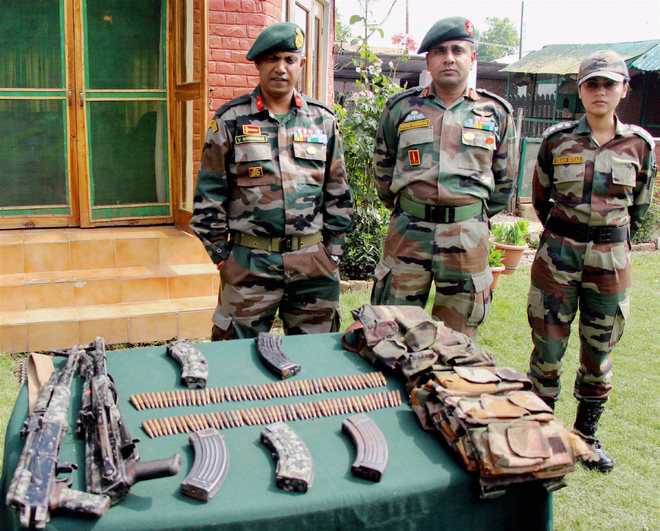
The arms and ammunition recovered from the Sopore encounter site on Thursday. PTI

Majid Jahangir

Tribune News Service

Srinagar, June 1

Two local militants of the Hizbul Mujahideen were killed in an encounter with security forces in north Kashmir’s Sopore sub-district on Thursday morning.The two slain militants, the police said, were instrumental in the grenade attack on a police party yesterday in Sopore town that left four policemen injured.The militants were killed in a joint operation which was launched in the wee hours by the J&K Police, Army’s 22 Rashtriya Rifles and the CRPF’s 92, 177 and 179 battalions at Sopore, some 55 km from here.As the forces were zeroing in on a suspected house after a specific input, the militants hiding there opened fire, resulting in injuries to two Army men, who were evacuated to a hospital.“The militants were asked to surrender, but they opened fire. In the encounter that followed, two militants were killed,” said Inspector General of Police, Kashmir, Muneer Ahmad Khan said.Two AK-47 rifles and other ammunition were recovered from the site.The two slain militants were identified as Basharat Ahmed Sheikh of Bomai, Sopore, and Aijaz Ahmad Mir of Brath Kalan.The police said the two militants had planned the grenade attack.“The two militants had assigned two persons to hurl the grenade. We were able to identify one grenade thrower who was caught on a CCTV camera. The grenade thrower was arrested during a raid and we got a clue from him about the militants,” a police officer in north Kashmir said.The local sources said the militants had appeared at the funeral of a slain militant and given a gun salute. They said that Aijaz had been studying law through the distance mode before he went underground last year.

Lady doctor treats2 injured jawans

  • A young Army lady doctor was part of the anti-militancy operation in Sopore and provided medical support to the two injured jawans. The Army said Capt Eram Riyaz tirelessly administrated medical support at the encounter site, helping the two injured jawans with grenade splinters. “She then evacuated the injured jawans to the nearest medical facility at Pattan for further treatment,” an Army officer said.

clip