Sanjha Morcha

What’s New

Click the heading to open detailed news

Current Events :

web counter

Print Media Reproduced Defence Related News

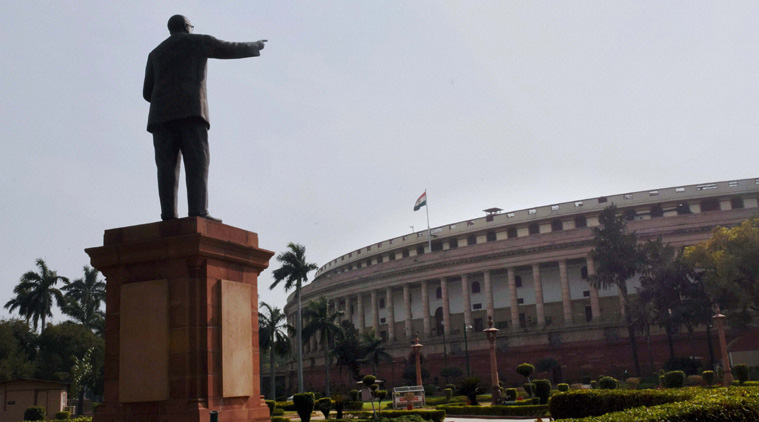
Government moves to double MPs’ salary to Rs 2.8 lakh a month

The proposal, currently with the Finance Ministry, also suggests that basic pension should be raised from Rs 20,000 per month to Rs 35,000.

parliament-7591

The government has proposed increasing the monthly salary of an MP from Rs 50,000 to Rs 1 lakh, constituency allowance from Rs 45,000 to Rs 90,000 and secretarial assistance plus office allowance from Rs 45,000 to Rs 90,000.

The central government seems set to double the salaries and allowances of Parliamentarians. If a proposal in this regard is approved by the Finance Ministry, every MP will get Rs 2.8 lakh per month. Their pension, too, will see a jump.

watch vedio  below

https://www.youtube.com/watch?v=XYlkvjpFjsc

The government has proposed increasing the monthly salary of an MP from Rs 50,000 to Rs 1 lakh, constituency allowance from Rs 45,000 to Rs 90,000 and secretarial assistance plus office allowance from Rs 45,000 to Rs 90,000. The proposal, currently with the Finance Ministry, also suggests that basic pension should be raised from Rs 20,000 per month to Rs 35,000. Those who have served for more than five years would get an additional amount — the number of years multiplied by Rs 2,000. Currently, the additional amount is the number of years multiplied by Rs 1,500.

If the Finance Ministry agrees to allocate the amount, Parliament will amend the Salary, Allowance and Pension of Members of Parliament (Amendment) Bill to incorporate the changes, sources said. “The ministry is expected to accept the proposals,” said a top government official.

The Finance Minister had allocated Rs 295.25 crore for Lok Sabha MPs and Rs 121.96 crore for Rajya Sabha MPs — which includes expenses such as travel — in his last budget.

IAF BASE ATTACKED Driver’s killing was a professional’s job

5Jupinderjit Singh,Tribune News Service,Chandigarh, January 9

2016_1$largeimg10_Sunday_2016_011527507

Allegedly attacked by militants in the wee hours of January 1, curiously the nature of injury on  deceased taxi driver Ikaagar Singh’s neck and that of the injured jeweller Rajesh Verma is very different. Both were allegedly assaulted by a sharp-edged weapon.Doctors who conducted the  medico-legal examination say Ikaagar’s throat may have been slit by a professional killer. But the same could not be said about the jeweller, who survived the attack.Officials wonder if Ikaagar and Rajesh were attacked by different terrorists who formed part of the group that let off Salwinder Singh, SP, or by different groups of militants. Doctors and police officials say Ikaagar’s injuries show he may have put up a resistance against the attackers. But in case of Rajesh, there are no such signs.  Ikaagar’s body had stab wounds in the chest and the stomach.Investigators are yet to declare Ikaagar clean as a phone call from Pakistan was received on his phone. But Satnam Singh, the deceased’s brother, says his brother scuffled with the militants and that is enough proof of his innocence. “My brother fought the terrorists. He tried to overturn the car to stop the terrorists from reaching their target. That is why the Chief Minister has acknowledged his sacrifice. On the other hand, a trained police officer with years of experience could not do anything,” he remarked.While Ikaagar’s body was found near Kathlore bridge on way to Pathankot from Kohlian village chowk, his Innova car was found abandoned 2 km from Kohlian village town towards Pakistan. Two tyres of the car were deflated.Ikaagar lived in an impressive house in Bhagwal village. He had bought a second-hand Mahindra Scorpio worth Rs 3 lakh two weeks ago for which he took a loan.The police are trying to ascertain if Ikaagar had any other source of income as his life style was opulent. “On the one hand they declare him a martyr and on the other, they have doubts about him. Why would he have struggled with the terrorists if he was hand in glove with them? Why did terrorists kill him and not the SP,” asked Ikagaar’s brother.The Punjab government has declared Ikaagar a martyr even though the investigations are yet to be completed. The family has been paid a compensation of Rs 5 lakh and the government has promised a job for his sister or wife.The narrow street to his house is being paved again. It would be a huge embarrassment for the government if found that Ikagaar had ties with anti-social elements.


Governor briefed on security along LoC, border

Tribune News Servic,Jammu, December 22

2015_12$largeimg22_Tuesday_2015_235325382

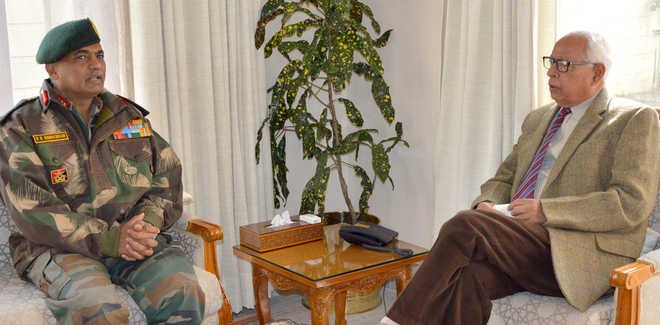
Governor NN Vohra today reviewed the security scenario on the Line of Control (LoC) and international border and discussed measures that could enhance transparency in the administrative set-up.In a meeting, General Officer Commanding of 16 Corps, Lt Gen RR Nimbhorkar briefed the Governor about the situation along the LoC and the emerging security environment during the current winter.The Governor discussed with Lt Gen Nimbhorkar several issues related to more effective surveillance of the international border and further strengthening of the counter-infiltration grid. The Governor also spoke about security concerns in the hinterland.In a separate meeting, Chief Information Commissioner GR Sufi apprised the Governor about the efforts being made by the Commission for enabling implementation of the Right to Information Act, 2009, in the state and enhance awareness among the masses regarding their right to seek relevant information from all public offices under the Act.The Governor discussed with Sufi the measures which could be taken to further enhance transparency in the functioning of the administrative apparatus in Jammu and Kashmir.The Governor also met Ranjeet Singh, national president of the Bahujan Kranti Party (BKP) (Marxvad-Ambedkarvad). BKP president Ranjeet Singh submitted a memorandum to the Governor regarding the BKP’s demands.The demands included bringing about constitutional and statutory provisions for improving the electoral process, particularly deleting the names of contesting candidates from ballot paper; election-related expenditure being met by the government instead of candidates and political parties; elections being contested on the basis of party ideology and not in the name of any individual; grant of right to political parties to recall elected candidates; terminating recognition of political parties which fail to fulfil 75 per cent of promises mentioned in their election manifestos; and doing away with MPLAD and constituency development funds.

Army holds blood donation camp

A blood donation camp was organised by the Jammu and Kashmir Light Infantry Regimental Centre under the aegis of the Chinar Corps, on its Rangreth here on Monday.The camp was inaugurated by the Officiating Commandant, JAK LI Regimental Centre, Col AA Bapat.A defence spokesperson said the camp was organised with a view to augment the stock of blood at the civil hospital in Srinagar.“Nearly 50 Army personnel from the Regimental Centre donated blood. The blood units collected were provided to Lal Ded Hospital in Srinagar,” the spokesperson said.Senior officials of the Public Health Department present during the event mentioned that the blood will meet the urgent surgical requirement at the hospital.


WHEN TERROR CHECKED IN

HT investigates and reconstructs the audacious attack on the Pathankot air base that has tested India’s response and its relations with Pakistan

From page 1 Hours before the long gun battle began at the Indian Air Force air base in Pathankot, one of the terrorists named Nasir called his mother in Pakistan and told her he was on a fidayeen mission. “Host a lavish party,’’ he said. He wanted his ‘martyrdom’ to be celebrated and informed his mother that she would get a call from ‘Ustad’ once he had attained it. The terrorists had no confusion. They were crystal clear about their task and had come prepared to turn their bodies into missiles. Unlike the six terrorists who managed to breach the high-security airbase despite concrete and credible intelligence that came from Pathankot’s Superintendent of Police (SP), Salwinder Singh, the security establishment was far from prepared for the deadly assault. At first, the Border Security Force (BSF) which guards the international border between Punjab and Pakistan had no clue that a heavily armed group had infiltrated into India. Even after they were accidentally — and providentially — discovered, the terrorists, armed with assault rifles, were mistaken to be robbers.

AP PHOTOLt Col Niranjan Kumar’s funeral in Elambulasserry in Kerala on January 5

It is not often that intelligence comes knocking on the front door. Before the Mumbai attacks in 2008, intelligence agencies had failed to join the dots despite ‘Taj Hotel’ appearing in several intercepts, but on the night of December 31, barely an hour before the dawn of a new year, the terrorists came face to face with an SP rank officer in Pathankot. He was blindfolded and thrown out of the car before the terrorists fled in his blue-beacon XUV. The information provided by the controversial and colourful SP Salwinder Singh was, however, dismissed by his seniors, who thought he had probably partied too long. Even after he was finally taken seriously, the Indian security establishment was unclear of where the terrorists would strike or how many they numbered. By late morning on January 1, it was clear that the first day of the new year was signing in with a terror imprint: Innova driver Ikagar Singh’s body was found with his throat slit. Salwinder Singh’s Mahindra XUV was tracked to just outside the air base and his jeweller friend Rajesh Verma too had checked into a hospital with a gash on his throat.

Phone lines started buzzing between Delhi and Pathankot, between Jammu and Udhampur, where the army’s Northern Command is based, between Chandigarh, which headquarters the Punjab Police, and Chandi Mandir in Panchkula, where the Army’s Western Command is headquartered. And between the Prime Minister’s Office and Manesar, where the elite commandos of the National Security Guards are based. The country’s security establishment was on high alert and defense establishments in Pathankot were asked to activate their quick reaction teams (QRTs).

Soon, it also became known that the terrorists had an unmistakable Pakistan connection. They had made the cardinal error of using the phones that they’d snatched from Ikagar and Rajesh. The intelligence agencies had intercepted vital inputs: conversations between the terrorists and their handlers and Nasir’s farewell call to his mother. In one call, the handler reprimands the terrorist for sparing the SP and in another, he can be heard telling one of the terrorists that one group has moved ahead.

FIRST CONTACT

The terrorists had not just moved ahead, they had managed to enter Pathankot’s air base undetected, even as QRT’s made plans of stopping them at the gates of their respective establishments. The terrorists had checked in and were lying in wait. They were already inside the reinforced gates well before the NSG commandos took position. The terrorists had managed to evade the BSF, the Punjab Police and the Garud and Defense Service Corps. The base’s security cover has weakened over the years. The perimeter wall has no patrolling road around it. At several points, the wall shares its length with residential houses with no efforts to contain encroachment around the base. Members of the Gujjar community have settled around the boundary wall and are allowed inside the base to gather fodder and to graze their animals. The road where Ikagar and Salwinder were kidnapped is barely five kilometers from the international border but there is no police picket on it. The first police picket at Kathlour Bridge let the SP’s blue beacon car go thinking it was a VIP vehicle. The approximately 30km distance to Pathankot airport was covered in an hour with no stop before Salwinder and his cook Madan Gopal were thrown out. Nasir and his terror companions made their first attempt at martyrdom in the dead of night intervening January 1 and 2. The fidayeen squad first shot a Garud, the Indian Air Force’s in-house commando team and quickly made their way to the DSC mess where Jagdish Chand, an ex-army wrestler was preparing tea. Chand grappled with the terrorists, overpowered one, snatched his rifle and shot him dead before being killed himself. In the mess, the terrorists killed four more DSC men. The terror imprint had been firmly stamped at first contact even as QRTs waited for the terrorists disguised in army fatigues to show up at their gates. After one terrorist was killed, the remaining are

CONFUSION REIGNS

Pathankot has a large air base with nearly 10,000 families living within the sprawling perimeter with a circumference of 25 kms. The fear of a hostage situation was real. The base also had 23 foreign military trainees from Nigeria, Afghanistan, Bangladesh and Myanmar. That the trainees were in close proximity to the DSC mess gave the IAF some anxious moments till they were rescued by the army and the NSG. The gates to the technical area where the IAF’s fighter machines — MIGs and MIs — are parked were also barely 500 metres from the mess. “God was on our side,’’ an air force source said, adding, “There was no fog and we were lucky to be able to fly our UAV’s.” Luck was constantly by their side as confusion reigned. The terrorists had not only hauled in 50 kg of ammunition and 30 kg of grenades that could damage tanks, but had also brought in inflammable gel to set machines on fire. By the evening of January 2, the remaining three terrorists were engaged and killed. The air traffic control, which was the operation control room, burst into celebration thinking there were only four terrorists. “Liquor was filled in glasses and the operation, though not officially declared ended, was considered to be over,” a source revealed. The same message was perhaps relayed to Delhi for soon the Home and Defense ministers tweeted congratulatory messages. In fact, the party had started too soon.

MISPLACED RELIEF

The security grid had planned well: mine protected vehicles had been moved from Northern Command to Mamoon, not far from Pathankot. Highly trained men had moved in too but none knew that two more terrorists lay in wait. They had come well equipped with morphine injections and packets of cooked chicken and rotis.

Presuming the battle to be over — despite the SP’s cook having said there were at least five terrorists — the NSG went about its task of sanitizing the complex. Tragedy struck when its bomb disposal squad officer, Lt Col Niranjan was removing bombs from the dead body of one of the four terrorists. “He pulled out a grenade and his buddy told him to throw it away. He did, but it exploded,’’ said an officer privy to the incident, adding, “Niranjan was wearing his armour but his lungs collapsed due to the sheer impact of pressure.”

Firing started again between 10 and 11 in the morning. Six defense personnel were on the first floor of the same building from which the fifth and sixth terrorist had fired. Luck saved the day again: a latch door between the ground and first floors stayed untouched. Perhaps the terrorists didn’t know they had six defense personnel right above them as perfect hostages. Even after the six had been rescued, the battle was fierce. Cannon fire was used to try and silence the terrorists, who showed no signs of having been silenced. “I could have taken a tank and blasted the building or used rocket launchers but that would have damaged civilian areas. They continued to engage us through the day,’’ an officer said.

Finally, it appears, ‘the cooking phenomenon’ — to use a military term — was set in motion. The phenomenon is a process where ammunition starts exploding on its own. This coupled with cannon bursts resulted in the two terrorists literally melting. All that was found the next morning were pieces of flesh and bone. The NSG sent a dog into the building the next morning to ensure that the terrorists had been killed. If the bodies had melted, how did they know there were two terrorists and not one? “Because the pieces of bone and flesh were found at two different locations of the ground floor,” an officer said. The gun battle had indeed ended. But amid the rubble at the Pathankot airbase lie questions that need answers. The hows and the whys are being addressed by the National Investigation Agency. Maybe this time the post mortems and enquiries will plug holes to ensure that terror does not check in as easily again.

LIST OF LAPSES

When terrorists struck at the Dinanagar police station in July last year, it was a signal to Pakistan-based terrorist outfits plotting on making Punjab the new port of terror. The audacious Pathankot airbase attack has only confirmed the terrorists’ insidious intent to spread the jihadi arc to the border state

CHINKS IN THE BORDER

By all accounts, terrorists infiltrated into India from the Bamiyal belt. Besides its broken terrain and riverine topography, it has a 40-km unfenced stretch, supposed to be guarded with thermal imagers, floodlights and more boots on the ground. However, it remains thinly-manned while technical devices were found to be non-functional. As a result, it became the walk-in border for terrorists, not once but twice in past six months. The BSF has been in denial mode even though Dinanagar investigation has established that they entered from the Punjab border.

NO SECOND LINE OF DEFENCE

The latest depredation has also highlighted the absence of vigil in areas close to the border. After breaching the border security, heavily-armed terrorists were on the loose for 24 hours, carjacked two vehicles and travelled unchecked for about 35km before reaching their target — the IAF base at Pathankot. Despite a high alert sounded in the last week of December, there were no signs of beefed-up security or check points on key roads.

INTELLIGENCE FAILURE

There was no specific, actionable intelligence on an impending terror plot. The Union home ministry’s new year’s-eve advisory talked about “uncorroborated information” about Pakistan-based Lashkar-eToiba’s plans to strike and listed a range of general targets. There were no intelligence inputs on Jaish-e-Mohammad or the Pathankot airbase. The terrorists’ actions – the kidnapping of a Punjab police SP, a Jaish pamphlet from the abandoned vehicle, and their intercepted calls to their handlers in Pakistan – alerted security agencies.

POORLY GUARDED AIRBASE

Despite being a front-line airbase, the IAF complex sprawling over 1,900 acres, had a poorly-guarded perimeter wall. With cheek-by-jowl civilian dwellings on its periphery and thickfoliage along the boundary wall, it was only waiting to be breached by terrorists on a suicide mission. They went unnoticed even as they scaled the outer wall.

UNCHECKED NARCO-TERRORISM

Narcotic smuggling has been a cottage industry in the villages along Punjab’s border with Pakistan. Smugglers on both sides are known to help terror groups cross the borders and give them shelter. Officials suspect the Pathankot attackers too got their clandestine support.

THE BEST OF THE ELITE FORCES

India’s response to the fidayeen attack on the Pathankot fighter base set off a fierce debate over whether the NSG or the army’s Special Forces (SF) should have handled the operation. Here’s what you need to know about the two HISTORY The NSG was set up in 1984 soon after the assassination of Prime Minister Indira Gandhi as a counter-terrorism force to be used in exceptional circumstances.

The army raised its first Para Commando units in 1966. The redesignation of these units as SF happened in the mid-1990s. ROLE The NSG is trained and equipped for counterterrorism operations, hostage rescue, antihijack operations and urban warfare. It also guards VVIPs. The SF specialises in covert operations, warfare in jungles, mountains and deserts, low-intensity conflict and hostage rescue EQUIPMENT The NSG is equipped with German Heckler & Koch MP5 submachine guns, Swiss SIG SG 551 assault rifles, Austrian Glock-17 pistols and Heckler and Koch PSG1 sniper rifles. The SF is armed with Israeli TAR-21 assault rifles, US-made Colt M4 carbines and a mix of Israeli Galil and Russian Dragunov sniper rifles. STRUCTURE Half of the NSG personnel, also known as Black Cat commandos, are drawn from the army. The paramilitary and state police forces contribute the rest. Army personnel volunteer to join the SF and have to undergo a rigorous selection process. The SF comes under the defence ministry. DEPLOYMENT The NSG is deployed at four hubs across the country to mount a swift response. Two more are planned. The hubs came up after the 26/11 Mumbai terror attacks in 2008. The SF units are continuously deployed in operations in Jammu and Kashmir and the Northeast.



PATHANKOT ATTACK Sharif’s second meet on leads

Simran Sodhi,Tribune News Service,New Delhi, January 8

The uncertainty over the Foreign Secretary-level talks scheduled for January 15 in Islamabad continued today with Pakistan Prime Minister Nawaz Sharif reportedly ordering a probe into the evidence provided by India over the Pathankot attacks.Sharif held a second high-level meeting today with his senior officials, including Army Chief Raheel Sharif. This is his second such meeting in as many days. Sources said the meeting was called to discuss the Pathankot attacks.The leads provided by National Security Adviser Ajit Doval have reportedly been handed over to Pakistan Intelligence Bureau chief Aftab Sultan for further action.India has stated publicly that talks cannot happen till Pakistan acts on this “actionable intelligence”. A section of the Pakistan media reported that Pakistan officials felt the evidence provided by India was not enough as it contained mainly telephone numbers and they might seek additional information.Sources in the government told The Tribune that India had not received any such request from Pakistan so far.Sources said both PMs were keen on taking forward the dialogue process that had just resumed between the two countries. Sharif had yesterday held a high-level meeting with top officials.

Sharif chairs meet on Pathankot again

SAVING TALKS Reviews action on leads provided by India; Modi may visit Pathankot today or address soldiers via web chat

NEW DELHI: Pakistan on Friday reviewed the progress on leads provided by India about the Pathankot attack, a day after New Delhi linked next week’s talks between the foreign secretaries to Islamabad’s response to the audacious strike.

Prime Minister Narendra Modi, who has stressed on the need for urgent action when he spoke to Pakistani counterpart Nawaz Sharif, is likely to visit the Pathankot airbase on Saturday or address soldiers via web chat, government sources said.

However, Punjab DGP Suresh Arora told HT there was no official communication regarding the visit. While Islamabad pushed for a sustained dialogue in the wake of the attack that has cast a shadow on bilateral ties, authorities in New Delhi said they were awaiting a formal response from Pakistan.

Sources said India had shared actionable intelligence about the terrorists, believed to be from the Pakistan-based Jaishe-Mohammed group. “There is no deadline. But we hope Pakistan takes action in time so that the scheduled talks are not hampered,” said an official.

Sleuths of the National Investigation Agency (NIA) are probing whether the attackers in Pathankot had help from inside to enter the airbase and remain hidden for nearly 24 hours, sources said. The federal anti-terror agency on Friday formally summoned Punjab police officer Salwinder Singh who claims he along with a friend and a cook were abducted by terrorists involved in the attack. Sources said the SP may also have to go through a polygraph test.

Investigators say the probe will also determine whether weapons used by the attackers came in drugs consignments and the terrorists secured passage with the help of local drug cartels who may or may not have known their real identity.

“All these aspects are part of the inside angle probe,” said a counter-terror official.

A meeting chaired by Sharif in Islamabad, also attended by army chief Gen Raheel Sharif and ISI chief Lt Gen Rizwan Akhtar, reiterated Pakistan’s commitment to cooperate with India to “completely eradicate” terrorism.

A statement issued by Sharif’s office after the meeting contained several assurances that appeared to be aimed at assuaging Indian concerns.

“In line with Pakistan’s commitment to effectively counter and eradicate terrorism, the meeting reviewed the progress made on the information provided by the government of India,” the statement said without giving any details.

“The meeting expressed the confidence that building on the goodwill generated by the recent high level contacts, the two countries would remain committed to a sustained, meaningful and comprehensive dialogue process,” it said.

The statement reiterated Pakistan’s 2004 commitment about not allowing its soil to be used for terrorism directed at India.

“The people of Pakistan have evolved a political consensus for action against all terrorists and terrorist organisations without any distinction, and have resolved that no terrorist would be allowed to use Pakistan’s soil for committing terrorism anywhere in the world,” it said.

Pakistan repeated its condemnation of the Pathankot attack and the statement said the country’s “entire leadership and institutions were working in complete harmony to counter terrorism and extremism” – an indication that the powerful army was on board.

Besides the army and ISI chiefs, the meeting was also attended by interior minister Chaudhry Nisar Ali Khan, foreign policy chief Sartaj Aziz, national security adviser Nasser Janjua, foreign secretary Aizaz Chaudhry and the Director General of Military Operations.

The Pathankot attack had figured in another meeting between Prime Minister Sharif and his top aides on Thursday. Pakistani media reports said Sharif had directed authorities to launch a probe on the basis of the information provided by India.

India’s demand for action against the JeM had also figured at a meeting of corps commanders chaired by army chief Gen Sharif on Wednesday, sources said.

62694 58465 59128 72785521-0ae3-4fbd-bf51-df7137daf493


Pak bans 61 terror outfits, but JuD still ‘under observation’

Tribune News Service/PTI,Jammu/ Islamabad, Dec 18

The Pakistan government today named two terrorist organisations, Lashkar-e-Toiba (LeT) and Jaish-e-Muhammad (JeM), working in Jammu and Kashmir, as banned outfits among 59 other organisations.However, Mumbai attack mastermind Hafiz Saeed-led Jamaat-ud-Dawah is not among the list of 61 banned outfits but is “under observation”, the country’s Interior Ministry told Parliament today.State Minister for Interior Balighur Rehman presented a list of 61 banned militant, sectarian and extremist outfits in the country before the Senate, the Upper House. “Jamaat-ud-Dawah (JuD) is not included in the list of banned groups as it is under observation,” he said.The list of banned organisations includes groups like the Islamic State, Lashkar-e-Jhangvi, Sipah-e-Muhammed Pakistan and Sipah-e-Sahaba. It also includes Baloch separatist groups like Balochistan Republican Army and Lashkar Balochistan.The minister said the banned organisations are watched to prevent them from resurfacing under different names and the provinces have been asked not to allow banned outfits to come up. Both LeT and JeM are active in Jammu and Kashmir for past many years and despite facing ban for doing activities in Pakistan, these terrorist organisations are working in J&K. Both these organisations have been involved in terror activities in J&K and rest of India like 26/11 Mumbai attack, which was carried by LeT and they continue to get support from across the border. India has been continuously pushing for action against these banned groups who are using Pakistan’s territory to attack India. Many a times, India has given proof of camps being run by these organisations in PoK and are sending terrorists inside India, but no action has been taken so far.

UN designated Saeed as terrorist in 2008

  • The UN declared JuD a terror organisation and also individually designated Hafiz Saeed (pic) as a terrorist in December 2008. The US has already put $10 million bounty on his head
  • Saeed, who orchestrated the November, 2008, Mumbai terror attack in which 166 people were killed, roams around freely in Pakistan despite being a designated terrorist and has made many anti-India remarks and speeches


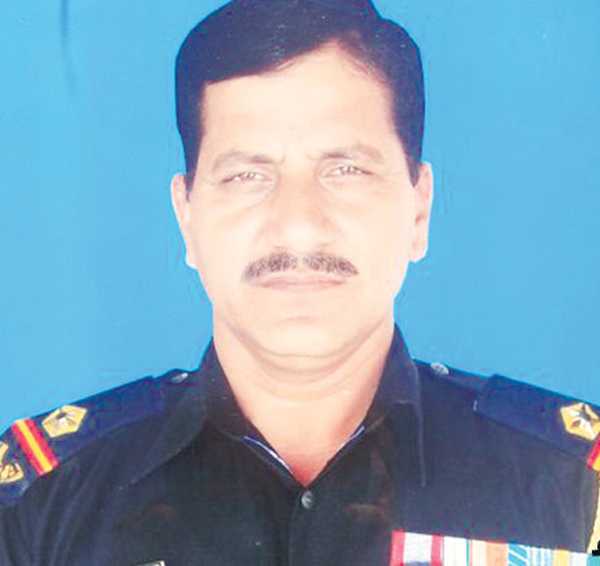
A Cook In The Army, Unarmed Hawaldar Jagdish Chand Killed The First Militant In #PathankotAttacks

Its not very often that people who are otherwise perceived to be common get a chance to show exemplary bravery. The DSC (Defence Security Corps) in particular is a service that rarely sees action, while the soldiers fight on the borders, the DSC even in the army are perceived to be back-room-boys which is why the valour of Hawaldar Jagdish Chand is even more superlative and tear inducing.

Hawaldar Jagdish Chand was in the mess at the Pathankot Air Base working as a cook, getting breakfast ready when the militants attacked. They had made their way from across the border in Pakistan, with the aim to blow up the Indian Air Force assets at the airfield.

Hawaldar Jadgish Chand

Twitter

Hawaldar Jagdish Chand realised there was something amiss, but he had no clue what were the weapons the intruders carried, how many of them there were and he had the darkness working to his disadvantage (the sun still wasn’t completely out yet). Hawaldar Jagdish Chand didn’t have a weapon, but the former soldier of the Dogra Regiment (he retired in 2009 from the Army) wasn’t going to let that get in his way.

Jagdish Chand chased down and caught one of the intruders. In the hand-to-hand combat that followed in the morning of February 2 in the early hours of the morning at the Pathankot Air Base, he struggled with the rifle of the intruder and shot him with it. He later fell as the other intruders fired at him – again like cowards under the cover of darkness.


The intruders then attacked the air base in which six other brave sons of India laid down their lives including Commando Gursewak Singh of the Grud Commando Force, a champion Commonwealth shooter Subedar Major Fateh Singh and  Lt. Colonel Niranjan of the NSG.

Hawaldar Jagdish Chand’s bravado needs to be celebrated even more because it shows that when nation is under attack, the front line of India’s defence starts not just from the captains or the men in the trenches but also from the men in the kitchen. The men who’re equally capable of cutting the enemy to size, regardless of which army branch they work in. The men who show that an army man never retires.

RIP Hawaldar Jagdish Chand, its people like you who put the fear of the Indian army into the enemy.


Discipline paramount, no place for body art in army

PATIALA: Sounds strange, but the presence of tattoos on their bodies prevents several potential Punjabi candidates from getting selected to the Indian Army every year.

BHARAT BHUSHAN/HTColonel Vaneet Mehta training jawans recruited during the previous rally in Patiala on Thursday.

Despite a specified policy on tattoos in place since 2012, the trend remains prevalent. Now, the Patiala office that caters to five districts has especially highlighted the rules on tattoos for nearly 30,000 candidates participating in the upcoming recruitment drive for the post of jawan.

Director of the local office Colonel Vaneet Mehta said that the military life is all about discipline. “But as we have seen in recent years, several candidates are debarred from selection during the screening process due to objectionable tattoos on their bodies. We have, therefore, highlighted the rules in our publicity material for awareness of candidates participating in our upcoming recruitment drive, so that they are not disqualified just because of these mistakes,” he said. THE REGULATIONS As per the army’s regulations on the display of tattoos that were released in 2012, candidates appearing for selection to the post of jawan are allowed only limited and prescribed-size tattoos on inner parts of their forearms, i.e. from inside of the elbow to the wrist and on the reverse side of their palms. Permanent body tattoos on any other part of the body are not acceptable and candidates are debarred from selection during the screening process, state the rules mentioned in the publicity material. The Indian Army, recently, specified tattoo rules for commissioned officers as well.

TATTOO SCREENING SOON AFTER SELECTION IN RACE

Colonel Mehta said that the presence of tattoos will be checked soon after the candidates get selected in the initial race. Following this, dope test and other physical tests will be conducted before the final medical test. The written test scheduled in January-end will lead to the final selection. NOT MANY SURVIVE INITIAL STAGES

Even as the number of candidates registered for the upcoming drive has increased by 8,000 to 9,000, not more than 10% of the total registered candidates are able to reach the final stage. A senior army official said that as many as 70% candidates fail to clear the initial run, in which a candidate has to cover 1.6 km in 5.4 minutes. “Not more than 10% survive the recruitment process till the final stage,” he said. In 2013, the Patiala office recruited 1,172 jawans, which went down to 972 in 2014. The prevalent drug abuse in Punjab and availability of other lucrative career options had led to the decrease in the recruitment of Punjabi youth in the army, said another officer. “With more candidates this time, we hope to see an increase in the selections,” he said.


Movement near Tibri Cantt sighted by drone

Ravi Dhaliwal,Tribune News Service,Gurdaspur, January 7

Those living in the city and its suburbs remain in the grip of fear even as a joint operation by nearly 1,000 Army men, Punjab Police personnel and the BSF is under way near Pandher village where terrorists were spotted yesterday.Hundred floodlights have been installed in the vicinity of a 15-acre sugarcane field where heavily armed militants are said to be hiding. The operation is being conducted barely 2 km from the outer wall of the Tibri Cantonment.This morning, Brig VK Tripathi, a hurriedly drawn up map in hand, asked Satnam Singh, who claims to have sighted two terrorists in long coats, dark glasses and boots, at 2.30 pm yesterday, to wear a bullet-proof jacket. Later, the Brigadier and 12 Army personnel took him to a point from where the terrorists are believed to have sneaked in.   The Military Intelligence (MI) confirmed that “some people were in the sugarcane field.” However, officers refused to elaborate. Brig Tripathi reportedly noticed footprints near the point identified by Satnam. “The depth of the footprints indicates the men are carrying a heavy load,” said an Army officer.A dog squad was rushed to the site. Minutes later, a senior police officer announced that he was sure somebody was hiding in the area.  The Air Force drone camera has spotted some movement too. But no official was willing to confirm this. A military helicopter kept hovering over the area as the Army, police and BSF officers met on the Gurdaspur-Mukerian road for confabulations.At one point of time, both the SWAT teams, which arrived here yesterday, were put in a state of preparedness. Thrice the SWAT and Army teams geared up to comb the sugarcane fields but on all these occasions the plan was put on hold either due to ‘technical reasons’ or ‘logistical glitches.’ As night descended, at least 100 floodlights were installed at various points. Later in the evening, two Armoured Personnel Carriers were brought in by the Army. Institutes in the city were shut and the Tibri road leading to the Civil Hospital from Pandher village was cleared of traffic. The hospital was asked to be ready for any eventuality.