









Sanjha Morcha

What’s New

Click the heading to open detailed news

Current Events :

web counter

Print Media Reproduced Defence Related News

Too close for comfort ::: China, with Pak, is obsessed with the strategic containment of India

Too close for comfort
Ganging up: China is backing Pak-sponsored terrorism against India.

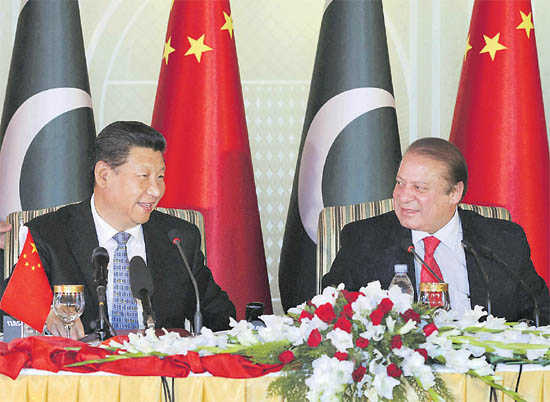
NEW Delhi appeared “shocked” by China’s recent veto of action against Jaish-e-Mohammed (JeM)  chief Maulana Masood Azhar, when there was widespread support in the UN Sanctions Committee to act against him for his role in the Pathankot attack. The UN declared the JeM a terrorist organisation in 2001. The former Director-General of the ISI, Lt-Gen Javed Ashraf Qazi, acknowledged in the Pakistan parliament in 2004 that the JeM was responsible for the attack on the Indian Parliament — an action that took the two countries on the brink of war. This veto was, however, not an isolated action by China which has long backed Pakistan-sponsored terrorism against India.China’s contacts with radical Islamic groups backed by the ISI is nothing new. It was one of the few countries that had contacts with high-level Taliban leaders, including Mullah Omar, during Taliban rule between 1996-2000. There was even a Chinese offer to establish a telephone network in Kabul during this period. Moreover, after the Taliban was ousted from power in 2001 and was hosted by the ISI in Quetta, the Chinese maintained clandestine contacts with the Mullah Omar-led Quetta Shura. China recently joined the ISI to sponsor the so-called “Afghan-led” peace process with the Kabul government. Beijing appears convinced of the need to have an ISI-friendly government in Kabul. The mandarins in Beijing evidently favour such a dispensation, in the belief that the ISI will rein in the Taliban support for Uighur Muslim militants in Xinjiang. While India received overwhelming international sympathy and support during the 26/11 terrorist carnage, the Chinese reaction was one of almost unbridled glee, backing Pakistani protestations of innocence. The state-run China Institute of Contemporary International Relations claimed that the terrorists who carried out the attack came from India. Even as the terrorist strike was on, yet another Chinese “scholar” gleefully noted: “The Mumbai attack exposed the internal weakness of India, a power that is otherwise raising its status both in the region and in the world.”Not to be outdone, the foreign ministry-run China Institute of Strategic Studies warned: “China can firmly support Pakistan in the event of war… While Pakistan can benefit from its military cooperation with China while fighting India, the People’s Republic of China may have the option of resorting to a strategic military action in southern Tibet (Arunachal Pradesh) to liberate the people there.” Rather than condemning the terrorists and their supporters, Chinese foreign ministry spokesman Qin Gang urged India and Pakistan to “maintain calm” and investigate the “cause” of the terror attack jointly. The visiting chairman of Pakistan’s Joint Chiefs of Staff General, Tariq Majid, was received in Beijing like a state dignitary by Chinese leaders, with promises of support on weapons supplies ranging from fighter aircraft to frigates.China has developed strong lobbies in Indian business. Political parties, journalists and academics act as apologists for its actions, even when such actions constituted what can only be described as unrelenting hostility towards India’s national security concerns. Even the “Ayatollahs” of non-proliferation in the US, who rant and rave against India’s nuclear and missile programmes, suddenly lose their speech when it comes to condemning Chinese actions. These worthies have documented evidence on how China initially provided nuclear weapons designs to Pakistan for its enriched uranium warheads and also upgraded Pakistan’s uranium enrichment capabilities. More ominously, China provided a range of designs and materials to enable Pakistan to develop plutonium reactors, heavy water plants and plutonium separation facilities in the Khushab-Fatehjang-Chashma nuclear complex. This has enabled Pakistan to make light plutonium warheads and embark on the production of tactical nuclear weapons.This development has seriously enhanced the prospect of Pakistan triggering a nuclear conflict by the use of tactical nuclear weapons. Pakistan now no longer speaks of a “credible minimum deterrent”, but of possessing a “full spectrum deterrent”. There has been no other instance in the contemporary world of such large scale and unrestrained transfer of nuclear weapons capabilities, as what has transpired during the past four decades between China and Pakistan.  Worse still, while China balks at backing our entry to the Missile Technology Control Regime, virtually every ballistic missile in Pakistan’s inventory today is of Chinese origin.  The 750-900 km Shaheen 1 is a variant of the Chinese DF 15 missile.  Shaheen 2 and Shaheen 3, with ranges of 1,700 km and 2,750 km, are evidently variants of the Chinese DF 21A. The vehicle that transports and launches Shaheen 3 reportedly has a design identical to that of a missile supplied by China to North Korea in 2011.New Delhi should have no doubt that Beijing’s ties with Pakistan are primarily motivated by a burning desire for “strategic containment” of India. New Delhi appears to be still looking for a coherent strategy to pay back China in its own coin and raise the strategic costs for Beijing’s unrelenting hostility towards its security interests. India needs more proactive coordination of  its policies with those of key regional powers, like Japan and Vietnam, to meet challenges China now poses. India, Vietnam and Japan should jointly seek to coordinate these efforts with the US.  Washington, unfortunately, has a track record of striking its own deals with China, with scant regard for the interests of its partners. Moreover, while dealing with these maritime and strategic challenges, India has to simultaneously strengthen confidence-building measures on its borders with China. These CBMs have been useful, especially after President Xi Jinping’s visit to India, in maintaining peace and tranquility along the Sino-Indian border. It is inevitably going to take a long time before the border issue is sorted out with China, in accordance with the Guiding Principles agreed to in 2005.It is astonishing that in all these years, there has been no significant or sustained diplomatic effort by successive governments in India to focus attention on these developments. And the less said about our journalists and academics visiting the “Middle Kingdom” the better. They are generally busy singing paeans for the qualities of head and heart of their hosts, rather than bothering about such issues. While the invitation to Chinese dissidents for a meeting in Dharamsala could have been handled more professionally, China should be made to pay a price for meddling in developments in our northeastern states.

Militant, jawan killed in Kupwara gunfight

THE 23-YEAR-OLD SLAIN SOLDIER, A NATIVE OF JHUNJHUNU IN RAJASTHAN, WAS SERVING IN THE ARMY FOR PAST SIX YEARS

SRINAGAR: A militant and a soldier were killed on Wednesday in the ongoing gun battle at Machil sector in Kashmir’s Kupwara district while four other soldiers have been injured.

On Tuesday, five soldiers were injured when the army confronted a group of heavily armed militants near the Line of Control (LoC) as they were trying to infiltrate the border.

An army spokesperson said a search operation was underway and one weapon and some “warlike” stores were recovered.

Sources added that choppers were also used by the army for the purpose of locating the militants hiding in the dense forests.

Police said the body of the militant was not yet recovered from the site of the gun battle and an extensive search operation was on.

The slain soldier has been identified as Ajay Singh Choudhary, a 23-year-old ‘signalman’ who was a native of Jhunjhunu in Rajasthan.

He was serving in the army for the last six years and is survived by his wife, an army official said.

BEIJING SAYS
NO INCURSION,
TROOPS ON LAC’S
CHINESE SIDE

BEIJING: Soldiers from the People’s Liberation Army (PLA) were patrolling the Chinese side of the disputed frontier with India along Arunachal Pradesh, Beijing said on Wednesday, dismissing reports that hundreds of its troops had crossed the border last week.

Around 250 PLA soldiers reportedly crossed the Line of Actual Control (LAC) in Kameng district of Arunachal Pradesh on June 9, reports had quoted unnamed Indian defence officers as saying.

The incursion by Chinese troops was temporary and they went back to their own territory within hours, the reports had said. “The IndiaChina border has not been clearly demarcated. This was a regular patrol on the Chinese side of the LAC,” foreign ministry spokesperson Lu Kang said.

t is rare for incursions to take place – or at least to be reported – in the eastern sector along Arunachal Pradesh, which China claims and shows on maps as “south Tibet”.

The Indian defence officers said this was the first incursion in the region this year. India and China have an unresolved, heavily militarised border running about 3,488 km. Much of the confusion arises, according to diplomats and experts, because the border is not delineated, leading to competing claims.

China’s foreign ministry reiterated the same point while dismissing the reported incursion.
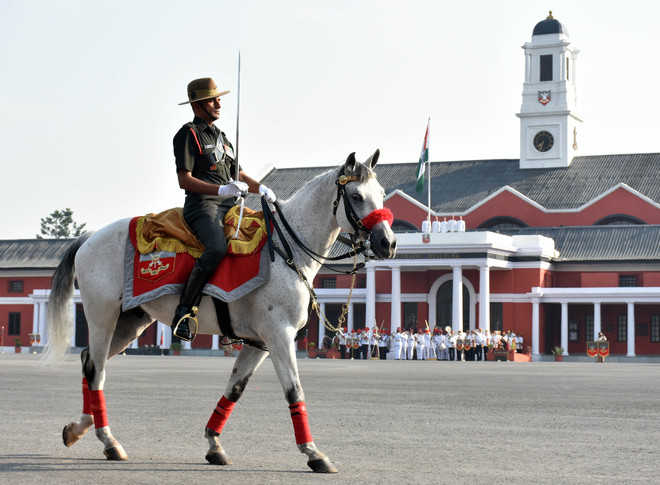

Grey charger of IMA and eye-catcher

Grey charger of IMA and eye-catcher

Dehradun, June 11

Besides the passing-out batch of 610 young and vibrant young officers, there was a horse that flawlessly took part in the passing-out parade and drills and impressed the gathering here today. Called the grey charger of the IMA, it was trained and inducted into the academy in June 2015. The grey charger, named “Tughlaq”, immaculately performed drills in its maiden passing-out parade. ‘Tughlaq’ gained the attention of proud parents, and relatives of happy GCs. It was born at the Army Breeding Centre, Hempur (Uttarakhand), in 2007 and underwent rigorous training before it was selected for the passing-out parade. Academy Adjutant Major Sumit Lagwal mounted on ‘Tughlaq’ during the entire course of the passing-out-parade. — TNS


India, US, Japan begin naval exercises in disputed waters

India, US, Japan begin naval exercises in disputed waters
A Coast Guard helicopter close to a Korean ship at the Indo-Korea exercise ‘Sahyog-Hyeoblyeog’, in the Bay of Bengal in Chennai on Friday. PTI

Ajay Banerjee

Tribune News Service

New Delhi, June 10

India on Friday joined the US and Japan to conduct week-long Naval exercises in the disputed East China Sea, around 5,000 km from here. The Navy personnel of three nations will practise submarine hunting and validate procedures at sea.In other words, collectively countering any adventurism by the People’s Liberation Army Navy (PLAN) of China. The move comes at time when Chinese submarines routinely foray in the Bay of Bengal and the Indian ocean.Japan is hosting the exercise called ‘Malabar’ near the Okinawa islands — located 370 km east of the Senkaku islands — controlled by Japan but claimed by China. It was only last year that Japan was made a permanent member of the ‘Malabar series’ of Indo-US exercises.

Both Japan and China have overlapping claims in these waters and even impose their respective air defence identification zones (AIDZ) over the islands. The US stands firmly with Japan on the matter and in December 2013 even sent its fighter jets to fly over the Senkaku when China unilaterally imposed an ADIZ of its own.Sources said the exercise was aimed at ‘strengthening’ India, Japan and the US naval cooperation. Specialists from the three forces will sit down to formulate procedures at sea and validate the same during the sea-phase of the exercise that will include scenarios of anti-submarine warfare, air defence and anti-surface warfare.More than 100 assets — warships, fighter jets, surveillance aircraft with capacity to spot submarines, amphibious plane, specialised helicopters — will be part of the sea-phase of exercise.The US will lead the way with its 1,00,000 tonne nuclear powered aircraft carrier, the USS John C Stennis, over 20 major warships, about 50 anti-submarine warfare helicopters, long-range maritime surveillance aircraft, the Boeing P8-A, and over 100 aircraft, including Boeing Super Hornet ship-deck based fighters.India is fielding its stealth frigates INS Shayadri and INS Satpura, fleet tanker INS Shakti and missile corvette INS Kirch. Apart from this, a detachment of Indian Marine Commandos (MARCOS) will participate in the exercise. Japan will field the JS Hyuga —a flat deck helicopter carrier with onboard copters; amphibious plane the ShinMaywa Industries and the PC 3 Orion planes.

East China Sea tension

  • Japan is hosting exercise ‘Malabar’ near the Okinawa islands — 370 km east of the Senkaku islands — controlled by Japan but claimed by China
  • Japan was made a permanent member of the ‘Malabar series’ of Indo-US exercises last year
  • Both Japan and China have overlapping claims in these waters and impose their respective air defence identification zones over the islands. The US backs Japan

610 gentlemen cadets pass out of IMA

610 gentlemen cadets pass out of IMA
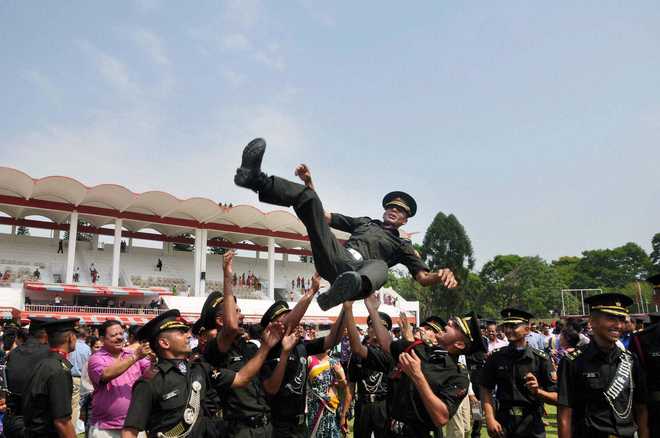
Cadets celebrating their success after the Passing Out Parade at IMA, Dehradun, on Saturday. — PTI

Dehradun, June 11

A total of 610 gentlemen cadets, including 45 from six other countries, took part in a colourful Passing Out Parade at the end of their training at the Indian Military Academy on Saturday.Congratulating the gentlemen cadets on the completion of their training at the prestigious academy, GOC-in-C of South Western Command Lt Gen Sarath Chand, who was the reviewing officer for the POP, asked them to imbibe and uphold the IMA’s motto of valour and wisdom during their professional careers.He said it will help them achieve professional competence and inculcate in them the qualities of fair play, civility, maturity and tolerance in adversity.Out of a total of 565 gentlemen cadets from the country who passed out of the Academy the maximum 98 were from Uttar Pradesh followed by Bihar and Haryana which had 60 each.As many as 36 gentleman cadets were from Maharashtra, 35 from Rajasthan, Himachal Pradesh 32, Punjab 27, Tamil Nadu 21, Delhi 20, Kerala 16, Jammu and Kashmir 15, Madhya Pradesh 14, Karnataka and West Bengal 13 each, Andhra Pradesh and Jharkhand eight each, Orissa seven, Assam six, four each from Telangana, Chandigarh, Gujarat and Chhattisgarh, two from Manipur and one each from Meghalaya, Mizoram and Tripura.IMA credo, which places safety, honour and welfare of the country first, has a universal appeal to men and women in uniform all over the world.Lt Gen Sarath Chand asked them to be proud of the high standards of training they had received at the academy and utilise it to serve their respective countries.”Being in uniform we have a definite role in contributing to the society and help in nation building,” he said.The coveted sword of Honour went to Academy Cadet Adjutant Rajendra Singh Bisht.The Gold Medal for the Gentleman Cadet standing First in the Overall Order of Merit was presented to Battalion Under Officer Aman Dhaka. — PTI


Honorary officers form association

New Delhi, June 9

Honorary Commissioned Officers of the Army, Navy and Air Force have announced the formation of the National Council of Defence Honorary Commissioned Officers saying their demands are being ignored and status reduced with every pay commission. Honorary Commissioned Officers are defence personnel who get honorary rank just a few months before retirement. A few senior-most among the non-officer ranks get this honour. They have alleged anomalies in entitlements, pay, pension, canteen and health facilities. Now, they plan to take up anomalies in the 7th Pay Commission. The following have been elected officer-bearers of the new outfit: Capt Jagdish Verma from Himachal (chairman); Lieut Shiva Palan from Kerala (vice-chairman); Flg Offr BL Dhiman from Chandigarh (vice-chairman); Flt Lt Bakshi from Ambala (general secretary); and Capt SS Jaswal from Shimla (treasurer). — TNS



Security up at Pathankot air base ‘Shoot at sight’ orders issued; flag march in 20 villages near Zero Line

Security up at Pathankot air base
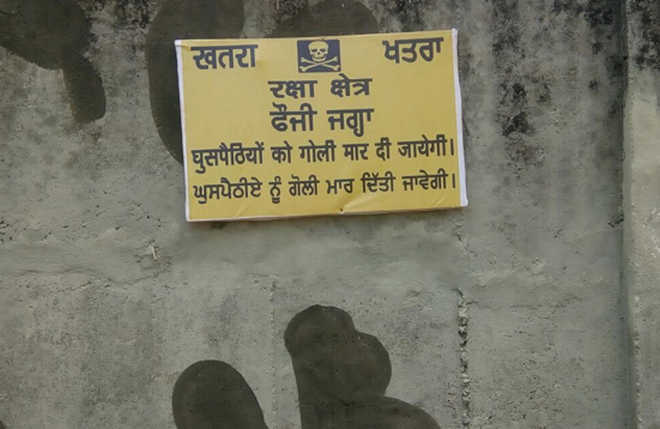
A poster with a warning pasted on a wall at Pathankot Air Force Station. Tribune photo

Ravi Dhaliwal

Tribune News Service

Pathankot, June 9

Security was beefed up today and “shoot at sight” orders issued at the Pathankot air base, spread over 16 square km, on Intelligence inputs.   Several posters have been put up on the boundary wall of the air base, warning that anybody found intruding into the security zone will be shot dead. Sources said the security agencies had received “credible intelligence inputs” that necessitated tightening of the security net. “We have got some inputs and want to follow these up. We cannot take chances. The security at the air base was upped when Home Minister Rajnath Singh visited it on June 4. Ever since, the vigil has not been downgraded; rather, it has been beefed up. The vigil has also been intensified in 20 villages near the Zero Line. A flag march was conducted by the Army, BSF and police to instil confidence among the people. We are also keeping an eye on the Gujjars (shepherds) living near the border as their links with terrorists cannot be ruled out,” said an officer.SSP Rakesh Kaushal said the flag march was a routine affair. “I requested the Army and the BSF to help us sanitise the area. Fifteen vehicles were pressed into service and these covered 20 ‘most sensitive’ villages. The operation was handled by SP (Operations) HP Sharma, who has been posted at the Narot Jaimal Singh police station for day-to-day surveillance along the border. His job is to coordinate with the BSF, Army, Intelligence and the J&K Police,” he said.“Under normal circumstances,” an Army officer said, “whenever any suspicious person tries to enter the premises, he is challenged  before being fired at. Now, the intruders will not be challenged. They will be shot dead.”  On January 2, terrorists  entered the air base and shot dead seven security personnel before NSG sharpshooters gunned them down.


Retired armyman sleeping in porch hit by stray bullet

BIZARRE INCIDENT Resident of Ghumar Mandi did not know what had hit him, until doctors pulled out a .32 bore bullet from his right arm

LUDHIANA: In a bizarre incident, a retired armyman sleeping in the open in the porch (verandah) of his house in Dyal Nagar, Ghumar Mandi, was hit by a stray bullet in his right arm on Saturday, but did not realise what had hit him until the doctors pulled out the bullet from the arm.

Police suspect that the bullet was fired from a pistol in celebratory fire from somewhere near his residence. A team from police station division near 8 reached the spot and started investigation.

The complainant Kewal Krishan, meanwhile, thought he had received an electric current and cried out for help. His son Baljit Singh, the first to his aid, claimed that as soon as he heard the cries, he took his father to a private hospital in the area.

“Doctors removed a .32 bore bullet from my father’s arm. I immediately informed the police,” said Baljit, claiming that the bullet could have been fired deliberately. He refuted the police theory of retaliatory fire.

Division number 8 SHO Gaurav Taura said police had now launching a hunt for people who owned a .32 bore weapon in the area. A case under Sections 336 (act endangering life or personal safety) of others) and 323 (voluntarily causing hurt) of the Indian Penal Code has been registered against unidentified accused.


3,000 ex-servicemen to be recruited in police: CM

3,000 ex-servicemen to be recruited in police: CM
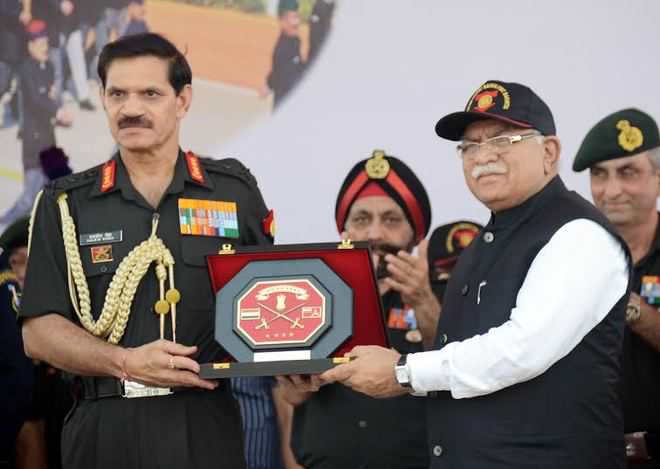
Army Chief Dalbir Suhag presents a momento to Chief Minister Manohar Lal during an ex-servicemen rally at Bahadurgarh in Jhajjar district on Friday. Tribune Photo

Tribune News Service

Bahadurgarh (Jhajjar), June 3

Chief Minister Manohar Lal Khattar today announced to fill 3,000 posts in the Police Department under the ex-servicemen’s category, besides setting up the state’s third Sainik School in Jhajjar’s Matanhel village.Khattar was addressing an ex-servicemen’s rally after the foundation stone-laying and bhoomi pujan ceremony of a residential colony over five acres for serving and retired army personnel at HUDA Sector 7 in Bahadurgarh. Finance Minister Capt Abhimanyu, Army Chief Dalbir Suhag and Lt-Gen KJ Singh were also present.“The welfare of serving soldiers and ex-servicemen is among the highest priorities of the state government. As many as 3,000 ex-servicemen will be given jobs in the police while the process to fill 1,000 posts under the ex-servicemen category is already going on,” said the CM, adding that classes in Matanhel’s Sainik School would begin next year.Khattar maintained the state government was planning to associate ex-servicemen with government schools with the twin aim of bringing about a qualitative improvement in the education standard and enhancing the strength of students in schools.“There are about 2.82 lakh ex-servicemen in the state and we want to use their experience for the betterment of the educational system,” said the CM.He also announced to give some relaxation in the norms to construct flats in the residential colony “As per rules, 400 flats can be built over the land but we have accorded special relaxation to construct 500 flats ,” Khattar added.The residential colony would be named after Major Rajiv Joon, a recipient of Ashok Chakra and Shaurya Chakra, who laid down his life fighting terrorists in Anantnag in 1994. The CM also honoured Rajiv’s brother, Paramjeet Joon, during the rally.Army plans educational complex in Sonepat Jhajjar: The Army has decided to set up an educational complex in Sonepat district to provide quality education to wards of serving and retired defence personnel. The complex would have law, management, IT and technical institutes along with hostels and these institutes would be affiliated to Delhi University. Army Chief Dalbir Suhag disclosed this while interacting with ex-servicemen in Bahadurgarh here on Friday. General Suhag informed he had talked to Chief Minister Manohar Lal Khattar about the plan who not only approved it in principal but also assured to provide adequate land for the purpose. A degree college would also opened in the centre, said the Army Chief. About the one rank, one pension scheme, the Army Chief said war widows would now be able to get their full arrears under the scheme in one instalment while the proposal to pay the arrears to ex-servicemen over 80 years of age in one or two instalments was also being considered. Other ex-servicemen would be paid their arrears in four equal instalments.— TNS


India, USA ink deal to exchange terrorist info

short by Shubhodeep Datta / 02:21 pm on 02 Jun 2016,Thursday
India and the USA on Thursday signed an agreement to exchange terrorist screening information. The agreement allows both the countries to access information through the designated contact points, subject to domestic laws and regulations. The agreement was signed by the Union Home Secretary, Rajiv Mehrishi and the Ambassador of USA to India, Richard Verma.

PULGAON FIRE J&K ammo depots need a relook

J&K ammo depots need a relook

Ravi Krishnan Khajuria

Tribune News Service

Jammu, June 1

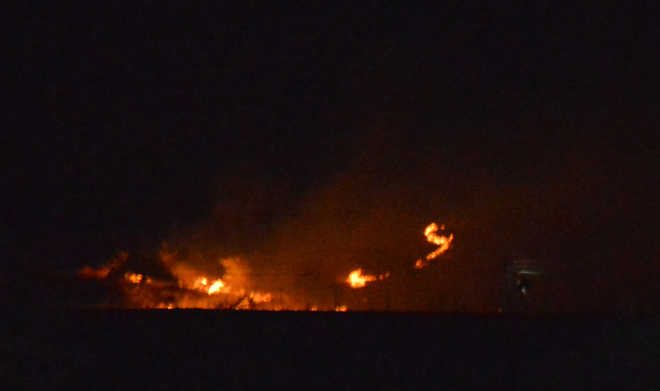
While 16 Army men lost their lives in an inferno in country’s biggest ammunition depot at Pulgaon in Maharashtra on Tuesday, similar depots in Jammu and Kashmir, by and large, lack sufficient safety measures.“One-third of the 1.3-million Army is in J&K and we share our borders with Pakistan and China. Therefore, we have ammunition depots with every Army formation in the state. There are five main ammunition depots — at Jandrah (that replenished supplies during Kargil War), Srinagar, Leh, Udhampur and Nagrota,” said defence sources.However, it also remains a fact that 80 per cent of ammunition is kept in open under sheds and at times rising mercury can lead to ammunition bursting on its own, they added.The sources added that lack of sufficient safety measures does pose a serious threat to all including people living in villages close to such depots.Fire incidents in ammunition stores have been reported in the state earlier. Khundroo’s 21 Field Ordnance Depot fire in 2007 still remains fresh in the minds of many. An Army officer was among 15 persons killed in the incident.“While every kind of ammunition including anti-personnel mine, anti-tank mine, mortar, missile has a shelf-life and a temperature limit, dedicated teams of ammunition technicians, security officers, administrative officials and a good number of civilian employees remain at work in various field ammunition depots but we still lack sufficient safety measures,” they added.They said that though refrigeration facilities exist in some of the ammunition depots in the state, majority of the ammunition is kept under sheds in the open.“In some depots we do have refrigeration facilities but they are not up to the mark,” they added.The sources said that by compromising on safety measures, civilians in vicinity of such depots were being put to risk.In March, this year people of six villages in the Nagrota Assembly seat resorted to protest demanding relocation of the 15 Field Ammunition Depot at Jandrah.They had claimed that not only the depot posed a risk to them but the Army was also not allowing them to either go for renovation of their houses or construction of new ones.The villagers from Kanyala, Kahpota, Madeen, Jandrah, Nagola, Ponthel had met Jammu Deputy Commissioner  Simrandeep Singh and apprised him of  the problems being faced by the arbitrary orders which prohibited them from undertaking any repair, construction, modification etc within a radius of one kilometre of the 15 Ammunition Depot.On November 20, 2013, civilian employee Sanjiv Kumar Baru of Kour Jagir area, who had been working as painter in the same ammunition depot died and a trooper was injured, after an 81 mm mortar shell had exploded.

Ammunition kept in open sheds

  • There are five main ammunition depots in the state
  • 80 per cent of the ammunition is kept in open sheds
  • Lack of sufficient safety measures pose a serious threat to people living in villages close to such depots