Sanjha Morcha

What’s New

Click the heading to open detailed news

Current Events :

web counter

Print Media Reproduced Defence Related News

Govt announces financial aid, job for martyr’s kin

Govt announces financial aid, job for martyr’s kin
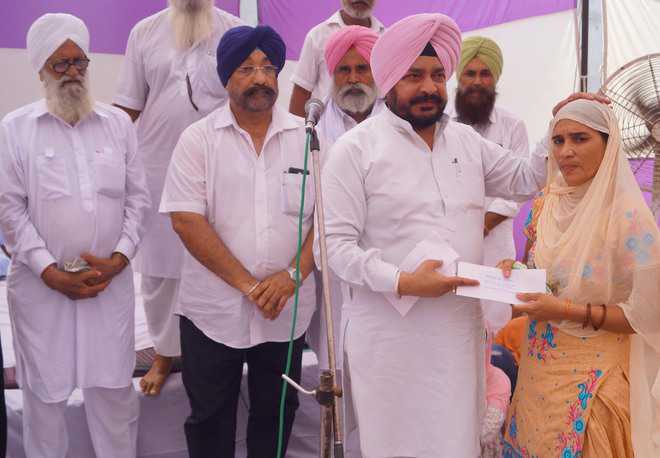
Forest Minister Sadhu Singh Dharamsot hands over a cheque to BSF ASI’s wife Karamjit Kaur in Mansa on Sunday. Tribune photo

Tribune News Service

Mansa, September 10

The state government today announced that a government job would be given to Navdeep Singh, son of BSF ASI Kamaljit Singh, who was killed in firing by the Pakistani soldiers in Poonch in Jammu and Kashmir last week.The announcement was made by Forest Minister Sadhu Singh Dharamsot at the bhog ceremony organised to pay tributes to the departed soul.The minister said Kamaljit Singh would be remembered for the bravery that he showed in line of his duty.The minister handed over cheque for Rs 2.5 lakh each to martyr’s father Roop Chand and his widow Karamjit Kaur. He then announced that Navdeep Signh would be given a government job after completion of his graduation. He also assured that the government would stand by the family in the hour of need.Rajya Sabha member and senior SAD leader Balwinder Singh Bhunder announced a grant of Rs 5 lakh for the construction of the martyr’s memorial in the village.


2 jawans killed in Pak’s BAT attack in Poonch; intruder gunned down

2 jawans killed in Pak's BAT attack in Poonch; intruder gunned down
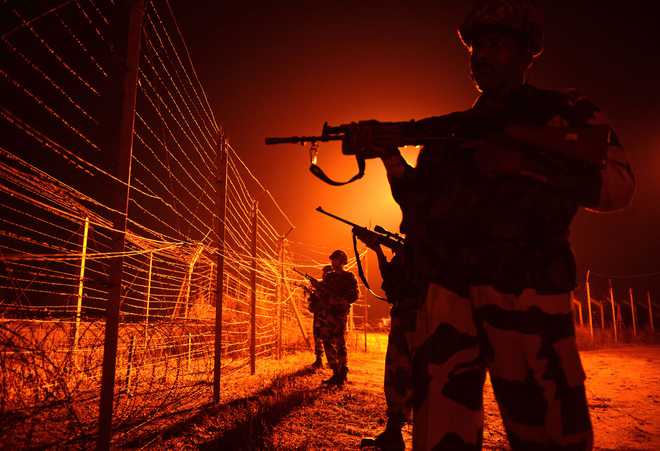
This was the third BAT action in Poonch this year. — PTI file photo

Jammu, June 22

Pakistani troops on Thursday carried out an attack 600 metre inside the Indian territory in Poonch sector of Jammu and Kashmir, killing two jawans and losing one of their men in the retaliatory action.One of the attackers was injured in the Indian retaliatory action and his body was extricated under the cover of heavy firing by the Pakistani troops from their posts across the LoC, an Army official said.(Follow The Tribune on Facebook; and Twitter @thetribunechd)The Border Action Team (BAT), which generally comprises special forces of the Pakistan Army and some terrorists, carried out the attack at around 2 pm with the aid of cover fire by the Pakistani troops from their posts, he said.The slain soldiers hailed from Maharashtra. They have been identified as Naik Jadhav Sandip Sarjerao, who hailed from Aurangabad, and Sepoy Mane Savan Balku from Kolhapur.This was the third BAT action in Poonch this year.The official said the Indian Army’s ‘Area Domination Patrol’ was “targeted by the armed intruders and exchange of fire occurred.””Pakistan’s BAT team was 600 metre within the Indian side of the LoC and 200 metre from the Indian posts,” the official said.The Indian troops retaliated and in the firefight, two Indian jawans were killed, the official said.The Indian troops killed one armed intruder, whose body “is within visual reach”, he said.While the firefight was going on, the Pakistani posts resorted to heavy firing, the official said.”The operations are in progress and heavy exchange of fire is going on,” he added. — PTI 


Army Chief sees possibility of 2-front war

Tribune News Service

New Delhi, September 6

Despite a credible deterrence, a two-front war—a situation where India has to fight Pakistan and China simultaneously—cannot be ruled out, Army Chief General Bipin Rawat warned here today. It would predominately be a “land war”, he added.War is very much in the realm of reality, General Rawat said while speaking at a seminar here.He said it was a “myth” to assume that “democracies or nuclear armed” neighbours don’t go to war.Pakistan believes that India is its main enemy and has launched a proxy war against it. “Differences with our western adversary (Pakistan) are irreconcilable. We don’t see any scope of reconciliation, because their military, polity, and people have been made to believe that there is an adversary, India, which is all out to break their nation into pieces,” he said.Referring to the recent standoff between Indian and Chinese troops at Doklam in Bhutan, he said more incidents like that could not be ruled out.China, he said, would continue to try and nibble away at Indian territory. Terming it as “salami slicing”, he said China would continue to test our limits and threshold. India would have to be prepared for that, he said.He said Pakistan could try to take advantage whenever India got engaged with China. “We have to be prepared for conflict on the northern and western borders,” the Army Chief said.Believing that there would be no war could affect modernisation of forces and budgetary allocations. “Only militaries don’t go to war, nations go to war; and we must prepare ourselves accordingly,” he said.“Credible deterrence does not take away the threat of war… Nuclear powers don’t go to war and that nuclear weapons are weapons of deterrence, yes they are. But to say that they can deter war, they will not allow nations to go to war, in our context that may also not be true,” Gen Rawat said.


Gen Bipin Rawat says…

On Pakistan: Differences with our western adversary (Pakistan) are irreconcilable. We don’t see any scope of reconciliation, because their military, polity, and people have been made to believe that there is an adversary, India, which is out to break their nation into piecesOn China: Salami slicing (taking over territory in a very gradual manner), testing our limits of threshold is something we have to be wary about and remain prepared for situations emerging which could gradually emerge into conflict


The J&K police and its resilience by Lt Gen Syed Ata Hasnain (retd)

The Jammu and Kashmir police is doing an admirable job against all odds in the strife-torn Valley. Despite being at the focused receiving end of terror outfits and socially ostracised, the force refuses to buckle under pressure. It’s time to synergise and strengthen the state police. –

AS photos of late Feroze Ahmad Dar, the SHO Achabal, flash on social media one deeply regrets his loss along with six of his colleagues, all bravehearts of the Jammu and Kashmir Police (JKP). The six Kashmiri policemen have become the victims of the continued targeting of JKP personnel in the last few weeks. The tragedy is as deep as the untimely martyrdom of Lt Umar Fayaz, the young Army officer from Kulgam also killed by terrorists a few weeks ago. These killings have been a part of the ongoing focus of the terror groups to intimidate those in the service of India, to prevent the success of the campaign to allow maximum Kashmiris to aspire for government services. In recent times, I have been one of those who has perpetually extolled the virtues of the JKP.  I even wrote a laudatory ode to it in a defence journal, following that with the same in a journal of the National Police Academy. I have worked with this force through thick and thin. It is only when you have done so that you can take liberties with analysing its capability and offering a critique. The force continues to do yeoman service to the state and the nation. Its plural and syncretic character is an asset. I find all segments of faith within it, all professionally and socially in sync with each other. I never felt the need to ever know the faith of a JKP cadre who was working in coordination with the Army. I met hundreds of them during and at the end of various successful joint operations and hugged them all as I did my own soldiers. The public in rest of India rarely gets to know the degree of intense support the Army receives from the JKP. The Supreme Court of India has clearly laid down a set of do’s and don’ts for the Army, while it functions under AFSPA 1990. One of these outlines the necessity of ensuring that every time the Army operates in any civilian area outside the LoC belt (where the Army operates alone), it will do so only with the presence of civil police (JKP). That rule has established an unbreakable bond which brings policemen and soldiers together to respond to situations in the quickest possible time.  While the Army’s units which are the frontline response troops receive intelligence from myriad sources, including its own, the most actionable intelligence is usually provided by the JKP through its various intelligence organisations. The combination of such intelligence with the Army’s crack troops of the Rashtriya Rifles and the Special Operations Group (SOG) of the JKP usually sounds the death-knell of many a prominent terrorist leader. In 2011, this combination wiped out 19 such leaders across the length and breadth of the Valley and broke the back of Pakistan-supported terroristsIt is for reasons given above that one feels aggrieved to see the JKP at the focused receiving end of the terror groups who know that it is the force multiplier for the security forces in Kashmir. Adversaries in such proxy conflicts rarely like to remain outside the loop of such situations; they monitor, take feedback and alter strategy. Taking 2008-10 as a case in point. The agitational turbulence of 2016, post the killing of Burhan Wani, ensured that a prime part of the strategy was to lay the JKP low through social targeting. Families of the police were singled out in villages to break the homogeneity of JKP and dilute its motivation. For a moment in time I felt that the nexus of separatists and their masters had succeeded as 54 houses of policemen were initially burnt and families forced to apologise at mosques. This social ostracisation should have demoralised the force no end, broken its confidence and laid the foundation for a compromising attitude towards their responsibilities. I hope I am right in saying that some astute leadership and the resolve to cleanse Kashmir’s killing fields off the presence of Pakistan-sponsored radicals and terror groups is ensuring that the JKP instead of wilting is actually emerging stronger. The adversaries are not going to wilt. They will re-evaluate options and select innovative ways of targeting the JKP, social media and other forms of media being one, while the harnessing of mosque power could be another. There are already messages across social media from Kashmiris warning policemen about how they are being used by Indian authorities. The cyber space must not be left uncontested even if it has to be done in an unstructured way. There are other issues which must be attended to forthwith. Compensation for the houses of policemen burnt to intimidate them must be released quickly and must be sufficient. Compensation to families of policemen martyred must be at par with casualties of central forces and paid with urgency and without reminder. Officers of the force on deputation and serving away must return as it happens in the Army. These officers relate best with the men and will provide the necessary leadership which is so much required under the current challenging circumstances. Lastly, JKP has to realise that its personnel are going to be baited. It must improve its relationship with the people through friendly measures and outreach, while ensuring that subversion of its ranks is guarded against. There will be fresh and manipulated accusations of misdemeanour too. Without a proactive and experienced leadership handling the threats is not going to be easy.The writer, a former GOC of the Srinagar-based 15 Corps, is now associated with the Vivekanand International  Foundation & the Institute of Peace and Conflict Studies. – See more at: http://www.tribuneindia.com/news/comment/the-j-k-police-and-its-resilience/425154.html#sthash.fiIqCA3l.dpuf


Bad to worse Fresh fault-lines emerge in Kashmir

Bad to worse

KASHMIR is losing the count of its dead as the ongoing conflict enters a dangerous and audacious phase. Last week saw a spurt in killings and an unusual happening: politicians skipping the funeral prayers of policemen dying in the line of duty. The massacre of six policemen in an ambush on Friday evening in the Acchabal area of Anantnag district, within hours of the killing of Lashkar-e-Toiba commander Junaid Mattoo, delivered a message to the security forces that militants would retaliate instantly and fiercely to  avenge the killing of their colleagues. This is not the first time policemen have been ambushed, but the latest killings have created a scary environment. The all-pervasive thought ruling the Valley is that the “enemy” wears the uniform. This has propelled new challenges for the state police, already under pressure from the conflict between the prevailing pro-militant sentiment and the call of duty. The task is getting tougher as the hostility towards them is no less than that towards other uniformed forces. Political support, too, is not discernible as most politicians have chosen to stay away from their funeral prayers. That has not gone down well with the families of the slain policemen, even though politicians’ decision could have been influenced by security concerns. Immediately after the Acchabal atrocity, militants mounted another attack on the security forces’ camps in Bijebhra, Anantnag, on Saturday. The militants have shown their capacity to strike anywhere and anytime. Also, a nexus of militants and stone-throwers has surfaced at encounter sites. Security forces view them as disrupters of operations and “enemies” like the holed-up militants, while the locals sympathetic to the idea of separatism see them as innocent protesters under attack from the “Indian forces that have declared a war on the people of Kashmir”. Such emotional bonding is unprecedented in Kashmir. The locals’ connect with militants and disconnect with the state police is a new and dangerous phenomenon. Things are bad and are likely to worsen because there is no counter to the prevailing sentiment and violence in Kashmir. 


Panchkula peaceful, normalcy returns Educational institutions, shops open today; checking at entry, exit points to continue

Panchkula peaceful, normalcy returns
The Army holds a flag march in Panchkula ahead of the sentencing of the dera chief in Rohtak on Monday. Tribune photo: Ravi Kumar

Tribune News Service

Panchkula, August 28

After witnessing violence on August 25, which resulted in over 32 deaths and injuries to more than 200, normalcy returned to Panchkula today. As no incident of clash was reported after the CBI court pronounced 20-year imprisonment to the Dera Sacha Sauda chief, schools, colleges and other educational institutions will remain open tomorrow.After the CBI court verdict, the Army, paramilitary forces and the Haryana Police conducted a flag march in Panchkula to ensure law and order.Panchkula Deputy Commissioner Gauri Parashar Joshi said schools, colleges and other educational institutes would remain open tomorrow.Panchkula Police Commissioner AS Chawla said no incident of violence was reported from any part of the district. The entire district remained peaceful today. Checking at entry and exit points would continue in the coming days, he said. Today, the security forces had barricaded the entire District Court Complex and the district administrative complex in Sector 1.At the entry and exit points of Panchkula, the police were deployed and they were checking suspicious vehicles. Inside the city, the traffic movement was normal.The Deputy Commissioner said the Army was still on the “moving mode” in Panchkula district. On derequisition of the Army, she said they would take a call in this regard tomorrow.Industrial Area to be openOffice-bearers of the Panchkula Beopar Mandal and the Industries Association said shops and industries in Panchkula district would remain open and fully functional tomorrow.People not allowed to enter MDC police stationAs the fire engine and 29 luxury vehicles, which were part of the dera head’s convoy, were parked in the Mansa Devi Complex (MDC) police station, the public was not allowed to enter inside it. Paramilitary forces were deployed inside the police station to keep the public away from these vehicles.Decision on Army derequisition todayPanchkula Deputy Commissioner Gauri Parashar Joshi said the Army was still on the “moving mode” in Panchkula district. On derequisition of the Army, she said they would take a call in this regard on Tuesday.No violence reported from districtNo incident of violence was reported from any part of the district. The entire district remained peaceful on Monday. Checking at the entry and exit points will continue in the coming days. —AS Chawla, Panchkula Police Commissioner


Evolving Situation in J&K: Summer 2017 (Part II) by Lt Gen Syed Ata Hasnain (Retd)

Amarnath Yatra is a worrisome event from a security point of view because the mileage gained by terrorists and its implications can both be immense. Hence the need to over insure that both routes, the Pahalgam and Baltal ones, be secured each by sufficient strength of the Army and CRPF along with the inevitable J&K Police. To task the Rashtriya Rifles Headquarters (HQ) Victor Force to oversee the security from Avantipur would be incorrect as it has enough on its hands with South Kashmir. A separate HQ has to be deployed for the Yatra; this is a dire need.
How should the establishment handle the strife in the streets and yet remain untainted and un-besmirched by adversary propaganda. The Army has obviously taken upon itself to tweak its concept and be more aggressive in its stance after taking a couple of casualties at encounter sites interfered with by mobs. The re-introduction of the general cordon and search operations (CASO) is one such measure. It has been demonstrated in a more benign manner and without the offensive content of the 1990s. This is sensible thinking as flexibility is being exercised. Simultaneously the message must go home that it can be far stronger and offensive. Domination operations in the Kulgam-Shupiyan-Pulama-Bijbehara quadrangle can be facilitated with availability of more troops.
The root of all problems is unobstructed flow of money into terror conduits, something well known for many years but insufficiently acted upon. It is good to see networks now being investigated with raids by the National Investigation Agency (NIA). If this is successful and networks are disrupted, money available for sponsoring stone throwers and other troublemakers can be arrested. Simultaneously, those involved as leaders of the strife must be arrested and transported away from the Valley for detention.
Smart operations always include an element of soft power. Non-professionals always object to its employment but the Army has too much experience to ignore this. For all the bluster that is being laid at the doorstep of the Army Chief, one must never forget that he is a thorough professional. He has communicated his intent to his troops and the people alike but will invariable follow up with enough windows to create the conditions for outreach and engagement. Noticeably, none of the winning hearts and minds (WHAM) activity has lessened in content. Education, skill development, employment opportunities and sports can and must become joint ventures with the J&K government. The sports model of the Kashmir Premier League (KPL) conducted for two years by the J&K Ministry of Sports and the Army is already existent and should be revived.
It is good to see the Haryana government announce concessions in the admission of students from J&K to universities in Haryana. The message of safety of Kashmiri students is as essential and must come as reassurance from states where such admissions take place.
One has said it often but it is never enough to state that what has been missing has been a sincere effort to link the people of Jammu with the people of Kashmir. Both remain seething at each other in a permanent state of misunderstanding. The Kashmiri Pandits are an important segment of the Kashmiri society. They remain in suspense with insufficient efforts to create openings that can happen if the people within the state can encourage this. Suggestions on this have been communicated through the Jammu media, which can play a very positive role through outreach to the Valley media.
There is some seriousness on the issue of counter-propaganda but people have little idea yet on countering radical ideology and propaganda through social media. A consultative body on this is essential so that the conceptualisation is clearer. It needs execution at the central and state levels.
The well-known separatist leadership is sufficiently tainted and a return to it by the Central Government appears unlikely. Peace delegations that keep harping on engagement and outreach need to adopt more realistic policies of reaching and engaging the people instead of the separatist leaders. The continued insistence on reverting to the four point formula and how the same almost delivered only helps in reviving memories of a failed attempt. Pakistan may yet be important because it remains the chief sponsor of all that troubles in Kashmir today. However, it is more important to convey to it the clear message that it can never achieve its aims in J&K. Somehow the perception seems to prevail that with recent apparent foreign policy successes of Pakistan it is riding a wave of confidence. This is perhaps being aided by perceptions of India’s isolation on the One Belt One Road project. Such situations are very temporary as can be seen via the recent successful visits of Prime Minister Narendra Modi to Germany and Russia, both crucial countries.
So, at the cost of a little repetition, it is clear that this summer in Kashmir is all about getting the mix of hard and soft power right. Tweaking has been done to achieve an aim and send a message; re-tweaking will also be done in due course as corrections are achieved.
It is still going to be a hot summer but a mix of pragmatism, correct signaling and some effective operations will see it through to a stage where hopefully we may once again start looking at things with a long term perspective and a wider one.
This commentary is Part II of the two-part analysis on the evolving situation in Kashmir.


Cabinet gives nod to GoG scheme

Tribune News Service

Chandigarh, August 24

The Cabinet today took a number of important decisions, including approval to the ‘Guardians of Governance’ (GoG) scheme, formation of a sub-committee to work out modalities for closure of two state-owned thermal plants that had exceeded 25-year lifespan, one-time settlement scheme for rice millers and extension to service providers in the Veterinary Department.Besides, the Cabinet approved formulation of the District Mineral Foundation Rules to ensure implementation of development programmes in the areas affected by mining in the state.Besides ensuring compliance with the conditions imposed in the Environment Clearance and Mining Plan, the District Mineral Foundation Rules will enable the department concerned to take preventive measures to check illegal mining.Under the ‘Guardians of Governance’ scheme, which is aimed at ensuring efficient and effective implementation of government schemes at grassroots level, a monitoring mechanism has been put in place to ensure its smooth functioning at village, cluster, tehsil and district levels.The GoG scheme would be launched in a phased manner over a period of three years.The one-time settlement policy for defaulter rice millers paves the way for recovery of Rs 2,000 crore-Rs 2,400 crore of the whopping Rs 3,500-crore outstanding payments against undelivered rice.The Cabinet approved allotment of land to six entrepreneurs who ran their business from rented old sheds of Rural Industrial Development Centre (RIDC) in Banur.The land on which their units were located had been given to the Centre for establishment of Footwear Design & Development Institute (FDDI).As many as 16 additional information technology assistants will be engaged for administrative secretaries/secretaries to enable them monitor, review and implement the e-governance projects effectively. The assistants will be hired on outsourcing basis.During the meeting, the Cabinet also okayed raising the paddy procurement share of rice shellers located in border areas and constituting a three-member committee to fix and ensure minimum payment to labourers working in mandis in the ensuing procurement season.


DSP post for Harmanpreet

  • The Cabinet okayed appointment of cricketer and Arjuna Award recipient Harmanpreet Kaur as DSP in the state police
  • It also approved government jobs to two children of martyr Naib Subedar Paramjit Singh, who was beheaded by Pakistani troops near the Line of Control in May this year

Islamic State bleeds Marawi

Militants affiliated to IS have been holed up in the city since May 23. Artillery, urban gun battles, and aerial attacks have been unable to dislodge them

HOW DID IT START?

AFPFilipino soldiers patrol a deserted street in Marawi on Tuesday.

On MAY 23, Filipino forces launched an offensive in Marawi to capture Isnilon Hapilon, leader of the Abu Sayyaf terror group. Abu Sayyaf militants opened fire on the forces and called for reinforcements from the Maute group, another terror organisation. President Roberto Duterte placeed Mindanao — of which Marawi is a part — under martial law

HAS TERROR AFFECTED PHILIPPINES BEFORE?

Muslims make up an estimated 10% of the Philippines’ population and Islam is the second largest religion. Mindanao, the country’s southernmost island, is Muslim-majority, with most practicing Sunni Islam Philippines witnessed its first terror attack in 1971, but since January 2000, Islamist militant and separatist forces have carried out more than 40 bombings, mostly in Mindanao

HOW DID ISIS GET INTO PHILIPPINES?

Various factions in Mindanao have a history of armed violence over land and resources. Now, they have formed a coalition against a common enemy — the government in Manila — with the IS convincing them that the answer to Mindanao’s problems is Islamic law. Pledging allegiance to IS has facilitated cooperation across clan and ethnic lines, and widened recruitment Experts say IS, facing losses in Syria and Iraq, has looked to the Philippines to establish a province in the region