Sanjha Morcha

What’s New

Click the heading to open detailed news

Current Events :

web counter

Print Media Reproduced Defence Related News

Army equipped to fix ammunition shortage, but needs to monitor quality by Gautam Moorthy and Syed Ata Hasain

In the first of a two part series on ammunition shortages in the army, Gautam Moorthy and Syed Ata Hasain write that governments in the past appeared to believe the threat of conventional war to be negligible enough not to warrant even making up of deficiencies, let alone a sustained build-up. Read the second part. 

Gautam Moorthy & Syed Ata Hasnain

Two major heart-warming decisions by the government: the first came before the Doklam standoff and the second even as the Chinese continue to blow hot and hot with intimidation, threats and rhetoric.

The Army has been delegated special financial powers by the government to make up its critical deficiencies in ammunition and spares. This was received with much satisfaction among those whose responsibility it is to ensure that the fighting troops get the wherewithal to implement the military goals set out for them.

Setting a figure of Rs 40,000 crores for this is not a small sum even though making up critical deficiencies may need much more.  Then the Ministry of Defence (MoD) demanded an additional of Rs 20,000 crores, presumably for the current annual defence budget  for the purpose of once again making up deficiencies in ammunition and spares. The latter presumption is a fair one considering that acquiring weapon systems at this stage to meet the Chinese threat may be too little, too late.

Some have even put a number on it: about Rs 98,000 crores if we wish to make up ammunition for the 40 day-reserves by 2019.

Governments in the past appeared to believe the threat of conventional war to be either non-existent or negligible enough not to warrant even making up of deficiencies, let alone a sustained build-up. Or perhaps the view was that we have lived with the deficiency for many years and could do so for some more, in the absence of ‘real threats’. The real threat seems to be upon us now and the procedure to release and delegate additional funds has been in progress for the last few months.

The current government has fathomed the seriousness of the issue and has moved to empower the Vice Chief of the Army Staff (VCOAS) to move ahead without the Army having to look over its shoulder. It is a critical decision for the Army whose current holdings of major war fighting equipment cannot be effectively brought to bear on the enemy and would be rendered ineffective in the absence of critical spares and ammunition.

So what has actually been done? First of all, and perhaps a case of better late than never, the government has finally accepted the inability of the ordnance factories to meet the annual targets set by the army, targets that the factories themselves agree to. Ten separate contracts in respect of various ammunition items have been signed under the delegated financial powers of the VCOAS.

To diversify the supply chain, the army is procuring ammunition from private industry as well as public sector undertakings (PSUs), a domain that was entirely of the Ordnance Factory Board (OFB) until now.  It is also in keeping with the Make in India philosophy. ‘Requests For Proposals’ for various types of ammunition items, 22 in all, have been issued to Indian companies for the first time in history since Independence. Invitation of
bids have been asked for supplying yearly quantities, for a contractual period of ten years under ‘Manufacture of Ammunition for Indian Army by Indian Industry’ initiative.

Full powers have to be given to the Army HQ to procure operationally critical ammunition and spare parts. Additional steps include monitoring of delivery to the Army by the manufacturers by fixing numerical targets instead of financial targets, strict budgetary controls, an eagle eye focus on quality and an increase in storage capacities.

Critical equipment, ammunition and spares have to be put in the hands of the fighting formations early enough, perhaps as early as to empower and enable our formations not to be deterred by the bellicose Chinese threats and propaganda.

Consequent to the devastating fire that took place last year in the ammunition depot at Pulgaon near Nagpur that killed 19 people, the MoD, has approved a procedure for disposal of dangerous ammunition and regularisation of losses for defective ammunition to bring in accountability in the functioning of ammunition factories that are under the OFB, which till now were not held accountable. However, much remains to be done on the major issue of quality checks during manufacturing.

Lt. Gen. Syed Ata Hasnain (Retd), a former GOC of Srinagar-based 15 Corps, is associated with the Vivekanand International Foundation and the Institute of Peace and Conflict Studies. Twitter: @atahasnain53

Lt Gen Gautam Moorthy, former DG Ordnance Services, is now a part of the
Armed Forces Tribunal at Kolkata. Twitter: @GautamMoorthy ‏


India-China standoff: What is happening in the Chumbi Valley?By Lt Gen H S Panag

Depending upon the situation, we must mobilise to call China’s bluff and be prepared for border skirmishes or even a limited war.

“Yatung was a small spread out town… we were received by representatives of the Chinese General in Command at Lhasa, and of the Dalai Lama and Panchen Lama.” Thus wrote Jawaharlal Nehru to the Chief Ministers of India on October 15, 1958, describing his stay at Yatung for two days in September-October 1958, during his to and fro journey to Bhutan through the heart of the Chumbi Valley. Today it seems like a fairytale, but for 50 years up to 1954, we had an Indian Army Infantry Battalion located at Yatung with a detachment at Gyantse. These were gradually withdrawn after the Panchsheel Agreement was  signed on 27 April, 1954. We continued to have our Consul General in Lhasa and Indian Trade Agency trading posts at Yatung, Gyantse and Gartok upto 1962 when they were wound up.

Chumbi Valley has been in the news for a couple of weeks owing to reports about the Chinese intrusion into the Doklam (Donglang according to China) Plateau. There has been some confusion created about the place of intrusion with names like “trijunction”, “Doka La”, “Sikkim Border”, “Donglang”, “Mount Gipmochi (Gyemo Chen)” and “Doklam” used by the angry People’s Republic of China (PRC) and People’s Liberation Army (PLA) spokespersons, and our media.

Where is Doklam Plateau?

Doklam Plateau is an 80-89 square km plateau with average altitude of 4,000-4,500 meters, located in Western Bhutan. It is a salient of Bhutanese territory that juts north into the Chumbi Valley with India (Sikkim) to the north-west, west and south-west and Tibet to the north, east and south-east. The trijunction of India, Bhutan and Tibet is on the north-western edge of the Doklam Plateau where the Batang La post of India is located and north-west of which along the crest line are the Indian defences of Sikkim.

What is the military significance of the Chumbi Valley and the Doklam Plateau?

Salients on borders whether towards own or enemy’s territory have military pros and cons. Chumbi Valley is a 100-km dagger-shaped north- south salient that lies between India (Sikkim) to the north-west, west and south-west, and Bhutan to the north-east, east and south. Some 100 km south of the dagger point is Bangladesh and, in between, lie 70 km of rugged mountainous terrain of India/Bhutan and the Siliguri Corridor, which at its narrowest point is only 30-km wide and has a number of rivers running in north-south direction. On the face of it, at the strategic level, it gives the PLA a launch pad to choke India’s vital lines of communications running through the Siliguri Corridor to the North East. But this will require a major offensive by five to six divisions as part of an all-out war, with holding forces to contain the north western, western and eastern flanks. Given the existing road communication, limited deployment space as the Chumbi Valley at Yatung is only 25-30 km wide as the crow flies, vulnerability to air power and Indian counter-offensive from the flanks, this hypothetical threat is a non-starter.

In fact, the Chumbi Valley is more vulnerable to an Indian offensive or counter-offensive from the north-west and west from Sikkim and ‘by your leave’ complementary offensive via Bhutan from the east. Again this can only happen in a major war, the probability of which is very low. Nations armed with nuclear weapons do not generally risk an all-out conventional war, though probability of border skirmishes or a limited war cannot be ruled out.

The Doklam Plateau gives the PLA the advantage of outflanking from the south west, the defences of Sikkim, where we have a major terrain advantage vis the Chumbi Valley. The implications are strategic. We not only lose our major advantage of a strategic offensive / counter offensive from Sikkim but also give the PLA a launch pad for an offensive through the Rangpo River valley towards Kalimpong without violating the neutrality of Bhutan. The probability of war may be low, but the bottom line is that India cannot afford to surrender its strategic advantage and create a vulnerability by allowing the PLA to take possession of the Doklam Plateau. It is pertinent to mention that all the disputed areas that the Chinese claim along the Line of Actual Control (LAC) are related to strategic or tactical advantages in event of a war.

What is the dispute in the Doklam Plateau?

Map released by the Chinese spokesperson*

*Map released by the Chinese spokesperson showing the disputed area as per its perception of the 1890 Anglo-Chinese Convention. The Trijunction is marked at Gyemo Chen (Mount Kipmochi). The dotted line on the map running through Sinche La shows the Indian and Bhutanese perception of the Trijunction and the boundary.

The LAC only defines the approximate border which has emerged out of the frontier regions over the last 100 years. Same is the situation on the Bhutan border. There is no mutually accepted International Boundary.  Even in respect of the de facto borders, there is no delineation agreement, which China has signed with India or Bhutan.  Ancient feudal and colonial treaties or agreements are cited to press rival claims. There is no de juresanctity of the border. Empirically, it is the de facto position, which reigns supreme with respect to borders. And the de facto position is signified by physical possession and presence. The problem with the borders with Tibet is that the rival claimants have not physically secured all their claimed areas. Hence, jostling for positions of advantage as part of the continuous competitive conflict is a constant feature which may take place by design or at times by default.

The de facto position is that India holds the posts of Batang La and Doka La  to the north-west of Doklam Plateau as part of its defences in Sikkim. India and Bhutan consider that the trijunction is located at Batang La. The Doklam Plateau is in the possession of Bhutan but it secures its possession with only one post at Zompleri, which is occupied only in summers. China claims the entire plateau and as per its version the Trijunction is at Mount Gipmochi (Gyemo Chen) which is 7-8 km to the south-east of the de facto present position. Since the Doklam Plateau is largely not physically held by the Bhutan Army, the PLA has been patrolling this area at will. India also patrols this area with a mutual understanding with the Bhutan Army to safeguard its vulnerable eastern flank. Indian and PLA patrols have confronted each other in this area in the past and matters were resolved by agreeing to disagree to maintain status quo for peace.

China bases its claims on the Anglo-Chinese Convention 1890 as per which the Sikkim-Tibet border was agreed upon. Ironically, Sikkim and Bhutan were neither invited to nor are signatories to the convention. This convention did not prevent China from starting confrontation at Nathu La in 1967. Moreover, China’s approach to various colonial treaties/conventions has been selective on one pretext or the other. China has officially acknowledged the various areas of dispute including the Doklam Plateau with Bhutan and 24 rounds of negotiations have been held. It has formally been agreed to by China and India, in 2012, that the Trijunction points between India, China and third countries will be finalised in consultation with the concerned countries. In 1988 and 1998, China and Bhutan have also formally agreed to maintain status quo with respect to the disputed areas pending final settlement. Notwithstanding the patrolling by both sides, this status quo has not been disturbed until June 2017.

Bhutan, being a small nation, has a special relationship with India based on formal treaties renewed over the 100 years. As per the 2007 treaty, India and Bhutan have agreed to cooperate with each other on issues relating to their “national interests” and not allow the use of their territory for activities harmful to national security and interest of the other. Shorn of diplomatic ambiguity, it implies that Bhutan will be guided by India with respect to its foreign and defence policy. De facto, India is responsible for the defence of Bhutan, but except for the Indian Military Training Team no Indian troops are permanently stationed in Bhutan. However, troops of both countries do carry out joint training on as required basis. On the borders, there is intimate cooperation between the Royal Bhutan Army and the Indian Army particularly in disputed areas like the Doklam Plateau. Bhutan, being a small country, was keen to settle the disputes on its western boundaries in favour of China in exchange of a favourable settlement for two northern areas of dispute. However, keeping in view India’s sensitivities it refrained from doing so particularly with respect to the two disputed areas of Doklam Plateau and Sinchulumpa-Giu-Darmana south and east respectively of the Chumbi Valley.

The present standoff

On June 16, China began construction of a road from Sinche La towards the Bhutan Army post of Zompleri. Indian troops from Doka La confronted the PLA troops in conjunction with the troops of the Bhutan Army. No fire arms were used, but, human chains were formed by both sides and “jostling” (pushing and shoving) which has become a common feature in such confrontations have continued on and of since then. Both sides seem to have reinforced the present positions with additional troops and the standoff continues.

While such ‘standoffs’ have taken place for prolonged periods in the Depsang Plains in 2013 and Chumar in 2014, the emphasis still was on diplomacy and having made the ‘political statement’, the PLA reverted to status quo. However, this time the official statements and Chinese media have been unusually belligerent giving short shrift to diplomatic niceties. Words and phrases like “do not forget 1962”, “PLA will teach India a lesson”, “no talks until Indian troops withdraw”, “option of war is open” and “either Indian troops return to their territory with dignity or will be kicked out of the area by the PLA”, have been freely used. India and Bhutan in typical diplomatic language have urged China to maintain status quo ante pre June 2017 and respect the interim agreements with respect to Trijunction points reached with India in 2012 and the 1988, and 1998 agreements with Bhutan to maintain the status quo pending final settlement.

Chinese Strategy

What are the reasons for this unusually belligerent stance of the Chinese? Are we heading towards border skirmishes or even a more serious confrontation?

The Doklam incident as also other border incidents in the past have nothing to do with the territorial disputes per se. Nations with credible conventional and nuclear deterrent, do not part with territory under their control whatever be the nature of the dispute. China is well aware of this, but selectively starts such confrontations to make ‘political statements’ and keep India on the edge. Such incidents always take place to coincide with major diplomatic events or as a response to perceived Indian actions that are contrary to Chinese world or regional view.

India is the only country in the region that has not accepted Chinese political hegemony. China views India as a competitor that challenges its preeminent position. Indo-USA strategic cooperation is seen as a threat. India is seen as the principal instigator of the Tibetan struggle for freedom. The presence of the Dalai Lama and the Tibetan Government in Exile at Dharamsala only reinforces the Chinese belief. The recent visit of the Dalai Lama to Tawang annoyed the Chinese no end. India, along with Bhutan, is the only country that has not become part of the much-touted One Belt, One Road. Prime Minister Modi was scheduled to meet President Donald Trump in the third week of June.

China decided to embarrass India in the Doklam area by trying to alter the status quo. It aimed at driving a wedge between India and Bhutan and thus chose to show its presence in Bhutanese territory, to which India also is very sensitive. China’s strategy is to make India lose face by forcing it to withdraw and thus wean Bhutan to its own sphere of influence.  Anything short of mutual withdrawal will leave China in de facto control of the Doklam Plateau outflanking and compromising the Indian defences in Sikkim.

What should be the Indian strategy?

This is a critical moment in Sino-Indian relationship. Any sign of weakness will have repercussions on the entire boundary question. Today, it is Doklam and tomorrow, it will be somewhere else. Acceptance of Chinese position in Doklam will lead to unacceptable ‘loss of face’ domestically and internationally.

China understands only one language and that is the language of strength. Our own experience of the 1967 confrontation in Sikkim and the Sumdrong Chu incident in 1986-87 proves this point. India must not back down unless it is mutual withdrawal to restore status quo ante pre-June 2017 and respect for past interim agreements to maintain status quo with respect to Trijunction points. In Doklam, we are in a position of advantage and from Batang La can cut off the PLA intrusion at Sinche La. We can build up much faster than China for any serious military confrontation. Depending upon the situation, if need be, we must mobilise to call China’s bluff and be prepared for border skirmishes or even a limited war. The tenor of the Chinese statements and our measured and nuanced response itself reflects that we have the psychological advantage.

There is no gain in saying that we must engage with China to settle the matter diplomatically and a direct military confrontation is the last resort. This is a defining moment, as giving in to Chinese bullying at this juncture will have serious repercussions for our rightful place in the comity of nations and our status as an emerging power.



HEADLINES ::::::26 DEC 2017 @ WWW.SANJHAMORCHA.COM

  • MEMORIES FLOW AS CAPT. AMARINDER HOSTS NDA BATCH MATES FOR A REUNION AFTER 58 YEARS
  • ARMY DENIES BODIES OF MAJOR AND THREE JAWANS, KILLED IN PAKISTANI CEASEFIRE VIOLATION, WERE MUTILATED
  • LANCE NAIK CREMATED WITH STATE HONOURS IN BATHINDA ZOOM BOOKMARK SHARE PRINT LISTEN TRANSLATE
  • PAK SNIPER SHOT; SHELLING ON LOC ARMY RETALIATES AFTER KILLING OF 4 SOLDIERS, INCLUDING MAJ; CEASEFIRE VIOLATED AGAIN
  • RAJOURI ATTACK: LANCE NAIK CREMATED IN TALWANDI SABO
  • SHAHEEDI JOR MELA BEGINS, CCTVS, DRONES KEEP VIGIL
  • Governor, Speaker pay tributes to Sahibzade
  • COW SMUGGLERS WILL BE KILLED: R’STHAN MLA
  • A PRECIOUS LESSON FROM PAKISTAN BY SHARAT SABHARWAL
  • PAK ‘HUMANITARIAN’ FACE, WITH GLASS INTERFACE
  • In new video, Jadhav hails Pak for meeting
  • WORLD’S LARGEST AMPHIBIOUS AIRCRAFT MAKES MAIDEN FLIGHT IN CHINA
  • PAK VIOLATES CEASEFIRE YET AGAIN, TARGETS ARMY POSTS IN POONCH
  • TWIN SURRENDERS ASHRAF JEHANGIR QAZI

One of a kind Chief by Wg Cdr JS Bhalla (Retd)

One of a kind Chief

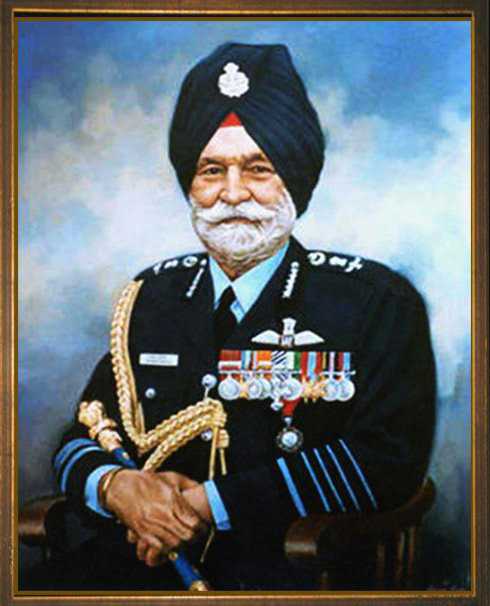
Wg Cdr JS Bhalla (Retd)IT was a foggy winter morning at Halwara. As visibility improved, squadrons launched their aircraft for local flying. It was around 1000 hours  when I heard  “Halwara 10” calling. “Come in 10” was my spontaneous reply without realising that call sign “10” is designated for the Chief of the Air Staff. It took a few seconds for the information to sink in. The aircraft asked for descend, giving ETA 15 minutes. There was no intimation about this movement and it appeared to be a surprise visit of the Chief after the 1965 operation. Gnats and Hunters were carrying out local flying with gusto to complete their task. I handed over the controls to my number two and at a dizzy speed, Stn Cdr Group Captain Dilbagh Singh (later Chief of the Air Staff) was informed about the unscheduled arrival of the then Chief of the Air Staff, Air Marshal Arjan Singh (later MIAF). His sudden arrival had shaken up everyone in the unit. To clear all doubts, I was asked to reconfirm if the Chief  was on board. I held my nerves and asked, “Confirm if Chief onboard.” “Affirmative, Sir,” came the prompt reply. Adding “Sir” to the conversation elevated our spirits and we all swung into action. All aircraft on local flying were asked to fly for endurance, keeping the airspace clear for the Chief’s arrival. All air activity came to a standstill to keep the noise level to the bare minimum for the VVIP to land and unboard the aircraft. The Canberra aircraft made a smooth landing and was directed to VIP dispersal. The Stn Cdr and Command Air Defence Officer were the only two officers present to receive the Chief. Other PSOs were incommunicado carrying out their respective tasks, unaware of the Chief’s visit. Those were mobile-less days, landline was the only mode of communication.        We received a message to assemble in the officers’ mess by 1300 hours. It may be for a pep talk, I thought. The Chief arrived in the mess to address us. “Well, gentlemen, Halwara has played a very crucial role in the 1965  war and the station has earned many gallantry awards which has made me feel proud. I thought of conveying my gratitude to you all in person for your hard work and good show.” The talk carried on for sometime, turning into a friendly discussion. His persona impressed everyone.  Many of us who expected a fault-finding mission were relieved with his narration. His talk boosted our morale, we were happy to hear that our unit had done well and the appreciation came from none other than the Chief.  There was no ceremonial parade, no guard of honour, no lineup of officers, yet the visit had gone well. That was his way of visiting a unit. Not to disturb the normal routine of the unit  may be one of the reasons for keeping his visit a surprise. The memories of the past came alive when the country gave a fitting farewell with full military honours to the MIAF, a hero of World War II and the 1965 war.


SANJHA MORCHA MARTYRS STATUES MAINTENANCE FUND COLLECTION:: RESPECT TO MARTYRS

Dear Veterans,

Sanjha Morcha team has decided to collect donations from all segments of society including Veterans for upkeep of Martyrs Statues in all States.

Today we know that Defence forces are loosing its respectability and dignity due to our own elected representatives either at state level or at National Level.

The basic reason is that our commanders are more prone to maintain discipline and wait for orders from the Politicians who are clueless about the role and functioning of the Armed forces.

The Defence forces are compared with the Para Military forces and picture is painted by our political leaders in favour of Police forces not defence Forces. The police forces has started getting gallantry awards primarily meany for defence forces.This has further brought down the status of Defence forces in the eyes of citizens.

Nothing can be done or undone till we get a full time and pro Defence Minister and our commanders take collective stand to stop  degradation of the Status of Defence forces .

Further the erosion of respectability has been done and is still deteriorating due to continuous Agitation at Jantar Mantar as veterans are being projected as Labour Union leaders fighting for their demands.

Its high time that The Battalion Commander of Jantar Mantar Regiment Maj Gen Satbir Singh along with his s second-in-command Brig JS Sandu and troops must call off JM agitation and get in to some constructive work in the welfare of ESM widows,Martyrs Families instead of seeking Votes to become Chairman of IESM and keep collecting donation by misguiding Veterans especially JCO/OR. Must forget to claim for Rajiya Sabha seat for  Maj Gen Satbir as was demanded by Brig JS Sandhu at a GOG briefing at Jallandhar for Punjab ESM

 Earlier Sanjha Morcha got lot of Donations for Nepal Disaster to the tune of Rs 4 Lakhs for the Prime Minister Relief Fund in the form of cheques but same were returned to the Donates as PM did not abide by his promise for Grant of OROP as per Rewari promise made to ESM before elections.

Now Sanjha Morcha has taken a vow to maintain the Martyrs Statues in all states by forming team of ESM where ever Statues are Installed.

It is a wastage of time and high expectations even from the Station Commanders what to expect from  civil Administration. Though  DC over looks all problems of ESM through  Deputy Director Sainik  welfare Officer of every state .

The DDSW are the last ones to look into maintenance of the Martyrs Statues to ensure that they are kept Neat and Clean at least once in a Month . If we as Veterans fail to provide due respectability to our own brothern  Statues what can you expect from any civilian organisations. 

As  a motivation factor the NCC training programme need to be revised and they should be taught about the war heroes who won gallantry awards and even Cadets can be made to assist in maintenance by washing it once in a month which will be motivation factor for the students and automatic respectability will be given by public too.

The donations received by Sanjha Morcha will be displayed on the Web site with Rank Name and amount along with Address and cheque photo will be uploaded without the account Number.

The donations received will be accounted separately for each State and will be uploaded as per State donations.

Sanjha Morcha will nominate or pick up Volunteer ESM who will be willingly take the responsibility. These teams can hire Labour and payment will be reimbursed  by Sanjha Morcha as per demand received and with authenticity of picture of the Statue Maintained. A normal Labour now day may cost Rs 500/- per day. We expect two labour Cost per month amounting to Rs 1000/-. Any material  purchased for painting will also be reimbursed by Sanjha Morcha.

The family/Relatives  of the Martyrs will be equally involved in the Maintenance and on every anniversary the Status would be garlanded apart from garlanding every month after the maintenance.

Further details will be worked out its just the idea to begin with.

Veterans are requested to forward their views at Sanjha Morcha email ID and the same contents of emails with suggestion by the Vetran will be uploaded on the web site along with Photographs of the donor.

In Punjab The GOG( Gurdian of Governance )  members who would be ESM may be given responsibility if approved the the Chairman Capt Amarinder Singh and Sr Vice chairman  Lt Gen TS Shergill and Vice Chairman Maj Gen SPS Grewal.

#############################

Email ID—-sanjhamorcha303@gmail.com

DONATION CHEQUES OR DIRECT RTGS 

Bank Details:
Name Of Account:

Ex-Servicemen Joint Action Front(Sanjha Morcha)

Account No: 

7386000100000193

Name of Bank:

PUNJAB NATIONAL BANK

RTGS/IFSC Code(for e transfer):

PUNB 0738600
Postal Address of Bank:

SCO145,SECTOR 40C CHANDIGARH(U.T)160036

:


HEADLINES :::13 JUL 2017

breakl line

MAJ GEN SATBIR SINGH ::ISSUE RECEIPTS TO VETERANS FOR DONATED AMOUNTS TO UFEM FOR TAX EXEMPTION–PART V

Untitled


SMOOTHER SAILING FOR TOP BRASS BY LT GEN SYED ATA HASNAIN PVSM, UYSM, AVSM, SM, VSM & LT GEN GAUTAM MOORTHY,PVSM, AVSM, VSM,ADC

ARMY GETS POWERS TO BUY AMMO

CHANGE THE KASHMIR NARRATIVE BY G PARTHASARATHY

CHINA READY FOR ‘CONSTRUCTIVE’ ROLE IN J AND K

2 SOLDIERS DIE IN LOC FIRING J&K PUT ON ‘HIGHEST’ ALERT, ANTI-TERROR OPERATIONS LIKELY TO BE STEPPED UP

EX-SERVICEMEN BURN PAK FLAG

CHINA PLANS TO DOWNSIZE ARMY TO LOWEST STRENGTH IN ITS HISTORY

STRATEGIC DRAWDOWN THIS IS THE FIRST TIME THAT PLA ARMY PERSONNEL WOULD BE REDUCED TO BELOW ONE MILLION

CAPT SEEKS MODI’S HELP IN CHECKING UNEMPLOYMENT

TWO SOLDIERS KILLED IN PAKISTAN FIRING AT LOC

SENA: SEND COW VIGILANTES TO FIGHT MILITANTS IN VALLEY

WHY MUM ON CONVICTED NETAS, SC PULLS UP EC

breakl line


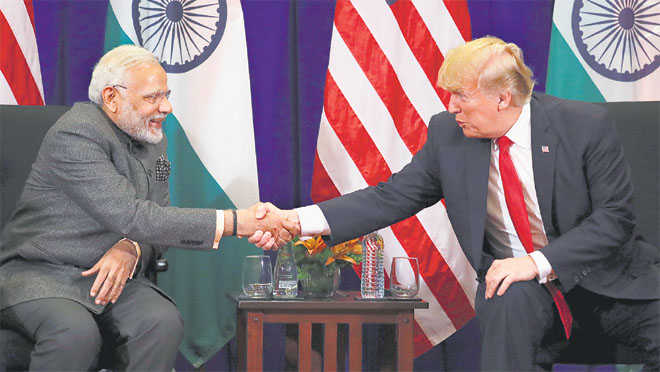
Trump, Modi in same boat by KC Singh

Trump, Modi in same boat
Like meets like: Both Trump and Modi are given to rabble-rousing to serve their end.

KC Singh

THIS week in the US, the oldest and most powerful democracy of the world, and in India, the largest, domestic politics and national security challenges ran on parallel tracks. Coincidently, both are led by right-wing leaders not above rabble-rousing for electoral advantage.In Alabama, US President Donald Trump faced a crucial election to a Senate seat which his party had held for two decades. However, the Republican Party nominee Roy Moore, twice removed in the past from the post of Alabama’s Chief Justice and now saddled with charges of sexual misconduct, was trounced by a genial Democrat who had been a successful prosecutor of members of the Ku Klux Klan.The Alabama contest acquired an edge because Trump threw his full weight behind Moore despite serious charges against him and his known bigotry. The loss narrows Republican lead in Senate to 51-49. In Gujarat, Prime Minister Narendra Modi likewise took the low road to campaigning by abandoning talk of development and the “Gujarat Model”, which he marketed to propel himself to power at the Centre in 2014, for bigoted charges about Pakistan hand in a Congress conspiracy to appoint a Muslim as the CM of Gujarat. Not resting there, he further saw more seditious activity when a former PM, a recently retired Vice-President, a former foreign minister and sundry retired distinguished diplomats attended a private dinner in honour of an erstwhile Pakistani foreign minister Kasuri. The narrow win by the BJP in a state taken as Modi base and where, as someone put it in an ironical reference to Mahatma Gandhi, he conducted his experiments with truth, is a warning that his magic is dissipating, especially  in rural India, which still forms two-thirds of the nation.India and the US this week also had reason to assess geopolitical changes that colour their external environment. The US released its National Security Strategy, which outlines the challenges and possible “Priority Action”. In line with Trumpian rhetoric it begins by reiterating an “America-First Foreign Policy”. The new slogan is “peace through strength”, to be achieved by principled realism. It exposes the false belief that US power could be self-sustaining without constant vigil, effort and innovation. Thereafter follows a frank assessment of who and how is countering US hegemony.The document claims that the US stood by as others “subsidised their industries, forced technology transfers and distorted markets”. The obvious reference is to China. Free enterprise it adds is “history’s greatest antidote to poverty”. Thus the US will react to political, military and economic competition it faces globally. Then the antagonists are listed. Russia wishes to restore its great power status and establish its influence near its borders. China, on the other hand, more assertively, wants to displace the US in the Indo-Pacific and expand the reach of its state-driven economic model. While both, it is surmised, aspire to project power worldwide, they are currently engaged in overturning regional balances of power. The third force seen as posing a threat to the US is Islamic militancy.The US counter strategy is to work with allies and partners. India is seen as a force for stability in the Central and South Asian paradigm, which contains a quarter of the global population, one- fifth of US-designated terror groups and two nuclear armed states. Even more significantly, India is seen as relevant in the Indo-Pacific theatre, which is incidentally defined as stretching from India’s west coast to the “western shores of the US”.  The paper surmises that the competition is between “free and repressive visions of world order” and the US thus must counter these shifts in the Indo-Pacific, Europe and the Middle East.The challenges are frankly identified but the solutions are thin and skirt over the gap between US rhetoric and action. If China is indeed the challenge, the US cannot be seen as sending contradictory signals to its allies and partners in the Indo-Pacific, like withdrawing from the Trans Pacific Partnership. Leading from behind cannot be the way forward as all regional powers suspect that Trump may be just bargain-hunting with the Chinese, using them to goad the dragon and not necessarily contain it.The Indian encirclement by China has become more palpable in the past month or so while the Modi government has been entirely fixated on Gujarat. The handing over of Hambantota port in Sri Lanka to China on a 99-year lease, despite assurances that it is only for civilian use, creates a security challenge. It will, at the very least, be a listening post for the Chinese from where naval activities of rival powers can be monitored. A free trade agreement signed in unseemly hurry by the Maldives with China again brings its trade and influence to India’s west coast. The most troublesome is the success of the two main communist parties in Nepal. The likely ascent of KP Oli as Prime Minister augurs ill for India. In an earlier incarnation, he had caused consternation by his pro-China tilt. India should expect his anti-India bias, exacerbated by the Modi government’s blockade in 2015, to manifest in closer integration with Chinese economy and mainland by subscribing to the Belt and Road connectivity project. This hardly provides solace when combined with reports that unlike what the Modi government marketed as Chinese withdrawal at Doklam, the Chinese have, in fact, bivouacked in larger numbers for a permanent pressure point on Bhutan and India.The lesson that both India and the US need to imbibe is that there is a vast difference between perceiving a threat and devising a strategy to counter it. For instance, Trump cannot hope for de-radicalisation of Islam if he simultaneously does not stop feeding its radicalisation by recognising Jerusalem as Israel’s capital without first a peaceful resolution of the Israel-Palestine dispute. Similarly, Modi cannot begin to counter China without first securing India’s immediate periphery, which includes Pakistan. Using an imaginary Pakistan hand in Indian domestic politics is picking up the worst from Indira Gandhi’s election playbook. It helped neither her nor perhaps Modi. But it certainly signalled that he has no desire to engage Pakistan at least in his current term as PM.Meanwhile, The Economist has devised a new term, “sharp power”, for nations actually attempting to interfere in domestic politics of other countries. The US is seeing a special prosecutor investigating the possible role of Russia in the US presidential election. In Australia, Sam Dastyari, a Labour MP, had to resign for suspected lobbying for China. A New Zealand MP was discovered as having taught at a Chinese spy school. Germany has detected an outreach by Chinese agencies to opinion makers. China has nearly 500 government-funded and staffed Confucius schools abroad which function more than soft power peddlers. Europe is just starting to see that China is not just a benign trade destination. It is a rising competitor poaching technologies and equipment, using annual foreign investment now of over $150 billion.It is high time that rulers of major democracies wised-up to the real challenge, which is without and not within their nations. “Sharp powers” need a sharp response.The writer is a former Secretary, Ministry of External Affairs


143 killed in Doda, Kishtwar in 3 yrs

Ranjit Thakur

Doda, November 6

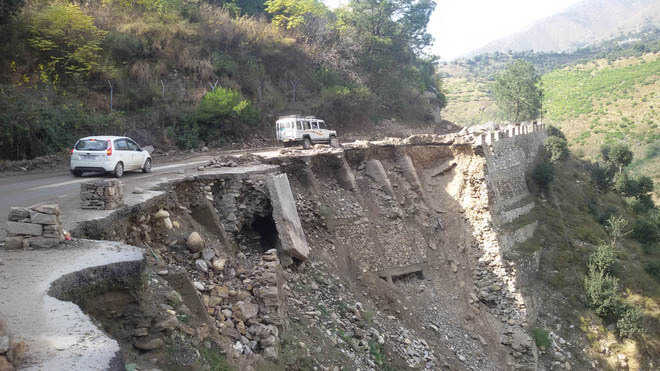
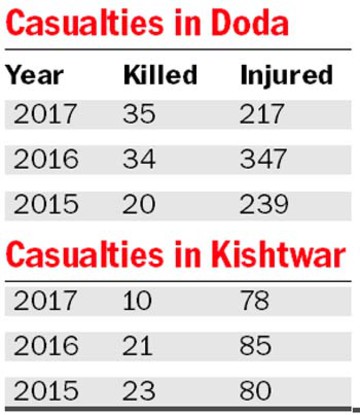
In all, 143 people have been killed and 1,046 injured in different road accidents across the twin districts of Doda and Kishtwar in the past three years.The road accidents in Doda-Kishtwar have killed more people than terrorism or natural disasters. Experts have blamed human negligence, bad maintenance of roads, untrained drivers and poor condition of vehicles for the accidents.As per the official figures, 89 people lost their lives on Doda roads while 803 people got injured in 462 road accidents since 2015. In Kishtwar, 54 people got killed and 243 people got injured in separate accidents.Officials in the traffic police said rash and negligent driving continued to be the main cause for the high number of fatalities in Doda and Kishtwar while poor condition of vehicle, use of mobile phones while driving and poor road conditions were also the contributing factors.Former minister and senior National Conference leader Khalid Najeeb Sourawardi said, “The traffic police are completely busy doing challans, but they never check vehicle overloading or driving licences.”“It saddens me that there has been a negligible impact on the number of deaths despite our best efforts to educate people by holding meetings, protests and rallies in Doda. I think, unless the state government passes a strong law against the violation of traffic rules and punish drivers stringently, the problem cannot be solved,” Ishtaq Ahmed Dev, a civil society member, said.“I have personally identified 36 ‘black spots’ from Assar to Kishtwar, which are highly vulnerable due to absence of road barriers, which need to be checked by the authorities without further delay. However, the roads are not the only reason of accidents here, but human errors too. We are collectively working with the police and the district administration to stop rash driving and educating drivers to adhere to traffic rules,” Zooheb Patigaroo, Deputy SP, Traffic Doda-Kishtwar Range, said.“We just have 60-70 policemen on the Batote-Kishtwar national highway. Also, we are working collectivity with the district police to regulate the traffic norms,” he added.

Mishaps mainly due to rash driving

  • Officials in the traffic police said rash and negligent driving continued to be the main cause for the high number of fatalities in Doda and Kishtwar while poor condition of vehicle, use of mobile phones while driving and poor road conditions were also the contributing factors
  • As per the official figures, 89 people lost their lives on Doda roads while 803 people got injured in 462 road accidents since 2015. In Kishtwar, 54 people got killed and 243 people got injured in separate accidents

Reinstatement of IAF man set aside SC: Indiscipline can’t be taken lightly

Reinstatement of IAF man set aside
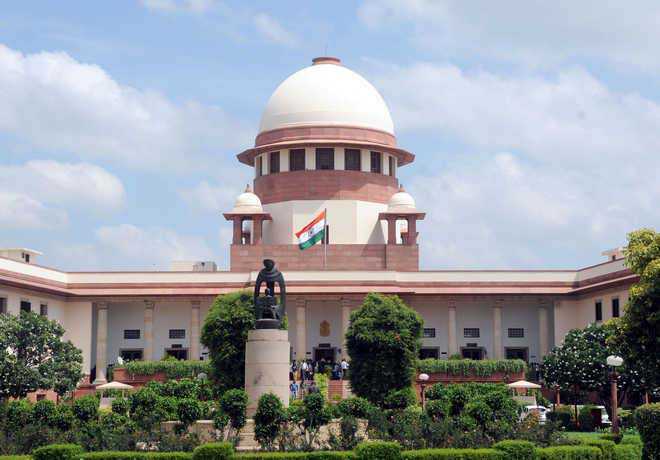
File photo of the Supreme Court

Satya Prakash

Tribune News Service

New Delhi, August 13

Maintaining that indiscipline by Army men can’t be taken lightly, the Supreme Court has set aside an order of the Armed Forces Tribunal (AFT) that had reinstated an Indian Air Force Corporal despite finding him guilty of unauthorised absence from duty for one-and-a-half years.A Bench of Justices Dipak Misra, Amitava Roy and AM Khanvilkar said such serious misconduct amounted to indiscipline and cannot be countenanced. It came down heavily on Nallam Shiva for overstaying his casual leave period without informing his seniors. (Follow The Tribune on Facebook; and Twitter @thetribunechd)The SC, however, modified the order of dismissal from service to one of discharge from service after Shiva’s counsel submitted that an order of dismissal would come in the way of his re-employment anywhere else.Shiva had joined the IAF on March 28, 2006, and in due course of time was promoted to the rank of Corporal. While serving in that capacity, he overstayed the casual leave granted to him from October 20, 2012, till November 4, 2012, until April 11, 2014, allegedly due to his ill-health and family problems.Resultantly, he was tried before the District Court Martial in November 2014. The disciplinary authority sentenced Shiva to undergo punishment of four-month rigorous imprisonment, dismissed him from service and also reduced his rank. He challenged the order before the AFT on the ground that he overstayed because of compelling circumstances due to a matrimonial dispute and illness of his father, resulting in mental disturbance.Noting that it was Shiva’s first offence, the AFT held that the punishment was excessive and disproportionate and ordered reinstatement. It said he deserved a chance of being rehabilitated in service. It was this order of the AFT that was challenged before the SC.Justice Khanwilkar said, “He did not bother to intimate his whereabouts either to his superiors or to the nearest military station. If he was suffering from any illness or for that matter if his father suffered a paralytic attack, he ought to have gone to the Military Hospital. However, he did not choose to go to the hospital but to a quack.”


The spirit of 1962 by Zarrar Khuhro

The spirit of 1962
In February this year, a delegation led by Maj Gen Zhao Jin Song, the Vice Chief of Staff of PLA’s Headquarter Western Theatre Command, Chengdu, China, called on senior Indian Army officers, in New Delhi. — Agencies/File

IN a subcontinent dominated by Pak-India conflicts, the short, sharp Sino-Indian war of 1962 remains rather neglected, with little analysis of how it helped shaped the region into what it is today. The recent standoff at the Doklam plateau, and the inevitable parallels that are being drawn, makes it worthwhile to take another look at this conflict.The road to the 1962 war starts in Tibet — in fact, it starts because of the road to Tibet. No sooner had Mao proclaimed the People’s Republic of China (PRC) in 1949 that troops were sent to conquer this land, via a road that passed from the western Chinese province of Xinjiang through Aksai Chin and on to Tibet. When a Tibetan uprising took place in 1959, this was again the route Chinese reinforcements took. The revolt failed and the Dalai Lama fled to India where he was granted asylum, much to China’s chagrin. Soon after, India starts to strengthen its position along the McMahon line, the border between Indian and China. In particular it expanded its positions in Ladakh, which borders Aksai Chin.The Indo-China war’s role in regional politics is often ignored. To the Chinese, this potentially threatened a crucial supply route to Tibet, and thus their hold over it. Then there was the fact that India was a Soviet ally, and though China and the USSR shared the communist ideology, a Cold War waged between the two nations. Pressed on its long border with the USSR, China saw India was a potential threat that needed to be whittled down at some point, and that point came in 1962.The Chinese struck in force, one army moving into Ladakh and another striking across the McMahon line from Tibet at four points. Unprepared and underequipped, with primary units deployed against Pakistan, the Indian forces were hopelessly outmanned and outmatched. The shock was such that a larger invasion was feared, but Beijing then announced a unilateral ceasefire, withdrawing to maintain a strategically favourable position along the sprawling border.Up until then, Pak-China relations had been cordial but wary, and no warmer than Sino-Indian relations in the days of “Hindi-Chini Bhai Bhai.” After all, Pakistan was a card-carrying capitalist US ally, and China had fought a bloody war against the US in Korea in the 1950s.Moreover, China also had territorial claims on parts of Azad Kashmir, and Tibet and Korea had demonstrated China’s willingness to take decisive action to secure its interests.The build-up to 1962 changed this, and while Pakistan did not engage in hostile action against India, it did pile pressure by announcing the holding of border negotiations with China. When the war ended with India being militarily and diplomatically humiliated, Pakistan was quick to conclude a border treaty with China in 1963. Justifying the deal, then foreign minister Zulfikar Ali Bhutto said Pakistan “would not like to see the tantrums and crisis (that marked the dispute) between the PRC and India”. The lessons learned by Pakistan were that (a) disputes with China were to be avoided, (b) this state was a potential hedge/ ally against India and (c) that the Indian army was not as strong as it had seemed during its capture of Goa. This latter conclusion was crucial, as the idea of the Indian army being susceptible to strategic surprise played a significant role in the calculations that led to the ’65 war. The war also seems to have led to a feeling that China might overtly aid Pakistan in a future conflict with India. While this proved untrue, it was something that New Delhi also feared, and there was much speculation in India at the time that the Sino-Pak border agreement had secret military clauses too.For India, while this war resulted in military humiliation and a serious loss of prestige, it served to unify the nation, feeding nationalist sentiment and spurring the process of militarisation. That, in turn, had the effect of slowing Indian economic growth somewhat as funds were diverted to the military. On the international front, Anglo-American military aid given to India after the war brought India closer to the West, while simultaneously souring Pakistani attitudes towards its Western allies. Ayub Khan bluntly told both Washington and London that they must abandon the aid-India programme to keep Pakistan’s friendship.Consequently, when the US State Department protested at the signing of economic and trade agreements with China, the complaints were shrugged off. When Zhou-En-lai was invited to visit Pakistan in 1964, the US protested again to no avail. Pakistani officials and newspapers adopted a clear pro-Beijing line, questioning the value of a Western alliance that couldn’t resolve the Kashmir dispute.Trends and attitudes were established in this period that have marked the dynamics of the subcontinent ever since, and the alliances and enmities of today can be said to find their genesis in 1962.By arrangement with the Dawn